
- Not all thyroid medications are equally effective for weight loss, and those containing T3 thyroid hormone give you a much better chance of losing weight compared to T4-only medications.
- T2 thyroid hormone, available as an over-the-counter supplement, has a targeted effect on metabolism and can rival T3 when it comes to weight management.
- T4-only medications like levothyroxine and Synthroid are the least effective thyroid medications for weight loss because they don't directly boost your metabolism.
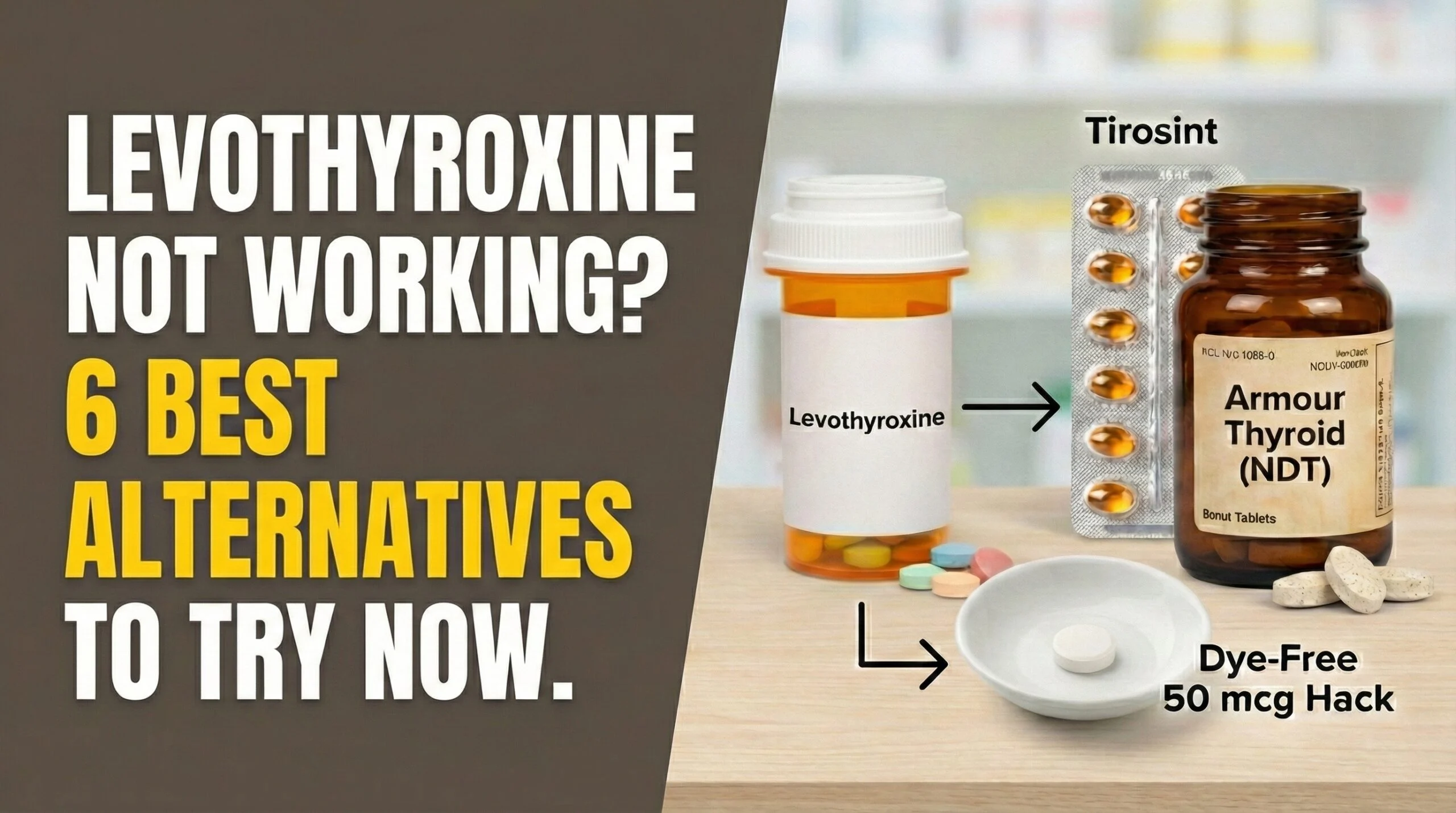
- Thyroid medications that contain T3 include liothyronine, Cytomel, sustained release T3, NDT formulations like Armour thyroid, and compounded T4/T3 combinations.
- If you are on thyroid medication and still struggling to lose weight, switching to or adding a T3-containing medication may be the change that finally helps.
It’s no secret that thyroid patients often struggle with their weight.
If you are reading this, and you have low thyroid function or hypothyroidism, then you probably know what I am talking about.
Your thyroid is one of the primary regulators of your metabolism.
This is why people who have low thyroid function end up gaining weight more easily compared (1) to the general population.
In short, low thyroid leads to a lower-than-normal metabolism which ultimately results in weight gain.
That’s all well and good, but why is it that so many thyroid patients continue to stay overweight despite taking thyroid medication?
And why is it that so many thyroid patients continue to experience low thyroid symptoms despite taking the very medication that should solve both problems?
The truth is that some thyroid medications are better tolerated and are considered to be more effective than others, especially when it comes to helping with weight loss.
Here’s what I mean:
Are All Thyroid Medications Equally Effective at Managing Weight?

In other words, is there a ‘best’ thyroid medication for weight loss? One that stands above the others and one that you can reliably count on to help you lose weight whenever you take it?
Unfortunately, it’s not quite that simple.
There definitely is a class of thyroid medications that can give you a much higher chance of success in your weight loss efforts, but nothing is ever guaranteed.
The class of thyroid medication that I am talking about is much more powerful than the most commonly prescribed thyroid medications like levothyroxine and Synthroid.
Which class of thyroid medication am I talking about?
Any prescription thyroid medication that contains T3 thyroid hormone, the most biologically active thyroid hormone that we know of.
Emerging research suggests that it’s not the only thyroid hormone that can help, though.
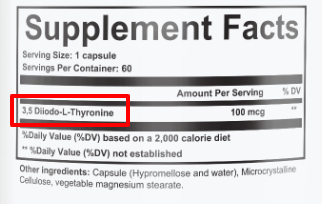
T2 thyroid hormone can definitely give T3 a run for its money when we are talking about its impact on metabolism and weight.
Even though T2 thyroid hormone is much less biologically active compared to T3, it seems to have a more targeted effect on the mechanisms which control metabolism.
It’s hard to declare a winner between these two, but one thing is for sure, we can definitively state that T4 thyroid hormone is not even a contender.
And it’s T4 thyroid hormone that most thyroid patients take.
Putting that aside for a moment, let’s talk about how to get T3 and T2 thyroid hormones.
How do you do it?
It’s actually fairly easy, all things considered.
T3 thyroid hormone is found in several different thyroid medications and T2 thyroid hormone is available as an over-the-counter supplement (it’s the only active thyroid hormone that doesn’t require a prescription).
Between the two, T2 is obviously much easier to get because you can purchase it right now without a prescription.
So let’s focus on T3 for a moment since it’s slightly more difficult to get and is found in multiple thyroid medications.
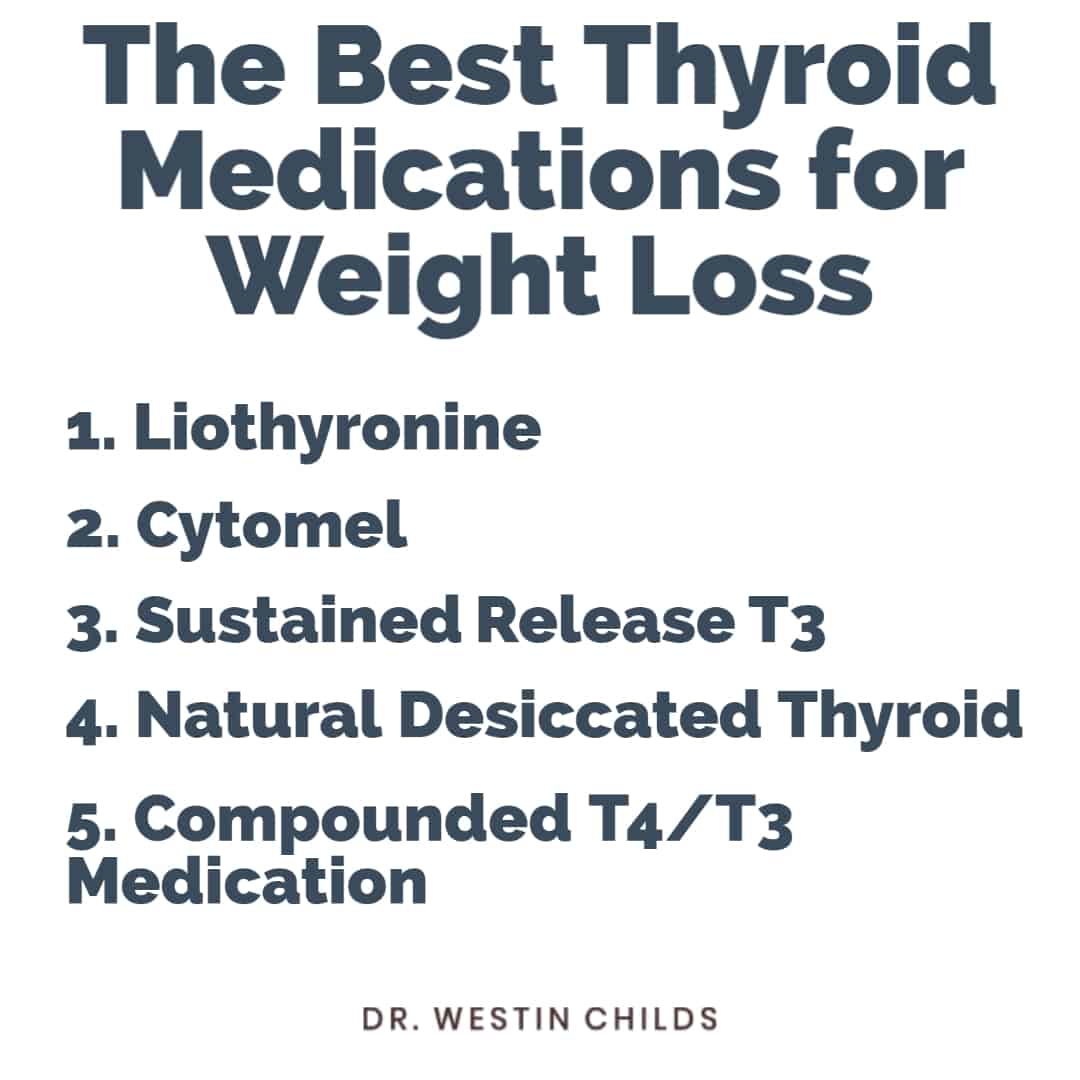
The most potent include:
- Liothyronine – This is a pure T3-only thyroid medication.
- Cytomel – This is a pure T3-only thyroid medication.
- Sustained Release T3 – This is a pure T3-only thyroid medication.
- Any NDT (Natural Desiccated Thyroid) formulation – This contains both T3 and T4 and includes medications like Armour thyroid. The T4:T3 ratio in NDT is static and comes as 38 mcg of T4 to 9 mcg of T3 in each grain. A grain is a unit of measurement for NDT thyroid medications.
- Compounded T4/T3 thyroid medication – This combination thyroid medication is available from compounding pharmacies.
T4 vs T3 and T2 Thyroid Hormones
Why are T2 and T3 thyroid hormones more effective than T4 when it comes to weight loss?
It has to do with how quickly the body can utilize each.
T3 and T2 are both unique in that they do not require activation by the body in order to be used.
This differs from T4 thyroid hormone which requires activation in the form of thyroid conversion.
Thyroid conversion is the process by which your body takes T4 thyroid hormone and turns it into T3 thyroid hormone (2).
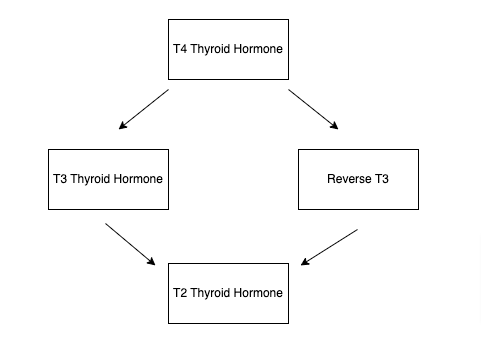
For this reason, T4 thyroid hormone can be thought of as a reserve thyroid hormone that your body can draw upon for use when it needs it.
This means medications like levothyroxine and Synthroid must be activated before they can be used by the body.
And it is this extra activation or conversion step that seems to make all of the difference for many thyroid patients (3).
And I’m not the only one to suggest that T3 thyroid medications are superior when it comes to weight loss.
We also have several studies that show that thyroid patients who switch to NDT medication (like Armour thyroid) from T4-only thyroid medications like levothyroxine, lose weight and feel better (4).
What’s even more interesting is that the weight loss mentioned above occurred without dietary changes or exercise which implies that the change in thyroid medication by itself was sufficient to impact metabolism and weight.
In addition to these studies, we also have data directly reported from thyroid patients which shows that they prefer thyroid medications with T3 in them compared to those with T4 only.
A survey of over 12,000 thyroid patients illustrated this point perfectly.
Thyroid patients taking NDT and T4/T3 combinations had fewer weight issues compared to those taking levothyroxine and Synthroid.
The findings are similar when it comes to T2 thyroid hormone as well.
T2 thyroid hormone has been shown to increase resting metabolic rate (5) most likely through its impact on T3 thyroid hormone receptors.
Based on available data and thyroid patient experience, it’s pretty clear that if weight loss is your goal then you should probably be incorporating both T3 and T2 thyroid hormones into your daily regimen.
Understanding The Role of Thyroid Medication Dosing
This is one huge area of confusion for many thyroid patients, so let me take some time to clear it up.
I frequently hear thyroid patients complain that “X” or “Y” thyroid medication didn’t help them lose weight.
This even happens for the most powerful thyroid medications which contain T3 thyroid hormone!
Thyroid patients will say that they’ve tried everything, including Cytomel, and it still didn’t impact their weight.
And while this definitely does happen, there’s one big problem with statements like this…
You can’t tell whether a thyroid medication is effective or not unless you first know that you were dosed correctly!

Let me explain…
Imagine you have two people who are both taking the same thyroid medication but at different doses.
Person A is taking liothyronine at a dose of 5 mcg/day along with levothyroxine at 75 mcg/day.
This person is still struggling with low thyroid symptoms and weight gain even while taking T3 and T4 thyroid hormones.
How can this be when I just stated that T3 medications are some of the best for weight loss? Shouldn’t she be losing weight effortlessly?
Let’s take a look at person B for comparison:
Person B is taking liothyronine at a dose of 15 mcg/day along with levothyroxine at 50 mcg/day.
This person is feeling better and has lost 10 pounds while using this combination of thyroid medications.
When all is said and done, person A claims emphatically that liothyronine is a failure and does not help with weight loss while, on the other hand, person B claims that liothyronine is an amazing weight loss medication and has helped her lose 10 pounds without changing her diet or exercise routine.
Both people have the exact opposite experience despite taking the exact same thyroid medications.
But there’s a big difference between the two of them, right?
Person A is taking 1/3 of the dose that Person B is taking of the same thyroid medication!
And this is a perfect example of how dosing plays a huge role in how well you feel as a thyroid patient.
I often will see thyroid patients make sweeping claims and generalizations about thyroid medications without mentioning anything about the dose!
You simply can’t make assertions about any thyroid medication without first assessing whether or not you were adequately dosed.
The assumption made by many thyroid patients is that their doctor knows how to dose them so they assume that this couldn’t possibly be causing any problems but that couldn’t be further from the truth.
Doctors tend to underdose thyroid patients because it’s safer than the alternative (which is overdosing them), especially when they use inaccurate thyroid lab tests such as the TSH to determine the dose.
So don’t fall into this trap!
If you want your thyroid medication to be effective then you need to make sure you are not only on the right type of thyroid medication but also that your dose of thyroid medication is optimized for your body.
Taking More Thyroid Medication Isn’t the Answer
Another trap I see thyroid patients fall into is what I will call the “more, more, more” trap.
If the answer to my weight problem isn’t solved by my current thyroid medication dose then the answer must be to simply take more of the same thing but at a higher dose.
The theory here is that if you can push yourself into a hyperthyroid state then you will lose weight, right?
You would think so, and maybe hope so, but it isn’t really true in practice.
Not only is taking too much thyroid medication dangerous, but it’s also not likely to help you lose any weight.
This is also why you do not want to use thyroid medication to aid with weight loss if you don’t have a thyroid problem!
Why is this?
Most thyroid medications that people take contain only the T4 thyroid hormone.
Medications like levothyroxine and Synthroid fall into this category.
These medications, while they can be effective for some, often fail to help many thyroid patients (as many as 20% (6)) feel better.
It has been shown that these medications can readily be converted into the inactive thyroid hormone metabolite known as reverse T3 instead of the active thyroid hormone T3.
And if your body takes levothyroxine and turns it into rT3 instead of T3 then your symptoms and weight gain may get worse.
This protective mechanism is built into your body to prevent the damage that can occur from hyperthyroid states.
And you can trigger this mechanism by taking too much thyroid medication.
In addition to this protective mechanism, we know that hyperthyroid states cause dysregulation in hormones that help regulate your weight such as cortisol and insulin.
The hyperthyroid state may contribute to insulin resistance (7), as well as cortisol resistance (8), thereby making your weight problem worse, not better.
Bottom line:
Don’t think you can just increase your dose to help you lose weight.
In fact, taking a high dose is not only dangerous but it might cause you to gain weight through reverse T3 conversion.
Reasons You Aren’t Losing Weight on Your Thyroid Medication
It may be tempting to think that there are only certain thyroid medications that will help you lose weight but that isn’t the truth at all.
In fact, any thyroid medication has the potential to help you lose weight so long as your body can utilize it.
The key is to figure out what your body needs.
And there’s a good chance whatever you are currently taking isn’t working if you aren’t losing weight.
Here are some tips and tricks to help you find the best thyroid medication for your body, one that will help you lose weight:
#1. You need T3
There are just some people out there who will need T3 thyroid hormone in some form no matter what.
Most doctors like to believe that everyone is fine taking a T4-only thyroid medication like levothyroxine but it’s clear that this treatment strategy doesn’t work for everyone.
We know from research that approximately 20% of the population has a problem utilizing levothyroxine to its fullest.
And if you are one of the unlucky few in this percentage then you will most likely need to add T3 thyroid hormone to your regimen.
Conceptually speaking, this is an easy thing to do.
Practically speaking, it’s quite difficult because it will require a prescription from your doctor.
It’s not impossible to get your doctor to prescribe T3 but it can take some time and some convincing on your part.
If you are unable to work with your doctor then consider using this resource to help you find a more thyroid-literate doctor.
#2. You aren’t absorbing your medication
You can take all of the thyroid medication in the world, but it won’t do you any good if your body isn’t able to absorb it.
Thyroid medication, in general, is quite fickle.
Do you remember your doctor or pharmacist telling you to avoid taking your thyroid medication with food?
The reason for this is that food can impair its absorption.
Your thyroid medication will look for basically any reason to not make it into your bloodstream through your intestinal tract.
Before you jump to another medication proclaiming that your current one doesn’t work, make sure you aren’t missing an absorption issue.
It could very well be the case that your thyroid medication is fine, it’s just that your gut needs some tending to.
Avoid taking your thyroid medication with food, coffee, various drinks, and even supplements as all of these things can negatively impact absorption.
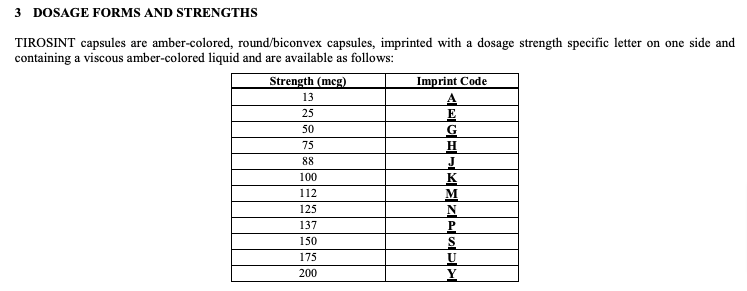
You can also try switching to cleaner thyroid medications that are easier to absorb, such as Tirosint or Tirosint-Sol.
#3. Your dose is not quite right
Lastly, don’t blame your thyroid medication if you can’t lose weight until you optimize your dose!
Optimizing your dose includes so much more than just looking at your TSH (9).
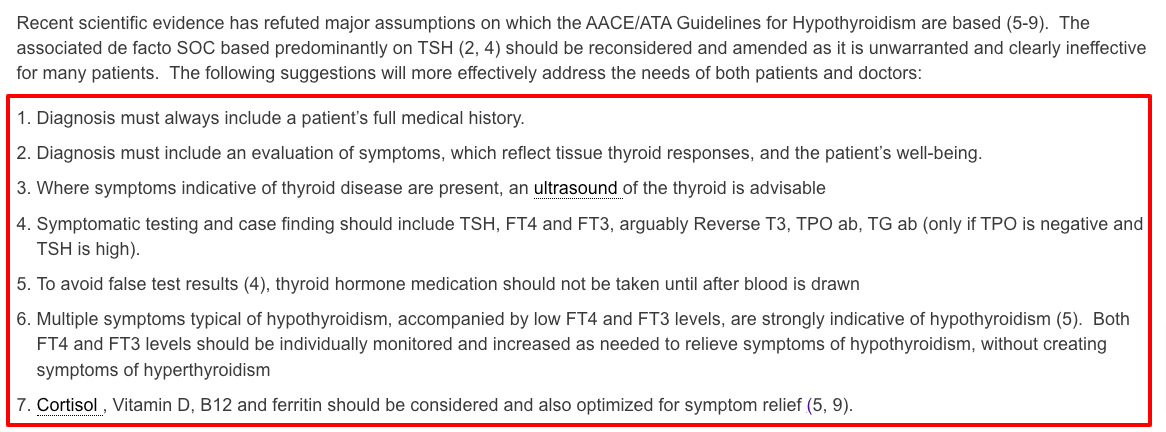
You should also be looking at your free thyroid hormone lab tests such as free T3 and free T4 and sometimes even reverse T3 and thyroid antibodies (when the situation calls for it).
You might be on a dose of thyroid medication that puts your TSH in the sweet spot but is not high enough to increase your free T3 and free T4.
If this happens then you will have a very hard time losing weight and feeling better.
Final Thoughts
If you are a low thyroid patient struggling to lose weight and you are looking for some help from your thyroid medication make sure you follow these rules!
#1. Make sure that your thyroid medication is being absorbed properly.
#2. Make sure that your dose is optimized and high enough for your body.
#3. Consider taking T3 and T2 thyroid hormones in some form (T3 is available as a prescription and T2 can be purchased over the counter).
#4. Check your lab tests to make sure your free T3 and free T4 are in the optimal range!
Now I want to hear from you:
Are you currently struggling to lose weight?
What thyroid medication are you taking right now? Do you think it’s helping or hurting you?
Are you taking a medication that contains T3 right now? If so, have you noticed a difference?
What changes, if any, are you planning on making after reading this?
Leave your questions or comments below!
Scientific References
#1. ncbi.nlm.nih.gov/pmc/articles/PMC4911848/
#2. ncbi.nlm.nih.gov/books/NBK285545/
#3. ncbi.nlm.nih.gov/pmc/articles/PMC4557078/
#4. pubmed.ncbi.nlm.nih.gov/23539727/
#5. ncbi.nlm.nih.gov/pmc/articles/PMC6068267/
#6. ncbi.nlm.nih.gov/pmc/articles/PMC5527224/
#7. ncbi.nlm.nih.gov/pmc/articles/PMC3034962/
#8. pubmed.ncbi.nlm.nih.gov/14666786/
#9. thyroiduk.org/further-reading/a-patients-guide-to-the-diagnosis-and-treatment-of-hypothyroidism/


I am 48 years old, 5’4” and 185#s. I have been taking different doses and types of T3 and T4 since 2014. In 2018 my previous Dr retired and my new dr only prescribed Synthroid, which I packed on 45# in three months. He passed away and in 2/2019 I found a new dr who agreed that I needed T3, so I was still on Synthroid and she added Sustained Release T3 compound at a dose of 10mcg and gradually increased it to where I am now at 60mcg in the morning and 30mcg in late afternoon. I had some RT3 issues during the increases so we removed the Synthroid altogether and I am now on SR T3 only.
I still am overweight by 45#s but some of my other symptoms have subsided. I still have fatigue issues but I also have CAEBV, so we are looking into gut issues and trying to clear them all up in hopes to put the CAEBV in some kind of remission. She also will look into heavy metal toxicity on my next labs in Jan. I take numerous supplements and BHRT Progesterone because I am estrogen dominant and low cortisol, which I will also test salvia in Jan. I am on an Intermittent 14/10 & 16/8 diet.
My last labs were:
TSH <0.50 (1.8-2.0)
T4free .20 (1.0-1.5)
T3free 3.4. (3.0-4.0)
RT3. 2.5 (9-35)
T3:RT3 ratio 136
Iron 121 (37-145)
Ferritin 126 (20-50)
TIBC 330 (250-350)
HS-CRP 14 (<1.0)
HBA1C 6.2 (<5.2)
Homocysteine 4.9 (5.5-8)
Vit D 70.78 (35-80)
ESR/SED 17 (<10)
Any ideas of how to get this weight off?
My name is Anna I have been on thyroid medication for about 8 to 10 years, mostly levothyroxine. In the last 1 1/2 years I have been taking Synthroid 125. My doctor keeps telling me she will not let me take any other natural drugs because she is probably getting a kick back from giving me these drugs. I have no thyroid. It was removed around 2018. I have tried and tried to get her to let me try something else. I have gained more weight than I even weighed at 9 months pregnant. I have since switched doctors and I am running into the same situation. I have told her of the side effects I have and she dosen’t seem to care. I am ready to just stop taking anything at all. PLEASE HELP!!!
My Dr let me try T3 alone but I can’t seem to sleep through the night when I take it. I wake up around 3 and can’t go back to sleep. I stopped it after one week because I cannot go without sleep. Is this common or should I have kept going with it?
Hi Susan,
Insomnia isn’t really a common symptom when using T3 but it can happen.
Hello Dr. Childs,
Do patients, who have about 15 pounds to lose and have been diagnosed hypothyroid, generally have more success losing 15 pounds of weight with a NDT like Armour or a straight compounded SR T3? I understand that everyone is different, but I just want to know what is your opinion ‘generally’ among patients. Thank you.
Sincerely,
Catherine
I had been taking Levothyroxine for about 3 years and had an extremely hard time losing weight, even with diet & exercise change. I recently switched to Tirosint, and though I still want to give it some more time, it isn’t doing much at all to help. My T3 levels are within normal range, but do you still think I’d need a T3 medication to help with the weight loss? Or would that just cause me to go hyper? I don’t even think my endocrinologist would approve of it.
Hi Val,
T3 medications tend to be better for weight loss compared to T4 only thyroid medications but they can cause issues such as increasing your risk of hyperthyroidism.
I take armour thyroid and have for many years. All of my labs are in the normal areas except for the t4 is always low. I have never seen any weight loss benefit. My doctor seems fine with this but I would like to know why the t4 remains low. Even if he ups the dose it still remains low.
Hi April,
Armour thyroid pushes the T4 lower because it contains T3. Some people experience this issue when using NDT because they are more sensitive to the effects of T3 at the pituitary level.
I am on 5mg liothyronine plus .137mg levothyroxine.
I just added the liothyronine 3 months ago. I still hair fatigue and hair loss not losing an weight. Alot of other symptoms.
Hi Cathy,
It’s important to remember that it’s not the medication that makes you feel better but the dose. So if you are not feeling well on those medications then take a close look at your dose as you may need a higher dose.
Hello Dr.
After the birth of my son In November of 2018, i lost about 40 pds in 2 months. Then, about a year later, I gained the 40 back within about 4 months, plus 20 more! This is very abnormal for me, as I’ve always been pretty petite and active, especially as a new mom. I finally got into an endocrinologist and was diagnosed w hypothyroidism. After several labs and complaints to my Dr., she finally did more than just a tsh- she did a free t3, and free t4 and those levels came back within a normal range. However, I’m still not losing ANY WEIGHT!! It’s been a year on my t4 now(synthroid 88mcg), so why havent I lossed any weight? I don’t know what else 2 do and my Dr is refusing anymore testing or med changes. Please help!, Dr.!!
Hi Dr Childs,
What are some reasons doctors may be hesitant to prescribe T3 (except conventional thinking that T4 is better)? Are they dangerous somehow? Or..?
Thank you:)
Hi Joy,
Please see this podcastt episode that I did with Paul Robinson which explains the issue: https://www.restartmed.com/using-t3-thyroid-medication-to-feel-100-again-dr-westin-childs-paul-robinson/
Hi, in Nov 21 my dr said I needed to cut back on NDT and wanted to completely take me off t3. Ive been down this road so many tx. I said ok but take it from the NDT and don’t mess w/t3. I take 5mcg to. Since we dropped NDT from 87. or something, still taking t3 have gained about 10#. Also my balance temp in a.m. is around 96 and afternoon goes up to 97.8. Some ways I feel better and some not . I’m very good w/diet bc of hashi’s but can’t deal w/gain. Whats up?
Hi Dorothy,
Unfortunately, it’s not uncommon for thyroid patients to gain weight when they drop their thyroid dose. The best thing you can do is weigh the pros and cons of wherever your thyroid numbers were at to determine if you are willing to accept some level of risk in exchange for a more normal weight. Most thyroid patients prefer to accept a slightly higher risk of bone loss and atrial fibrillation in exchange for more suppressed thyroid function and a more normal weight.
I restarted levothyroxine after a few years away from it whilst I dealt with breast cancer. During that time I consumed a healthy green sugar free, wheat, dairy, grain free diet and no one ever picked up on my thyroid levels being low, that is until recently, admittedly I had take the focus off my diet. With the advice of my Dr I recently started on levothyroxine 25 mg and after 2 months she rang to say my results were good. I have gained loads of weight though and now I’m fed up, tired, and depressed. So I’m taking myself off all they thyroid meds again and will be mindful of my diet. My question is what happens if I go for a long period without supplementing my thyroid. What will be the damage.?
Hi Emma,
Please see this article which answers that question: https://www.restartmed.com/side-effects-of-stopping-thyroid-medication/
Hi Dr. Westin, I’m a 60 year old female that had a total thyroidectomy in 2015 due to cancer. I’m on 50 mcg of levothyroxine and 5 mcg of liothyronine. I cannot lose weight no matter what I’ve tried. I’ve done the Keto diet and others with no luck. Do you think an increase in the liothyronine would help? Thank you!
Hi Linda,
It may, yes! Please see this article which shows why levothyroxine isn’t always enough for those without a thyroid: https://www.restartmed.com/levothyroxine-thyroidectomy-patients/
Also, you can read more about weight loss after thyroidectomy here: https://www.restartmed.com/weight-loss-thyroidectomy/
My issue is that I’ll have a prescription take it as supposed to. May take a month to work, I will feel great for a month or two. All my levels look great. Then after awhile I’ll start feeling terrible. Have my levels checked again and hour after taking my meds (with no food, coffee anything) and my free T3 and Free T4 levels are very low. This while taking both Synthroid and Cytomel and then switching to Armour. Same results. Almost like I’m not even taking anything when I am. This has been a roller coaster for several years now. Once I start losing weight then I also seem to lose T4 and T3. Gained back increase meds lose weight then lose T4 and T3. My Endo nor regular doctor can explain this saying I should if anything need a decrease when weight loss not increase. I’m just tired of the roller coaster and want to stabilize.
Hi Karla,
You may have an absorption issue or it may be interference with other medications/supplements you are taking. You can also look at your gut health to see if that’s contributing. Simple things like reacting to lactose in Synthroid, for instance, can limit the effectiveness of thyroid medications. You can learn more to take your thyroid medication correctly here: https://www.restartmed.com/how-to-take-your-thyroid-medication/
Hello,
I have been taking Synthroid for about 30 years for hypothyroidism. I have been on between 75 mcg – 225 mcg over the years. Just recently my doctor changed my dose to 150 mcg from 175 mcg. I have never had an issue with weight gain until about 2 years ago. I am 49 and have gained around 25 lbs, mainly in my belly area. Any recommendations?
Hi Wendy,
Yep! I would start with a full thyroid panel and hormone panel to help you identify what is causing the weight gain. You will most likely find that it’s a combination of hormones and not just one.
You can also check out these resources:
https://www.restartmed.com/lose-weight-hypothyroidism/
https://www.restartmed.com/product/weight-loss-bundle/
https://www.restartmed.com/body-fat-hormone-guide/
Hi Dr Childs,
I started on Levothyroxin a number of years ago, after being diagnosed with hypo and for the first year, I dropped so much weight, it was amazing! After about a year, the weight all came back very quickly. I’ve tried Armour Thyroid and upping my Levo to try to get back to that hyperthyroid state. I actually quit my thyroid medicine altogether now since it’s doing the opposite of what it did in the beginning and causing MORE weight gain! I don’t know what to do. I feel awful, lethargic, moody, depressed, sluggish. What can you recommend I do to aid in weight loss and feel better?
Hi Vicki,
I would recommend reading these case studies to see what it takes for thyroid patients to lose weight:
https://www.restartmed.com/adding-t3-ndt/
https://www.restartmed.com/victoza-weight-loss/
https://www.restartmed.com/thyroid-weight-loss/
https://www.restartmed.com/weight-loss-naturethroid/
I have been taking Thyroid S NDT for several years with successful weight loss and feeling better than I did on T4 monotherapy. On my latest batch however, I started getting a severe pressure headache and raised blood pressure. My blood tests have been similiar for a few years including the one with the latest batch of NDT…. T4 mid nomal range, FT3 slightly higher than normal range with a suppressed TSH. Following blood tests to find the cause, the only conclusion from the hospital was the NDT. I was then told to go back on T4 monotherapy, but this increased my fatigue with increased bloating. I then trialled synthetic T3 at a very small dose but still felt fatigued. If I tried to increase the dose spread throughout the day, the pressure headache came back. My BP was still elevated but slightly less. I went back on T4 monotherapy, and the bloating and sluggish feeling is very evident, which is troubling, and my BP has not lowered fully on T4 only. I know I don’t convert well, hence me changing to NDT. I wish I could go back on it, but the headaches are debilitating. I am 53 and in the menopause.
Hi, I have been diagnosed with Hashimoto disease and am taking 25mg of Levothyroxine and 5mcg of Liothronine. This has been for almost 6 weeks, along with some supplements that were recommended for me to take. My symptoms have improved slightly, as I also suffer from severe fatigue, low energy and some pain but I have not lost any weight. I also exercise regularly. I have been considering a cleaner way to treat this but I do want it to be effective.
In addition to my comment above. I have been recommended HRT to help with early onset menopausal bone loss. I am taking a once yearly infusion for that. I do not want to take HRT until my thyroid meds and symptoms are sorted. In addition to the elevated blood pressure, I have a dull back ache around my kidney area with the need to urinate a lot. I have been told to take BP medication but I do not want to due to the awful side effects. I have ordered a natural supplement in the hope to help the BP which I think is related to my thyroid medication issues. Do you think these issues are related to dosages rather than the particular meds themselves? The strange thing, is that I feel far better when I come off all of the thyroid medications since the headaches, elevated BP and bloating started.
Hi Dr. Childs,
Are you currently struggling to lose weight? Yes
What thyroid medication are you taking right now? Do you think it’s helping or hurting you? Levothyroxine 50 and 75mcg (alternate)
How do I find out if my body is absorbing my medication?
How do I know if my medication is optimized for my body?
Thanks,
Sonja
Hi Sonja,
You can determine that through a combination of thyroid lab tests and symptom assessment. Here are some resources to help you further:
https://www.restartmed.com/normal-thyroid-levels/
https://www.restartmed.com/testing-for-thyroid-conversion-issues/
excellent resources and advice etc
Hi Dr. Childs,
I am 77 years old and have NO thyroid. Due to blood tests, my doctor raised my levothyroxine from 75mcg to 88mcg. I am now suffering with weight gain, bloating, exhaustion, constipation and sensitivity to cold. I want to sleep all the time and am depressed. My blood test in May 2024 went from 8.34 to 0.27 in August 2024. I feel as though I am blowing up like a balloon!!
Hi Dr. Childs
I am 58 years old and struggle with weight loss. I currently take NP thyroid (120 Mg) medication. How would I find out if this medication is right for me? I do labs regularly but since weight loss is so difficult for me, I wonder if I should be on a different Rx for hypothyroid.
Hi K.,
The best way to know for sure is by evaluating both your lab test results and how you are feeling. If a medication is working then you won’t have any residicual symptoms and your labs will be normal-ish.