

You can take your thyroid medication exactly as prescribed and still not get what you need. Here’s why:
Every single dose of levothyroxine has to make its way through your gut in order to get absorbed and used by your body.
And there are plenty of different compounds found in both foods (and supplements) that can block this process.
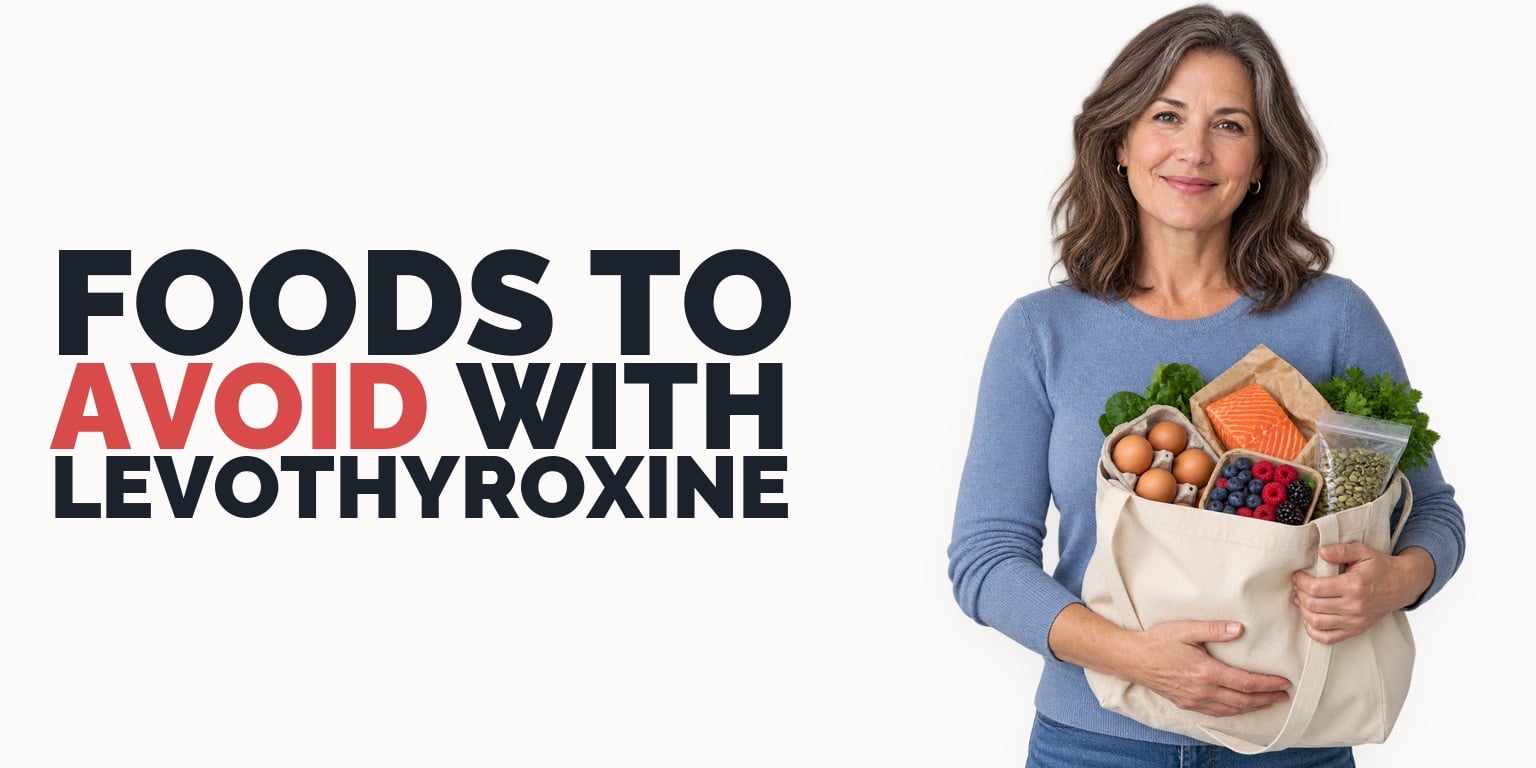
If you feel like your thyroid medication isn’t doing its job, make sure you aren’t taking it with or near these 5 foods:
1. Milk and Dairy Near Your Levothyroxine Dose
Milk is filled with protein, calcium, and vitamin D that can help keep your bones strong, which is important if you have a thyroid problem.
But many of those same compounds wreak havoc on your levothyroxine, especially calcium.
If you put calcium and levothyroxine in your gut at the same time, they will form a compound that your body can’t absorb[1][4].
This renders much of your dose completely inactive, which means it can’t help fix your low thyroid symptoms.
A single glass of milk for breakfast is enough to cause this issue.
2. Coffee Near Your Levothyroxine Dose
Coffee is probably worse than dairy for your thyroid meds for two reasons:
First, it contains caffeine. This speeds up your GI tract so your medication spends less time in your gut.
And second, it contains tannins. These act as binders in your gut, blocking your thyroid medication from getting absorbed.
Research shows that taking your thyroid meds with coffee will block about 30% of it from getting into your body[2].
That’s like cutting your dose of 100mcg per day down to 70 mcg. I can guarantee if this happens, you will feel it.
Switching to decaf helps with one part of the problem, so it’s better than nothing, but it doesn’t solve the tannin issue.
3. High-Fiber Foods
Fiber acts like a sponge in your gut.
It traps your thyroid medication and carries it through your GI tract before it has a chance to get absorbed[3].
Unfortunately, most people eat all of their fiber at breakfast (or at least most of it), which is exactly when they take their thyroid medication.
Foods like oatmeal, cereal, toast, and smoothies with chia or flax are all high in fiber.
This doesn’t mean fiber is bad for you. In fact, fiber is great for helping to fix your thyroid gut and for balancing blood sugar.
But you don’t want to have it around the time that you take your meds.
4. Iron-Rich Foods
Iron is something that your thyroid genuinely needs, but also one that can cause serious problems if used incorrectly. But more on that in a minute.
First, you need to understand why your thyroid needs iron:
It’s a part of the enzyme thyroid peroxidase, which is considered heme-dependent or iron-dependent[7].
In other words, it needs iron to do its job.
And its job is to build thyroid hormones.
If you are iron deficient, you will feel sluggish not only from its impact on your red blood cells, but also from its impact on your thyroid[8].
So you absolutely need it, but you need to take it at the right time.
The problem with iron occurs when you take it anywhere near the same time as your thyroid medication.
Iron can bind to it and form a complex that your body can’t absorb[1]. And the drop in absorption is big enough to alter your thyroid labs significantly.
This applies to iron supplements, but also to food: red meat, liver, shellfish, spinach, and iron-fortified cereals.
Cereal is especially bad because a single bowl provides you with milk, fiber, and iron, all at the same time.
5. Soy-Rich Foods
Soy may be one that you aren’t expecting, but it’s up there with coffee as one of the worst offenders[1].
It works against your thyroid in two ways:
First, it interferes with how much levothyroxine you absorb (a common theme here), and second, its isoflavones can interfere with the enzyme your thyroid uses to create thyroid hormones.
The problem with soy is that it is surprisingly prevalent.
You’ll find it in obvious places like tofu, edamame, soy milk, and miso, but it’s also commonly found in processed foods, protein powders, and meal replacement shakes.
If you are eating a lot of processed foods, there’s a very high chance you are consuming a lot of soy (way more than you realize).
Foods to Include in Your Thyroid Diet
People get frustrated when I give them long lists of foods to avoid, because it feels restrictive.
Which is exactly why I’m giving you this section:
Foods to eat with your levothyroxine (but not at the same time), to help support its function.
While you should NEVER eat anything at the exact same time as your thyroid meds, there are certain foods that you can eat afterward which give your body the nutrients it needs to better facilitate the function of whatever you are taking.
Here’s what I mean:
Cage-Free Eggs
Eggs are one of the most efficient foods you can eat if you have a thyroid problem.
Why?
Because the yolk includes a combination of both iodine and selenium.
Iodine is used by your thyroid gland to create thyroid hormones[5], which is still important, even if you take thyroid medication.
And selenium helps convert T4 into T3[6], even if that T4 floating around in your body came from your levothyroxine or Synthroid.
For thyroid patients, 1-3 eggs per day is usually a good target, but even just a few times a week can be very beneficial.
But remember:
Almost all of the nutrients in eggs come from the yolk, so don’t substitute this recommendation for egg whites thinking that you will get the same benefits.
Wild-Caught Fish
Thyroid hormone is made out of two things: iodine and tyrosine.
Tyrosine is an amino acid, which means you get it from any source of protein.
Fish happens to provide both the iodine and tyrosine at the same time[5].
Most types of fish are great for your thyroid, but I would put preference on salmon.
Salmon has a high concentration of long chain fatty acids known as eicosapentaenoic acid and docosahexaenoic acid (EPA and DHA) which helps with three things:
#1. They help lower inflammation, which is a known blocker of T4 to T3 conversion[12].
#2. They help support T3 cellular sensitivity, which means your thyroid medication can more effectively activate the nuclear receptors in your cells.
And #3. They can help alleviate thyroid-specific symptoms like depression and brain fog[13].
The ideal amount for thyroid patients is about 2-3 servings per week.
Grass-Fed Beef
Iron was number four on the list of foods to avoid, now it’s on the list of foods you need.
This may seem like a contradiction, but it isn’t, here’s why:
Many thyroid patients have a suboptimal level of iron in their body. This level isn’t enough to show up as anemia, but it’s definitely enough to impact thyroid function and your symptoms[8].
It’s been my experience that optimizing iron levels can be done through whole food sources such as ground beef and this is preferred to taking iron supplements, whenever possible.
The answer with the iron problem isn’t about avoiding it, it’s about keeping it away from your thyroid medication so it can help you feel better without causing problems.
Pumpkin Seeds
Pumpkin seeds are the easiest food on this list to actually eat, because there’s nothing to cook and nothing to prepare.
They’re also one of the best sources of zinc you can get outside of oysters.
Why does zinc matter so much for thyroid patients?
Two reasons:
#1. Zinc is required by the enzymes that convert T4 into T3, which is the exact same conversion your thyroid medication depends on.
And #2. Zinc is part of the structure of your thyroid hormone receptors, which means even perfectly converted T3 still needs zinc to get into your cells and do its job.
Research shows that giving zinc to patients who were deficient measurably changed their thyroid hormone levels[9].
Pumpkin seeds will also give you selenium, though brazil nuts are much stronger if you want a shortcut. Two or three brazil nuts per day is plenty, and more is not better here.
For pumpkin seeds, a small handful each day is enough.
If you would rather not rely on food alone, this is the exact combination in my T3 Conversion Booster, which pairs zinc and selenium together for this reason.
I would pay extra attention to this one if you’ve been cutting back on red meat, because that’s usually where zinc starts to slip.
I’ve written a longer piece on how to use selenium to support your thyroid if you want more detail.
Sweet Potatoes
Vitamin A is probably the most overlooked nutrient for thyroid patients.
Low vitamin A is tied to impaired thyroid function, and your vitamin A status affects how well your thyroid gland works[10].
Sweet potatoes are one of the best sources you can get, because they’re loaded with beta-carotene, which your body converts into active vitamin A.
But there’s a catch:
That conversion depends on thyroid function.
So if your thyroid is struggling, you convert beta-carotene more slowly, and the carotene starts to accumulate in your skin. This is why some thyroid patients notice their palms turning slightly orange[11].
It isn’t dangerous, and it’s actually a useful clue that your thyroid needs attention.
It also means sweet potatoes work best alongside optimizing your thyroid, not instead of it.
One serving a few times per week is plenty.
And remember that sweet potatoes are high in fiber, which was number three on the list above, so keep them away from your morning dose like everything else.
Check Your Medication Timing and Follow-Up Labs
If you’ve been taking your medication with breakfast, coffee, or your morning supplements, there’s a reasonable chance you haven’t been getting your full dose for a while.
That matters, because if your labs were drawn during that stretch, they were measuring a dose you never fully absorbed. Your doctor may have raised your dose to compensate for a problem that was never about the dose at all.
The fix costs you nothing. Take your medication first thing on an empty stomach, wait 30 to 60 minutes before coffee or breakfast, and take your iron and calcium in the evening instead.
Then, once you’ve been doing that consistently for six to eight weeks, get your labs redone and see where you actually land.
And while you’re looking at what interferes with your thyroid, you should also check the prescription medications that cause thyroid problems, because food is only half of that picture.
If you want help making sense of the result, you can use my free levothyroxine dose adjustment calculator. Put in your TSH and your current dose and it will tell you whether you should be going up, coming down, or holding steady.
Scientific References
1. Wiesner A, et al. (2021). Levothyroxine Interactions with Food and Dietary Supplements-A Systematic Review. Pharmaceuticals (Basel, Switzerland). doi:10.3390/ph14030206.
2. Benvenga S, et al. (2008). Altered intestinal absorption of L-thyroxine caused by coffee. Thyroid : official journal of the American Thyroid Association. doi:10.1089/thy.2007.0222.
3. Skelin M, et al. (2017). Factors Affecting Gastrointestinal Absorption of Levothyroxine: A Review. Clinical therapeutics. doi:10.1016/j.clinthera.2017.01.005.
4. Zamfirescu I, et al. (2011). Absorption of levothyroxine when coadministered with various calcium formulations. Thyroid : official journal of the American Thyroid Association. doi:10.1089/thy.2010.0296.
5. Sorrenti S, et al. (2021). Iodine: Its Role in Thyroid Hormone Biosynthesis and Beyond. Nutrients. doi:10.3390/nu13124469.
6. Köhrle J (2005). Selenium and the control of thyroid hormone metabolism. Thyroid : official journal of the American Thyroid Association. doi:10.1089/thy.2005.15.841.
7. Hess SY, et al. (2002). Iron deficiency anemia reduces thyroid peroxidase activity in rats. The Journal of nutrition. doi:10.1093/jn/132.7.1951.
8. Garofalo V, et al. (2023). Relationship between Iron Deficiency and Thyroid Function: A Systematic Review and Meta-Analysis. Nutrients. doi:10.3390/nu15224790.
9. Nishiyama S, et al. (1994). Zinc supplementation alters thyroid hormone metabolism in disabled patients with zinc deficiency. Journal of the American College of Nutrition. doi:10.1080/07315724.1994.10718373.
10. Capriello S, et al. (2022). The relationship between thyroid disorders and vitamin A.: A narrative minireview. Frontiers in endocrinology. doi:10.3389/fendo.2022.968215.
11. Mandal SK, et al. (1985). Carotene and retinol levels in the diagnosis of hypothyroidism. The Journal of the Association of Physicians of India.
12. Wajner SM, et al. (2011). IL-6 promotes nonthyroidal illness syndrome by blocking thyroxine activation while promoting thyroid hormone inactivation in human cells. The Journal of clinical investigation. doi:10.1172/jci44678.
13. Liao Y, et al. (2019). Efficacy of omega-3 PUFAs in depression: A meta-analysis. Translational psychiatry. doi:10.1038/s41398-019-0515-5.