

- Not all thyroid medications are equally effective for weight loss, and those containing T3 thyroid hormone give you a much better chance of losing weight compared to T4-only medications.
- T2 thyroid hormone, available as an over-the-counter supplement, has a targeted effect on metabolism and can rival T3 when it comes to weight management.
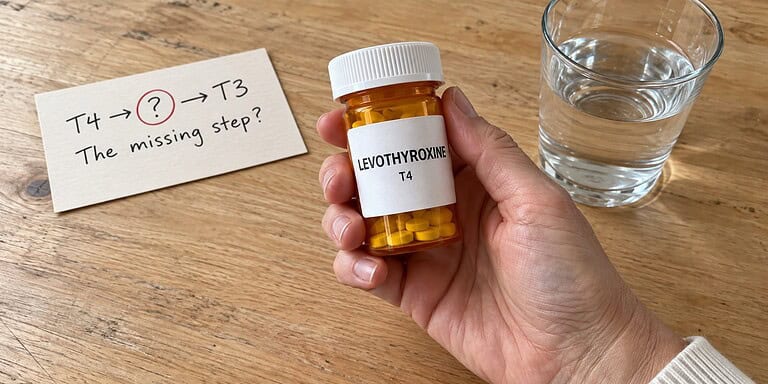
- T4-only medications like levothyroxine and Synthroid are the least effective thyroid medications for weight loss because they don't directly boost your metabolism.
- Thyroid medications that contain T3 include liothyronine, Cytomel, sustained release T3, NDT formulations like Armour thyroid, and compounded T4/T3 combinations.
- If you are on thyroid medication and still struggling to lose weight, switching to or adding a T3-containing medication may be the change that finally helps.
It’s no secret that thyroid patients often struggle with their weight.
If you are reading this, and you have low thyroid function or hypothyroidism, then you probably know what I am talking about.
Your thyroid is one of the primary regulators of your metabolism.
This is why people who have low thyroid function end up gaining weight more easily compared [1] to the general population.
In short, low thyroid leads to a lower-than-normal metabolism which ultimately results in weight gain.
That’s all well and good, but why is it that so many thyroid patients continue to stay overweight despite taking thyroid medication?
And why is it that so many thyroid patients continue to experience low thyroid symptoms despite taking the very medication that should solve both problems?
The truth is that some thyroid medications are better tolerated and are considered to be more effective than others, especially when it comes to helping with weight loss.
Here’s what I mean:

Are All Thyroid Medications Equally Effective at Managing Weight?
In other words, is there a ‘best’ thyroid medication for weight loss? One that stands above the others and one that you can reliably count on to help you lose weight whenever you take it?
Unfortunately, it’s not quite that simple.
There definitely is a class of thyroid medications that can give you a much higher chance of success in your weight loss efforts, but nothing is ever guaranteed.
The class of thyroid medication that I am talking about is much more powerful than the most commonly prescribed thyroid medications like levothyroxine and Synthroid.
Which class of thyroid medication am I talking about?
Any prescription thyroid medication that contains T3 thyroid hormone, the most biologically active thyroid hormone that we know of.
Emerging research suggests that it’s not the only thyroid hormone that can help, though.
T2 thyroid hormone can definitely give T3 a run for its money when we are talking about its impact on metabolism and weight.
Even though T2 thyroid hormone is much less biologically active compared to T3, it seems to have a more targeted effect on the mechanisms which control metabolism.
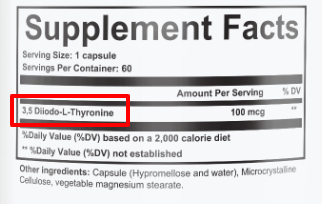
It’s hard to declare a winner between these two, but one thing is for sure, we can definitively state that T4 thyroid hormone is not even a contender.
And it’s T4 thyroid hormone that most thyroid patients take.
Putting that aside for a moment, let’s talk about how to get T3 and T2 thyroid hormones.
How do you do it?
It’s actually fairly easy, all things considered.
T3 thyroid hormone is found in several different thyroid medications and T2 thyroid hormone is available as an over-the-counter supplement (it’s the only active thyroid hormone that doesn’t require a prescription).
Between the two, T2 is obviously much easier to get because you can purchase it right now without a prescription.
So let’s focus on T3 for a moment since it’s slightly more difficult to get and is found in multiple thyroid medications.
The most potent include:
- Liothyronine – This is a pure T3-only thyroid medication.
- Cytomel – This is a pure T3-only thyroid medication.
- Sustained Release T3 – This is a pure T3-only thyroid medication.
- Any NDT (Natural Desiccated Thyroid) formulation – This contains both T3 and T4 and includes medications like Armour thyroid. The T4:T3 ratio in NDT is static and comes as 38 mcg of T4 to 9 mcg of T3 in each grain. A grain is a unit of measurement for NDT thyroid medications.
- Compounded T4/T3 thyroid medication – This combination thyroid medication is available from compounding pharmacies.
T4 vs T3 and T2 Thyroid Hormones
Why are T2 and T3 thyroid hormones more effective than T4 when it comes to weight loss?
It has to do with how quickly the body can utilize each.
T3 and T2 are both unique in that they do not require activation by the body in order to be used.
This differs from T4 thyroid hormone which requires activation in the form of thyroid conversion.
Thyroid conversion is the process by which your body takes T4 thyroid hormone and turns it into T3 thyroid hormone [2].
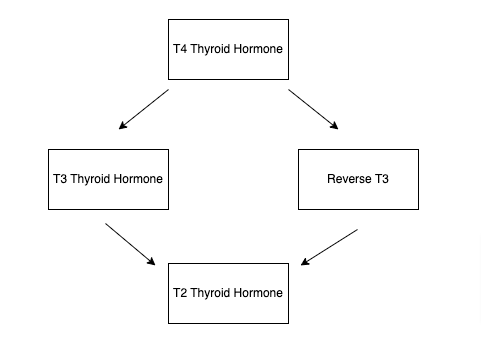
For this reason, T4 thyroid hormone can be thought of as a reserve thyroid hormone that your body can draw upon for use when it needs it.
This means medications like levothyroxine and Synthroid must be activated before they can be used by the body.
And it is this extra activation or conversion step that seems to make all of the difference for many thyroid patients [3].
And I’m not the only one to suggest that T3 thyroid medications are superior when it comes to weight loss.
We also have several studies that show that thyroid patients who switch to NDT medication (like Armour thyroid) from T4-only thyroid medications like levothyroxine, lose weight and feel better [4].
What’s even more interesting is that the weight loss mentioned above occurred without dietary changes or exercise which implies that the change in thyroid medication by itself was sufficient to impact metabolism and weight.
In addition to these studies, we also have data directly reported from thyroid patients which shows that they prefer thyroid medications with T3 in them compared to those with T4 only.
A survey of over 12,000 thyroid patients illustrated this point perfectly.
Thyroid patients taking NDT and T4/T3 combinations had fewer weight issues compared to those taking levothyroxine and Synthroid.
The findings are similar when it comes to T2 thyroid hormone as well.
T2 thyroid hormone has been shown to increase resting metabolic rate [5] most likely through its impact on T3 thyroid hormone receptors.
Based on available data and thyroid patient experience, it’s pretty clear that if weight loss is your goal then you should probably be incorporating both T3 and T2 thyroid hormones into your daily regimen.
Understanding The Role of Thyroid Medication Dosing
This is one huge area of confusion for many thyroid patients, so let me take some time to clear it up.
I frequently hear thyroid patients complain that “X” or “Y” thyroid medication didn’t help them lose weight.
This even happens for the most powerful thyroid medications which contain T3 thyroid hormone!
Thyroid patients will say that they’ve tried everything, including Cytomel, and it still didn’t impact their weight.
And while this definitely does happen, there’s one big problem with statements like this…
You can’t tell whether a thyroid medication is effective or not unless you first know that you were dosed correctly!
Let me explain…
Imagine you have two people who are both taking the same thyroid medication but at different doses.
Person A is taking liothyronine at a dose of 5 mcg/day along with levothyroxine at 75 mcg/day.
This person is still struggling with low thyroid symptoms and weight gain even while taking T3 and T4 thyroid hormones.
How can this be when I just stated that T3 medications are some of the best for weight loss? Shouldn’t she be losing weight effortlessly?
Let’s take a look at person B for comparison:
Person B is taking liothyronine at a dose of 15 mcg/day along with levothyroxine at 50 mcg/day.
This person is feeling better and has lost 10 pounds while using this combination of thyroid medications.
When all is said and done, person A claims emphatically that liothyronine is a failure and does not help with weight loss while, on the other hand, person B claims that liothyronine is an amazing weight loss medication and has helped her lose 10 pounds without changing her diet or exercise routine.
Both people have the exact opposite experience despite taking the exact same thyroid medications.
But there’s a big difference between the two of them, right?
Person A is taking 1/3 of the dose that Person B is taking of the same thyroid medication!
And this is a perfect example of how dosing plays a huge role in how well you feel as a thyroid patient.
I often will see thyroid patients make sweeping claims and generalizations about thyroid medications without mentioning anything about the dose!
You simply can’t make assertions about any thyroid medication without first assessing whether or not you were adequately dosed.
The assumption made by many thyroid patients is that their doctor knows how to dose them so they assume that this couldn’t possibly be causing any problems but that couldn’t be further from the truth.
Doctors tend to underdose thyroid patients because it’s safer than the alternative (which is overdosing them), especially when they use inaccurate thyroid lab tests such as the TSH to determine the dose.
So don’t fall into this trap!
If you want your thyroid medication to be effective then you need to make sure you are not only on the right type of thyroid medication but also that your dose of thyroid medication is optimized for your body.
Taking More Thyroid Medication Isn’t the Answer
Another trap I see thyroid patients fall into is what I will call the “more, more, more” trap.
If the answer to my weight problem isn’t solved by my current thyroid medication dose then the answer must be to simply take more of the same thing but at a higher dose.
The theory here is that if you can push yourself into a hyperthyroid state then you will lose weight, right?
You would think so, and maybe hope so, but it isn’t really true in practice.
Not only is taking too much thyroid medication dangerous, but it’s also not likely to help you lose any weight.
This is also why you do not want to use thyroid medication to aid with weight loss if you don’t have a thyroid problem!
Why is this?
Most thyroid medications that people take contain only the T4 thyroid hormone.
Medications like levothyroxine and Synthroid fall into this category.
These medications, while they can be effective for some, often fail to help many thyroid patients (as many as 20% [6]) feel better.
It has been shown that these medications can readily be converted into the inactive thyroid hormone metabolite known as reverse T3 instead of the active thyroid hormone T3.
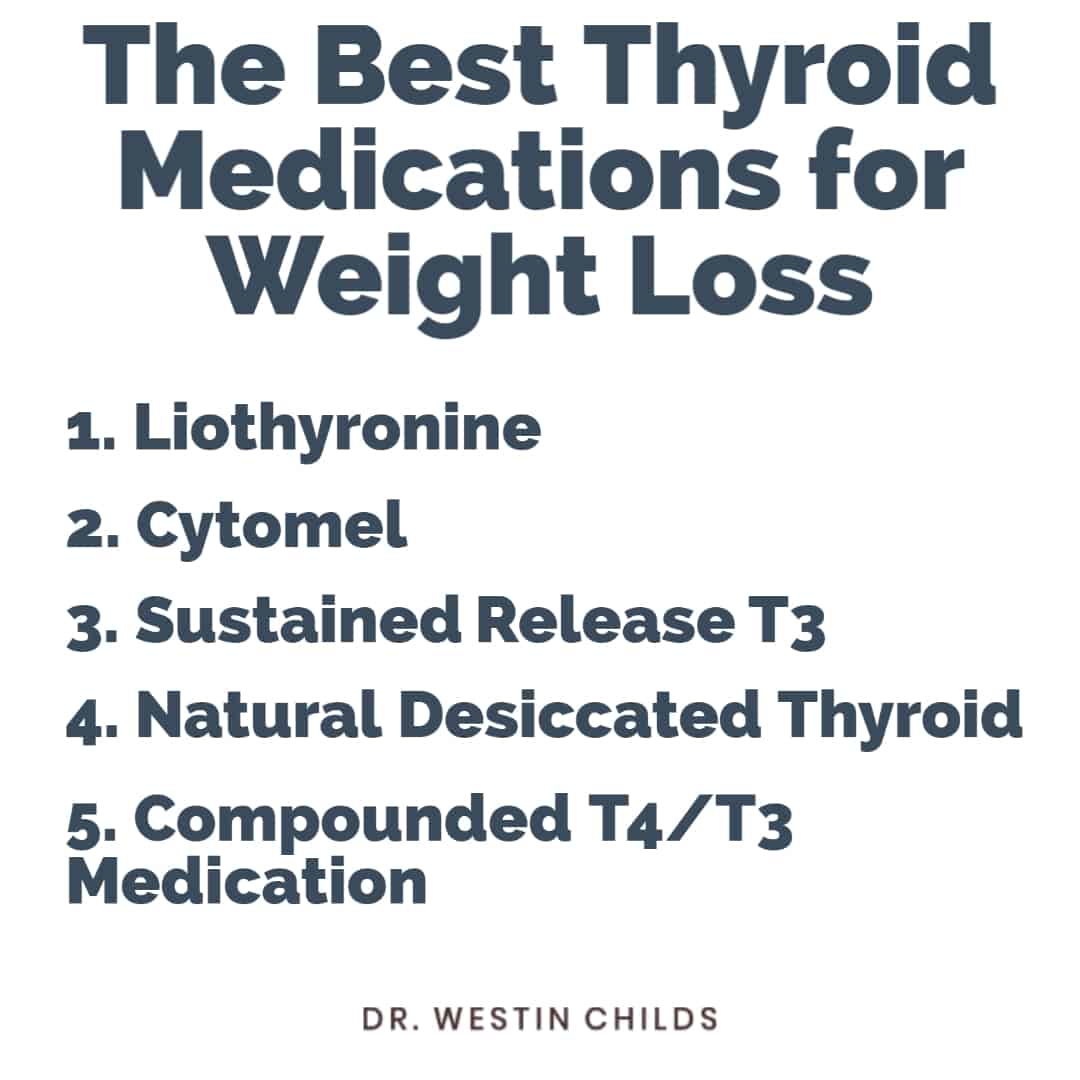
And if your body takes levothyroxine and turns it into rT3 instead of T3 then your symptoms and weight gain may get worse.
This protective mechanism is built into your body to prevent the damage that can occur from hyperthyroid states.
And you can trigger this mechanism by taking too much thyroid medication.
In addition to this protective mechanism, we know that hyperthyroid states cause dysregulation in hormones that help regulate your weight such as cortisol and insulin.
The hyperthyroid state may contribute to insulin resistance [7], as well as cortisol resistance [8], thereby making your weight problem worse, not better.
Bottom line:
Don’t think you can just increase your dose to help you lose weight.
In fact, taking a high dose is not only dangerous but it might cause you to gain weight through reverse T3 conversion.
Why Weight Loss May Stall on Thyroid Medication
It may be tempting to think that there are only certain thyroid medications that will help you lose weight but that isn’t the truth at all.
In fact, any thyroid medication has the potential to help you lose weight so long as your body can utilize it.
The key is to figure out what your body needs.
And there’s a good chance whatever you are currently taking isn’t working if you aren’t losing weight.
Here are some tips and tricks to help you find the best thyroid medication for your body, one that will help you lose weight:
#1. You need T3
There are just some people out there who will need T3 thyroid hormone in some form no matter what.
Most doctors like to believe that everyone is fine taking a T4-only thyroid medication like levothyroxine but it’s clear that this treatment strategy doesn’t work for everyone.
We know from research that approximately 20% of the population has a problem utilizing levothyroxine to its fullest.
And if you are one of the unlucky few in this percentage then you will most likely need to add T3 thyroid hormone to your regimen.
Conceptually speaking, this is an easy thing to do.
Practically speaking, it’s quite difficult because it will require a prescription from your doctor.
It’s not impossible to get your doctor to prescribe T3 but it can take some time and some convincing on your part.
If you are unable to work with your doctor then consider our directory to find a thyroid doctor.
#2. You aren’t absorbing your medication
You can take all of the thyroid medication in the world, but it won’t do you any good if your body isn’t able to absorb it.
Thyroid medication, in general, is quite fickle.
Do you remember your doctor or pharmacist telling you to avoid taking your thyroid medication with food?
The reason for this is that food can impair its absorption.
Your thyroid medication will look for basically any reason to not make it into your bloodstream through your intestinal tract.
Before you jump to another medication proclaiming that your current one doesn’t work, make sure you aren’t missing an absorption issue.
It could very well be the case that your thyroid medication is fine, it’s just that your gut needs some tending to.
Avoid taking your thyroid medication with food, coffee, various drinks, and even supplements as all of these things can negatively impact absorption.
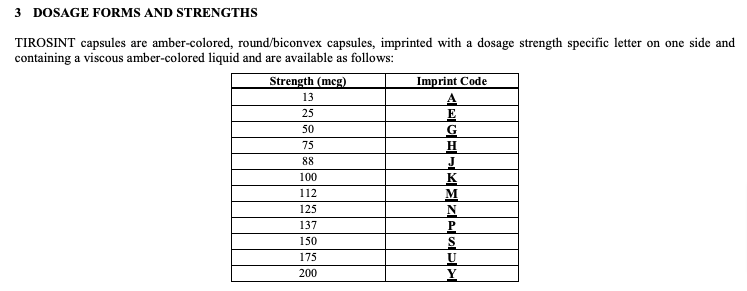
You can also try switching to cleaner thyroid medications that are easier to absorb, such as Tirosint or Tirosint-Sol.
#3. Your dose is not quite right
Lastly, don’t blame your thyroid medication if you can’t lose weight until you optimize your dose!
Optimizing your dose includes so much more than just looking at your TSH [9].
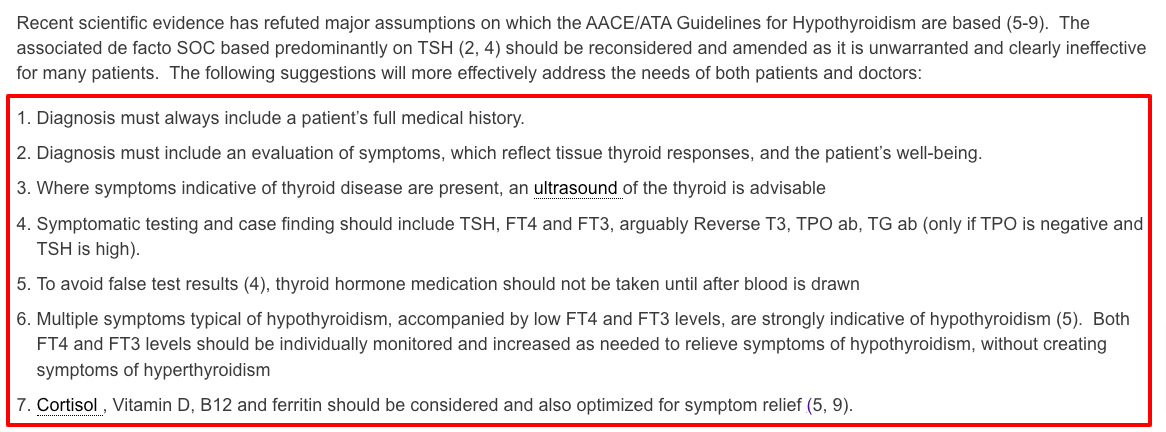
You should also be looking at your free thyroid hormone lab tests such as free T3 and free T4 and sometimes even reverse T3 and thyroid antibodies (when the situation calls for it).
You might be on a dose of thyroid medication that puts your TSH in the sweet spot but is not high enough to increase your free T3 and free T4.
If this happens then you will have a very hard time losing weight and feeling better.
Your Next Steps: Thyroid Medication and Weight Loss
If you are a low thyroid patient struggling to lose weight and you are looking for some help from your thyroid medication make sure you follow these rules!
#1. Make sure that your thyroid medication is being absorbed properly.
#2. Make sure that your dose is optimized and high enough for your body.
#3. Consider taking T3 and T2 thyroid hormones in some form (T3 is available as a prescription and T2 can be purchased over the counter).
#4. Check your lab tests to make sure your free T3 and free T4 are in the optimal range!
Now I want to hear from you:
Are you currently struggling to lose weight?
What thyroid medication are you taking right now? Do you think it’s helping or hurting you?
Are you taking a medication that contains T3 right now? If so, have you noticed a difference?
What changes, if any, are you planning on making after reading this?
Leave your questions or comments below!
Scientific References
1. Sanyal D, et al. (2016). Hypothyroidism and obesity: An intriguing link. Indian journal of endocrinology and metabolism. doi:10.4103/2230-8210.183454.
2. Robin P Peeters, Theo J Visser (2017). Metabolism of Thyroid Hormone. Endotext [Internet].
3. Midgley JE, et al. (2015). Variation in the biochemical response to l-thyroxine therapy and relationship with peripheral thyroid hormone conversion efficiency. Endocrine connections. doi:10.1530/ec-150056.
4. Hoang TD, et al. (2013). Desiccated thyroid extract compared with levothyroxine in the treatment of hypothyroidism: a randomized, double-blind, crossover study. The Journal of clinical endocrinology and metabolism. doi:10.1210/jc.2012-4107.
5. Senese R, et al. (2018). 3,5-Diiodothyronine: A Novel Thyroid Hormone Metabolite and Potent Modulator of Energy Metabolism. Frontiers in endocrinology. doi:10.3389/fendo.2018.00427.
6. Carlé A, et al. (2017). Hypothyroid Patients Encoding Combined MCT10 and DIO2 Gene Polymorphisms May Prefer L-T3 + L-T4 Combination Treatment – Data Using a Blind, Randomized, Clinical Study. European thyroid journal. doi:10.1159/000469709.
7. Chu CH, et al. (2011). Hyperthyroidism-associated insulin resistance is not mediated by adiponectin levels. Journal of thyroid research. doi:10.4061/2011/194721.
8. Seck-Gassama, et al. (2000). [Serum cortisol level variations in thyroid diseases]. Dakar medical.
9. Rowe M, Hoermann R, Warmingham P. A Patient's Guide to the Diagnosis and Treatment of Hypothyroidism. Thyroid UK.