
- Tirosint contains only 4 ingredients (1 active T4, 3 inactives) versus levothyroxine's 9+ fillers and dyes. This superior absorption means you get more usable hormone in your body, producing real symptom improvement.
- Switch to Tirosint if you have GI problems like low stomach acid, SIBO, reflux, or food sensitivities. Studies show Tirosint absorption isn't affected by stomach acid, making it ideal for patients with absorption issues.
- T4-only therapy works best when combined with T3 medication like Cytomel. Adding T3 multiplies symptom reduction beyond Tirosint alone.
- Most doctors readily prescribe Tirosint because it fits the current T4-only paradigm, making it easier to obtain than NDT or combination T4/T3 therapy while still providing measurable improvement.
You’ve probably heard from other patients that switching from levothyroxine to Tirosint made all the difference.
Considering that they are both T4-only thyroid medications, what is the difference between these medications?
Why do some patients have decreased symptoms, lose more weight, and feel better on Tirosint but not on levothyroxine?
Is there a difference between this thyroid medication compared to the others?
It turns out that many patients actually do much better on Tirosint (but not everyone).
In this article, I am going to discuss who might do better on Tirosint, why most thyroid patients will probably do better on this medication, and make a case for switching thyroid medications…
*Special note: I have no affiliation with the makers of Tirosint or receive payment from them in any way. I am simply sharing my experience using this medication in hopes of helping others.
Tirosint the T4 Only Thyroid Medication
As mentioned previously Tirosint is a T4-only thyroid medication.
That means that it contains only the T4 thyroid hormone known as thyroxine.
T4 thyroid medications are the most commonly prescribed medications used to treat hypothyroidism and other medications in this class include Synthroid, levothyroxine, and Levoxyl.
So, what makes Tirosint different?
The primary difference between Tirosint and other T4 medications is not in the active ingredients but in the inactive ingredients.
This medication contains the fewest inactive ingredients compared to all other formulations.
We’ll talk about why this is important in a minute but first, let’s spend some time talking about T4 medications in general.
If you’ve read my blog before you probably know that I’ve spent a lot of time and energy writing about how T4-only thyroid medications generally don’t work well for many patients.
And this general unhappy feeling is not just seen on my blog (1).
Why is that?

Well, T4 thyroid hormone is not an active thyroid hormone.
The only active thyroid hormone is T3 otherwise known as triiodothyronine.
And in order to create T3, your body must use T4 as a substrate and precursor hormone.
So, many health providers give patients T4 thyroid hormone with the hope that the body will be able to naturally take care of this conversion process.
The problem with this logic is that under special circumstances the body will actually produce reverse T3 (the antithyroid metabolite) instead of T3 hormone.
This is the primary reason that many thyroid patients simply don’t do well on T4-only thyroid medications.
But this isn’t the whole story.
It turns out that many patients would probably do well on T4 thyroid medication IF (and this is a big if), it was being absorbed properly, and if they don’t have any negative reactions to the fillers/inactive ingredients in the thyroid medication.
And that’s where Tirosint comes into play.
You see:
All T4 thyroid hormone medications contain the active ingredient T4, what they differ in is the inactive ingredients.
And many people are sensitive to these inactive ingredients.
It’s these inactive ingredients that change the absorption of the hormone or simply cause reactions themselves.
This reaction can trick patients into wrongly believing that their medication doesn’t work or that hypothyroidism isn’t the cause of their symptoms.
But what if you could take a thyroid hormone medication with very few inactive ingredients that would almost ensure proper absorption and assimilation? (2).
This would remove the conversion variable and give you clear insight as to whether or not T4-only thyroid medication works for you.
Well, that’s exactly how Tirosint works.
Tirosint contains the fewest inactive ingredients (3) out of all of the T4-only thyroid medications and many patients have reported an improvement in overall symptoms when switching (4).
Why do you think these patients notice an improvement when switching?
Is this medication magically better than levothyroxine or Synthroid?
No, it’s a matter of absorption in the GI tract of the thyroid hormone and a reduced risk of negative reactions to the fillers.
And much of this change has to do with the ingredient list (including both active and inactive).
Tirosint vs Levothyroxine vs Synthroid
To illustrate this point let’s go over the ingredient list of these medications quickly.
Ingredients in Tirosint include (both inactive and active ingredients):
- Levothyroxine (this is the T4 thyroid hormone) <— Active ingredient
- Gelatin <— Inactive ingredient
- Glycerin <— Inactive ingredients
- Water <— Inactive ingredient
As you can see Tirosint has 1 active ingredient and 3 inactive ingredients for a total of 4 ingredients total.
Compare this to levothyroxine:
- Levothyroxine (this is the T4 thyroid hormone)
- Butylated hydroxyanisole
- Silicon dioxide
- Crospovidone
- Magnesium stearate
- Mannitol
- Cellulose
- Povidones
- Sodium lauryl sulfate
- Sucrose
- And color additives include dyes (more below and depending on the strength)
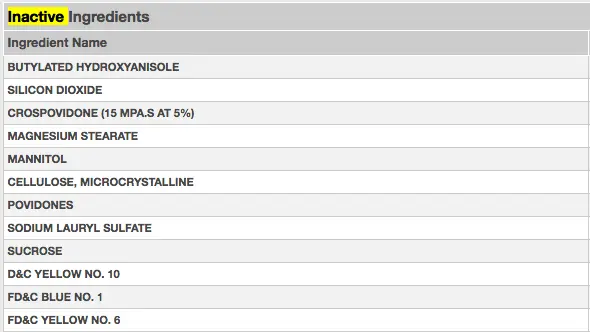
As you can see levothyroxine has a huge list of inactive ingredients.
It is these inactive ingredients that alter absorption and therefore influence the amount of thyroid hormone that makes it into your body.
These variables make it difficult to determine if any negative symptoms you may experience with a thyroid medication are due to the hormone or due to the inactive ingredients.
Special note:
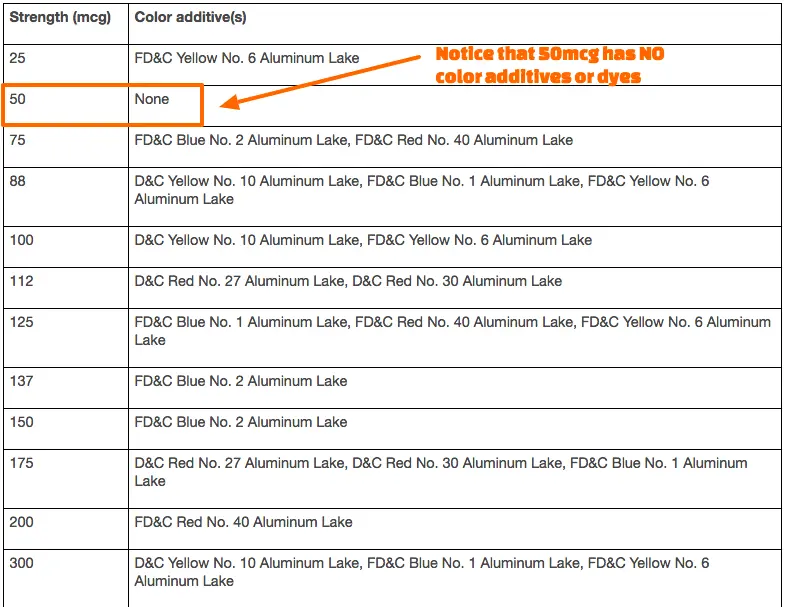
Below is the list of fillers, dyes, and additives to each dose of levothyroxine.
You can see that the 50mcg dosage does not have any extra dyes, so if you can’t switch medications from levothyroxine to Tirosint (due to price or some other reason), it would be worth a trial of switching to a 50mcg dose.
In fact, when I dose levothyroxine I almost exclusively use the 50mcg dose because of this.
If you are on 125mcg of levothyroxine then using 2.5 tablets of 50mcg may improve your symptoms versus using the 125mcg tablet.
This may require that you take more than 1 tablet, but it’s worth the price if you start to feel better.
Who Should Consider Using Tirosint?
Does this mean that every patient on levothyroxine who is still feeling symptomatic should switch to Tirosint?
No (nothing is ever that easy!), but there are a few patients who should strongly consider making the switch to Tirosint if they are on levothyroxine or Synthroid.
If you fall into any of the following categories then Tirosint may be a better option for you than levothyroxine/Synthroid and/or Levoxyl:
- Patients with gastrointestinal issues include (but are not limited to): Low stomach acid, acid reflux, SIBO/SIFO, IBS, IBD, and any GI-related surgery (including gastric bypass).
- Patients who don’t tolerate Synthroid, levothyroxine, or Levoxyl, or who have experienced any of the likely negative reactions to inactive ingredients.
- Patients taking acid-blocking medications such as proton pump inhibitors (6) – Tirosint has been shown in studies to not be affected by changes in stomach acid.
- Patients who have undergone bariatric surgery (7).
- Patients with multiple food allergies or sensitivities to multiple foods.
- Patients with gastroparesis or damaged intestinal motility (8).
- Patients with increased intestinal permeability.
- Patients who don’t tolerate NDT medications or are too sensitive to T3-containing medications.
- Patients who are extremely sensitive to medications and supplements or who react to these substances at very low doses.
- Patients who have experienced some improvement of levothyroxine or Synthroid but still have room for improvement.
- Patients who can’t take levothyroxine on an empty stomach or who drink coffee in the morning (9).
This list should serve as general and broad guidelines for who should consider switching to Tirosint.
One important point I want to expand on is the implication that gastrointestinal problems have on thyroid hormone (and other nutrients).
Hypothyroid patients (yes even those already on thyroid medications but still with symptoms) are in a tricky situation.
Thyroid hormone is required for proper stomach acid (HCL) production (10) and HCL is required for proper thyroid (and other nutrients (11)) hormone absorption.
This means that if you are being undertreated then there is a chance that you are also not fully absorbing thyroid hormone and/or other nutrients – making your problem worse.
This general lack of stomach acid can also worsen or create other intestinal problems which make absorption even worse.
This may explain why some studies show that up to 50% of hypothyroid patients have SIBO (12), or why up to 40% of hypothyroid patients have vitamin B12 deficiency (13).
The point is that these GI problems are very important and contribute to a reduction in the absorption of not only oral thyroid hormone medications but also nutrients which can worsen symptoms.
It’s worth taking some time to point out that replacing thyroid hormone doesn’t necessarily reverse these conditions and taking extra steps to treat these GI problems if present will be necessary for many patients.
Does Tirosint Cause More Weight Loss Than Levothyroxine or Synthroid?
I get this question from many patients in some form and the answer is that yes, it might cause weight loss in some individuals.
This is only true if your body has no issues with the conversion process of T4 to T3 and if your problem with levothyroxine was a lack of absorption.
If the change from levothyroxine to Tirosint results in an overall increase in thyroid hormone in the body, and the conversion of T4 to T3, then yes, Tirosint may result in weight loss.
This makes the huge assumption that your body has no issues with converting T4 to T3 and this is a very big assumption to make.
We’ve spent time focusing on the absorption issue, but in reality, this general lack of absorption and reaction to inactive ingredients probably represents 20-30% of patients.
Another 30-40% of patients simply need T3 added to their T4 dose for optimal results, and altering T4 dosing won’t necessarily change this.
You can read more about why levothyroxine can actually contribute to weight gain here, and you can read more about how to use Synthroid and levothyroxine for weight loss properly here.
Combining Thyroid Medications (T4 + T3)
This is probably the best way to use Tirosint and this is how I use it effectively in my practice.
Switching from Tirosint to levothyroxine
Tirosint by itself usually results in a reduction of overall hypothyroid symptoms due to superior absorption, but this effect is multiplied by the addition of T3-containing thyroid medications like Cytomel or liothyronine.
Other thyroid hormones and medications can safely be added to Tirosint, but remember that general rules for taking thyroid hormones still apply.
That means don’t take Tirosint with food, avoid taking supplements or vitamins at the same time as Tirosint, and so on.

One of the best parts about switching to Tirosint is that most providers won’t argue with you about the change.
Tirosint is still a T-only thyroid medication and using this medication fits into the current paradigm of thyroid treatment (however flawed this paradigm might be).
Compare that to trying to get your provider to switch you to NDT, which is infinitely more difficult.
Nowadays it’s also becoming more commonplace for providers to add lower dosages of T3 to T4 thyroid doses.
So switching from, say, 125mcg of levothyroxine to 100mcg of Tirosint + 5-10mcg of Cytomel is becoming more commonplace than say switching from 125mcg of T4 to 2-3 grains of NDT.
Tirosint Dosage vs Levothyroxine Dosage
Is there a difference in dosages between these two medications?
While both contain equivalent dosages and concentrations of thyroid hormone, some patients do find that switching over may result in almost hyperthyroid-like symptoms.
In my opinion, this results from increased absorption and a flush of thyroid hormones into the body.
If this does occur in you, simply slightly reducing the dose is usually enough to control these symptoms.
But, in general, the dosage between these thyroid hormone medications is equivalent.
FAQ & Recap
The bottom line is that many patients stand to benefit from switching to Tirosint from levothyroxine or Synthroid (and even other forms of thyroid medications).
This improvement is felt to be due to increased and superior absorption in addition to a reduction in symptoms related to inactive ingredients.
Remember that Tirosint has 1 active ingredient and 3 inactive ingredients making it the “cleanest” thyroid hormone medication.
Special interest should be taken in certain patients with gastrointestinal symptoms as these patients tend to have low stomach acid and other nutrient deficiencies.
Another huge benefit of Tirosint is that this medication fits the current thyroid treatment paradigm and because of this many providers are more willing to prescribe this medication over other formulations.
At the end of the day, you are a unique patient and it may take a combination of time and trial and error to find your optimal dose, but don’t give up! With persistence, you will get there.
Below I’ve also included some frequently asked questions that I receive from patients regarding Tirosint.
You can use this list if you don’t feel that your questions or concerns were answered in the information above.
If you have any other questions or comments please don’t hesitate to leave them in the comment section below as I check these frequently and I want to keep the conversation going.
Is Tirosint a T4-Only Thyroid Medication?
Yes, Tirosint is a T4-only thyroid medication.
It does NOT contain T3.
Medications that are T4-only thyroid medication include levothyroxine, Synthroid, Tirosint, and Levoxyl.
Medications that contain T3 only include Cytomel, liothyronine, and SR T3.
Medications that contain both T4 and T3 include Armour thyroid, NP Thyroid, and Adthyza.
Will it Work for Me?
There is no way to know for sure if Tirosint will work for you.
In my experience, I’ve found that most people do subjectively experience a reduction in hypothyroid symptoms when switching to Tirosint even when switching from levothyroxine to Tirosint or Synthroid to Tirosint at the same dose.
That doesn’t mean it will work for you, but it’s certainly worth a 1-2 month trial in most cases, especially if you don’t feel well on your current regimen.
When trying to optimize and reduce your symptoms it’s important to take into account other factors like T4 to T3 conversion, inflammation, and other hormone imbalances.
These other factors may be playing a role in why you are or aren’t doing well on your current regimen.
Can Tirosint Cause Weight Gain?
Like other T4-only thyroid medications, Tirosint can potentially and indirectly lead to weight gain.
This usually occurs from improper thyroid conversion and the production of too much reverse T3.
Recall that reverse T3 is the antithyroid metabolite and directly competes for binding and cellular activation with T3.
The more reverse T3 you have in your body the more likely you are to experience hypothyroid-like symptoms (even with a normal or low TSH).
Many patients on T4-only thyroid medications also may experience a condition known as low T3 syndrome which is felt to be due to a variety of reasons including lack of thyroid conversion (though this condition doesn’t always have high levels of reverse T3).
How Do You Take It?
Like other thyroid hormone medications, Tirosint should be taken on an empty stomach in the early morning. You should also avoid supplements and the intake of food for at least 60 minutes after taking it.
Some patients opt to split the dose and/or take this medication at night, but these are advanced techniques and depend on symptoms.
It is worth mentioning, however, that some studies have shown that Tirosint can be taken with foods (14) which makes it unique among other thyroid formulations.
These studies show that taking Tirosint in the morning with food does not impact its absorption.
Tirosint can and should be considered, in cases where you may be experiencing nausea when taking your thyroid medication on an empty stomach.
Even though it can be taken with food doesn’t necessarily mean that you should take it with food, but it’s certainly worth considering in certain situations.
Can it be Used with Other Thyroid Medications?
Yes, Tirosint can safely be combined with other thyroid hormone medications.
It is often best used in combination with Cytomel, liothyronine, or SR T3.
Can Tirosint be Taken with Supplements or Vitamins?
If you are taking vitamins or minerals then it’s best to consume these supplements 30-60 minutes after you take your medication.
Doing this will help enhance absorption in the gastrointestinal tract.
It’s also best to avoid taking Tirosint directly with supplements that contain iron or calcium as these may directly bind up the active thyroid hormone.
You can see a list of other substances that interfere with thyroid hormone absorption here.
Does Tirosint Have Any Side Effects?
Like other thyroid hormone medications Tirosint (if used in high doses) can result in hyperthyroid-like symptoms:
- Heart palpitations
- The feeling of anxiety or jittery sensation
- Rapid weight loss
- The sensation of overheating or feeling too warm
- Anxiety, depression, or other mood changes
- Insomnia or change in sleeping patterns
These would be considered adverse or serious side effects and if you experience any of these you should seek medical care as soon as possible.
Because of the small list of inactive ingredients, many patients tolerate Tirosint quite well and generally don’t complain of minor side effects like headaches, rashes, flushing, etc.
This doesn’t mean that you can’t or won’t experience any negative side effects from this medication, but it does mean that the chance of this happening is low.
Any minor symptoms associated with using Tirosint are usually self-limiting which means they tend to resolve on their own within a few weeks.
If you are ever worried about a side effect you feel is related to your medication then it’s best to contact the doctor who prescribed the medication for you.
Can Tirosint be Taken with Food or Coffee?
Believe it or not, Tirosint is one of the only thyroid medications that CAN be taken with food (and even with coffee).
As you probably know, thyroid patients are told that they should take thyroid medication on an empty stomach and avoid eating or taking supplements for at least 1 hour afterward.
While this rule technically still applies to Tirosint, some studies have shown that eating food right after taking it, and even drinking coffee while you take it, do not alter how much is absorbed into your body.
This is potentially great news if you are someone who has to have coffee in the morning.
While I typically don’t recommend drinking coffee before you take your thyroid medication, this might be an alternative for those people with schedules that don’t really allow for a 1-hour rest after eating or right after waking up.
But remember:
If you take levothyroxine or Synthroid, you should absolutely avoid coffee when taking your medication. Drinking coffee can speed up your intestinal tract (from the caffeine) and reduce thyroid hormone absorption.
If this sounds like you then you may want to consider switching to Tirosint.
How Much Does Tirosint Cost?
Because Tirosint is a newer formulation of T4 thyroid medication the price tends to be more expensive than other generic brands.
You can see a list of cash prices below using goodrx.com:
Without insurance, and for the 100mcg dose, Tirosint will cost around $122 (depending on your location).
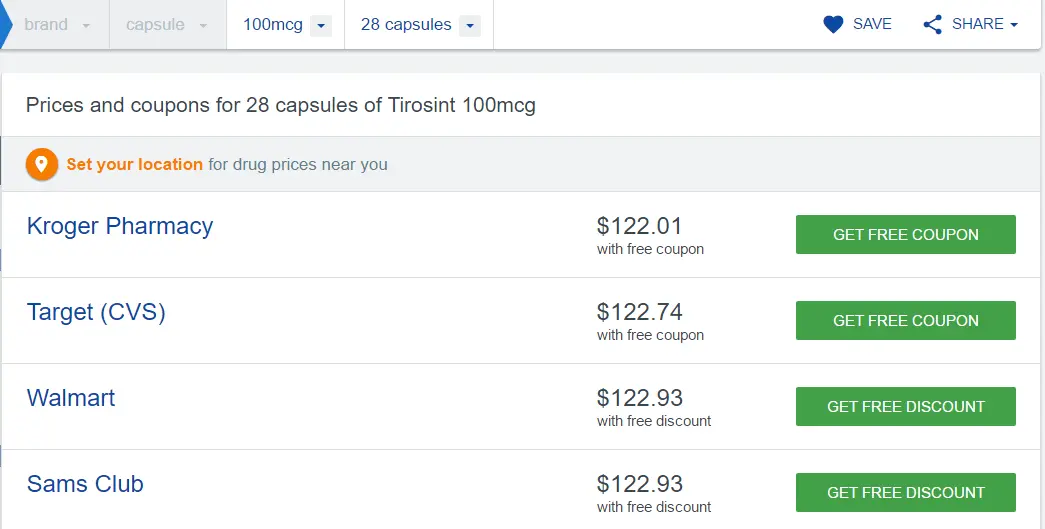
You can use goodrx.com to get a discount on medications (even other formulations of thyroid hormone and other medications).
If your insurance won’t cover the cost and if the cash price is too high you still have one last option:
A manufacturer coupon.
Tirosint does have coupon codes as well which can help reduce the cost to around $35 per month.
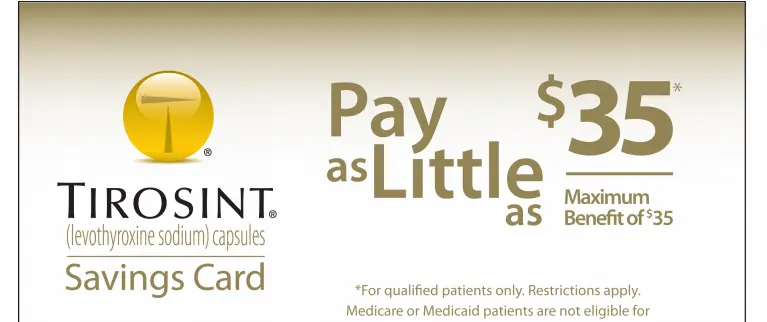
You can find more information about the coupons here.
At the end of the day, paying up to $100 per month may be expensive but if it improves your quality of life the price may be more than worth it.
Now I want to hear from you:
Are you doing well on your current thyroid medication?
Have you considered switching to Tirosint?
Is your doctor willing to work with you to switch medications?
What other strategies have you tried?
Leave your comments or questions below!
Scientific References
#1. https://www.ncbi.nlm.nih.gov/pmc/articles/PMC3169863/
#2. https://www.ncbi.nlm.nih.gov/pmc/articles/PMC3726924/
#3. https://www.ncbi.nlm.nih.gov/pmc/articles/PMC5581367/
#4. https://www.ncbi.nlm.nih.gov/pmc/articles/PMC5318319/
#5. https://www.ncbi.nlm.nih.gov/pmc/articles/PMC1440339/
#6. https://www.ncbi.nlm.nih.gov/pubmed/24246350
#7. https://www.ncbi.nlm.nih.gov/pmc/articles/PMC3726924/
#8. https://www.ncbi.nlm.nih.gov/pmc/articles/PMC4884855/
#9. https://www.ncbi.nlm.nih.gov/pubmed/22932947
#10. https://www.ncbi.nlm.nih.gov/pubmed/12754530
#11. https://www.ncbi.nlm.nih.gov/pmc/articles/PMC1552819/pdf/gut00693-0062.pdf
#12. https://www.ncbi.nlm.nih.gov/pmc/articles/PMC4056127/
#13. https://www.ncbi.nlm.nih.gov/pubmed/18655403
#14. https://www.ncbi.nlm.nih.gov/pmc/articles/PMC3873683/



Hi,, please help me with the conversion,, I am currently on Synthroid 50mg, Cytomel 5mg, I am switching to Tirosint, what would be the dose?
Thanks
Hi Margerite,
Synthroid and Tirosint are both T4 medications so the conversion from 50mcg of Synthroid would be 50 mcg of Tirosint. The cytomel is a different story entirely.
Dr. Westin I tried for years natural med 3 kinds but ended up on levothyroxine which I feel the best. Tried to add syntetic t3 that was terrible to me.so I had to stop taking it. I feel great on levothyroxine taking 75mcg but one symptoms still persist. Hair thinning, balding up to the point that I need a wig. I could not solve this issue yet. Trying to switch to Tirosint to see if it helps on that. What is your opinion. Could it help?
Hi Kinga,
I would check out this article for more information on hair loss: https://www.restartmed.com/thyroid-hair-loss/
It might also be the case that your hair loss is unrelated to your thyroid.
I’m a 49 year old female. I had a partial thyroidectomy in 2010 due to benign cysts on the left side of my thyroid. After the surgery, I was prescribed Synthroid, which was a horrible experience. I started having severe panic attacks immediately following my surgery. So many people do not make the connection with mental health and thyroid problems. I was close to being suicidal while on synthroid. After 6 weeks of pure hell I was switched to Armour thyroid med and did fine with that until it became almost impossible to get. I was then put on Torosint, 125 mcg and have done very well on it. Now, my insurance company has just decided they want me to be on synthroid or Levothyroxine because of price of Tirosint. I love the way insurance companies become doctors when they don’t want to pay for the meds that are actually needed and prescribed. My doctor will contact my insurance company to get it cleared to continue giving me Tirosint but it just makes me so mad that insurance companies think they know more than doctors do.
Hi Jodie,
They can, and certainly do try but it is always up to you whether or not you want to pay the out of pocket price for the medication. They can’t force you to use Synthroid or levothyroxine but they can increase the price of your existing medication to try and push you towards that route. But you always have the option of paying out of pocket for Tirosint if you want. The price (with a coupon) is around $30 per month and without a coupon is probably closer to $100. But if it means keeping your life intact and maintaining your mental health then it may be worth it.
Dr. Childs, I had a total thyroidectomy 15 yrs ago, I don’t even recognize myself anymore. I have gained 80 lbs and the rollercoaster ride has been horrible. Can your information help me? You talk a lot about malfunctioning thyroids, but what about NO thyroid. Please help. Beverly
Hi Beverly,
In general, most of the information presented on my website is relevant to those with and without a thyroid. I would take a look at these articles which are specific to those without a thyroid, though, so you better understand your situation:
https://www.restartmed.com/weight-loss-thyroidectomy/
https://www.restartmed.com/thyroidectomy/
https://www.restartmed.com/thyroid-surgery/
What would be a good dosage to take if i am taking 1.5 grains of WP and 20mcg of cytomel? I can’t get the WP or Nature anymore! tired of hunting it down. I know the tirosint is a bit stronger?
I am presently taking 200mcg of Tirosint daily. My new Endocrinologist is unhappy with my blood results:
FreeThyroxine
Normal Range: 0.6 – 1.6 ng/dL
Your Level: 2.2 ng/dL.
I had a pituitary tumor in my teens/twenties and no longer produce TSH.
I recently had a parathyroidectomy and am in recovery.
I am very sensitive to medication changes.
My Endocrinologist
told me to take 100 mcg on Saturdays and Sundays, to which I immediately became depressed and anxious when I did so.
My MD tried lowering my Tirosint daily dose to 188mcg, in the past, which seemed fine, but I became symptomatic ( hairloss, extremely cold, brain fog etc.) again in 6 months, so he put my dose back to 200 mcgs. I have been taking Tirosint for over 2 years, with great results. I feel good, vital, no brain fog, no muscular cramps, not cold, hair growth much better, energy level high. The biggest problem arose when the parathyroid disease reared its ugly head and in came hypertension, osteoporosis, calcaemia, kidney stones and more.
BTW, no thyroid hormone has ever produced weight loss for me.
I have no history of heart problems or hypertension (except with the parathyroid situation).
I am 61, 5’2″ and 196#
So, my questions:
1) What dose do you recommend?
2) What test(s) am I missing, that might prove my case, to my Dr.’s?
3) Are there big risks with this dose, if I have none of the symptoms?
4) Would you recommend not changing my dose, until a few months have passed, since my parathyroidectomy was today, and can only predict the physical changes, as there hasn’t been time to see any. My PTH is 19 now, down from 121.
Hi Karen,
Unfortunately, I can’t provide specific medical advice to your case unless you are a patient of mine. I am only able to answer general questions on this blog.
Hi! I have congenital hypothyroidism (since birth), and been through my share of medication changes (and attempts at self-medicating in my teens…ie deciding I didn’t need meds for this…I was wrong). In any case, the worst part for me has always been switching of meds due to discontinuation or some other reason. I have been dosed as high as 150mcg with Levoxyl (before it was taken off the market), and now at 125 with Tirosint for a few years. Overall I feel pretty good, but am 48 and a bit worried about the connection to osteoporosis that I’ve read about. Thankfully I’ve been blessed with good genes and never had to worry about weight much (helps that I’ve always been active in athletics). Tirosint, however, is not cheap, $65 per month with my insurance, and I was interested to see your comparison of 50mcg of levothyroxine which has no additive coloring. Is that the generic version or is there a brand name that you recommend. Not looking to switch right now, just curious in case the cost of Tirosint becomes prohibitive at some point, as it’s been steadily going up. One more thing, they just changed the packaging to omit days of the week on the blisters. I am bummed because that really helped me keep track since I tend to forget sometimes when I’m in a hurry and I do have the occasional memory fog (due to getting older or being hypo I don’t know, but used to it).
Hi Fin,
In my experience, Tirosint is much better than the 50mcg version of levothyroxine.
I had a TT about 4.5 weeks ago for papillary carcinoma. Thyroid levels were all in normal range prior.
I’ve been on levothyroxine and have recently experienced abdominal pains, bloating and the worst reflux of my life. I’ve always had reflux and a hiatal hernia but they were manageable with ranitidine. I’ve been suffering so much lately, I went to see a gastro who prescribed a PPI (protonix). I hope I didn’t have to throw a PPI in the mix as a result of levothyroxine. And the worst part is that I have to space them out 4 hours, so by the time I eat breakfast I have a hunger headache.
Not sure if I should switch thyroid meds or try taking one of the meds at night.
Also, I am sensitive to side effects and have several (minor) food allergies.
And lately, I’ve had joint pain. Though I was told my calcium levels were normal after surgery and my parathyroids were not damaged.
I know another variable to consider in the big picture is that my own natural thyroid hormone will still be in my system until the 6 week mark. I’m told it is then I will truly know how it feels to not have a thyroid and if I need more or less supplementation.
Any advice would be greatly appreciated!! I just want to feel normal again!!
Hi Michelle,
I would take a look at these articles for a better idea of what to expect after thyroidectomy:
https://www.restartmed.com/weight-loss-thyroidectomy/
https://www.restartmed.com/thyroidectomy/
https://www.restartmed.com/thyroid-surgery/
https://www.youtube.com/watch?v=pK01OROzIe0
The only concern I have with switching from Synthroid to Tirosint is that of tweaking the dosage. The website for Tirosint says you can’t cut pills in half. However, I experimented with a pill cutter and made a perfect half, with no spillage whatsoever. I didn’t take it, of course. I would need to be assured that it was safe to take Tirosint once the capsule has been opened. Do you know why we aren’t supposed to cut them in half? Do you have any patients who cut the capsules in half? Thanks!!
Hi Nicole,
Medication capsules tend to delay absorption until specific parts of the intestinal tract to optimize medication absorption. Some may also cause irritation in the esophagus or stomach if they aren’t protected. This may be part of the reason why they don’t recommend breaking the capsule.
Hello I really could use some answers. I’m working with my naturopath to switch me from Armour thyroid which I was at 75mg over to tirosint at 112 milligrams and I felt like I was having a lot of headaches and loopy headed feeling
I had my dose reduced to 88 mcg, however I’m still having headaches but I don’t feel quite as loopy..
I have several questions but the main one that I would like to ask is Armour measures t4 differently than the other t4 medications alone do armor only has something like 38 milligrams of t4 so when you switch someone over to something that is t4 only and that is tirosint which is liquid what would the proper dose be? I still feel that my dose is too high because of this constant headache. My labs have shown me in the hypo status and my t3 is mid to upper level. I could really use some answers I’m starting to get very upset and have some depression was not finding the right dose I can always go back to Armour if I can’t figure this out with tirosint but I really feel like because tirosint is liquid it should be dosed at a smaller rate?
Hi Tara,
The fact that Tirosint is a liquid does not necessarily change how you dose it. It’s more readily absorbed compared to capsules which may mean that some people absorb more than others, but in general, the way to transition from Synthroid to Tirosint is to keep your dose the same at first and then adjust as necessary.
I have been taking Levothyroxine for many years. The last dose prescribed was 125MCG. I am seeing a new physician. He changed me over to Tirosint 50mcg. I was also put on the Paleo diet. Have been on both for a week. I am not losing weight even though the strips show I am in ketosis and I am sweating terribly. Actually, I feel bad all over. Is this normal with the switch being so recent? I had radio active iodine over 30 yrs ago for Graves’ disease. Thank you for any info.
Hi Char,
It doesn’t really make sense for you to transition from 125mcg to 50mcg considering these are the same medications from an active ingredient standpoint. All you did was dramatically reduce your dose which may explain your current symptoms.
I want to try Tirosint but I can not afford 122.00 a month. I don’t have insurance so I have to pay cash. Is there any other discount programs that would bring it to at least 40.00 a month?
Hi Julie,
Yes, there are discount programs which are available and I have links to those programs in the article itself if you want to take a look at them. My experience is that these coupons and discounts don’t always work, however, so keep that in mind.
Hello
I had my thyroid removed in Jan 2019 due to cancer. The surgeon prescribed 100mg Levothyroxine. I seemed to do well on this only it was generic. My endocrinologist wants me on brand only. She switched me Unithyroid. After 3 weeks I had terrible joint pains. She then switched me to Tirosint. About three weeks into both the unithyroid and tirosint I broke out in hives and extreme itching. She sent me to the dermatologist. She put me on Predisone. I have taken 2 rounds of it. Plus topical creams/ointments to relieve the itchy. It is not working. My skin has always been extremely sensitive. I get blood work done again in a few days. Could this be a reaction to the tirosint (too much.) I currently have headaches and trouble with eye sight as well. The itchy and redness along with extremely dry skin is driving me nuts.
thanks
My daughter is 23 and has Graves. Her thyroid was made inactivated by radio iodine right before 9th Grade. She has dealt with extreme depression and self-harm since her first year in college. I can’t help but think it has to do with her taking Synthroid and her inability to absorb T3. It’s very tricky to be involved with her care now because of her age, but I want her to straighten out her hormone difficulties instead of being on prescription meds for her depression and anxiety. Does this sound like a T3 absorption problem?
Hi Lisa,
It’s probably not a T3 absorption problem but more of a T4 to T3 conversion issue. Synthroid does not contain any T3 (only T4) but it is possible that she isn’t absorbing her T4 medication as well.
I would suggest you read these articles for more information:
– https://www.restartmed.com/t3-thyroid-hormone-depression/
– https://www.restartmed.com/hypothyroidism-and-depression/
– https://www.restartmed.com/t4-to-t3-conversion/
Tirosint question:
I just went into REMISSION of Hashimoto’s disease. I am happy but still have alot of unexplained fatigue even after a consistent use of bioidentical hormones. I have only been on 15mg of Armour. It is a tiny improvement in energy and the only option for me. I was given a trial of oral Tirosent to try. I felt extremely sad and emotional on the first dose. I didn’t take any of my Armour with it. Is this a bad idea to try another few days? My doctor was so confident that it would finally work for me! She just wants SOME improvement in my symptoms now.
Please, please help.
Thank-you,
Courtney
Hi Courtney,
Every medication change requires some amount of adjustment and this adjustment phase can vary in length. It’s probably too soon to tell if you are responding well or not to your medication just based on your reaction over the course of a few days.
I became allergic to my generic Levothyroxine after taking antibiotics! Tried Synthroid reacted and just got Tirosint sol! It’s making my ears so clogged I feel like they are going to bust even with small amounts and severely dizzy. Could it be I’m allergic to even the actual Levo ingredients or is it symptoms of starting this?
Hi Paula,
I would never say never, but I find it highly unlikely that you would be reacting to the thyroxine component of the medication because this thyroxine component is identical to what your body produces naturally. It would not really be compatible with life you were allergic to hormones that your body produces. It’s theoretically possible, however, but highly unlikely.
Hi. Is it, or an equivalent of it, available in Canada? I’m having a terrible time on Synthroid and no one seems to have any answers for me.
Hi Heather,
Yes, it looks like Tirosint is available from some Canadian pharmacies.
Can you take tirosint if your thyroid has been removed? (Cancer)
Hi Rosie,
Yep! Tirosint can be used in all of the same situations as levothyroxine/Synthroid.
I have been taking bio-identical T4/T3 for 10 years. I never see it mentioned. My TSH is 8 so my doctor added 25 mg of Tirosint. I’m having heart issues now and not feeling well. I’m more tired than ever. Don’t know what to do? What is your opinion of bio identical and why is it never included in a discussion about thyroid replacement? Thanks!
Hi Elaine,
All of the thyroid medications are bio-identical but I imagine that most physicians are probably not aware of that. This is actually uncommon for prescription hormones as most hormones (including birth control and medications for menopause) are NOT bio-identical.
Hi Doc,
My mother is 98 and is on Synthroid now. She was on Levoxyl for many years before her cardiologist switched her to Tirosint in 2012. She tolerated it very well and so many of her symptoms like hair loss, lethargy, lack of energy, dizziness, and anxieties, etc. went away.
She was put back on Synthroid by her new PCP for reasons we don’t know. Her old symptoms all came back.
Questions:
1) How do we convince the new PCP to switch her back without angering her?
2)We noticed that her caregivers are not giving her the 8 oz of water required after taking her Synthroid in the morning. What happens to absorption and the impact on her gastric condition without this water?
3) We also noticed that the PCP raised her dose to about 2 times what she was taking while on Tirosint. PCP does not test her T3, only TSH a while ago. Nor did she test her T4 level. What further tests should be taken to ensure the right dose?
Other medications my mother is taking is Valproic 9 ml (liquid version equivalent to 750mg – 250mg=3ml) at 3ml 3 times per day for seizure. And an extremely small dose of bp medication – Bystolic 1.25mg per day. She takes no other medication. She is lethargic most of the time now and seems not able to connect with you. She also has age-related dementia.
Any help you can give us to convince her PCP to switch back to Tirosint will be greatly appreciated as this happened on January 9, 2019, and we just now discovered it. Lin
Thank you, Lin
Great read. I just switched from Levothyroxine, today, since taking it for 7 years. The problem I have while on it is extreme tiredness and fatigue. I can sleep for 10 hours, be up for 2 and want to take a nap again. It has impacted my lifestyle so, I am hoping that Tirosint is a better option to regain my energy.
I was considering trying Tirosint but thought I would read some reviews before talking to my Dr. about it.
I just got on Drugs.com and something appears to be amiss with recent batches of Tirosint. Person after person recently reported that they WERE doing very well on Tirosint but are now having major problems with it. This wasn’t just a few people, it was almost every review lately. Many reported that there was a new manufacturer? I don’t see how that could be, but that’s what they said.
Don’t know what to do now. Recent reviews for Tirosint are awful and the cost is sinful. Of course, people on Medicare aren’t eligible for the cheapest way to buy it. The cheapest I could find was $120.00 for a 90 day prescription. $40 a month….I could probably do, but they seem to go up every year lately. The last thing I would want to do is start using it, only for the price to double or triple. That happened to many.
Hi Dr. Weston
Are you doing well on your current thyroid medication? Welcome your feedback.
What other strategies have you tried?
No. I am in transition trying to figure out how to proceed. This leaves in the position to personally experiment with how and what medication to take based on symptoms.
Have you considered switching to Tirosint?
Yes. My Integrative MD thought it might be a good choice.
After reading your blog, I question if I was taking thyroid medication correctly (Levoxyl and NP Thyroid).
To avoid having to be concerned about food and thyroid medication, I have been taking it sublingually for years! (Another MD gave me this tip years ago).
I tried taking Tirosint orally, and as your above blog mentions I became obviously hyperthyroid.
Is your doctor willing to work with you to switch medications?
Yes, but my insurance company does not cover Tirosint so I was switched back to Levoxyl.
BUT with the acute Tirosint hyperthyroid symptoms on 2/14, it became evident that my thyroid and insulin resistance was related to being hyperthyroid.
So I went off ALL thyroid medicine (Levoxyl 50mcg & NP Thyroid 30mg BID) till I got hypothyroid symptoms. My MD thinks I only stopped T4 medication.
Response is positive! Profoundly less GI inflammation, BG’s more predictable with Rapid Acting and Long Acting Insulins and better energy and cognition.
I started to feel “thyroid cold” (wearing a winter hat in the house with temps@ 72) within 36 hours. Tried NP thyroid 30mg BID and sx of abdominal inflammation returned. Today tried NP thyroid 15mg (split tab) warmed up after eating breakfast, BG’s and abdominal swelling great.
1/25/20 Thyroid LABS:
TSH-0.029 | FT3-3.1 | FT4-1.25 | Rev T3-29.1 | Thyroid TPO aby-42 | Cortisol am 0.8 | HgA1c with 14u Basaglar Insulin-10.0 | C-peptide-6.2.
HISTORY: Been on T4 medication for 21 years, T3 medication natural and synthetic for 17 years. Starting feeling rotten in August 2019 felt hypothyroid– like my previously stable Thyroid dose had plummeted. Turns out I went hyperthyroid (even though fatigued,super slow GI Motility, and brain fogged).
Your feedback is appreciated.
I wanted to let everyone know about another thyroid medication I found out about. Walmart changed their usual generic I have used for years to a medication called Euthyrox. At first, I was very upset over the change but looking into this product further I found that it is manufactured by merck pharmaceuticals in Germany to be marketed in the US by Provell. No matter what strength, these pills contain no dyes, lactose, or gluten. It’s $4 per month at Walmart on their plan, regardless of insurance. These pills come in a blister pack instead of a bottle so each pill is protected from light, which can effect potency.
If you can’t afford Tirosint then your next best bet might be this Euthyrox. It’s unheard of to be able to get quality packaging like this, along with no dyes from even name brand companies like Synthroid and it’s only $4 at Walmart. I’m pretty excited about this.
Okay, but if you’re absorbing tirosint better then shouldn’t there be a conversion chart? If you’re only absorbing about 80% from pill forms with fillers then you’re going to be overdosed switching to the same amount on Tirosint? That’s what I want to know. Does the average person have to drop down in dosage because of this? This is important information before making switches in brands and something most patients would like to know. I think Tirosint has been on the market long enough for this info to be provided. A difference in 12 or 25 mcg can mean the difference between being able to work and get out of bed. Thanks
While on generic Levo over a ten year period I suffered from gradual onset of dizziness, vertigo, nausea, reflux, headaches, flushing and about three years ago started developing a rash and facial darkening/red(not lupus or melasma,) as well as stomach bloating and burning /stiffness in my fingers. I’m not sure if It was the same generic maker but I know that Sandoz pharm was the supplier for Walmart for several years. I also tried Unithroid and experienced some of the same symptoms. When I tried Euthyrox(no dyes) I developed a serve headache and head pain but no stomach bloating or finger issues. I contribute the head pain to lower potency as five mcg of cytomel made it go away. On NP Thyroid I had none of these symptoms. Now, a lot of these symptoms can also be due to low T3.
Some of these binders could be causing the side effects but the one constant in generics and name brands like Unithroid and Synthroid are dyes. They all use Blue #1 and Yellow #10 in the 88mcg strength, however Unithroid and Synthroid take it one step further to make their “olive” a bright color by adding Yellow #6. Sandoz generic does not use yellow #6 and their “olive” is muted and they compensate with Red #30. I read that in 2003 the FDA asked Drs to stop adding Blue #1 to tube feedings because it had killed patients. Now I’m not getting that high an amount but I can only imagine that just like T4 builds up in your system then dyes can too. If a spec of gluten causes illness in celiac disease then small amounts of dyes and fillers could cause reactions as well.
Yesterday, my Dr immediately suggested Tirosint as he has in the past. Obviously, I still have symptoms of low T4/T3 but I don’t have any of the symptoms mentioned above. Started the sample this morning and was up moving around walking my dog and feeling clear headed. I finally decided to give Tirosint a serious try because I’m tired of playing the “is it my thyroid or the fillers and dyes causing these symptoms” game. You cannot keep trying to treat a symptom of hypothyroidism when it’s actually a side affect of dyes and fillers. If the above symptoms completely go away after several weeks and months then I’ll know it was due to inactive ingredients. If some symptoms linger then I can narrow it down to thyroid and begin to find ways to correct those.
As far as price, I’m on insurance and United Healthcare stated they may cover it with a Dr’s statement claiming it is necessary. I see they also have coupons on their website.
I have gained 50lbs and it’s been 2 years changing from synthroid to desiccated hormone. I don’t feel better. The reason I switched was because I was getting palpitations on synthroid. My doctor decided to increase my synthroid to help me lose weight and that’s ehen I started with palpitations. When we went back to regular dose I was still getting palpitations so I switched to desiccated hormone. Since then I gained 50lbs. I need help with these doctors!
pick up my Tirosint tomorrow, gastric surgery 2008. Diagnosed Hypothyroid in 2017 with a TSH of 88, have spent the past 4 years with a TSH in the 40’s and after years of suggesting lack of absorption, I saw a new physician assistant who picked up on it right away, I may FINALLY get this thyroid normalized after all!! So excited at the possibilities of these severe symptoms going away, losing this excess weight. I never understood how I could be overweight without a stomach!!! Beyond excited about the potential to be healthy again!!!
Hi Nicole,
It’s good for people to hear about situations like yours because there are still many people who wrongly believe that weight gain is all about calories. Hormones are the predominant player in weight gain and obesity and the best way to lose weight and keep it off is by addressing them. Thank you for sharing and glad you are getting on the right path!
What do you know about the above comment Regarding Tyrus sent formula being changed or different or made by a different company and not working as well and all the complaints about the new formula
Hi Faphne,
I’m not aware of a formula change for Tirosint unless you are referring to another thyroid medication? Others have had their formulas changed recently.
Thank you for the information. Diagnosed in 2013 with hypothyroidism due to very low T3. My T4 and tsh levels were fine. So was started on Cytomel to begin with and everything was until about 3 years ago and T4 went low for the first time ever. Started name brand Synthyroid which helped. Last summer I felt awful run down thought it was maybe dehydration. Emailed my symptoms again and again to my endocrinologist Dr. Motwani (former)since May. She told me to seek mental help! I quickly got referral to a new endocrinologist and just started Tirosint on Feb 12. I’m not sure if it’s helping or not yet. Been very moody and somewhat achy. Will get labs next week so hopefully that may show what could be going on.
Hi Sarah,
You did the right thing! If your doctor isn’t willing to work with you then it’s time to switch doctors.
Hi Dr. Childs,
I have been on Armour Thyroid 60mg once daily and Levothyroxine 25mcg once daily for many years, but I don’t feel like it is working for me. My PCP HATES the Armour and has tried to get me to drop it, but the only reason he gives me is that “you aren’t a pig, you shouldn’t be taking pig hormones” which isn’t a good enough reason for me to drop it and possibly end up with even WORSE symptoms. My husband has a medical background (veterinarian), and he says my bloodwork just doesn’t make sense, and he thinks something else is going on….like my hypothalamus….but we haven’t been successful in getting any of my doctors to follow up on this. Meanwhile my weight has crept up year after year, I have no energy and brain fog. I DO have other medical issues that COULD be causing these problems, but most of them showed up AFTER the hypothyroid diagnosis. So, basically, I am very confused and very frustrated, and I really don’t know what to ask or where to go from here. One question I do have is this: If there is a chance that I don’t convert T4 to T3 normally, why bother to even take a T4 only medication? Why wouldn’t I just take Armour Thyroid or another similar medication? My second question is this: Do you think I would benefit by trying tirosint, or would I even be able to tell a difference since I am currently taking two types of medications? Sorry for the LONG, rambling recitation! Maybe you can make sense of what I trying to say. Thank you for your article. I am going to show it to my primary….even though I know it will be a waste of time:(
Penelope Malcolm
Hi Penelope,
It’s usually preferable to start with T4 thyroid medications because they are better tolerated compared to T3 medications. T3 medications can cause issues, which aren’t serious but require monitoring by the physician. So, in many cases, they prefer to prescribe T4 medications because it’s easier.
Hi Dr. Childs!
I had my whole thyroid taken out in December 2019 due to cancer. At first they put me on a generic. Then a few months later switched me to Synthroid. Then added Cytomel. I had a couple of Synthroid dosage changes over the next several months. Added another dose of Cytomel. My reflux was going through the roof during all of this. Finally got my doctor to change the meds. Over the past 6 weeks or so, switched from Synthroid to Tirosint. Helped reflux a bit. Took me off one dose of Cytomel. Helped reflux a bit more. Took me off other dose of Cytomel and it helped reflux some more. Then started having extreme fatigue along with heart palpitations, chest pressure, shortness of breath – which all happens whenever my dosage gets off. I was also getting lightheaded. He increased my Tirosint dose from 88 to 100 mcg 10 days ago. I have improved a little, but not much. Went to family doctor earlier this week to get an EKG and bloodwork to make sure not something else. Appears to be thyroid like I figured. I’m missing quite a bit of work.
My body tends to not do well with some medicines. So I was very excited to try Tirosint since it is more natural than Synthroid. But I feel awful. Still super fatigued. Still having palpitations. Chest pressure has pretty much gone away thankfully. Have to sit down often as I’m too weak to stand for any length of time. Plus I’m still having reflux although it’s better than while on Synthroid and Cytomel. Any idea if I need a higher dose or what? I would appreciate your thoughts. Thanks!!!
I was on switched back and forth between Synthroid and Levothyroxine for a few years. I was suffering from a multitude of issues like heat intolerance, not being able to sweat, headaches, exhaustion, insomnia, just to name a few. I finally got tired of the symptoms and decided to do my own research. I found a NP that’s certified in functional medicine who finally figured out that I have Hoshimotos. we tried Nature-Throid and Armour and just didn’t get the desired results. She switched me to Tirosint and recommended a gluten free diet and I can definitely say a lot of my symptoms have disappeared. I feel much better on the Tirosint than I did with any of the others.
Hi Terra,
That’s great! Thanks for sharing.
I just switched from Levothyroxine 112mcg to Tirosint yesterday 6/4/21
Despite my blood test levels are in the normal range . I’m told. I still have alot of symptoms of thyroid problems. I’m always tired, my joints ache, I profusely sweat with little effort and I have Gi problems.
I have little faith in my doctors.
I’m the one who had to do the research into other medications to even know about Tirosint. How long will it take to start feeling any better even if Tirosint is going to make a difference? Thank you
Hi Timothy,
Compare your lab tests to those values found here to see if they are truly optimal: https://www.restartmed.com/thyroid-tests/
If Tirosint is the thing that you need then you should see some improvement within 3-6 weeks or so.
Thank you. I’ll check into that. I will also get back to you in about a month and let you know if I’m doing better with the Tirosint.
What could explain tremors throughout the limbs when taking Tirosint75?
I did inherit some very light tremors, but while on Tirosint my limbs start jittering all over the place when some thing winds me up. So I cold quit roughly a year ago, which gradually reduced the tremors to more “normal” levels, but feel like a run over rag all day long (TSH 15.32, T4 10.9, T3 4.7). Noting I did gain roughly 30kg while on Tirosint, which is now dropping again without dietary changes. Only real oddity is a natural repulsion (top/bottom) when I consume too much fat (>1 burger within 2-3 days) or dairy (specially cheese), even though I don’t have a lactose intolerance.
Before Tirosint the name of the game was Euthyrox, which didn’t seem to have the tremor issue, but also didn’t change the ragyness and rather made me demental, cutting almost a decade out of my memory.
Thank you!
Hi Andy,
Assuming the tremors are related to the medication (which may or may not be true), tremors are often associated with too much thyroid hormone.
I have been on tirosint 25 mcg since December with 2.5 mcg of liothyronine after trying to find something since Naturethroid left. I have felt bad on everything. My labs look great but I’ve had a weird bloating/swelling in my abdomen. At first I thought I have gained weight and was constipated but if I take a day off the swelling goes away and eliminating is easier. Could it be a weird reaction to gelatin?
Hi Lynn,
It’s possible, but it could also just be related to a dosing issue which would be more common.
I’m curious what your dosage and side effects are now is now Lynn as I will be starting a similar dosage and med combination!
Hi Dr. Childs,
I’ve been in synthroid for the last 25 years. I was on 175mcg. Up until last year when I got Covid. I only had mild symptoms, but it messed up my system. I started getting way to much synthroid and my body stopped turning the T4 into T3. So I was anxious, my heart was racy, until I got checked out, at emergency room. I tried telling my Reg Dr I needed cytomel, for some reason he didn’t give it to me. Maybe he read the charts wrong? Any way I ended up only taking 75 mcg of synthroid. But I still wasn’t right. I got into a Endocrinoligist and he put me on cytomel 5mcg with my synthroid. He talked about trying me on Tirosint, but didn’t. I wondered why?? I only take .25 mcg a day of cytomel. My Reg Dr had put me on Lisinopril 10mg a day. Which I could not take made me dizzy and feel bad. I cut it down to .25 mcg a day. I’ve read so much bad stuff on Lisinopril. I’m wanting to know what you think of it? I’m 63, I love the outdoors, hiking, kayaking, walking, fishing, and traveling to The Mts. Some times my O2 level drops up in the 9000 high altitude while we are staying at cabin. I keep 02 bottles on hand, but this has limited everything I do. I live down at 1700 altitude. It never bothered me before my body changed last year after Covid. I did go in and have a stress test in September of last year, it was all good. Can you give me some insight into that also? I just called this morning to talk to my Drs nurse and see if I can try Tirosint since it is a much cleaner thyroid medication. I’m waiting on call back. Would appreciate any advice you have. ( I do take zinc, multi vitamin, D3, Brazil nuts, and magnesium. I am a celiac also. Thank you, Cindy
Hi Cindy,
I’d be happy to point you in the right direction but I’m not 100% sure I’m following the question. Can you please clarify so that I can help further?
Tirosint makes me feel great but each time I try I get water retention so I only last one week before going back to my other medication. Any chance it might go away if I stick with it for longer? I prefer Tirosint because of price.
Hi Lena,
Yes, it may go away with either time or with altering your dosage.
I’ve been on generic levo (25mcg) and just started liothyronine (2.5mcg) 3 weeks ago due to my T3 being slightly lower than ideal. All my other numbers are within range except TPO (~350). I split the 5mcg lio to avoid the side effects–too anxious, heavy crashes and lightheadedness.
I’m going to start tirosint (25mcg) this week, and I’m wondering if I should start it by itself to see a baseline reaction before introducing lio into the mix as I haven’t been on lio that long in the first place. Any advice?
I am generally pretty sensitive to drugs, which is why even the smallest dose of lio yields side effects.
Hi Jenny,
There really isn’t a wrong or right way to approach changing your medication. If you tend to be sensitive to thyroid medication then that’s probably a good idea. Just be aware that it will take longer to see the benefits if you take that route but as long as you know what to expect, that isn’t an issue.
Dr child’s I have followed you for sometime . I’ve been on levothyroxine for over over 20 years and as much as 400 mcg daily. Slowly it was lowered back to 200mch and and levothyronnin added , first 25 mcg am then another 25 at pm. I have gastroparesis. I have had no success at feeling better or at my levels , now out of work due to hip injury/surgery no insurance etc but the weight is just pounded on no matter what I eat . Would this drug be applicable to my situation ?
Hi Florasila,
It can certainly be considered in your situation but I would also look into T3 medication and, potentially, levothyroxine injections:
https://www.restartmed.com/levothyroxine-injections/
https://www.restartmed.com/liothyronine/
This was a really helpful read. I’ve been on tirosint for over a decade and it’s worked well for my hypothyroidism. Unfortunately last year my insurance decided to no longer cover tirosint. I’m currently paying $70 a month. I had tried a generic first years ago and was experiencing headache and nausea. My health insurance decided I have to “try” 4 generics before they would consider the negative side effects. I just started taking levothyroxine this morning.
Hi Jenna,
Is this an affordability issue? If so, Tirosint does have some coupon programs you may want to look into.
This article is dated 9/13/2024, but Nature-throid and WP Thyroid have not been available since 2020… just thought I would mention it! I am currently on NP Thyroid – active ingredient is desiccated thyroid (T4 / T3) – Inactive ingredients include calcium stearate, dextrose, and mineral oil. I am currently working with a functional doctor to wean me off of thyroid medication. If it doesn’t work, would I be better taking Tirosint?
Hi Paula,
Thank you for bringing this to my attention! I’m aware that Nature-throid and WP thyroid haven’t been available for some time and I’ve been going through articles making updates, but it looks like this one was missed. Anyway, the reference to WP thyroid and Nature-throid have been removed and replaced with references to Adthyza and NP Thyroid.
I have been diagnosed with Hashimoto’s, psoriasis and psoriatic arthritis, my last 3rd tail of eyebrows are diminished and almost gone. I’m 65 and I take Levathyroxine 100 mg /day. I’m gaining weight no matter how little I eat and I’m very active, but exhausted and in a lot of pain. My doctor just recently switched my blood pressure med from metoprolol which caused my heart rate to beat at 43 for 2 yrs we thought I have heart failure. Then we switched to amlodipine which brought it up to 55 -60, but that has caused a lot of edema in my ankles and feet. I’m miserable!
I’m taking Biotin for the hair loss on my head for 6 months which has helped some. Recently a Dexa scan showed I have some bone loss in my hips and lower spine. Now the doc wants me to take 1000mg of Calcium per day. Some much going on. What to address first or all at the same time. I think I really need some help to get this right.
Please advise.
Thank you!
Hi Dr. Childs
5 days ago I switched from 100 mg eltroxin to 88 mg tirosint (I also take 7,5 mg liothyronin spilt between morning and afternoon) on day 5 I experience migraine like headaches (like really bad). I do have low stomach acid and issues with my gut leading to an inefficient digestion. On the positive side: I also experience more energy . Too early to give up but I wonder if the dose is too high?