
- Elevated reverse T3 acts as a brake on your metabolism at the cellular level. If your body is in chronic stress from illness, infections, or emotional trauma, it creates this anti-thyroid metabolite to conserve energy.
- Calculate your free T3 to reverse T3 ratio using your lab results. A ratio below 0.20 means too much reverse T3 is blocking thyroid function, and this is the most sensitive way to catch early thyroid problems.
- You can lower reverse T3 fastest by taking T3-containing medications like Cytomel or liothyronine, which directly suppress the T4 your body converts into reverse T3.
- Insulin and leptin resistance drive T4 to reverse T3 conversion. Treating these hormone imbalances is essential for keeping reverse T3 down long term, not just temporarily with T3 medications.
- Sleep 7-8 hours, manage your stress, exercise regularly, and eat whole foods. These four foundations matter more than supplements when it comes to lowering reverse T3 and restoring thyroid function.
Reverse T3 could be the missing link to finally explain why you still have hypothyroid symptoms despite taking thyroid medication.
The crazy part is that most doctors don’t even order reverse T3 and, even if they do, most aren’t sure what to do with the results.
This means it’s up to you as a thyroid patient to understand what this lab test is, how to interpret your results, and how to manage high levels (if present).
High reverse T3 has the potential to slow down your metabolism, reduce thyroid function at the cellular level, and result in full-blown symptoms of hypothyroidism.
It may seem like a daunting task to learn all of this information but don’t worry, it’s not as hard as you think, and learning about it now can pay dividends to your future self.
Today you are going to learn…
- How to tell if you have too much reverse T3 in your body
- The name of the blood tests you need to have ordered
- How to calculate your free t3:reverse T3 ratio (and why this is important)
- What causes elevated reverse T3
- And how to “flush” out or lower high levels of reverse T3 and how I treat patients with Thyroid resistance and high levels of reverse T3 in my office
Let’s jump in.
What is Reverse T3 Anyway?
What it boils down to is this:
Reverse T3 is a hormone metabolite that is created from the T4 thyroid hormone (1).
T4 thyroid hormone, of course, is the primary thyroid hormone that your body produces directly from the thyroid gland.
Your body then takes T4 thyroid hormone and eventually breaks it down into T3, T2, T1, and sometimes reverse T3 through something called thyroid conversion.
A simplified version of that conversion process can be seen below:
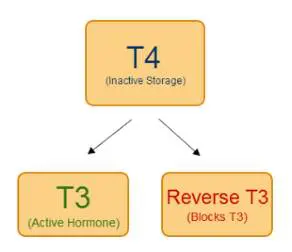
This conversion process is incredibly important to the body because it allows fine-tuning of thyroid hormone function throughout all of your cells.
And this is something you definitely want to happen, at least when it’s working correctly.
When it isn’t working correctly, the conversion process can slide down the wrong path which leaves you with the wrong types of thyroid hormone metabolites, namely reverse T3.
Unlike T4, T3, T2, and T1, which all have pro-thyroid effects, reverse T3 can be thought of as an anti-thyroid metabolite.
While T4, T3, T2, and T1 promote thyroid function, reverse T3 antagonizes thyroid function at the cellular level.
For people without thyroid disease, this conversion process works perfectly.
But if you have thyroid disease, especially for those taking thyroid medications, you can inadvertently alter this conversion process and lead to the creation of anti-thyroid metabolites which can act to make your thyroid function less efficiently.
Easy so far, right?
Why Does Your Body Even Have Reverse T3?
That’s a great question and answering it will help you understand why, in certain situations, your body creates it.
The fact is we aren’t 100% sure why reverse T3 exists in the body but we can make some general assumptions about why it exists.
The prevailing thought, and one that I am in agreement with, is that reverse T3 is meant to act as a brake on your metabolism (2) during times of extreme stress.
Let’s look at chronic illness as an example:
When your body is recovering from an illness (like pneumonia or a bloodstream infection) does it make sense for your body to increase its metabolism and provide energy to your muscles?
Of course not!
It makes far more sense to conserve your energy and metabolism by slowing down energy production and providing energy to vital organs and your immune system to take care of the immediate threat.
This is a protective mechanism designed by the body to ensure that it can weather illnesses.
What may surprise you is that it has a name and is well-documented in medicine.
It’s known as euthyroid sick syndrome.
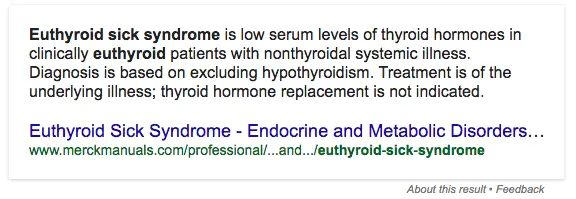
Patients who are under stress develop this condition by altering thyroid hormone metabolism through the conversion process I mentioned above.
Stress results in a typical change in thyroid lab tests manifested as low free T3, high reverse T3, and normal T4 and TSH levels.
I want you to take another glance at those lab tests mentioned above and even compare them to your results.
Do you see any similarities between your lab tests and the lab pattern typically seen in euthyroid sick syndrome?
If you are like many thyroid patients reading this then there’s a good chance you do.
But how can this be? Wouldn’t your doctor notice it?
You would think so but that isn’t the case!
Even though every doctor should have learned about euthyroid sick syndrome in medical school they believe that it’s a condition that only exists in extremely sick patients seen in the hospital or ICU.
Unfortunately, we are seeing more and more patients with multiple chronic medical conditions present with the same thyroid lab tests as those who are hospitalized which leads me to one important conclusion:
Maybe doctors are missing something about our current lifestyle, the increasing rates of illness and chronic medical conditions, and the impact that these have on reverse T3 and thyroid lab tests.
There are studies like this one (3) which can shed light on this very issue.
They show that other situations aside from being hospitalized can lower free T3 levels, increase reverse T3 levels, and cause changes in thyroid function that resemble “sick euthyroid syndrome“.
And it’s small things like this that may explain why so many thyroid patients walk around with hypothyroid symptoms despite being told they are “normal”.
Are You Pooling Reverse T3? High Reverse T3 Explained
Now that you better understand why you want reverse T3 levels to be as low as possible the next thing you need to understand is what causes them to be elevated.
Before we jump into the causes, though, let’s briefly go through some of the symptoms associated with an elevated reverse T3.
As you might suspect, the higher your reverse T3 the more hypothyroid you will feel.
Patients with high levels of reverse T3 tend to have one or more of the following symptoms:
- Decreased metabolism
- Lower than normal body temperature
- Cold intolerance
- Weight gain without changing eating habits
- Fatigue or low-energy
- Pain in the joints, muscles, or tendons
- Depression, anxiety, or bipolar disorder
- Other symptoms of hypothyroidism
These are the most common symptoms but realize that each person will present in a different way from the next.
For instance, I’ve seen people with high levels of reverse T3 present with a complete inability to lose weight and with severe depression without manifesting the other symptoms mentioned.
Others may experience issues primarily with their body temperature and even others still may have a mix of all of those symptoms.
There’s obviously a significant overlap between the symptoms I mentioned above and other medical conditions which is why reverse T3 testing is very important (we will discuss this topic soon).
But first:
What causes elevated reverse T3 levels, and what should you look out for?
- Calorie-restricted dieting – Especially HCG-based diets or VLCD (very low-calorie diets). These diets (4) have been shown to reduce metabolism and increase reverse T3.
- Chronic illness and infections – This includes viral infections like infectious mononucleosis (5), bacterial overgrowth syndromes like SIBO, and even chronic illnesses like cancer, cardiac/heart disease, arthritis, diabetes, and even obesity.
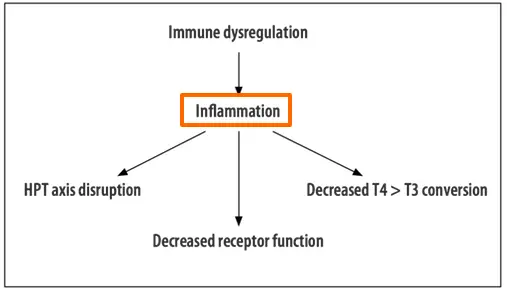
- Chronic Inflammation – Any cause of inflammation can result in decreased T4 to T3 conversion (6) and higher levels of reverse T3.
- Chronic untreated Gut infections – Up to 20% of T4 (7) is converted to T3 in the gut, which means if you have gut issues you may be missing out on up to 1/5th of your conversion power. Gut imbalances that thyroid patients deal with include SIBO, dysbiosis, reflux/GERD, yeast overgrowth, history of chronic antibiotic use, and inflammatory bowel disease.
- Emotional and physiological stressors (8) – This includes social issues like the death of a loved one, family problems, divorce, etc. It also includes psychological (PTSD) and physical trauma (motor vehicle accidents, TBI, or otherwise) (8).
- Some Prescription Medications – The most common medications causing elevated reverse T3 include blood pressure medications, diabetic medications, anti-seizure medications, narcotics, and antidepressants. A common example is the use of beta blockers which can be used to treat the symptoms of hyperthyroidism (9) in addition to elevated blood pressure (10).
What You Need to Know About Reverse T3 Testing
Reverse T3 testing is actually pretty straightforward.
There is a serum marker for reverse T3 that most standard lab companies can run.
What isn’t always straightforward is interpreting your results, but even that is not as difficult as it may sound.
Before we talk about interpreting your results, it’s important to understand how reverse T3 testing fits into a complete thyroid lab panel.
There are no fewer than 4 standard lab tests that need to be run to adequately assess thyroid function and each of these lab tests provides you with different information.
You never want to just order one lab test without the others because you won’t get the information you are looking for.
This applies to reverse T3 just as much as it applies to TSH testing.
This means if you are planning to really understand your thyroid, you will need to get the following thyroid lab tests: TSH, free T3, free T4, reverse T3, and thyroid antibody levels.
Obtaining these other lab tests will help you put your reverse T3 level into context, especially when combined with your symptoms.
One of the most powerful use cases for reverse T3 is in catching early thyroid disease.
Take a look at this image to see what I mean:
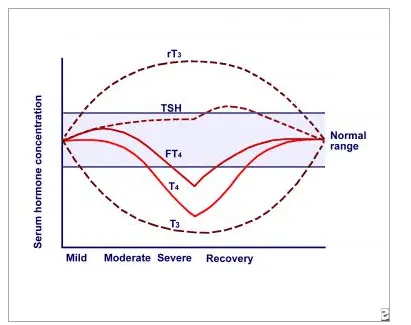
This image demonstrates the severity of the disease state on the X-axis and the concentration of thyroid hormones on the Y-axis.
Basically, it shows what happens to thyroid lab tests and when they become abnormal in relation to the severity of your disease.
What should stand out to you is the fact that reverse T3 (abbreviated as rT3) and T3 (abbreviated as T3) are the earliest markers of thyroid dysfunction.
They become abnormal much sooner than the other thyroid lab tests which makes these lab tests sensitive for diagnosing early thyroid problems.
What’s more, is that the difference between these two lab tests is more dramatic and pronounced than any other thyroid lab test.
For this reason, these two lab tests are critical in evaluating thyroid function.
You can determine the spread between these two values with a simple calculation which will give you the ratio of reverse T3 to free T3.
This ratio is called the free T3:reverse T3 ratio and is something that every thyroid patient should calculate using their own thyroid lab tests.
In an ideal world, you want your free T3 levels to be as high as possible (generally upper 1/2 to 1/3 of the “normal” reference range) and you want your reverse T3 levels to be as low as possible.
To calculate your free T3: reverse T3 ratio simply divide the numbers.
Your ratio should be > 0.20.
Any ratio < 0.20 indicates too much reverse T3 to free T3 and means that you should focus on either increasing your free T3 or reducing your reverse T3.
In order for this calculation to work, your units must be the same.
The units used in the United States for free T3 are pg/mL and the units used for reverse T3 are ng/dL.


Using the example above, if you divide 2.8 by 14.4 you are given a value of 0.19 which is less than that <0.20 level mentioned above.
If your free T3 and reverse T3 lab tests are not in these units, you can easily convert them and then make the calculation with some simple tools available online.
If you want a down-and-dirty way to assess your reverse T3 then you can also just look at the absolute value.
In most patients, a reverse T3 level of less than 15 ng/dL is ideal.
Values higher than this tend to start causing problems, especially if associated with a low free T3.
How to “Flush” Out Or Lower Reverse T3 Levels
So you’ve found out that your reverse T3 level is elevated, what now?
Your next step should be to try and drive that level as low as possible.
This is sometimes referred to as lowering reverse T3, treating reverse T3 pooling, or flushing reverse T3 out of your system.
These are all different names used to describe the treatment of high reverse T3.
What I want you to be aware of is that treatment should focus on
What you need to be aware of is that the treatment will focus primarily on the underlying cause (11).
Because of this, there really isn’t a one-size-fits-all treatment program that I can recommend.
I can and will give you recommendations for common causes, but you will still need to tailor that to your specific situation.
With this in mind, let’s talk about 5 different ways that you can lower reverse T3:
#1. T3 Containing Thyroid Medications
The fastest and easiest way to get rid of excess reverse T3 is with bioidentical hormone formulations that contain pure T3 thyroid hormone.
This would include medications like liothyronine, Cytomel, or sustained-release T3.
The reason this approach works so well is that when you give your body T3 hormone directly it automatically suppresses T4, which reduces the substrate that your body uses to create reverse T3.

In essence, you’re starving out the ‘food’ source your body uses to make reverse T3.
Naturally what will happen with T3 medication use is that your T4 levels will decrease, your free T3 levels will increase, and your TSH will decrease.
While on T3 thyroid medication it’s important to monitor reverse T3 closely, at least once every 6 to 8 weeks.
Typically within 2 months (and assuming your dose of T3 is high enough), your reverse T3 should drop to less than 10.0.
This is definitely the fastest way to reverse T3, but it doesn’t take into account the underlying cause.
So if you use T3 to reduce your reverse T3 without making any other changes, it’s likely that your reverse T3 will just jump back up once you stop taking T3 medication.
Is NDT Helpful for Reducing Reverse T3?
It certainly can help but there are a few things to realize if you want to use this class of medications to treat reverse T3:
- Each grain of NDT has about 38 mcg of T4 and 9 mcg of T3, which means that NDT still primarily consists of T4.
- In order to flush out the reverse T3, you must lower the substrate of T4 which generally means lowering your total dose of T4. In some cases, you may have to drop your NDT dose in favor of pure T3 medications.
- NDT dosing is static meaning you can’t individually alter the concentration of T4 and T3 unless you add additional thyroid medications.
You can still treat elevated reverse T3 with the use of Natural Desiccated Thyroid, but it’s generally not considered the best option.
#2. Supplements Can Enhance T4 to T3 Conversion
In addition to medications, every thyroid patient should also consider utilizing nutritional supplements.
The reason is simple:
The hypothyroid state sets the body up for certain nutrient deficiencies and since most thyroid patients are under-treated, most also have these deficiencies.
This is for 2 main reasons:
The first is that low thyroid states lead to low stomach acid which leads to decreased absorption of nutrients across the board.
The second is that low thyroid states also increase your risk of developing gastrointestinal imbalances which may further impair the absorption of minerals and nutrients.
You can check out this post here for more info about which supplements you should consider using and how to check to see what your body needs.
If you are trying to support the conversion of T4 to T3 with the use of supplements then there are a few you should pay special attention to.
The two primary supplements that you should focus on are zinc and selenium. Both of these supplements have been shown in some clinical studies (12) to increase T4 to T3 conversion, thereby potentially decreasing reverse T3.
In addition to zinc and selenium, I’ve also seen great success with guggulsterone or guggul extract.
We aren’t as concerned about supplements that promote thyroid hormone production (such as iodine and L-tyrosine), but they can still be helpful in some cases.
In addition to these supplements, you can also check out some natural therapies that have some good data behind their use as effective tools for naturally improving T3 levels and reducing reverse T3 levels.
#3. Reversing Hormones that promote T4 to Reverse T3 Conversion
As you are probably aware your hormones all work in tandem with one another.
This means that as one system slows down it may drag down other systems or cause an increase in other hormones to make up for the deficit.
This relationship holds true for thyroid hormones and their impact on leptin and insulin levels.
The link between these hormones is clear:
This is very important because hypothyroidism leads to a state where developing both insulin and leptin resistance becomes much easier.
Why do we care?
Because insulin and leptin resistance both cause inflammatory states which contribute to T4 to reverse T3 conversion.
Not only do they contribute to high reverse T3 levels but they also make weight loss very difficult.
Patients with high reverse T3 levels almost always have high fasting insulin and high fasting leptin levels.
In fact, I don’t think I have ever seen a patient with a reverse T3 greater than 25 with a normal insulin or leptin level.

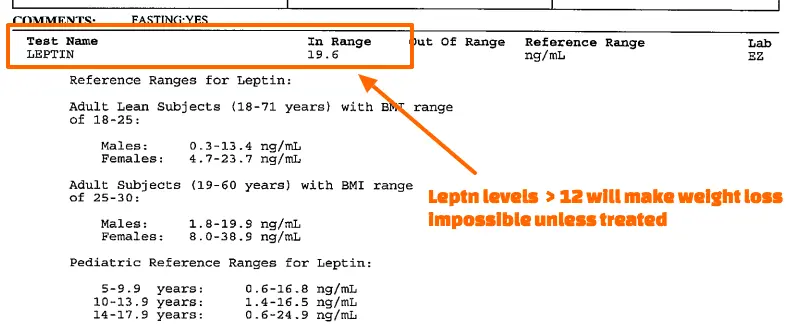

You can see examples from several patients above showing abnormal reverse T3 levels, high fasting leptin, and high fasting insulin levels.
These values may fall within the “normal” range but they are far from normal and will lead to symptoms of hypothyroidism, weight gain, and weight loss resistance.
Another big reason I want to talk about these hormone imbalances is that doctors don’t frequently run tests to check for either of them.
Doctors will routinely check hemoglobin A1c but rarely order fasting insulin and fasting leptin levels.
This means that if you have known thyroid conversion problems, it’s probably going to be up to you to request these additional hormone tests.
Treating and reversing both insulin and leptin resistance is very important for not only lowering reverse T3 but maintaining low levels over time.
To learn more about how to address these hormone imbalances please see the following case studies below:
- Victoza weight loss: 40 pounds lost with Victoza + LDN
- Byetta weight loss: 42 pounds lost over 3 months
- Hashimoto’s weight loss: 55+ pounds lost over 9 months with before/after pictures
These case studies provide a step-by-step walkthrough of how to approach leptin and insulin resistance including which medications, hormones, and supplements are most effective.
If you know you have insulin resistance then you can consider using these supplements to help lower your levels:
- Berberine: Helps reduce cholesterol, improve fasting glucose, and may help with weight loss.
- Alpha Lipoic acid: Helps sensitize the body to insulin and may help to reduce nerve damage in certain patients
- Chromium: Helps improve insulin sensitivity to cells and may help reduce cardiovascular disease in certain patients.
If you prefer the natural approach to treating leptin levels you can find more information here.
#4. Addressing Inflammatory Levels and “Cooling Off” Your Body
Everyone knows inflammation is bad for the body (15), but very few people understand how it makes things worse and, more importantly, how to address it.
Part of the reason for this is that the markers we use for inflammation are non-specific.
That means most of the time we know inflammation is present, we just don’t necessarily know what’s causing it.
Sure, in the presence of other abnormalities we might be able to take a guess, but we will rarely ever know with 100% certainty.
And this is a problem because inflammation is a known contributor to thyroid conversion problems.
We know that inflammation directly promotes the production of reverse T3 (16) by pushing your body down the T4 to reverse T3 conversion pathway.
So if you have high reverse T3 levels you need to be actively searching for sources of inflammation and treating the underlying cause.
You can easily test for inflammation by ordering these lab tests:
- CRP: You want this to be as low as possible but definitely < 1.0 for optimal thyroid function.
- ESR: Another non-specific marker of inflammation (17), for optimal thyroid function this should be < 10.
- Ferritin: Both a marker for iron stores and an acute phase reactant (18), this marker can be used in certain instances to help isolate non-specific inflammation in the body.
If you know that you have both high levels of inflammation and high levels of reverse T3 then you can safely assume that the inflammation is likely worsening your thyroid function.
The next step is to find where it’s coming from.
In hypothyroid patients it’s usually in these three places:
- Hormone imbalances (especially insulin and leptin resistance)- Please refer to the section above to understand how to both diagnose and treat these conditions.
- Undiagnosed gut imbalances like SIBO and SIFO – Both of these gut issues promote inflammation (19) in the GI tract and lead to increased intestinal permeability. You can find more about both here.
- Undiagnosed food sensitivities – These sensitivities promote inflammation (20) and further food sensitivities unless treated.
Bottom line?
If you have both high reverse T3 and elevated serum markers for inflammation you should be looking at the 3 main causes above and treating those if applicable.
If you don’t know where the inflammation is coming from you can still do some good by taking supplements designed to help reduce inflammatory levels and promote the “clean up” of breakdown products in the liver:
- Milk thistle + MSM: Designed to help improve liver function and promote proper phase 1 and phase 2 elimination of medications, supplements, and other products that need elimination in the liver. This combination may also help reduce AST and ALT levels (21)(if you have fatty liver).
- Omega 3 Fatty Acids: Omega 3 fatty acids can help reduce inflammation by reducing inflammatory cytokines.
- Curcumin: This well-studied herb activates PPAR-gamma levels (22) helping to reduce inflammation in the body.
- Quercetin & Bromelain: Particularly helpful in patients with digestive issues and those with chronic sinus/upper respiratory illness-like symptoms (post nasal drip and chronic stuffy nose).
This approach isn’t ideal but it’s better than simply ignoring it.
#5. Lifestyle changes to Balance Hormones and Promote Thyroid Function
Never underestimate the power of these 4 major areas when it comes to improving your thyroid:
- Getting 7-8 hours of quality sleep per night
- Reducing and managing your stress
- Daily low-intensity exercise and episodes of high-intensity exercise 1-3x per week
- A well-balanced diet full of real, whole foods
If you don’t practice these 4 basic things it doesn’t matter what you do, you won’t get better.
These are particularly important for those with high reverse T3 levels.
Remember that your body is a network of systems and hormones that all interact with one another.
When one system isn’t working properly, it will bring other systems down.
These areas are so important that many thyroid patients can see significant improvement in their thyroid symptoms by optimizing them without the need for additional treatments or medications.
The only problem is that most thyroid patients take them for granted and would prefer to take a supplement and call it a day.
Don’t fall into this trap!
Take that supplement if you want, but make sure you are also paying attention to your diet, exercise routine, sleep schedule, and stress levels.
Final Thoughts
Elevated reverse T3 is a serious issue for many thyroid patients and it’s a problem that is often ignored by many conventional doctors and endocrinologists.
The best way to evaluate your reverse T3 is by testing for it along with free T3 and free T4 levels.
To get a better idea of how reverse T3 is impacting your body, you can measure your free T3:reverse T3 ratio.
If your free T3/reverse T3 ratio is < 0.2 you have too much reverse T3 in your body.
The fastest most effective method for optimizing reverse T3 is with the use of pure T3 thyroid medication.
Now I want to hear from you:
Is this the first time you’ve heard about reverse T3?
Have you had your levels checked? If so, was it high or low?
What type of treatments have you tried to lower your reverse T3?
Have you tried medications that contain T3 like Cytomel or liothyronine? Did they work for you?
Leave your questions or comments below!
Scientific References
#1. https://www.ncbi.nlm.nih.gov/pubmed/3428867
#2. https://www.ncbi.nlm.nih.gov/pubmed/7355063
#3. http://www.ncbi.nlm.nih.gov/pubmed/12055988
#4. http://www.ncbi.nlm.nih.gov/pubmed/12055988
#5. https://www.nlm.nih.gov/medlineplus/infectiousmononucleosis.html
#6. http://www.ncbi.nlm.nih.gov/pubmed/11716958
#7. http://www.ncbi.nlm.nih.gov/pubmed/3049061
#8. http://www.ncbi.nlm.nih.gov/books/NBK28/
#9. http://www.ncbi.nlm.nih.gov/pmc/articles/PMC3475282/
#10. https://www.ncbi.nlm.nih.gov/pmc/articles/PMC5369873/
#11. http://www.ncbi.nlm.nih.gov/pubmed/16399020
#12. https://www.ncbi.nlm.nih.gov/pubmed/8157857
#13. https://www.ncbi.nlm.nih.gov/pmc/articles/PMC3608008/
#14. https://www.ncbi.nlm.nih.gov/pmc/articles/PMC3356957/
#15. https://www.ncbi.nlm.nih.gov/pmc/articles/PMC3492709/
#16. https://www.ncbi.nlm.nih.gov/pmc/articles/PMC3978663/
#17. https://www.ncbi.nlm.nih.gov/pmc/articles/PMC4653962/
#18. https://www.ncbi.nlm.nih.gov/pubmed/24549403
#19. https://www.ncbi.nlm.nih.gov/pmc/articles/PMC3099351/
#20. https://www.ncbi.nlm.nih.gov/pmc/articles/PMC1774228/
#21. https://www.ncbi.nlm.nih.gov/pubmed/17548789
#22. https://www.ncbi.nlm.nih.gov/pmc/articles/PMC2234255/



Hey Dr. Childs,
I have been very passionate about functional medicine for the last 3 years and have altered my life to this lifestyle and never will change. However, despite eating gluten/dairy/soy/nightshade/egg free, taking targeted supplements, reading countless blogs and following medical functional docs (Hyman, Mercola, Axe, etc) seeing a “hormone specialist ND” , FDNs, DOs, etc, taking NDT, doing body weight training etc….I am only getting worse.
I recently was pushed too high on my Wp Thyroid with cytomel, and became hyperthyroid. Doc took me off and said my RT3 was too high and removed everything for 14 days to clear it out to start on a Wilsons type approach with ST3 medication. My temps are all over the place, sometimes 96.9, sometimes 99.0, etc. I haven’t been able to lose a SINGLE lb in 2 FULL years despite all my efforts. I have bad edema, acne, bloating, low progesterone etc. I have supplemented with progesterone bioidentically before and blew up in weight so immediately stopped. Everything has been all over the map and I just need help. I did a GI screen and showed no overgrowth as well as doing a lactose breath test and showed no SIBO. I also did a 4 point saliva cortisol and it showered normal/normal/moderately high/normal. So just a little elevation in the evening. I am so depressed on where I am at and don’t recognize myself in the mirror. I believe in eastern medicine and all of this lifestyle but it has yet to work at all for me.
I am hopeful that this T3 titration will work somewhat, however it’s day 3 and I just feel terrible and even more swollen/bloated and like I’m gaining more weight.
I am 145 at 5’4″ and just a swollen mess.
I have been told my testosterone isn’t high enough for PCOS , and I eat so clean that insulin doesn’t seem to be an issue (a1c was a 5.5). I just don’t know where to turn.
Iodine made me break out rapidly, progesterone made me gain so much weight, naturthroid and WP did nothing for the 2 years I was on NDT. I AM LOST and need help. Any advice for someone who has tried everything??
HI Tina… we must be twins. I am 53 years old, 5’4″, went from being 125 10 years ago to 143lbs and increasing. I work out doing interval weight training and cardio 3-5 week for an hour, eat clean, have seen holistic/alternative med docs for 15 years. My first one diagnosed me correctly with hypothyroid despite my conventional doc saying my symptoms were “normal” and as were my test results.
I was on Armour Thyroid for past 8 years with improvement in fatique but not weight gain. Slowly added a few pounds per year. Past two years I gained 10-15 lbs without change in clean diet or exercise. I too need help and a functioning doc who specializes in thyroid. I heard Armour reformulated in 2009 and 2015. Curious if that has anything to do with my rapid increase in weight.
After spending days reading and listening to every word in this blog, things are starting to come together.
WIll do testing for Leptin Resistin, retest my thyroid T3 and T4 all levels as well as other areas suggested. Thinking at first glance, the more Armour thyroid my doc prescribes, the worse I get leading me to believe I am not converting to T3 but rather reverse T3.
I too am lost and need help. Need to find a doc to help me.
Wonderful article! Lots of good information! I found your article when trying to find out if turmeric can help lower rt3. I recently found I have excess rt3. I’ve been following the STTM (stop the thyroid madness) and it has been extremely helpful in my hypo journey. From the information in the books, on the site, and their groups, I requested to lower my NDT and add in T3 to help get my rt3 go down. My labs showed inflammation from my 4 iron labs. But I also suspect adrenals issues, also very common among us hypo patients. According to STTM, adrenal issues like low cortisol or mix of high and low cortisol can cause inflammation but also includes things like gut, autoimmune, hypothyroidism itself, heavy metal toxicity, lyme, just to name a few. Like you, they suggest using selenium (if labs show low), milk thistle but advise that milk thistle can lower iron in some, treating inflammation, and adding using T3. They also suggest treating adrenals and low iron issues. I wish more docs had your knowledge in treating hypothyroidism. But thankful for information in your article and from STTM sites, books, and FB groups.
Hey Melanie,
I’m glad you’ve found it helpful!
Thank you so much for taking the time to explain everything in so much detail! I’ve read through many of your articles, and am now at the edge of deciding whether I should take WP thyroid or just Liothyronine.
My TSH level has been on the higher side ranging from 3.5-4.3 on different days.
T4 Thyroxine is normal at around 7.9 ug/dl and Free Thyroxine at 1.2 ng/dl.
Free T3= 3 and Reverse T3= 16.7 so the ratio is 0.179 (less than your cut off at >2.0).
Since my T4 is normal, I’m wondering if taking NDT might contribute more to the problem to because my body may convert the extra T4 from NDT to reverse T3 instead of free T3.
Also, I remember you mentioned the SHBG level is an indicator of hypothyroidism at a cellular level. Is 61.0 nmlk/L normal.?
Lastly, is there any link between hypothyroidism and PCOS? Will thyroid medication affect testosterone/estrogen levels? Can NDT help lower testosterone? I’m looking for a good solution to hit 2 birds with one stone targeting hypothyroidism & PCOS high testosterone levels. Any good advice? You are the best! I wish every doctor was like you!
Hi Janelle,
Yes there is a link between PCOS and hypothyroidism.
I have been on synthorid and cytomel for a while. In January of 2016 I started to gain weight and feel awful. I tried many different things increased cytomel, added supplements. In July, I stopped everything but synthroid. Then in September changed to natureroid. I have changed my diet and have had no success in how I feel and my symptoms are getting worse, especially with the weight gain. Any suggestions?
Hey Cicilia,
The best thing you can do is find someone willing to help you figure things out. I find that most patients who try to deal with their symptoms on their own end up frustrated and either over/under treated. These type of symptoms are quite common and fixing them usually isn’t too difficult if you understand what you are doing.
Dear Dr. Childs
I am a 56 year old women. I have had hypothyroid about 7 years. I have been taking NP Thyroid 90 every morning. My TSH Sens is 0.02, my Free T4 is .69 and my Free T3 is 3.0. My leptin is 9. My thyroid Ab group is thyroperoxidase Ab, S- 1.4 and thyroglobulan antibody s – <1.8.I keep gaining weight and feel tired all the time. Any suggestions on what I should do? Thank you Linda
Hey Linda,
I would start with the suggestions in this article but realize they are only a starting point. Treating metabolic damage like you have is difficult and requires help from someone who understands what they are doing.
Scratching my head over my higher reverse t3 numbers! My t3 is 2.2 pg/mL and my reverse t3 is 23 ng/dL. Well that puts my ratio at 9.6, ack! I also have awesome insulin and leptin levels, and follow the AIP diet. My fasting insulin was 1.7 and my leptin was 5.9. I started taking zinc and selenium and hoping that helps my body convert t4 to the right pathway! And will be pouring over your website to try and gain more understanding, thanks for all you do!
Hey Rachel,
It’s only really a problem if you are symptomatic. If you feel fine then I wouldn’t worry about it.
I am currently on 150mcg cytomel a day split into 3 doses around 5hrs apart. I have had no reliefe from my hypothyroid symptoms. Main thing is about 15-18lbs of water retention and weight gain,dry skin, acne and no libido ect. I am more temp tolerant, and my hair breaks less. That is it. I have been on this dose for about 1 week. I also want to know if you accept distance patients?
Hey Bonnie,
That’s a good dose of cytomel so I would be surprised if you didn’t have any improvement with it. Also, water retention could be from many causes including other hormone imbalances. And I’m not currently accepting patients right now.
Hi Dr. Westin Childs,
Where are you practicing right now?
Thanks!!
Hey Mark,
I’m physically located in Arizona but not currently accepting new patients.
I’ve been advised that a low T3:Reverse-T3 ratio contributes to coronary artery calcification, which I have been trying to control for the past five years. I’m advise to get T3 between 4-6 and T3:RT3 above 20. As briefly as possible, my T3 was in this range a few years ago before I learned its importance. I was taking 25 mg of iodine and my doctor thought that inadvisable, so I cut back and forgot about it. When I found out about the heart disease connection, I started trying to increase my now low T3 (2.4) by taking iodine. This time there was no improvement in about six months. So I found a doctor who would prescribe thyroid medication. I started with 15 mcg Liothyroinine and still saw no improvement. In fact my reverse T3 increased dramatically from 15.4 ng/dl to 26.4 ng/dL. My T3:RT3 went from 15 to 9. Three weeks ago the doctor increased my dosage to 25 mcg per day. I will re-test in a couple of weeks. My TSH has been between 5-7 with the iodine supplementation. Any thoughts about what is going on? Why did the iodine work so well two years ago but have no effect in the past six months? What might be causing the dramatic increase in reverse T3?
Hey Mike,
While yes that ratio does contribute to coronary artery disease and calcifications there are other conditions which seem to contribute more (such as insulin resistance and abnormal blood glucose homeostasis). I would also caution against focusing solely on lab values as a marker of success without changes in imaging (are the calcifications worsening?) or without changes in your clinical symptoms.
Also, taking T3 thyroid hormone by itself should lead to a drop in T4 due to a lack of substrate, so if your reverse T3 levels are increasing then your T3 dose is not likely high enough to cause pituitary suppression which means your body is still producing T4. You can simply drop the T4 by increasing the dose of T3, but more important than that would be to focus on the cause of reverse T3 in the first place. You will want to look at inflammatory markers, insulin, leptin and other hormones to find out what is causing the high reverse T3 levels.
Thanks, Dr. Childs, and happy new year.
As I mentioned, I’ve been working on the coronary calcium for five years. The past year I made some progress, an increase of only 26 points, against what had been yearly increase of 100 points or more. I think the major change was getting a root canal tooth removed after reading Dr. Thomas Levy on that issue. My most recent score was 695, still high risk.
I do a lot of reading, and I’m taking a raft of supplements, including vitamins C, K2, E, D3, CoQ10, zinc, selenium, niacin to reduce Lp(a). You get the idea. My CRP has always been fine. PL-PLA2 sometimes a bit high.
I have not tested for thyroid antibodies, but my wife and I eat low carb, non-gluten diet. I exercise vigorously and have no serious hypothyroid symptoms, only cold hands and low pulse rate, which could be because I’ve exercised strenuously for fifty years. I don’t have heart disease symptoms either, but I gather when the symptoms appear, things are well advanced.
One addendum: I have had one symptom of heart disease: atrial fibrillation, which was an issue before I started taking about a gram of magnesium per day.
I was hoping maybe you could steer me in the right direction! I’m 32 and have been to multiple doctors (some Holistic) and no one has been able to help me! My guess is that I’m having both adrenal and thyroid issues. I have had most of these symptoms for over 5 years but I got a lot worse after I went through a very stressful event a few months ago (Didn’t sleep or eat much for over a mth)
Test results show:
No hashimotos
ANA direct = negative
Thyroid peroxidase TPO = 10 (0-34)
THyroglobulin antibody <1.0
Aldosterone 19.3 (0-30)
ACTH 49.6 (7.2-63)
TSH 2.60
T3 2.9 (2.3-4.2)
T4 1.0 (0.8-1.8)
Reverse T3 = 15
All lipids are within good range
Glucose serum 94 (65-99)
Sex Hormone Binding Glob is always high and has been for years 215 (24.6-122)
Free testosterone 0.5 0.0-4.2
Prolactin stays on the high side 23.4 4.8-23.3
Estradiol 193.39
Ferritin and iron is low
Iodine 40.9 (40-92)
Dhea has been low the past couple of years.
DHEA sulfate 47.4 (84.8-378)
Dehydoepiandrosterone = 475
Saliva test for adrenals shows normal levels throughout the day but high during the evening hours around 5 pm
Symptoms: Hair loss (has got a lot worse over the past few months), fatigue, Brain fog, Joint pain that comes and goes in hands, I wake up with a locked jaw that gets better as I wake up, Melasma over entire face, Gains wt easily but has kept my weight down due to diet and exercise. My body can’t handle any kind of stress or even excitement ( My body over reacts to everything that seems to get my adrenaline pumping and it takes a while for my body to calm down such as a rapid heart beat ). I have been dairy and gluten free for years. I try not to eat any soy and try to only eat sweets once or twice a week at the most.
I am extremely sensitive to most vitamins, caffeine, and all medications. I am also sensitive to chemicals (Clorox and other cleaning agents cause me to have headaches and I get very dizzy).
I currently take vitamin C, B complex, Vitamin D, and probiotics. I try to take magnesium but it tends to make me feel jittery. I drink 1/2 teaspoon of sea salt in water every morning for adrenal support.
I tried armour thyroid for only 3 days but it made me extremely fatigued to where I didn’t’ want to get out of bed . After trying armour my TSH shot up to 7 (was 2) but I can’t recall what my Reverse T3 was at the time. I am scared of trying any other thyroid meds due to that it took my body over a month to recover from the armour. My recent doctor prescribed me Slow release T3 compounded. Do you believe this would help or be a good idea to try? I also recently started taking kelp to increase my iodine levels. What are your thoughts on ways to increase iodine or if this sounds like a good idea considering my labs? Any help would be greatly appreciated! I’m scared to try any medications in fear of losing more hair (very thin now) and worsening my symptoms so I would love to hear what you think!
Hey Len,
Not everyone does well on NDT, and most people that transfer over do so at low dosages or never get to the therapeutic dosage range for their body. This leads to people wrongly believing they don’t do well on certain medications.
You will need a full evaluation including other hormones to determine what your body would do best on. The best thing you can do is try to find someone local to help you out.
First, thank you for your website. It has been so valuable since having a total thyroidectomy in April. I have had trouble getting regulated on NDT. I have been systematically getting all the various labs done that you have recommended. I am addressing all of my “low” values (iron, ferritin, testosterone, adrenals), but my question revolves around Leptin. Within the last six weeks my FBS was flagged as high, as well as my A1C as compared to six weeks earlier. My fasting insulin has doubled and my Leptin is 30. I purchased a meter and having been checking myself several times a day. I feel like I need to address the leptin/insulin issue. What would you recommend, or how can I communicate this to my doctor. Though I follow a Paleo/AIP protocol and exercise with weight training 3x week, weight will not budge. I was also told in April that I have Hashimotos.
Hey Karla,
The sudden rise in your leptin/insulin is likely secondary to a reduction in your thyroid hormone post thyroidectomy. This happens to patients with just plain hypothyroidism but usually takes years to develop. The good news is that you know what is wrong, the difficult part will be obtaining treatment. General physicians aren’t taught to test or look for leptin resistance and there are few treatments available. On the other hand, general physicians don’t really know how to address fasting insulin levels that are elevated unless they are accompanied with an elevated Hgb A1c at which point they will recommend metformin or other diabetic medications. You are probably sitting in a position where you have high fasting insulin/leptin levels but relatively normaly hgb A1c levels which means most providers won’t be likely to treat you. The best thing you can do is find someone who evaluates hormones in a similar manner you see on this site.
I am about three months postpartum and was being treated for subclinical hypothyroidism during pregnancy with T4 only medication. My levels were great…FT4 about mid-range and FT3 upper range during pregnancy. However, during the postpartum period, my numbers have gone crazy. My FT4 is slightly below mid-range, my FT3 is waaaay ABOVE range, and my RT3 is at 16. I have been told I could be pooling. But my numbers don’t fit any scenarios you discussed above. We ran my labs multiple times to rule out lab error. I decreased my T4 meds and rechecked after a month. My FT4 had dropped, probably too low, my FT3 was still high, and RT3 still at 16. Ferritin levels and iron levels were good. Vitamin D was at 60. My doctor has no clue what to do and wants me to find another doctor that can help me figure this out.
I was feeling perfectly good at first, but now I’m starting to have more hypo symptoms once again…mostly just foggy, depression, tiredness, and not losing weight. I do have a three month old baby that still wakes in the night. What do you think could be going on???
Hey Jessica,
Unfortunately, I can’t give you specific medical advice because you aren’t my patient but a couple things to consider:
– Your lab tests don’t really matter if you are feeling well, meaning there is no need to change your dose based on your numbers below
– If you dropped your dose then became symptomatic, then I think you have your answer
– Postpartum hormones are always in flux, which is why I generally don’t recommend checking thyroid hormone (or other hormones) immediately after pregnancy
Hopefully this helps give you some guidance.
Hey there 🙂 Found you by accident surfing on the web about reverse T3 etc. I have had Hashimotos since I was 23. I have always been on T4 meds like Levoxyl and Levothyroxine and did okay with them. I started on Armour and then Nature Thyroid because of my TSH level. Found out through a board on Facebook that I should be checking TSH, T3Free, Reverse T3, Free T4. Thankfully my doctor is amazing and willing to help and listen. At the moment I am on 2.25 grains of Nature Thyroid and I have NEVER FELT MORE HORRIBLE. The worst muscle aches and pains and weakness that I have ever had even being on the T4 meds only. I am so discouraged because there is so much info and so many opinions.
My T3 Free numbers were a 2.7pg/ml (Out of the range of 2.0 – 4.4 pg/mL)
TSH 1.850 uIU/ml (Out of the range of 0.450 – 4.500 uIU/mL)
REVERSE T3 was 23.1 ng/dL (Out of the range of 9.2 – 24.1 ng/dL)
T4 Free was 0.86 ng/dL (Out of a range of 0.82 – 1.77 ng/dL)
I have had gallbladder surgery last year and it seems like a reactivated Epstein Barr numbers in my blood work.
My doctor wants to put me on Cytomel? Will this help me? I am so scared to add or take away anything to my body since I have had so much the past two years. My doctor is so willing to help but don’t know how well versed she is in thyroid issues…..HELP!!!!
Hey Cathy,
I can’t provide personalized medical advice via this forum since you are not a patient of mine. Your situation is not as complex as you might think, but you do need someone who understands thyroid function to help you further.
Dear Dr. Childs,
I see that you do prescribe bio-identical hormones. Do you find that compounded bio-identical progesterone has an effect on compounded Tri-iodo-L-Thyronine. I know that progesterone supports the thyroid, so when supplementing both, have you found that one affects the other in any significant way.
Sincerely,
Karen
Hey Karen,
I haven’t found progesterone to clinically impact thyroid levels, but I have found that thyroid hormone supplementation can impact progesterone/estrogen levels significantly.
Hi Doctor, Thank you very much for all the information you provide.
Do you know any fellow practitioner in Australia who follows a similar protocol as yours? My Free T3 is 2.7 (3.1 – 6.0) and Reverse T3 is 0.624 (1.200 – 2.200). I feel crushed. Also, I am Vitamin D and Iodine deficiency 🙁 …I am also a good doctor deficiency as well 🙁
Hey Martha,
Unfortunately I don’t know any other providers who practice like me, this is something that was self taught – so the only way that doctors may practice like this is if they spent the time researching on their own.
Thanks, Dr. Childs, for your reply.
If there is any chance that you can treat me, despite of the (very) long distance, please I kindly ask you to let me know. I feel horrible and I think that what makes me feel worse is being unsupported by a good physician.
Thank you very much
Martha
Hi Dr. Childs,
If you don’t know of any other providers who have a practice such as yours, and you are not accepting new patients, have you considered teaching and training seminars to educate doctors so we all may benefit from your knowledge? Thank you.
Yeah, it’s something I am looking into for the future but don’t have any concrete plans at this time.
Hello,
I can’t find the erase button on this board. Please erase my previous post.
My wife wants me to return to a previous doctor. And for legal reasons,
she wants this post removed.
thank you
John,
———————————
IE : ” hi Doctor Childs,
This is all quite interesting. I say this after being treated on T3 – for 30 years —…………………. etc “”
Please remove.
Hi Doc
I am a doctor myself and I must say your site is great. I have been having some symptoms my self for a few yrs. Persistently low DEHA-S levels, hair loss on my legs back pains etc..
Did my Thyroid panel: TSH 1.59mIU/l (normal for lab 0.4-4.5)
Free T4 1.0 ng/dl (Normal 0.8-1.8)
Free T3 2.2 ( low) (normal 2.3-4.2)
Reverse T3 22 ( normal 8-25)
Between 2011-2013 I was under tremendous stress with a legal issue, It took a toll on my system. I weigh 187 lbs age 48. Is a good idea to start on T3 alone..?? possibly cytomel/ liothyronine or 1 grain of westhroid ..
Regards Dr Uche
Hey Chris,
In this case it’s probably better for T3 only titration. I would also check both free and total testosterone and coritsol levels then treat both.
Hi there..
Thanks for the quick response… When you say treat both I assume you mean Supplement the DHEA or do you mean the T levels if indeed they are abnormal.. Do you have a contact number ? or practice number..?
Hi Dr Westin
I weigh 190lbs.. I started off on lowering mt Reverse T3 ( level was 22) with Cytomel 10mcg.. It there an optimal dose..? IS it best to titrate up to 15mcg or titrate depending on symptoms..? and what a good duration.? 6wks or just depending on levels and symptoms..
Hey Chris,
There is no optimal dose based on weight/age/sex/etc. instead it’s based on a combination of other factors including lab tests, symptoms, body temp, resting heart rate, etc.
I love your website – tons of great info. Thank you for the education! I am a Chernobyl survivor battling Hashimoto for the past 30 years after partial thyroidectomy. I am on 112 mcg T4, and 7.5 mcg T3. My latest numbers are TSH 0.045, FT3 2.7, Ft4 1.1, rT3 15.6. Antibodies 37-42.
I calculated my T3/rT3=0.173
B12 573, Vit D 75, Zn 80, Se 145, CRP 0.31, low cortisol, low testosterone, low DHEA, Ferritin 20, HGB 13.9
I think my T3 should be increased, but my Doc is afraid due to low TSH. I am a classic hypo with low energy, weight gain despite clean diet, hair loss, brain fog, irritability, cold intolerance, constipation, low libido, and so on. I am a full time medical professional, wife and a mother. I am so exhausted of being exhausted. Any advise would be greatly appreciated!!!
Do you think its safe for me to be on T3 only?
What can I do to increase Ferritin?
Thank you for your expertise!
Irina
Hey Irina,
You can check out this article for more help with your iron levels: https://www.restartmed.com/hypothyroidism-iron-deficiency/
Hi. My mom is 6 months post thyroidectomy with 5% remaining thyroid. She is taking 75 mcg of Levothyroxine but still has depression, anxiety, severe leg cramps, hair loss, weight gain and started having epigastric pain that is the same kind of pain when she had a duodenal ulcer. Physcian ordered omeprazole. She was goiing to the gym 4-5 days/week but now does not have the energy.
I am an RN, nutritionist and currently in ND school. I ordered a lab panel and results are as follows: Electolytes normal – checked due to leg cramps. TSH=1.120, RT3=24.6 (9.2-24.1), FT3=2.8 (2.0-4.4), FT4=1.83 (.82-1.77), T4=11.5 (4.5-12). I am coming up with 0.11 ratio and think she would benefit from an RT3 flush with a bioidentical T3. Would this been reasonable to you? It is very difficult to find physicians that know the information that you are sharing. Her endocrinologist says she is “normal” because her TSH is normal and does not do any other testing. Her suffering is leading me to websites such as yours, trying to find an answer. Any information that you can provide is appreciated.
Hi Shar,
Some patients post thyroidectomy do better with the addition of T3 thyroid hormone.
Yes hi I have high rt3 at 134. My Dino test came back positive and an being treated with antibiotic. I am t3 meds 3mcg x2 daily repeating blood word in two weeks. Was put on tons of supplements, and on cortef. After being on cordef for two week was haveinv horrible side effects so had to stop. Also on ldn. Still not feeling well, it’s a day to day right now. Any recommendations? I suck at handling stress, am a recovering bulimia-purge.
Low vit b, was anemic, low mag, nutrient deficiencies. Currently gained 8 lbs, eating greens, and superfoods, implemented exercise three times per week. Been treeatdd by current doctor since Jan.
Hey Charlene,
Patients who have had bulemia and/or anorexia like behavior in their life tend to react much slower to medication changes and tend to take a lot longer to feel better.
Roughly 5 years ago, (age 47) during an extremely stressful period of my life, I was prescribed levothyroxine for an elevated TSH of 4.7 (0.40-4). At the time, the only other level read was my FT4 = 1.22 (.80-1.8). I had felt many symptoms of hypothyroidism so was kind of excited for the treatment.
Two years later, with little change in my symptoms, and after my doctor quit his practice, I stopped taking the levothyroxine. The next year I found an endocrinologist who (for the next two years) ordered many tests and a whole lot of lab work, resulting in lots of head scratching and being told we will just monitor you for a while.
I am now 52, I still feel like crap and my weight of 185 at 5,8 makes me feel like a slug. Since stopping levothyroxine my FT4 levels have ranged between 2.98 – 4.48 (0.80 – 1.80) my FT3 readings have ranged between 9.2 down to my latest reading of 5.7 (2.30 – 4.20) and my DHEA, has ranged from 200 to 457 (15 – 170). No rT3 has EVER been ordered or suggested. I am currently in search of a new endocrinologist but was wondering if those numbers mean anything to you. So far none of my doctors can figure me out. Just looking for some direction.
Hey Cheryl,
Lab values by themselves mean very little if they aren’t paired with symptoms, body temp, resting heart rate, etc.
Oh yes, I get that! It’s just that, even with my doctors having all that vital info before them, they still can’t make heads or tails of my numbers. They would explain “if this number were high while this number was low, then it could be this or that, but your numbers aren’t like that”. They literally have nothing to offer (besides, wait and see) to help me understand my combinations. So I was only wondering if you have run across numbers like mine or if am I just the ‘lucky one’.
Thank you
Wait and see while the dog is gnawing off your leg. That’s a tough approach.
Hello Dr. Childs. I posted on Feb 22nd. I realize you are bombarded with questions, but am I on the right “thinking” track in regards to needing a RT3 flush with bioidentical T3 for my mom? Thanks for letting me pick your brain. Shar
Hey Shar, yes that would be a reasonable approach to start with.
Thank you so much!!!
No problem 🙂
I know that you have mentioned before you no longer take patients and you don’t have recommendations on doctors in other areas, but like many, I am desperate. I have been to so many docs, gone completely broke, begged and pleaded and am suffering miserably. I live in Seattle. I need someone who can help. I have tried all kinds of natural thyroid meds, T3, Wilson’s protocol, diet changes, supplements and I have gotten worse. I need help. I truly can’t live like this anymore.
If there is anything you can provide as far as recommendations I would be so incredibly grateful. Thank you!
Hey Tina,
I plan to email my mailing list when and if slots open up for new patients, but I don’t expect this to happen for a while (if it happens at all and I wouldn’t recommend you wait for that to happen if you are suffering). If possible you might be able to seek out someone local, but I don’t have any resources I can guide you towards.
Tina. I hope that I am not overstepping any bounds (including Dr. Childs :)) but I “hear” the desperation in your e-mail. My mom has expessed some of your same symptoms.
I have been to many A4M conferences and those who go through their training/internship programs seem to look for root causes of imbalances and incorporate additional complimentary treatment protocols. Although I do not know any of these practitioners nor do I know Dr. Childs or his professional opinion, you can check out this website: http://www.a4m.com/directory.html#directory_search_form for those who are A4M boarded and practice in Seattle.
Hi Tina
I feel your pain.. I am a physician and have Thyroid issues too.. what are your lab results.?? I may be able to give you some pointers
Wow. This was so kind. Thank you. I really appreciate the help. Means a lot
Hi – I just got back my lab results. I was on 3 grains of Armour Thyroid and my Dr said i should increase by half a grain, every time i went he asked me to increase, so i asked why he was doing this and he said he was just testing cos really i was normal. I told him i was not, it was 5 degrees outside and i was wearing a T shirt, i had serious heat intolerance and swelling, he then said, OMG since when, and i told him i had been saying this for the past 8 months, he then told me that if i had heat intolerance and swelling, then i had Thyrotoxicosis and that i should reduce the meds by half a grain. i didn’t do that, maybe i did wrong, but what i did was stop all my medication at once, i just continued to take my supplements. This was 2 months ago and now i’ve got my results as follows, l still have issues with weight, and fatigue and brain fog. I also have Hashimotos.
TSH 6.79 T4 Free – 6.5 T3 Free – 1.3 Reverse T3 <0,009
Thyroglobulin antibodies 103.00
Thyroperoxidase antibodies 345.5
I'm exhausted, and weight keeps coming on. My power naps are about 3 a day of minimum 30 minutes.
Hi, I am awaiting results for reverse T3, I was amazed to see your point about beta blockers, I have been taking propranalol for years for essential tremor.
I have been to the Dr so many times about issues of sleep disturbance, fatigue in the daytime, joint pain and muscle weakness.
All I ever hear is it’s your age, I am 55 years, and had a full hysterectomy at 37 years of age. I just want to know if it’s a result of beta blockers or no HRT, or something else. How long would it take to determine the true cause of my issues, if they are related to reverse T3. If I stop the beta blockers I wont be able to do my job, If proven to be raised levels of Reverse T3 is there a medication I could take that wouldn’t contradict the propranalol.
Thankfully
Catherine Burton
Hey Catherine,
Usually there are other factors that contribute more to reverse T3 levels than beta blockers.
Hi Dr. Childs,
What a great article. I really appreciate your straight forward approach and easy to understand writing style. I believe I’ve been suffering from T4 to T3 conversion issues for some time. I’ve had hypothyroid-like symptoms for over 5 years, but my labs have always been in normal range. I’ve been to 5 different doctors both in the conventional world and the alternative world – none of them have been overly concerned about my thyroid. After reading your article I pulled out all my old labs and did the math – in 2014 my T4:T3 ratio was 0.11, in Dec 2016 it’s 0.13. My hair is falling out, my skin is so dry it hurts, my eyebrows are practically nonexistent… the list goes on. However, I am underweight, not over – for now.
I have a pretty good understanding of what my underlying factors are – chronic stress, EBV and definitely some gut issues. I am also homozygous MTHFR which as I understand it, makes detoxing more difficult. I’d like to bring this to the attention of my primary care doctor and work collaboratively with him to create a plan. He’s open minded and is usually interested in my input. However, I feel like we have yet to really get to the root of the problem. Any advice on how to have that conversation or suggested starting points for a treatment plan would be appreciated.
Thanks for all you do and for making information like this accessible and understandable for people like me! You’re really making a difference!
Jessica
How would you treat a patient if their reverse t3 was exactly 15 and ratio above .20? Would you want this lower or is 15 the absolute cut-off?
Hey Denise,
Reverse T3 by itself is not very helpful, you need a more complete panel. Sometimes high reverse T3 is a normal compensatory reaction from high doses of T3.
I had to switch doctors. The new endocrinologist convinced me to switch to Levothyroxine from Armour Thryroid. I had been on Armour for 10 yrs. The doctor insisted it was a more stable medication, and that my blood tests were always fluctuating. It’s been a year on the Levothyroxine and I feel terrible. I have developed all kinds of muscle and tendon tenderness, tendonitis and muscle cramping. As well as weight gain. I am having a hard time convincing the Dr. to switch me back. Any thoughts on what I can say to convince them to switch me back?
It’s really terrible that as a patient I have to beg them to listen to me.
Hey Lise,
It’s generally not worth it to try and convince a doctor to treat you a certain way, your time is much better spent looking for someone who is more willing to listen to you.
Ahhh, gotcha and thank you Dr. Westin for the response. My ft3 was a tad above range, 4.4 with range limit of 4.2. Ft4 is still rather low at about 10% of range. I am on 150mg NP and 25 mcg cytomel. I am perplexed on which to cut, nurse practitioner said play around and find what makes me feel good. I feel if I cut 30mg of the NP, that should do the trick of getting that ft3 back down some.
I have had low thyroid for over 20 yrs. I took T4 meds for over 20 yrs. No one cared about constipation, dry skin, memory problems, intolerant to cold, very low body temp, ect. Two years ago I tried T3 meds and loved it. About one year ago I thought I needed new hormones, (E2 and Test) pellets under the skin. By the last round in November, I couldn’t lose the weight that these things put on me, I started producing Tsh again. No one knows why. Is it important? Who Knows. The doctor suggested Nature Thyroid meds, so I tried it. I had allergic reactions 3x. So then I thought I needed an endocrine’s advice. This doctor told me taking T3 was cheating, like taking steroids. It would also hurt my heart. He put me on low dose of T4 med. Two days later, tummy aches, eyes puffy and swollen, ect. Finally, after one month I went back to T3 meds. Mood improved in less than 24hrs.
I also started producing thyroid antibodies that are going up, not sky rocketing, just climbing up. Yep, I’m taking my health back into my hands.
I work in laboratory medicine, and understand the numbers game. I just wish I didn’t have to play it. 🙁
Tracie
Hey Tracie,
Thanks for sharing your story and I think this is a great starting point to help you get back on track.
I found your article very helpful!! My doc tested tsh and t4 which came back normal. I asked her to check t3, which is on low end (2.4). She left it up to me if I want to proceed and treat, but didn’t say with what. After finding your website, I now know about rt3 and asked if she would check it, which she will. I plan to go in soon. She’s willing to check whatever I ask, which is great, I just wish conventional doctors were more in tune with this instead of the patient having to do so much research! So thank you for the very helpful info!
My d3 also tested low, (26.5) and my cholesterol high (ldl 129 hdl 147). In your experience, can either of these two be related to slow thyroid? I already was taking 2000 d3 (liquid form with k2) which I’m increasing to 10,000 then retest in 8 wks. I get confused what to focus on. If my rt3 comes back high, would you recommend treatment, or wait to see if increasing d3 helps my symptoms ( fatigue, stubborn weight, eczema, depression)? My doctor is willing to try what I suggest, depending on how I feel. Thanks in advance!
Hey Kristen,
As a rule of thumb if you have to ask for testing you will most likely never get the right kind of treatment necessary to feel better. Testing is only about 5% of the problem, the other 95% is dependent upon how and what you are treated with (including other hormone imbalances).
Wow thanks for the speedy reply, I appreciate it! Yes, I feel I need to find a functional medicine doctor in my area to address my symptoms. I do believe in conventional doctors to a point, but I think they focus too much on prescriptions before exploring further. Thanks for what you do!
Dr Childs, I have managed most of my symptoms by switching from Levothyroxine to NathureThroid. I still have fatigue and brain fog…. but The one major issue I have is weight loss. No matter what diet I try, I cannot even lost 1 pound. Sometimes I even gain weight. Ive tried KEto, low cal, high cal. Paleo, you name it!
I could really use some guidance on that. PLEASE help!
Here are my labs:
Reverse T3: 17.4
T3 Total: 2.6
T4 Total: 7.9
T4 Free 1.29
TSH 1.55
Vitamin D 35 ng/ml
Ferritin 20 ng/ml
Average Glucose/ A1C 105 mg/dl 5.3%
Hello Dr. Childs,
Love your website and the breakdown of information provided. I have had hypothyroidism for the past 15 years and was being treated with synthroid. Unfortunately, my symptoms have become much more severe over time and thanks to you website, i had my physician test my reverse T3 in addition to the others standard readings. My T3 just cam back today at a level of 30 with my TSH, T4 and T3 at normal levels. I was so relieved to now have the data to be able to better understand my thyroid condition and actually start taking an appropriate medication (doctor put me 5 mg of liothyronine) to help me during the next couple of months. In the meantime, since my symptoms and acid reflux has become so severe and debilitating over the past two months, I I am now committed to a total change in diet to help my body heal. I just downloaded your 4 week food plan and I noticed that in the list of basic guidelines, there is no mention of dairy products needing to be removed, however in reviewing all your recipes, I noticed that there are no dairy products. Should dairy products be avoided? Thank you for helping to educate and support those of us who have been living in a chronic state of illness not understanding why we just could not get better!
Hey Isabel,
Dairy is highly individualized, but the best way to approach it is to remove it for at least 4 weeks before a trial introduction back into your diet. If you find you can tolerate dairy products then using raw/organic/full fat dairy products may be fine for your body.
Hi Dr. Childs,
Thanks for another great article. I’ve printed several and put them in a binder I now call my ‘thyroid bible’ along with my labs, food and symptom journals and find the info very useful.
If I understand this article, if a person (me) has a conversion/reverse T3 issue and is given a higher dose of T4 (Synthroid), this could actually prevent balance of the thyroid hormones because being a poor converter, I now have more opportunity to create RT3, which might further block the absorption of liothyronine at the cellular level. If correct I get the sense my current provider is taking me down this path. A recent increase of T4 shows optimal TSH and T4, meanwhile doubling liothyonine saw no effect on consistently decreasing FT3 values. I was told that a sub-reference value (20ng/dl) was ok because things fluctuate. There has been no fluctuation in 7 months, only decreased values. Hoping this provider is willing to work within these constructs but if not I’ve scheduled with a local integrative/functional MD to pursue root cause and optimal treatment options.
Is it possible that Reverse T3 rises within quite a short time. I have adrenal fatigue, which was already getting better before we started treating my SIBO. I took first Biocidin for 3 weeks, but this got my SIBO so bad that I was spending most of my time in bed. So I went on Rifaximin for 4 weeks, which has helped and now I’m absorbing nutrients and things are better. But as a result I now get very tired in the evening as well whereas before I was kind of waking up towards the evening as you often do if you have a bit low cortisol. I have a functional doctor and a functional nutritional therapist helping me out. We checked my TSH, Free T4, Free T3, TPOAg and TyglAg and they had got better during the last 7 months. Yet, I got more thyroid symptoms like the tiredness in the evening. Cortisol is still the same a little bit below normal. So I’ve just taken a test for Reverse T3 and am hoping that this would be the answer to why I’m not getting better now. So I was wondering that as my symptoms got noticeably worse during the SIBO getting worse, I was wondering if the reverse T3 could have increased during a short time of feeling really bad.
Dr. Childs,
Thank you for this information – extremely helpful. Do you have any recommendations for colleagues in the NY/NJ area that understand thyroid issues particularly reverse T3? My T3 to RT3 ratio is low and I believe I may have subclinical hypothyroidism. I don’t want to go to someone that will misunderstand or put me on the wrong course of treatment.
Alternatively, would you be willing to consult with someone by phone or visiting from out of town even if they don’t live in your area?
Thanks,
El
Dr. Childs is the following possible? A person is taking both Synthroid and Cytomel or NDT. This would cause RT3 to be
elevated in order to prevent T4 from converting and increasing T3 too much with T3 meds on board?
Hi Dr Childs,
Great reading! Several endocrinologists haven’t been able to offer any treatment protocol for exactly what you have described. I have normal T4 and TSH, low to normal T3, but highly elevated RT3 out of the reference range. Being out of options, I have obtained T3 myself and my only question top you is, what is the process following the recommended 2 months of T3 titration? I was under the impression you can’t abruptly stop taking T3 or is the dosage at the end of the 2 months not significant enough to damage/stop natural production if you suddenly stop taking it?
I will be getting bloods done at 4 and 8 weeks to monitor it.
Thanks in advance!
Eljay
Interested in the answer to this too
My Dr wants me to start cytomel and drop my synthroid way down. I am so nervous as I am a “sensitive” patient. What if I can’t tolerate this protocol? What should someone like myself do?
Appreciate any suggestions. Struggle with everything.
Thank you,
Jeanette
I had left another post but failed to mention that I also am dealing with adrenal exhaustion. I am so afraid to start this protocol as I already feel terrible.
Suggestions appreciated.
Jeanette
Hi,
I have the following blood tests as of 3/17/17:
Got my DHEAS & 4 times saliva test results back today. These were done by ZRT.
DHEAS (saliva) 8.8mgmL 2-23ng/mL (Age Dependent) in the picture this shows it as high
Cortisol 6:30 am 7.2 ng/mL Low 3.7-9.5 ng/mL (morning)
Cortisol 11:55 am 1.9 ng/mL Low 1.2-3.0 ng/mL (noon)
Cortisol 4:46 pm 1.8 ng/mL High 0.6-1.9 ng/mL (evening)
Cortisol 9:43 pm 0.5 ng/mL High? 0.4-1.0 ng/mL (night)
Iron total 85 45-160 mcg/dl
Iron binding capacity 299 250-450 mcg/dl
(calc) % Saturation 28 11-50 %
(Calc) & Ferritin 29 10-232 ng/ml
Vitamin B12 328 200-1100 pg/mL.
Magnesium, RBC 6.2 4.0-6.4 mg/dL.
TSH 1.03 .40-6.20
FT4 1.16 .54-1.24
FT3 2.7 2.5-4.4
RT3 24.8 9.0-27.0
TPA 1.5 <=9.00
AB <0.9 <=4.0
Selenium 197.1 60.0-230.0
Zinc 14.6 9.0-14.7
Iodine (urine) 57 34-523
I haven't slept in over 3 weeks for more than just an hour or 2 and then dose the rest of the night. Any suggestions?
Hi Dr. Child’s,
9 weeks ago I switched from Armor to Synthroid and recently added cytomel.
After 2 weeks of 10 mcg of cytomel, my numbers are as follows:
Ft3-2.7
Ft4-1.39
RVT3-16.4
TSH-.371
I have Mitral Valve Prolapse and am VERY sensitive to all meds…haven been on a beta blocker for 30 years and I have started having a lot of palpitations and anxiety…any suggestions since my ratio is 16? Not fatigued at all, just more loose bowels than usual. Also working on getting magnesium levels up but very difficult!
Dr. Child’s,
After reading many of your articles on Thyroid issues I noticed in one you had listed an Arizona address & contact info to see patients.
I moved from Queen Creek AZ to Washington state but had my former husband go to the address listed for you online. Long story short he was told you were no longer practicing there. I called the phone number listed and left several messages but didn’t receive any call backs. I’m fairly new to Hypothyroid as diagnosed just last Spring right after diagnosed with Fibroids and then undergoing Hysterectomy leaving healthy Ovaries. I was also diagnosed with OSTEOARTHRITIS just this past year by my Pain specialist. Its in my cervical’s and entire spine. Its just been one thing after another!
I’m having a horrible time finding a good doctor to help me. I dealt with terrible and long-term stress for many years which is I think reason for thyroid issues plus chronic pain after a freak accident slip & fall 1994 led to back & knee surgery. Due to over 1 year misdiagnosed issues damage to nerve root led to chronic pain in low back reason for pain meds & then accident car accident few years later 2005. Then another car accident just this Feb. 2017!!
I know this Email is quite long but please bear with me.
I decided to try & wean myself off one of my chronic pain medication since Feb of this year & it’s been horrible but I had actually thought I was going to make it after the worst part seemed to be behind me or so I thought was over..that is until this past week! My muscles & joints all over down to the soles of my feet are in excruciating pain! I just saw my new pain doc today & broke down. I explained I’d been trying to get my Endo to see me & get my last lab results from 2 months ago! I truly feel my levels have been off & may be contributing to severe pain.
She agreed & suggested I be checked every 6 weeks until feel better.
My usual weight of 115-120 has rocketed to 136 with majority of fat around my midsection. I look 6 months pregnant & feel so disgusting! I saw my GPA day b4 & she obtained my lab results of 2 months. She told me my Thyoid levels were pretty high. I explained I’d just been able to finally get an Appt with my Endo for next week. She said I’d need new labs taken.
My concern is when they finally called the girl on phone..some office person told me labs normal..when asked her about TSH..she paused & only said I’d need to cut back my thyroid meds’s & wait 6 months to be seen! I refused to wait that long & she clearly knew nothing about labs let alone what TSH even meant!
So Dr. Child’s I am pleading with you for your help.
I honestly feel the T3 and debilitating pain throughout my entire body for these last 2 weeks now truly has to do with the issues you wrote about..it’s as if they each are describing me and my body & symptoms!! I did see a Naturopath in Arizona last November after unable to see or reach you.
He prescribed changing from Armour to Naturethroid plus a number of supplements some of which I’d taken for years. He also put me back on a natural Progesterone cream & low dose Testosterone pill. I’ve been menopausal since 2009 (actually still had menses monthly but lab panel showed full menopausal with all symptoms) on bio-identical hormones right after being diagnosed. My new Gynecologist didn’t think it was necessary regardless of how bad I felt.
Naturopath also ordered battery of tests plus saliva and Adrenal Fatigue with numerous others. Yet..with being here & my continued issues especially zero sleep and weight gain plus fatigue I truly feel I NEED another doctor! He also feels it has to do with the fact that I’m exposed daily to Wi-Fi signals from computer system in house & told me to do away with & revert to dial up instead.
So, Dr. Childs are you available to see patients?
I am in a desperate need of a physician who actually knows and can treat this horrible illness! Helping people online is absolutely wonderful but also still
treating them personally and helping them to have a normal or semblance of normal life is a very generous gift!
One more thing…before my first freak accident in 1994 a slip & fall which led to both knee & back 1995 & 1996 surgery…I was extremely healthy and active & looked beautiful and had a great healthy body & never took any drugs or had any illnesses!
Just wanted to give u a bit of my former health HX.
I also slept like a baby & have eaten a very healthy diet with supplements & never a smoker & social drinker
OR was social drinker..mostly white wine..now..nothing! Now I am Always exhausted due to
Lack of sleep & no meds have helped. Sleep studies first Dx Sleep apnea after contracted a severe staph infection in both lungs while trip to Mexico 1999.
Almost died. Took docs almost year to correctly diagnose! So..you see this is yet another reason I am begging you for your help! I’m afraid I will end up in same situation again…please..can YOU help me?
I relocated to a small town..Kennewick WA. NOT MANY Thyroid docs especially of your caliber!!!
Dr. CHILD’S, I will anxiously await your reply…please know I wouldn’t be so desperate if I had either experienced any change in my Thyroid issues but everything is only getting worse!
THANK YOU Dr. Child’s for all the information in these 2 articles. In case I don’t hear from you I plan to print out this info & take to my Endo Appt next week to both reason & run the T3 tests needed.
I truly feel this may be the issue…
Again Thank you Dr. Child’s.
Curious… I have hypothyroidism but continue to gain weight despite healthy clean eating and interval training. Looking into Leptin Resistance. I check all the boxes.
My Reverse T3 to Free T3 ration is .3 It is not below the .2 you mentioned I will get more uptodate blood work per your suggested areas to test. But, is this an indication that my body is not converting T4 to T3 but rather to reverse T3?
My doctor’s answer to increased weight and hypothyroid symptoms is to add an afternoon dosage of armour. I am concerned about taking any T4/T3 if I am converting to Reverse T3. Counter productive.
How do we find a doctor in Cleveland area?
Dr Childs,
Thank you for your articles, they are a lot of help!
Let me ask you what shall i start with? T3 only or T3 plus Ndt?
I have low FT4 ….11.3 ( 10.3 – 24.5)
Low/mid FT3 …..4.27 ( 2.3 – 7.00 )
High TSH……8.28
High Reverse T3 …..27 ( Insulin 7,8, SIBO)
I take all the reccommended supplements for several months.
I’m going to start with T3 only but i have read that T4 levels will be lowered after introducing T3.
Should i add some T4 or it is not necessary?
Thank you
Hi Olga,
Yes, T4 levels will drop with the use of T3 only.
Dr. Childs, thank you for reply.
Is this drop of T4 levels dangerous or is it OK?
Hi! I’m currently struggling with high RT3, but am also pregnant. I’m reading that I need to drop the NDT and Cytomel that I’m currently taking in order to flush the RT3 out, but I’m scared of doing this while pregnant. I’m reading conflicting information about the baby’s needs for thyroid hormones (most commonly said is baby takes T4 and converts it to T3, which makes me scared to take away the little T4 I currently have. There’s very little information about treating pooling while pregnant – can you point me to someone or a resource to guide me? Currently my functional doctor doesn’t recommend flushing the RT3 and says the elevated number is likely just bc of pregnancy. Obviously, my reproductive endocrinologist isn’t knowledgeable in this area. Any wisdom? Thank you!
Hi Gypsy,
I wouldn’t recommend changing up your thyroid medication while pregnant without physician supervision.
Hi Dr. Childs, thank you so much for information very useful but hard to implement without a right doctor. How can I become your patient? Who do you recommend if I can’t see you? Please help, what you are explaining makes so much sence. I am looking forward to your response. Please help.
Hi Suzanna,
Unfortunately Dr. Childs is no longer accepting patients and we currently don’t have anyone to refer you to.
If I get the program and Dr.Childs recommends the medi1cation list, will he be prescribing them as well?
Hi Suzanna,
Dr. Childs only prescribes medications and hormones for his patients and he is currently not accepting patients. If you are referring to one of the other programs we offer, those do not include medications.
Hi dr child’s!
What a great article thank you!
I asked my dr to check rt3 last year as weight loss was extremely difficult. Rt3 was 585!!!
I started t3 I’m on 15mcg daily. 6 months later my rt3 is 274.
I am diabetic on insulin. I eat under 30g carbs daily. My leptin levels last time I checked were very high (can’t remember exactly but very high!). I weight 80kg – 12kg over my happy weight. I’m down as type 1 dm but no antibodies. Metformin doesn’t work for me but I do think I have insulin resistance as my insulin requirements are increasing even on low carb diet.
I take 200mcg selenium & 60mg zinc citrate daily.
I was thinking I might need more iodine? Last iodine spot test was 80 & I take 5 drops 3 x weekly.
I have been recovering from very severe cfs following EBV. Before then I was very active & fit. I do think my thyroid is the main cause of my weight issues.
I’d love any input you may have I’m 100% compliant!
Many thanks
Stefi x
Perhaps I should be increasing the t3?
Hi Dr. Childs in your post you wrote “For reverse T3 I use > 15 as my cutoff for abnormal”. Couldi you tell me please what is the considered unit of measure for reverse T3?
Thanks
Michele
ng/dL
Thanks Dr.Childs. I tried to calculate my ratio Ft3/Rt3 and I don’t realize your indication about.
I have a good Ft3, upper 1/2 of the normal reference range (0,33 ng/dL), and I have also a good Rt3 by your indication (14 ng/dL). I expect to have a good ratio but if I calculate FT3/RT3: 0,33/14 = 0,023, that is very far from >0,20 you consider in your post. What’s happened?
Hi Michele,
The ratio is only important if you symptomatic. If you are just fine then don’t worry about the numbers.
Dr. Childs I would talk with my doctor about your interesting post without any doubt. So, if you consider 15 ng/dL as the limit between normal and abnormal RT3, and 0.20 the limit between normal and abnormal ratio FT3/RT3, I realize that the limit between normal and abnormal FT3 is 3 ng/dL. This is impossible: the usual range for FT3 is 0,15-0,45 ng/dL. It could be that the limit ratio FT3/RT3 is 0,020 instead 0,20?