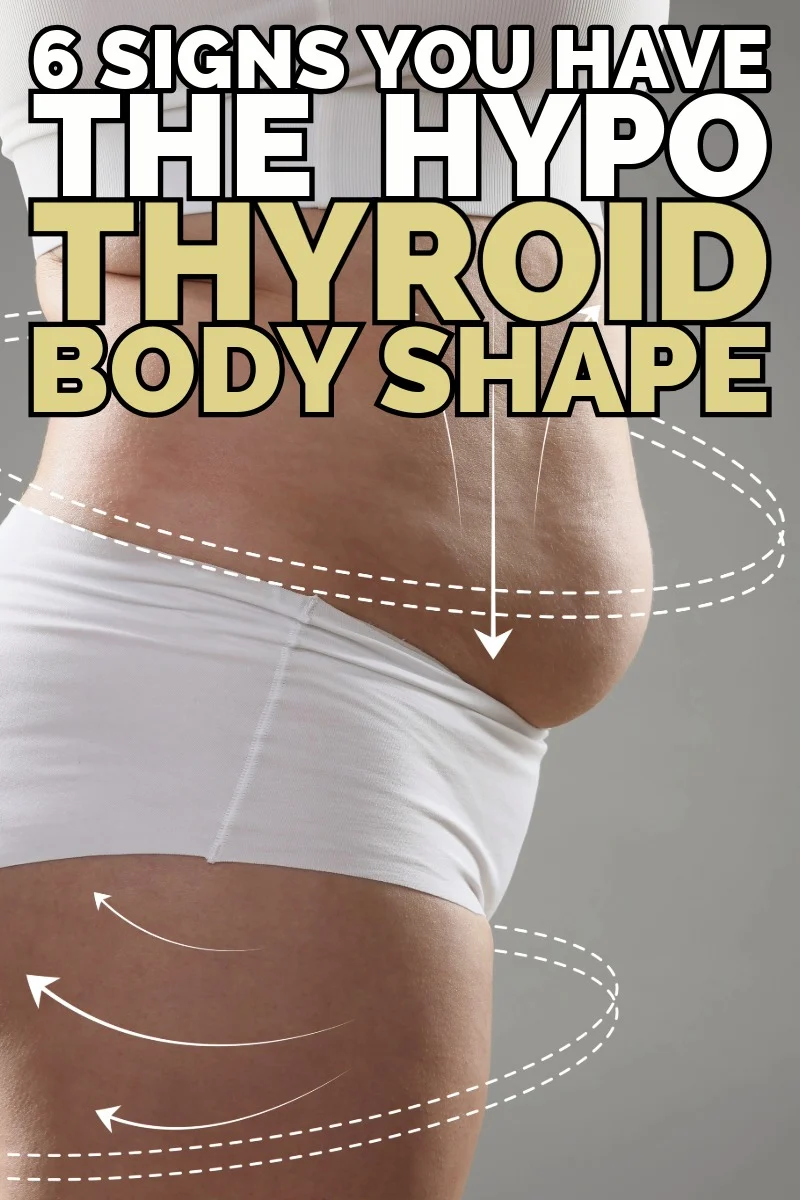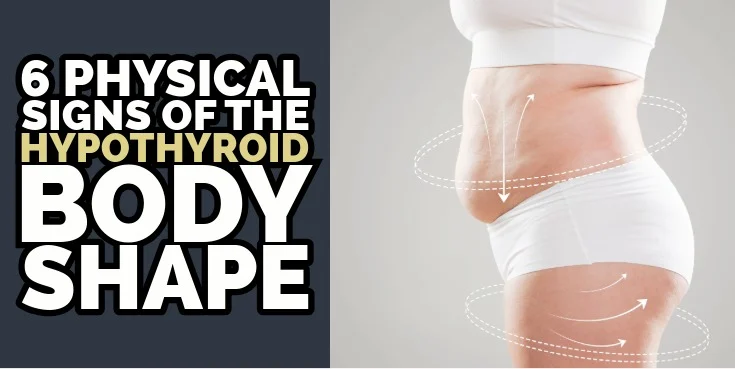


- Your hypothyroid body shape typically starts with moon face from fluid retention and reduced lymphatic drainage, often accompanied by eyebrow hair loss, acne, and scalp thinning. This is a concrete sign your thyroid needs attention.
- The thyroid belly combines trapped gas, constipation, and a sluggish metabolism. Use magnesium to improve elimination, berberine to balance gut bacteria, and daily 30-40 minute walks to target belly fat.
- An enlarged neck (goiter) occurs when your thyroid gland becomes inflamed or damaged. Look for a fuller neck, lost jawline definition, tight collars, or hoarseness as clues your gland is struggling.
- Hypothyroidism disrupts your sex hormones, causing estrogen dominance. This directs fat storage to your hips, thighs, and butt, creating a pear shape, plus generalized weight gain even when eating well and exercising.
- Body recomposition in hypothyroidism works backward. you gain fat and lose muscle, creating weakness and a soft, jiggly feel. Combat this with 100g daily protein, 100g carbs, and twice-weekly resistance training to rebuild lean mass.
Your body will tell you if you have a thyroid problem.
How?
Because it will start to change in shape and size, and not in the way that you want.
The good news is that these changes are predictable and reversible.
You just need to know what to look for so you can fix them.
Here are 6 physical changes that occur to your body when you have hypothyroidism.
I call this the hypothyroid body shape:

#1. Moon Face
The hypothyroid body shape almost always starts in the face.
Low thyroid hormones cause fluid retention and reduced lymphatic drainage [1]. The result? Your face starts to blow up, especially in the morning.
Thyroid patients will sometimes refer to this as having a “moon face” because the face becomes plump and rounded.
If you are someone who wakes up with a puffy face or eyes, that’s a sign your thyroid is changing (and not for the better).
Other facial signs that may accompany this swelling include:
- Eyebrow hair loss
- Acne
- Accelerated aging and an increase in wrinkles
- Hair thinning on your scalp
If you have these symptoms, don’t let your doctor tell you your thyroid is fine. It isn’t.
#2. Bloated Belly
Thyroid problems will also cause changes to your belly size [2], but not just from fat.
The thyroid belly stems from a combination of trapped gas, constipation, and a sluggish gut.
For thyroid patients, this bloating gets progressively worse throughout the day and reaches its peak right before bed.
To make matters worse, a sluggish thyroid will also lead to a sluggish metabolism.
So on top of the bloating, you’ll also have to deal with belly fat.
Don’t worry, though, because this particular symptom is very responsive to treatment and can be eliminated in a matter of weeks.
#3. Enlarged Neck
Many thyroid patients will develop a visibly thicker neck that protrudes forward [3].
Why?
Because this is where your thyroid gland sits, right at the base of your neck.
And when it’s inflamed or damaged, it enlarges and pushes outward, making it more visible.
Believe it or not, many thyroid patients miss this sign. But if you’re paying attention, you may notice:
- A full or thicker neck
- Loss of jawline definition
- Tightness in clothes that have collars or in necklaces
- And a subtle bulge at the base of your throat
If the enlargement is big enough, it may start to impact your voice, leading to hoarseness.
Not all thyroid problems cause neck enlargement, but it’s common in certain inflammatory conditions like Hashimoto’s thyroiditis.
#4. Weight Gain
This is one symptom that you won’t miss.
The hypothyroid body wants you to store fat in your hips, thighs, and butt region. But you can also experience a generalized weight gain across your entire body [4].
The reason for this pattern of weight gain is simple:
It’s due to the effect that thyroid dysfunction has on the sex hormones estrogen and progesterone.
When your thyroid is low, it will cause a buildup of estrogen and depletion of progesterone.
This leads to a state of estrogen dominance, which directs calories and fat into the areas I just mentioned.
As a result, you may start to take on a “pear” shape.
Another sign to look out for is unexplained weight gain.
The hypothyroid body will cause you to gain weight even if you are eating healthy and exercising regularly, because it slows down your metabolism.
#5. Cracked Heels & Swollen Ankles
You can also tell if you are taking on the hypothyroid body shape by looking at your feet.
Over time, thyroid patients develop what I call thyroid feet.
This means cracked heels, swollen ankles, and brittle toenails.
The toenails and cracked heels won’t change your body shape, but the swelling and edema will.
Fluid retention is a hallmark of hypothyroidism, and it can happen anywhere.
It just so happens to occur frequently in the ankles and lower legs of women with thyroid problems.
This swelling gets worse at the end of the day and tends to improve as you sleep.
It also happens to be very hard to treat, so this is something that may stick around for a while.
#6. Redistribution of Body Fat & Muscle
This is referred to as body recomposition, and it can be a good thing.
Most people want to build muscle and lose fat. In essence, replace fat with muscle.
This makes you leaner, stronger, and healthier.
Unfortunately for thyroid patients, they recomp in the opposite direction… they gain fat and lose muscle [5].
You’ll feel these changes as weakness, a doughy or soft feel to your muscles, and more jiggling when you move around.
Most of this recomposition will occur in your arms, legs, and midsection.
What happens is that your midsection becomes thicker and your arms and legs get smaller, and this is the classic hypothyroid body shape.
What to Address When Hypothyroidism Changes Your Body
The good news is that you can address every single one of these changes and get back to your old body.
Here’s how to do it:
Step 1. Facial Puffiness
Fixing a moon face is actually easier than you might think. There are several treatments that work fast, and you can see results in minutes if you do them right.
Here’s how:
- When you first wake up, use a cold compress on your face. This will reduce facial swelling in a hurry if you don’t want to look puffy all morning.
- Before you go to bed, use a gua sha to help mobilize fluid from your face. A simple couple-minute routine is all you need here.
- Throughout the day, minimize your intake of salt and sodium.
- If you are using my thyroid massager, use it on your face after your neck each day.
Step 2. Abdominal Bloating
Remember:
Your thyroid belly isn’t just from fat. It’s from gas, stool, fluid, and fat.
If you want to slim your waist, you’ll need to treat all of these.
Here’s how:
- Take ozonated magnesium each night before bed. This will help you eliminate the extra 3-5 pounds of stool that’s sitting in your gut.
- To prevent bloating and gas, take berberine each day. This will kill off bad bacteria and create room for healthy bacteria to thrive.
- For the actual belly fat, walk for 30-40 minutes each day. Walking is a surprisingly effective fat loss treatment for thyroid patients.
Step 3. Neck Enlargement
Your neck size is due to thyroid gland inflammation. If you reduce inflammation, you will reduce your neck size.
Here’s how:
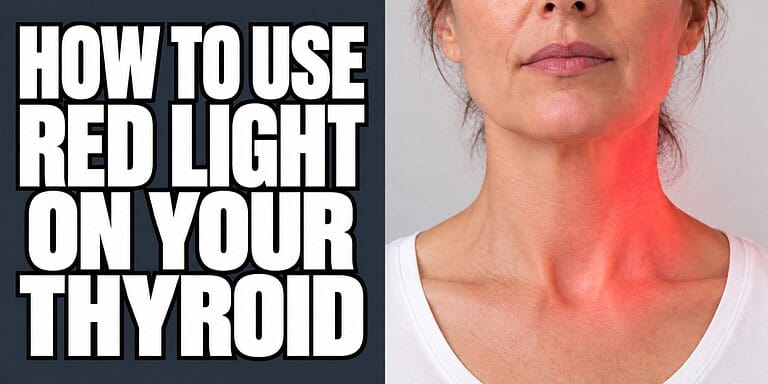
- The best way to normalize the size of your thyroid gland is with red light. 10-20 minutes, 5 days per week, will do the trick. Use a contact device (no panels) with 630, 660, 830, and 850 nm wavelengths.
- If you can’t get a red light, try topical magnesium or topical glutathione right on your thyroid gland.
Step 4. Muscle and Body Fat
Replacing fat with muscle is easier than you think. You just need the right inputs (protein) and outputs (strength training).
Here’s how:
- Eat 100 grams of quality protein each and every day. If this sounds like a lot, boost your intake with plant or whey protein. You can easily add 20-40 grams with powders.
- Eat 100 grams of carbohydrates each day. Carbs won’t make you gain weight, but they can help your thyroid work more effectively.
- Use resistance training at least twice per week. For thyroid patients, a full-body strength training session that hits all major muscle groups is all you need. Don’t kill yourself, just stay consistent.
Step 5. Thyroid Treatment
For long term results, you’ll need to optimize your thyroid. Most thyroid patients only take T4, but you need more than that.
Here’s how to do it:
- Optimize your dose of thyroid medication to ensure your free T3 and free T4 are in the optimal (not normal or low normal) range.
- If taking levothyroxine, add in T3 as liothyronine and T2 as 3,5 diiodo-l-thyronine.
- If your doctor isn’t willing to try new thyroid medications, add over-the-counter desiccated thyroid extract to your routine. This contains added hormones, prohormones, and enzymes.
Is it easy? Not necessarily, but is it worth it? Absolutely.
I’ve helped thousands of thyroid patients get their old body back using these 5 steps, and you can use them too.
By the way, I really just touched on the surface of how to optimize your thyroid medication.
If you want to learn more about that, check out this article next.
Scientific References
1. Cohen B, et al. (2023). Dermatologic manifestations of thyroid disease: a literature review. Frontiers in endocrinology. doi:10.3389/fendo.2023.1167890.
2. Ebert EC (2010). The thyroid and the gut. Journal of clinical gastroenterology. doi:10.1097/mcg.0b013e3181d6bc3e.
3. Ahmet S. Can, Anis Rehman (2023). Goiter. StatPearls [Internet].
4. Sanyal D, et al. (2016). Hypothyroidism and obesity: An intriguing link. Indian journal of endocrinology and metabolism. doi:10.4103/2230-8210.183454.
5. De Stefano MA, et al. (2021). Thyroid Hormone Action in Muscle Atrophy. Metabolites. doi:10.3390/metabo11110730.