
- Elevated reverse T3 acts as a brake on your metabolism at the cellular level. If your body is in chronic stress from illness, infections, or emotional trauma, it creates this anti-thyroid metabolite to conserve energy.
- Calculate your free T3 to reverse T3 ratio using your lab results. A ratio below 0.20 means too much reverse T3 is blocking thyroid function, and this is the most sensitive way to catch early thyroid problems.
- You can lower reverse T3 fastest by taking T3-containing medications like Cytomel or liothyronine, which directly suppress the T4 your body converts into reverse T3.
- Insulin and leptin resistance drive T4 to reverse T3 conversion. Treating these hormone imbalances is essential for keeping reverse T3 down long term, not just temporarily with T3 medications.
- Sleep 7-8 hours, manage your stress, exercise regularly, and eat whole foods. These four foundations matter more than supplements when it comes to lowering reverse T3 and restoring thyroid function.
Reverse T3 could be the missing link to finally explain why you still have hypothyroid symptoms despite taking thyroid medication.
The crazy part is that most doctors don’t even order reverse T3 and, even if they do, most aren’t sure what to do with the results.
This means it’s up to you as a thyroid patient to understand what this lab test is, how to interpret your results, and how to manage high levels (if present).
High reverse T3 has the potential to slow down your metabolism, reduce thyroid function at the cellular level, and result in full-blown symptoms of hypothyroidism.
It may seem like a daunting task to learn all of this information but don’t worry, it’s not as hard as you think, and learning about it now can pay dividends to your future self.
Today you are going to learn…
- How to tell if you have too much reverse T3 in your body
- The name of the blood tests you need to have ordered
- How to calculate your free t3:reverse T3 ratio (and why this is important)
- What causes elevated reverse T3
- And how to “flush” out or lower high levels of reverse T3 and how I treat patients with Thyroid resistance and high levels of reverse T3 in my office
Let’s jump in.
What is Reverse T3 Anyway?
What it boils down to is this:
Reverse T3 is a hormone metabolite that is created from the T4 thyroid hormone (1).
T4 thyroid hormone, of course, is the primary thyroid hormone that your body produces directly from the thyroid gland.
Your body then takes T4 thyroid hormone and eventually breaks it down into T3, T2, T1, and sometimes reverse T3 through something called thyroid conversion.
A simplified version of that conversion process can be seen below:
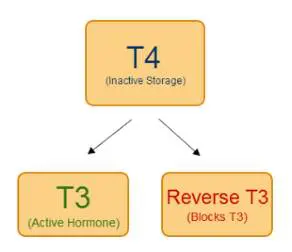
This conversion process is incredibly important to the body because it allows fine-tuning of thyroid hormone function throughout all of your cells.
And this is something you definitely want to happen, at least when it’s working correctly.
When it isn’t working correctly, the conversion process can slide down the wrong path which leaves you with the wrong types of thyroid hormone metabolites, namely reverse T3.
Unlike T4, T3, T2, and T1, which all have pro-thyroid effects, reverse T3 can be thought of as an anti-thyroid metabolite.
While T4, T3, T2, and T1 promote thyroid function, reverse T3 antagonizes thyroid function at the cellular level.
For people without thyroid disease, this conversion process works perfectly.
But if you have thyroid disease, especially for those taking thyroid medications, you can inadvertently alter this conversion process and lead to the creation of anti-thyroid metabolites which can act to make your thyroid function less efficiently.
Easy so far, right?
Why Does Your Body Even Have Reverse T3?
That’s a great question and answering it will help you understand why, in certain situations, your body creates it.
The fact is we aren’t 100% sure why reverse T3 exists in the body but we can make some general assumptions about why it exists.
The prevailing thought, and one that I am in agreement with, is that reverse T3 is meant to act as a brake on your metabolism (2) during times of extreme stress.
Let’s look at chronic illness as an example:
When your body is recovering from an illness (like pneumonia or a bloodstream infection) does it make sense for your body to increase its metabolism and provide energy to your muscles?
Of course not!
It makes far more sense to conserve your energy and metabolism by slowing down energy production and providing energy to vital organs and your immune system to take care of the immediate threat.
This is a protective mechanism designed by the body to ensure that it can weather illnesses.
What may surprise you is that it has a name and is well-documented in medicine.
It’s known as euthyroid sick syndrome.
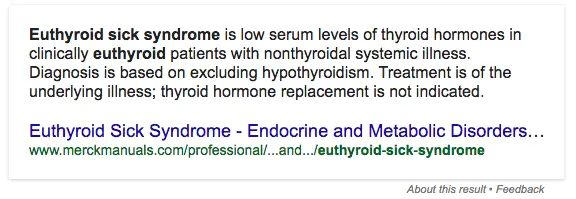
Patients who are under stress develop this condition by altering thyroid hormone metabolism through the conversion process I mentioned above.
Stress results in a typical change in thyroid lab tests manifested as low free T3, high reverse T3, and normal T4 and TSH levels.
I want you to take another glance at those lab tests mentioned above and even compare them to your results.
Do you see any similarities between your lab tests and the lab pattern typically seen in euthyroid sick syndrome?
If you are like many thyroid patients reading this then there’s a good chance you do.
But how can this be? Wouldn’t your doctor notice it?
You would think so but that isn’t the case!
Even though every doctor should have learned about euthyroid sick syndrome in medical school they believe that it’s a condition that only exists in extremely sick patients seen in the hospital or ICU.
Unfortunately, we are seeing more and more patients with multiple chronic medical conditions present with the same thyroid lab tests as those who are hospitalized which leads me to one important conclusion:
Maybe doctors are missing something about our current lifestyle, the increasing rates of illness and chronic medical conditions, and the impact that these have on reverse T3 and thyroid lab tests.
There are studies like this one (3) which can shed light on this very issue.
They show that other situations aside from being hospitalized can lower free T3 levels, increase reverse T3 levels, and cause changes in thyroid function that resemble “sick euthyroid syndrome“.
And it’s small things like this that may explain why so many thyroid patients walk around with hypothyroid symptoms despite being told they are “normal”.
Are You Pooling Reverse T3? High Reverse T3 Explained
Now that you better understand why you want reverse T3 levels to be as low as possible the next thing you need to understand is what causes them to be elevated.
Before we jump into the causes, though, let’s briefly go through some of the symptoms associated with an elevated reverse T3.
As you might suspect, the higher your reverse T3 the more hypothyroid you will feel.
Patients with high levels of reverse T3 tend to have one or more of the following symptoms:
- Decreased metabolism
- Lower than normal body temperature
- Cold intolerance
- Weight gain without changing eating habits
- Fatigue or low-energy
- Pain in the joints, muscles, or tendons
- Depression, anxiety, or bipolar disorder
- Other symptoms of hypothyroidism
These are the most common symptoms but realize that each person will present in a different way from the next.
For instance, I’ve seen people with high levels of reverse T3 present with a complete inability to lose weight and with severe depression without manifesting the other symptoms mentioned.
Others may experience issues primarily with their body temperature and even others still may have a mix of all of those symptoms.
There’s obviously a significant overlap between the symptoms I mentioned above and other medical conditions which is why reverse T3 testing is very important (we will discuss this topic soon).
But first:
What causes elevated reverse T3 levels, and what should you look out for?
- Calorie-restricted dieting – Especially HCG-based diets or VLCD (very low-calorie diets). These diets (4) have been shown to reduce metabolism and increase reverse T3.
- Chronic illness and infections – This includes viral infections like infectious mononucleosis (5), bacterial overgrowth syndromes like SIBO, and even chronic illnesses like cancer, cardiac/heart disease, arthritis, diabetes, and even obesity.
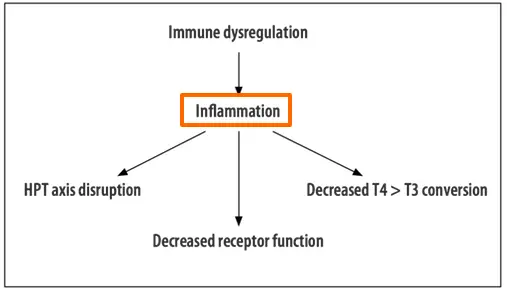
- Chronic Inflammation – Any cause of inflammation can result in decreased T4 to T3 conversion (6) and higher levels of reverse T3.
- Chronic untreated Gut infections – Up to 20% of T4 (7) is converted to T3 in the gut, which means if you have gut issues you may be missing out on up to 1/5th of your conversion power. Gut imbalances that thyroid patients deal with include SIBO, dysbiosis, reflux/GERD, yeast overgrowth, history of chronic antibiotic use, and inflammatory bowel disease.
- Emotional and physiological stressors (8) – This includes social issues like the death of a loved one, family problems, divorce, etc. It also includes psychological (PTSD) and physical trauma (motor vehicle accidents, TBI, or otherwise) (8).
- Some Prescription Medications – The most common medications causing elevated reverse T3 include blood pressure medications, diabetic medications, anti-seizure medications, narcotics, and antidepressants. A common example is the use of beta blockers which can be used to treat the symptoms of hyperthyroidism (9) in addition to elevated blood pressure (10).
What You Need to Know About Reverse T3 Testing
Reverse T3 testing is actually pretty straightforward.
There is a serum marker for reverse T3 that most standard lab companies can run.
What isn’t always straightforward is interpreting your results, but even that is not as difficult as it may sound.
Before we talk about interpreting your results, it’s important to understand how reverse T3 testing fits into a complete thyroid lab panel.
There are no fewer than 4 standard lab tests that need to be run to adequately assess thyroid function and each of these lab tests provides you with different information.
You never want to just order one lab test without the others because you won’t get the information you are looking for.
This applies to reverse T3 just as much as it applies to TSH testing.
This means if you are planning to really understand your thyroid, you will need to get the following thyroid lab tests: TSH, free T3, free T4, reverse T3, and thyroid antibody levels.
Obtaining these other lab tests will help you put your reverse T3 level into context, especially when combined with your symptoms.
One of the most powerful use cases for reverse T3 is in catching early thyroid disease.
Take a look at this image to see what I mean:
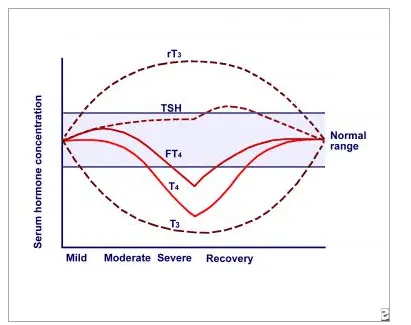
This image demonstrates the severity of the disease state on the X-axis and the concentration of thyroid hormones on the Y-axis.
Basically, it shows what happens to thyroid lab tests and when they become abnormal in relation to the severity of your disease.
What should stand out to you is the fact that reverse T3 (abbreviated as rT3) and T3 (abbreviated as T3) are the earliest markers of thyroid dysfunction.
They become abnormal much sooner than the other thyroid lab tests which makes these lab tests sensitive for diagnosing early thyroid problems.
What’s more, is that the difference between these two lab tests is more dramatic and pronounced than any other thyroid lab test.
For this reason, these two lab tests are critical in evaluating thyroid function.
You can determine the spread between these two values with a simple calculation which will give you the ratio of reverse T3 to free T3.
This ratio is called the free T3:reverse T3 ratio and is something that every thyroid patient should calculate using their own thyroid lab tests.
In an ideal world, you want your free T3 levels to be as high as possible (generally upper 1/2 to 1/3 of the “normal” reference range) and you want your reverse T3 levels to be as low as possible.
To calculate your free T3: reverse T3 ratio simply divide the numbers.
Your ratio should be > 0.20.
Any ratio < 0.20 indicates too much reverse T3 to free T3 and means that you should focus on either increasing your free T3 or reducing your reverse T3.
In order for this calculation to work, your units must be the same.
The units used in the United States for free T3 are pg/mL and the units used for reverse T3 are ng/dL.


Using the example above, if you divide 2.8 by 14.4 you are given a value of 0.19 which is less than that <0.20 level mentioned above.
If your free T3 and reverse T3 lab tests are not in these units, you can easily convert them and then make the calculation with some simple tools available online.
If you want a down-and-dirty way to assess your reverse T3 then you can also just look at the absolute value.
In most patients, a reverse T3 level of less than 15 ng/dL is ideal.
Values higher than this tend to start causing problems, especially if associated with a low free T3.
How to “Flush” Out Or Lower Reverse T3 Levels
So you’ve found out that your reverse T3 level is elevated, what now?
Your next step should be to try and drive that level as low as possible.
This is sometimes referred to as lowering reverse T3, treating reverse T3 pooling, or flushing reverse T3 out of your system.
These are all different names used to describe the treatment of high reverse T3.
What I want you to be aware of is that treatment should focus on
What you need to be aware of is that the treatment will focus primarily on the underlying cause (11).
Because of this, there really isn’t a one-size-fits-all treatment program that I can recommend.
I can and will give you recommendations for common causes, but you will still need to tailor that to your specific situation.
With this in mind, let’s talk about 5 different ways that you can lower reverse T3:
#1. T3 Containing Thyroid Medications
The fastest and easiest way to get rid of excess reverse T3 is with bioidentical hormone formulations that contain pure T3 thyroid hormone.
This would include medications like liothyronine, Cytomel, or sustained-release T3.
The reason this approach works so well is that when you give your body T3 hormone directly it automatically suppresses T4, which reduces the substrate that your body uses to create reverse T3.

In essence, you’re starving out the ‘food’ source your body uses to make reverse T3.
Naturally what will happen with T3 medication use is that your T4 levels will decrease, your free T3 levels will increase, and your TSH will decrease.
While on T3 thyroid medication it’s important to monitor reverse T3 closely, at least once every 6 to 8 weeks.
Typically within 2 months (and assuming your dose of T3 is high enough), your reverse T3 should drop to less than 10.0.
This is definitely the fastest way to reverse T3, but it doesn’t take into account the underlying cause.
So if you use T3 to reduce your reverse T3 without making any other changes, it’s likely that your reverse T3 will just jump back up once you stop taking T3 medication.
Is NDT Helpful for Reducing Reverse T3?
It certainly can help but there are a few things to realize if you want to use this class of medications to treat reverse T3:
- Each grain of NDT has about 38 mcg of T4 and 9 mcg of T3, which means that NDT still primarily consists of T4.
- In order to flush out the reverse T3, you must lower the substrate of T4 which generally means lowering your total dose of T4. In some cases, you may have to drop your NDT dose in favor of pure T3 medications.
- NDT dosing is static meaning you can’t individually alter the concentration of T4 and T3 unless you add additional thyroid medications.
You can still treat elevated reverse T3 with the use of Natural Desiccated Thyroid, but it’s generally not considered the best option.
#2. Supplements Can Enhance T4 to T3 Conversion
In addition to medications, every thyroid patient should also consider utilizing nutritional supplements.
The reason is simple:
The hypothyroid state sets the body up for certain nutrient deficiencies and since most thyroid patients are under-treated, most also have these deficiencies.
This is for 2 main reasons:
The first is that low thyroid states lead to low stomach acid which leads to decreased absorption of nutrients across the board.
The second is that low thyroid states also increase your risk of developing gastrointestinal imbalances which may further impair the absorption of minerals and nutrients.
You can check out this post here for more info about which supplements you should consider using and how to check to see what your body needs.
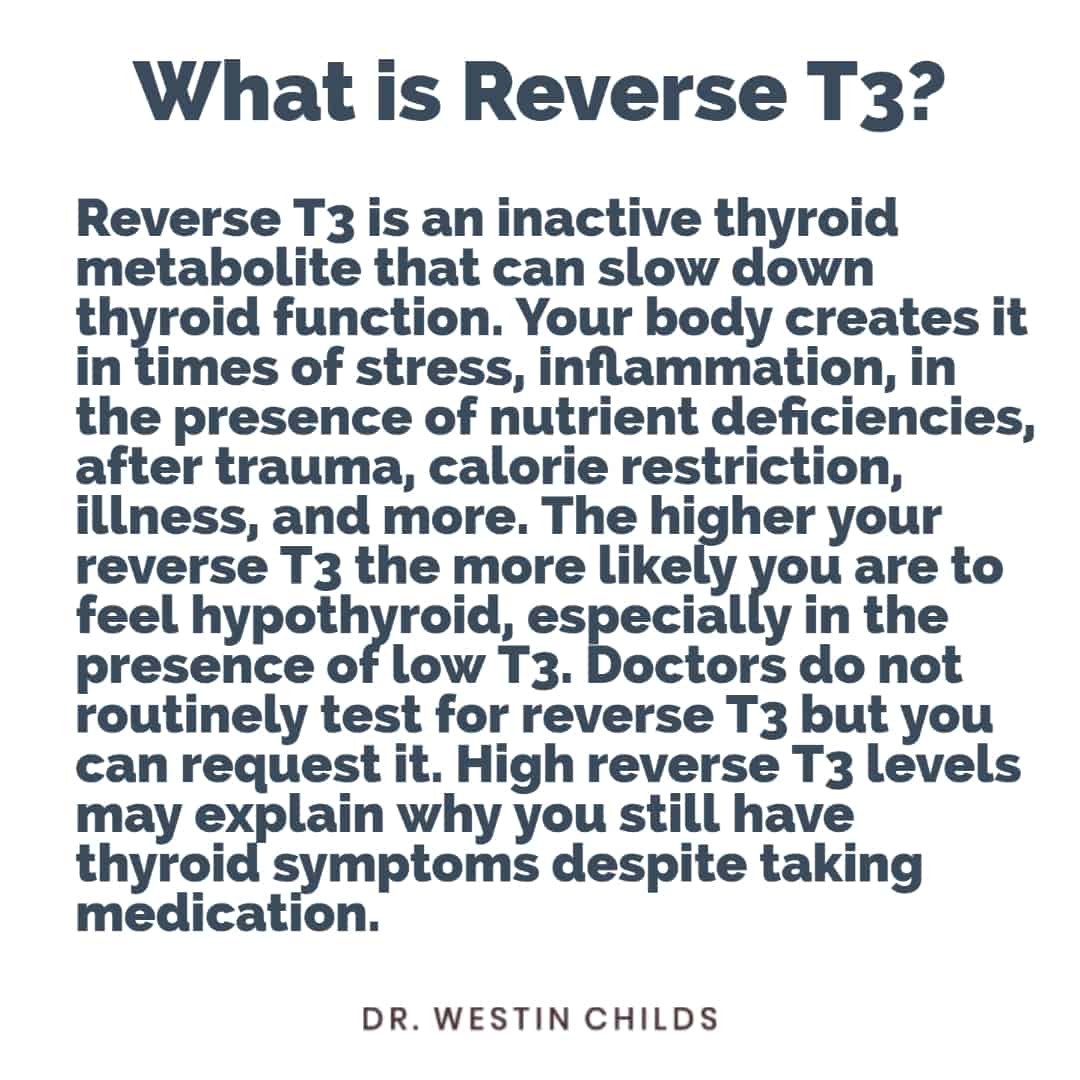
If you are trying to support the conversion of T4 to T3 with the use of supplements then there are a few you should pay special attention to.
The two primary supplements that you should focus on are zinc and selenium. Both of these supplements have been shown in some clinical studies (12) to increase T4 to T3 conversion, thereby potentially decreasing reverse T3.
In addition to zinc and selenium, I’ve also seen great success with guggulsterone or guggul extract.
We aren’t as concerned about supplements that promote thyroid hormone production (such as iodine and L-tyrosine), but they can still be helpful in some cases.
In addition to these supplements, you can also check out some natural therapies that have some good data behind their use as effective tools for naturally improving T3 levels and reducing reverse T3 levels.
#3. Reversing Hormones that promote T4 to Reverse T3 Conversion
As you are probably aware your hormones all work in tandem with one another.
This means that as one system slows down it may drag down other systems or cause an increase in other hormones to make up for the deficit.
This relationship holds true for thyroid hormones and their impact on leptin and insulin levels.
The link between these hormones is clear:
This is very important because hypothyroidism leads to a state where developing both insulin and leptin resistance becomes much easier.
Why do we care?
Because insulin and leptin resistance both cause inflammatory states which contribute to T4 to reverse T3 conversion.
Not only do they contribute to high reverse T3 levels but they also make weight loss very difficult.
Patients with high reverse T3 levels almost always have high fasting insulin and high fasting leptin levels.
In fact, I don’t think I have ever seen a patient with a reverse T3 greater than 25 with a normal insulin or leptin level.

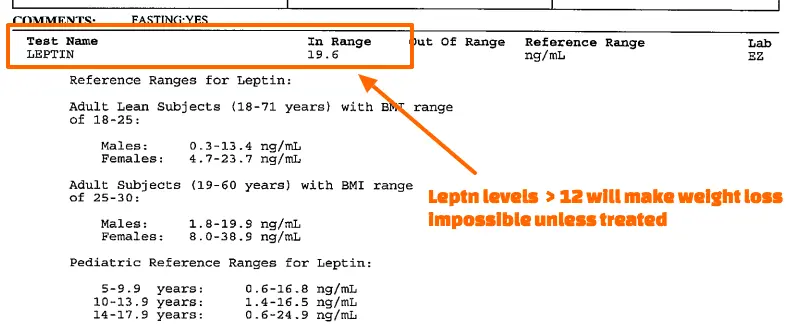

You can see examples from several patients above showing abnormal reverse T3 levels, high fasting leptin, and high fasting insulin levels.
These values may fall within the “normal” range but they are far from normal and will lead to symptoms of hypothyroidism, weight gain, and weight loss resistance.
Another big reason I want to talk about these hormone imbalances is that doctors don’t frequently run tests to check for either of them.
Doctors will routinely check hemoglobin A1c but rarely order fasting insulin and fasting leptin levels.
This means that if you have known thyroid conversion problems, it’s probably going to be up to you to request these additional hormone tests.
Treating and reversing both insulin and leptin resistance is very important for not only lowering reverse T3 but maintaining low levels over time.
To learn more about how to address these hormone imbalances please see the following case studies below:
- Victoza weight loss: 40 pounds lost with Victoza + LDN
- Byetta weight loss: 42 pounds lost over 3 months
- Hashimoto’s weight loss: 55+ pounds lost over 9 months with before/after pictures
These case studies provide a step-by-step walkthrough of how to approach leptin and insulin resistance including which medications, hormones, and supplements are most effective.
If you know you have insulin resistance then you can consider using these supplements to help lower your levels:
- Berberine: Helps reduce cholesterol, improve fasting glucose, and may help with weight loss.
- Alpha Lipoic acid: Helps sensitize the body to insulin and may help to reduce nerve damage in certain patients
- Chromium: Helps improve insulin sensitivity to cells and may help reduce cardiovascular disease in certain patients.
If you prefer the natural approach to treating leptin levels you can find more information here.
#4. Addressing Inflammatory Levels and “Cooling Off” Your Body
Everyone knows inflammation is bad for the body (15), but very few people understand how it makes things worse and, more importantly, how to address it.
Part of the reason for this is that the markers we use for inflammation are non-specific.
That means most of the time we know inflammation is present, we just don’t necessarily know what’s causing it.
Sure, in the presence of other abnormalities we might be able to take a guess, but we will rarely ever know with 100% certainty.
And this is a problem because inflammation is a known contributor to thyroid conversion problems.
We know that inflammation directly promotes the production of reverse T3 (16) by pushing your body down the T4 to reverse T3 conversion pathway.
So if you have high reverse T3 levels you need to be actively searching for sources of inflammation and treating the underlying cause.
You can easily test for inflammation by ordering these lab tests:
- CRP: You want this to be as low as possible but definitely < 1.0 for optimal thyroid function.
- ESR: Another non-specific marker of inflammation (17), for optimal thyroid function this should be < 10.
- Ferritin: Both a marker for iron stores and an acute phase reactant (18), this marker can be used in certain instances to help isolate non-specific inflammation in the body.
If you know that you have both high levels of inflammation and high levels of reverse T3 then you can safely assume that the inflammation is likely worsening your thyroid function.
The next step is to find where it’s coming from.
In hypothyroid patients it’s usually in these three places:
- Hormone imbalances (especially insulin and leptin resistance)- Please refer to the section above to understand how to both diagnose and treat these conditions.
- Undiagnosed gut imbalances like SIBO and SIFO – Both of these gut issues promote inflammation (19) in the GI tract and lead to increased intestinal permeability. You can find more about both here.
- Undiagnosed food sensitivities – These sensitivities promote inflammation (20) and further food sensitivities unless treated.
Bottom line?
If you have both high reverse T3 and elevated serum markers for inflammation you should be looking at the 3 main causes above and treating those if applicable.
If you don’t know where the inflammation is coming from you can still do some good by taking supplements designed to help reduce inflammatory levels and promote the “clean up” of breakdown products in the liver:
- Milk thistle + MSM: Designed to help improve liver function and promote proper phase 1 and phase 2 elimination of medications, supplements, and other products that need elimination in the liver. This combination may also help reduce AST and ALT levels (21)(if you have fatty liver).
- Omega 3 Fatty Acids: Omega 3 fatty acids can help reduce inflammation by reducing inflammatory cytokines.
- Curcumin: This well-studied herb activates PPAR-gamma levels (22) helping to reduce inflammation in the body.
- Quercetin & Bromelain: Particularly helpful in patients with digestive issues and those with chronic sinus/upper respiratory illness-like symptoms (post nasal drip and chronic stuffy nose).
This approach isn’t ideal but it’s better than simply ignoring it.
#5. Lifestyle changes to Balance Hormones and Promote Thyroid Function
Never underestimate the power of these 4 major areas when it comes to improving your thyroid:
- Getting 7-8 hours of quality sleep per night
- Reducing and managing your stress
- Daily low-intensity exercise and episodes of high-intensity exercise 1-3x per week
- A well-balanced diet full of real, whole foods
If you don’t practice these 4 basic things it doesn’t matter what you do, you won’t get better.
These are particularly important for those with high reverse T3 levels.
Remember that your body is a network of systems and hormones that all interact with one another.
When one system isn’t working properly, it will bring other systems down.
These areas are so important that many thyroid patients can see significant improvement in their thyroid symptoms by optimizing them without the need for additional treatments or medications.
The only problem is that most thyroid patients take them for granted and would prefer to take a supplement and call it a day.
Don’t fall into this trap!
Take that supplement if you want, but make sure you are also paying attention to your diet, exercise routine, sleep schedule, and stress levels.
Final Thoughts
Elevated reverse T3 is a serious issue for many thyroid patients and it’s a problem that is often ignored by many conventional doctors and endocrinologists.
The best way to evaluate your reverse T3 is by testing for it along with free T3 and free T4 levels.
To get a better idea of how reverse T3 is impacting your body, you can measure your free T3:reverse T3 ratio.
If your free T3/reverse T3 ratio is < 0.2 you have too much reverse T3 in your body.
The fastest most effective method for optimizing reverse T3 is with the use of pure T3 thyroid medication.
Now I want to hear from you:
Is this the first time you’ve heard about reverse T3?
Have you had your levels checked? If so, was it high or low?
What type of treatments have you tried to lower your reverse T3?
Have you tried medications that contain T3 like Cytomel or liothyronine? Did they work for you?
Leave your questions or comments below!
Scientific References
#1. https://www.ncbi.nlm.nih.gov/pubmed/3428867
#2. https://www.ncbi.nlm.nih.gov/pubmed/7355063
#3. http://www.ncbi.nlm.nih.gov/pubmed/12055988
#4. http://www.ncbi.nlm.nih.gov/pubmed/12055988
#5. https://www.nlm.nih.gov/medlineplus/infectiousmononucleosis.html
#6. http://www.ncbi.nlm.nih.gov/pubmed/11716958
#7. http://www.ncbi.nlm.nih.gov/pubmed/3049061
#8. http://www.ncbi.nlm.nih.gov/books/NBK28/
#9. http://www.ncbi.nlm.nih.gov/pmc/articles/PMC3475282/
#10. https://www.ncbi.nlm.nih.gov/pmc/articles/PMC5369873/
#11. http://www.ncbi.nlm.nih.gov/pubmed/16399020
#12. https://www.ncbi.nlm.nih.gov/pubmed/8157857
#13. https://www.ncbi.nlm.nih.gov/pmc/articles/PMC3608008/
#14. https://www.ncbi.nlm.nih.gov/pmc/articles/PMC3356957/
#15. https://www.ncbi.nlm.nih.gov/pmc/articles/PMC3492709/
#16. https://www.ncbi.nlm.nih.gov/pmc/articles/PMC3978663/
#17. https://www.ncbi.nlm.nih.gov/pmc/articles/PMC4653962/
#18. https://www.ncbi.nlm.nih.gov/pubmed/24549403
#19. https://www.ncbi.nlm.nih.gov/pmc/articles/PMC3099351/
#20. https://www.ncbi.nlm.nih.gov/pmc/articles/PMC1774228/
#21. https://www.ncbi.nlm.nih.gov/pubmed/17548789
#22. https://www.ncbi.nlm.nih.gov/pmc/articles/PMC2234255/


Hi
I have no thyroid but have Hashimoto’s Hypothyroid. Recent blood tests were TSH=.08 , T4=7.61 and t3=4.9….no reverse T3 run. Have to wait til July when I see new endocrinologist. These numbers seem good to me. Thoughts?
Hey Patty,
People get too obsessed with lab numbers when trying to treat the thyroid, they are not 100% accurate and therefore only represent a small part of a larger picture. I don’t recommend basing treatment off of lab tests alone.
Hi there, awesome article. I have high reverse t3 and boarder line low thyroid levels and I have never been on any thyroid medication so I’m just wondering if when you say “clearing out reverse t3” you mean it as it can be a temporary treatment that you use to clear the build up and then stop and have your thyroid revert back to normal and healthy.. Or would you have to be on it permanently?
Hey Madison,
I’m glad you liked the article. Obviously each patient is different, but some patients can flush out the system and have a return to normal (assuming they also treat the cause of the high reverse T3 in the process), while others may need therapy long term – it just depends.
Awesome thanks so much for getting back to me you are awesome! What if people have low/normal T4 as well as low/normal T3 and high/normal Reverse T3… In this situation is it usually better to use the NDT + T3 option so you are still getting the T4?
I have sent and email through your site I really hope it gets to you 🙂
Hi there Dr. Westin
Awesome article, reading this was very knowledgeable. My thyroid has been out of wack for the last year or so. Currently im taking Levothyroxine NA 0.15MG and my tests as of late are: T4 – 21 PMOL/L, T3- 3.12 PG/ML, RT3- 24.3 Ng/DL and TSH – 6.72 mIU/L ( this was a lot higher from 13 to 20 last year with taking less T4 thyroid medication). My new doctor told me to get off t4 completely to flush out my high reverse T3.
He recommended me to take Cytomal 25MCg for 2 months once a day. I just want your thoughts on if 25 mcg might be to much to take or just perfect. And is slow release t3 a better way to go then cytomal. Oh and both my thyroid Antibodies are High as well. Just want your input:)
Thanks James
The article said it should be used as a temporary treatment so the body can naturally balance back to correct levels…
Hi. I need advice. My reverse t3 is 44. Also my free T3 is 2.4. Been to two doctors. One prescription was for T3 , 5mg 2x per day. The second opinion was a functional approach because my pregnenolone is low, 59. Please help me decide which course to take. Thank you!
I just got diagnosed with reverse T3 ans also considering the functional medicine approach.
Hi Vanessa,
That sounds like a good idea 🙂
Hello, thanks so much for the article. I’ve had hypo symptoms for years, started after the birth of my 2nd child when I just couldn’t lose weight and had hair loss(all the hypo symptoms) but my results are always in the normal range although low on the range when not medicated, normal when medicated. There are 4 of my family members with hypothyroidism. I am just not classed as being hypo as my T4, T3 and TSH comes back normal. I have the classic moon face, swollen neck and also often swell up. I got so poorly that I chose to self medicate eventually with NDT. I was cutting out physically. I had gestational diabetes in my last two pregnancies and was pretty insulin resistant. Starting a low carb diet now. Was told by an endo I saw during pregnancy that my reverse T3 was high but I’ve had no treatment here in regards to my hormone/thyroid issues or investigations. I think doctors think I am making it up. I also often have inflammation markers in my bloods. I am in the normal rage for rheumatoid factor but it’s really near the threshold. Had elevated C-reactive protein in the past but not at present. Had lots of back, joint pain issues over the years. Low vit D, prone to low iron but not had that checked in ages. My stomach is also swollen a lot, so much so I got asked if I were pregnant the other day and I am not. No chance of getting any type of sustained release t3 as uk based. Can you advise the best supplements to take to increase my immune system please?. It’s impossible to lose weight. Or I do for a bit and then put more on. I’ve gone through stages where I have exercised loads and actually put on weight! Done diets where I have put on weight.
Hi Katie,
Yes, please see the ingredients found in these supplements that can enhance immune function:
https://www.restartmed.com/product/functional-fuel-detox/
https://www.restartmed.com/product/pure-d3-liquid/
https://www.restartmed.com/product/omega-soothe-sr/
https://www.restartmed.com/product/ultra-biotic-x100/
I have been on t4 for a long time and had all the symptoms of hypothyroid, infact it was horrible as the doctor initially gave a very high dose t4 and it affected my whole body. I started having fluid retention and it was causing nerve numbness when i was asleep
they developed hyper tension and started BP tablets.
Later I found a funtional doctor in India and started on t3 t4 medication. Did feel better, but not able to loose weight so far, my eneryg level has improved. but my hscrp was 3.7 .
My doctor put me on progesterone as i had cramps right side.
the dose was 200ml cream and had so much energy i gave my thryoid medication for 2 weeks, but started getting numbness and water retention my weight increased. BUtmy hscrp went to 0.9. Again i have started my thryoid meciation, i want to understand why my hscrp went down after i stopped thryoid medicaiotn and started progesterone
I’m no doctor but when I went on NDT my TPO antibodies shot up, My A1C went pre-diabetic. Once I went back to T4 only all of the resolved. Also on NDT my pregnenolone was -10. I don’t think all of us can absorb T3 properly and some of us have sensitivities to the pig hormone. I had some great benefits from NDT but the negatives outweighed the positives for me. So I had to go back to Synthroid after trying NDT, t4/t3 combo, Tirosint/ cytomel. Couldn’t function on any of those. Now I’m back on Synthroid only. I have stiffness and swelling with it but I can at least function mentally and emotionally. Praying one day to be completely off hormones. Had Covid in November and it the stress of trauma of the infection threw off my progesterone, became estrogen dominant, lots of brain swelling, blurred vision and POTS symptoms for a while. I’m finally starting to turn the corner but have felt hypo off and on and also had a very high RT3 after and during covid. ANNOYING!!
Hi Keeley,
It is rare but some people do react with an elevation of thyroid antibodies when using medications like Armour thyroid.
Please let me know previous thoughts on the email.
Dr. Child’s,
Thank you for these very informative articles. I’ve been on the Hashimoto’s ride for quite and have done a TON of research trying to help myself get better. I have also seen MANY doctors who have been useless in helping me. In Georgia Naturopathic type doctors are hard to come by. I have cleared high Reverse T3 levels several times during the course of my illness. I have addressed adrenal health and iron levels. Even still Reverse T3 always returns when I go back to adding NDT.
My questions to you are:
In your opinion can one simply stay on T3 only for life or is T4 medically necessary to the body. I’ve read conflicting opinions on this.
Secondly, could Reverse T3 levels rise due to taking too much T3 along with the NDT?
Thank you…
Hey Laura,
Most people do fine on T3 only medications. If you are a post thyroidectomy patient I would proceed cautiously, but in my experience they are still able to function quite well with T3 formulations only. I say proceed cautiously because theoretically some individuals may have a hard time transporting T3 into the brain.
You also have to consider that you are more than just your labs. Your reverse T3 levels will elevate as a natural safety mechanism if your free T3 levels get too high. If you are not symptomatic, then don’t worry about your reverse t3 levels.
And yes, I’ve seen reverse T3 levels rise as free T3 levels rise for the reason I stated above.
Hi Doc!
Could you elaborate on your statement “theoretically some individuals may have a hard time transporting T3 into the brain” — why would this be the case for just some? Are there any links/references you could provide to explain further? Thanks so much for all the great info on your site! Lee M.
Laura, not sure what part of GA you’re in, but I highly recommend Vine Medical for doctors who are willing to take a natural approach to thyroid issues. They are in Alpharetta, but do telegraphy as well.
I am reading your very interesting information and seek to find some answers. I do know that my hashimoto antibodies rose after prolonged period of high stress. I did take 10mg of cytomel and within a month gained 25lbs on top of the 20lbs I previously gained within a year. Does this explain further any direction of uncovering the Sx and cause? Please advise.
Hey Ana,
Unfortunately that isn’t a lot of information to go on. Weight gain around the time of taking cytomel doesn’t necessarily mean that it was due to this medication (though it is possible). It’s also possible that you would have gained 40 pounds instead of 20 because you were on the cytomel. You need someone to dig into the problem and figure it out.
Hi there,
I have about 10-15 extra pounds of body fat around my mid section and my BMI is off. I eat really well, exercise and otherwise do everything ‘right’. I had my thyroid removed 15 years ago and ever since I crossed over to menopause (I’m 56) I have not been able to get back to ‘normal’. It’s not far off – I just know I could be feeling better. I SO appreciate this article as I never knew what reverse T3 was and no one (of many docs)bothers to check it. Are there natural forms of Zinc and Selenium – or supplements the only way to go? In appreciation.
Hey Debbie,
Yes, you can get zinc and selenium from natural sources – but I almost always have my patients add these supplements even if they try to consume enough via food sources. I just feel that the results are better that way.
What amounts of selenium and zinc would you recommend for an 11 yr old and do you want patients to take selenium along with Vit E? Thank you.
Hey Gail,
I wouldn’t make recommendations for a child unless I knew their health history and medical problems.
I love reading stuff about this. I’ve been dealing with my thyroid issues for 5 years and I’m only 22. They haven’t been able to level my thyroid my t4 levels are high my t3 is fine, but I still have all the symptoms. What should I ask my doctor next time I see him? I want to get to the bottom of this but evrytime I read about something and bring it to my doctor he tests me for it and I end up being normal. Just want to know the right words or terminology to ask him.
Hey Leah,
You will never get help the way you are going about it. If your doctor isn’t ordering the right tests it’s because they don’t understand how to interpret them. So, even if you get them to order the tests – they won’t know what to do with the results, which means you won’t get the right treatment anyway. You will need to find a new doctor to help.
If you visit a compounding pharmacy,there are usually business cards posted for practitioners in your area who specialize in this. Or you can ask the people at the compounding pharmacy. Our local compounding pharmacy is amazing!
Hi Just thought I would sail into this one for Kelly and anyone else. I went to my closest compounding pharmacy to where I work in the middle of sydney ‘Newtons Pharmacy’ in York Street and I asked them for a specialist GP or Naturopath for hormones and thyroid issues, they sent me to Dr Edward Butterworth in O’Connell Street. I had been seeing him for thyroid issues 2013 but then went to a Functional Medicine Practitioner / DR in the area where I live. But after mentioning a number of times to her that I was in a lot of discomfort and ongoing pain and lots of stuff turning on in the body and the brain, and not happy in this Catch 22 situation, she ordered other bowel tests etc all expensive. So I went back to my original hormone specialist Dr Edward Butterworth (whom it turns out I should have stayed with) for a second opinion who then asked me if the other Dr had taken my Reverse T3 levels and I said ‘No’, she had said at my appts that research had come in and said that RT3 testing and protocols had not been found to be a good idea. So all my blood tests do not show any results for the Reverse T3. So Dr Butterworth ( worth his butter! ) got my tests done and now I am on Lio-thyronine and progesterone creme made specially for my hormones (I am 55) . I bought all this yesterday for the next 2 months. Yes I agree ! always ask your compounding pharmacy for a recommendation and/or a second opinion. Sometimes here in Australia in Sydney not even the Functional Medicine Dr’s know how to treat thyroid issues and this Dr has thyroid issues herself. So I should have stayed with Dr Worth his Butter ! I would not have gone through 4 years of discomfort, crazy ville-ness and empty pockets!
Hi Louise
I had a thyroidectomy 12 years ago and have not felt normal since. I live in Sydney and I have tried to seek help from Endo and Functional medicine doctors. The later helped somewhat with prescribing T3 but the weight gain just does not shift. Any info would be greatly appreciated.
Hi Mia,
You’ll have to be very aggressive if you don’t have a thyroid, you can find some more tips here: https://www.restartmed.com/weight-loss-thyroidectomy/
i taking armour and t3 25 mg in the afternoon
seems to be helping with anxiety
2 endo have told me to stop – it could ruin my heart and cause bone loss
any thoughts
Hey Maria,
It can definitely cause those issues if the dose is too high, the trick is getting on a dose that works well for the patient but doesn’t cause those side effects.
What dosages of selenium and zinc do you recommend?
Hey Cathy,
It depends on the person but generally 60mg of zinc and no more than 400mcg of selenium.
I’ve read that zinc supplementation should be limited to no more than 30mg so as to not unduly lower copper levels. It seems that you disagree?
It seems I do! 🙂
Hi Dr. Childs,
I’ve been hypo for about 17 years. Sometimes I test positive for Hashis and sometimes not. I take10 mcgs of Liothyronine three times a day (total 30 mcgs per day). I read in someone else’s post that this dose can cause heart and bone issues. Can you elaborate? Also, how would I know if this is happening? I do have occasional palpitations and would have more if I didn’t take Magnesium every night.
I cannot take any brand of T4, including Synthyroid, Levoxyl, Tyrosint, Armour, Naturethyroid and Westhyroid. When I do, even at very low doses, I experience widespread debilitating muscle pain. I have re-tried taking T4 more times than I can count and always have the same result. Not a single Dr. I’ve talked to has ever heard of this side effect or can explain it. Have you ever heard of this reaction? Seems strange given that I seem to need it. My T4 is always low, and Drs. always want me to take it.
Hey Lori,
It’s not about the dose so much as it is about your body and how you tolerate the dose. I’ve had people on much higher doses that do great, and people on much lower doses that are symptomatic. If 30mcgs is elevating your resting pulse > 90 and you are having palpitations then it may be too high a dose for your body. And it’s easy to follow bone density with dexa scans, so it would be worth looking into that as well.
Hi Lori,
I saw your comment and wanted to ask how are you doing now? Do you still take Cytomel? Magnesium? How are your symptoms? Your comment sounded just like what I’m going through now (I even take reacted mg every night to help with the shortness of breathe…)
I hope this note finds you well. I really empathize with your comment and wish your wellness.
Hi Lori, I am having the same problem when I take synthroid,. It sends me into some type of flare that makes me hurt all over. I will be starting t3 here shortly … sure hope it helps. I tried it about years ago and after about 2 weeks… started making me have severe panic attacks. I have never broken up the dose thru out the day. I will have to try that.
I have been on Levo for several years. I didn’t know it can make your body hurt all over. As I often have body pain all day and wasn’t sure why. This may be.
Hi Claudia,
The chronic pain associated with hypothyroidism can be managed with the treatments found in this article: https://www.restartmed.com/hypothyroidism-chronic-pain/
Can you just add Cytomel T3 to Naturthyroid 1.5grams to clear out Rev T3?
Or do you take T3 by itself?
How much T3 do you add?
Hey Pam,
Usually you need to remove the NDT as well, but it just depends. Dose depends on the person, there isn’t a specific dose to start with. I usually gauge the dose of T3 based on the reverse T3 levels. But remember to search out the cause of high reverse T3 to begin with, otherwise it will come back again.
So if you Rt3 was 20 (10-24), what would you consider a clearing dose of T3? I have been under poor care for 3 years resulting in fibro and nearly quit work. I think I have found a good dr who has checked Rt3. I want to understand if she is being conservative or not when we discuss stopping NDT and starting T3. Thank you.
Hi Bella,
Doses vary from individual to individual and depend on many different factors. A dose as low as 5mcg can work for some while others need much higher.
So much conflicting information out there.
I recently found my adrenals are mostly low. I feel better in higher doses of ndt, but end up with symptoms of hypo and hyper at same time. Prednisone was prescribed, and it’s horrible too.
Can these issues of muscle pain, cramps, low temps, sleepless nights, swelling, be caused by reverse t3 levels being off?
Hey Danielle,
It’s possible. You could still have tissue level hypothyroidism despite being on NDT.
Could you please explain tissue level hypothyroidism. Thanks
Hi Roslyn,
Tissue level hypothyroidism is the idea that each tissue has a certain “demand” or “need” for thyroid hormone and this demand is different for all tissues in the body. Furthermore it may be possible to have sufficient thyroid hormone for some tissues but not for others.
My problem with the Liothyronine or Cytomel they are made with a wheat-gluten filler. I am wheat-gluten sensitive, therefor I cannot take either of these medicines. What else can be recommended.
Hey Cyndi,
You can try sustained release T3 which is made with cellulose.
I had a partial thyroidectomy for a goiter in 1982 and put on synthyroid. My doctor six months ago added 10 mg of generic cytomel, I am on 112. Of synthyroid. Is this a effective combo? Thanks
Hey Jude,
It’s only effective if it works for you, and only you can answer that!
Hi.. I was on Synthroid only for last 10 yrs. felt horrible gained weight constantly cold all the time. Took my records went to see a new dr. Last reverse T3 was almost 30. Dr put me on T3 only. I’ve never felt better. Been on it now for 5 weeks. Best decision I made. I was diagnosed with Intracellular Hypothyrodism Diease.
Hey Pamela,
I’m glad you found a doctor willing to work with you! It’s unusual for doctors to prescribe T3 only medication nowadays even though your experience reflects what most of my patients feel as well.
I took cytomel for a yr, after taking it for 6 mos and quitting at least 6 mos- due to no effect. It didnt work the full yr I took it either.
Fat, freezing and fried (from exhaustion)
Would love to have something that works. I was at 10mcg maybe and she wouldnt give me anymore ever as my T3 was fine and my TSH was kind of low actually. I bet Im a person who needs a TSH of 1 before my dose is enough!
My rT3 is high also. Ratio Over 20, I think it was 21 or 22.
Hi Pamela
Can you please email me, I would like to speak to you about your high RT3.
Thank you
Debbie
My email is djmcavoy@comcast.net.
Thank you
Debbie
Hi! Thank you for all the information. I wish other doctors were better educated on thyroid issues. You mentioned that taking T3 will make TSH go down, but what if I have a lower TSH and high Reverse T3? Do I want TSH to go down any further? I suffer from hyper & hypo symptoms. My lab values are as follows: TSH .49 (.3-5.0), T3 Reverse 21 (8-25), FT3 3.3 (2.2-3.9), T4 1.6 (.6-1.6), TPO antibodies 28 (0-8.9). I clearly have something going on, but doctors just say I’m fine because TSH is great. I’m currently on the hunt for a new doctor. 🙂
Hey Sheri,
You are welcome!
I was just stating it as a fact, not that it necessarily matters. Suppressed TSH levels are fine provided you don’t exceed the limit of what the body requires. If you exceed that limit then it can cause damage, but that’s why I recommend following resting pulse + basal body temp while on T3.
And yes, you definitely have a problem with T4 to T3 conversion with a reverse T3 that high. I would also suspect a severely reduced metabolism.
Thank you for your response! It sounds like the next step would be finding a local functional medicine practitioner who can help me search for my root cause as to why I’m not properly converting T4 to T3. What exactly do you mean by a”severely reduced metabolism?” My BMI is in the low/normal range, however my energy levels are much lower than they should be. Thanks again!
Hey Sheri,
Your metabolism and thyroid function are linked, I was just implying that your thyroid function is still suboptimal.
Hi – just got back labs – let me say, I WAS on 300mcg Synthroid, and 7.5 mcg Cytomel. I didn’t feel like they were doing anything for me, still had issues with weight, and fatigue. We started all over again. No thyroid meds for a while, got labs done…
TSH 18.5, T4 Free – 0.2, T3 Free – 0.8, T4 Free (direct dialysis) – <0.2, then T4 Total – <0.8, no reverse T3 done. Put me on 175mcg Synthroid and no Cytomel this time. I'm still exhausted, and weight keeps coming on. My naps are HEAVY. But in my thyroid's defense, I only get around 5 hours of sleep a night until Friday night. Then I catch up on my sleep. I'm swollen and constipated too, and all the rest of the horrid s/s of hypothyroid disorders. I'm going to add zinc to the supplements I'm already taking. Good article.
Hey Kathi,
I wouldn’t put much weight on your lab tests at this point, it’s clear that you need more T3. Your sleep needs to be addressed ASAP as well.
Hello
I have the symptoms of hypothyroid with normal levels but a low free t3/Rt3 ratio. I do have lyme disease but I was extremely well for 10 yrs after the tick bite, only becoming unwell 5yrs ago during a period of prolonged overwhelming stress. I have eliminated all the stress now and as most of my symptoms can be explained by hypothyroidism is it worth me trying T3 for a period of time to see if i can clear the RT3 and get my body back to managing the lyme as it was for all those years. Thank you.
Hey Karen,
It’s worth a shot, I’ve done it successfully with other lyme patients. Just make sure to use higher doses of T3, preferably sustained release.
I was wondering if you have tried getting treatment for your Lyme by repeated, mostly whole-body, hyperthermia ( H20 temp 109 degrees,to raise body temp to at least 105 degrees, sustained for 20-60 min) treatments? Repeated treatments are needed to repeatedly catch the spirochete out of its cyst form it was explained on one site.
Hi Alice,
Would love to know more about the whole body hyperthermia treatment for Lyme. Where do you get it? Thanks
Hi! First, thank you for all the great info you are putting on this website! So helpful and informative! I’ve been misdiagnosed for years and I have some of the lab tests to prove it. But I’ve now been on a combination T4/T3 50/12.5 for 9 months. Had to insist on my labs being re done because I went from feeling a little better to horrible once again. My FT3 (253pg/dl range 202-443) and my FT4 (1.5ng/dl range .7 -1.9) both stayed the same. The TSH dropped from 4.87 to .88. RT3 went from 20.8 to 27. Oh and my TPO increased to 387. TgAB went up to a 4. So obviously I’m not getting what I need into the cells and the autoimmune component is getting worse. Your article talks about T3 only, but I was wondering if I should be staying on the compounded T4/T3 and just add more T3 as a second med and increase as you have written about in the article? Side note, I’ve gone gluten free and reduced sugar so I’ve lost weight, but energy is non existent. 🙂
Hey Ruth,
Hard to say, no two patients are alike. You will have to use the combo of lab work + trial and error + symptoms.
Hi Dr. Childs , would like to know what could cause high Rt3 when not on any thyroid medications ?
My son is 21 has type 1 diabetes (diagnosed at 10 ) , could that itself cause the high Rt3 it’s at top of range?
His FT3 is 3.1 (2-4.0 ) and Ft4 1.27
What can be done to make it lower without thyroid meds .
Everyone with insulin resistance will have higher levels of reverse T3, the only way to reverse it is to reduce hgb A1c and insulin levels.
Als what do you think about LCHF way of eating ?
I had two relapses on Rebif, none so far on Copaxone. I do notice my balance was getting worse, and my memory, as well as erectile dysfunction and spasms’ had no choice to sick for other solution and I was introduce to totalcureherbalfoundation gmailcom which I purchase the MS herbal formula from the foundation, the herbal supplement has effectively get rid of my multiple sclerosis and reversed all symptoms.
Hi Dr Child’s!
Firstly thank you so much for your amazing blog!
I had a thyroidectomy almost five years ago. I’ve felt terrible ever since! After reading your blog, I searched for an integrated GP who ran the test for negative t3. My levels are 693! That same doctor unfortunately also prescribed 200mg a day of dedicated thyroid hormone and after 6 tablets I was in the ER needing medication to lower my heart rate, the doctors said I had thyroid poisoning.
Now my body is struggling to calm so my new GP is waiting a few weeks before we introduce t3, 10mg a day to lower my negative t3 (after reading this article), what happens if you can’t tolerate t3? Should we be lowering t4 so the my per day is the same?
I’ve had chronic iron problems for five years with my iron at 16, I’m booked to get an iron transfusion next week. Finally I have hope and I can’t thank you enough!!!
I really need some advice and help bc I am at my wit’s end with trying to my a solution to feeling normal again. 5 yrs ago when pregnant with my 2 child I happen to feel a lump in my neck. End up having a total thyroidectomy due to it being cancer. So I went from feeling totally normal never having any thyroid issues what so ever to Bam…Feeling like death ever since my surgery. Not one single Dr that I went to remotely prepare me for what life was going to be like post thyroid. They made it seem like you just have it remove and then take a pill everyday for the rest of your life and you will be fine. NO big deal….I went from being on 0 meds before my thyroid surgery to now I am on 5 different meds trying to get back to my old normal, Which none are working. I am constantly fatigue no matter how much sleep I get. Never want to do anything bc after I work and see about the house and kids I am totally worn out. I am very short fuse,irritable, and brain fog etc..These are just a few of my horrible symptoms my list goes on and on. I can’t even stand being around my own self. So I can only image what it is like for other people who have to be around me. My Endo Dr only believes in T4 and tells me as long as my TSH is were he wants it then that is all he cares about. He said my symptoms are related to post surgery and my season of life of having 2 small kids. I ask about adding a T3 along with my Synthroid and he said No bc that wouldn’t make any difference. After feeling very discouraged I was starting to just accept this was as good as it was going to get and this is now my new normal. I did do my own research and follow the Dennis Wilson Protocol bc once I started taking and recording my Temps they were always around 96 degrees. So I started on his T3 protocol and was able to capture my temp at 98 and maintain it but I still did not see any positive benefits from it. Actually they only thing that change was now I am constantly hot always sweeting and having real bad night sweets where my house stays on 64 and the rest of the family are complaining on how cold it always is in the house. Now I am very discourage bc I truly thought that the T3 was may answer. Here are my Labs that I got done on my own just to see If these symptoms were all in my head are was there truly something wrong with me and that I wasn’t crazy. TSH 0.009, total T4 10.7, total T3 118.3.
Free T4 1.83, Free T3 4.1 and Reverse T3 27. Can you please give me some advice from where to go from here. I am wondering if it might be Adrenal Fatigue. What test or medication would you recommend base on this brief hx. I would greatly appreciate any advice that you give that might help in any way….. Thanks in advance for your help!!!
Hey Sherrer,
It sounds like you are over treating yourself with T3 medication which may be making some of your symptoms worse.
I am on 1/2 grain naturthroid my recent labs last month were tsh was 1.97 t4 1.19 t3 2.7pg/ml and i got my reverse t 3 tested for the first time and its 24.4 ng/dl. I have been severly fatigued and losing insane amounts of hair and anxiety.
Hey Tara,
Your reverse T3 is quite high, I would consider implementing some of the steps in the article to help lower it.
I am afraid of t3 causing more hair loss… I. Mean it’s not just a little hair loss. I have lost their half of my hair (no joke). I read online of some peoples hair loss getting worse by adding t3. I worked with a functional med dr 2 years ago. I am an extremely clean eater. No dairy, no gluten, hardly any soy or corn. Also stay away from foods I tested an IgG reaction to. I eat organic and plenty of veggies. I also only do filtered water not tap to not get added junk. I do liver supporting supplements and and adrenal support. I do t know other than possible heavy metals I have compound heterozygous mthfr or extreme stress or inflammation that’s causing this. Would I still add in some t3 and would I cut down my naturethroid?
T3 can definitely accelerate hair loss, what I’ve found in some people is the hair cycle appears to just be more rapid in general. Meaning more hair is falling out, but more hair is also growing. Then there are some other people who actually do just lose hair on T3.
Hi, I just started armour thyroid 4 weeks ago for low free T3 levels (2.2) and lower than optimal T4 levels (0.9). My tsh was already .3. I started on 60mg and was fine for a week…then anxiety, racing thoughts and jitters came out of nowhere. I immediately went to 30mg and the symptoms disappeared within 24 hrs. I felt great at 30mg for 2 weeks, but then the achy joints came back so I decided to try 45mg. After two days of that dose the anxiety, along with depression and racing thoughts, came back with a vengance. Now I just decided to go completely off. I’m newly pregnant and I’m worried about the levels fluctuating so much. Does this sound like my reverse T3 skyrocketed with upping the dose, or does it sound like free T3 is pooling? How long would you expect it to take for the levels to drop and for the anxiety to go away? It only took 24 hrs last time but now it’s been 3 days. 🙁 Thanks so much!
Hey Jennifer,
Some patients don’t tolerate T3 or NDT. In these cases it doesn’t mean they don’t need thyroid hormone, but instead they need to try various types of medications to find out what works best for them.
Thanks. Do you have a list of functional medicine Drs that would be able to help me? I’m in the Twin Cities, MN. I’m having a hard time finding names. Thanks so much!
Unfortunately I do not. Nowadays many people claim to practice functional medicine but really just practice conventional medicine with some supplements.
Dr. Westin, the symptoms of panic, racing heart, and inability to sleep for more than a few hours at a time are getting worse. I’m trying to make an appt to see someone that’s not my general MD (she just told me I turned hyperthyroid with the NDT and to wait 4 weeks to see her again) but most are booked out a bit. Do you have any insight in the meantime as to why symptoms are getting worse, not better, after removing the higher dose? The first time I removed the high dose 3 weeks ago the anxiety went away right away. Now I lower the dose to the pt of going off and symptoms aren’t going away. I am pregnant and I know cortisol and thyroid hormones change in pregnancy. The first time I lowered the dose I had just conceived. Now I’m 6 weeks pregnant. Could this have something to do with it not getting better as quickly?
I would recommend you find someone local to see you and get checked out ASAP. While pregnant you don’t want to mess around with symptoms like these.
I know this post is more than a year old, but I’m pretty sure that it was the elevated progesterone levels due to pregnancy that kept your anxiety, panic and racing heart going. Progesterone stimulates thyroid. I learnt this the hard way myself. This is why post-partum thyroiditis is a terrible phenomenon.
This article really opens my eyes, I have had Hashimoto going on 20 years, I have kept all my lab results since 2009. During that time period my RT3 has only been checked twice!!! Both times it’s been in the 9.5 range. My FT3 is way too low in the range (never going higher than 3) it’s only 13% of its range. and my FT4 is actually below range, last tested .76. Rule of thumb for me is for my FT4 to be about mid range and FT3 to be in the upper half to upper third of its range.
I find that I have insulin resistance, PCOS ( surgery induced menopause – complete hystertectomy with BSO), I have depressed progesterone. I know my hormones are all wacked. I gained 20 lbs in a year and holding steady at 179.
I am just started taking Selenium, but only 200mg so,I will up that. Berberine 3x 500mg ,Vitamin D, Biotin, Armour 90mg,Ashwaganda 800mg. Eating high protein, mid fat, low carb, 1600 calories a day, strength train full body 3x wk. not sure how that will all play out on my journey to healing or how long it will take. I get my probiotics in my Raw Meal protein shake, do you think that’s sufficient or should would Prescription-Assist be another needed layer? Can a person take too much probiotics?
No one is wanting to put the pieces together for a treatment plan.
I am hoping to find a functional dr to assist with my treatment, I plan on firing my Endo.
Thanks for the information.
Hey Kat,
No problem and good luck!
In general it’s not necessarily about the amount of probiotics, but which probiotic your body needs. Most with hypothyroidism do better on soil based organisms.
Hi Kat,
I’m just finding this information! It is awesome, just wish we could clone Dr. Child’s since I’ve been on a search for 3 years. I, too, have PCOS (lean)with a total hysterectomy in 2012 and haven’t been right since 2014! Hormones all off, terrible IBS-D, but I have trouble maintaining weight! I take Synthroid and cytomel but my reverse T3 is 21.7 (ratio of FT3/RVT3 is 14.28…eye twitching for three years and palps and exercise intolerance…how do you address inflammation and high cholesterol and get RVT3 to clear? Have you had any luck? Diane:-)
I was diagnosed 10years ago with Hypothalamic Hypothyroidism (of unknown reason, all other Pituary levels were normal but my 24hr cortisol level was high normal) and I was started on synthroid and cytomel. I felt better with the hormones, I continue on them but feel that I may have induced the diagnosis due to the extreme stress in my life at the time. Do you think I will ever be able to stop the synthroid and cytomel.
Hey Greer,
Hard to say, some people are able to do it, others are not. Only time will tell.
As an aside you should probably be checked for adrenal cushings with a dexamethasone suppression test. In some cases the cortisol can impact thyroid function and the tests appear relatively “normal”.
Hello Dr.Westin,i really do need your help in reading my thyroid report.My doctor says i’m normal but i have all the symptoms of Thyroid disorder.Can you please give me your reading on my lab report.Thank-you.
Anti-thyroglobulin(Anti-TG)13 IU/ml
Anti-thyroid peroxidase(Anti-TPO) 6 IU/ml
Thyroid Stimulating Hormone 1.86 mIU/L
Free T3 4.0 pmol/L
Free T4 13.3 pmol/L
Reverse T3 406 (140-540)pmol/L
Hey Isabel,
I never recommend looking at thyroid lab tests in isolation, they aren’t normal by my standards but that doesn’t necessarily mean anything without the context of symptoms and other medical conditions.
Hi,
Great article, very explanatory.
I would like to know your opinion regarding iodine supplements for thyroid problems, like iodoral.
I have been dealing with tingling and burning all over plus pain in upper back, arms and gluteus. After visiting a lot of different specialist, and without any clear diagnosis and help, I found a doctor who just ordered for me the complete thyroid panel that you describe plus several other hormonal tests.
In the mean time he wanted me to take iodoral every day, because he suspects problems with my thyroid.
I have my tests back, but won’t have the appointment until the 24th this month when my doctor will let me know his opinion regarding the results..
I took iodoral just for one day and I am still dealing with a weird sensation in my throat. As I have read is a side effect of iodoral.
I have researched about iodoral and lugo’s solution over internet, and there is so much controversy with iodine supplements. I am confuse wether to take it or not.
My T4 free is 1.18
TSH is 1.020
TPO is 8
T3 FREE is 2.9
T3 Reverse is 16.8
Thanks
Hey Ana,
I don’t base my iodine recommendations off of thyroid lab tests alone. I would wait until you touch base with your physician and go with his recommendations.
My son, age 13, was diagnosed with SIBO (Small Intestine Bacterial Overgrowth) and Fructose Malabsorption in the fall of 2014. He missed over half of the school year and slept 18-20 hours for several months. We now have the SIBO under control, but he still suffers from crushing fatigue, a very low body temperature (usually around 96-97 degrees), a weak voice, depression, constipation, weakness, and weight gain- just about everything that would point to hypothyroidism. (I am hypothyroid myself.)
We saw an endocrinologist at the hospital twice and she thought that his symptoms were not due to a hypothyroid. His GI doctor ran a reverse t3 test and it came back at 23. So far, we have just had him on thyroid supplements (that include zinc and selenium), which seemed to help him wake his body up a bit early on, but now over this summer he has been back to very low energy and the above symptoms.
Do you have any advice on what to do next or what to try? I am broken-hearted that my son is so lethargic and is not participating in life normally.
Thanks for your help!
Hey Amy,
I can’t give you any advice because he isn’t my patient but it sounds as if he might benefit from thyroid hormone with all of the symptoms you suggest he has.
Amy, what happened with your son? I think fructose malabsorption is a bigger deal than people realize!
He is 16 now. He had a rough sophomore year last year. He missed all of October and most of November from school. This time, the doctors in the emergency room diagnosed him with mono and also swollen lymph nodes in his abdomen (which had originally seemed like appendicitis). He recovered, but all of the doctors were not sure it was really mono and he never really got back to even “his normal” level of energy. (His GI doctor did a colonoscopy and endoscopy to see if he could figure it out, but found nothing.) This past March, he went through another bout of fatigue, as he had in 2014. After about a month of sleep, he slowly came out of it again. In June, after a fever and sudden and unexplained onset of pain in his knee, he was admitted to the hospital for 4 nights with a bad bone infection (osteomyelitis) in his leg. He was on heavy-duty antibiotics for 6 weeks, which I thought would mess with his stomach, but he actually seems a little better since then. * He has been on thyroid support supplements for several years now. His doctors all think his thyroid is fine and won’t give him thyroid hormones. Even though he was diagnosed with SIBO and fructose malabsorption (and originally tested way off the charts for both), his stomach doesn’t seem to bother him. It is his low energy which has seemed to set off his other symptoms. I am still confused on how to help my son. He is such a sweet kid and it breaks my heart to see him go through all of this! Thanks for asking!
Hi,
I’ve been to multiple pcp’s and endos and basically it of options with my insurance. They are all only concerned with TSH. Finally got one of the pcp’s to order reverseT3. He admitted he’d never heard of that. When the results came it was 60, which according to the lab was high. He hadn’t ordered freeT3 so not very helpful. I had already researched and concluded that I need T3, pretty much begged him to prescribe and he wouldn’t (because TSH was normal range). My main question to you is this, how can I get T3 without a prescription? Or is there some alternative supplement that would work? Any suggestions would be helpful. Changing doctors is not an option, been there done that.
Thanks
Hey Catherine,
T3 is the active thyroid hormone and therefore the most potent of all thyroid medication which is why the only way you can get it is through a prescription. I don’t recommend attempting to self dose with T3 because it can very quickly lead to thyrotoxicosis if you aren’t experienced.
I would also point out that T3 is likely only a small part of your problem here because low T3 and high reverse T3 potentiate multiple hormone imbalances in the body and fixing one generally doesn’t lead to significant improvement.
At this point your best option is likely seeking further care outside of the insurance model.
Hi am 42 year old female. I have been on ERFA f(125) or over two years and it hasn’t done much for me, other than I can get by with 7 hours sleep rather than 9. In fact when I started the ERFA I was not hypothyroid. My TSH level was something like 2.65. I had my T3 and T4 tested but can’t remember the levels, just that the doc was happy with the levels after the treatment.
Before taking ERFA I took a product called Thyroid Energy by NOW Foods and felt ok, just not good enough. I stopped that when I started the ERFA.
I became sick this May and had my thyroid tested then. The doctor said my T4 was dropping and put me on Thyroxine 30 mpg in the evenings which made me feel better initially and then much worse after a few weeks. I was tested again and told I was not responding to the Thyroxine. I had my Reverse T3 tested and was told that it was high, to stop the Thyroxine and to continue with the ERFA. I still feel awful.
I am off to see an endocrinologist on Friday, but I have seen an article saying I will need to come off the ERFA and take another medication for life. I am so scared about this! I just want to get off all meds. It’s costing me a fortune and not doing anything for me.
Has putting me on the ERFA when I didn’t really need this done this to me or would the reverse T3 problem have always been there?
Any advice much appreciated!
Oh and also I have a heterozygous MTHFR mutation and am taking 1000mcg of folate and 1000mcg of B12. I think this may be making the problem worse. My son has had the full gene testing and found other mutations that mean he cannot tolerate the methyl donors and I am concerned that I may also be carrying those mutations.
Hey Daniela,
It’s impossible to say unless you have reverse T3 checked before and after. Many thing scan cause an elevation in reverse T3 levels including T4 only medication but it’s certainly not limited to just that.
Hi Dr Childs,
Wow thanks for getting back to me so quickly!
FYI doc stopped the Thyroxine when my T3 went to 3.5 pg/mL and Reverse T3 was at 30 ng/dL (T4 was 1.6 ng/dL and TSH was 0.01 uiU/mL). In May (before thyroxine) it was Free T3 1.0, Free T4 0.69 and TSH 1.04 (that’s when I had the M Pneumonia – I was told the changes in results from six months prior were a big deal but not linked to the infection – six months prior it was Free T3 2.9, Free T4 0.94 and TSH 0.06.
Have you ever had patients come off the ERFA completely and be fine? I would like to stop it as the only difference has been 7 hours sleep vs 9 hours before and a slight change in energy. The ERFA costs a fortune here in Hong Kong and I really can’t afford it anymore!
Thank you!
Hello. My Dr did order a rt3 and regular thyroid tests. The rt3 was very high. He wanted to put me on SNYTHROID. Reading about rt3 doctors seem like they don’t agree at all on this and seems I also have a heart issue. I declined the medicine as my Mother passed away having a massive heart attack was on Synthroid. So reading about the synthroid medicine and effects it can have on ones heart I felt I don’t want to touch that. So I have a few issues. I have hormones all over the board from female related surgery. Change of life from that. Weight gain and I suffer from tachycardia high blood pressure. I ask. What’s safe???? Can this ever get outbid my system? I did have a Dr say recent illness and stress can all raise this. Can it all of a sudden go away? The fatigue not as bad as it was but weight gain and not eating real different stinks. I don’t want to add problems to my problems. I don’t like to take medicines unless I have to. I am super sensitive to many. My Doctor knowing my situation knowing about my family’s heart iissues understood my decline for treatment with valid reasons. Left it up to me on research and what to do next. Reading all the controversy about rt3 is hard to choose the right thing to do. What would you suggest?
Hey Ane,
I feel that the use of T3 is quite safe if used correctly but that requires knowledge about how to use it and not everyone has that. I can’t provide specific medical advice to your situation so instead I would recommend you seek someone out who is knowledgable and who can help you further.
Very informative article with great insight!
My Dr. says I am borderline for T3 meds and it is up to me.
I feel tired in the afternoon, have some anxiety, and have low body temperature at all times (96.6-97.4). I am currently taking .088 mcg of Synthroid.
Free T3: 2.6
Reverse T3: 14.5
T3/Reverse T3 ratio: .179
Free T4: 1.39
TSH: 3.05
Any thoughts on whether I should start T3? Thanks so much! Really appreciate all the articles and insight.
Hey Jeff,
I would certainly consider a trial of T3 medication with your symptoms and labs.
My 19 year old daughter has benefited significantly from Liothyronine. Her reverse T3 came out very high when she went in to be tested for fatigue, depression and extremely low bloodpressure 75/44 and positional hypotension which caused her to blackout even when sitting. The liothyronine 5mg twice a day has brought her temperature up to normal but she needed to take it with real licorice root extract (not DGL) (3x day at 400mg to bring up her blood pressure and reduce the blackouts. With both of these taken together, her low thyroid symptoms have resolved. What was the source of her reverse T3? Undiagnosed Celiacs. She is now on a gluten free, dairy free diet and will soon be starting the GAPS diet.
Hey Anne,
Great story and thanks for sharing! I would also point out that many patients nowadays have what’s known as non celiac gluten sensitivity which can also cause issues but antibody tests for celiacs disease may come up negative.
Is it possible for your RT3 to be too low?
Hi Elizabeth,
For some people this may be an issue, particularly if they are very sensitive to T3.
Hi, just thought I’d share my quick little story and ask for a bit of advice. I have been “moving through thick mud” for the last 6 months, finding it hard to move my legs, get out of bed, always feeling “like I’ve been hit by a mini moke” and still exercising like crazy, and eating like a sparrow because I was putting on weight…(10 kilo in 6 months!!) I went to my regular GP where he gave me a standard Thyroid test which all came back at normal levels, and he sent me on my way and told me to exercise MORE and cut down on carbs, after all Beck….your symptoms are telling you that you are 45 years old…. But I barely eat carbs!! I told him. “Come back in a month” he says “and I’ll weigh you again”. Buggar that! I thought….So I asked another GP from a different clinic what could be happening to me. She did a full blood test…requesting everything from Iron to folic acid. She found that my thyroid function test, like the other doctor, came back in normal ranges, however my serum Reverse T3 test came back at 628 pmol/L (normal range is (170-450). Now I know you said don’t get too hung up on numbers, but my second opinion did say that the result is very high…and has put me on a concoction of vitamins and iron tablets to see if my reverse T3 improves before putting me on anything else. She has put me on Vita D (results came back low), Folic Acid (as it also came back very low), Iron (normal range but a bit low), Selenium, and an Adrenal support. Is she treating me correctly for Reverse T3 issues or should I go and get a third opinion? I am running out of doctors in the area lol. I don’t want to appear like a hypochondriac but I want my old body back and I want to jump out of bed again without the stiffness and aches and pains, I also want my voice back!!! I sound like stevie nicks on a big night of smokes!!
Any advice would be greatly appreciated. By the way…I am in Australia, Melbourne.
Hi Rebecca,
Most patients with very high reverse T3 levels need more aggressive treatment with nutrients designed to improve conversion.
What kind of nutrients would help high rt3? Mine is 31( ratio 9-18). Thanks.
Great Article! I am a Graves patient treated with Radioactive Iodine 24 years ago. Have only recently found a doc that will treat me with NDT and look at other thyroid levels. I have been treated with Levothyroxine for all those years and just last month started on NDT. I had Rt3 at 20 before(on levo) and now it is at 24, with a ratio of 5.125 I am feeling awful. My doc wants to add Cytomel only. Don’t I need to decrease my dose of WP Thyroid when I add the Cytomel to get my levels to drop? Although he is willing, I don’t think he has the experience. Do you normally decrease the NDT when treating with Cytomel to lower Rt3? Not asking for medical advice just wondering what you usually do.
Thank you!!! Karen
Hi Karen,
Approaching your thyroid levels is different for each person and may require some degree of trial and error.
I have had Hasimotos for 9 years and have been treated successfully by an endocrinologist with T4 thyroxine treatment. Recently I moved and found a intergrative GP to help manage my thyroid condition. He did a reverse T3 test as he suspected my t4 dose was high and maybe not entirely effective, the result was the highest he has seen, 1000! He suggested t3 and t4 treatment. I am feeling nervous about changing my treatment when I have been feeling fine with no major symptoms. So I found a new endo and they said to not pay attention to this test and go back to t4 just slightly reduced as I was hyper-thyroid. I’m so confused with the differing opinions and don’t know what to do! I don’t want tondosregRd a test that was the out of range but I am feeling normal….your insights would be most appreciated.
Hi Lisa,
There’s really no reason to change medication or dosing unless you feel poorly.
I found this article while searching for Low RT3 numbers – just rec’d labs back and mine is 5.5 on a scale of 9-27.
My Free t3 was 2.6 on scale of 2.3-4.2
what does a low reverse t-3 mean? thanks!
Hi Andrea,
It usually indicates you have sufficient serum T3 levels.
Hi Dr. Childs,
I want to express my gratitude for the impressive information you provide. It’s broken down into the basics for us “lay people” to really grasp. I didn’t think I could find a more knowledgeable thyroid specialist than my current doc, but am considering going to you on my next labs for a new perspective.
A couple others have also asked this question: My reverse T3 is less than <5. Is that good, or can reverse T3 ever be too low?
Thank you in advance.
Hi Lisa,
I don’t get worried when reverse T3 is low, though I don’t typically keep patients on regimens that maintain low reverse T3 levels long term.
Hi
Im just understanding this finally…thankyou for such great explanation. So I just was diagnosed w Lymes and I did lab work and had low t3 and Im thinking thats do to Lymes. Im on antimicrobials killing off the bugs and feeling great but today i saw a thing Klinghart(kinda a lyme expert) said to do Wilson protocol with t3 . Just a little nervous as to what Im doing …I bought IAS t3 pro and have been taking 5mcg every hour going to try to get to 75mcg or 98.6 whatever feels best..What do you think?
Hi Michelle,
Wilsons protocol can certain help some patients, but it’s not for everyone.
Thank you for the information. I exercise daily and I am VERY careful with my diet – no processed foods, no sugar, no alcohol, etc. About a year ago I gained 12 pounds. I have talked with several doctors to no avail and started research on my own.
T3 = 2.67
RT3 = 20.1
Thyroidglobulin antibody = 445
TPO = 319
I’m taking 125 mcg Levo and a few months ago my dr started me at 5mcg every other day of T3 (wondering if this is enough).
Based on my bloodwork, what suggestions would you offer? Would you consider the RT3 to high and T3 low? Should I be asking my dr. to take another look?
Appreciate your help!
Hey Maureen,
I can’t offer advice on your labs because I’m not your doctor but I would recommend you seek out someone who will actually look at them correctly.
Hi Dr. Childs,
Thank you for your article. I learned a lot of about RT3. The following are my test result from the past.
8-Jun-2007 24-Oct-2013
TSH 5.99 ulU/mL (0.40 – 4.70) 5.28 ulU/mL (0.40 – 4.70)
Free T4 15.6 pmol/L (9.0 – 25.0) 15.6 pmol/L (9.0 – 25.0)
4-Nov-2014 15-Jun-2015
TSH 5.22 mlU/L (0.270 – 4.200) 6.100 ulU/ml (0.270 – 4.200)
Free T4 14.4 pmol/L (12.0 – 22.0) 1.20 ng/dl (0.93 – 1.71)
In 2013/2014, I get tired very easily and have very little energy left to do work. Even though my TSH was high, my doctor said I am normal based on my Free T4. Only in Jun-2015, when my TSH was much elevated that my doctor decided to put me on Thyroxine (Euthyrox) initially for 50ug and 1 month later 75ug. And I didn’t feel tired or sleepy after that.
20-Jul-2015 12-Oct-2015
TSH 2.620 ulU/ml (0.270 – 4.200) 0.961 ulU/ml (0.270 – 4.200)
Free T4 1.42 ng/dl (0.93 – 1.71) 1.63 ng/dl (0.93 – 1.71)
Total T3 1.84 nmol/l (0.90 – 2.60)
TRGAb <10 U/ML (0.0 – 60.0)
TPOAb <10 U/ML (0.0 – 60.0)
19-Feb-2016 27-Jun-2016
TSH 2.770 ulU/ml (0.270 – 4.200) 4.280 ulU/ml (0.270 – 4.200)
Free T4 1.48 ng/dl (0.93 – 1.71) 1.28 ng/dl (0.93 – 1.71)
My TSH continue to drop and Free T4 increase. In May-2016, I decided to cut to Euthyrox 50ug.
Date: 1-Nov-2016
TSH 4.63 ulU/ml (0.270- 4.200)
Free T4 1.37 ng/dl (0.93 – 1.71)
Free T3 4.5 pmol/l (2.8 – 7.1)
Reverse T3 26 ng/dL (10 – 24)
TPOAb 29.3 U/ML (0.0 – 60.0)
Sex Hormone Binding Globulin 17 nmol/L (11 – 52)
I have been slowly gaining weight, despite my diet control & exercise. Almost everyday, I have moments of floating sensation and bouts of giddiness. I constantly have headache. My skin will itch every 4 days, and it will go off after taking Cetirizine HCl 10mg. So, on 1-Nov-16, I went for a full thyroid test above. The Reverse T3 is high. TPOAb has gone up.
Is my Reverse T3 and TPOAb a concern? Is my overall thyroid function a concern? Do I need to reduce the Reverse T3, and what's the best method given my situation.
Thank you.
Hey Meng,
You will have to take these questions to a physician, I can’t comment on your case because you aren’t my patient. The best thing you can do is find someone willing to help you further.
Hi Dr Childs,
Curious if you could speak to the difference of using Sustained Release verses Regular T3 medication for clearing out RT3? I’m assuming the daily dosage is the same. Do you have any preference and if so, can you explain why?
Thanks,
Josie
Hey Josie,
Actually dosage generally doesn’t translate over due to absorption issues.
It is making me gain weight.
It can absolutely contribute to weight gain!
I take cytomel and t3 and I keep gaining weight even though I am trying to diet. I was fine before my tyroid problem I could eat and not gain any weight. Do you have any suggestions. Thanks
Hey Dianna,
It may be because your dose is too low or that you are on the wrong type of thyroid medication.
Hi Dr. Childs, I have been on NDT and Liothyronine for several years (Hypothyroid) and can’t seem to get a good balance. Eventually because my Free T4 levels are low, my doctor raises the NDT and I end up with too much RT3. One of my symptoms is a prickly kind of feeling in my arms. I haven’t found that symptom anywhere. Have you seen this before? I had the same thing happen when one doctor tried to switch me back to synthroid. It is frustrating because I already feel terrible and then I have to deal with this too. I do appreciate your article very much and hopefully I can show this to my new doctor. Thanks
Hey Marilyn,
No problem, I hope it helps! Good luck with your new doctor.
So, I finally have an appt this week with a holistic functional MD, I finally have an opportunity for someone to listen and hopefully connect the dots. Dr. Child’s, I am nervous that I may talk to much but then worried that I may not tell her all my struggles, in your opinion what and how much should I reveal without sounding like a novel?
Also what would you say would be some of the most important questions for me to ask during this appointment- the first consulatation is an hour long. Any help would be appreciated, thanks in advance.
Hey Kat,
It’s more in the hands of your provider than it is yours. What I mean is that your provider should direct the questions so he/she can find out what is actually important. Unfortunately the skill level of holistic providers is all over the map, so they will either get it or not.
Hi Dr. Childs,
Thank you so much for all the information. Great website. Thyroid test results: PA said the Reverse T3 is high and ratio of FT3 and Reverse T3 is off, but said nothing else. Results: Reverse T3=19, FT3=3.5
FT4=1.31, TSH=1.450, TPO=15 Is the Reverse T3 then collecting and not being used appropriately? Pre-diabetic.. A1C, 5.8… Have low body temperature and can’t lose weight. Also have had 2 ANA tests come back high. Any suggestions how to proceed to get the numbers in a better range?
Thank you so much!
Brenda
Hi Brenda,
You will need a comprehensive treatment plan that includes lifestyle changes, medications and supplements.
Hello Dr. Childs,
My daughter was diagnosed almost 3 years ago at the age of 7 with Hypothyroid. Like most, she started on Synthroid, and has had good lab results since then. She is always complaining about being tired, having occasional headaches, and frequent mood swings. Recently I have been concerned about her weight gain. That’s when I started doing my own research and see that these can all be side effects from the Synthroid. Her last lab work results were all good in June ’16 – TSH=1.160 and T4 = 1.71. I just contacted her Pediatric Endocrinologist and asked if we could have T3 added to her lab work. She just dismissed it and said TSH and T4 are sufficient for her. I was taken aback by that… I thought she would be happy to add it to humor me. My daughter is due to go next week for lab work, for an appointment the first week in January. The Dr. just said she would like to see her sooner due to our concerns. I have brought up the fatigue for the last 3 years, and mentioned the weight gain at the last appointment, and she wasn’t concerned at all because her lab work was good. I don’t want to “waste” another appt with nothing to back up my suspicions. I am in the Tampa Bay area, where there aren’t a lot of other Pediatric Endocrinologists available. This Dr. was my 2nd opinion 4 years ago, for follow up on my daughters short stature. Do you have any suggestions? Should I maybe ask her primary Pediatrician if they will do the lab work? Do you think it’s necessary for a 9 (almost 10) year old? Thanks so much!
Hey Renee,
Most providers aren’t comfortable with the addition of T3 and most don’t understand the nuances to the advanced tests you are referring to. Your best bet is to find someone willing to work with you who understands these nuances.