
- A low TSH doesn't automatically mean you have enough thyroid hormone in your cells. Your pituitary gland is more sensitive to thyroid hormone than other tissues, so TSH can be low while peripheral tissues remain hypothyroid.
- Always request Free T3, Free T4, and Reverse T3 testing in addition to TSH, since high reverse T3 with low free T3 indicates thyroid resistance that a normal TSH completely misses.
- You can have a low TSH with symptoms of hypothyroidism if your cells aren't receiving adequate thyroid hormone, which may require switching from T4-only medications to combinations containing T3.
- Stress, yo-yo dieting, and fasting promote conversion of T4 into reverse T3 instead of active T3, causing weight gain and fatigue despite a suppressed TSH.
- Check additional markers like body temperature, resting heart rate, and symptoms to confirm your actual thyroid status rather than relying on TSH alone when adjusting medication.
Would it surprise you to know that you can have a low TSH but still be hypothyroid?
This situation is not uncommon and may be occurring in your body right now.
On the flip side, a low TSH can also be an indicator of hyperthyroidism.
Your TSH can be a helpful tool in evaluating thyroid function in the body but it certainly isn’t the only tool (and it isn’t even the best).
This article will help you understand how to evaluate your TSH, what causes a low TSH, and what it means if you have a low TSH while taking thyroid medication:
What Does your TSH Actually Mean?
First things first.
We need to talk about what your TSH actually is and what causes it to change.
Once we discuss these things it will be easier to understand the more complex aspects of this hormone.
But first, let’s start with some basics:
TSH, which stands for thyroid stimulating hormone, is a hormone secreted by your pituitary gland and is a part of your endocrine system.

As the image above shows, TSH is only a part of the entire thyroid regulatory system.
It’s supposed to target your thyroid gland directly which results in the production of thyroid hormone (both T3 and T4) from the gland.
Basically, it does exactly as its name suggests: stimulates thyroid hormone from the thyroid gland.
So, why is this important?
If your TSH is low then it will not be stimulating your thyroid gland and you will have low levels of circulating thyroid hormone.
3 Main Causes of Low TSH
Now that you understand what the TSH does in the body we can discuss conditions that may cause your TSH to be lower than normal.
When evaluating your TSH there are 3 primary conditions that can alter your TSH and lead to a low TSH:
#1. Too much thyroid production (Endogenous Hyperthyroidism)
The most common cause of low TSH is the condition known as hyperthyroidism.
Hyperthyroidism is a medical condition that causes abnormal production of thyroid hormone that exists outside of the normal feedback loops meant to protect this from happening.
The most common cause of this condition is the autoimmune Graves’ disease which is probably the main reason that you may experience a low TSH (1).
If your body produces too much thyroid hormone then that thyroid hormone will feedback to your brain and it will naturally respond by reducing the TSH to try and protect against too much thyroid hormone.
Identifying a low TSH caused by hyperthyroidism is quite easy because the TSH will be low and the free T3 will often be high (2).
In addition, you might also see the presence of thyroid-stimulating immunoglobulin in the bloodstream.
We won’t focus too much on this today because the diagnosis and management of hyperthyroidism are relatively easy compared to the other conditions we will discuss.
#2. Too much thyroid medication (Exogenous Hyperthyroidism)
Another increasingly common condition that may lead to a low TSH is the use of prescription thyroid medications.
If you take thyroid medication by mouth, it will be absorbed by the gastrointestinal tract and hit your bloodstream.
From there it will circulate to your brain where it will tell your body to produce less TSH.
As you take thyroid medication you are effectively shutting off the normal feedback loop which exists to produce thyroid hormone because your body doesn’t need to produce it anymore.
This is both a good and a bad thing.
Good if your thyroid can’t produce thyroid hormone, and bad because it can make interpreting your thyroid lab tests more confusing as you shut off the normal production of thyroid hormone.
Even as you take thyroid medication your body will still be able to produce some natural thyroid hormone, but this amount will slowly decrease as you increase the amount of thyroid medication that you are taking.
The idea that taking thyroid medication drops the TSH is incredibly important because it’s how many Doctors determine if your dose is ‘sufficient’.
The problem with this approach is that newer studies have shown that TSH doesn’t always do a good job at predicting if you have enough thyroid hormone (3) in your body and that is one of the major reasons I am writing about this topic.
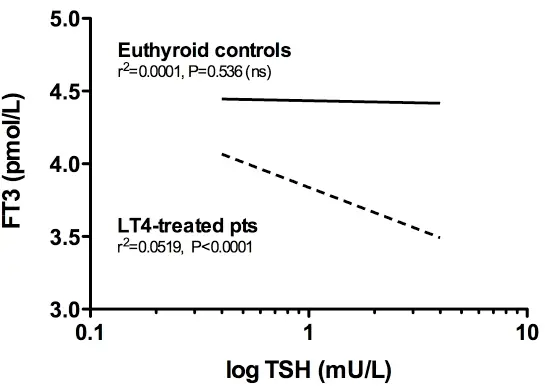
People who have a low TSH from taking thyroid medication may have low, normal, or high free T3/free T4 which differentiates this condition from low TSH (4) caused by overproduction of the body.
Also, those with this condition may have variable symptoms ranging from those of hyperthyroidism to those of hypothyroidism.
#3. Not Enough Production of TSH From the Pituitary Gland
Another reason you may have a low TSH is due to issues directly related to the pituitary gland itself (5).
If your pituitary gland is unable to produce TSH then obviously your levels will fall because your body can’t get it anywhere else.
This condition will always result in both a decrease in TSH and a decrease in circulating thyroid hormones and it’s best to think of this condition on the hypothyroid spectrum.
Emerging information is also showing us that the pituitary gland and hypothalamus are increasingly sensitive to environmental triggers such as the foods that you eat and your weight.
Both of these conditions can alter the amount of TSH and TRH that your brain is capable of producing which will then impact your free thyroid hormones.
Consider this example:
If you are someone who is under a significant amount of stress and you are a frequent dieter (both conditions known to lower the TSH and TRH) your TSH may be falsely low which will reduce
If you didn’t understand that a low TSH could be caused by stress and diet you might be inclined to believe that your thyroid is perfectly normal, even though it isn’t.
For this reason, and many others, it’s important to have a complete understanding of conditions that impact the TSH and how they present.
You can learn more about the way that each of these conditions impacts TSH and cause different symptoms here.
Using TSH to Diagnose Thyroid Problems
It may surprise you to know that there are no fewer than 5 different blood tests that you can run on your thyroid.
Despite this, doctors tend to order only one of those tests.
In fact, the current paradigm of thyroid treatment places a considerable amount of weight on this single test (6).
In other words:
Doctors use this test as a surrogate marker to evaluate thyroid function in your entire body.
We will talk about why that isn’t necessarily a good thing in a moment, but we need to stay on track.
So how does your TSH level alter your thyroid hormone?
This part can be a little confusing but I’m going to try and explain it in a way that makes sense.
Assuming that you are not taking thyroid medication (this assumption is very important) a high TSH usually indicates that you are not producing enough thyroid hormone.
I know what you’re thinking…
How can a high TSH mean that I have low thyroid hormone if TSH is supposed to make my thyroid gland produce more thyroid?
In order to understand this question, you have to understand the concept of feedback loops in the body.
A feedback loop is designed to manage the concentrations of hormones in your body by telling your body to reduce or increase certain hormones based on specific signals.
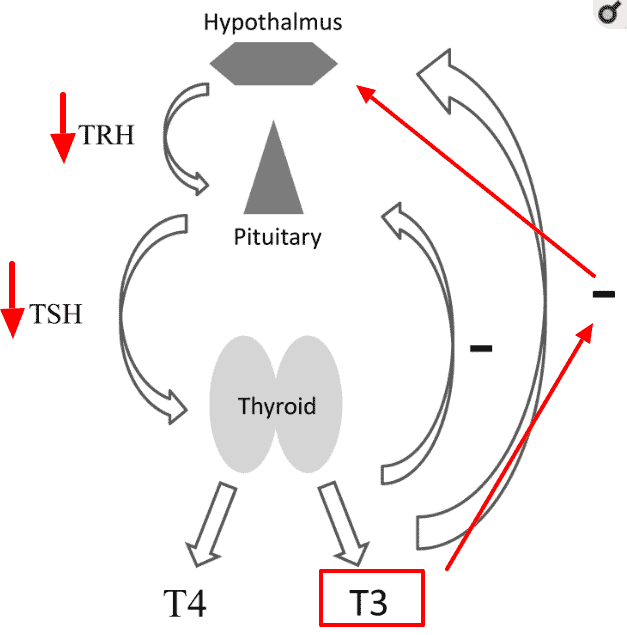
In this case, thyroid hormones which are released from the thyroid circle back to your brain and tell your body that you have ‘enough’.
Your body then reacts by adjusting the TSH.
If your TSH is high, it means that there is a low amount of thyroid hormone in the bloodstream which is coming into contact with your brain.
If the concentration of thyroid hormone is low in the serum then your body will react by increasing TSH to try and force the thyroid to produce more thyroid hormone.
The opposite is true when you have too much thyroid hormone in your body.
As thyroid hormone increases (either because you are taking thyroid medication or because your body is producing it), your brain will react by lowering the TSH to try and reduce the stimulation of the thyroid gland.
This is how a low TSH is often associated with hyperthyroidism and how a high TSH is often associated with hypothyroidism.
Instances Where the TSH can be Misleading
And, if this wasn’t confusing enough, it gets even more interesting.
Just because your TSH is low doesn’t mean that your body is getting enough thyroid hormone.
We often associate a low TSH with a state of hyperthyroidism, meaning too much thyroid hormone, but that isn’t always the case.
I want to spend a large portion of this article discussing states where there is discordance between the TSH and the thyroid status in your body.
Discordance refers to a mismatch between what we expect to happen and what actually happens.
So, when you have a low TSH, especially if you are taking thyroid medication, we expect that to mean that you have too much thyroid hormone in the body.
But this isn’t always true.
There are several states which can cause your TSH to be lowered but where there is an insufficient amount of thyroid hormone in your cells.
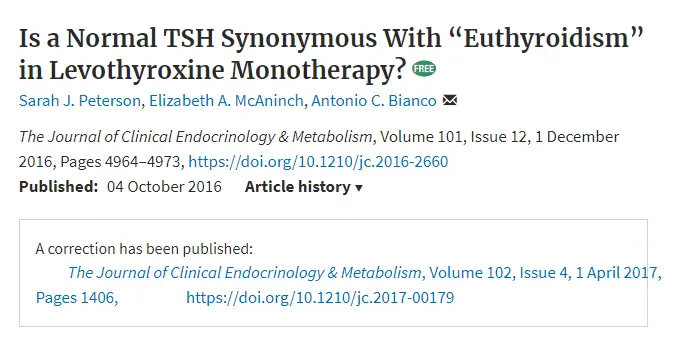
This has been shown in several studies (7) which highlight the difference between healthy individuals and their TSH and what happens to patients who take thyroid medication to normalize their TSH.
Those who take thyroid medication have significantly lower free thyroid hormone levels than controls.
With that in mind, let’s focus on understanding what happens to your TSH when you are taking thyroid hormone and why it doesn’t always mean that you are ‘healthy’.
What Happens to Your TSH When Taking Thyroid Hormone?
It turns out that TSH is a really good predictor of what is happening in the pituitary gland itself, but it doesn’t necessarily tell you how much thyroid hormone is getting into your other tissues.
And this is important because almost every cell in your body has a thyroid receptor.
So TSH would be a great predictor of thyroid function in the body IF your pituitary gland was just like every other tissue in the body, but it isn’t.
Your pituitary gland has special deiodinases which are different than other tissues in the body making it more sensitive to thyroid hormone than other tissues.
What does this mean?
It means that as you give someone thyroid hormone (especially T4) their pituitary gland will sense the thyroid hormone and drop the TSH in accordance.
But your other tissues may not get that thyroid hormone.

This results in patients who have normal or low TSH but still have symptoms of hypothyroidism.
Do all thyroid hormones alter the TSH equally?
No.
And in order to understand this, we need to talk about basic thyroid physiology first.
The two most important thyroid hormones in circulation include T4 and T3.
T4 is the inactive thyroid hormone in your body, but it has the potential to be activated by deiodinases after cleaving off an iodine moiety turning it into T3.
T3 is the ACTIVE thyroid hormone in your body. It turns on genetic transcription resulting in changes to your genes and the production of enzymes in your cells.
Why is this important?
Because most thyroid hormone that is used as a replacement is in the T4 form.
Meaning the thyroid hormone that doctors give you MUST be activated before your body can actually use it.
But here’s where things get interesting:
Your pituitary gland has no problem activating T4 into T3, in fact, it does this quite well.
But other tissues in your body have to compete with an inactive thyroid metabolite known as reverse T3.
Reverse T3 is the ugly stepsister of T3 and directly competes with T3 for binding and turning on genes.
Oh, and reverse T3 is created from T4 just like T3 can be.
So this means, in most tissues in your body, there is a tug-of-war going on between T3 binding and reverse T3 binding.
But this tug-of-war is not happening in your pituitary gland.
This is why basing your dosing decisions on the TSH by itself is not necessarily a wise decision.
So, how does taking thyroid hormone alter your TSH?
Taking either T4 or T3 will reduce your TSH, no question about it.
It turns out that T3 is about 3-4 times more powerful at reducing your TSH than T4 (8) is but they will both reduce it.
So if your TSH isn’t the best way to evaluate thyroid function…. what is?
Using Free T3, Free T4, and Reverse T3 for the Whole Picture
If you want to get a picture of what is actually happening in your thyroid gland then you really need to order more than just the basic TSH.
Ordering and evaluating your free thyroid hormones (like free T3, free T4, and reverse T3) can help give you an idea of what kind of competition exists for binding in your cells.
For instance:
We know that T3 is the “good” thyroid hormone so we can conclude (under normal circumstances) we probably want more free T3 in our body than reverse T3.
Why?
Because if they are both competing for binding in our cells, we probably want the good guy to win.
So it makes sense that if we test your thyroid hormone and you have low free T3 with high reverse T3 that probably isn’t a good thing.
And this condition happens to have a name: thyroid resistance.
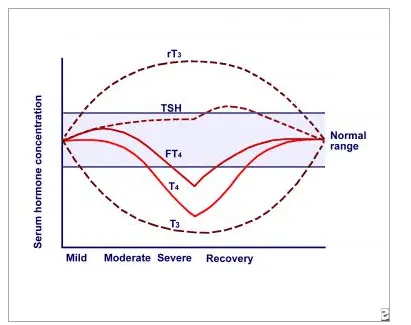
But, what is the TSH doing in situations like this?
Your TSH may be normal in this type of condition making diagnosis difficult.
Because really what is happening is that you have tissue-level hypothyroidism with “normal” blood levels of thyroid hormone.
Now your next question should be: is this common?
And the answer is that yes, it is more common than you think.
Conditions and behaviors such as repeated exposure to stress, yo-yo dieting, fasting, taking certain medications, and exposure to endocrine disruptors can all impact how well your body converts T4 to T3.
The presence of the conditions listed above promotes the conversion of T4 to reverse T3.
You can easily identify the relative levels of each of these thyroid metabolites with the following tests:
- Free T3
- Free T4
- Reverse T3
- Total T3
- Bottom line: You need more than just your TSH to determine what is actually happening in your body. Make sure that you get a complete thyroid panel when evaluating your thyroid function.
What is a Normal TSH?
Even though we know that the TSH isn’t necessarily the best test to use to diagnose or manage hypothyroidism it still has some value.
So what is the ideal TSH level?
Well, that depends on whether you are on thyroid medication or not.
Ideal TSH levels based on your condition:
- Not taking any thyroid medication – Generally healthy populations (not on thyroid hormone) have a TSH between 1.0 and 2.0 (9).
- On Thyroid medication – Your TSH may fluctuate dramatically based on whether you are taking T3 or T4, but in most cases, you will want a TSH that is less than 1.0. This lower TSH is required to obtain close to normal free thyroid hormone levels in those taking thyroid medication (10).
What’s interesting is that the reference range for the TSH ranges from 0.300 to 5.00 in most cases.
But this represents the REFERENCE range, not necessarily the OPTIMAL range.
Focus on the optimal range I’ve listed above if you want to feel normal and you can read more about optimal ranges in this post.
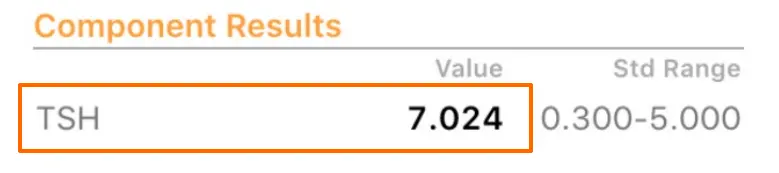
What does it mean if your TSH is low and you AREN’T taking thyroid medication?
If you are NOT taking thyroid medication and you have a low TSH then that truly might be a sign that you are hyperthyroid or have a condition known as subclinical hyperthyroidism.
But this same concept doesn’t necessarily hold true if you are taking thyroid hormone (although it may).
So let’s talk about what can happen to your thyroid while on thyroid medication:
Low TSH but Normal T4 & T3
If you are taking thyroid medication is it possible to have a LOW TSH but normal T4 and T3?
Yes, you can definitely have a low TSH with normal free thyroid hormones.
But what does this actually mean?
If you fall into this category then you will need to use more than testing to determine what is happening in your body.
For instance:
If your TSH is low and your free T4/T3 levels are normal but your body temp is low, your resting heart rate is low and you have all the symptoms of hypothyroidism – are you really “normal”?
The answer is obviously not, and that’s why you need more advanced measurements to determine what is happening in your body.
If, on the other hand, your TSH is low and your free T3/T4 levels are normal but you are having symptoms like heart palpitations or anxiety then it may simply be that your dose is TOO high.
Yes, both conditions can and do happen which is why constant adjustments of thyroid dosing are necessary.
Some people are exquisitely sensitive to thyroid hormone (including even T4 thyroid doses) which can create strange symptoms that may include both a mix of hyperthyroidism and hypothyroidism.
In these cases, it’s best to determine if your symptoms coincide with changing your medication and if other factors (such as body temp, heart rate, etc.) imply your thyroid hormone is too high/low.
- Bottom line: A low TSH with normal T3 and T4 levels may indicate subclinical hyperthyroidism if you are not taking thyroid medication, or a hypothyroid state if you are taking thyroid medication.
Low TSH with Symptoms of Hypothyroidism
Is it possible to have a low TSH but still have symptoms of hypothyroidism?
YES!
As I’ve mentioned previously your TSH only tells you how much thyroid hormone is influencing your pituitary.
It does NOT tell you how much thyroid hormone is influencing your hair follicles, cardiac tissue, skeletal muscles, insulin receptors, etc.
If you don’t have enough thyroid hormone hitting your hair follicles you will have hair loss.
If thyroid hormone doesn’t hit your heart cells then your heart rate will slow and so will your metabolism.
If it doesn’t get into your skeletal muscles then you may present with chronic pain and muscular pain.
If it doesn’t come into contact with your insulin receptors then you may develop insulin resistance.
The list goes on and on.
If you fall into this category then you may simply need more thyroid hormone or you may ultimately need to switch to a different type of thyroid hormone that contains T3.
- Bottom line: You can have a low TSH with symptoms of hypothyroidism. This occurs when your cells are not getting enough thyroid hormone but your pituitary is.
Low TSH and Weight Gain
Is it possible to gain weight with a low TSH?
The answer is ABSOLUTELY.
In fact, this happens all the time.
If thyroid hormone actually made people lose weight don’t you think there would be weight loss clinics pushing thyroid hormone-like crazy?
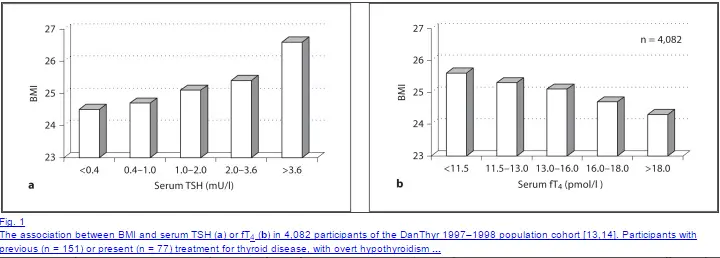
Of course, they would, and the drug companies would be fumbling over themselves trying to patent a new thyroid medication that they could make money from.
You don’t see this happening because thyroid hormone (as a medication) is not a weight loss drug… necessarily.
In most cases, people who are gaining weight with a low TSH usually have 1 of 2 problems (or both):
- T4 to T3 Conversion problems
- Allergies or sensitivities to the inactive ingredients of thyroid hormone (11)
The conversion problem refers to having issues turning T4 into the active thyroid hormone T3.
If your body isn’t good at converting thyroid hormone (from inflammation, infection, medical issues, etc.) then you will have plenty of T4 floating around in your system but very little T3.
The T4 floating around in your system can and will drop your TSH, but it doesn’t mean that it’s necessarily active in your cells.
You can test for this by looking at your free T3/free T4 levels and by evaluating your reverse T3 levels.
If you are having issues with conversion then you can bypass the system by taking medications that contain T3 thyroid hormone-like Cytomel, WP Thyroid, Armour Thyroid, or Nature-throid.
- Bottom line: High levels of reverse T3 can cause your TSH to drop and cause your metabolism to slow resulting in weight gain. To treat this condition you may need T3-containing medication.
Conclusion
Remember that while TSH can be helpful, it isn’t the only (or necessarily the best) way to determine what is happening with your thyroid.
Using a more comprehensive thyroid testing profile in conjunction with your subjective symptoms can help nail down what is actually happening to your body.
When talking about thyroid function it’s important to remember how critical the conversion of T4 to T3 is in regard to how you are feeling.
High levels of reverse T3 with low levels of free T3 may indicate thyroid resistance.
In cases such as these, your TSH becomes less helpful and often is lower than normal.
Now it’s your turn:
Do you have a low TSH?
Are you still experiencing the symptoms of hypothyroidism?
Have you checked your free T3 or Free T4?
What TSH level do you feel “best” at?
Leave your comments or questions below!
Scientific References
#1. https://www.ncbi.nlm.nih.gov/books/NBK285567/
#2. https://www.ncbi.nlm.nih.gov/pubmed/2816972
#3. https://www.ncbi.nlm.nih.gov/pmc/articles/PMC3148220/
#4. https://academic.oup.com/jcem/article/101/12/4964/2765082
#5. https://www.ncbi.nlm.nih.gov/pmc/articles/PMC3169862/
#6. https://www.ncbi.nlm.nih.gov/pmc/articles/PMC5321289/
#7. https://academic.oup.com/jcem/article/101/12/4964/2765082
#8. https://www.ncbi.nlm.nih.gov/pubmed/402379
#9. https://www.ncbi.nlm.nih.gov/pmc/articles/PMC3245392/
#10. https://www.ncbi.nlm.nih.gov/pmc/articles/PMC3148220/
#11. https://www.ncbi.nlm.nih.gov/pubmed/23377335




I’ve been waiting for an article like this…THANK YOU! This should be required reading for all doctors and health care professionals.
Hi Nicole,
You’re welcome and I hope you find it helpful.
I am on synthroid, no thyroid gland. My tsh is .09. T3 and t4 perfect. My tsh dropped when I stopped hurt and had an abundance of estrogen and testosterone. Drank some peppermint tea and tsh dropped and estrogen began to leave body. How to get tsh back to where it should be can endocrinologist put it back some how. Miserable.
I must say this is the best breakdown of TSH that I have ever read online! Thanks.
I m pregnant. Each pregnancy I have low TSH as low as .033 at times my T3 and T4 are normal. I dont experience any hyper or hypo symptoms that I can think of. I m not on medications. I dont eat as well as I should. I m not sure if this is due to my diet or something else. Both of my previous pregnancies my children have speech delays. Should i take thyroid medication to address the low TSH?
Sent you a comment could you please email me info
Hi,
Taking 150mcg thyrax. Test result:
TSH 0.153
FT4 18.96
FT3 2.65
Total Thyroidectomy done year 2015 then radioactive therapy 2016. Now gaining weight from 54 kilos to 68 kilos. Help please. Thanks!
Hi Rachelle,
You can find more info on how to lose weight after thyroidectomy in this guide: https://www.restartmed.com/weight-loss-thyroidectomy/
Hope this helps!
Can low dopamine cause low TSH 0.01 or too much PTU ( antithyroid medication ) cause low TSH level 0.01 thanks
Hi Tekin,
PTU will typically cause your TSH to increase (not decrease).
Thank you so much Doctor you are so kind to reply to my comment. My TSH almost 8 years was 0.01 so PTU wasn’t working? Same dose 300 mg a day! My free t3 and freet4 was up and down but not TSH level!
This is confused me more Doctor! How can be 8 years PTU Antithyroid medication not increase my TSH levels not even 2-3 times I checked my all blood tests results only once 2014 October my TSH was normal or almost normal TSH :1.3mU/L(0.35-4.94) before this blood tests 6 May 2014 :TSH 0.01 (0.35-4.94)
Free t4 was 11.3pmol/L(9-19.1)
Freet3 :5.04pmol/L (3.6-6.5 normal range) 30 June 2015 blood test results was TSH was 0.01 (0.35-4.94)freet4 was 14.4 pmol/L(9-19.1)
Freet3 was :7.66pmol/L (3.6-6.5)TSH so quickly dropped again? strange
i believe im wrongly diagnosed or ignorant doctor not treate me well just watch me suffer for graves disease symptoms low libido ,anxiety,depression ,low mood ,easily get anger
I have hashimotos and am on compounded t4 /t3. I also take an additional t3 in the afternoon because I’m still symptomatic. I recently had blood work and I’m not sure what is going on because my TSH is low free t4 is low and free t3 is on the lowest side of normal. The doctor does not seem concerned so I am not sure where I should go from here.
Absolutely the best explanation of how the thyroid functions.
Thank you so much.
Hi Alex,
No problem! Glad you found it helpful 🙂
Dear Dr. Childs, I have scanned your article and the posts for both very low TSH (.16) and low Free T4 ( .67) but normal or on the higher side of Free T3 (at 4.) These are my labs, over and over again, regardless of how many grains of thyroid I take, or the brand. My doctor has increased them and switched them faithfully but nothing changes. I feel better when I am in a warm, dry climate, not Chicago, but my job and family are here for now so that is where I am stuck. I am basically tired all of the time, cold, on migraine meds, and very low blood pressure and pulse. Thin but not in good shape because no energy to exercise. Any thoughts for why I have this combination of results and what can change it??
Thanks, Martha M
Dr. Child’s
Please help! My TSH 0.01 (never changes no matter what dose of synthroid or armour). Since the last year, my other labs are very high. T4 2.2, T3 5.8, T3 reverse 37
I was taken off all thyroid medication several months ago then I was put on 50 mcg Synthriod because of heart palpitations and increased heart rate. Now my blood pressure is very high. What’s going on with me?
Hi Dr. Westin,
I currently have a tsh of 3.12, t3 2.6 , t4 1.2. My doctor upped my dose 8 days ago and last night I was awake all night, sweating on and off and a lot of anxiety. What really concerns me is I have developed high blood pressure with high heart rate. How soon could I re test to see if my tsh is now too low? I am taking synthroid as I tried to use amour, nature throid and np with no luck. Always had high heart rate and lots of anxiety. Thanks.
Dr Childs, I just got back my results and I have a low .038 TSH, t4 5.9, t3 uptake 28, free thyoxine index 1.7, rev t3 18.0. I have been on natur throid 130mg.for hypothyroid. I was on on Armour 135 and switched 6 months ago. Little concerned because I have been on clean, gluten & dairy free, Keto diet and Im in the 4th month and only lost 10lbs with exercise. If I cheat I gain. I don’t even like sugar Im only 5’1 and gain gain gain I have gone from 135lbs to 170. A glucose serum of 104,231 cholesteral,140 LDL cholesterol, ferritn serum 201,alkaline phosphatase 119.not good….help I’m also woman 59 years old.
Hi Debra,
I have several case studies on my blog that should help you, just poke around for them.
Will I benefit from your 60 day diet plan if I’m already eating a low carb? also if I eat pretzels 1 hour later I’m in hypoglycemic state as I was since I was as my whole life with sugar swings. I need to lose 15 more lbs to be healthy
Low TSH, sub level free t4, just below mid level of ft3.
2.25 grains of naturethyroid. Have tried taking more but felt jittery so dropped back – regardless the free t’s never really move? thoughts?
Hi Andrea,
NDT doesn’t allow for optimal T4 and T3 dosing in most people.
Do you find many with hypothyroid end up needing additional t3 along with NDT? I do take the typical thyroid supporting supplements, etc and while some may help in general, they don’t bring my labs up.
Hi Andrea,
Yes, some people do need T3 + NDT.
Gloria Tks Very informed Lab done 11/01/21 T3uptake 34 : T4 Total 9.2. Free T4 3.1. TSH 0.06L On Meds Synthroid 0.125 McGill Jan 22 TSH 0.1 Med change to Levothyroxin 88mcg March continue on Levothyroxin 88 mcg Lower than 0.1 Have not had a copy of Lab as yet Call placed to Dr office re What plan she has No med No return call Did some research Conyinue to call office No appt for two weeks Out of med Dr not returning calls Please advice Tks
Hi Gloria,
If you are in need of thyroid medication you may want to try an urgent care to see if you can get just a few weeks until you can get in to see your regular doctor or endocrinologist.
Could you expand on this statement? Why not? What is a better way to do optimal dosing in your opinion?
Thank you for this article!!! I will be taking it to my Dr. visit tomorrow. I was feeling OK on Levothyroxine 112 for 8 years and my T4 was always in range but my TSH was .3 so my doctor said I had to take a lower dose of 100, otherwise I would “burn out” and get osteoporosis. The result is hell: Low energy, cold intolerance, hair loss, joint pain, head aches, weird sleep (like I can’t wake up), depressed thoughts for no reason and so on. AND guess what? Now my TSH is a .1 after rising briefly to a .7 back in Dec. I cannot live like this and now want to try ND Thyroid for sure. I also want more testing-they never have checked my free T3 or free T4 since thyroidectomy 16 years ago. I am otherwise healthy and weight 129 at age 53–have always eaten whole foods, mainly vegan with a little dairy and occasional egg. I have educated myself and searched and you are the ONLY doctor I have found that I have total confidence in! You deserve a gold medal for all the wonderful info you are providing to people like me who cannot see you personally. Please accept a HUGE thanks for me, as I now feel that, for the first time in 16 years, I have the knowledge to take my thyroid replacement care into my own hands. As a patient, you have to, sadly, because no one else will.
Thank you–fantastic information. I will bring it to my doctor. I need it desperately as I am an under medicated T4 patient with a total thyroidectomy. You deserve a gold star for all you are doing to help people like me!
Hi Sheriann,
No problem and I hope you find it helpful.
Presented your post to my NP today. She was very impressed and ordered all tests for the first time. Also agreed to try to put me on ND Thyroid which she has never prescribed in 30 years of practice. She was going to “call Walmart” to get a conversion table, but fortunately I already had the conversion table from you:) I am so excited to finally see my free T3 and reverse T3 scores after 16 years of feeling not that great on levo, and even more excited to see how I will finally feel on NDT, which my mom always told me years ago she felt great on. I honestly believe I am one of those people who does not convert T4 to T3 all that quickly. Although my T4 is high and my TSH very low I still have low body tem, cold hands, and pulse of 62 right now during the middle of the day. My blood pressure was only 90/70 to day as well. NP had to admit that this was not 100% normal. Also, I’m glad I also know to raise the NDT dose slowly, because the NP knows nothing about all this–it’s SO important to take responsibility for your own health! Thanks again–will keep you posted.
Sounds good, hope you are doing well.
Thank you so much for this article. It is extremely helpful to me. I am in remission from Graves, was diagnosed 8 years ago. I went into remission when I did “block and replace” on my own. The treatment my endocrinologist was doing, of just the anti-thyroid medication, was not working and she wanted me to have my thyroid removed (I also have graves eye disease although things have resolved). I can’t seem to find a doctor in San Diego who supports me and who will treat me properly. I have had to finagle and be very savvy myself with my medication by doing my own labs personally and making my own dosing decisions. I went hypothyroid a couple of years after going into remission and I now have to take a high dose of Levoxyl (250mcg) and Cytomel (30mcg) but my TSH is still suppressed and basically has never come back from when I was diagnosed with Graves’ disease. My free T4 and free T3 levels are always in the normal range even though my TSH was suppressed. Doctors get very concerned and want me to cut way back on my doses. When I do that I become very symptomatic and I will not live like that again. I live in San Diego and I am looking for a good doctor to treat me and allow me to be treated by my symptoms while keeping my free T4 and free T3 in the upper and of the “normal range” even if I have no TSH. My heart rate is very low 40-55 bpm) very healthy and I’m an athlete. Am I being reasonable? Do you know of any doctors near me who I could see? Thank you so much for any help at all and please please feel free to email me.
Thyroid removed 5/11/15
Was suffering from IBS became pre diabetic a1c 6.0 was on synthroid brand 75 until 8/22/17 TSH jumped from 2.70 to 6.25 so PCP raise dose to 100 and I dropped to .01. Stared seeing ENDO and she dropped me to 100 3 days a week and 75 4 days a week TSH moved to4.25. But still had symptoms of hypo fatigue jitter weight gain or unable to loose weight has continued since the surgery from 160 to 188. Bloating constantly leaky gut. Changed to Tirosint 88 lost all hypo symptoms and felt great stomach problems changed lots of energy checked TSH now back to .01. ENDO is looking to adjust but I really think because of my stomach issues and non ANA lupus that I may not be converting T3 and may need a T3 drug Tirosint seems to have help me the most except for weight gain or unable to lose weight I wish the doctor will suggest that the cytomel may be a good trial because I really thought I was on my way to recovery but it lasted 4 weeks Every person that I meet that does not have a weight problem with no thyroid takes a t4 and a T3 and everyone that is over weight is on a cheap t4 only. I had to make the first doctor put me on the brand synthroid and I pay for it because I stayed at .01 no matter what dose I was on
My gyno requested blood work because of weight gain/stress/anxiety symptoms. The stress is probably because I’ve steadily gained 40 pounds in 12 months. #stillgaining I exercise 4 x per week and eat a balanced diet. I’ve been on 1 grain of Nature Throid for about 6 months with relief of cold hands/temp and joint pain but now my blood work came back TSH .009 and T4 is .9. She told me I am very HYPERthyroid and to go see an endocrinologist (who cant see me for 3 weeks). What could be going on? I went on NDT due to hypo and weight gain and now I’m told i’m hyper with weight gain. Any insight would be appreciated.
Hi Michelle,
You are most likely not hyperthyroid, she just thinks you are because your TSH is slightly suppressed. It’s still very possible to have hypothyroid symptoms with a suppressed TSH.
I agree with Westin Childs (I don’t know what your free t3 is, but that free t4 is NOT elevated at all)! I cannot tell you how many times a doctor has freaked out over my TSH that is exactly your number (totally suppressed). I always retort with, “there is NO WAY I am hyperthyroid with a heart rate of 68, BP of 110/65, normal body temp and free t’s inside the normal range”. These doctors have totally moved away from physical examination and have unfortunately relied on labs only. Sometimes you have to listen to your own body, and what it is telling you, and continue your search for a doctor who is well versed. We need more Westin Childs’!
It’s unfortunate when docs only look at the labs… in pharmacy school they taught us “treat the patient, not the labs.” Lab values are reported as what values are normal for 95% of the population… leaving 5% to be outside of that range but still normal.
Thank you Dr. Childs for such thorough, helpful information. Every GP/PCP/gyny would benefit from reading your tutorial.
Hi D. Ellis,
Yes, very good point. Reference ranges (and RDAs) are based on standard deviations which leave out the bottom 2.5% and the top 2.5% of the population. This guarantees that the standard advice and recommendations given will not be ideal for at minimum 5% of the population total.
Dr- Childs, I am so glad I found your web site, your articles are great!
My problem is that my TSH was suppressed at 0.006 with borderline normal low T4 and T3 in May 2016 when I was on Armour Thyroid 135mcg.
In September my new endocrinologist lowered Armour to 120 and added 25mcg Tirosint. Nothing changed and I knew he would want to lower the dose, so I asked him to switch me to Tirosint only. I was on 175mcg Tirosint and 7.5 Cytomel. TSH stayed at 0.006 and T4 went to 1.76 on a scale .82- 1.77 and T3 3.6 on a scale 2.0 – 4.4. In December 2016 we removed Cytomel and I was on Tirosint 175 for two months. TSH didn’t budge T4 and T3 were 1.83 and 3.7 respectively.
In Feb. 2017 we lowered Tirosint to 150mcg and May 2017 results were, unchanged TSH at 0.006, T4 at 1.35 and T3 at 2.7. I feel great, I am not cold, I have no palpitations, I have decent energy for my age of 55, I exercise regulary, doing cardio and weight lifting.
My endo is worried about me getting accelerated osteoporosis (i was diagnosed with osteopenia last year) and possibly heart problems. I’ve been on AIP since I was first diagnosed with Hashimotos in March 2016 and I put it in remission 4 months later by sticking to the diet.
My next lab is in the beginning of July and I will ask for Reverse T3 test.
I have two questions: if my TSH is suppressed, will I really get accelerated osteoporosis? And secondly, What would you do to get TSH to more normal numbers, closer to 0.4.
I would greatly appreciate your suggestions.
Pika
Hi Pika,
The data doesn’t really support the notion that a suppressed TSH leads to accelerated osteoporosis in most cases.
I discuss how to manage thyroid medications in the private videos on my weight loss program here: https://www.restartmed.com/hormone-mastery/
I am so tired of this osteoporosis line! My TSH was on zero for 7 years when I was hyperthyroid due to Graves. After TT the highest number I ever got was .7, even though I went through a ton of hypo symptoms and a miserable life just to get that:( After a dexa-scan of my hip, they tell me my bones are five years younger than my age (53). And FYI, I haven’t drunk milk since I was 10 years old.
Sheriann,that’s what he said. No data to support low TSH causes osteoporosis to happen any faster than normal.
Drinking milk is not a good way to get calcium.Milk promotes mucus buildup in your lower gut and prevents nutrients such as calcium to aborb into your system. Ionic Fizz Cal/Mag is the best.
Hi Pica-was inspired when I read your story because mine is the same. I had radiation on my thyroid for Graves’ disease two years ago. Now my tsh is low and my T4 and T3 are falling in normal range but I have hypothyroid symptoms. My endo said the symptoms I’m having are not thyroid related. Went to get another opinion at another endo and she suggested I come off my Stmor Thyroid and take Tirosint. She said I may not be absorbing the armor properly and Tirosint is more easily absorbed because it is in s gel form and has only 4 ingredients. I am considering the switch and was glad to hear that you found improvement on it. Thank you for sharing your story.
Dr. Childs,
Apologies in advance for what is sure to be a long winded comment. I just want to share my experience and hopefully give some others who are seeking help some hope that there is a way out of what they’re going through.
Most of all, thank you for your informative website and for talking about the things that thyroid patients such as myself can’t ask their doctors. My endocrinologist runs a specialty thyroid practice at a major academic medical center, and from what I’m told a renowned name when it comes to thyroid care. That said, he did not help me feel better. A very nice man, but also old school. Before turning 40 I never had thyroid issues (i.e. out out of range labs), although had been feeling cruddy since about age 37. Honestly the only reason they paid me any attention this time was because I developed a very rapidly growing nodule and a TSH of 42. After numerous ultrasounds and a couple of biopsies, it was determined I had a benign adenoma. I was also told Hashimoto’s based on the ultrasounds (negative antibodies). I was started on T4 only, which did bring down my TSH to within “reference range”.The nodule shrank somewhat, but was still very, very visible on my neck. I’m a healthy weight (5’8″ ~137 lbs) but my bone structure is such that i have a long scrawny neck of someone much thinner. I elected to have a partial thyroidectomy because I couldn’t deal with walking around looking like I’d swallowed half a tennis ball. The surgical path was reviewed by the hospital’s tumor board, and stated findings “consistent with Graves”. When I questioned the surgeon (after downloading the report myself), he told me not to worry about it and that it was likely just a mistake. What could I say? He was the head of endocrine surgery. Never got an answer on that particular issue.
This was a couple of years ago, and I’ve since relieved my endo of his duties, and found a clinical nurse specialist who has been very open to treating me according to what is hopefully become a more accepted paradigm. I tried Armour which unfortunately didn’t work and now take T4, and generic Cytomel. I’ve also struggled a great deal to get my Ft3 and Ft4 as high as the low end of the references range. After getting even more discouraged after my most recent results I found your website. Thanks to the additional information you provided I had some other labs tested. My iron saturation is 15%, Ferritin is 14, B12 and D also at lower ends of their ranges. I think you get the idea. Additionally, even even though I was taking my thyroid meds 30-45 minutes before food, I often took them with black coffee (whoops!). I’ve forwarded sections of your website and various posts to the nurse specialist that prescribes my meds and for the first time in a long time I have hope that making some concrete changes regarding supplementation and how I take my meds, might help me to feel better.
Apologies again for the long post, but too often we are discounted by physicians, and I can’t tell you how much I appreciate your efforts to help those of us who live too far away to see you in person.
Hi Melissa,
Thanks for your comment and I’m glad you found it helpful. I hope you are able to start feeling better with this information.
I also appreciate your detailed info and support. It helps us all to learn from each other! Thanks for sharing.
Hello Dr. Childs! I have been watching your videos on Youtube as well as reading the articles on the website. Moreover, this is the first time I ran into such good attitude towards the patients, because many doctors do not pay attention to their feelings.
I think you’re doing great job out there! 🙂
However, I do have a question; I understood the main point of doing the physical examination first, to do the hormone tests. Unfortunately, right now I do not have the opportunity to do the tests (long story).
So the question – Is there any possible way to lose up to 6-7 kilograms in 2 weeks? Because there is nothing I tried and it worked…e.g. Intermittent Fasting, HIIT..etc
I have been struggling with my weight for really long time. Apparently, I am on the medication – Euthyrox 125 mg, still feel tired, sleepy and didn’t return to my normal weight( I do not eat much). The dose of Euthyrox is set by the doctors (in the last 3-4 years doctors increased it from 75 mg to 125 mg). The last I went to the doctors, they said that the T3 & T4 were in the norm.
Hi Kamiki,
It will probably be impossible and unhealthy to lose 6-7 kgs in 2 weeks. Any diet that you find that will result in that kind of weight loss in that amount of time will ultimately cause metabolic damage and you will regain the weight back over a few months. You can find more information about how to lose weight safely and effectively in my weight loss program here: https://www.restartmed.com/hormone-mastery/
Thank you very much!!!
I believe that’s typically my case , am hypothyroidism and am on levo 150 …my levels were ok but am always tired and hv mood swings ,cant loose weight no matter how hard i diet and exercise,my T3 and ft3 were low so i tried to get cytomel from canda ,uk or usa or thybon henning from germany as all T3 medications are not available in the middle east but wasnt able to get without prescription,
Lately i hv been facing extreme pain in my muscle it is spasmed all the time am extremely tired ,getting up a couple of stairs is a challenge for me,i gained weight and my body is bloating and full of water although(was diagnosed with fibromyalgia)i dont eat that much
So my last lab test was as follows
TSH 0.005
T3 96.28
FT3 3.04
FT4 1.91
Anti TPO 62.6
Anti TG less than 2.4
My doctor lowered my dose to 100 levo ,what is your tips/recommendations for me ?! Should a try to get Cytomel or not?!
Hi Soha,
You really need to get your reverse T3 checked in addition to SHBG to determine what is happening with thyroid hormone in your tissues.
Actually those 2 tests are not done here in EGypt?! Any other recommendations?! Should i go for cytomel or stick wz that lower dose 100 levo?! Thanks for all ur great tips and replies, i really do appreciate
Hi Soha,
Those tests can be done if you live in Egypt, I know because I have at least 2 patients from Egypt and they were able to get them done.
Ok thanks may be i should ask in another lab. ,do u hv online appointments?! How much i should i pay your good self to get a full diagnosis and recommendations?!
I am about 35lbs over weight, age 49.female. A couple of months ago the weight just started adding on and isn’t stopping.
I was prescribed 90mg of Armour twice a day last year and taken off cytomel.
I’ve recently seen a nurse practitioner in an Interogative Hormone practice. I’m not happy with her follow up and I’m not feeling any better. She told me to cut my Armour in half so take it once a day. Also, not a thyroid problem but an adrenal problem.
I think it looks like thyroid resistance and I’ve never been able to convert my T3’s properly.
But what to do?
Ultra sound findings, right thyroid lobe measures 4.3×1.6×1.5 cm and left lobe 3.9 x 1.7 x 1cm. Isthmus measures up to 0.2 cm AP.
Moderate diffuse heterogeneity of the thyroid parenchyma without discreetly lesion or any definite hypervascularity. No lymphadenopathy.
Impression: Moderately atrophic and heterogeneous thyroid likely sequela of chronic thyroiditis, without discrete nodule or hypervascularity.
Here are my labs…
TSH .006
T4 10.3
Free T4 1.61
Reverse T3 31.5
Free T3 8.5
Sex Hormone binding glob, serum 185.4
Leptin 26.1
Thyroid antibodies
Peroxidase 102
Thyroiglobulin antibodies 39.3
Saliva DHEAS 1.7
Saliva cortisol 5.7 morning, 1.4 afternoon, .9 evening, .7 before going to sleep
Saliva Estradiol .9
Progesterone 29
Ratio: Pg/E2 32
Testosterone 15
Hi Sarah,
I would be evaluated for peri menopause/menopause with FSH and LH testing, it’s also likely that you have thyroidal damage due to chronic inflammation from hashimoto’s. In cases of chronic damage to the thyroid gland thyroid serum levels seem to be relatively preserved but these patients stand to benefit significantly from thyroid hormone replacement.
My Lh was 20.1
And my FSH was 33.6
Aren’t those normal levels.?
What is thyroid hormone replacement?
Thank you so much for responding.
My medical doctor said I was to complicated so she is sending me to an endocrinologist on the 22 of this month.
I am currently on 90 mg of Armour
Sarah, The same thing happened to me years ago. I went from being a normal weight to 45 lbs overweight! It turned out I was peri-menopause AND Estrogen Dominant. One of the symptoms is also weight gain and very tender bloated breasts. My breasts almost felt like when I first began breastfeeding my daughter they were that swollen and sensitive. Anyway, I know your comment is 1.5 yrs old, i just wanted to reach out to you. My NP put me on Natural Hormone Replacement Therapy. It changed my life! Bio-identical Progesterone Oil that you rub on areas of your body with low fat(inner forearms,behind the knees etc) It was a life changer for me! I also went on DHEA as I was extremely low. I really hope you feel better 🙂
When you discuss high RT3 – how high is high? I went to see an endo a couple of weeks ago….and as you can imagine it didn’t go very well. She didn’t even want hear anything about RT3, nor my left-over symptoms of HPA axis dis-regulation. I’m certain that my hypothyroidism was driven by my adrenal crash 2 years ago. My sex hormones are still low (I’m working on it). I’m still on 48.75 mg of Nature-Throid, but I’ve been watching my RT3 and it has historically been over 15 ng/dL (ranging from 15 – 19.3). But at the same time my FT3 to RT3 ratio was over 20 in 2015 and was under in 2016. I do not want to be or become thyroid hormone (T3) resistant. How do I reverse this? Is it recommended to titrate down my Nature-Throid, and get off?
Hi Candace,
You can find a complete guide to evaluating and treating reverse T3 in this post: https://www.restartmed.com/reverse-t3/
Thank you so much! I think I may have read it already….but I’m going to go read it again! 🙂 I really appreciate your time and all the informative articles that allow us to take responsibility for our own health.
No problem, hope it helps!
Hi,been attending endo because concerned re cognitive issues/fatigue/aches/low mood.Long term Hashimotos. Have been taking t4 long term, 100mcg
Now also 15mcg t3 per day. If I stop t3 I become even more forgetful.
Latest blood tests- tsh 0.145 free t4 19.1 tt3 1.3
temp very low without t3. Mood & energy/motivation better with t3 but as it’s quick release I take several small doses.Not due appointment for 3 months.
I would like to know if all my hair follicles are dead can my hair grow back with treatment as I am going bald and wear wigs and scarfs to hide it
Susan
I take t4 and t3, but I still have trouble loosing weight. I recently had blood test on my progress which also included my Estrogen and Testerone . My Estrogen was 130 and Tesrterone was zero. I understand once you have been Menopause, I am 68, Estrogen levels usual drops to 75. Do you consider 130 to high and if so, could this be causing me to hold onto weight around my middle and hips.
Hi Rosemary,
The hormone changes associated with menopause do contribute to both weight gain and weight loss resistance, so it is possible.
Dr. Westin
I am a walking thyroid problem. I was diagnosed with my thyroid prob in 2006, and just in these recent weeks I have learned so much from you. So much that these doctors at Palo Alto Medical Foundation do not know. I need help, YOUR help. Your view and guidance on what I am missing or what I need to do to help me feel better and help me with my weight problem. At PAMF I just get the run around and all they say is take your medication(levothyroxine)but nobody understands exactly how horrible I am feeling. Initially I was diagnosed w Graves’ disease, I had the radioactive iodine tx, but my TSH levels are rarely ever stable they fluctuate, so I never feel good/normal/stable. I am now considered hypothyroid. I just need some guidance and help from u(if in any way by phone consult or in person) I am in San Jose California, but I would totally fly to Az to seek your help. I know your practice is closed and I could see why(you are great)but pls I ask for you to consider my case and pls pls pls make an exemption. I would forever be grateful. Please help me…..I’ve searched for help here in Ca but we aren’t as lucky as Az…we don’t seem to have someone like you here.
I am 49 years old and I have graves disease. I am gaining weight and very miserly. How or what should I be doing to stop the weight gain, I am taking thyroid medication 10 mg. 2 pills a day.
Hi Anna,
That’s a very complex question without a straightforward answer, but you can find more info here: https://www.restartmed.com/hormone-mastery/
Hi Dr Childs
I am on WP thyroid 81.25mg since December 2016 and just had my blood test done about 2 weeks ago and my test results are as follow:
TSH : 0.12/L (low)
Free T4: 0.9 ng/dl
Free T3: 2.9 pg/ml
Prior to December i was on WP 65mg and my TSH was also suppressed (0.18 L) and my free Ts were still same (low normal) as what they are now. I would really appreciate if you can tell me the possible reasons why i am not able to improve my free Ts even when my doctor increased the dosage from 65mg to 81.25 mg? Any suggestions to what i can do to help increase my free Ts as i am still having hypo symptoms?
Thank you
Anila
Hi Anila,
You can find info on how to increase your free T3 levels here: https://www.restartmed.com/increase-free-t3-naturally/
Hi Dr. Childs:
I had the left side of my thyroid removed on 3/13/17. I was taking armour 30mg in the am, 45 in the pm. Felt very tired. lab work numbers are below six weeks after sugery.(Ive always had a very low free T3) which is the reason I don’t take synthroid.
TSH: .83 range (.400-4.500)
FT4: .6 range (.7-2.0) – Low
FT3: 2.4 range (2.6-4.4) – low
Switched me to WP thyroid 81.25mg a day. still tired, cant lose weight. Want to try cytomel. Dr says increasing my meds would be malpractice because my TSH is to low. what are your thoughts? Thanks! Kelly
Hi Kelly,
The current standard of care is to treat based on the TSH, so your doctor isn’t completely incorrect in his assertion that it will be malpractice. That being said the TSH is a rather poor predictor of tissue levels of thyroid hormone and so dosing really shouldn’t depend upon the test in isolation. The best thing to do is find a physician more willing to work with you.
Hi, i am 30old,man,For years I have symptoms like; Hair loss, chronic fatigue, keratoconus, sleeplessness , waking sleep rhythm alterations. Mental tiredness, anxiety or depressive sensations, feelings similar to depersonalization! I did the blood tests for the thyroid and the result was; Tsh 3.88, ft4 1.20, ft3 3.87. No autoimmune disease. Thyroid morphologically normal but i have a nodule of 1.7cm. The doctor says I have subclinical hypothyroidism and I have to take 50mcg levothyroxine right away.i have tryed to take tiche50mcg (t4only) ut i was very bad with fatigue,anxiety, depressed mood. So I took for 21 days 33mcg of naturethroid, for a few days I felt more energy and not tired! But I felt a bit nervous inside. I did not have palpation or tachycardia. After 7 days I did not feel nervous and slept better, I had an increase in energy and well being on alternate days! I used 250mg of rodhiola for adrenal fatigue and I felt weak and fatigued and sedated! I stopped the rodhiola. I also passed to 25mcg of synthetic t4 / t3 (ibsa 33mcg), I felt much better physically and mentally! !!! Serene stable and positive mood. I increased the dosage from 33 to 66mcg t4 / t3 synthetics and I started to feel very bad! Extreme fatigue, weakness, depressed mood. The physician has returned me to the 33-mg dose for 2 days, but I’m still sick and I’m afraid not to go back as before. What can be the cause? Thank you very much for your site. I graduated in chemistry and pharmaceutical technologies. i write from Italy.
Thank you very much for this and similar articles you wrote. They helps to understand what is going on with our thyroid. Is there any article about high TSH but normal fT3 and fT4 (according with your info that should be in the last third of range). Taking 63mg of Thiche (only syntetic T4), feeling is terrible, very fatigue. Also my ferritine level is at the bottom (22, but since is higher than recommended minimum -20- there is no additional Ferrum prescribted). Any way taking New Iron (medicinalis) one tbl per day for 4 months already but the situation is not better. Thanks for recommendation!
Hi Janja,
I don’t really understand your question. A high TSH would indicate that your thyroid is sub optimal, so there really wouldn’t be a need to write an article about this because you are by definition hypothyroid. The low TSH state is more confusing to patients than a high TSH state.
Hi Dr Childs and thank you. I am working with a doctor and he thinks the reason that even 5 mcg of liothyronine added to my 88 mcg of levothyroxine makes my rt3 come down, ft3 comes up but I have hyperreflexes and symptoms of hyperthyroid. Very low tsh
But antibodies very high tpo 178 TgAb 2100. And we cannot get them down. So we’re addressing my exhausted adrenals, yeast, inflammation in my gut. So no more liothyronine for now until these other things are addressed. But only 1 month off liothyronine I am severely hypothyroid. Would just a very small amount of liothyronine help while addressing these other issues. I believe he’s on the right track but my situation is very complex. He is very open to my research, what I have learned from all of your information on Facebook, Pinterest and my gmail updates. I wonder if you could help by suggesting some other areas to address.
Hi Marsha,
I discuss how to add and titrate thyroid medication in the private video section of my weight loss guide.
Thank you Dr Childs.
Hello Dr. Childs,
I am a little confused about TSH levels. I had thyroid CA in 2000, and had a total thyroidectomy and followed by I131. Never been able to loss weight until this past year. Changed my died and workouts. I only each chicken, fish, veggies and very limit carbs. I also work out 5-6 times a week with 1 of the workout being a 4-6 hour hike.
Lost about 70 lbs. Blood work always good until April. My blood work came back with a TSH of 3.7 and T4 1.78. Dr. lowered my medication and now my blood work is TSH 5.8 and T4 1.8. I always thought that my TSH should be lower a suppressed.Can you tell me what my TSH should be. I am now having a very hard time working out. Fatigue, muscle and joint aches, and over all not my normal self. Second question can a diet and workout change the way you absorb your medication or the amount you may need?
Thank you,
VC
Hi VC,
The higher the TSH the lower the thyroid hormone is in your body. It seems odd to me that your physician would lower your thyroid medication with a TSH in the 3 range, I’m not sure what the logic behind that decision is. In regards to your other question, yes it’s felt to be protected to suppress TSH levels post thyroidectomy for thyroid cancer in most cases. The reason is that we are always unable to remove the complete thyroid and the nature of thyroid stimulating hormone is to stimulate thyroid tissue, so TSH would theoretically be adding fire if some thyroid tissue had cancer in it.
Hello !Doctor Childs I want to share to you that my mother is suffering a thyroid disease which she already consulting to the doctor almost 6 month already but her thyroid has no changes .Again the doctor requesting another Tsh and t4 this is already the 3rd time request of her doctor. I want to know what does it mean. And doctor said if she willing to be have operations , but my mother want to take only medicine because she is afraid of operation.
Hi Albert,
I would suggest starting with a complete thyroid count (which is outlined in this post).
Dr Childs – thank you for the information in your article and the clear way in which it was written. After radiation therapy on my thyroid two years ago for Graves’ disease, I find myself with a low tsh, normal t3 and t4 but terrible hypothyroid symptoms which fluctuate but never go away. After my last lab, my endo basically told me my symptoms can’t be thyroid related because the numbers do not indicate that. I did go see another endo who suggested I switch from Armor thyroid (120 mg) that I’m on to Tirosint. She believes I may have an absorption issue and would do better on this. She did agree that my tsh is not going to be a good indicator in my case. I don’t think they have checked my reverse T3 and I would like to ask you if that is something I should have checked or would that not play a part in my case since I’m presently on Armor thyroid which includes the T3. Could reverse T3 still play a part or no, since I’m on Armor with T3. Thank you.
Hi Donna, like you I’ve had a super low TSH (.1) while having “normal” T3 and T4 and I always feeling very hypothyroid (cold, tired, etc.) I’ve gone through lots of switches and they don’t change much, but one thing did seriously change from levo to armour and that was that RT3 went from 34 (real bad!) to 16 (normal). That was a big improvement. But you are already on armour or T3, I realize. I wish I knew like people like us have such low TSHs with everything else normal and we still don’t feel good.
I’ve had hashimoto’s for a number of years and have been relatively stable on 50ug t4 and 5ug t3. Tried Armour 15 and did very poorly both mentally and physically(under-dosed in my opinion). Improved immediately by going back on prior t3/t4 dose. New doc doesn’t approve of t3 and I’ve tried to go to t4 only but each time I develop joint/muscle/tendon issues and dr. says there is no correlation, although she agreed to keep me on t3 unless my tsh numbers dropped too low. And now they have (0.16, 0.27-4.2 range). I agreed to try lowering t4 to 25ug and a week later I’m noticing increased joint pain, muscle weakness etc. This Dr won’t run any labs but tsh. Can you give me any logical explanation why my tsh might crash without any medication changes?
rT3 was high when I first started t3/t4 and was low a year ago; thyroid antibodies were also high in the beginning and within normal a year ago. Total t3 was low (.76, .80-2 range) about 6 months ago. Tsh used to be a fairly constant 2ish until I tried the Armour but has been steadily dropping after going back to my “old” routine.
Hello. My TSH has been rising over the past year, it went from .8 to 4.5. Even at .8 I’m still just really fatigued and gaining weight. Now I’m at 4.5 and they just want to shove saxenda and contravene down me. They say if I just lost weight my synthroid would work better. I’m 5’3″ and 176 lbs. I have asked over and over about T3 and reverse T3 and they say that has nothing to do with hashimoto. They see hashimoto as an autoimmune disease that you just have to treat with synthroid and that antibodies never go down and is something you will just have for the rest of your life. I go to Oklahoma Heart Institute! The endocrinologist I see there even teaches endocrinology at OU. Why do they not see that T3 is part of the thyroid?
Hi Kassia,
Using T3 just isn’t in the current treatment paradigm. It doesn’t matter if your endocrinologist is Harvard trained, teaches at Hopkins or does cutting edge research – they don’t believe T3 should be part of thyroid treatment so they simply won’t prescribe it. It’s difficult for patients to understand, but that is just how endocrinologists practice thyroid management.
I have an upcoming appointment with my Endo doctor but they will not allow me to get the blood test you recommend (says insurance will decline it), only a partial listing of the ones you mentioned. I would like to go out and purchase all the suggested labs myself, what website do you recommend that has the ability for the patient to select and purchase their own labs. All of my thyroid was removed about 12 years ago so I rely completely upon medication. I have never had some of the suggested levels mentioned checked so definitely want to after reading your article.
Hi,
I’m always hesitant to write about my thyroid issues, because I tend to fall outside of the norm on most things. For one thing, I’m very underweight. I have a body mass index of 16.8. I’m 5’3″ tall and weigh 95 pounds. In that I eliminated wheat gluten and grains, my diet is restrictive, but the fact is I’m not dieting. I simply am not hungry most of the time.
Typically, I have been able to sleep at night after Chinese herbs, some supplements, low dose naltrexone was used for my autoimmune issues, and multiple infectious agents were discovered/treated naturally. I’m still in treatment though.
However, last year, I begin having nightmares, waking with panic, and eventually, I started waking at all hours of the morning. I generally can’t sleep until 1:45 am or 2 am. Trust me when I say that forcing the issue makes it worse.
I always have my doctors test for most of what you recommended except the leptins. That’s new to me. Here are my current results with the range listed first and my results in parenthesis. By the way, my thyroid was fully destroyed in 2003. I had them check via ultrasound to see if there might still be tissue. I was told no. Although I don’t think ultrasound is definitive, nothing could be observed through scan.
I’m about to go crazy, because I’ve tried Cytomel when my free T4 was a lot lower and I had “normal” TSH but high reverse T3 levels. Doses much lower than 5 mcg caused me to have twilight sleep for two months before I called it good.
What can you recommend? My doctor isn’t knowledgeable about how to deal with reverse t3–she said that to me directly. I have never met one endocrinologist that could help me either, and because I asked questions, seeing one in town is now impossible anyway. Do you have thoughts? Anyone like me on your blog? I added selenium. Zinc made me sick so I’m trying to add that through juicing. Effectively, I’m force feeding right now. I have both hypo and hyper symptoms. Not much hair loss though, but the fatigue is unreal. Normally, I can escape through sleep and avoid this type of anxiety. I felt like this when I was told I had autoimmune Graves’ disease. I was later told it might have been Hashi’s also. Sorry for the long post!
T3, Total
60 – 181 ng/dL (102 ng/dL)
Free T4
0.89 – 1.76 ng/dL (2.09 ng/dL)
Free T4 (Ref)
0.89 – 1.76 ng/dL (1.93 ng/dL)
T3, Reverse
9.0 – 27.0 ng/dL (26.8 ng/dL)
TSH
0.33 – 4.70 uIU/mL (0.04 uIU/mL)
What if you have no TSH, a normal T4 but a high T3? No one ever seems to cover this combination. Everytime my doctor say it’s because I have too much T3 medicine but any time they reduce it I can’t function and my cycle is HORRIBLE! It’s bad no matter what but it’s a nightmare when my medicine is lowered. I’m taking Liothyronine at 25 mcg and levothyroxine at 0.125 Mg. There’s more but I’ll just leave it at that. Any tips are welcomed.
Dr. Child’s,
I have a free T3 of 2.5, a TSH of 3.0 and all the symptoms of hypothyroid. I was put on the teeniest dose possible of naturethroid and within a week it sent me hyper with terrible heart palps and racing pulse. Does this mean I am probably not a candidate for the meds if such a tiny amount did this?
Thank you!
Hi I’m on 137.5 levothyroxine and 15 liothyronine. My levels are TSH .01, FT4 .7, FT3 3.3. Where do I go from here♀️
Please and thank you
Dr. Childs,
Thank you for the information.
Is there any risk with having low TSH, if T4 and T3 levels are almost normal? I take NDT and would like to continue to raise my free T4 and T3 levels, but the TSH looks low.
Free T3: 2.86
Free T4: .69
TSH: .091
Appreciatively,
Barbara
Hi Barb,
I don’t recommend treatment based on numbers alone, you just end up chasing the wrong target.
Everytime I open up something on the web site I found something different to think about. I have hyperthyroidism but after 8 mo on Methamizole I stopped taking it. I got a severe rash and itch on my entire body. Lost a lot of hair after 3 months on medication. Extreme heat intolerance and weight gain on a under 5 foot woman’s frame. I switched doctors now and am going to Winthrop hospital for a 3rd opinion. I found out that if you have a hot nodule you can have half of your thyroid removed without taking Synthroid. I don’t tolerate medication very well since I had parts of my intestines and bladder removed. Any suggestions. My T3 range was 200, and my T4 tange was 1.1 My TSH came back as a 0.03 out of range. What does this mean?
I’m confused. So it is possible to have a low TSH and a normal Ft4 after medication, but still you have symptoms that indicate hypothyroidism? That seems to be happening to me. After medication switch (because of production failure of the old medicine) my TsH dropped to 0,29, while my FT4 is still 23. But my body tells me my thyroid is working to slow. Weight gain, feeling down, hair loss, tired, etc. What to do? I just decided to go back to my old brand and dosis, because it became available again. I don’t feel like my practitioner takes my problems serious. Last time I talked to her about my weight struggles she referred me to the hospital for a gastric bypass. Not only is my BMI to low to be considered for such an operation (but to high to be considered not obese), but also my kcal intake hardly exceeds 1750 on a daily basis 🙁
Hi Martine,
Yes, it is very possible to have a low TSH (or normal TSH) and still be hypothyroid. The general idea is that the TSH gives you a marker of thyroid status in the pituitary but does NOT give you information about other tissues in the body.
So your pituitary may be getting the feedback that there is sufficient thyroid hormone reaching your pituitary gland, but that doesn’t mean there is sufficient in other tissues in the body.
So what should I do then? How can I check the thyroid status in other parts of the body?
Is it by testing my blood for FT3?
Daughter diagnosed with hashimotos and put on .75mcg Levo, recent labs
FT4 .84
TSH .11
FT3 2.8
D3 31
She is cold, tired, gaining weight, fatigues easily, pale in coloring. Has mthfr gene mutation one copy
I had thyroid cancer and had both of my thyroids removed in Aug ’15, my levels have not balanced out since then. First my T4 and TSH was too high. Now my TSH is 0.006 and my T4 is 3.45. My medication (Unithroid and Synthroid) have been adjusted 6 times. My endocrinologist suggests a body scan next if my levels are still LOW.
Hi Nette,
Your situation is not uncommon, it may take some time to find the right balance for you (but remember medication is never as good as the “real deal”).
Thank you great article!!!
I just started going to a new doctor because I have new employer paid insurance.They tested my TSH only, not T3&4. Even though I asked for all three.Then made the assumption that I need less thyroid medication. I know I will have symptoms of hair falling out, cold hands cold feet and fatigue if they lower my dose. I have been dealing with this for 20 years and my last doctor understood what you are saying that the TSH is not a good indicator and was giving me a slightly higher dose of thyroid which made my TSH .03.
How can I explain what you are saying to this new doctor without upsetting her because in my past experience doctors do not like being told they are wrong! 🙂
Hi Jenn,
You won’t have much luck trying to explain any of this to a conventional physician. You will have the most luck looking outside of the insurance model and searching for a physician who specializes in hormone management. Conventional physicians are set in their ways and have very little to no interest in changing how they practice.
Thank you for your informative site. I have been on thyroid med for more than 15 years… Armour years ago switched to compounded T3/4. Since moving to AZ (2 years ago) I have had lab and symptoms all over the board… long story short prescribed various WP/Nature Thyroid and now back 90 days on compounded time release veg cap Avicel filler… the Nature Thyroid suppressed my TSH to .006… Hence put back on compounded T3/4 ~ 27/140… 90 days later now my TSH remains .006 Free T4 1.28, Free T3 3.6. My doctor is taking me off ALL medication for a month to “reset and retest” concerned about the abnormal suppression of TSH… I do not have Hyper symptoms… I too am concerned about the severe suppression but T3/4 are the best ever! I have researched over many years… am well versed but am at a complete loss! I do not want to feel so bad again due to no meds. I am 59 y/o menopausal on Bioidentical HRT (troches and Progesterone). Thank you for all that you do!
Hi Susan,
I can’t imagine a scenario where you suddenly feel great after stopping all medications, but that is between you and your current physician. I think you will likely find that you will always feel better with a somewhat suppressed TSH but they won’t want you to be there so they will constantly switch your medications around.
Hi there, I am in the U.K. Diagnosed in 2001 in February my doctor said my blood tests were too high and had to go down to 100mg of Thyroxine. Results were
T4. 24.1. Range (8.0-19.9)
TSH. 0.02. Range (0.30-5.50)
T3. 3.9. Range (2.5-5.7)
It’s now 23rd September and I am so tired, headaches, arms aches difficult to lift tendons sore, back aches and leg pains swelling behind right knee. My brain does not get things right and my eyes are sore I fall asleep during the day even when taking to someone.
Today I saw my doctor and told him how
I was feeling and could I gave a test. He said no, I did one in May. But I have been on the lower dise since February. In 2001 they same thing happened and he put me up to 125mg. Afterwards I felt better again. He didn’t bother to test me to see my levels then. Don’t know why he refuses to follow either now.
I am not sure what to do, do you think it is the thyroid or some other depletion?
Thank you I found your above article very enlightening.
Gail
Hi Gail,
Most likely your symptoms are related to thyroid function, especially if they began after you lowered your dose. The hard part is getting your Doctor to keep you on a dose that improves your symptoms.
So how can I make him understand that my body is not functioning on the lower thyroxine?
I realise it’s not getting into my tissues. My tendons in arms and legs are catching and painful as well. I find I can do the exercises I could six months ago as my body has become stiff! I have now bee injuring myself when previously I had been fine! Feeling helpless!
Hi Gail,
It will be very difficult to convince your physician to change your management or treatment, most patients find that it’s instead easier to look for a new physician or another specialist.
Thanks for the reply. So in other words they want us unable to function so they can dish out more pills by saying you are depressed, or physcotic and put you on those drugs.
I get the picture Agenda 21 rings a bell!
Hi!!
I have been telling my doctors allll of this for years. It is so hard for me to FEEL “therapeutic” my numbers can say whatever they want but I know my body. I usually feel good at 1.0 or below. I was pregnant and they increased my meds and now I delivered and was out of my meds and I am all screwed up. Its so annoying. Insurance has also forced me to try generic even though when I had my thyroid removed I tried and failed on them and have been on brand since..
I increased my cytomel from 10 to 15. My tsh went down (suppressed as expected) but my t3 also went down (from 3.2 to 2.8). Any ideas why t3 went down? Thank you for your time. Greatly appreciate it.
I am 72 year old women with total thyroidectomy for non-cancer reason. I have been on 88 microgram of Synthroid for a while. I have excessive sweating for a while, also. However, thyroid function tests have been alright until now, when TSH (not-reflexed) is low at 0.22 (reference range of 0.47-4.68), T3 is low at 72 (reference range of 76-181) and free T4 is low normal at 1.1 (reference range of 0.8-2.2). Do I have to adjust the dose of Synthroid ? If yes, lower or higher dose ? I’d appreciate it greatly if you answer these questions to my e-mail address.
Had more labs done. Confused at my doctors office calling and saying they are good.
TSH was at 2.21 in 2015, 1.55 8-’17, is now .52 9-’17.
(Range .53-5.65, optimal .53-1.5)
FreeT4 was at 1.46 in 2015, 1.2 8-’17, is now 1.2 9-’17.
(Range .68-1.92, optimal 1.3-1.92)
FreeT3 was 3.0 in 2015, 2.5 8-’17, is now 2.9 9-’17.
(Range 2.2-3.9, optimal 3.475-3.9)
My doctor had me on 75 Levo raised to 88. Put me on 5 Cytomel and raised it to 2 x’s per day. I still am feeling very fatigued, brain fogged, and have had a few heart flutters. Any suggestions?
Hi Deb,
If your physician isn’t willing to change your medication then you can take steps to increase your T3 levels naturally, you can learn more here: https://www.restartmed.com/increase-free-t3-naturally/
I have pretty much felt absolutely miserable and have gotten worse over the last 8 years. I have been on Levo. The whole time I have Hashimoto and my doctor has never tested my reverse T3 and basically she told me that my TSH was a normal range so there was nothing else she could do for me. I am wondering if I have a issue With my adrenal glans.I have been to 2 endocrinologist and my GP in the last 8yrs how is it possible for an endo to be so unaware. Why do most endo so unwilling to order these test and to prescribe t3. While on levo i felt horrible it effected my memory and all sorts of other issues the only thing it seemed to help was my inlarged goiters and my hair loss. If I have a super stressful busy day I spend the next day on the couch paying for it. Help
Hi Angela,
The good news is that you can start right away with some basic therapies to help. I would recommend that you sign up for my email list to get the 3 day meal plan, and then start with at least 1-2 supplements designed to either increase adrenal function or improve T4 to T3 conversion. From there you can ask for a complete thyroid panel and further understand what is happening in your body.
Hi Dr child’s. I really need some advice. My sistuation at the moment is this. I was diagnosed with Hypo 4 years ago. My TSH was 39.5 Gp started me on 50 levothyroxine did not explain the condition just take this and all your symptoms will be sorted. However non of my stmymotoms have changed and I am at this point severely fatiguiged daily migraines. Hair loss ( excessive) eye twitches leg spasams back problems pains also in my back when my kidneys are I have bouts of constipation then bouts of diareaha. I have feeling of something pressing on my throat. And my voice is very deep and only yesterday my voice totally disappeared. (It is back today) my body aches and I feel as though I have weights on my legs and arms.i have vision problems which I had before diagnosis but seem to get worse once starting on the Levo. I can not focus properly and vision is blur and I have flashing lights. The week before my period my body feels 100% worse! I can not focus mthe migraines are so bad I throw up! I feel and this is no exaggeration like I’m dying! Following the inictial 39.5 TSH all other TSH were coming back in range. However 5 months ago week before my period I noticed the symptoms I’ve just explain above are worse and I wasn’t recovering once my period had finished. So this is 5 months on to the day of those symptoms and I went to see GO he again ran TSH and said the hair loss was probably anemia. Results came back after just two days and No anemia but TSH was 28.5 he called to say he was upping my meds to 150 and I’ve been taking them as unstructured. I have asked repeatedly for FT3 FT4 RV T3 bloods to be done and he refuses. Keeps telling me it’s my Thyriod I just need to see how I go on higher dose of Levo. I have read your above article and watched listened to the video and it makes perfect sense about the limitation with TSH testing only. I have also watched your video concerning suppliments and found it amazingly in lightening about deficiencies not only causing these symptoms built making patients worse if the are lacking in those you stated. Please could you advice me further on how I can get some help. I am in the UK and its such a struggle as I have found most GP’s here are all of the same thinking!! Thank you for such honest and open information. This has given me a clear understanding and some hope!
So good to read this article. I have been chronically ill since 2011 and am bed bound, hardly able to walk, severe fatigue, dizzy, headaches, muscle, bone and joint pain, gut issues – the list goes on. I have been trying to get my FT4 and FT3 into range since 2011. I was diagnosed with Hashis in 2007. I do not convert T4 very well. However, I cannot tolerate T3 either and have tried everything suggested to improve but to no avail. I do have inflammation and infections from a tick bite (Lyme and co-infections). I’m at my wits end trying to figure why I can’t utilise my thyroid meds. I’m curretnly taking 75mcg and 100 mcg of Levo alternatively. I add in just 1mcg of T3 twice per day. However, I’m not well on it. My labs always come back with FT3 below range. I can’t tolerate NDT’s and don’t know how I can overcome this problem. My entire skeleton hurts and I wonder if my thyroid issues are contributing to my osteoporisis – is that possible. I know that my lyme is making me ill too so I get very confused. I live in the UK and there are no doctors who understand my thyroid or lyme – there are no lyme doctors and thyroid doctors just look at the TSH and T4 and do not take much notice of the FT3 as they believe that the pituitary and TSH are all that is required. So relieved to read an article like this but regular doc will not accept it so I have a battle to try and get well. Any ideas?
Cherie, I don’t know if I’m suppose to comment, but if there’s a chance that I can help another struggling with thyroid issues, I have to try.
Two things could be happening.
The T4 that your taking could be unable to convert into T3, or it could be converting into RT3.
I understand that taking T3 medication can make you feel unwell, but in my experience, if you stick with it your body will adjust and what you feel as negative side effects from the T3 will diminish.
(If you have high blood pressure and/a high resting pulse, keep a close eye on them while taking T3).
Personally, I would highly suggest getting your vitamin D levels and calcium levels tested. If they come back with low vitamin D, and high calcium, definitely get your PTH levels checked, as this presentation could lead to a diagnosis of hyperparathyroidism, (which isn’t that difficult to cure, and could make you feel much better, especially regarding the bone pain. My thoughts are with you. -London
Dr. Child’s, I don’t think my Nature Thyroid is working for me. Do I just need to increase the dose or change to a different medication? I’m exhausted, my muscles hurt and I’ve gained 15 lbs. I had my thyroid removed in 2009. Thank you.
6/16/17
TSH – .9
FT3 – 2.5
FT4 – .69
130mg of Nature Thyroid
10/03/17
TSH – .238
FT3 – 2.5
FT4 – .77
162.5 mg of Nature Thyroid
My thyroid was surgically removed a couple of years ago. I am taking synthroid. My TSH was 0.24.I am 5’2″ and weigh 111lbs. Can the synthroid cause me to be slender because I have lost weight?
I have been taking synthroid for 19 years since my thyroid was removed when I was 12 due to a benign nodule. Recently, my free T3 and free T4 have been normal but my TSH has been 22-25. My endocrinologist thinks I should start taking T3 (cytomel*). I am wondering if I may have a pituitary problem. I feel great, no symptoms. Do you have any thoughts on this? Thanks in advance.