
What Your Low TSH Means With Thyroid Medication & Without

What Your Low TSH Means With Thyroid Medication & Without

Key Takeaways

  • A low TSH doesn't automatically mean you have enough thyroid hormone in your cells. Your pituitary gland is more sensitive to thyroid hormone than other tissues, so TSH can be low while peripheral tissues remain hypothyroid.
  • Always request Free T3, Free T4, and Reverse T3 testing in addition to TSH, since high reverse T3 with low free T3 indicates thyroid resistance that a normal TSH completely misses.
  • You can have a low TSH with symptoms of hypothyroidism if your cells aren't receiving adequate thyroid hormone, which may require switching from T4-only medications to combinations containing T3.
  • Stress, yo-yo dieting, and fasting promote conversion of T4 into reverse T3 instead of active T3, causing weight gain and fatigue despite a suppressed TSH.
  • Check additional markers like body temperature, resting heart rate, and symptoms to confirm your actual thyroid status rather than relying on TSH alone when adjusting medication.

Would it surprise you to know that you can have a low TSH but still be hypothyroid? 

This situation is not uncommon and may be occurring in your body right now. 

On the flip side, a low TSH can also be an indicator of hyperthyroidism. 

Your TSH can be a helpful tool in evaluating thyroid function in the body but it certainly isn’t the only tool (and it isn’t even the best). 

This article will help you understand how to evaluate your TSH, what causes a low TSH, and what it means if you have a low TSH while taking thyroid medication: 

What Does your TSH Actually Mean?

First things first. 

We need to talk about what your TSH actually is and what causes it to change. 

Once we discuss these things it will be easier to understand the more complex aspects of this hormone. 

But first, let’s start with some basics: 

TSH, which stands for thyroid stimulating hormone, is a hormone secreted by your pituitary gland and is a part of your endocrine systโ€‹โ€‹em

a diagram of the hypothalamus, pituitary, and thyroid gland highlighting the role that TSH plays.

As the image above shows, TSH is only a part of the entire thyroid regulatory system. 

It’s supposed to target your thyroid gland directly which results in the production of thyroid hormone (both T3 and T4) from the gland.

Basically, it does exactly as its name suggests: stimulates thyroid hormone from the thyroid gland.

So, why is this important?

If your TSH is low then it will not be stimulating your thyroid gland and you will have low levels of circulating thyroid hormone. 

3 Main Causes of Low TSH

Now that you understand what the TSH does in the body we can discuss conditions that may cause your TSH to be lower than normal. 

When evaluating your TSH there are 3 primary conditions that can alter your TSH and lead to a low TSH: 

#1. Too much thyroid production (Endogenous Hyperthyroidism)

The most common cause of low TSH is the condition known as hyperthyroidism. 

Hyperthyroidism is a medical condition that causes abnormal production of thyroid hormone that exists outside of the normal feedback loops meant to protect this from happening. 

The most common cause of this condition is the autoimmuโ€‹โ€‹ne Graves’ disease which is probably the main reason that you may experience a low TSH (1). 

If your body produces too much thyroid hormone then that thyroid hormone will feedback to your brain and it will naturally respond by reducing the TSH to try and protect against too much thyroid hormone. 

Identifying a low TSH caused by hyperthyroidism is quite easy because the TSH will be low and the free T3 will often be high (2).

In addition, you might also see the presence of thyroid-stimulating immunoglobulin in the bloodstream. 

We won’t focus too much on this today because the diagnosis and management of hyperthyroidism are relatively easy compared to the other conditions we will discuss. 

#2. Too much thyroid medication (Exogenous Hyperthyroidism)

Another increasingly common condition that may lead to a low TSH is the use of prescription thyroid medications. 

If you take thyroid medication by mouth, it will be absorbed by the gastrointestinal tract and hit your bloodstream. 

From there it will circulate to your brain where it will tell your body to produce less TSH. 

As you take thyroid medication you are effectively shutting off the normal feedback loop which exists to produce thyroid hormone because your body doesn’t need to produce it anymore. 

This is both a good and a bad thing. 

Good if your thyroid can’t produce thyroid hormone, and bad because it can make interpreting your thyroid lab tests more confusing as you shut off the normal production of thyroid hormone. 

Even as you take thyroid medication your body will still be able to produce some natural thyroid hormone, but this amount will slowly decrease as you increase the amount of thyroid medication that you are taking. 

The idea that taking thyroid medication drops the TSH is incredibly important because it’s how many Doctors determine if your dose is ‘sufficient’. 

The problem with this approach is that newer studies have shown that TSH doesn’t always do a good job at predicting if you have enough thyroid hormone (3) in your body and that is one of the major reasons I am writing about this topic. 
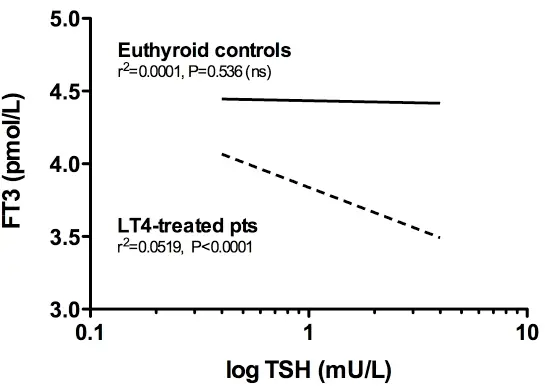
graph showing which compares Ft3 levels to the TSH in patients with normal thyroid function and in those being treated with levothyroxine.

People who have a low TSH from taking thyroid medication may have low, normal, or high free T3/free T4 which differentiates this condition from low TSH (4) caused by overproduction of the body. 

Also, those with this condition may have variable symptoms ranging from those of hyperthyroidism to those of hypothyroidism. 

#3. Not Enough Production of TSH From the Pituitary Gland

Another reason you may have a low TSH is due to issues directly related to the pituitary gland itself (5). 

If your pituitary gland is unable to produce TSH then obviously your levels will fall because your body can’t get it anywhere else. 

This condition will always result in both a decrease in TSH and a decrease in circulating thyroid hormones and it’s best to think of this condition on the hypothyroid spectrum. 

Emerging information is also showing us that the pituitary gland and hypothalamus are increasingly sensitive to environmental triggers such as the foods that you eat and your weight. 

Both of these conditions can alter the amount of TSH and TRH that your brain is capable of producing which will then impact your free thyroid hormones. 

Consider this example:

If you are someone who is under a significant amount of stress and you are a frequent dieter (both conditions known to lower the TSH and TRH) your TSH may be falsely low which will reduce 

If you didn’t understand that a low TSH could be caused by stress and diet you might be inclined to believe that your thyroid is perfectly normal, even though it isn’t. 

For this reason, and many others, it’s important to have a complete understanding of conditions that impact the TSH and how they present. 

You can learn more about the way that each of these conditions impacts TSH and cause different symptoms here.

Need More Help? Get My Perfect Thyroid Diet Meal Plan (+ Shopping List)

Join 200,000+ thyroid patients and get the plan by email right away.

Using TSH to Diagnose Thyroid Problems

It may surprise you to know that there are no fewer than 5 different blood tests that you can run on your thyroid. 

Despite this, doctors tend to order only one of those tests. 

In fact, the current paradigm of thyroid treatment places a considerable amount of weight on this single test (6). 

In other words: 

Doctors use this test as a surrogate marker to evaluate thyroid function in your entire body. 

We will talk about why that isn’t necessarily a good thing in a moment, but we need to stay on track.

So how does your TSH level alter your thyroid hormone?

This part can be a little confusing but I’m going to try and explain it in a way that makes sense. 

Assuming that you are not taking thyroid medication (this assumption is very important) a high TSH usually indicates that you are not producing enough thyroid hormone.

I know what you’re thinking…

How can a high TSH mean that I have low thyroid hormone if TSH is supposed to make my thyroid gland produce more thyroid?

In order to understand this question, you have to understand the concept of feedback loops in the body. 

A feedback loop is designed to manage the concentrations of hormones in your body by telling your body to reduce or increase certain hormones based on specific signals. 
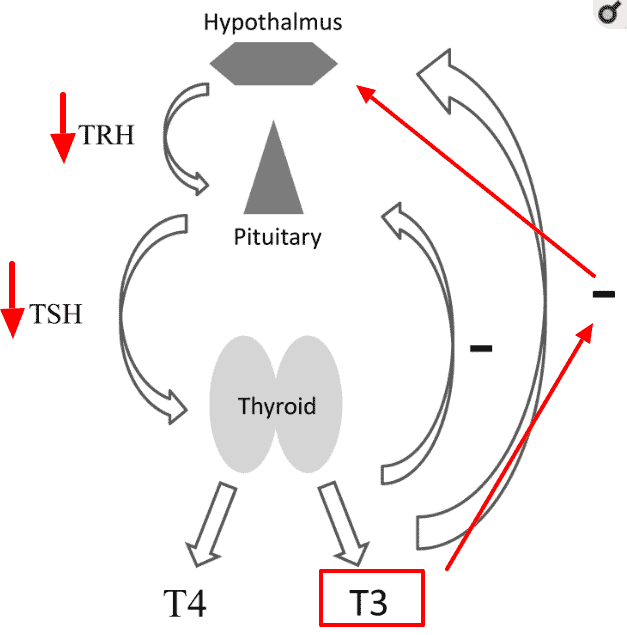
Figure of the hypothalamus, pituitary, and thyroid gland and the impact that T3 thyroid hormone plays in the feedback loop.

In this case, thyroid hormones which are released from the thyroid circle back to your brain and tell your body that you have ‘enough’. 

Your body then reacts by adjusting the TSH. 

If your TSH is high, it means that there is a low amount of thyroid hormone in the bloodstream which is coming into contact with your brain. 

If the concentration of thyroid hormone is low in the serum then your body will react by increasing TSH to try and force the thyroid to produce more thyroid hormone

The opposite is true when you have too much thyroid hormone in your body. 

As thyroid hormone increases (either because you are taking thyroid medication or because your body is producing it), your brain will react by lowering the TSH to try and reduce the stimulation of the thyroid gland. 

This is how a low TSH is often associated with hyperthyroidism and how a high TSH is often associated with hypothyroidism.

Instances Where the TSH can be Misleading

And, if this wasn’t confusing enough, it gets even more interesting. 

Just because your TSH is low doesn’t mean that your body is getting enough thyroid hormone. 

We often associate a low TSH with a state of hyperthyroidism, meaning too much thyroid hormone, but that isn’t always the case. 

I want to spend a large portion of this article discussing states where there is discordance between the TSH and the thyroid status in your body. 

Discordance refers to a mismatch between what we expect to happen and what actually happens. 

So, when you have a low TSH, especially if you are taking thyroid medication, we expect that to mean that you have too much thyroid hormone in the body. 

But this isn’t always true. 

There are several states which can cause your TSH to be lowered but where there is an insufficient amount of thyroid hormone in your cells. 

This has been shown in several studies (7) which highlight the difference between healthy individuals and their TSH and what happens to patients who take thyroid medication to normalize their TSH. 

Those who take thyroid medication have significantly lower free thyroid hormone levels than controls. 
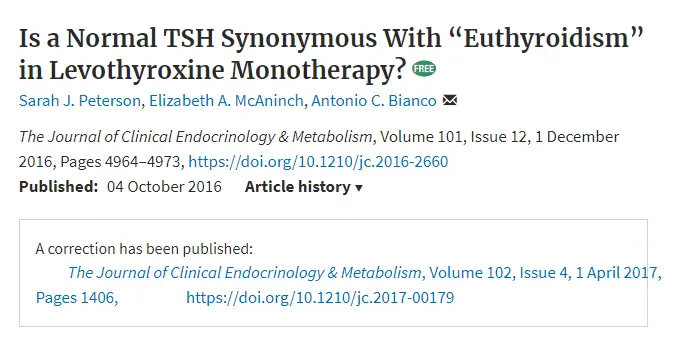
research study discussing the idea that a normal TSH means euthyroidism when taking levothyroxine monotherapy.

With that in mind, let’s focus on understanding what happens to your TSH when you are taking thyroid hormone and why it doesn’t always mean that you are ‘healthy’. 

What Happens to Your TSH When Taking Thyroid Hormone?ย 

It turns out that TSH is a really good predictor of what is happening in the pituitary gland itself, but it doesn’t necessarily tell you how much thyroid hormone is getting into your other tissues. 

And this is important because almost every cell in your body has a thyroid receptor.

So TSH would be a great predictor of thyroid function in the body IF your pituitary gland was just like every other tissue in the body, but it isn’t.

Your pituitary gland has special deiodinases which are different than other tissues in the body making it more sensitive to thyroid hormone than other tissues.

What does this mean?

It means that as you give someone thyroid hormone (especially T4) their pituitary gland will sense the thyroid hormone and drop the TSH in accordance.

But your other tissues may not get that thyroid hormone. 

shop thyroid support supplements that can help you get back to feeling 100% again

This results in patients who have normal or low TSH but still have symptoms of hypothyroidism.

Do all thyroid hormones alter the TSH equally?

No.

And in order to understand this, we need to talk about basic thyroid physiology first. 

The two most important thyroid hormones in circulation include T4 and T3.

T4 is the inactive thyroid hormone in your body, but it has the potential to be activated by deiodinases after cleaving off an iodine moiety turning it into T3. 

T3 is the ACTIVE thyroid hormone in your body. It turns on genetic transcription resulting in changes to your genes and the production of enzymes in your cells.

Why is this important?

Because most thyroid hormone that is used as a replacement is in the T4 form.

Meaning the thyroid hormone that doctors give you MUST be activated before your body can actually use it.

But here’s where things get interesting:

Your pituitary gland has no problem activating T4 into T3, in fact, it does this quite well. 

But other tissues in your body have to compete with an inactive thyroid metabolite known as reverse T3.

Reverse T3 is the ugly stepsister of T3 and directly competes with T3 for binding and turning on genes.

Oh, and reverse T3 is created from T4 just like T3 can be.

So this means, in most tissues in your body, there is a tug-of-war going on between T3 binding and reverse T3 binding.

But this tug-of-war is not happening in your pituitary gland.

This is why basing your dosing decisions on the TSH by itself is not necessarily a wise decision

So, how does taking thyroid hormone alter your TSH?

Taking either T4 or T3 will reduce your TSH, no question about it.

It turns out that T3 is about 3-4 times more powerful at reducing your TSH than T4 (8) is but they will both reduce it.

So if your TSH isn’t the best way to evaluate thyroid function…. what is? 

Using Free T3, Free T4, and Reverse T3 for the Whole Picture

If you want to get a picture of what is actually happening in your thyroid gland then you really need to order more than just the basic TSH. 

Ordering and evaluating your free thyroid hormones (like free T3, free T4, and reverse T3) can help give you an idea of what kind of competition exists for binding in your cells.

For instance:

We know that T3 is the “good” thyroid hormone so we can conclude (under normal circumstances) we probably want more free T3 in our body than reverse T3. 

Why?

Because if they are both competing for binding in our cells, we probably want the good guy to win.

So it makes sense that if we test your thyroid hormone and you have low free T3 with high reverse T3 that probably isn’t a good thing.

And this condition happens to have a name: thyroid resistance

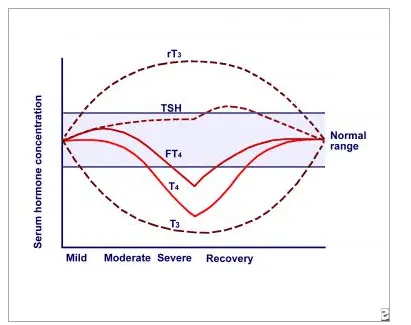
A graph of thyroid hormone concentration and disease severity with various thyroid lab tests listed that highlights how they change with disease severity.

But, what is the TSH doing in situations like this?

Your TSH may be normal in this type of condition making diagnosis difficult.

Because really what is happening is that you have tissue-level hypothyroidism with “normal” blood levels of thyroid hormone.

Now your next question should be: is this common?

And the answer is that yes, it is more common than you think. 

Conditions and behaviors such as repeated exposure to stress, yo-yo dieting, fasting, taking certain medications, and exposure to endocrine disruptors can all impact how well your body converts T4 to T3

The presence of the conditions listed above promotes the conversion of T4 to reverse T3. 

You can easily identify the relative levels of each of these thyroid metabolites with the following tests: 

  • Free T3
  • Free T4
  • Reverse T3
  • Total T3
  • Bottom line: You need more than just your TSH to determine what is actually happening in your body. Make sure that you get a complete thyroid panel when evaluating your thyroid function. 

What is a Normal TSH?

Even though we know that the TSH isn’t necessarily the best test to use to diagnose or manage hypothyroidism it still has some value. 

So what is the ideal TSH level?

Well, that depends on whether you are on thyroid medication or not.

Ideal TSH levels based on your condition:

What’s interesting is that the reference range for the TSH ranges from 0.300 to 5.00 in most cases. 

But this represents the REFERENCE range, not necessarily the OPTIMAL range.

Focus on the optimal range I’ve listed above if you want to feel normal and you can read more about optimal ranges in this post.
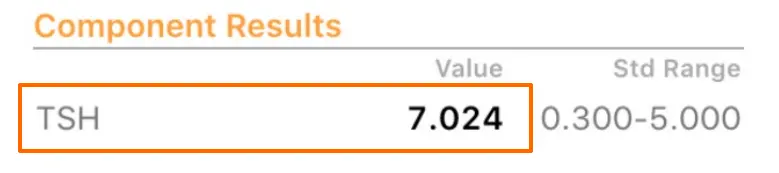
an example of a high tsh thyroid lab test in a patient with hypothryoidism.

What does it mean if your TSH is low and you AREN’T taking thyroid medication?

If you are NOT taking thyroid medication and you have a low TSH then that truly might be a sign that you are hyperthyroid or have a condition known as subclinical hyperthyroidism. 

But this same concept doesn’t necessarily hold true if you are taking thyroid hormone (although it may).

So let’s talk about what can happen to your thyroid while on thyroid medication:

Low TSH but Normal T4 & T3

If you are taking thyroid medication is it possible to have a LOW TSH but normal T4 and T3?

Yes, you can definitely have a low TSH with normal free thyroid hormones.

But what does this actually mean?

If you fall into this category then you will need to use more than testing to determine what is happening in your body.

For instance:

If your TSH is low and your free T4/T3 levels are normal but your body temp is low, your resting heart rate is low and you have all the symptoms of hypothyroidism – are you really “normal”?

The answer is obviously not, and that’s why you need more advanced measurements to determine what is happening in your body.

How To Tell If It's Really Your Thyroid: Get My Hypothyroid Symptoms Checklist

Get the PDF. Check off your symptoms. Find out in 60 seconds if it's your thyroid (or something else).

If, on the other hand, your TSH is low and your free T3/T4 levels are normal but you are having symptoms like heart palpitations or anxiety then it may simply be that your dose is TOO high. 

Yes, both conditions can and do happen which is why constant adjustments of thyroid dosing are necessary.

Some people are exquisitely sensitive to thyroid hormone (including even T4 thyroid doses) which can create strange symptoms that may include both a mix of hyperthyroidism and hypothyroidism. 

In these cases, it’s best to determine if your symptoms coincide with changing your medication and if other factors (such as body temp, heart rate, etc.) imply your thyroid hormone is too high/low. 

  • Bottom line: A low TSH with normal T3 and T4 levels may indicate subclinical hyperthyroidism if you are not taking thyroid medication, or a hypothyroid state if you are taking thyroid medication. 

Low TSH with Symptoms of Hypothyroidism

Is it possible to have a low TSH but still have symptoms of hypothyroidism?

YES!

As I’ve mentioned previously your TSH only tells you how much thyroid hormone is influencing your pituitary.

It does NOT tell you how much thyroid hormone is influencing your hair follicles, cardiac tissue, skeletal muscles, insulin receptors, etc.

If you don’t have enough thyroid hormone hitting your hair follicles you will have hair loss.

If thyroid hormone doesn’t hit your heart cells then your heart rate will slow and so will your metabolism

If it doesn’t get into your skeletal muscles then you may present with chronic pain and muscular pain.

If it doesn’t come into contact with your insulin receptors then you may develop insulin resistance.

The list goes on and on.

If you fall into this category then you may simply need more thyroid hormone or you may ultimately need to switch to a different type of thyroid hormone that contains T3. 

  • Bottom line: You can have a low TSH with symptoms of hypothyroidism. This occurs when your cells are not getting enough thyroid hormone but your pituitary is. 

Low TSH and Weight Gain

Is it possible to gain weight with a low TSH?

The answer is ABSOLUTELY.

In fact, this happens all the time.

If thyroid hormone actually made people lose weight don’t you think there would be weight loss clinics pushing thyroid hormone-like crazy?
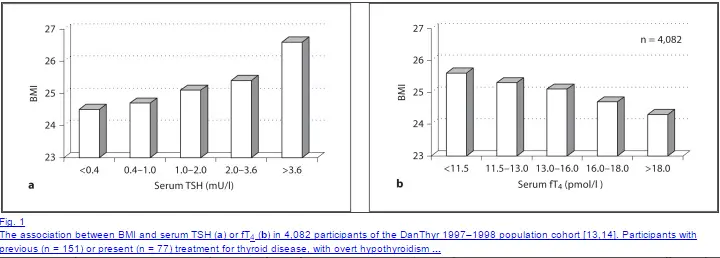
two graphs which show the connection between TSH and free T4 levels and how they change with increasing and decreasing body mass index.

Of course, they would, and the drug companies would be fumbling over themselves trying to patent a new thyroid medication that they could make money from. 

You don’t see this happening because thyroid hormone (as a medication) is not a weight loss drug… necessarily. 

In most cases, people who are gaining weight with a low TSH usually have 1 of 2 problems (or both): 

The conversion problem refers to having issues turning T4 into the active thyroid hormone T3. 

If your body isn’t good at converting thyroid hormone (from inflammation, infection, medical issues, etc.) then you will have plenty of T4 floating around in your system but very little T3.

The T4 floating around in your system can and will drop your TSH, but it doesn’t mean that it’s necessarily active in your cells.

You can test for this by looking at your free T3/free T4 levels and by evaluating your reverse T3 levels. 

If you are having issues with conversion then you can bypass the system by taking medications that contain T3 thyroid hormone-like Cytomel, WP Thyroid, Armour Thyroid, or Nature-throid.

  • Bottom line: High levels of reverse T3 can cause your TSH to drop and cause your metabolism to slow resulting in weight gain. To treat this condition you may need T3-containing medication. 

Conclusion

Remember that while TSH can be helpful, it isn’t the only (or necessarily the best) way to determine what is happening with your thyroid. 

Using a more comprehensive thyroid testing profile in conjunction with your subjective symptoms can help nail down what is actually happening to your body.

When talking about thyroid function it’s important to remember how critical the conversion of T4 to T3 is in regard to how you are feeling.

High levels of reverse T3 with low levels of free T3 may indicate thyroid resistance.

In cases such as these, your TSH becomes less helpful and often is lower than normal. 

Now it’s your turn:

Do you have a low TSH?

Are you still experiencing the symptoms of hypothyroidism?

Have you checked your free T3 or Free T4?

What TSH level do you feel “best” at?

Leave your comments or questions below! 

Scientific References

#1. https://www.ncbi.nlm.nih.gov/books/NBK285567/

#2. https://www.ncbi.nlm.nih.gov/pubmed/2816972

#3. https://www.ncbi.nlm.nih.gov/pmc/articles/PMC3148220/

#4. https://academic.oup.com/jcem/article/101/12/4964/2765082

#5. https://www.ncbi.nlm.nih.gov/pmc/articles/PMC3169862/

#6. https://www.ncbi.nlm.nih.gov/pmc/articles/PMC5321289/

#7. https://academic.oup.com/jcem/article/101/12/4964/2765082

#8. https://www.ncbi.nlm.nih.gov/pubmed/402379

#9. https://www.ncbi.nlm.nih.gov/pmc/articles/PMC3245392/

#10. https://www.ncbi.nlm.nih.gov/pmc/articles/PMC3148220/

#11. https://www.ncbi.nlm.nih.gov/pubmed/23377335

low tsh on thyroid meds? don't freak out yet pinterest image.

picture of westin childs D.O. standing

About Dr. Westin Childs, D.O.

Hey! I'm Dr. Westin Childs, a former Osteopathic Physician (D.O.) who transitioned from traditional clinical practice to specialize entirely in helping people like YOU overcome thyroid problems, hormone imbalances, and weight-loss resistance. I am passionate about researching and sharing evidence-based solutions, and I formulate specialized thyroid supplements that have been trusted by over 100,000 patients over the last 10 years. You can read more about my own personal health journey and why I am so passionate about what I do.

P.S. Here are 4 ways you can get more help right now:

#1. Get my free thyroid downloads, resources, and PDFs here.

#2. Need better symptom control? Check out my thyroid supplements.

#3. Sign up to receive 20% off your first order.

#4. Follow me on Youtube, Facebook, TikTok, and Instagram for up-to-date thyroid tips, tricks, videos, and more.

322 thoughts on “What Your Low TSH Means With Thyroid Medication & Without”

  1. I take a t4 and t3 combo Med. My tsh is almost 0 but my t4 is still low, t3 is normal but still very very hypo feeling! No reverse t3 or antibodies to anything. What is going on!?

  2. My levels are in the low range of normal after taking armour thyroid..but I’m feeling anxious,and have pain..dr says I need to increase my Zoloft…

  3. Hello.
    I started synthoid about 6 weeks ago. My tsh is almost 6 and t3 was 82. After 6 weeks my tsh went down to 1.5 but t3 went down to 70. What does that mean?
    Thank you in advance

  4. On Armour Thyroid for several years. Can’t find a physician who really understands thyroid function. My last TSH level was 0.006. Doc said that’s too low & reduced my dose. How low can TSH be and not be too low?

  5. Having difficulty getting my medications right. I felt better when my TSH was higher around 2.32 and my T3 and T4 though continued to be too low. My Dr. Put me on Synthroid 0.50mcg and took me off of the Levothyroxine 0.25mcg and I was on a compounded T3 15mcg and I felt better then but now I feel like I am dying. I feel like i need to go back on the Levothyroxine I dont think the Synthroid is my drug I am having double vision and diarrhea with this and things are going down hill.
    My last numbers TSH 0.55, T3 3.7 and T4 3.6 Any suggestions

  6. I feel best when my TSH IS 3. When it drops to 1, I can barely function, gaining 3+lbs of fluid, depression, extremely dry skin, hot & cold temps, flushing of face when active, cold nose, hands & feet. I’m barely functional. Yet many say I should not be taking so much Synthroid (250 mcc daily) & I’d be healthier if Tsk is 1. I’m confused.

  7. Have been experiencing Thyroid disfunction for past couple of years. First diagnosed with Hashimoto’s and then re-diagnosed not having Hashimoto’s. I do have food sensitivity and food triggers. I calculated my T3 and RT3 ratio from blood draw on 08/08/2017 indicating 22 from a Ft3 2.8 pg/mL and RT3 12.7 ng/dL. My TSH 1.830 uIU/mL. My Ft4 0.69 (LOW) ng/dL. TBG 19 ug/mL and (TPO) AB 10 IU/ml.Thyroglobulin <1.0 IU/mL. My FT4 0.69 ng/dL (LOW). My medication: Generic T4 75mcg once daily and Generic T3, 5mcg two tablets in morning and two tablets at lunch. I like my FT3 and RT3 ratio above 20 and my TSH between 1.0 and no higher than 2.0 uIU/ml.
    My current lab work as of 12/21/2017 after increasing my T4 medication to 100 mcg. daily and same does of T3 5mcg, 2 tablets twice a day is as follows: TSH dropped LOW to 0.030. I am concerned! My ratio of T3 and RT3 dropped as well to 17.9. I am concerned with that drop as well. My FT4 has gone up to 1.30 ng/dL. I am pleased with FT4 indicator going up. My TBG is same as last lab work 19 ug/mL. My physician is very good and understands that I may have difficulty converting T4 to T3 medication as my liver experienced Hepatitis C when I was young. I am a practicing vegan dietetic measures and prefer not to go Paleo dietetic measures (I understand that Paleo might be better for my thyroid health challenge. I will see my physician in a few days and am confident with outcome. I will ask if we might bump up T3 meds regarding RT3 FT3 ratio dropping under 20 and discuss his opinion on big drop of TSH. I am functioning well on medication and observe I am not tired and sleepy and yawning as prior to medication., Thank you for your concern.

  8. Great article – very informative.

    My wife has had hypothyroidism for 20+ years. She has been on T4 with gradually increasing doses over the years. Recently her FNP checked her TSH and it was too low and she dropped her from 112 to 100 and then down to 88. She is constantly tired, takes multiple naps every day – IMHO is depressed, and just generally not feeling well. We tried to convince our FNP that her TSH may be low, but she was feeling better at the higher dose. She wouldn’t budge, but I was able to get her to order all the tests you recommended. All the numbers are “normal” but if I read your article correctly, I think maybe she is thyroid resistant. I believe the “right” choice for her would be to add T3 to her prescription, but our FNP is “happy” with her results (regardless of her symptoms). What is your opinion?

    TSH – 0.672
    T4 – 7.5
    T3 Uptake – 26
    Free T4 – 2.0
    RT3 – 20.4
    TPO Ab – 9
    Antibody <1.0

  9. Hi Dr. Childs,
    I have been on Armoid Tyroid for years. This past Nov my blood test came back with TSH of 3.55. 2016 is was 343, and 2015 2.81. I started with 30mg, then got bumped to 45, now my doctor bumped it up to 60. I was feeling great before the bump to 60 but since then I have lost weight, having hot/cold sweats day and night, my heart is palpating, I’m having trouble sleeping, which is very rare for me and I get out of breath doing the simplest things. What’s going on?

  10. I was diagnosed with Hypothyroidism about 9 years ago and have had TSH levels as low as .002. Over the years, I have been prescribed Nature Thyroid and Armour Thyroid. My Endocrinologist and GP have never tested me for T3, Reverse T3 or Free T4. Nor have they tested me for Tgab to test for Hashimoto’s. I am a 52 year old male and struggle to maintain my weight. My BMI is 23, I am 5’10 and weight 170. I eat over 3,000 calories a day, all day long. I cannot eat enough and still never gain weight. If I miss a work out, I actually lose a pound or two.

    Over the last two years I have had a terrible time remembering things, my anxiety is quite high, trouble concentrating, trouble sleeping. These symptoms have started to affect my work performance and relationships. I am currently prescribed 90 mg of Armour Thyroid which I take in the AM on an empty stomach. My last TSH level was at .005. I seem to have the symptoms of Hyperthyroidism but my Dr. says I have Hypothyroidism (I assume because of my low TSH).

    My GP recently diagnosed me with early dementia based on just the symptoms I described above and my wife and I were devastated. No blood tests were ordered, no scans, no neurological evals, just a quick diagnosis of dementia of a 52 year old able bodied man with a family. Pretty awful situation that has left us feeling sad and scared. At this point we are taking my thyroid situation into our own hands because we have yet to find a Dr willing to do the tests and work through this with us. Thank you for your article and the work you are doing Dr. Childs. If you can offer any advice, my family would be grateful. At this point, we have requested a complete thyroid panel be ordered. Anything else we should be requesting?

    • Hi Cass,

      It would also be worth evaluating various other factors such as inflammatory markers, insulin levels and testosterone. You might even consider looking at genetic markers which may predispose you to developing early onset dementia. In general I would probably probe a little bit deeper into your diagnosis to determine if that is truly the cause perhaps with further testing.

  11. ALL LOW THYROID LAB RESULTS, LOW FT3, LOW FT4, LOW TSH, LOW REVERSE T3, LOW VITAMIN D, ETC….
    Hi Dr. Childs, I so appreciate you taking the time to read and answer questions.
    My thyroid test results are unlike any results I have read or heard of.
    I am taking 112mcg of Synthroid and 75mcg of Cytomel… (gradually increased over two years to reach those doses)
    I’ve been basically the same weight, (around 120lbs) my whole life, then about two years ago I went up to 130lbs and no matter what I did I could not lose any weight. That’s when the doctor noticed the loss of the outsides of my eyebrows, did thyroid test, and told me I had hypothyroidism, (which both my mother and sister have). It took awhile, however after about 8 months of taking/adjusting my thyroid meds my weight dropped back to normal and I felt alive again, though that only lasted for about 8 months, (for the past 8 months) my weight has been increasing rapidly and much higher, (150lbs), and number and severity of my hypothyroid symptoms have increased dramatically.
    However, ALL MY THYROID TESTS ARE LOW… (and have been decreasing over the past two years despite the thyroid medications).
    Below my thyroid test results while on Synthroid and Cytomel.
    TSH = 1.60 –>0.22 –>0.01 –>0.05 –> 0.01
    Free T4 = 0.89 –> 0.67 –> 0.71 –> 0.7
    Free T3 = 2.6 –> 2.5 –> 1.8 –> 1.6
    RT3 = 9.7ng/dl
    TPA= <10.0
    Cortisol= 12.3ug/dL
    Antibody test for autoimmune thyroidists is negative.
    Two years ago I was also in the middle of the summer, (I literally work out in the sun the entire day) I was diagnosed with a vitamin D deficiency and put on 50,000 units of vitamin D monthly for the past two years. My doctor rechecked it a month ago and it is even worse, 10ng/ml. Yet my calcium levels have been slowly increasing and have reach 10.0, I don't take any vitamin supplements nor anti-acids and there is very little calcium in my diet. My potassium levels have also been increasing, from 3.4mmol/L to 4.7mmol/L.
    Decreasing lab values over the past two years.
    Glucose= 92mg/dl to 64mg/dl Bilirubin= 0.5mg/dl to 0.1mg/dl
    There was nothing else remarkable on any of my test.
    Though, I should note that I've had more than several head injuries in my lifetime, the most recent being 3 months ago when traveling at 65mph someone clipped my bumper which sent my car spinning, repeatedly slamming my head into the window. I also fell off the roof about 4 months ago but I don't remember hitting my head, however recently my memory fails me more often than not. I also noticed about 2 months ago a knot (?) on the left side of my neck at the base of my skull a bit larger than a marble, very hard, painless and unmovable. Oh, and I had carpal tunnel surgery sometime in the middle of this.
    Me nor my GP could make sense of my lab results. I saw the Endocrinologist a week ago and he had me stop taking both thyroid medications, but literally would not talk to me, just said to have labs for TSH and FT4 done in two weeks and then to see him in a month. And my GP increased my vitamin D to 50,000 every 7 days.
    I felt like my normal level of unwell, until day 4 off my thyroid medications, which was two days ago when unwell went to much worse.
    Can you tell me what if anything you conclude from this strange constellation of lab results, vitals and my state of being? I pray you have some idea, because I'm in a very dark place and I am losing my grip. Thank~you so much for reading this…
    With Gratitude ~Tigger turn to Eeyore desperate to be Tigger again…

    I look in the mirror and don't recognize my own body, I can't recall basic things like how to spell words, I kept trying to write the word 'only' the other day but I kept spelling it 'alonely', I knew it was wrong but I could not figure out how to spell it correctly, I forget everyday things the other day I spent 5 mi

    • I look in the mirror and don’t recognize my own body, I can’t recall basic things like how to spell words, I kept trying to write the word ‘only’ the other day but I kept spelling it ‘alonely’, I knew it was wrong but I could not figure out how to spell it correctly, I forget everyday things the other day I spent 5 minutes with my house key in my hand trying to figure out where the ignition switch was in the car, (my car doesn’t use a key and starts by pushing the button). I’m literally losing my mind. I sleep more hours than I am awake a day, and during the hours I am awake I feel exhausted… I’m sorry I’m rambling, because no one seems to get how far I am from okay. -London

  12. Hi Dr. Childs,
    I’m a 58yr old women, My labs are TSH 0.08 and my Free T4 Reflexive is 1.90 and I take 100mcg of Levothyroxine. I was diagnosed with Hashimoto 38 yrs ago. I have gained 20 lbs and my muscles ache, dry skin, very cold. Should my medication be changed? Also my thyroid is assymetrical. Having US this week. Suggestions???

  13. Dr. Childs –

    Thank you for this article. I have had a suppressed TSH for 8 years (0.02mlU/L), with normal T3 and T4 (free or total) while taking Cytomel 25mcg, and Synthroid 100mcg. I’m active (run, bike, hike, walk, etc.) 53yo female. I describe the way I felt prior to medication as “hitting a wall”, I couldn’t get a good deep breath, constantly cold, and my legs felt like lead. These meds were a lifesaver! I felt normal, I gained weight when I wasn’t paying attention, and lost it when I worked at it. My BMI floated between 23 and 25.

    Fast forward to today.

    I had the same doctor for 20 years, but she moved on and my new PCP was alarmed at the TSH. I knew that Cytomel suppressed the TSH, but she didn’t. So she referred me to an endocrinologist.

    The Endo adjusted the Cytomel from 25mcg once a day to 20mcg (10 am 10 pm) Sept 2017. I felt horrible the first 30 days of this change. Not “hitting” the wall, but maybe slapping it pretty hard.

    The Feb 2018 test were: TSH (0.02mlU/L), TT3 (121ng/dL) and FT4 (1.4ng/dL). No change, but I have also gained weight.

    After reading your article, I feel like I can ask better questions to my Endo to get a better understanding as to what happens. I do have one comment, and three questions for you:

    First, thank you for providing the complete thyroid panel, which I will ask for at my next appoint in April.

    Questions –
    *Will Total T3 include reverse T3?
    *If I’m taking Cytomel, and my T3 numbers are normal, can RT3 still be a problem?
    *After this test in Feb above, the Endo wants to lower the Cytomel from 20mcg to 10mcg. I am reluctant to do this in one shot because of the experience of lowered from 25 mcg once a day, to 20mcg twice a day (10 am 10 pm). Is it prudent to be cautious about cutting my dose?

    Thank you for your time.

    Eli

  14. Was taking 100 Synthroid last fall….many symptoms of hypothyroid. Started 5 of cytomel along with morning dose of Synthroid….began to feel like a new person again. Two months later added 2.5 cytomel in afternoon. Now 2 months later I am having fullness in my head and feeling off balance/intermittent dizziness, but only starts in early evening for about 4 hours. Could this be from the addition of the extra 2.5 cytomel I take about 2:30 in the afternoon everyday?

  15. I had a T4 of 1.7 in January on 100 levothyroxine.

    Doctor cut me down to 50.

    6 weeks later T4 1.5 on 50 levo, but <0.01 TSH.

    Now Doctor wants me to go off levothyroxine.

    I'm confused. Is it safe to go off completely?

  16. Great information. I’ve been trying to get my doctor to run the tests you listed but I’m told it isn’t necessary! I insist I want to know! Exploring getting new doctor.

  17. Hello

    I know this is an old post and I hope you can help. I really am at a loss of how to help myself.

    I was diagnosed with an underactive thyroid 6 years ago. I have been taking Eltroxin ever since. I am currently taking 150 micrograms daily.

    For the past 6 weeks, I have been feeling like the walking dead. I have every symptom of an interactive thyroid so I went to see an endocrinologist. He sent me for a panel of blood tests. The results are as follows:
    TSH 0.03 uIU/ml
    FT4 14.6 pmol/Leigh
    Anti TG Antibody 1.76 IU/ml
    Anti TPO Antibody 0.16 IU/ml

    My doctor has asked me to decrease my Eltroxin from 150 to 125 micrograms per day. I don’t understand this. Why would he decrease my Eltroxin when my thyroid is underactive?

    Please help!

  18. Always told I have an underactive thyroid. Prescribed 50mg new blood are showing fish 0.01 and t3 23.1. Am I on the correct dosage. I feel that my symptoms have heightened and have developed new symptoms that werenโ€™t present before.

  19. Hi Dr. Childs: I have antibodies for both Graves disease and Hashimoto’s Disease. I am just now recovering from my latest bout of hyperthyroid. My levels are T4 Free 1.54 and T3 150 and TSH .006. I was taking 20 mg. Methimazole. My endo says I need to stay on 10 mg Methimazole because I could swing back into hyperthyroid. The problem is, I have all of the symptoms of hypothyroid. I am not eating more than 800-1000 calories per day, I work out 4 days a week and I am stuck at the same weight for 3 weeks. I stopped taking my Methimazole because I do not want to go to full-blown Hypo. This has happened to me before and I had to go on Synthroid to get back to normal.

  20. Hi Dr. Childs! This is the best explanation of the various thyroid blood tests and interactions I’ve ever seen – and I’ve seen a lot.

    I’ve had something odd happen – and would love to know if you’ve ever heard or seen anything like it.

    History: Had half my thyroid taken out due to nodules 40 years ago. Currently 58, and moved from synthyroid to NDT 20 years ago. Durig a shortage of Armour (my pharmacy couldn’t get it) I grew some nodules – but those have been static over 15 years. I’ve been vegetarian for the past 5-6 years, and have lost over 100 pounds putting me into a normal weight range (female, 150 lbs, 5’7″). I frequently(2-4x/week) do 3-mile hikes, do some strength exercises, and swim sometimes to keep me healthy.

    Have been stuck at 150 lbs (my goal weight is 140) for over a year, and decided to try a “fast”. My fast consisted of less than 200 calories a day with things like a hard-boiled egg, half an avocado, or a couple macadamia nuts.

    I used keto urine strips, and the third day of the fast, I went out for an easy tempo walk. But when I came back I didn’t recover. Pulse stayed high, and I couldn’t sleep that night. The following morning I was almost at the top of the keto range for the strips (nothing prior). Went to the doctor that morning and my T4 was crazy high (which prompted her to do an antibody test, which came back normal – not elevated).

    Anyway, could fasting or ketosis cause a sudden change in thyroid function? My doctor didn’t seem to believe me when I said it was a sudden onset. Is it possible the cortisol uptick from fasting triggered my own thyroid on top of the desiccated thyroid?

    Broke the fast that day and have all but quit (taking 20% of normal) the thyroid. I don’t want my thyroid to start making nodules again :-/

    The TSH was 0 on the test, the T4 was 2.69 (and I felt horrible). I’ve used how I feel to manage my thyroid levels and have a good feel for what’s right with no issues for 15 years. Any ideas or suggestions on what to research?

  21. Hi Dr. Childs, I am grateful for your thyroid facts and opinions. My new PCP 12/17 wants me to reduce Armour (90 mg) to 6 days a week from 7 after 3-month blood test TSH 0.08, T3 to 119, Free t4 1.0, no other thyroid tests. Cancerous thyroid removed 12/2014, on levo, hair fell out, low temp and jittery 125 mcg, then 100 then 75 mcg for 2 years until new PCP 12/2017 asked to change to Armour 90 mg). 3 months later I am hesitant to reduce from 7 days to 6 as I feel well, not freezing all the time even in 65 deg F days, my hair is GROWING BACK! I am 60 years old, usually 100 lbs, now 102-105 lbs, 4’11’, osteoporosis diag in 2011. Please advise me. Thank you, God Bless, Alicia Harris

  22. Good morning;

    Thank you for a wonderfully written article! I have had Hashimoto’s for almost 40 years and I’m still learning new things every day! I take both T4 (currently 50 mcgs) and T3 (50 mcgs) daily. For about the past year my TSH has been between .008 and .045. We have tested approximately every 6 weeks and have adjusted my T4 down – we have not touched the T3 dosage as it is for depression and it works!

    I have never had a full panel as you suggest – but will be bringing that up to my doctor today. I made an appointment to see an endocrinologist (my primary has been taking care of my thyroid with no difficulties for years) but what suggestions would you have in the meantime?

    For the past 18 months, I have completely changed my diet and exercise habits and have seen great success in weight loss, stamina, and pain. I know that the meds needed to adjust down because of the weight loss, however, I am stumped as to why my TSH is still so high!

    I would value your input greatly, thank you.

  23. Hello Dr. Childs,

    I’d appreciate your thoughts on the following labs results. TSH has been extremely suppressed, yet free T4 levels remain low and T3 levels are lower than optimal. The doctor had me run additional tests to look for potential pituitary and/or hypothalamus disorders. Your thoughts, please? Thank you in advance!

    * Female, age 43
    * Been taking thyroid meds for Hypo since my early 20s
    * Currently taking 2 pills of 5mcg liothyronine (10 mcg total) along with 1.75G WP Thyroid upon waking
    * Labs just taken 3/30/18:
    – TSH = .006 (it’s been this low for 3+ years)
    – Free T4 = .79 ng/dL (it’s been dropping in the last 2 years)
    – Free T3 = 2.5 pg/mL
    – T3 = 85 ng/dL
    – Reverse T3 = 13.7 ng/dL
    – Thyrotropin Receptor Ab, Serum = <0.50 IU/L
    – LH = 7.8 mIU/mL (day 12 of cycle; average cycle 27 days)
    – FSH = 6.0 mIU/mL (day 12 of cycle; average cycle 27 days)
    – Prolactin = 9.0 ng/mL
    – Iodine, Random Urine 45.9 ug/L
    – Growth Hormone, Serum = 1.8 ng/mL

    • hi stacie,
      my TSH, FT4 and FT3 are IDENTICAL to yours…and they don’t make sense….as a low TSH while on thyroid meds with a sl LOW FT4 and a nl FT3.

      as you know a low TSH is associated with HIGH FT3 and FT4….i will look for another post from you.
      feel free to email me…

      • Hi Lauren,

        A low TSH is not necessarily associated with a high free T3 or high free T4. You can very easily suppress the TSH with levothyroxine and have a low free T3 level and it happens frequently.

      • Hi
        A low TSH is not always associated with a high FT3 or FT4 and sometimes a low TSH can be the result of taking Armour Thyroid or combination of T4/T3 meds.

  24. I go to an internist doctor, not a specialist. My Tsh is .63. I am tired all the time. I take Synthroid .88. I feel my best around 2 to 2.5.

  25. Are these results ok? TSH .007 T4 1.3 and T3 4.2. I’m taking Levothyroxine 150mcg and Cytomel 5mg twice a day.

  26. I am currently on 50mcg of levothyroxine and 50mcg of Cytomel. My recent bloodwork: TSH: 0.01,
    T4: 4.90, T3: 2.39. Still, have hypo symptoms and weight gain. My PCP reduced my Levo to 25mg. and wants to do bloodwork in 6mo. What should I do or suggest to her?

  27. My TSH has been dropping every 6 mos. I had a thyroidectomy 6 years ago and take Synthroid every day. My TSH is now 0.038. I have been on a strict diet and work out every day, and the weight is just not coming off. I see my doc next week to go over my results. Any ideas to help with the weight loss?

    • Hi
      I had thyroidectomy in 2016 and my labs are always low. I have been on a combo of T3/T4 (100mcg synthyroid and 10mcg Cytomel)

      I found its best to make sure your Vitamin levels are optimized (not just at the low end of the normal range) as many doctors think this is good… itโ€™s not. VitD3 should always be taken with Vit K2.

      Looking for a good support group for thyroid disease go to Healthlock thyroid UK …great group.

  28. Hi,
    My thyroid was obliterated 15 years ago for Gravesโ€™ disease and a goiter after trying one year of back and forth medicines. I have been to several endocrinologists and until my recent one never felt like myself. But now I am on 137mg levothyroxine feel good except I now have a hyper parathyroid tumor. But my TSH level is 0.07 every blood test. I also still show signs of hypothyroidism such as fatigue and very intolerant of cold. I guess my question would be what else can help me?

  29. More than 15 years ago I was diagnosed with hypothyroid. I was put on medication. My ENT was trying to help me feel better and raised the amount to 225 mg. He also put me on Cytomel. Two years ago I was looking to figure out why I am so tired all the time. I went to a diabetes doctor to help with insulin resistance and he checks my thyroid and said I was on too much thyroid medication because of the low TSH. My last levels a week ago were free t4 1.64, free t3 3.6, and tsh, .01. I do not feel like I have symptoms of hypo. I crash at about 2 pm and do not feel any energy until later in the evening, if at all. Can a person go from hyper to hypo? What does the low tsh really tell me? I am tired of being so tired.

    • Go to Endocrinologist for your thyroid issues. The ENT is not capable of handling thyroid disease as your finding out!

  30. I am almost 60 years old and have been on various thyroid medications for about 20 years. My levels seem to fluctuate excessively. I am currently of Tirosint. My TSH W/REFLEX TO FT4 is low at 1.7, but my T4 FREE is 1.7. I am having major issues with cramping and wonder if it is related to my Hashimoto diagnosis. I am in good physical condition. I ran a mountain trail run a half marathon a few days ago and ended up having extreme cramping in my calves and thighs for the last 7 miles. My doctor does not seem to think there is a correlation between the muscle cramping and my thyroid issues. Is there any test, etc you can recommend to see if there is something else going on that is related?

  31. I have had hypothyroid for the last 19 years. I am currently taking Synthroid and liothyronine Sodium. My doctor does check my t3 and t4 levels on a regular basis but recently my TSH was setting at .09 so she adjusted my Synthroid only (cut it back to 1/2 a pill 3 days a week). after 6 weeks I had it retested and now it is set at .05. She is very strict about checking all aspects of the thyroid. I did read all your documentation and from what I gather from your information is that my body is having a tug of war with the t3s. My question is this…my thyroid seems to be VERY sensitive to constant changes…why don’t they just rip the sucker out (not that I want any surgery)? Wouldn’t that help regulate things a bit better?

    • Hi Marlene,

      Typically people who have their thyroid out find it much more difficult to titrate medications after the procedure. I can’t imagine a scenario in which it would be easier to remove the thyroid than play around with medication dosages, etc.

  32. Dr.Childs,

    My endo keeps telling me I must lower my Synthyroid from (100mcg)to(88mcg) and I’m to keep taking the 15mcg cytomel. She keeps telling me Im hyper and that im going to develope heart disease and this all comes from my DEXA Scan that says I have osteopenia (low risk). I don’t have any hyper symptoms at all and Im just not understanding and they don’t explain why.

    I had thyroidectomy (cancer) 16 months ago and all my test have pretty similar (TSH) results.

    MARCH 2018:

    FT3 (2.0 – 4.4) 2.980

    FT4 (0.93 – 1.7) 1.23

    TSH (0.27-4.20) ……0.076 (L)

    Reverse T3 (9.2 – 24.1) 19.3

    Thanks Grace

  33. Iโ€™m on Armour at 180 mgs. Iโ€™ve been on Armour for several years. My free T3 and 4 are normal. My Tsh is very low. I have no hyper symptoms except a high heart rate. But I had a high heart rate before ever being diagnosed hyperthyroid and taking Armour. I believe I have a high heart rate due to being anemic. I feel good on 180 mgs and my hypo symptoms have gone away. I didn’t have a hard time or an easy time losing weight. My new dr want to lower my dose until my TSH goes to the normal range. I know that my symptoms will come back at a lower dose as they didnโ€™t go away until my previous dr increased it to 180 mgs. My previous dr left the state and so closed his practice. My new dr doesnโ€™t believe in desiccated thyroid, says it doesnโ€™t work and wants me to switch to synthetic thyroid. I donโ€™t want to take synthetic and I donโ€™t want to go below 180 mgs. What can I say to convince my new dr to keep me on Armour and to not lower my dose. She seems fixated on the high heart rate that Iโ€™ve had before being on thyroid medicine. She says that my high heart rate proves Iโ€™m over medicated. If she took away my Armour and I was not on any thyroid medication I would still have a high heart rate.

  34. At the present time/ HYPO? Hashi? Have been on (increasing dose of Levo/then Synthroid 125 MCH presently. I am at the end of my rope. I can hardly function. (I have told the ENDO this. and he continues to up the dose) Even those I’m feeling worse and worse. I went to a functional med Doc. We did some blood work (RT3 28)H (Thyro Antibodies 362)H (TPO 350)H (T4F 1.49 and TSH .55)*Both in the normal range (T3f 3.4) also within range. *I’m now stopping Synthroid slowly . and going to start Cytomel. Is this what you would say will work???. I’m 53. Hysterectomy. left ovaries. 30 years of Crones. (MANY years on Prednisone and other Biologics) Have not medicated for 10 years for the crones.* I believe these created my autoimmune issue to begin with

  35. Hi,

    I have been on levothyroxine for about 10/11 years. I was diagnosed with Hashimoto’s disease in 2010. I recently had a new test done done to check my levels because I felt really off and my Doctor didn’t change my meds or really tell me anything about what I was seeing so maybe you could help me?
    My TSH was <0.006, my T4 was 16.8, and my T3 was 4.5. I'm just really confused about what is happening to my body right now; with all my levels being that way. I have never seen my TSH level that low.

    • Hi Ashley,

      In Hashimoto’s, the amount of thyroid hormone that your body is capable of producing can vary based on the severity of the disease. If your thyroid pumps out more than normal, plus you are taking some medication, then you will likely see your TSH drop.

  36. Multi-nodular goiter removed years ago. Other lobe shrunk significantly, yet dr. thinks I don’t have Hashimoto’s due to my blood test. She thinks Central Hypothyroidism. FT3/4 levels perfect, but she thinks with my TSH at .006 is way too low. She wants to cut Naturethyroid 1.95 mg. down to 90 mg. I have suffered significant hair loss, muscle pain, etc. Yet she now believes I could be Hyper. I’m on bio-identical creams via doctor, so I don’t think it’s my age (65). Looking for a new doctor.

  37. Hi Dr. Childs, I have been struggling to find the right treatment for my Hypothyroid. I’m 19 yrs old and live an extremely clean life style. I run everyday and eat a very clean diet of wild caught salmon, veggies, egg whites and a whole egg. I also have guacamole at times with veggies. I never had a weight issue. I am 5ft3 and normally weigh 117 until lately. I was eating this way and working out etc. I noticed hair loss and weight gain so I changed my workouts to more cardio. I found a doctor who was listening to my symptoms of always being tired and cold, hair loss and weight gain. She had diagnose me with Hypothyroidism. I had full panel of test and at the time I had low T3 normal TSH and T4. I went on a compound for my T3 and saw results even though I had low T3. Fast forward I was referred to an endocrinologist because my Testosterone was elevated and the thought was PCOS I have delayed menstral cycle and no acne and no facial or body hair ever.
    Ever since I started the endocrinologist I went on birth control and that was awful tried it for a couple of months and blew up. Now off of the birth control for a month and half now and I’m have been on Tirosent and Cytomel since January with normal range free T4 and T3 but now have low TSH. I am at my heaviest at 126. I am eating and exercising as I always have. Why am I gaining weight?? What should I be doing next? Also, my cortisol levels have double since March. I am in college and have lots of stress. I don’t believe I have Cushings Disease. Welcome your feed back Please!!!

    w

  38. At The End Of My Rope
    hypo diagnosed at age 22 a year after pregnancy. TSH was controlled with levothyroxine at 150mcg. After two years thyroids normalizes a year later I was back on meds. Symptoms were tolerated well enough. fast forward to the past three years. I went 6 months without insurance and no couldn’t get a doctor to prescribe me meds without being seen. I got sick all the hypo symptoms you can name I had it. when I finally got in to be seen My TSH was <0.01 in r.r
    0.36-3.74ulU/mL instead of looking into what could be going on they accused me of taking thyroid meds and put me on amour thyroid at 60mg. And my thyroid started to swing ever 6 weeks it was something different it would go hypo TSH 14.6 they back to hyper about 8 months ago the swings stopped and 6 months ago I switched back to Levo 150 and it has been lowered at my last labs down to 125. My last two labs are 2/16/2018 Before switching off amour
    TSH <0.02
    Thyroglobulin AB <0.9
    TPOAb 124.0
    Free T4 .96
    TSI <=122% my are 98
    T3, free 6.0
    T4 6.59
    After medicine switch
    TSH <0.02
    T3, Free 3.0
    T3,Total 124
    I have been given a Hashimoto’s diagnosis but I'm worried I might have Graves disease as well. Please help me My doctors won't run test I as for. I've asked her to run reverse t3 and a full thyroid panel everytime she tests and her nurse said she's going by textbook because she is in over her head. I had to get a new doctor after not having insurance because my old one retired and he was good. What test should I demand and how do I get her to do it? I have been experiencing a mix of hypo and hyper symptoms and as of late more hyper than anything.

  39. HI There,

    I am very discouraged over my sudden weight gain, fatigue and irritability. I have been on Synthroid to treat my hypothyroidism for the last 23 years. I can usually tell when my dosage is “off” and after testing it usually is. I am currently taking 112 micrograms after a new Doctor had lowered my dosage from the 125 I had been on for many years, even after my “hypo” symptoms. Fast forward 1 year and I am feeling fatigue,irritability, body aches, depression, and have gained 20 lbs in the past 2 weeks. I had a blood draw last week with no Doc to help with a dosage change. ( due to an out of state move and 4-5 week wait to see an endocrinologist). Again, I take 112 of Synthroid daily. My TSH is .015, with a T4 of 1.93. What dosage do you think I should be on given my symptoms and test results. I am 45 and most likely in menopause but I shouldn’t be symptomatic because of hormones my IUD is providing. I’d appreciate any help you can give, I am so discouraged.

    • Hi Jenel,

      I usually look at much more than just labs/symptoms to determine dosing so I can’t really provide that type of information. I would suggest that you take into account other hormones such as leptin/insulin when considering dosing adjustments, however, as these may play a role in some of your struggles.

  40. So I was suspicious of hypothyroidism but my TSH has always been low normal (<1) but have had hair fall brittle hair, low resting heart rate (53) and Iโ€™m not that fit right now and feel like I easily put on weight, (though I am not overweight at all.) so I went to a lab and paid for my own thyroid panel.
    TSH- 0.86 (normal)
    Free T4 – 1.12 ng/dL (in normal)
    Free t3 – 1.6 pg/ml (low)

    Any insight/way forward from here would be much appreciated.
    I’m a 28 y/o female with no other real issues that Iโ€™m aware of. Pretty healthy lifestyle.

    • Hi Jane,

      In order to get a better idea you really need to get the following tests: cortisol, thyroid panel (complete panel, what you have currently is not complete), estradiol, progesterone, free & total testosterone, leptin and insulin. This would be the best starting point to really put together the whole picture.

  41. I had my thyroid removed in January of 2016 for graves and TED. My TSH remains at less than .01 and my free t3 and t4 are in normal range. I take 137 Synthroid a day. at 125 a day I felt tired cold etc. I have gained 15 lbs and cannot lose weight. I am 70 and weigh more than I have ever weighed, almost 150. My TED dr is concerned about the low TSH. My endocrinologist has checked pituitary hormones and HAMA but all are normal. What is going on and what should I do?

  42. Excellent article. I have suffered with thyroid issues for probably most of my life. I can tell the doctor what tests and what meds to give me! I am taking Armour right now and they lowered the dosage again but everything seems to be functioning better now. I still don’t have a TSH but all my levels are fine. Never, and I mean never was inflammation explained to me as a problem with thyroid. I almost had hip surgery last year my pain was so severe. My hair is still falling out but I am going to give it time to catch up to the new dosage. I will be watching this site and I hope you still monitor it because you are doing a great job!

    • Hi Georgianne,

      Glad you like it! I check the site every day and publish at least 2-3 blog posts each week ๐Ÿ™‚

  43. I had a total thyroidectomy 1.5years ago due to the medicine I was on affecting my kidneys. Since then, I have gained 40 lbs. I started out on 150 Levo, but my endo has added t3 and reduced my Levo to 112, all in hopes of getting my tsh to rise. It has been between. 001 and. 02 since surgery. She has concluded my tsh is just never going to go up and that I’m one of “those people”. Do you have any thoughts. I have no energy and I can’t stop gaining weight in spite of working on lifestyle changes.

  44. Blood tests show low TSH (.14) and High T3,free (1.14) but t4 (4.6), T4 free (1.14), T3 )156_ and Reverse T3 (9) are all in range. I take 90 mg Armour. Should I be concerned that TSH and Free T3 out of range. I still have low body temp and occasional shaky hands and anxiety, but energy levels are typically good. Sleep very poor (under 5 hrs) in spite of poor sleep. Been on Armour for 5 years. Male 71 yrs, lost 40 pounds over past 5 years but diet changed to low carb, gluten and dairy free, low sugar.

  45. I’ve had Hashimoto’s for 22 years. I have been on 237mcg of Levo for the last 2 years. All of a sudden I had 2 regular thyroid tests done and the TSH was .06 and .09, over the last 4 months. My dose is now down to 175mcg. And I have another test coming up in 3 weeks to recheck again. Why after 22 years is it doing this (looking hyper in blood work) but I still feel like crap.

    • Hi April,

      With Hashimoto’s, the amount of thyroid hormone that your thyroid can produce varies over time. It’s very possible that your thyroid gland is producing more thyroid hormone than normal and now with your added medication it’s enough to suppress your TSH. The amount of thyroid hormone that people need changes over time, just like any other hormone in the body, so you’ll never stay on a “static” dose forever.

  46. Hello Dr Childs. I am 50. 136 pounds. Had a full thyroidectomy. Gaining weight. Eye sight deteriorating. My TSH just came back at 4.4. My new doctor says this is normal. My old doctor never let it go above 3. Going with the first doctor’s wisdom, Does this mean I’m on too much or too little meds? thanks

  47. I am not on any thyroid medications. Two years ago, I had really bad hyperthyroid symptoms–shaking, anxiety, high energy (like a 5 year old with ADHD), heart palps, rapid weight loss (I loved it!) I actually felt like my old self except for the shaking and anxiety. Then I got really, really ill–like close to dying ill–that no doctor could figure out. They diagnosed it as fever of unknown origin (104 for 12 days straight). After that, I felt very hypo, gained back all the weight, felt like a slug with severe brain fog. Two years later I’ve fought my way back with diet, supplements, and iodine. My latest labs show my TSH is still 0.007, my FT3 and FT4 are optimal, but my reverse T3 is at the very top of range at 24. My symptoms aren’t too bad except for low heart rate, low temperature, an enlarged thyroid (I have Hashimoto’s and nodules), and can’t lose a pound. How can I bring the RT3/FT3 back into balance without meds? No doctor will give me anything.

  48. Hello,
    I am a 71 yr old woman, about 160 lbs, 5’8″. I have been taking synthroid for decades. For many years I took a dose of 2 MCG. Then 10 yrs ago it was lowered to 125.
    My blood test indicated a tsh level of 0.04 L. The other thyroid markers were within normal range.
    I believe I may be having breathing difficulties – worse when I am standing still – due in part to too much thyroid. I suspect that because when I’ve forgotten to take the medication I now believe my breathing problems are not as bad. I am also very intolerant of heat. Very! But other symptoms would point to low thyroid? However, I need to address the breathing, heart, problems first! I think with age my body does not handle the replacement hormone as well, at least when it comes to the heart.
    I’ve also been taking a weight loss pill, Tenuate Dospan. I am going to reduce that dosage too.
    What confuses me is I don’t have bulging eyes or unexplained weight loss – much the opposite. It seems that 2 worlds exist in my aging body – hyper and hypo thyroid.
    Any information would be helpful. Meanwhile, I am going to reduce the dosage and get another blood test and possibly see a specialist.
    Also, with the low tsh reading I have had much more hair loss and very dry skin – that doesn’t make sense?
    Thanks,
    Beverly

    • Hi Beverly,

      You can suppress the TSH with T4 only medication no problem, but that doesn’t mean that your body is properly converting T4 into T3. You’ll need to check your free T3 and total T3 to determine if that is happening.

  49. I have been hypothyroid off and on since my second child was born. During my last pregnancy I was on levothyroxine and I started to cut back my meds because I felt hyperthyroid. After a month of being off the meds, I had a 0.2 tsh level but didn’t test for t3 or t4. I have never had a low tsh result before. If I test for t3 or t4 I’m not sure what I would do with the results, especially since I don’t feel hyperthyroid. What would you recommend?

    • Hi Rachel,

      The best place to start is with a complete thyroid panel because this can help you understand what is actually happening and help you plan your next move. Without this information you would simply be guessing.

  50. I was taking methimazole for hyperthyroidism but I stopped taking the medication when I found out that my free t3 and free t4 were normal. When off medication my TSH is 0.01. You indicated in your video that a TSH level of less than 1 is optimal for a healthy person. Does this mean that I am ok and have gone into remission?

    • Hi Elva,

      No, it sounds like your hyperthyroidism is back or never went away. A TSH of 0.01 is not a healthy normal range.

Comments are closed.

0