
- After thyroidectomy, you'll likely gain 20-30 pounds as a new baseline unless you proactively manage your thyroid medication and hormones, making proper replacement critical from day one.
- Total thyroid removal creates a more challenging weight loss scenario than autoimmune hypothyroidism because your body cannot produce any thyroid hormone on its own, requiring higher external replacement doses.
- Standard levothyroxine-only replacement after thyroidectomy fails to achieve weight loss for most patients. You typically need combination T4 and T3 therapy at higher doses to match lost metabolic capacity.
- Patients who gain less weight post-thyroidectomy consistently use T3 supplementation, optimize other hormones (insulin, cortisol, sex hormones), and maintain lean muscle mass through strength training.
- Weight loss after thyroidectomy is possible but requires patience and physician collaboration. Expect 1-2 pounds per week maximum, and plan for 6-12 months of treatment adjustments before reaching your goal weight.
Almost every patient gains weight after having a thyroidectomy.
In fact, it’s considered normal to gain 20-30 pounds and most doctors just shrug it off as “normal”.
When you consider that thyroid hormone controls the metabolism of your entire body and that after removing it most patients gain 20-30 pounds, shouldn’t we at least consider that something is wrong here?
Maybe our current treatment recommendations might be flawed.
It just seems logical, right?
I hate to break it to you, but most doctors don’t think twice about it. And there aren’t a lot of resources for patients after they get a Thyroidectomy.
But here’s the deal:
Patients who have had a total thyroidectomy deserve special attention because their situation is unique, and they shouldn’t be treated like all other thyroid patients.
Luckily, there are some tips and tricks you can use to help with weight loss after thyroidectomy and I’m going to share them with you here…
Why Do Patients Gain Weight After Thyroidectomy?
It’s well known that many patients (especially women) gain weight after having their thyroid removed.
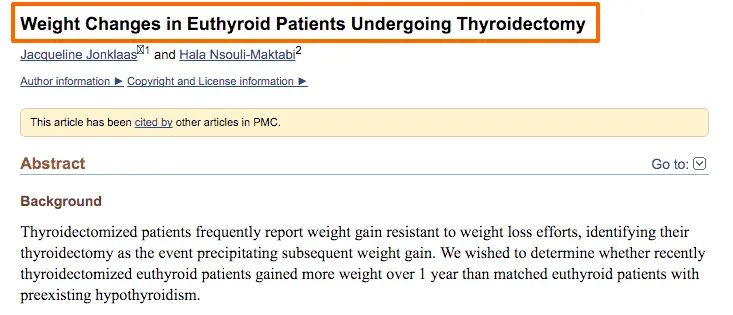
In fact, it’s been shown that women who have a total thyroidectomy gain more weight than patients with hypothyroidism (1).
And, let’s face it:
Most Doctors don’t do a good job of treating hypothyroidism, otherwise, websites like this wouldn’t exist!
And, following the trend, doctors typically do an even worse job in treating post-thyroidectomy patients.
Let’s take a minute and talk about weight gain after thyroidectomy.
Why are patients gaining so much weight?
The truth is that regulating hormones is very complex.
The thyroid system in your body is no exception.
And the medical world doesn’t have a great track record in balancing and regulating hormone levels.
Take for instance Type I Diabetes:
Medicine has developed near-continuous blood glucose monitoring systems and we still don’t do a great job of controlling blood sugar (2).
Now compare that to your thyroid.
How often are you getting your labs tested? How often is your medication being changed? Are you feeling any better about those changes?
It might be time to make a change to our current treatment paradigm, or at least consider the fact that we don’t have it all figured out.
In order to understand why our current treatment doesn’t work, we have to understand why we actually gain weight…
Weight Gain is Not About Calories
Weight gain is not about eating too many calories or not exercising enough. Period.
It’s about an imbalance in your hormones.
How else do you explain the sudden weight gain in post-thyroidectomy patients despite eating the EXACT same foods before and after?
Or how about the weight gain associated with menopause (3)?
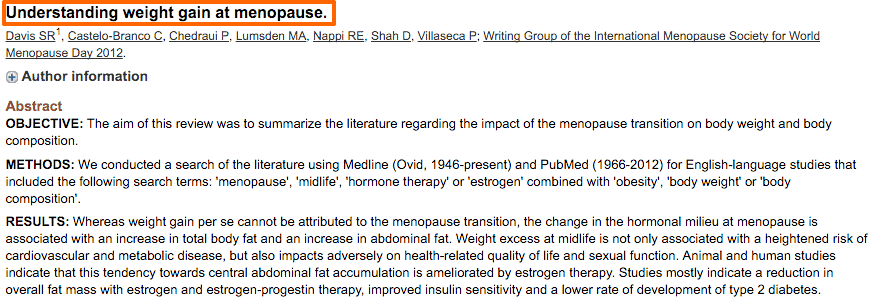
Do these women just happen to magically start eating more and exercising less at the precise time their estrogen levels drop (in the case of menopause) or their thyroid levels drop (in the case of thyroidectomy)?
Obviously not.
Weight gain is a hormonal problem!
And to fix it we have to fix the hormonal imbalance.
Unfortunately, the current paradigm is set to make you believe that in order to lose weight you must eat less and exercise more.
You even get this kind of advice from places like the Mayo Clinic (4) and Livestrong…
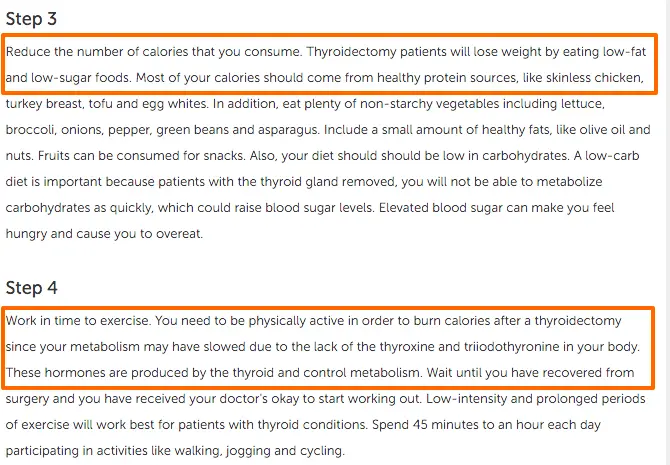
This is bad advice, so please don’t follow it. (Check out this post on nutrition facts that should be common sense but aren’t for more info)
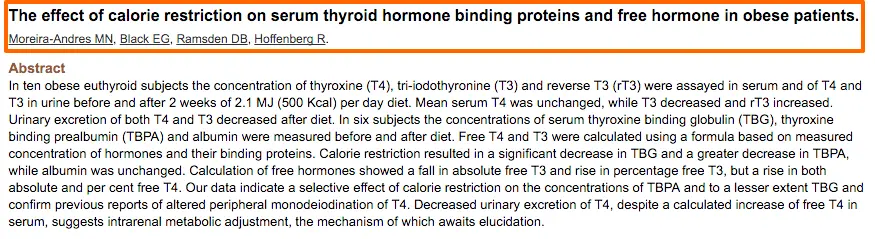
In fact, reducing your calories has been shown to reduce your overall metabolism, and may make your thyroid function even WORSE (5).
Dieting leads to low levels of Free T3 and higher Levels of Reverse T3 which means you’re going to slow down your metabolism even more.
I know what you’re thinking:
I don’t have a thyroid and I take medication so it doesn’t matter to me.
Not true at all.
If you’re on T4 medication your body must convert it to the active Free T3 in order for it to work.
And your body can still turn it into Reverse T3 as well.
So it definitely still matters to you.
What about Diet after Thyroidectomy?
The truth is that diet is still important for weight loss in Thyroidectomy patients, but not as you think.
I don’t want you to think you need to restrict your calories to lose weight (that won’t work).
But it is still important for you to eat a HEALTHY, nutritious, and whole-food diet.
If you don’t know what that is you can find a lot of information about it here.
And, to answer your question, yes it will work for patients with a sluggish thyroid and for those without a thyroid.
So in addition to eating a whole food diet, what other things will help with weight loss after thyroidectomy?
Let’s jump into some tips that can actually help you lose weight if you no longer have a thyroid.
1. Get On the Right Type and Dose of Thyroid Medication
This is a critical step and the first place I recommend you start. (It can also be the toughest part because it requires a doctor to prescribe you the RIGHT medication)
As I’ve mentioned before your thyroid controls the metabolism of your body.
And currently, we have an epidemic of thyroid patients that are being undertreated.
To understand why this is you need some basic understanding of thyroid physiology:
There are 2 main types of thyroid hormone that your doctor can prescribe.
T4 = The inactive thyroid hormone <— This is what most Doctors prescribe and very few people do well on this medication (Yes I said that it is inactive by itself)
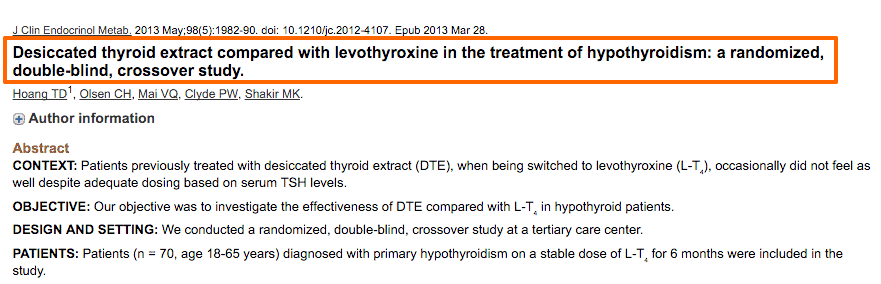
T3 = The ACTIVE hormone <— Most people do better on this medication (6) but most Doctors don’t prescribe medications containing T3
For more information on thyroid medications check out this post here.
Most people do better on medication that contains the T3 hormone and studies show this to be the case.
Patients on Natural Desiccated Thyroid hormone (a medication that contains T3) lose more weight and have better satisfaction than patients on levothyroxine (the medication you are most likely taking).
Why is this?
It turns out that your thyroid produces both T4 and T3 medications (when it’s functioning normally).
It produces about 80% T4 and about 20% T3 (7).
When your thyroid is gone most patients are given T4 medications ONLY (remember that this is the INACTIVE hormone).
As a result, most patients develop weight gain and symptoms of hypothyroidism.
So what can you do?
Whenever possible I recommend attempting to mimic nature. That means dosing your thyroid with 20% T3 and 80% T4.
If your doctor is willing to work with you, you have a couple of options:
Get on Natural Desiccated Thyroid Hormone which contains roughly around an 80/20 ratio of T4 to T3 – in addition to other less biologically active thyroid hormones.

Add Cytomel or liothyronine to your dose of T4 – Let’s say that you are currently on 100mcg of T4. In this case, I would simply add 20-25mcg of T3 medication to your regimen (note: you may need more or less depending on how sensitive you are to this medication).
Adding T3 medication to your regimen can drastically improve your overall symptoms and metabolism thus leading to more weight loss.
And remember:
After thyroidectomy, the ONLY way you are getting T3 is in the form of medication.
2. Optimize your Free T3 Levels
Under normal circumstances, your body must produce free T3 from T4 (unless you provide T3 directly via medication).
The problem is that your body can also turn T4 into Reverse T3 which is a thyroid blocker (it sits on free T3 receptors on the cells and blocks the action of thyroid hormone).
Because of this, it is important to optimize this system and make sure your body is producing as much free T3 as possible and as little reverse T3 as possible.
I’ve gone into a lot of detail on how to increase your free T3 levels naturally in this article, but I will also go over some useful info here as well.
In order to optimize free T3 levels you will want to do the following:
- Take supplements that increase T4 to T3 conversion like zinc, selenium, and B6
- Get off of medications (if possible) that block (8) T4 to T3 conversion like antidepressants, narcotics, mood stabilizers, pain modulators, blood pressure medications, and diabetic medications. You can find an entire list of supplements and medications that interfere with thyroid function here.
- Heal any digestive issues you may be dealing with like acid reflux, bloating, or irritable bowel syndrome – use a high-quality multi-strain weight loss probiotic.
- Make sure your iron levels are in the “optimal range” (more info in this article here)
- Reduce inflammation in the body (high levels of inflammation promote reverse T3 production)
Bottom line:
Higher free T3 levels = Higher metabolism = more weight loss
Increase these levels naturally with supplements or artificially with medications, but either way, you will want your free T3 levels as high as possible (but still within natural physiologic ranges).
3. Balance ALL Hormonal Systems in the Body
Balancing your thyroid is just one piece of the weight loss puzzle.
In fact:
I’ve never seen a thyroid patient with just ONE hormonal imbalance, and patients with weight loss resistance tend to have several.
And it’s also important to remember that hormones interact with other hormones!
For instance, thyroid hormone interacts with progesterone (9), cortisol (10), and insulin levels (11).
This is especially true in patients without a thyroid.
To make your weight loss efforts MOST effective you will want to evaluate the following hormones:
- Insulin Levels – High levels of insulin (AKA insulin resistance) cause weight gain in the belly. More info here.
- Estrogen Levels – High levels of estrogen and low levels of progesterone promote weight gain in the hips/butt and thighs.
- Testosterone Levels – Low levels of testosterone cause depression, weight gain, and reduced muscle mass.
- Leptin Levels – Leptin resistance causes increased appetite, low metabolism, and chronic weight gain. Find out how to reverse it here.
- Cortisol – Adrenal fatigue leads to weight gain in the belly, reduced energy, and inability to tolerate stress. Almost EVERY thyroid patient has issues with cortisol.
Use the following guides to help balance these hormones:
- Learn how to use progesterone safely and correctly for weight loss here
- Learn how to use powerful supplements such as Berberine and Alpha lipoic acid to help with weight loss and improve insulin signaling
- Learn how to deal with Testosterone and DHEA here
- Learn how to lower Leptin levels with targeted supplements here
I’ve included a table below that will teach you what tests to ask for and how to determine if your hormones are out of balance:
4. Be Strict with your Diet but Don’t Restrict Calories
When I use the word diet I am referring to the food that you eat.
I’m not referring to DIETING or eating a calorie-restricted diet.
In fact, eating a calorie-restricted diet will actually make your thyroid function worse (12).
Since we’ve already discussed diet in this article I won’t go over it much more except for some general guidelines:
- Stick to Organic Food groups and Grass-Fed/Organic Meats
- Don’t be afraid of eating Healthy Fats
- Eat lots of Vegetables
- Don’t snack every 2-3 hours
- Avoid Processed foods or anything that comes in a box or package
- Avoid sugar and artificial sweeteners as much as possible
5. When your Energy Improves make Exercise Count
It may be difficult to think about exercising when you are suffering from fatigue after your thyroidectomy (another sign that you are being undertreated), but I can’t underscore how important exercise is for your health.
Exercise isn’t important because you are “burning calories”.
It’s important because it helps to balance hormones in your body (13), release endorphins (14), and stimulate neurotransmitter release (15).
Even if your energy levels are low, I recommend that you start with low-intensity exercise on a daily basis:
That can be walking for 30 minutes per day.
Once you have a handle on low-intensity exercise, you can then start to add in slow-weight training and high-intensity exercise.
These types of exercise have been shown to be more effective than traditional “aerobic” exercise and have the additional benefits of building muscle mass and taking up less time than standing on a treadmill for hours.
Putting it all Together
I know that it can seem impossible to lose weight after thyroidectomy, but let me tell you that it IS possible and I’ve helped MANY patients do it.
It just takes a systematic approach and a sympathetic physician.
Because getting on the right type and dose of thyroid medication (preferably medication that contains T3!) is so important I recommend that you find a Doctor who is willing to work with you.
In addition, you will need to find someone who will look at your other hormone levels and treat them appropriately.
The other aspects: Diet, exercise, lifestyle changes, and supplements/vitamins – are things that YOU can take care of.
Also, remember that healthy weight loss may take months to achieve. But once you are able to lose pure fat mass without losing muscle mass, your weight loss will be long and lasting.
Now I want to hear from you:
What have you done to lose weight after your thyroidectomy?
What has worked, and what hasn’t?
Was changing your thyroid medication helpful?
Leave your comment below!
Further resources:
Weight changes in euthyroid patients undergoing thyroidectomy (16).
Weight changes in patients with thyroid cancer after thyroidectomy (17).
Weight gain in hyperthyroid patients after thyroidectomy (18).
More studies show weight gain in hyperthyroid patients after thyroidectomy (19).
Scientific References
#1. http://www.ncbi.nlm.nih.gov/pmc/articles/PMC3229816/
#2. http://www.ncbi.nlm.nih.gov/pubmed/8299480
#3. http://www.ncbi.nlm.nih.gov/pubmed/22978257
#4. http://www.mayoclinic.org/healthy-lifestyle/weight-loss/basics/weightloss-basics/hlv-20049483
#5. http://www.ncbi.nlm.nih.gov/pubmed/6771066
#6. http://www.ncbi.nlm.nih.gov/pubmed/23539727
#7. https://www.ncbi.nlm.nih.gov/books/NBK499850/
#8. https://www.ncbi.nlm.nih.gov/pubmed/20578900
#9. http://www.ncbi.nlm.nih.gov/pubmed/9846161
#10. http://www.ncbi.nlm.nih.gov/pmc/articles/PMC3520819/
#11. http://www.ncbi.nlm.nih.gov/pmc/articles/PMC3356957/
#12. https://www.ncbi.nlm.nih.gov/pubmed/12055988
#13. http://www.ncbi.nlm.nih.gov/pubmed/10683091
#14. http://www.ncbi.nlm.nih.gov/pubmed/6091217
#15. http://www.ncbi.nlm.nih.gov/pmc/articles/PMC2077351/
#16. http://www.ncbi.nlm.nih.gov/pmc/articles/PMC3229816/
#17. http://www.ncbi.nlm.nih.gov/pmc/articles/PMC4595360/
#18. http://www.ncbi.nlm.nih.gov/pubmed/24522995
#19. http://www.ncbi.nlm.nih.gov/pubmed/11531931

Yes.. as soon as I switched to Armour Thyroid I lost 5 lbs within 3 months.. and kept losing for the next 2 years. I stabilized after 2 years with a loss of about 25 lbs. I did nothing different during that time. Although my lab results were all over the place because it took a while to normalize, especially after I was able to add cytomel / T3 replacement. In the meantime I was able to deal with inflammation that showed up due to tooth infection and other stress which was addressed when I started seeing a chiropractor. I have since modified my diet by eliminating tea/coffee and sugar. It was mystifying to me why the lab results never showed much in the way of cortisol levels or iron deficiency or any of the other signals. This has been an ongoing challenge but the best help has been my ability to find your blog articles and stay focused on feeling better. Meanwhile, I have been sharing information with my physician. Thanks so much for taking the time to share your expertise!
Hey Janel,
You are very welcome! I’m glad you were able to lose that weight with the change in medication. I’ve found that most patients with weight loss resistance and/or leptin resistance tend to do better on T3 formulations instead of NDT by itself.
Your situation with lab tests is not uncommon. Lab tests are not important but I don’t base treatment and management on them in isolation, you need more data – like resting heart rate and basal body temperature.
Dear Dr. Childs, I am 15 years post total thyroidectomy. I have a great Endocrinologist that doesn’t treat JUST my lab values. He added Liiothyronine to my T4 regimen, and I feel much better since starting this combination. I sometimes forget to ask the questions I need to ask at my appointments so wondered if you could expound on which vitamin/supplements are most important to be taking after TT. I feel a bit overwhelmed by all the literature and recommendations and wonder if you can shed some light. I switched to a more vegetable and fruit based diet a couple years ago, and feel better. I ride my recumbent bike for 60 mins 5-7 x per week and do some light weight bearing exercise. I still don’t feel “healthy”, for lack of a better word. I’m 56, and would like to optimize my health and maybe trim off a few inches around my middle. I want to prepare for a healthy retirement by establishing healthy practices now. Thank you for any information.
Hey Shelley,
Thanks for reaching out – any supplements that you take should be targeted at deficiencies that YOU have. I can tell you from experience that most TT patients have the following deficiencies: zinc, omega 3 fatty acids, b vitamins (b6 and b12), iron and magnesium.
For weight loss efforts make sure you evaluate insulin and cortisol levels as these are most likely to be contributing to abdominal visceral adiposity (AKA belly fat).
Is keto diet safe after thyroidectomy?
Hi Richard,
It depends on the individual.
I am looking for some help. I have hypothyroidism. My T2,T3,T4 are normal. My TSH is 4.0. What is causing it? What can I do naturally to fix it .
Hey Heather,
Check out this post here for more info: https://www.restartmed.com/increase-free-t3-naturally/
hey doctor please tell me solve my issue i have hypothyroidism and i got a lot of trouble because of that I can’t sleep at night at all and the heart beats fast and there is a lot of restlessness and nervousnes.you please suggest me a diet plan or cure right time so that i can get rid of this disease
Hi Sadia,
Please see this article for more information on that topic: https://www.restartmed.com/can-hypothyroidism-be-cured/
“After thyroidectomy the ONLY way you are getting T3 is in the form of medication.”
I’ve got a relative who had a thyroidectomy 8 years ago. She only gets medication with T4 in it, yet the FT3 is pretty much in the same range as the FT4. How is that possible? Your sentence above suggests that it shouldn’t be possible.
Do you have any recommendation what one could say to a doctor if he isn’t willing to prescribe T3 medication (in addition to T4 medication)?
Hey Daniela,
I can see how that sentence is confusing. The only way to get either T4 or T3 hormone after thyroidectomy is in the form of medication. The body is still able to convert T3 from T4 if the medication supplied is T4 only medication (like synthroid or levothyroxine). Your relative has T3 in her body because it is being converted from the T4 medication that they are getting. I’ve found that relying upon this conversion as the primary source of T3 for the body is where patients can get into trouble. The thyroid produces BOTH T4 (80 percent) and T3 (20 percent) in addition to converting that T4 into even more T3 in the “natural” state and that is what we want to emulate when giving back thyroid hormone after thyroidectomy.
You won’t be able to talk a Doctor into doing anything that they don’t want to do. I wouldn’t even waste your breath or energy trying. It’s far more efficient to just find a doctor who is willing to work with you.
Heya
I’m wondering if you can tell me if I change my Tablet to under armour will my weight go town. I had partial taken out and 4 stone heavier and walk 5k 4 days a week and do weights and struggle loosing it. I take 200g of electroxin daily. Can you advise on this please
Hey Louise,
It’s more complicated than that, yes it may help you lose weight but not necessarily. It all depends on why you are gaining weight to begin with.
Dr. Childs,
I was wondering if you take new patients and would be willing to review my blood results. I am 6 years post surgery and still struggle. And you definitely hit the nail on the head when you stated that doctors really won’t or can’t address my weight gain. To them 20-30 lbs is no big deal – to me it’s life changing.
Hi Kym,
I’m not taking new patients at this time but when I do I will notify my email list!
I had RAI a few years ago… would this be similar to having a thyroidectimy in terms of treatment? I have had a really hard time getting my levels right.
Hey Kelli,
Yes, treatment is similar for those who have had RAI.
I had RAI a few years ago and have struggled to balance out my thyroid. would this be similar to thyroidectimy in terms of treatment? thanks!
Hello my name is Alexi and I have been thyroid-less for 2 years now. I have been on a roller coaster of dosages of Levothyroxine. Recently I have been just putting on the pounds like its my job! Since the surgery, i’ve gained almost 20 lbs and it feels like its still climbing as we speak. I have also experienced minor hair loss, memory fog, low energy and increased anxiety to name a few. I’ve been doing a lot of research and asked my Endocrinologist if there was anymore that he could do, even though my labs were supposedly “perfect” and he offered to prescribe Cytomel (I had already researched it so I knew it was t3 only) so he lowered me from 150 of levo to 125 & added Cytomel I think it was 10mcg 2x daily. I was on it for almost 2 weeks and suffered heart palpations that I thought were a side effect of the med, but were actually from having low TSH. So I stopped that combo and continued my 150 dose. Now that I am reading your post, you gave a ratio of 100mcg of levothyroxine and 20-25 of t3 cytomel. Do you think I was given too much t3 with my 125mcg of Levo and that caused my heart to start having issues? I had alot of hope for the t3 to make me feel better & got nervous and discouraged when i had the heart palpitations. Now that i’m reading your article maybe t3 supplement still has a chance in my med line up! Hopefully you can give me some advice..
Thanks, Alexi.
Hey Alexi,
The heart palpitations were most likely from the T3 medication, the TSH falls due to the T3. I’ve found several people that seem to be very sensitive after thyroidectomy to T3 medication, and in these patients it’s often helpful to try sustained release T3. The T3 itself has a VERY short half life in the serum but can impact the heart. One solution is to slow down the absorption of the T3 in the GI tract.
Also, don’t forget other hormone levels: cortisol, insulin, sex hormones, etc.
Thanks so much for the speedy reply. It is greatly appreciated. What is the difference between sustained release t3 and t3? Which one of those is Cytomel (generic version) considered? Also, what should my t4 dose be at if sustained t3 is added to my regimen?
My doctor was going to switch me from generic t4 to brand name t4 (Synthroid) to see if that had any impact on my health. do you think this is a waste of time and energy? I was going to go pick up the new med later today.
Hey Alexi,
Sustained release T3 is T3 medication that is more slowly absorbed than cytomel or liothyronine but it is the exact same medication. There is no way to tell what your dose should be because every single person is different, it takes trial and error to get there. I have just given some generic guidelines that can help get you there faster, but I’ve treated people all over the spectrum.
You may actually do well on T4 only medications if the dose was high enough, again you will just have to trial it out.
I had right PT in Feb.2015 and completion surgery in Sept.2015 for papillary Ca. First Endo left me hypo all spring and summer as he did lab work but neglected to call me with my results. Said if TSH was greater than 2.0 he’d call and I was to start on the prescription of Synthroid he gave me – but only if he called and he never did. I developed a new module in my left lobe and my HP redid my labs to find my TSH elevated. Synthroid was started immediately. I’ve gained 10 lbs with each surgery. I convinced my GP to add Cytomel to my regimen. 2nd Endo is adamant that I don’t need it and I don’t see him any more either. I exercise regularly and watch what I eat. I raven joined Weight Watchers again recently but am unable to lose weight. Very frustrating. I’m seeing a new Endo later this month and will see if he’s of any help.
Hey Sylvia,
Generally speaking endocrinologists don’t do a great job at helping people lose weight. And I definitely don’t recommend weight watchers as a way to lose weight, it will only further make it difficult to lose weight down the line – even if you lose a few pounds now. You will want to find a doctor who can help treat your thyroid and test you for other hormone imbalances.
Post RAI now 2 yrs ..this year adding weight is my new friend ..completely over it . Just on T4 meds Endo said I’m doing fine . I walk anywhere from 10,000 steps up to 20,000 daily watch my diet . Eat healthy no processed food. Little tea / coffee ..water mainly 2/3 litres daily . Should I be sourcing another doc . ?
Hey Robyn,
If you aren’t satisfied with your current care then I would recommend looking for a new one, just realize finding one to do the kind of stuff I’m talking about will be really difficult and you aren’t likely to find it in the insurance model.
I had my thyroid irradiated 5 years ago. Was on Synthroid for 2 years. Lost no weight, was exhausted. Went in Armor for 2 years-no improvement. Now back on Synthroid. Any suggestions? My energy level has improved some by adding in some excercise. I eat while foods, etc. Thanks!
Hey Deborah,
You need to have your other hormone levels checked so you know what to fix in order to help you lose weight. Look into insulin, leptin and your other sex hormones.
Would you recommend an endocrinologist or a tbyroidologist? I had a total tbyroidectomy.
Hey Gloria,
I would recommend neither. You won’t get the kind of care I’m talking about in this blog by seeing any of the conventionally trained Doctors.
Why can’t all doctors understand this like you. I am not like every other person with a thyroid. I don’t give a crap what my tsh says if my ft3 and ft4 are at the bottom of the range. 2 grains of NDT is better than levo thyroxine but I’m still not properly medicated. Very frustrating when he said oh it looks like you’ve lost some weight I’ll bump you to 2.5 grains. And I guarantee you when I go in June he will say oh you’re over medicated your tsh is too low but my others numbers will still be in the low end of the range. I work out 3-4 times a week and it is hard as hell to lose any weight.
Hey J Vaughan,
I would also look into your insulin levels! I find many of my thyroid patients also have high levels of insulin even while fasting.
I had a thyroid storm in 2013, resulting in hyperthyroidism, CHF, Afib. I had a hysterectomy in 2010. I had a cardio ablation in 2015. I then had 2 macular holes a year apart and cataract surgery a year after the last macular hole surgery. I continue to gain weight and have gained 50 lbs since my thyroid was removed. My Endo doctor has me at .4 and I take .75 Synthroid. I also have HBP and take metoprolol and Losartan. I also experience bouts with acid reflux. I am concerned with the weight I’ve gained and can easily gain 2 lbs easily. I don’t eat big portions and generally split portions with my daughter and still gain weight. We have been eating more plants based eating for the last year. Any suggestions?
I am a 72 yo female with IDDM, and acquired Hypothyroidism. Pre-op, My PC wanted me to take synthetic replacement thyroid hormone, but I said no. My surgeon ordered Armour, nd I took it after surgery. I found a Facebook group, Stop the Thyroid Madness, and I learned I was right! I said all along that I wanted FULL replacement of my thyroid hormones. And my NDT meds supplied it!
My endo refused to treat me once she learned I wouldn’t change to Synthetic meds, but my wonderful PC agreed that as long as I felt good, he’d go along with my plan. I am taking 90 mg of NPThyroid daily, along with 20mcg of T3 for T3 issue at this point. However, in the past nine months since my total thyroidectomy, I have lost 39 lbs. and feel great! I have felt good, have my energy back, and am very thankful that I took the natural route.
Hey Ruth,
Thanks for your story 🙂 I’m glad you found the right care and you are feeling better!
Hey! What kind of Dr or specialist are you seeing? I have been struggling to lose for a long while now..endocrinologist just lowered my Levothyroxin and I’m afraid my weight gain is spiraling out of control. I work out several times a week and eat a plant based diet. I would live to know more about who you are seeing? …and thanks Dr Westin for any input you may have. Thanks!
Georgia
I had parathyroid surgery five years ago and they found a thyroid tumor at that time which turned out to be cancerous. After a total thyroidectomy and the RA1 treatment I have been through two Endocrinologists and two Physicians. Finally found an endo. who seems interested in me as a patient and is knowledgeable and a M.D. who listens and researches. When they found the cancer I was already overweight so it has been a struggle to lose weight since my surgery. I am actually more active than I have ever been doing water aerobics four times a week, hiking and canoeing, and a little golf. I have actually gained forty more pounds since removal of the thyroid. Thank you for the informative post. I will ask for more test when I see my Endo. on Monday.
Hey Coleen,
No problem and I’m glad you enjoyed it!
Hi,
I had to have complete removal of my entire thyroid about 2 years ago and ever since then I’ve gained 55 pounds (I was 125 now I’m 180). I can’t seem to lose the weight and every time I ask my Edno what I could do to lose the weight he just ignores it and doesn’t help me with it. I was wondering is there anything (diet pills?) I can take to help me lose this weight? I have no energy at all. I workout and eat very healthy but nothing seems to work. I’m taking brand name Synthroid 125 mcg and my Dr said everything was balanced and normal from my blood work. Is there anything I can do or take?
Thank you,
Francis
Hey Francis,
Diet pills or medications won’t help you lose weight – you need to balance your hormones, and in order to do that you will most likely need some guidance from a physician.
My physician told me my hormones and everything was normal and balanced. I’ve been to many doctors to figure out what’s going on but no one seems to know what to do. My blood work and everything comes back balanced and normal every time. It’s very frustrating that I can’t seem to find anyone to help me.
Hi
I’m not giving medical advice but I was in the exact same boat. My dr finally agreed to help and gave me phentermine. I lost 15 so far three months in. Good luck
I am one year post TT and life is really miserable. I wish I had a doctor like you in my area. I have gained over 50lbs and have zero energy or zest for life anymore. My T4 levels are normal so basically my endocrinologist released me back to my family doctor. So many doctors go by the “levels” and don’t listen to the patient on how they feel in general. I am going to go to a new family doctor. What would you recommend I ask them to test? To help me gain my zest for life back? To help me lose this weight? To just feel normal again?
Hey Mollie,
Asking for the right tests usually don’t help because if the Doctor understood thyroid function they would order them to begin with and most don’t know what to do with the results once you get them back. Unfortunately most will treat you the exact same way regardless of how you feel because for the most part they are all trained the same way.
The tests you should ask for: TSH, free t3, free t4, reverse T3, sex hormone binding globulin and thyroid antibodies.
I’m 59 yrs. old. Had thyroidectomy, at 40. I have been 20-25 lbs. overweight for the past 10-15 yrs. I decided to try vegan diet last year, w/o any results. I’ve fasted, do meal-replacement shakes, increased exercise, 3-5 wkly. It took 8 mos. to lose 7 lbs. Then, I was gone 3 weeks on vacation, had a few treats, cheese, wine. And gain it all back.
I have never known about other hormones, you mentioned. I need a Dr. To test all my hormone levels. I am really discourages. Thank you
Hey Mary,
It will also be very difficult to lose weight if your thyroid hormone isn’t optimized in addition to the other hormones I’ve mentioned in the article.
Hi Dr. Westin,
Do you have a list of doctors who you recommend that may be helpful.
I too am without a thyroid since surgery in Feb. I was on Synthroid and wasnt feeling great and eventually got my doctor to change me to Nature-Throid. I was feeling better but now am back feeling exhausted and cant lose any weight.
Hey Charmaine,
Sorry I don’t know anyone else who share a similar philosophy as me. You might have luck with a local functional medicine doctor but they are hit or miss to be frank with you.
I had a total thyroidectomy almost 2 months ago. I was on 150 mcg synthroid for 2 weeks post surgery, then switched to 100 mcg synthroid. I immediately felt horrible on the lower dosage (I didn’t feel too good on the higher dosage either). I went to my regular physician (because my endocrinologist sucks, I live in a small town in the south and he’s the only one in town) who put me on 150 mcg again. I feel a little better but have absolutely no energy. I have gained 14 pounds in less than 2 months and I was already struggling with my weight before hand. My levels were extremely low on the 100 mcg
Hey Anita,
Unfortunately it’s considered normal when patients gain 20 pounds post thyroidectomy. It usually means you are being under treated or that you are being treated with the wrong medication. The hard part is convincing your doctor to switch your medication.
Any suggestions for a 60 yr woman who has undergone a total thyroidectomy and total hysterectomy and takes high blood pressure/beta blocker type medication. I am presently on 88mcg of levo. My weight is within normal range per my doctor, but I would like to lose 10 lbs. as I am a little sluggish. Ultimately, I would like to feel the best I can under the circumstances.
Hey Renee,
If you haven’t followed the steps above I would also recommend you find a doctor willing to work with you and look into potentially changing your medication.
My wife had a thyroidectomy almost 5 years ago. Since then, she has gained about 45 pounds and cannot lose the weight. She is currently on 137mcg of Synthroid. As I’m reading through the comments above, I see that this is a T4 medication. Do you have a recommendation for a good T3 medication? She just had her levels checked and her TSH level is at .8. She is really discouraged by the fact that her doctor keeps pushing calories and exercise. She has tried just about everything and just continues to struggle with losing even a pound.
Hey Eric,
NDT or Liothyronine both might work. It’s more about finding a doctor willing to prescribe the medication and treat in high enough doses to make an impact and not based off of the TSH.
Hello Dr,
I had total thyroidectomy 2 months ago. Since then I gained 8 lbs even though I am eating like before.After testing my blood my Doctor said my medicine is fine( I am taking 150 mg of levothyroxine) I am over weight anyway and I don’t want to gain any more weight. On my next appointment with my family doctor I will mention what you have suggested. Thanks a lot, though I hope that my doctor will listen to me. I really appreciate your time.
No problem, Sonia.
Good luck!
I’m 24 y/o and I had a had a total thyroidectomy in Feb 2015 and even before the surgy I had gained weight but was never clearly diagnosed until 2015. I was told when I was 18 that’s I had antibodies in my thyroid and when i got a blood test done my DR. At the time said I had hypothyroidism but never started me on any medication. It wasn’t until I moved and meet with an Endocronologist 4 years later that I had Graves’ Disease and long story short, I eventually had surgery. Was put on Levo, then synthroid, and now I have been on armour for almost year.
After the surgery almost 2 years later, I went from being 150lbs to 184lbs and the weight just seems to keep on coming. I have tried appitite suppressants, I’ve tried working out, and even counting calories. Nothing works. I currently see my primary care DR. to do all my testing and such and unfortunately I still feel the frustration of being ignored when it comes to my weight loss. He tells me I need to “exercise and eat right/healthy” and I honestly just want to punch him in the face.
He did a complete blood panel work up on me and said everything was coming back saying I was healthly and even my cholesterol was I never perfect range yet it still made no sense to me why I was continuing on gaining weight.
I am on birth control as well. I switched from the depo shot to mierena IUD hoping that might help but, still no luck. Can’t even loose 5lbs . What else could help me?! I’m honestly considering “extreme measures” like lap band or liposuction! My primary care dr did also suggest to me gastric bypass surgery. Crazy I know, I wouldnt consider myself that’s “fat” but what if it would help? I don’t want it to get to that point.
If you have any suggestions please let me know know.
Hey Sarah,
The best thing you can do is find a different provider who understands hormones and thyroid.
Dr. Westin Childs,
I am so glad I found this website as I am in desperate need of help.
I underwent 10 millicuries of RAI to treat a “severe” case of Graved disease in June of 2013.
I have not been the same since.
Pre RAI – I was a vibrant healthy, active individual who enjoyed all types of exercise. I was 37 at the time of RAI, and up until that point maintained the same weight since high school. Diet and nutrition had always been important to me. Pre Graves disease and RAI, I felt bright and enjoyed being social.
Post RAI – My life has been a living hell.
I have been prescribes synthroid – the max dose we have gone up to was .175
I felt no better
We then moved to Armour for about a year. NO change, felt worse.
Last, and where we are today, we moved to Cytomel (only) at 90.
(we weaned of Synthroid and built up the Cytomel)
My doctor’s claim “All my hormones are at normal levels and the thyroid hormone levels are at the high end of normal”
They have checked and rechecked ALL HORMONES.
YET
I am steadily gaining weight (25 pounds in total) despite my rigorous exercise routine. (Cardio 2x a week, Personal weight trainer 2x a week and Yoga 1x a week)
I have BRAIN FOG THAT MAKES ME FEEL LIKE A ZOMBIE
My doctor’s now say, there is nothing more they can do for me. I should consider taking an anti depressant. I should also consider checking myself into the MAYO Clinic
I have been living with this for 3 years. So true, I am depressed. But how will an anti depressant fix my hormonal imbalance and metabolism? Funny that my doctor’s can no answer that.
I am living a nightmare. I want to get back to my old self again. My personal trainer suggests a raw / vegan diet. I’d rather do that than take anti depressants.
Can you help?
Hey Lori,
You are right – taking an antidepressant likely won’t help with your hormones at all. You need to find someone to help figure out the hormonal imbalances causing your issues and go from there.
Hello,
I am 52 years old and just had a total thyroidectomy for thyroid cancer May 2016. I was also dually diagnosed with sarcoidosis. Several difficulties I am experiencing right now:
1) mmovable weight– I am 30 pounds overweight, had trouble before the thyroidectomy after menopause but now nothing works. Removed gluten from my diet with not much difference- eat fairly healthy- very few processed foods, lots of salad and vegetables, natural dressings.
2) Extreme joint pain- feet, hands, – there are days I can’t walk straight. Don’t know if the weight is effecting my bones. Rheumatologist thinks it might be muscle related- I think it is inflammation related.
3) Rash on face- this appeared before thyroidectomy (a few months) like a butterfly rash on my face, and despite plaquenil for sardoidosis, has not subsided.
4() elevated liver enzymes AST, ALT, and CO2
5) High cholesterol, that responded to statins but liver enzymes went up.
I am at a loss of what to do, but desperately want to get my body in balance and back to some kind of normal. Very disheartened. My oncologist was not happy with my TSH levels (2.4), last test. I am on 125 mcg every day of Synthroid. When I ask about T3, he feels there is no need to test for it but I worry due to
Get checked for Lupus it causes a butterfly shaped rash on the face.
Hi Dr Childs,
Firstly, can I say, what an informative video! My partner had a total Thyroidectomy over 6 years ago. He has a chronic sweet tooth, and it isn’t helped by the fact that we are both emotional eaters and can sabotage each other’s healthy eating attempts when we have had a bad day. I am emailing as my partner has battled with extra pounds for years, but did successfully lose a large amount of weight after gaining a substantial amount post surgery. He is now no longer obese,but or a 6’2″ guy, he weighs 210 lbs.He has started to go back to the gym, however, what you were saying about HIIT is very interesting as he will slog it out, in the moderate exercise category and get disheartened as he feels he has to be in the gym or 40 – 60 mins (at least). His medication is liquid T4 and tablet T3 (levels I so no have to hand). He has regular TSH level blood tests but I am intrigued about the Insulin and Leptin tests as a possible cause of slowed weight loss and increased weight gain. He just has to look at a cake or processed food at it gets stored! I have my thyroid and it is functioning well, so I feel bad as I forget that the treats and junk I occasionally eat don’t seem to have such an effect on me as it does on him. He is desperate to lose some weight, and did when he went Vegan for 3 months in Africa. But all his meals were being cooked for him, ad life back in the UK makes it harder to sustain a Vegan diet. He has ‘old fat’ on the front of his chest, but has a strong back. He can’t seem to lose the weight on this chest and stomach and it does look like it is left over from when he was larger, but it’s not lose skin. His skin is normal. The fat seems very lose and movable (if that makes sense?) He has an active job – he is a gardener and is on his feet most of the day. He complains about never feeling full and cannot stop eating when he knows food is available (like he lacks a ‘I’m full button in his brain). I’m thinking of advising him to follow your advice and listen to your videos. I think I will listen to the improving your metabolism video as well.
Any advice for a 37 years old, moderately active man who is struggling with his diet and to lose the weight?
Kind regards,
James
Hey James,
Thanks for reaching out. One thing I would consider in your partner is low testosterone. Men with visceral/abdominal fat may have low testosterone which would also make weight loss difficult due to issues with inability to gain muscle mass after work outs/etc.
You can check free and total testosterone to determine if his levels are high enough.
30 years ago, 75% thyroid removal and synthyroid medicine. 5 years ago, complete thyroid removal along with parathyroid cancer removal (1 removed) with cells found to have very slow “growth” factor. My labs are fine. Some bile reflux that improves with LOTS of chewing and no eating/alcohol after 6 PM. IF I could have more than 1/2 eyebrows and constant cold hands/feet – would be appreciated. And IF I could find a way of losing weight (10 pounds would help), life would be perfect. Any suggestions would be appreciated! Thank you for your video!
Hey Gail,
Most post thyroidectomy, post RAI, etc. patients require some T3 to feel optimal. If you haven’t already check out this blog post: https://www.restartmed.com/cytomel-weight-loss/
Thank you for quick response. Does a very low resting heart beat indicate need for T3? And would T3 stimulate cancer cells?
Wow. This is the best article I have read post thyroidectomy and weight gain. I had a thyroidectomy 18 months ago and still feel like crap. It was a total thyroidectomy and it was due to papillary thyroid cancer stage two.but parathyroids were damaged in the process. I now suffer from hypothyroidism and hypocalciumia. I have intense fatigue and brain fog and sometimes joint pain and headaches.and also trouble with weight gain. I was eating healthy to begin with but have since tried to have a gluten free diet. And consume more fruits vegetables proteins and super food. As far as activity Ive had a super physically demanding job and a am a mom to a toddler.i take synthyroid 175 mcg and d3 and calcium. But i know now i should be taking T3 as well. And also did not know about the other hormones affected. Good to know I’m not crazy. Also fpr reference I’m 22yrs old but feel alot older
Hey Hannah,
I’m glad you found it helpful and thanks for leaving your insight.
Hello Dr. Childs,
My Endocrinologist is unwilling to work with my weight issue after my Thyroidectomy (which I just had 2 months ago). Recently, I just did a blood test and my T4 is in range of 1.6; however, I noticed that my T3 is low in 1.7 with reference range of 2.0-4.8. Since my T3 was almost able to reach the normal range, do you think taking Zinc and B6 can help my T4 conversion to T3? With the boost of conversion, is it possible that I might be able to start losing weight? It is really difficult to find a MD to work with me to prescribe the T3 medication.
Thank you.
Tianna
Hey Tianna,
Maybe, but most likely not. This would be true if you just had hypothyroidism, but post thyroidectomy patients are different.
At age 26 I was diagnosed with follicular thyroid cancer which of course resulted in a thyroidectomy. I’ve always struggled with weight, but after surgery it was an even bigger struggle. I felt miserable; suffering from all of the typical symptoms of hypothyroidism. About a year and a half ago a friend introduced me to the Whole 30 program and it absolutely changed everything. I’m now 40 and since I began following this eating plan I have lost 90 pounds, I have more energy than I have ever had, and I am able to sleep though the night and wake up actually feeling rested. I would recommend this program for anyone, especially people who suffer with thyroid issues.
Hey Lacy,
Really any whole food diet is a great starting point, but you will find that many patients have problems despite eating a whole food diet like whole 30 and this blog is mostly dedicated to those people.
I am 38, and was born without a Thyroid. I was put on synthroid at 6 weeks old, and continued that for 32 yrs, until I found a Dr. willing to let me try armour. I switched and was able to lose that stubborn 50 lbs! Unfortunately that was short lived, lasted only about 4 yrs, the ” regain” was gradual, but I have gained it all back. I also notice I have symptoms of early menopause, or pcos, or my progesterone is super high. My anxiety is back with a vengeance as well. I was also born with hip dysplasia, and have developed AVN. orthopedic Drs. Have told me only treatment is replacement, but I am too young, so I languish in pain, with loss of mobility. I am ready to give up. Being born w/o a thyroid is very rare, hard to find advice on the subject.
Hey Gwen,
Being born without a thyroid is rare, but treatment is very similar to those post thyroidectomy and I’m sure many of your problems stems from under treatment with too little T3 (if any) in your regimen.
I just had a thyroidectomy almost 4 months ago, right after the surgery I started losing weight and I wasn’t doing anything I actually had no energy to do anything, but I had lost 15 lbs and I was shocked, so I thought if I started working out I would lose more weight and faster, but now that I started working out I can’t lose a pound, why is that??? I mean all my Dr did was up my medication 25 mcg and now I have energy but can’t lose anymore weight.
Hey Stephanie,
Some thyroidectomy patients actually lose weight after they have their thyroid removed because they were likely hypothyroid before the operation but just weren’t properly treatment.
In regards to your weight, your total weight is a combination of hormone imbalances. Your thyroid may be contributing 20 pounds, your insulin may be contributing 20 pounds, etc. So if you fix one problem, you will lose the weight associated with only that hormone imbalance.
So what medications would be best for me to take to take care of all of them?? Cause the only medication I’ve been on was/is levothyroxine and I have no clue what that took care of for me to have lost 15 lbs. Thank you
So what medications would be best for me to take to take care of all of them?? Cause the only medication I’ve been on was/is levothyroxine and I have no clue what that took care of for me to have lost just the 15 lbs, I mean I don’t have a clue about any of this t3, t4, tsh and what nots, all I know is I have a thyroid problem and Drs I see who are suppose to be specialist in this matter, who haven’t gotten me anywhere and I have Medicaid so I can’t be to picky cause not all thyroid Drs take Medicaid, so that’s why I’m asking you for help and suggestions. Thank you
Hey Stephanie,
The truth is that your standard medicaid/insurance based Doctors really won’t be able to help you, which is why you need to look to specialists outside of the insurance model. All so-called “specialists” including endocrinologists and PCP’s will all treat you the exact same way (they are all trained the same), so changing doctors is mostly futile.
So what kind of medication do you recommend I take to take care of the insulin, thyroid etc.???? Cause obviously levothyroxine isn’t working for me, I mean it’s not like I can go buy the medication you recommend, but I can always ask my thyroid Dr if she thinks the medication you do
recommend will work for me or not
This information is so valuable. Thank you. Presently I am in consult with doctors with regard to nodules on my thyroid that are pressing in on my esophagus. I had a fine needle biopsy which revealed cells that could be malignant. The doctor i am seeing now wants to do a molecular study on the specimen to determine if it is cancer. Once we get through that we will see what to do. I have been taking 30 mcg of Armor for 4 years, and prior to that I had taken Synthroid, but stopped because of pain and other symptoms. The prospect of having my thyroid out is terrifying. I deal with depression, joint pain and other issues. I am a personal trainer and fitness instructor, so the prospect of being lethargic, more depression and weight gain just makes me even more anxios. I will share your findings with my doctor to get a jump on all this. Thank you for helping us to understand a little better and dignifying us. We aren’t lazy, aren’t crazy. We need to be our own advocates in our health and find doctors that will partner with us in this journey.
I just got a call from my Dr to stop taking levothyroxine and to start taking armour thyroid, so do you think armour thyroid has enough T3 and T4 for me to feel better and lose the weight a lot easier/faster? Cause I have been eating like a rabbit and exercising 1 to 2 times a day and seeing nothing but my hair fall out, please help, thank you
Hey Stephanie,
I can’t answer that question because I don’t know anything about you or your history.
Hi there,
Seems to me I’m not the only one with this issue. I had a total thyroid removal back in December 2015. All was good, I lost a bunch of weight after the surgery. I have now gained most of it back. I’ve tried exercising, gluten free, weight watchers, all that and I can not lose a pound. My doctor assured me that if I kept up the healthy eating and exercise, all would be fine. Well, that’s not the case. My blood levels seem to be within normal range. If I get the Armour Thyroid, can I take that with the Levothyroxine? I feel like everything I eat puts weight on me…I have to do something soon before this gets more out of control than it already is. Thanks!
Hey Jenna,
I would take a look at this article for more info: https://www.restartmed.com/tsh-levels/
And this one as well: https://www.restartmed.com/levothyroxine-weight-gain/
Dr. Childs, can u recommend a Dr. In the Philadelphia area? Had a thyroidectomy 3 yrs ago (follicular cancer). 2 different Drs only chech TSH & give me .125 of Levo. No energy, caused female issues(has an ablation), I am in my 50’s. Please help.
Hey Kimberly,
Unfortunately I don’t know anyone in that area to refer you to.
July of 2015 I got a total thyroidectomy. I was 173lbs. I’m 5’7” and “larger framed” so i looked great. I love food but more so I love cooking. I eat well. Always have. Healthy. Natural. Etc within six months of my surgery I gained 20 pounds and have been stuck at 193 for a year now. Last year at my appt with my endocrinologist I told him my struggles. He told me to exercise more. So. I did. I work out 4x a week. I do weight training. And jogging. I still eat great and cook. I have yet to lose a single pound. And I can’t take it anymore. I have never worked so hard at losing weight. And I’m continuously disappointed. After more and more blood tests my Dr told me my levels are fine I just need to see a nutritionist. It’s like I’m screaming so loud yet no one can hear me. It’s so frustrating. No one that exercises like I do and eats whole like I do should weigh this much. I don’t know what to do. I hope this website can help me at my next appt with my Dr. Thank you I am desperate.
Hey Mercedes,
You most likely will not get the help you are looking for by seeing your endocrinologist. They aren’t trained to evaluate the thyroid in the way I am describing here which will just lead to frustration on your part. You will most likely have to look outside of the insurance model for proper help.
I had a partial thyroidectomy in 1999 and two weeks later had the rest removed. I have been on MANY doses of Synthroid and my levels seem as if they change every few months so I am always being changed to a different dosage. I do blood work every three months to regulate the Synthroid, however no matter how hard I try, I never feel “right”. At one point I was given Cytomel with the Synthroid and felt amazing for about a year, until a new doctor said it wasn’t needed and took me off of it. Now I’m up to 200 of Synthroid and although I work out EVERY day, I cannot lose a bit of weight. I have been so unhappy for the longest time because of my issues and then she put my on an anxiety/depression medication which I didn’t even bother to take. Are there some type of “over-the-counter” supplements that I can take that may have some of the benefits of Cytomel?
Hey Michele,
You can check out this article here for more info: https://www.restartmed.com/increase-free-t3-naturally/
In general supplements will always be inferior to cytomel in terms of results.
I had a TT Nov 2015. My endo has changed my meds every 6 weeks, lowering them each time. After being put on 50 Tirosint and 10 cytomel my TSH WENT FROM .07 to 6.24 and T3 and T4 were in range but are now 2.2 and .58. I had been on 90 Triosint and 20 cytomel previously. For over a year, I was eating high protein, very limited carbs, no sugar and walking 20-30 miles a week and was loosing less than 5 lbs a month. I gained 15 lbs in 5 weeks after she changed my meds. I loved your article and will be sharing if it with my doctor. I will ask for all of the tests you recommended. I have changed my diet to include only 20% protein. I am going to the health food store today to get the supplements you listed. I appreciate the work you are doing and hope to learn more from you. Thanks again.
Hey Tasha,
I wouldn’t recommend you get store bought versions of the supplements I listed, those type of supplements are notoriously low quality and contain inactive fillers/etc, that reduce potency.
Where do I buy the right ones? Also, curious have you ever heard of a TT on only 50 Triosint and 10 cytomel? Seems awefully low to me. Even with my TSH shooting up to 6.24, the endo only increased me to 75 Triosint and keep the cytomel the same. Should I be looking for another doctor?
You can find the complete list including recommended brands + products here: https://www.restartmed.com/thyroid-supplements/
Thank you for providing a lot of useful information. I do have a question regarding the diet guidelines that you stated would be listed below in the article, but I did not see this. Can you assist me in finding that? Also, under the Free T3 and Free T4 levels, you stated the levels should be 1/3 of the reference range, can you give an example please? I am not sure exactly what you mean by that. For example if a reference range is 2.0-4.4 for a free T3, what do you mean by 1/3 of this reference range? I have gained 30 pounds post TT and my doctors are not helpful. They talk about the calories in vs calories out and exercise. I actually eat very healthy and exercise at least 1 to 1.5 hours per day and can’t lose a pound. I have even kept track by measuring my food and tracking it. I had always been thin and fit but now I am overweight and depressed. I go nowhere unless I have to. My thyroid levels are within normal range. I am on 112 mug of synthroid and 5 mcg of cytomel. I am going to try the supplements and ask my other levels be drawn. My lipid panel was awful recently and 6 months before, it was ok. I wish I never had my thyroid out.
Shelly
Hey Shelly,
The dietary information can be found here: https://www.restartmed.com/the-thyroid-diet-4-week-plan/
I had a subtotal thyroidectomy 12 years ago and a completion a month ago. For years I was on levothyroxine alone and gained so much weight, I’m twice what I was before! Then I read about T3 and convinced my endo to give it a try. He reduced my T4 from 175 to 125 and added 15 T3. After completion the weight has been piling on again and I feel exhausted to say the least. He’s now increased my T4 to 150 but maintained my T3 at 15. Does the combination make sense to you? I feel like I need more T3. I take my doses as 10mg in the morning and the remaining 5 in early afternoon. I run out of energy by 1300. Thanks for any advice. I really want my life back!
Hey Ruth,
You should have your free T3/reverse T3 ratio checked to see if this is contributing to your fatigue.
I had my thyroid removed over 6 years ago. Since then I have steadily gained weight every year. I have been been doing crossfit for over 3 years, consistently working out 5-6 days a week with 2 a days 3 x / week. I have seen nutritionist after nutritionist. While I can see some small visual changes in my body, my weight has not decreased at all!! Very frustrating. I am 30 pounds over weight still and can’t lose it for anything. I currently take levothyroixe and liothyronine. Small dosage of T3 though. I feel my doctor would listen with other recommendations. I have transformed my diet, no dairy , Whole Foods, minimally processed. What else can I do?
Hey Tiffany,
I would recommend you take a look at some of these case studies to help you understand what you may be missing: https://www.restartmed.com/weight-loss-naturethroid/
Hi I had a total thyroidectomy done in September 2016 since then I have felt very low in energy, weight gain, skin has broken out, mood is awful and I can’t stop eating. Another symptom which is affecting my everyday life is the constant sweating it’s horrible, so I recently got my thyroid level checked and it came back low 0.03 I am due to see a local doctor next but have no appointment through from the consultant who performed my operation as yet, which is 3 months overdue. So against the consultants advice I have to get my doctor to alter my dose of levothyroxine ( which is currently 100mcg daily) cause it’s having such a dramatic affect on my everyday life I can’t wait for my consultant
Hi Dr. I had a right thyroidectomy in 2001 and have not been found to need synthroid medication as of yet. I have put on weight, mostly due to having two kids. During the past couple of months I have been exercising daily and have changed my diet to high protein/lower calorie, but have not seen ANY weight loss. Can thyroid levels change at any time? I have annual ultrasounds and blood work to check my levels, but am not due again for a few months. in your opinion, should I ask my doctor to move up my tests? Or could it typically take a few months to see any weight loss?
I had a total thyroidectomy in late 2009. I was on Synthroid only for the first year or two, then the doctor added Cytomel to my prescriptions. My weight was stable and balanced until I was taken off of Cytomel almost a year ago, due to arrhythmia issues with it. However, I remain on Synthroid 88 Mcg pretty much throughout the last eight years. Only in the last six or eight months, since going off Cytomel, has my weight gone up significantly. This in spite of regular exercise, and healthy eating habits unchanged. Although, without the Cytomel, I feel way more normal overall, I am still concerned about this weight gain. I am concerned about going on anything like Cytomel, because of a possible effect with my heart or blood pressure or other. Any advice as to other prescriptive options to Cytomel? I am in Canada.
Who is Anna?
I want to know why my doctor ordered a FSH test. I am 76 years old, had a total hysterectomy in 1995 and a Total Thyroidectomy in 2010, then RAI-131. After all of these years I have felt worse in the past year than ever before. I take Armour 90mg daily. Now I have a lump in my neck, will have a CT scan in a week. Back to original question why order a FSH, the results don’t break down into any specific hormone. The results were in the normal range for my age group, a little bit low.
What are the best tests for possible recurrence of Papillary Cancer?
I came up one this website and I’m glad I did. I had a total thyroidectomy in 2004. Since then my life has changed drastically. I have been struggling to lose weight for years. I have been on diets galore and they seem to work initially and then I end up gaining weight. I am a very active 36 year old and I am on a 1790 cal diet currently but despite that I continue to gain weight. I am on 125mcg of synthroid and this article has motivated to talk to my doctor about changing me to a desicated thyroid hormone or adding cytomel to my current meds. Has anyone had experience/success with either regiment? Any further recommendations/ articles are appreciated as my PCP sometimes isn’t willing to work with me on thyroid stuff.
Hi Roxanne,
The best thing you can do is find someone who understands what I’m talking about here.
Dr. Westin, I had a thyroidectomy May 3rd, 2016 and since then I have done nothing but gain weight despite me eating less and working out more. Every time I go to the Doctor they change my medication, it never seems to be right. Right now they have me on:
1. Levothyroxine Tab 0.125mg
2. Liothyronine Tab 5MCG
3. Phentermine Hcl 37.5mg Tab
Plus I take medication for high blood pressure and high cholesterol:
1. Nifedipine Tab 60mg
2. Hydrochlorothiazide 25mg
3. Atorvastatin tab 10mg
I am also on medication for arthritis:
1. Meloxicam
2. Ibuprofen 800mg
I also take several vitamins including Multi vitamin, Vit C, Fish Oil, potassium,
Vit D3, Cal-Mag, Vit E.
I am also on Estradiol Transdermal Patch twice a month. As you can see I take a lot of pills in one day. I just want to get healthy, lose weight and feel better. Any advice you could give me would be greatly appreciated.
Thank you.
Hi Luana,
It’s very difficult for patients to lose weight post thyroidectomy and basically everything needs to be as optimized as possible – your diet will also have to be pristine. I would try to find someone local who discusses what I talk about here to help you, it’s possible but difficult.
Dr. Westin, I was diagnosed with papillary thyroid cancer about 10 hours ago. I found your site while doing research and had a few questions. It looks like I will be having a thyroidectomy here in the very near future. I want to get a head start on what I need to do to lose weight. I know it will have a great deal to do with my levels so how often should I have them checked? I will also be on some type of thyroid replacement therapy, is one better than the other. Can I take Armour while on the replacement meds? I am basically looking for any good advise….
Excellent site, tho the stories are heartbreaking. Here’s another one. Niece about to have a partial, possibly total thyroidectomy. She will not listen to anyone but her doctor. One family, her cousin, had a total thyroidectomy and his health issues have been bad to worse to horrible. Another family member studied studied studied and was able to shrink thyroid nodules after being told she was probably headed to a thyroidectomy herself. Her complaints are lethargy, weight gain, beginnings of fibromyalgia type pain, and more… and this is before she even has the procedure. She has a goiter, likely nodule or nodules, but she does not even know what she has been told. The reason I am articulating all this is if there is any way to encourage her to put the brakes on removal after the biopsy, am just trying to get her to hit the pause button, to make biopsy and surgical removal two separate events instead of what the doctor is stating which is to perform the pathology on the spot, and then proceed.
So aside from the frustration of encouraging to pause, my core question is… how does a partial thyroid function, as in if 1/2 of the thyroid is removed, can things still function enough? Am trying to learn anything that might get through to her enough to have her hit the pause button.
Hi David,
My experience suggests that patients can survive with half a functioning thyroid gland, but I’ve never seen anyone thriving under such conditions without the need for replacement hormone.
I am wondering if all of this is true with just a partial thyroidectomy? I had my left side removed after follicular adenoma was seen. All blood wrk for function has come back “normal”. I was on Lipton injuections for 4 months do to a watermelon size fibroid that was removed 5 months before thyroid was removed. I am moody/ gaining weight and tired all the time. I eat well exercise and walk my dog everyday… I have no idea what kind of doctor to go to now or how to help myself feel better.
Hi Suzie,
Yes the information is relevant for those with a partial thyroidectomy.