
- TSH is one of the worst ways to evaluate thyroid function yet remains the most widely used test. Your pituitary gland is the most sensitive tissue to thyroid hormone, so it reaches optimal levels before other tissues do. A 'normal' TSH doesn't mean your cells have enough thyroid hormone.
- The optimal TSH range should be below 2.0, not the standard lab reference of 0.5-4.5. Anything above 2.0 suggests potential thyroid dysfunction. A healthy person typically has a TSH around 1.0.
- You can have a normal TSH but still be hypothyroid if you have low T3 syndrome, insulin resistance, chronic inflammation, or autoimmune thyroiditis. In these cases, free T3 and reverse T3 levels become more reliable indicators than TSH.
- The reverse T3 to free T3 ratio is one of the most sensitive ways to determine if your cells are getting enough thyroid hormone. Check all five tests together (TSH, free T3, reverse T3, free T4, and antibodies) for an accurate picture.
- If you have thyroid symptoms plus 'normal' TSH, your doctor likely needs to order a complete thyroid panel. A single elevated TSH only appears late in the disease process, after your thyroid has already lost significant function.
This guide will walk you through everything you need to know about TSH including why it isn’t always the best marker of thyroid function in the body and which conditions make the interpretation of TSH less accurate. You will also learn more reliable ways to test thyroid status in your body.
TSH might be one of the worst ways to evaluate thyroid function and yet it is probably the most widely used thyroid lab test out there.
Why?
In an attempt to oversimplify thyroid function and management, doctors have become reliant upon TSH testing.
But what if there was a better way? A way that reconciles the fact that so many patients have a “normal” TSH, and yet, still experience the symptoms of hypothyroidism…
Sound too good to be true?
It isn’t.
And we are going to talk about it in detail below.
In this post, we will discuss why TSH levels are not the best way to evaluate your thyroid function, but more importantly, we are going to talk about how to actually assess thyroid function and which lab tests you need…
Is your TSH Normal?
This is probably one of the most common questions I get on a daily basis (or some variation of are my lab tests normal).
Just take a look at the comment section of any post and you will find plenty of people posting their labs with that exact question.
So let’s answer it once and for all.
Is your TSH actually normal?
In order to find out if it is normal, we have to first understand what this test is actually testing for.
Don’t worry, we aren’t going to jump into advanced thyroid physiology (you can find more about that here if you’d like) instead I want to keep things basic:
TSH stands for Thyroid Stimulating Hormone and it comes from your pituitary gland (1).
The pituitary is a gland in your brain that attempts to tell your thyroid how much thyroid hormone to produce.
So why do Doctors care what the pituitary is telling your thyroid gland?
Well TSH turns out to be a quick and dirty way to diagnose both hypothyroidism and hyperthyroidism but it falls short when things get a little more complex.
In the case of standard hypothyroidism, your TSH increases.
In the case of standard hyperthyroidism, your TSH decreases.
But what about the non-standard cases?
What about patients who have normal TSH levels but every hypothyroid symptom?
Does the TSH work for everyone?
Not really and here’s why:
When we talk about any hormone we really need to understand how and where the hormone has action in the body.
Thyroid hormone is activated inside the cell of the target tissues and it does this through a nuclear receptor (2)(actually thyroid hormone has both genomic and non-genomic actions but the genomic actions are particularly important for symptomatic control).
In simple words, it means that thyroid hormone gets inside the cell and directly turns on genetic transcription (it changes your DNA/RNA directly).
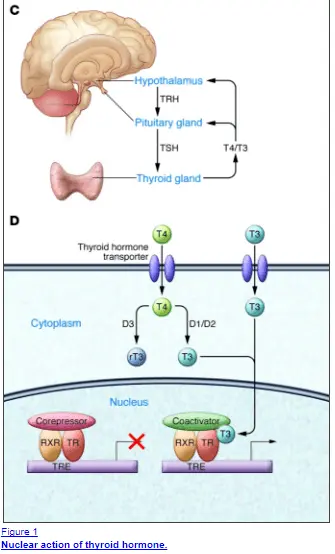
And this is good, but what is important here is that each tissue has a different demand for thyroid hormone depending on the situation.
Again, let’s put this into simple terms…
If you are incredibly sick in the ICU of a hospital, does it make sense for your body to put energy into growing your hair follicles or making your nails strong?
Not really…
Instead, each of the cells in your body has a different demand for thyroid hormone depending on the situation, time of day, stress you are under, etc.
So how does this fit in with the pituitary gland?
Well, the pituitary gland is just another tissue in the body that has a demand for thyroid hormone and sensitivity to thyroid hormone.
The downside is that unlike other tissues in the body the pituitary is the MOST sensitive tissue to thyroid hormone in your body.
It has a different set of deiodinases (3)(these are the enzymes that either activate or inactivate thyroid hormone).
Without making it too complex the pituitary gland has only the enzyme which activates thyroid hormone.
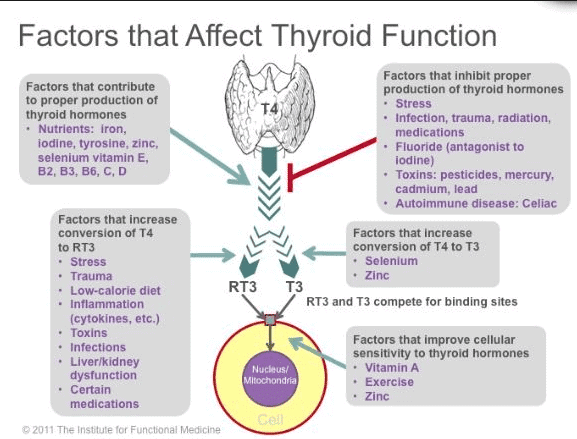
Now compare that to other tissues in the body which have the ability to both inactivate and activate thyroid hormone (your body does this through increasing or decreasing reverse T3 levels).
It’s like the pituitary gland has one switch and it’s the “on” switch.
That means if thyroid hormone is floating around in your body it will eventually make it to the thyroid gland which will cause your TSH to drop.
But that does not mean that the other tissues in your body are getting enough thyroid hormone.
Instead, it’s usually the opposite…
Normal vs Optimal TSH Range
Now having said all of those things it doesn’t mean that the TSH is entirely useless (in fact I will talk about how it can actually help somewhat helpful later).
But in order to understand how to evaluate your TSH, you need to understand that there is a huge difference between being “normal” and being “optimal”.
To start with I have never seen a healthy individual with a TSH > 1.0.
This would indicate, at least subjectively, that the ideal TSH (provided the disease is not present in any form) is somewhere around 1.0.
Nowadays due to the Standard American Diet (4), decreased activity levels, absurd rates of insulin resistance, and many other factors, it is truly rare to see a “healthy” person.
That means we need to change our definition of “normal”.
If you look at laboratory tests you will see that a normal TSH level generally falls within 0.5 to 4.5 (or some small variation).
You can see the range from different lab tests below:

As you can see the TSH reference range is 0.35 to 5.5.
You can see we have a problem here.
Truly “healthy” people have a TSH < 1.0 and yet the “normal” range extends all the way out beyond 5 in this case.
That means your Doctor won’t flag your TSH as abnormal unless it falls outside of those reference ranges.
But as I mentioned above it is important to consider that your pituitary is the MOST sensitive tissue to thyroid hormone in your body.
That means it is entirely possible to have a “normal” but less than “optimal” TSH.
By these new standards, you can consider a TSH which is greater than 2.0 to be an early indicator of some thyroid dysfunction in the body.
It certainly doesn’t mean that anything < 1.0 is “normal” (we need your other thyroid and hormone lab tests to determine that), but it does give us some guidance in terms of understanding how someone can be inside the standard reference range and still have symptoms.
This is where things can get a little more complicated.
There are several conditions where the TSH can be decidedly “normal” in fact it can even be sometimes < 1.0 but the patient can still be hypothyroid.
These conditions include:
- Low T3 Syndrome or Euthyroid sick syndrome
- Cases of Partial or complete thyroidectomy
- Cases of Insulin and/or Leptin resistance
- Cases of Chronic inflammation (including chronic pain, fibromyalgia, and/or chronic fatigue syndrome)
- Hashimoto’s or autoimmune thyroiditis
Unfortunately, patients who fall into any of these categories tend to get misdiagnosed and/or mismanaged by providers who rely solely on TSH levels for diagnosis.
- Bottom line: The “Optimal” range for TSH should be < 2.0, anything higher indicates potential hypothyroidism. Do NOT use the standard lab reference range as your definition of “optimal”.
Let’s go through some examples so you have a better idea of what I am talking about…
#1. Low T3 Syndrome
Low T3 syndrome is exactly as it sounds.
Patients have low T3 but the problem is that they have a relatively preserved TSH (in the normal or even optimal range), but free T3 levels that are either at the low end of the reference range or barely below it.
You can see the example below which shows a free T3 level of 2.5 with a reference range from 2.3 to 4.2.

This is a big problem because T3 is the active thyroid hormone.
So low levels of this hormone in your blood mean you will have low levels of active thyroid hormone despite whatever your TSH may be.
Basically what happens is your body decreases the amount of free T3 and increases the amount of reverse T3 in your body.
This is felt to be a protective mechanism to conserve energy when your body is under extreme stress.
The problem is that this condition extends beyond the typical acute illness that so many Doctors relate it to.
In fact, it has been shown that calorie restriction can even cause low T3 syndrome (5).
Answer this question:
Have you gone through a calorie-restricted diet in your life? Have you gone through the HCG diet or some other medically assisted weight loss program?
And in case you are wondering here are other conditions that can cause Low T3 syndrome and put the “brakes” on your thyroid function:
- Chronic yo-yo dieting or caloric deprivation leading to starvation
- Chronic illness, infection, or autoimmune disease
- Chronic medical conditions like Diabetes, cardiovascular disease, metabolic syndrome, etc.
If so, then there is a good chance you may have low T3 syndrome which is causing hypothyroidism but NOT altering your TSH.
Fortunately, it is relatively easy to check for and just requires the complete thyroid panel which we will be going over below.
#2. High TSH but Normal T4
Another subset of patients have what would be considered subclinical hypothyroidism where their TSH is absolutely elevated (even the conventionally trained physician would agree) but their free T4 is relatively preserved.
Let me show you an example below:
This TSH is elevated at > 3.0 which most physicians would agree is suboptimal (in fact some providers have recommended we change the range to include anything > 2.5 as abnormal (6)).
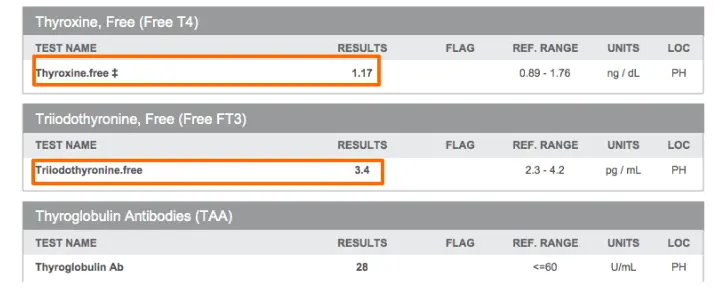
And yet despite the fact that the TSH is > 3.0, in this case, their free T4 is still relatively normal at 1.17 with a reference range of 0.89 to 1.76.
Occasionally this scenario will prompt a physician to simply recheck the thyroid lab tests within a month without proper treatment with thyroid hormone.
And patients who are in this situation feel frustrated because they are symptomatic with abnormal labs, but still aren’t getting treatment.
So why does the free T4 stay relatively preserved in some patients?
The answer depends but usually is made clear by checking reverse T3 levels.
Remember that T4 is simply a reservoir hormone for T3.
T4 is inactive unless it is converted to T3.
But it can be turned into Reverse T3 instead of free T3 which can put the brakes on the thyroid and your metabolism.
But unless you check the reverse T3 level your free T4 may appear falsely “normal” despite the fact that your body is lacking thyroid hormone at the cellular level.
#3. Partial Thyroidectomy with Falsely “normal” TSH and T4/T3
This is another big one that I will occasionally run into and it highlights just how good the body is at preserving serum levels of thyroid hormone (or how inaccurate thyroid lab tests really are depending on how you look at it).
Below is an example of a hypothyroid patient who underwent a partial thyroidectomy some 20+ years ago.
A partial thyroidectomy is a surgical operation in which only half of your thyroid gland is removed and should be compared to a complete thyroidectomy in which the entire thyroid gland is removed.
Patients who undergo a partial thyroidectomy may or may not be treated with thyroid medication after their treatment whereas those who undergo a complete thyroidectomy must be treated with medication afterward.
This patient was certainly still alive without half of her thyroid gland but she was not thriving.
She was experiencing massive weight gain (at one point she was 100 pounds overweight) with constant fatigue, brain fog, and depression.
With half of her thyroid gland, she was still able to produce some thyroid hormone but not an optimal amount.
Her TSH was still 2.37 (so within the normal range) with a reference range of 0.45 to 4.5 uIU/mL:
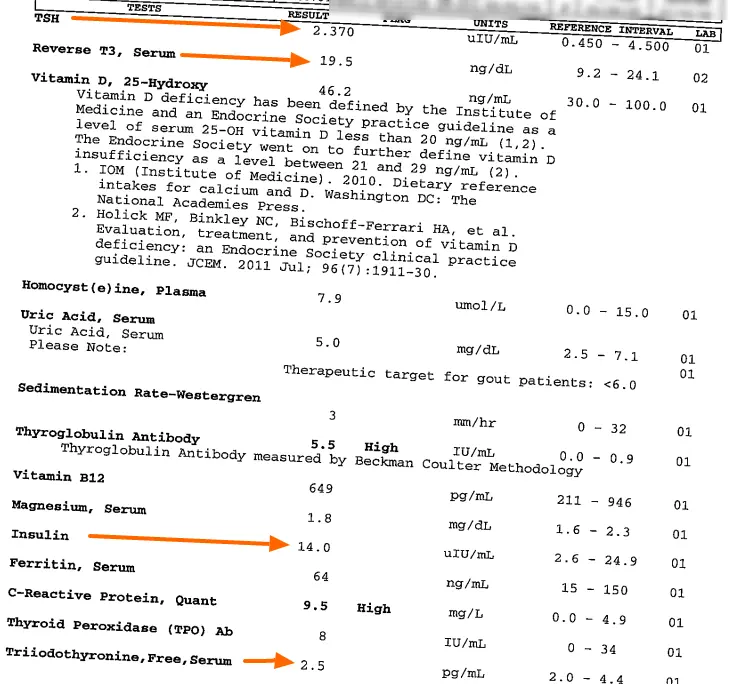
At first glance her labs look “decent” but how can you reconcile these labs with her clinical symptoms?
And it wasn’t until she was started on Nature-throid (she was previously on levothyroxine but didn’t feel any improvement) that she had a near complete resolution in all of her symptoms over about a 6 month period.
In the process, her body transformed and she was able to lose more than 50 pounds.
In fact, you can see her before/after pictures and her entire case study here.
So why is it that this patient was obviously hypothyroid, but she was still able to produce somewhat “normal” thyroid lab tests?
Again, it highlights the importance of not focusing solely on the TSH but instead using other markers to help diagnose thyroid-related problems.
Taking a closer look, you can clearly see that her other lab tests were indeed abnormal.
Her free T3 was at the low end of normal and her reverse T3 was greater than 15.
Putting these together, it would be safe to assume she had a conversion issue leading to disordered thyroid hormone processing.
When you understand how inflammation (indicated by her high CRP) leads to T4 to reverse T3 conversion (7), her thyroid labs make perfect sense.
But in order to come to this conclusion you really have to look at the whole picture.
#4. High TPO antibodies but Normal TSH with Hypothyroid Symptoms
Then, of course, we have the situation of autoimmune thyroiditis…
The situation where patients have hypothyroid symptoms, “normal” lab tests but elevated antibodies to either Thyroglobulin or thyroid peroxidase.
Patients in this situation are often told to take the “sit and wait” approach.
That is, sit and wait until your body destroys your thyroid gland from inflammation and autoimmunity, and then you will need thyroid hormone.
If the body is able to “preserve” thyroid function after a partial thyroidectomy (as evidenced above) then it is certainly able to preserve function if 10-50% of the thyroid gland is destroyed.
This often leads patients with autoimmune thyroiditis until their TSH finally increases to a point where providers feel thyroid hormone is indicated.
Obviously, there is a better approach and that is to look at and evaluate all thyroid laboratory tests (in addition to the TSH) and treat if there is a combination of symptoms + abnormal lab tests (even if those abnormal lab tests are just antibodies).
Below I’ve included an example from a recent patient who had undiagnosed autoimmune thyroiditis for many years:


You can see the TSH at 12.27 with a reference range of 0.40-4.50 in a patient with debilitating fatigue and weight gain for years (undiagnosed) with accompanying elevation in both thyroglobulin and TPO antibodies.
This is what will happen to your thyroid gland over time assuming you don’t treat the autoimmunity or inflammation, and it just doesn’t make sense to wait until the damage is greater than 50% to prove it.
(Bonus) #5. Increased D2 (Deiodinase) Enzyme Activity
Now that you have a basic understanding of thyroid physiology we can discuss another physiologic change that may make understanding your lab tests difficult.
There are enzymes in your body, known as deiodinases, which really help to control and regulate thyroid hormone at the cellular level.
Remember:
Thyroid hormone doesn’t do anything if it’s in your bloodstream. It must make it inside your cells to turn on your genes and have an impact.
And, in order to become active, it needs to be changed by certain enzymes in your body.
One particular enzyme, known as D2, plays a major role in converting T4 into the active T3 hormone (8), especially at the cellular level.
In this way, D2 helps regulate how much thyroid hormone each cell gets by activating or inactivating thyroid hormone as necessary.

While this is a great thing for thyroid control at the cellular level, it can also make diagnosing hypothyroidism more difficult.
Why?
Because D2 has been shown to increase its activity as thyroid hormone levels decrease in the bloodstream (9).
As this enzyme increases in activity, it can do a lot with a little and it can make what little thyroid hormone you have more effective by keeping it active inside the cell.
This helps your cells get what they need, but it also may falsely make your lab tests look more normal than they really are.
Understanding the way that these enzymes work is essential to understanding why treating “TSH” doesn’t work for all people.
In a sense, it doesn’t really matter to your body what your serum T4 level is because it cares much more about the concentration and activation of thyroid hormone inside the cell.
And this process is controlled by these very important enzymes.
Changes in TSH Over Time and With Disease Severity
Why is it that in all of these conditions (they account for the majority of you guys reading this post by the way) the TSH and other lab tests remain decidedly “average” despite obvious dysfunction in other lab tests?
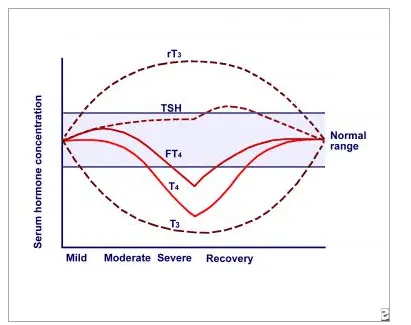
To better understand what is happening in your body it’s best to visualize the thyroid lab tests over time on a chart.
Above you can see a chart that depicts all thyroid lab tests over time and based on disease severity.
On the left is a mild disease state (inflammation, autoimmunity, chronic infection, dieting, etc.) and as you travel right on the X-axis, you can see how the lab tests change over time.
What’s important here is that the TSH doesn’t start to elevate until the disease state has reached “severe”.
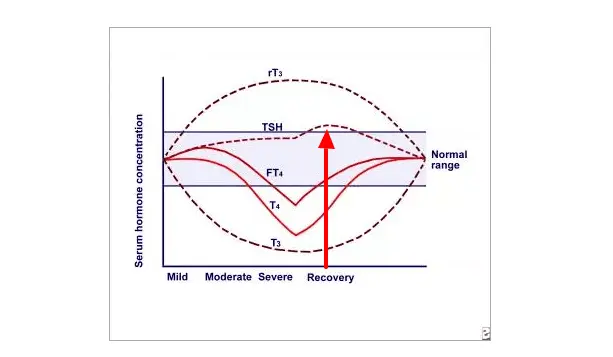
Around this time is when the free T4 level also begins to drop as well below the “normal range”.
But compare those lab tests to both reverse T3 and free T3 which show changes much earlier than the other lab tests.

Both rT3 and T3 can be used as sensitive markers for assessing thyroid disease severity because they become abnormal earlier than other thyroid lab tests.
This illustration helps explain (in addition to the differences in deiodinases, tissue level demands, etc.) why not all thyroid lab tests are created equal and why the TSH falls short if used by itself.
Even if the TSH is used in tandem with free T4, this combination still is less sensitive when compared to rT3:T3.
Instead one of the most sensitive ways to determine if tissues are getting enough thyroid hormone is the reverse T3 to free T3 ratio (which we will discuss below).
Conditions That Make the TSH Less Reliable
In addition to the conditions listed above, there are a few other states that make the TSH less reliable.
I am talking specifically about insulin and leptin resistance:
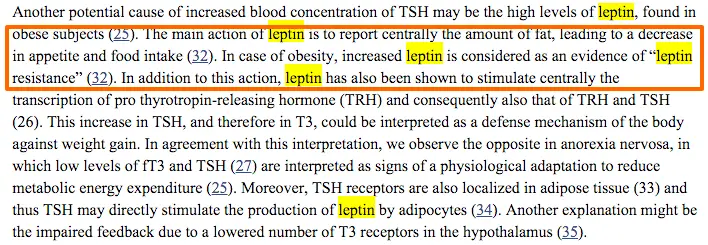
Both of these conditions reduce T4 to T4 conversion (studies showing this link for insulin resistance here (10), studies showing this link for leptin resistance here (11)).
In the most basic sense as leptin levels and insulin levels increase, the body preferentially converts T4 to the inactive thyroid metabolite reverse T3.
This leads to an “adaptive” state which reduces metabolic energy expenditure.
In lay terms, it reduces your metabolism or the number of calories that you burn on a daily basis.
The exact mechanism by which leptin and thyroid hormone are connected is not completely understood (you can read more about it here (12)), but one thing is certain:
Leptin levels and thyroid function are connected.
Leptin resistance and hypothyroidism both appear to be caused and sustained by calorie-restricted diets (chronic yo-yo dieting) which cause high reverse T3 and low free T3 levels leading to clinical hypothyroidism.
The big problem is that this condition is relatively new and our understanding is limited.
But, as a result, it’s not well recognized by many providers or physicians who aren’t trained to identify or look for it despite the fact that it is highlighted in the medical literature.
- Bottom line: If you have leptin resistance (as indicated by a high fasting leptin level) there is a VERY high chance you also have tissue-level hypothyroidism even if you have “normal” lab tests. This condition may need to be diagnosed by testing both your reverse T3 and free T3 levels together.
The Complete Thyroid Panel: How to Diagnose Hypothyroidism
So let’s say you are convinced that your thyroid is suboptimal and you’d like to prove it.
What tests do you need and how do you interpret the results?
We are going to go over them below, but I need to say something first:
Thyroid lab tests shouldn’t be used as THE definitive test for diagnosing and managing hypothyroidism by themselves.
They can be very helpful for the initial diagnosis and sometimes for management, but once you introduce thyroid hormone into the system exogenously (from the mouth) you have changed the dynamics of the system.
I’m not going to go into detail on this now, but just realize the lab tests aren’t the end-all-be-all for diagnosis.
Having said that they can be quite helpful, especially if you are thyroid hormone naive (meaning you haven’t been on medication before).
If this is the case, then these ranges may be helpful for you:
- Free T3: Should be in the top 50% of the reference range (may be falsely elevated in cases of high reverse T3)
- Reverse T3: Should be < 15 (without exception), if your Free T3 is high and your reverse T3 is high then your ratio of T3 hormone in your medication is off
- TSH: Should be < 2.0 *anything higher indicates tissue level hypothyroidism in other tissues in the body (note that a TSH < 1.0 does not indicate optimal thyroid function, especially in the face of abnormal free T3 and reverse T3)
- Total T3: Generally should be in the top 50% of the reference range
- Free T4: Generally in the mid-range (only useful if NOT on thyroid medication as high levels of T3 only hormone will drive the T4 down)
- Sex hormone binding globulin: In women, it should be in the 70-80 range and can be helpful for determining tissue levels of thyroid hormone (can’t be used if a woman is on birth control medication or oral forms of hormone replacement therapy)
- Thyroid antibodies: Should be < 30 (but preferably non-existent for whatever reference range is used)
- CRP and ESR: Both of these markers should be as low as possible (*note that these are non-specific markers for inflammation and as they increase so to will the reverse T3)
As you can see testing for hypothyroidism is far more complex than just testing the TSH (and maybe the free T4).
When you understand the physiology and how different aspects like inflammation, insulin resistance, differences in genetics, and leptin resistance alter thyroid physiology it is easy to see how the TSH falls short.
But remember:
Even those “optimal” reference ranges listed above can be misleading in certain cases, but if used in combination with hypothyroid symptoms (and occasionally basal body temperature + resting metabolic rate) it’s possible to avoid misdiagnosis.
I would also point out that these ranges are really only helpful for those not on thyroid medication already.
Once you start thyroid medication several changes take place that alters these numbers and makes interpretation difficult unless you understand the physiology.
As an example:
Increasing doses of Synthroid or Levothyroxine will certainly drop the TSH (remember there is no competition for reverse T3 in the pituitary) but may actually make thyroid function in the peripheral tissues worse due to T4 to reverse T3 conversion.
So lab tests in this instance would look something like this:
- TSH decreases
- Free T4 increases
- Free T3 drops
- Reverse T3 Increases
- Sex hormone binding globulin stays the same indicating low tissue levels of thyroid hormone
This pattern is seen very frequently in patients who are treated based on the TSH alone but have insulin/leptin resistance and/or a history of calorie-restricted dieting.
If you fall into that category you will need advanced thyroid testing and a provider who can interpret them for you.
When is the TSH Helpful?
We just spent all this time discussing why the TSH doesn’t provide very much value, but it turns out that it does have some limited value.
TSH can actually be very helpful in initially diagnosing hypothyroidism and (sometimes) in helping to determine the ideal dose of thyroid hormone medication.
First:
Newer studies have shown that the healthy TSH reference range should be between 0.3 and 2.5 mU/l (13).
If your TSH is outside of this range then you should be evaluated further and you should consider a trial of thyroid medication.
And Second:
The rate at which your TSH drops can be helpful in determining your total dose of thyroid hormone needed.
Let’s say you start with a TSH of 3.5.
You start titration with Natural desiccated thyroid and after 2 months your TSH drops to 1.0 on 2 grains (130-135mg) of NDT.
This indicates your total dose will likely need to be much higher than someone who drops their TSH down to 0.05 with the same dose.
This highlights that each patient has a unique demand for thyroid hormone in their body and standard dosing should not apply to everyone.
It’s also important to remember that both T3 and T4 will cause your TSH to decrease.
In fact, T3 thyroid hormone is 3x more potent at decreasing your TSH than T4 thyroid hormone (14), so put that into perspective when using medications like cytomel, liothyronine, or NDT.
So if you are started on any medication containing T3 and your TSH does not drop very quickly then that is an indication you might need higher doses of thyroid hormone.
Once you start treatment with thyroid hormone the TSH generally has less utility than the other thyroid lab tests indicated above, but it still can be useful under certain circumstances.
Recap & What to do Next
Let’s wrap this long post up with a recap and some direction if you feel you fall into any of the categories listed above.
First:
TSH can be a helpful test but it really falls short under many circumstances in both the diagnosis and management of hypothyroidism.
For several reasons (including pituitary sensitivity to thyroid hormone, hormone changes, and differences in thyroid medication) measuring the TSH isn’t the most accurate thyroid lab test.
In fact, even with the combination of all thyroid lab tests, sometimes a diagnosis can still be difficult to obtain (meaning it must be based on a combination of symptoms and lab tests).
In cases of low T3, subclinical hypothyroidism, partial thyroidectomy, and autoimmune thyroiditis the TSH may NOT accurately reflect the thyroid status of your body.
If you feel that your TSH doesn’t reflect your thyroid status then your best step is to look for a knowledgeable provider to order all of the tests necessary for diagnosis.
Generally, this means you will have to look outside of the insurance model (I know it’s not what you want to hear but it’s just the truth right now) because most Doctors practice what is known as the “standard of care” and that standard is to test only the TSH.
If you are working with someone and they don’t order the tests or balk when you ask for certain tests that is a good indication they are not the provider for you.
I’ve created a resource designed to help you find knowledgeable doctors which you can use here.
Now it’s your turn:
Do you feel TSH has been helpful in diagnosing or managing your thyroid condition?
Why or why not?
Have you had your other lab tests evaluated? Tests like free T3 and total T3?
What is your healthy TSH range?
Leave a comment below!
Scientific References
#1. https://www.ncbi.nlm.nih.gov/books/NBK499850/
#2. https://www.ncbi.nlm.nih.gov/pmc/articles/PMC3578364/
#3. https://www.ncbi.nlm.nih.gov/pubmed/21415143
#4. https://www.ncbi.nlm.nih.gov/pubmed/21139124
#5. https://www.ncbi.nlm.nih.gov/pubmed/3051835
#6. https://www.ncbi.nlm.nih.gov/pubmed/16148345
#7. https://www.ncbi.nlm.nih.gov/pubmed/27051079
#8. https://www.ncbi.nlm.nih.gov/pubmed/2333963
#9. https://www.ncbi.nlm.nih.gov/pubmed/17991805
#10. https://www.ncbi.nlm.nih.gov/pubmed/21104580
#11. https://www.ncbi.nlm.nih.gov/pmc/articles/PMC3608008/
#12. https://www.ncbi.nlm.nih.gov/pmc/articles/PMC377492/
#13. https://www.ncbi.nlm.nih.gov/pubmed/19941233
#14. https://www.ncbi.nlm.nih.gov/pubmed/402379



My TSH was 3.189 in June. My MD put me on hormone cream containing estrogen, progesterone and testosterone and retested my TSH in August and it was down to 2.030. This isn’t below 2.0 but would this be considered close enough to be optimal? My health has improved, but I still feel fatigued and tired daily even after a good night’s sleep.
Hey Julie,
I think you answered your question with this comment “but I still feel fatigued and tired daily even after a good night’s sleep.” 🙂 If you feel fatigued I certainly wouldn’t consider that optimal, but it’s also important to consider that other things besides your thyroid can contribute to fatigue and other symptoms.
Hi Dr. Childs,
I have Hashimoto’s disease, insulin resistance, Fibromyalgia,etc. My doctor recently reported to me that my tsh was 0.4 but that he did not want to make any changes. I originally was placed on 375mcg of levothroxine daily a couple or 3 yrs ago after years of lower doses. Then probably 6 months ago it was decreased to 234 mcg. I am not seeing an endocrinologist at this time. I have been following up with my primary care. What is your take?
When you mentioned that SHBG should be around 70-80 or else it can indicate tissue levels of thyroid hormone, what exactly do you mean by this? I have hashimotos and my shbg is 33. I have hypo symptoms but tsh, t3 and t4 are withing range. T3 and t4 are lowered (not optimal). Thanks for your time.
In certain instances SHBG can be used to determine how much thyroid hormone is being absorbed and making it to the liver.
Dr. Childs, I am loving your articles! I sit with your articles and my lab results and try to compare how I am doing. I really appreciate your time and knowledge. It is such a relief to know that there are doctors like you who get it. I’m trying to figure out why my Free T4 is always low at .86 ng/dL. TSH: 1.49, Free T3: 3.1, Reverse T3: 11.5, Sex hormone binding globulin: 54. Much appreciated.
No problem, I hope it helps.
I was diagnosed with Hashimotos that went back into normal range after giving birth 21 years ago. My tsh is 113 t4 in normal range & my doctor says it doesn’t matter that it is that high even if I show similar symptoms because I am post menopausal. Your thoughts would be greatly appreciated.
Dear Dr. Westin,
I am from Malaysia and I got my blood test results yesterday as follows:
Anti-TG 973
ANTI-TPO 600
FT4- 12.5
FT3 – 5.2
Serum Iron – 14.3
TSH – 1.300
Hi Dr Childs. I enjoy your posts. I won’t go into detail… I just know I have a thyroid issue that is not being addressed. Where are you located?. Are you taking patients? (TSH >8 /antibodies >900. Exhausted, …no one believing there’s a problem)…I respectfully do not feel my endocrine Docter is really “treating” me. Hoping you can help. Sincerely. Julia T.
Dr, Westin –
I think my body is not responding like a normal person’s body. I cannot get my T3 in an optimal range with the TSH dipping down to .01 or .02. Also, there is disagreement with some online posters of an online community I participate in as to whether or not my original labs indicated that I did have hypothyroidism. I do have symptoms – mild weight gain with no change in diet or activity level, very cold hands and feet, and easily fatigued. I have been a fitness instructor for 15 years so up until last year have been in fairly good shape. Based on your article, I am think I may be suffering from Low T3 Syndrome. I contacted your office this week and they have me on your waiting list. I would love to be your patient, as I feel like you could really help me based on your videos – I have watched the 3-video series!
My first labs before treatment were:
TSH 1.5 (range 0.4 – 4.5)
Free T4 of 1.2 (range 0.8-1.8)
Free T3 of 2.9 (range 2.3 – 4.2)
Question #1 : Is this truly suboptimal thyroid? I am beginning to question going on treatment given that it is 2 years later and my labs are not that much better (see below).
Current labs with 75 mg. Synthroid and 20 mcg Cytomel
TSH .04 (range 0.4 – 4.5) LOWER than my initial labs with NO meds
Free T-4 .09 (range .08-1.8) LOWER than my initial labs with NO meds
Free T-3 2.9 (range 2.3 – 4.2) Same as my initial labs WITH 20 mcg. Cytomel
Question 2: I had been feeling well and had symptom relieve with 75 mg. Synthoid and 20 mcg. Cytomel for almost a year, and out of the blue, I started getting symptoms of hypo again last month, and are still going on (total of about six weeks). WHY out of the blue on the same dosage would symptoms come back? Nothing else has changed!
Question 3: My doctor said when I asked about increasing dosage was that the .04 was already super low and she would NOT up my dosage. Doesn’t the T4 being low mean that it would make sense to increase the dose, even though the TSH is low? Also, WHY is my T4 decreasing to even less than it was without meds? Isn’t this what the Synthroid is for – to INCREASE the T4 (which it didn’t) and to DECREASE the TSH (which it did)?
I have similar readings…
Low tsh – 0.09
Free t3- 0.7
Free t4 – 2.7
Was on 100 mcg levothroxine..now taking 75mg Armour
Symptoms…better…but not great. Endo won’t increase my Armour either…
Have you hear anything back here?
Hey Michelle,
Thanks for sharing. As mentioned in this article if you treat based on the TSH you most likely will not feel optimal for the many reasons listed above.
I’m reading your post and my case so far is similar. I have all symptoms of hypothyroid cold hands, feet, fatigued/exhausted, slight weight gain . I’ve been in fitness industry for years, competed.
The first thing I did was increase my working out . I did 2- cardio sessions a day along w/ weight training for a few months and I gained weight.
I finally went to walk in and my TSH 1.7 , the only test the dr ordered. I have my regular primary care dr appt in a week (soonest I could get in) . Yes my situation is new. Started symptoms 5-6 months back.
At first I thought nothing of my symptoms . I started working out , being stricter w/ diet basically cleaning it up where I could. I feel awful . My reg dr will definitely order all tests.
This is so frustrating.
I’m glad I found this site and the information as well as others going thru the same. I’ll take every bit of info I can get.
I also went thru PA school and they did not go over the thyroid and testing thoroughly. I’ve always thought the ranges of hormones are too vast and should be re-evaluated with better system. Also , everyone should get base line of all bloodwork when they feel their best and younger to see what their “normal” is. Essentially a bloodwork screenshot .
Dear Dr. Westin,
HELP I have almost non existent TSH with low normal FT4 and FT3 with lots of low thyroid symptoms and no high thyroid symptoms and I am underweight. I discovered I had mercury poisoning in 2003 and have had my amalgams out and have done chelation with Liquid Zeolites. I was diagnosed with Hashimoto’s in Sept of 2016 but probably have had it for a long time.
Tests TSH
1999 10.2 (2 months later 6.88)
2004 .01
2007 70.431
2013 .01
2015 .08 (8 months later .02)
2016 <.015
Symptoms
I have had chronic hives for over 20 years
In 2003 I was tested for Mercury, my results 75, toxic dose 3
I used Aminophylline cellulite cream and broke out in hives that week
In 2003 I broke out in open sores all over my body for 2 years the day after a perm on my hair (have had many perms until then), this is when I did the chelation and had the mercury out of my teeth.
/Chronic fatigue, restless leg, food sensitivities, chronic sinusitis, dry skin, colder than the elderly, high cholesterol, (2003 had a live blood cell test – sluggish immune and lymphatics.), decreased stamina, low grade fever mostly under control, low blood pressure, insomnia, mental fogginess
I have been on bioidentical hormones since 2007, recently I have decreased -he estradiol and testosterone that were a little high.
The biggest problem I have is finding information for a non existent TSH and Low thyroid symptoms with Hashimoto's and low normal FT4 and Ft3.
My question is, would you consider putting me on low thyroid meds if my tsh is non existent with no high thyroid symptoms, but many low thyroid symptoms.
I do hope you can help,
thank you so much, Dhyanna Goulet
–
I think I mention in this article but yes, you can suppress the TSH with T4 but that doesn’t mean you are converting or increasing cellular levels of thyroid hormone. Patients routinely come to me with a suppressed TSH and if necessary I will increase the dosage or change around the ratio of T4/T3.
Dear Dr. Childs:
I have been reading your articles on thyroid disease and want to congratulate you for your great contributions to helping patients get the help they need. I feel completely abandoned by the healthcare community and this is why. According to my mother, who is now passed, in 1947 I was tested for Thyroid disease two days after I was born and the doctor discovered a lump on the left side of my neck. The test was negative and it was determined I did not have thyroid disease. Six weeks later, the lump had grown and my mother developed a breast infection from nursing me. The lump was incised and drained. Fast forward to 2016, I suffered all of my life from related thyroid diseases — too many to go into now. When I was sixty-five and admitted for yet another incident (17 all together) paralysis of my facial muscles, a liver specialist found nodules on my liver and said he had a hunch. He ran a full profile of thyroid testing and after said “Hasn’t anyone ever told you were “hypothyroid”? I am still suffering despite the endocrinologist testing that determined I should be on 100 Synthroid. I can’t research for one more doctor to help me . . . I have been around the world with them. I rely now on posts like these to help me. Thank you.
Hey Maura,
I’m sorry to hear about your situation and unfortunately it is all too common. Thank you for sharing your story.
Dear Doctor Childs, I appreciate getting these updates but I have never found any articles describing what the problem is when the TSH is <0.05 and I have low thyroid symptoms. I had mercury poisoning and probably still do to some extent even though I have done chelation. I had a new doctor when I got on medicare and she took me off thyroid meds. I have high Lead also. I was diagnosed with low thyroid years ago and was on Armour thyroid but now my doctor does not want to give me hypothyroid meds because the TSH is basically non existent. Unfortunately, I cannot find any info for my situation, non existent TSH…
I actually don't have high hopes to get the answer, it's been a long road to hoe…I don't want to give up, especially because I just got married last year at age 67, but the low sex drive (use to have high sex drive) is a major bummer. And being so cold all the time with many other symptoms of hypothyroid.
Thank you,
dhyanna
Hey Dhyanna,
This isn’t uncommon at all, I have many patients who present to me with a low TSH level but still remain symptomatic. It’s usually a combination of the wrong medication, high levels of reverse T3 and/or other hormones contributing to hypothyroid symptoms.
Dear Dr. Childs,
I’m very glad that someone is familiar with this, thank you. I’m not on any thyroid meds
I have never tested the Reverse T3
I do use Bio-identical hormones and recently the testosterone and estradiol were high and consequently have been lowered.
However, I am pretty sure that it is quite complicated with me, since I have had serious Mercury poisoning, have suffered with Hives for over 30 years, and for two of these years I had open sores all over the trunk of my body. The hives are better but I still get them often.
What I am concerned about is being on thyroid meds (Amour thyroid)for my hypothyroid symptoms. From what I understand,taking meds for low thyroid can support my Hashimoto’s disease so it doesn’t get worse and so it doesn’t progress too far and then be unable to heal at all.
My doctor would not give me hypothyroid meds because my TSH was so low. She is afraid that I will end up with too much thyroid even though the only high thyroid symptom I have is the outer third of my eyebrow is gone. It makes sense to see a specialist, the right specialist. Not sure I could afford one, however, where there is a will there is a way.
I guess the question is, what do I say to my doctor so she will understand. She does deal with Cancer and Autoimmune diseases so she is up on a lot. Of course I wouldn’t want to have too much thyroid either, but I’d love to get some help with the low thyroid symptoms. I asked her for a trial of hypothyroid meds and she said “No”.
Thank you for answering my last message, hope I get lucky again…
Unfortunately you will never (well, maybe 0.1% chance) get your Doctor to change their opinion on prescribing medication so it’s generally not even worth the trouble. Your best bet is to find someone who is more knowledgable about thyroid function and hormone balance in general, that will make things to a lot smoother for you.
If you spend some time reading comments on here you will find that your question has been asked many times over. If you read through them you will see the frustration of many patients as they go through the same thing you’re going through.
My TPO was over 1000 a year ago, my TSH is now 7.9, just been put on 50mcg of Levo 2 1/2 weeks ago. How long until I feel better? My T4 was 9. Thanks
Hey Jen,
It depends on dosing and a number of other factors, levothyroxine may not even be the best medication for your body so you may not get any improvement.
Hi Dr Childs
My test results are as follows
Thyroglobin Antibodies <1
Thyroid Peroxidase Andibodies 1
T4 Free 1.0
T3 Free 2.7
T3 Reverse 12
TSH 0.96
Leptin 21.6
Iodine 32
I have been on bio idendical hormones for 3 years now since my partial hysterectomy, all my symptoms are under control, sleeping 7-8 hrs, no night sweats etc..but I gained 50 pounds and NOTHING will make the weight come off! i am not gaining,cause i am constantly on a form of diet. I bloat even after drinking water, so i do IF daily it helps, my hair is thinning and falling, My question to you is its obvious i am Hypo, I saw your video on Phentermine, do you think with these #'s i can ask my hormone Dr to put me on Armour, and phentermine and I am also aready on bio testoterone. My only issue is the weight! Please and thank you!
Hey Sandra,
You can ask your Doctor to change your medication but more important than the type of medication is the dose, so if they aren’t familiar with dosing it likely won’t help with weight loss.
I would say I have a lot of the symptoms of hypothyroidism or Hashimoto’s at 24 years old: 60-70 lb overweight (gaining steadily for the past 10 years) and have found it impossible to lose weight, recent episcleritis once in one eye, chronic urticaria for the past two years mostly controlled with 3x daily dose of Zyrtec, fatigue, muscle cramps (feet and hands, recently back), joint pain and stiffness (doctors have always suggested going to a rheumatologist because of a lot of joint issues but never actually referred me so I have not gone), menorrhagia, coarse and dry hair, hair loss, forgetfulness, depression. My TSH levels two years ago were 2.0 mIU/L. I have also had thyroid levels checked before but I do not know if T3 etc where checked. This 2.0 level seems borderline but my doctor disagrees because the lab has a 0.4 to 4.0 normal range. Would you recommend asking again? And if so, what should I say? I do not have the option of going to a different doctor.
Hey Celena,
Unfortunately there is very little you can do in the way of convincing your Doctor to run the right tests or to treat you correctly. If you poke around the comment section of this blog you will see numerous people who have tried without success. The single best thing you can do for your health is to find a new provider to help you further (one that knows and understands this type of information) even if it means paying out of pocket.
Do you have any references or literature showing that TSH alone is not effective in diagnosing hypothyroidism? I am trying to go back with papers or literature rather than anecdotal information off of blogs etc. As a graduate student, I have a student health services system that will not allow me to go to another provider without a referral and I do not have the money for paying out of pocket.
Pretty much anytime I make a claim in an article I will source the claim so relevant links will be in the body of the content itself.
There are others in the comment section of the blog who have tried to bring literary sources to their provider and most of the time it is not met favorably. There is a lag time of about 17 years between research and clinical action and the reason for this has to do with how physicians are trained and really highlights that they are unwilling to change their practice (even in the face of evidence). It certainly doesn’t hurt to try, however.
Dear Dr Childs,
I wish to discuss my case with you. Hope you can provide some advice. I will write in detail, is that ok? Briefly, I has diagnosed with sub acute thyroiditis in December 2015. Am I okay to write to you in details of my circumstances.
thank you
Ash
Hey Ash,
You are welcome to share your case if you’d like but I can’t give you any medical advice because we don’t have a doctor patient relationship.
Do you mean you will read but not comment on where I stand or what I should do? How do we establish a doctor patient relationship? ☺
I’m not currently accepting any new patients, so at this point it’s impossible for me to give you medical advice.
Thank you
Dear Dr. Childs,
Thanks for usefull info. Im from Malaysia. My lab test in october 2016 as followed: TSH 1.00, FT4 12.9, FT3 3.8 and My TPO antibodies is 541. I experienced hypothyroid symptoms which included hair fall, weight gain, intolerant to cold, forgetfullness as well as muscle spasm. At this moment no dr can answer my question and i left untreated. Please give an advice..Thanks
Khairul
Hey Kaybee,
The best thing you can do is find a physician who understands what I’m talking about here so you can get help. You will never be able to convince conventional doctors that their is a problem.
I have many of the issues listed in above comments. More to the point, what type of doctor are you referring to when you say we need to seek advice from other doctors who are not conventional? I asked for an Endo and was told no, they are over booked, unless you have cancer forget it. So who do I see?
Hi Rene,
You have to find someone who has spent the time researching and developing treatments outside of the conventional treatment paradigm. Because this information must be acquired outside of conventional sources there really isn’t a “best doctor” to see, you have to find someone who has done their research and practices differently.
Hi,
I have just come across your post whilst looking up thyroid info on the web. I am in the U.K. So am lucky to have free NHS treatment but I do see that different doctors vary wildly in how they interpret test results. I started my problems in the mid 1990’s when I dropped so much weight everyone was convinced I was anorexic yet I was eating vast amounts of food. I also had a very fast pulse (140bpm at rest) I got pregnant with my second child in 1995 and was in and out of hospital throughout with early contractions, both me and baby weren’t gaining weight and I wasn’t sleeping etc. I haemorrhaged after giving birth to a healthy boy but I just seemed to feel ill all the time, hand tremors, sweating profusely, racing heart, weight loss. I then lost my voice and my eyes were protruding so my GP decided to check my thyroid. I cannot remember the results but the doctor said I had a very overactive thyroid, higher results than he had seen before and referred me urgently to an endocrinologist. I was diagnosed with Graves’ disease after full screening including antibody tests. They wanted to treat with either an operation to remove the thyroid or radioactive iodine but I declined both due to aging two small children and a husband with leukaemia so my hands were full. I started taking carbimazole and beta blockers but carbimazole didn’t suit me so then took propylthiouracil. I reached a time where I just knew I didn’t need them so stopped taking them. Several months later I saw my endocrinologist who was unhappy I had stopped taking them until he saw my blood results and agreed I was in normal ranges and was having no symptoms. He discharged me with a warning I would develop problems in the future.
We have a strong family history of autoimmune diseases in the family (my mothers side) including Graves, vitiligo, crohn’s and myasthenia gravis and all have been severe cases – my mum and aunt are identical twins and collapsed on the same day – mum didn’t make it but aunt did and was diagnosed with MG which left her on a ventilator – she is doing well now with plasma exchanges and other treatments and is home. My son is awaiting tests to see if he has crohns as he passes lots of blood and mucus several times a day, diarrhoea, mouth ulcers, weight loss – unfortunately the waiting time on NHS for tests is 4 months!
Four years ago i started gaining weight for the first time in my life, I was having to watch what I ate and still was gaining weight, my abdomen was bloated, I started needing a lot of sleep, even having to pull over from driving to take a nap, I was so cold all the time, my menstrual cycle got heavy and painful, my lovely nails became brittle with ridges, my hair became dry and thinned, my blood pressure was low as was my mood, my vision deteriated, my memory was shocking, no sex drive at all and I ached all over. I didn’t tell my doctor all this for awhile as thought with so many random problems, he would have had me down as a hypochondriac- I never thought they could all be connected. Eventually a new doctor ran blood tests and diagnosed under active thyroid and I was referred back to an endocrinologist and they put me on Levothroxine. I got lucky and he treats the symptoms not just the blood results so the dose was raised over time, even when my TSH got down to 2.5 he raised the dose further to 100 mcg as I was still having the symptoms. My TSH then stabilised at 0.88, other tests also stabilised but can’t remember numbers and I felt well. He told my GP I am biochemically euyroid when TSH is less than 1.0 For a few years all has been good until a few months ago when I started eating less but gaining weight, feeling tired and cold all the time. I even had a heater under my desk whilst others were complaining of the heat. My hair has started falling out and my hairdresser has had to cut a lot off to help it look better, nails are a mess again, menstrual cycle is heavy and painful again, I ache all over and breasts hurt and have lumps in them (moveable thankfully). Went back to doctors but could only see nurse practioner (nightmare getting doctors appointment these days) she ordered TSH but not T3/T4 tests. blood results of TSH back today 1.85 so they say normal even though I have all the symptoms and endocrinologist said to keep it below 1.0 now got an appointment to see nurse again on Monday (no doctors appointments available again)
I wish all doctors/nurses would realise no two patients are the same and treat the symptoms not just the blood tests!
Hey Julia,
Thanks for sharing your story. You might find this article helpful, which outlines why the TSH is a poor marker for assessing tissue levels of thyroid hormone: https://www.restartmed.com/tsh-levels/
Oh my God- Julia I just read your story at the end of Dr. Childs’ article and it is almost exactly what I’m going through. I just so wish that I could see Dr. Childs. I feel like he could straighten us out once and for all.
Great article! Very informative. I understand general practioners aren’t specialists In all fields. I just wish they would accept this themselves and instead of going straight off lab results and treating/not treating accordingly, they would listen to the patient who knows their own body and refer them to a specialist for treatment to sort out so that the person can be treated well by a specialist and subsequently be discharged healthy. Then if the patient returns and says the problems have reoccurred, the general practioner should listen and refer them back to the specialist. It shouldn’t be difficult to get treatment to live a normal life when the treatments are readily available.
I have Ra. Last year my tsh was .74. I have been exahused, cold. My body temp is now 7.5 instead of the usual 7.78. Snd mt tsh is now 2.37 with a free t4 of 1.49. Nobody believes i might have a thytoid proplem. Even when i pointed it to my rheumatologist she still said Its stll within normal limts. Drs. Dont even listen to u. They just look at your labs in isolation. They notice trends. My wbc and diff has changed dramatically from what it was in the last five years. But it is almost in normal limits. I am going to see a rhematoligist at the Cleveland clinic in 3 weeks. Would they be bright enough to pick up on this? If not who can i see to help me. Thanks, Molly
Hey Molly,
No, most likely not. Places like the mayo clinic and the cleveland clinic will pretty much tell you the exact same thing that your primary care/endocrinologist tell you. Your best bet is to look outside of the insurance model, or find someone who has a more functional/integrative/anti-aging approach to hormones.
So very helpful!! I’ve been on this roller coaster for some time now. My emotions are out of whack! I’ve had what feels like a lump in my throat (no masses) just this feeling on heaviness. I’m tired, angry, emotional, cry for no reason, exhausted, run down, can’t focus…..I’ve been searching for something like your article to help me. Thank you so much for this information!!! My current TSH is 1.08 and I get the same “it’s in the normal range” answers all the time, yet I still feel crappy! I looked back at my TSH results and in 2015 I had 2.28 levels and I weighed less than I have for a long time & I was super active!
Thank you for your amazing article!
Hi Jill,
No problem and I hope it helps.
Good Morning Dr. Childs!
I received my thyroid test results this morning from my Dr. My TSH is .55, my Free T3 is 2.3, and my T4 Total is 6.2. My Dr. is saying they are all in the “normal” numbers, but I feel like crap! Your thoughts on my levels?
Good Morning Dr. Childs,
I have been struggling with my weight for some time. No matter how clean I eat and exercise the scale keeps rising. My doctor immediately thought Thyroid but the tests come back “normal.” In January 2016, my TSH was 2.1. I was diagnosed with Raynauds in February 2016. In September 2016 at my yearly exam, my TSH was 2.21. I am constantly exhausted, I have gained 15 lbs in over a year (even though I work out 6 days a week and eat a healthy diet according to my doctor). I also get brain fog and irregular periods or skip periods all together but since my TSH is normal, the doctor says I have to wait and see what it is the next time around. I’m not sure what else I can do or should do at this point.
Thank You,
Lindsay
Hello Lindsay,
I read your story and except for having been diagnosed with Raynauds, my TSH has been crazy. But my Internist always states it is within “normal limits” and hasn’t ordered further testing on my Thyroid. Even though I have asked !
I really have look at the symptoms and know it has to be related ! I have almost ALL the symptoms.
My last TSH was greater than 2.14 which by this article is not within normal limits if the full panel would be done. And with the symptoms. It is sad we as patients , I have to really push for my health care and become the MD and push for my care !! I really feel for those who just take a Doctors word and not question their answers.
I hope you have found answers.
Good Luck !!
Sincerely
Kelly
Hello – my PCP does a blood test each Dec. to test my TSH levels since my mom and my sister both have thyroid issues. I’m almost 50 and so far mine has been normal according to that blood test. I have suddenly gained a lot of weight and am exhausted all of the time. Can my levels change quickly (it’s been 5 months since my last test) and how should I ask her to test if the blood test isn’t always the answer? Do I need to go to a specialist? What is the specialist called?
Hi Tammy,
Many women gain 10+ pounds around menopause, so your weight may be in part due to other hormones outside of your thyroid function.
Hi Dr.Childs,
Thank you for this wonderful explanation on TSH Levels ! But, I’m still unable to reconcile this knowledge with my recent Thyroid test results (shared below).
1. TSH – 0.06 uIU/ml (Reference range : 0.3-5.5)
2. Total T3 – 92 nq/dl (Reference range : 60-200)
3. Total T4 – 9 uq/dl (Reference range : 4.5-12)
(Method/Technology : C.L.I.A)
I’m 29 years old (Male) from India & I’ve been using Thyroxine Sodium tablets for the past 14 years. I’m currently on 125mcg dosage (per day) and as per your article, I reckon that my dosage should be decreased. Should I change dosage to 100 mcg then ? Thanks for your advice.
What is kids TSH refferance range? Is it same as adult or different?7Y to 10 Y kids
Hi Swati,
Kids are very different than adults in terms of thyroid values.
Dr. Child’s
Great work. I am frustrated with friends and family with thyroid issues ignore my suggestions to see a Functional Medicine Doctor like you. Even friends with elevated Cholesterol won’t consider a Functional Medicine Doctor. I ask them, do you have high cholesterol because your body isn’t making enough Lipitor. Here’s a story about cholesterol. My mom’s Cholesterol was over 350. After seeing a Functional Medicine Doctor he determined she was deficient in copper. Copper is essential for liver health and hemoglobin production. After adding a copper supplement to her diet, her cholesterol dropped over 100 points in 6 months. That was her problem. There are many other reasons for elevated Cholesterol.
Hello Dr. Childs
I have just come across your forum as I am just frustrated and disappointed with my hyper thyroid results.
TSH 0.01 – T4 16.
I just cannot get the TSH to budge, its mainly at 0.01 have seen it go to 2.0 but very rarely. I am tired in the evenings, mood swing most prevalent and my sex drive is dying. I am 60 and keep fairly active.
I have been taking Tapazole 5mg for 4 years now. I take 1 & half a pill a day I cannot take a 2nd full pill in the afternoon as I get a horrible headache. I tried replacing tapazole with propylthiouracil that was a horrible diaster with major side effects.
I have now visited a nauthropath and have started taking a remedy, motherwort, bugleweed etc potion.
Although it has been a month that I am taking the herbs (and my Tapozole) no change in my TSH, but a reduction in my T4 to 16. (normaly 18)
Can you recommend anything I can do to increase my TSH. Please and thank you.
Hi GD,
You can find some information in this post: https://www.restartmed.com/hyperthyroid-supplements/
I am desperately trying to help my 19 year old daughter figure out why she has been sick for the past 4 years. Stomach pain, sometimes nausea and vomiting, muscle & joint pain, chest pain, difficulty breathing (I’ve taken her to the ER twice because the chest pain was so bad), anxiety and depression, difficulty sleeping, fatigue, difficulty focusing on work tasks, cold hands and feet diagnosed as raynaud’s a few years ago, basal body temp hovers around 97.3, cystic acne worse than it has ever been. She consistently has all 10 of your most common symptoms of hypothyroidism! She will eat a small amount of food and then feel so full that she can’t eat any more. She eats very small portions of food yet she’s gained 15 lbs in the past 6 months. Her vit D was 17ng/ml in March is now at 47ng/ml, her iron was tested about 2 weeks ago was at 30 ug/dL, TIBC 367 ug/dL, iron saturation 8 %, ferritin 8 ng/mL. After all that her dr. says her iron level is really fine. She also had biopsies done of her esophagus, stomach, and small intestine checking for various different GI problems like ulcers and celiac but there were no issues there either. I asked them to test thyroid. TSH is .76, Thyroglobulin antibody <10, T3 uptake 30.2%, and T4 free 1.01. She does not take any medication except supplements and we are working on getting her hormones properly tested by an OBGYN. She take vit D, K2, zinc, B-complex, and probiotic. My sister and 3 relatives on my fathers side of the family all had hypothyroidism plus autoimmune disorders all throughout the family. How hard do I push for a hypothyroid diagnosis?
Thanks,
Alicia
Hi Alicia,
I would recommend you seek out someone who takes a different approach to see if they can help you further. Most of the time (in the conventional world) the harder you push the more resistance you will meet, and it won’t help long term.
Hi
I had ACDF surgery 6 weeks ago….I am recovering well but I can barely make it past 7pm without falling asleep. My hair is falling out and I am just exhausted. I went to my Dr. and he ordered blood work. I went this morning and just saw my results online. My TSH is 4.02 The last 2 times it was tested it was 1.68 in 2013 and 1.54 in 2014. The normal range on the report is .30-5.00. I am sure the Dr. is going to say there is not an issue. 🙁
Hi Allison,
Your hair could be falling out for a number of reasons, even several that are unrelated to your thyroid. I would probably start with a complete nutrient and hormone panel.
Thanks for such an informative article! I’m hoping you can offer an opinion or insight into some advice I’ve received from my doctor. I had lab work done approx 10 months ago during a routine physical. At that time my TSH was 1.5. During the last 6-8 months I’ve had increasing problems with weight gain, hair loss, extreme fatigue, and a variety of other symptoms. I went back in and had my labs done again. This time, my TSH was 4.4. My doctor recommended that I take OTC Remifemin for 3 months and come back to have my labs drawn again to see if there is improvement. I am 8 years post-op from a complete hysterectomy and never used HRT, stopped having hot flashes and most other menopausal symptoms about 3 years after surgery. Thus far, I have been unable to find a research based link between Black Cohosh and thyroid function and am not feeling very optimistic about the next three months. Can you offer an opinion about this?
Hi Dr. Childs,
My TSH levels in September of 2016 (last year) were 1.42. In May, they were retested and TSH was 1.02, Thyroglobulin Antibody was 34 and Thyroperoxidase Antibody was 17. It was around this time that I was also diagnosed with PCOS (I’m not too sure it this would affect it). Last week I went for a regular check and my TSH is now at 0.56. Is this a normal fluctuation or is it hinting towards a future hyperthyroidism diagnosis?
Thanks
M
Good morning , I just received my lab results, my TSH is 2.547, the numbers are so confusing ! I have all of the hypo symptoms… my lab reports did not show a T3 or T4 test, but from the article , does my level indicate hypo? Should I ask my GP for medication? What about a “therapeutic dose” will that help my symptoms ? Thank you so much !
Good morning. Your article was very informative but you don’t mention anything about changing TSH levels with age. I am 54, female, postmenopausal and my lab results are:
TSH 3.265
Total T4: 5.92
Total T3: 1.03
Free T4. 0.96
Free T3: 3.00
All of this is considered normal for my age range.
I have had symptoms such as thinning skin, some fatigue and muscle and joint ache after exercise, but is this just normal aging or could it be a thyroid problem?
My doctor is recommending a 25 mcg daily dose of thyroid medicine to lower my TSH to the optimal level of 2.5
I am wondering if this makes sense considering my age?
Thanks!
Hi, I have a 14 year old son who has had some health issues off aND on all his life. He has a slight movement in his neck and I want to make sure his nervous system develops correctly. He also has severe allergies and takes allergy medicine every night. I recently took him to a physician who believes in optical numbers. He take insure but also have to pay extra for the long visits. He seems to think my son needs Thyroid medicine. I started him on Natures Thyroid and he is taking 16.25 mg. I have spit the pill in half due to I don’t want to over medicate him. His first Thyroid test showed Tsh 2.6. He did another test a few months later and his tsh 1.76, t4 free 1.07, t3 rev. 13.5, t4 5.9, triodothyronine t3 112, triodothyronine free serum 3.8. My question is do you think he needs thyroid medicine. I really dislike that he is so young and needs daily meds. I want his nervous system to develop. Could this be the reason he had had problems with nervous system development. He also has been fighting with acne. It has improved since he started taking meds but not cleared up. This could be due to the inconsistent of me givig the meds.due to not wanting to give him too much. Can you help confirm. I am worried mom. Thanks for your time and the article .
I was put on 50mcg of Levo and after a good while my tag dropped to 1.91 but last month it showed an increase to 3.49. I have not changed anything nor has the dosage changed. I am wiped out, however I have moved and have a new doctor who says 3.49 is normal and so is the sudden increase. He won’t change the dosage nor give me and endo referral. He says it is completely normal.
hey! i came across your very informative article while awaiting an apt for my MD to check my thyroid. I got my TSH labs from my previous MD and they are:
2/6/15 -0.181
4/17/15- 1.610
2/23/16- 2.12
2/18/17- 1.990
8/14/17- 2.470
I’m having the following symptoms for a long time but they are gradually getting worse:Fatigue, Depression, Anxiety ,Mood swings , Forgetfulness, Difficulty falling asleep ,Sleepiness, Unable to loose weight, Low energy, Headache, Dry eyes, Dry hands/feet, Low sex drive, Problems staying focused….
My apt isn’t until a couple more weeks but after trying to change my depression medicine and birth control with no change in symptoms, I am convinced its my thyroid. Do you think I’m on the right track?
The previous MD I was seeing was only drawing my TSH and nothing else.
Hi Katie,
It’s hard to say without full evaluation of thyroid hormone and other hormone systems in your body. It seems your current testing is somewhat limited.
Hi Dr. Childs. I am trying to interpret lab results that I recently had done last week. According to lab range, most of my levels are within normal limits so of course my primary doctor and endocrinologist say that I am fine. However, I have been having symptoms for the past four years that only seem to be getting worse. I have been losing hair on the sides of my scalp to the point where I can’t wear my hair in a ponytail because it looks like I am going bald, and I barely have any outer eyebrow hair. My nails are thin and brittle and usually tear or peel very easily. I am tired even after getting 7-9 hours of sleep each night, especially later in the afternoon and wide awake between 10:00 PM and 12:00 AM. I have recently been getting headaches more often, muscle aches, joint pain, constipation, irritability, depression, acne, intolerance to cold, low morning body temperature, heavy menstrual cycles, and increased weight gain despite exercise and a low carb diet. I have a family history of hypothyroidism on both sides of my family. I was on Accutane for three months for my acne and stopped treatment in March of 2016. While I was on Accutane, my liver enzymes were never elevated. I am anemic and normally have a T3 uptake level of 21-22. I am worried because my liver enzymes and cholesterol levels are elevated, and I’m not sure if it’s my liver, my thyroid, or possibly my adrenal glands. I’m also not sure if I should be worried about some of these values being in the lab range if they should actually be in the optimal range especially since some are closer to the low index and some are closer to the high index. These are my current lab results from last week.
TSH- 1.24
T4 8.2
T3- 90
TPO Antibody- 2
Reverse T3- 23
AST- 29
ALT- 48
Vitamin D- 42
Hgb- 11.6
MCHC- 31.3
MCH- 26.1
Fasting Insulin- 2.9
Fasting Glucose- 73
B12- 953
Magnesium- 1.8
Calcium- 9.2
Potassium- 3.8
A1C- 5.3
Cortisol at 7:45 AM- 17.4
Cholesterol- 202
HDL- 66
Triglycerides- 67
Non HDL- 136
LDL- 120
CHOL/HDLC Ratio- 3.1
Hello Doctor,
thank you so much for this article,
I was diagnosed first of all with sub-clinical hyperthyroidism, then after all tests they say I have thyroiditis ( type subacute granulomatous thyroiditis ), TSH level was like this all this time:
2/13/2017 0.26
2/17/2017 0.16
3/13/2017 0.03
4/10/2017 1.38
4/17/2017 2.7
5/8/2017 3.41
6/6/2017 6.27
6/12/2017 4.86
7/17/2017 2.75
8/14/2017 1.18
based on what you said I should consider other factors in order to have the right diagnosis and the right treatment.
my question to you is, will this fluctuation affect me while trying IVF?
do I have to wait until TSH is stable?
I don’t know when TSH will stabilize and I don’t know when my thyroid gland will totally recover.
Thank so much
I am so confused about the tsh levels. Does “high” mean a tsh number bigger than 2? Or is that “low”? I know the higher it goes means “oversuppressed” (according to docs). Since I feel better around “2” and have more energy, or even a little higher than 2, wouldn’t that mean I’m LESS hypo than when the numbers are less than 2 and I feel bad (low energy, muscle issues, all the hypo symptoms)? It seems like this article is saying a number higher than “2” on the tsh means MORE hypo, rather than hyper. Just so I can communicate with my docs more effectively.
Hi Ava,
Generally it goes like this:
High TSH > 2.5 (without medication) = hypothyroid
Low TSH < 1.0 (on medication) = TSH is suppressed High TSH > 2.0 (while on medication) = under medicated
Low TSH < 0.5 (without medication) = hyperthyroidism This isn't universally true but can help as a generic reference.
Thanks for the diagram, it’s very helpful. However, I’m still confused. If >2=HYPO thyroid (presumably that’s true even on medication) then why do I feel better and a reduction of HYPO symptoms when I’m a little above 2? I know when I go hyper because my heart palpitates.
Hi,
I am 62 years old and have been taking Synthroid (generic) for over 30 years. Recently, Dec of 2016, my TSH reading was 5.3. The doctor didn’t change my dose which is .112 (2 pills) every day.
I just had the test redone this week 10/3/17. The TSH reading came back over 10.0+. The doctor has increased my dose to .125 (2 pills) each day.
Why would this number have increased so much in such a short amount of time? Should we be looking for something else that might be going on? I really feel tired all the time.
Hi Linda,
It’s hard to say what caused the change but something as simple as increased stress, a change in diet, changes in other hormones or medications, etc. could have all contributed.
Thank you for the informative piece. I was diagnosed with hashimotos disease when I was 13 years old. Despite having my thyroid peroxidase ab levels at 800+ and being symptomatic for hypothyroidism, I too had to play the “sit and wait game”. My reverse t3 levels were never tested and rarely were my t4 levels. I am 25 now and through out the years I have went to my pcp and complained of the classic symptoms, sever fatigue, weight gain, brittle nails, hair failing out, etc. Every time my tsh levels were tested and always came back relatively normal (per lab range). Always sent home with no treatment and no further testing. I also had a baby last year, through my pregnancy my tsh levels were never tested (I also didn’t know pregnancy could effect it). My OB thought nothing of the fact that I gained over 100 pounds and was severely fatigued. Present day, I finally got my tsh tested and it was at a 6.60. So today was my first day on levothyroxine. I am so glad I am finally getting treatment for it, but I don’t feel like I have a provider that it competent enough to properly dose my medication. I have a one year old daughter and I am so sick and tired of being sick and tired. I’ve spent most of my life worrying about my weight, starving my self so I can have a normal body, and constantly feeling too tired to do anything. I want to be a good mom that isn’t always feeling sick. I need to find a provider in the Michigan area who can help me. Do you have any recommendations or know of anyone?
Hi Brianne,
Unfortunately, I don’t know anyone in that area to refer you but you can continue to learn more about treatments and therapies on this website to help you along your journey.
I am so happy to find this article! I just had a right thyroid lobectomy at the end of June. Prior to that, my TSH levels had always been around 0.7 with 50 mcg of Synthroid and 5 mcg Cytomel daily. I’ve always suffered from fatigue, weight gain, hair loss and cold intolerance. My fatigue has been worse than ever since surgery, and I have noticed ‘brain fog’ more than usual lately… I thought that I was possibly just being dramatic, until I had my labs drawn yesterday (fist time post surgery). My TSH came back at 3.08. It’s never been that high!! However, my Free T4 is normal at 1.2 and Free T3 is also normal at 2.9. I am waiting for the physician to call me to determine what the plan of action is… I’m hoping she isn’t going to try and tell me that my results are ‘normal’ and just brush me off!!
Hi Tanja,
The response will depend on your physician and their current understanding of thyroid function. Under normal circumstances, and based on your symptoms, they will most likely increase your dose of medication.
My TSH went up after starting on 25 mg of Levothyroxine. I have read your article twice but am no closer to understanding my blood tests. I I have been diagnosed with sub clinical hypothyroidism and then told I am euthyroid several times due to fluctuations of TSH . In June I felt awful , so saw my GP, who given my history checked my thyroid. My TSH was 2.9 and T4 within range so told thyroid was fine. Got retested by my fertility specialist and she wanted it under 2.5 before starting IVF and it was 5.2 (&above range) when retested
Saw my GP who tested me again and prescribed 25 My of Levothyroxine. Before starting my TSH was 2.7. After 6i weeks on 25mg of Levothyroxine my TSH was 3.7 ,
Before:
Free T4 : 15.0pmol/L ( 10.0-20.0)
TSH: 2.7 m IU/L (0.30-4.00)
Free T3: 4.9pmol/L (3.0-6.5)
On Levothyroxine
Free T4 : 14.6 pool/L ( 10.0-20.0)
TSH: 3.7 m IU/L (0.30-4.00)
Free T3: 5.1 pmol /L (3.0-6.5)
I had to fight to get Free T3 tested as normal guidelines is to test TSH or TSH with T4. doctors don’t want to increase my dose because T3 and T4 are within range. Any suggestions would be great. The thyroid I really want to ensure healthy thyroid function before I start my IVF drugs next week.
Hi! My doctor is quite unknowledgeable on thyroid issues as he absolutely refused to order t3/t4 labs and finally at my request ordered TSH. Initially he ordered all 3 bc I begged, but the second time he only ordered TSH.
I was taking 300mg Thyroid-Gold, but started a bunch of new vitamins that help with with thyroid and noticed I was feeling symptoms of too much thyroid meds (mainly tachycardia, night sweats) so I decreased to 150 mg Thyroid-Gold and my symptoms were a little better for a while, but then my tachycardia and night sweats resumed (I was assuming it was because the vitamins continued to help. So I got my labs checked 6 Weeks after I went to 150mg)
I had been taking 150mg Thyroid-Gold for 6 Weeks (a type of natural dedicated thyroid from New Zealand that is gmo-free). My TSH was 0.03, free t4 was 0.7, and my t3 was 98. But my resting heart rate (fast asleep) was in the high 70s and low 80s sometimes! I just felt like it was too much medicine!
So I stopped my meds all together to see how my labs were 6 weeks after stopping my meds. My pulse was better, resting hr (asleep) was low 60s!, but weight gain despite working out and decreased appetite, and somewhat depressive thoughts. TSH was >100. (In the past without my thyroid when I was first diagnosed in high school it was in the 400s!). Then lab must’ve called the doctor and requested t4 be done as well (like I requested & he initially declined) and that was <0.4.
I was thinking of starting on 100mg of Thyroid-Gold since 300 and 150mg dosage symptom-wise were too much (even though labs were kinda okay with 150mg), and no meds was obviously too little. Does that make sense to re-start with 100mg? Was thinking of starting closer to the 150mg end than the 0mg end.
Thanks for your insight! Wish more MD’s understood the whole dynamics of the thyroid instead of just partaking in policy…
My T4, T3 Uptake, Free Thyroid, TSH are all normal. Free T3 is elevated (5.1). I’ve been on thyroid medication (Armour) for years and feel great (90mg pd). When we lower to 60, the other values tank and I feel catatonic.
Other oddities included FSH at 20.1 in the follicular phase – so def. OOR for that phase. Prog. and Estradiol were within range at 0.2 and <5 for the phase.
Unfortunately, prolactin levels were not tested. But I'll guarantee you they are off the charts, even though I'm not pregnant or nursing (and haven't been in almost 10 years). As we're symptomatic in ways that I'm just not going to put out in public.
So I guess my question is, given that Free T3 is elevated, but I otherwise am pretty much asymptomatic (with the exception of the hyperprolactinemia), do I bother doing anything about the T3 – or do I leave well alone?
Hello Dr. Childs,
I had Graves disease in my 20’s. I am now 70 and my TSH has suddenly increased to 3.7. I am fatigued and gaining weight in spite of exercising and limited diet. My doctor says I am normal. I have also had chemo (R-CHOP) for Diffuse Large B cell Lymphoma 5 years ago and had a hysterectomy at the age of 35 for fibroids. Could any of these previous health conditions/treatments predispose me to low thyroid? If so, how do I search for someone who will give me the proper meds?
Andrea Vaughan
Hi Dr Child’s,
I had graves disease and underwent iodine therapy and now I’m dependent on thyroid replacement. I have noticed if my tsh stays between 10 and 20 my t4 is middle of normal and t3 is middle normal. When I have tsh closer to a normal range then my t3 drops to the bottom of normal level, this doesn’t make sense to me. Also when my tsh is lower I feel hyper and have anxiety. Any advice?
Thank you very much.
Hi Dr Childs
My issue is low (unreadably TSH), normal range T3 & T4 and I feel miserably underdosed on current dose of whole thyroid, recently reduced because of low TSH.
History: 52yr female, radium reduction of overactive thyroid aged 39yrs at 64kg; height 1.66cm. Hypothyroidism within 6 months; treated with synthetics for about four miserable years; whole thyroid/natural thyroid since then which was much better. It’s been up and down with two moves of doctors as a result. Weight up and down, currently 88kg. Normal, reasonably high functioning lifestyle, long-term relationship, two grown sons out the home, several post-graduate diplomas, part-time study and full-time work over most of my adult life, professional leadership role. Past few years were okay on my dose but recently moved to holistic GP because previous GP refused to continue with my unreadably low TSH (normal range T4 and T3).
New doctor is supportive but recently reduced my dose from 150mcg down to 120mcg – agrees the TSH is useless, but does what is required to avoid risk to his registration, understandably. Antibodies fine, nil issue there.
150mcg was okay – I put strategies in place – never optimal, but okay, for some years.
120mcg: I am miserable: general malaise, feel foggy, stuck in thinking about how I can fix myself, feel I’m not with it, lost value and energy and I’m angry at having no power at all in my own healthcare. GP agreed (for now) not to reduce dose further although no ‘improvement’ in TSH, even after six weeks of dropping to 120mcg.
GP has advised to take vitamin D, zinc, vitamin c, iron, magnesium, which I’m doing. I recently began progesterone supplement, also. No other meds.
My diet is lower on carbs (little or no bread, fruit, milk, potatoes, rice, usually) with normal protein and veg etc. Poor exercise regime, on-off.
Apart from better exercise, which I know I need to do, what can I do?
More importantly, how can I maximise T3 whilst meeting current lab requirements for TSH to be readable?
Dr Childs.. I had my son tested for hypothyroidism/ Hashi’s since we have over 6 people in my family, including me that has suffered throughout the years. You will crack up when you hear the doc when he told my son he was doing a full panel, only did TSH. So much for full panel! She only tested the TSH and it was 2.51. Am i correct in stating that this is not optimal and I want the full , and real panel. Free T3, Free T4 and TPO etc ? He is not on meds so I dont feel that the 2.51 is optimal for a 19 year old boy. He has had insomnia for a long time. Falls asleep but wakes up all the time unless he takes sleep meds. I have learned alot from your website for myself and appreciate all your info! – Thanks! 🙂 Alyssa
The problem is that doctors do not want to spend that much time trying to figure out what’s wrong with you when your TSH range is ok. If your gaining weight it’s your fault. Push away from the table more and get up off the couch and exercise. If you know of a good Endo who cares enough to do all these test in Louisville,Ky please let me know. I go into my Endo today and he did the cancer blood test and it came back fine and He said, my TSH is fine (.02). I told him I have had a cold for six weeks and also ask why I keep gaining weight. He said, I have allergy’s and he raise my meds from 125mcg to 137mcg, see you in six months. Now I have never had allergy’s since I been going there, I don’t work out but I don’t just sit on the couch. I’m always busy, I rarely snack, I eat three times a day and don’t over eat because I just eat to take care of the hunger pains. The radiation changed my taste for most food.
Hi Diana,
Time with physicians is definitely a huge problem. Part of that problem has to do with reimbursement form insurance companies which only pay for very short visits. There are many problems with healthcare but you are right that time spent with the Doctor is a big issue.
I do think that most Doctors do actually want to help they are simply limited in what they can accomplish in 7 minutes and since insurance won’t pay for more time they stick to that time frame.
Hi, I’m having troubles with labs and symptoms. My thyroid was irradiated about 15 years ago and the irradiation was extreme. My dose was 180 of Armour for about 15 years. Did not do well on Synthroid. My new Dr. , based on labs, had lower my dose to 146 of NAture Throid. Here are the labs at the 146 dose. TSH is .02. T4 free is .96, T3 free is 6.4. He says I am still hyper bc of TSH and has lowered my dose again to 120. Do not have labs for that dose yet but will in two weeks. The problem is I feel like crap with hypothyroid symptoms. Felt great at 180 for 15 years. Very frustrated and upset. Do you have an opinion on what is happening here?
Hi Suzanne,
Many things may be interfering with the interpretation of your labs. I would take a look at this article for more information: https://www.restartmed.com/thyroid-lab-tests/
Good luck!
Hello, I can’t seem to find any info about “normal” tsh and elevated free T4 on the internet, but my stats were 2.3 mIE/l TSH and and 25 pmol/L T4, doing some more tests next week but shouldn’t my TSH be low if my T4 is high? Is it a pituitary problem or what can it be? My symptoms are more towards hyperthyroidism, can’t gain weight, bad sleep, muscle twitches, good appetite and eat a lot, fatigued, anxiety, bad digestion, frequent diahrrea, weak immune system
Hi Albert,
I tend to believe that a normal TSH is probably around 1.0 in a healthy adult, perhaps a little bit less.
Sir,
I am an extremely healthy, active (and physical) retired 59 y/o male, with NO symptoms, who went for a yearly examination and blood test….
Doc sez,… “TSH is HIGH NORMAL 4.2”.. Then he asks “Are you fatigued, cold, constipated?” To which I replied NO!… I have so much energy its insane!…Then he informed me that I do have ONE SYMPTOM…Total cholesterol of 260…Something new, as I have always been in the 200 to 220 range….He insisted on a trial of .25 mcg Levo and RECONVENE in 8 weeks… Is this standard protocol? Any thoughts?
Hi Paul,
I don’t think it’s necessary standard protocol but no one would fault him for taking that approach. I think a better approach would be, at least in an asymptomatic patient, to simply recheck the labs in 2-3 months and go from there. It’s certainly possible that the lab result was an error or something interfered with the test.