
7 Reasons your Thyroid Lab Tests are Anything but “Normal”

7 Reasons your Thyroid Lab Tests are Anything but “Normal”

Do you have all of the symptoms of hypothyroidism but have been told your Thyroid lab tests are “normal”? 

I’ve got some news for you…

Chances are VERY high that your thyroid lab tests are in fact NOT normal and that you are NOT crazy.

But it can feel like you are crazy when you go to Doctor after Doctor and you’re told the same thing.

So why is it that every Doctor is telling you that you are fine, despite how you feel?

Let’s talk about why your thyroid lab tests are anything but “normal”…

7 Reasons why your Thyroid Lab Tests are NOT normal

By the time most patients finally come to see me, they’ve seen 5+ different Doctors and they’ve all been told the same thing.

It can get very disheartening to hear it over and over. 

It’s not uncommon for patients to come to me on anti-depressants because other endocrinologists and primary care doctors think that’s really what’s going on. 

And while hypothyroidism can cause depression, most of the time I find that my patients really are suffering from hypothyroidism – they just don’t fit the typical “mold” and so they are misdiagnosed. 

Let me show you why your doctor may be missing your hypothyroidism…

Need More Help? Get My Perfect Thyroid Diet Meal Plan (+ Shopping List)

Join 200,000+ thyroid patients and get the plan by email right away.

#1. Your Doctor isn’t Ordering a Full Thyroid Panel or he isn’t Interpreting it Correctly

There are 2 situations that I see commonly in my office:

  • Doctors aren’t ordering the right tests and they are misdiagnosing the patient
  • Patients are asking for the right tests, but the doctors (and the patients) aren’t interpreting the labs correctly.

Do you fall into one of these categories?

It’s CRITICAL to not only order the right tests but to understand how to interpret them correctly.

Otherwise, you will miss the diagnosis!

That being said…

What tests do you need to order?

The “Complete” Thyroid Blood Panel

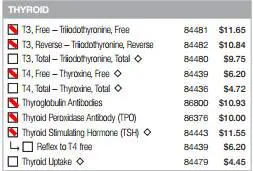
an example of a complete thyroid lab test request form

This is my “complete” thyroid blood panel that I order on every patient, let me break it down for you and why it is important…

  1. TSH – The TSH gives you an idea of how the pituitary is responding to serum levels of Thyroid hormone. The pituitary has different deiodinases than the rest of the body so it can’t be used a marker for tissue levels of thyroid hormone, but it can be helpful if elevated.
  2. Free T3 – How much active thyroid hormone is floating around in the blood. Free T3 is the free and active thyroid hormone and, perhaps, the most important thyroid lab test. 
  3. Free T4 – This gives you an idea of what kind of thyroid “store” your body has. T4 is the reservoir hormone your body uses to create reverse T3 or free T3. Remember that not all T4 will turn into T3 and in the presence of inflammation, leptin resistance, or nutrient deficiencies your body may turn T4 into Reverse T3. 
  4. Reverse T3 – This gives you an idea of what kind of stress the body is under, how much inflammation is going on, and what nutrient deficiencies you may be experiencing. High levels of reverse T3 are associated with thyroid resistance and tissue-level hypothyroidism. 
  5. Thyroid peroxidase and thyroglobulin antibodies – High antibodies are associated with thyroiditis and autoimmunity. If elevated, treatment should be targeted at reducing these values. These antibodies can also cause issues in other tissues including the breast (1) and brain (2). 
  6. Sex hormone binding globulin – This can be used as a surrogate marker for Tissue levels of thyroid hormone. Only two hormones increase this protein, estrogen and thyroid hormone. 
  7. Iron studies – Iron studies are critical for the proper interpretation of thyroid function. In the presence of low Iron thyroid hormone will be less active.

Now, what are the “optimal” levels for these tests?

  1. TSH – TSH should be < 2. A TSH < 2 does not necessarily mean that your thyroid function is normal. It’s not advisable to use TSH to track thyroid hormones as newer studies show this method to be flawed (3). In addition, the pituitary has location-specific deiodinases (4) which make it different from other tissues in your body in terms of how sensitive it is to thyroid hormone. 
  2. Free T3Optimal levels are usually in the upper 1/3 of the reference range. 
  3. Free T4Optimal levels are usually in the upper 1/3 of the reference range. Note that Free T4 levels may drop dramatically on pure T3 hormone replacement therapy like liothyronine, Cytomel, or sustained release T3
  4. Reverse T3Optimal levels are as LOW as possible. If > 15 I will start thinking about thyroid resistance at the cellular level or that leptin and/or inflammation are blocking thyroid hormone from getting into the cells. In the presence of High levels of reverse T3, your free T3 levels may look falsely “normal”. 
  5. Thyroid peroxidase and thyroglobulin antibodiesOptimal levels are as low as possible. I recommend tracking these values if you are being treated for Hashimoto’s. 
  6. Sex hormone binding globulinOptimal levels for Women = 70-80 range. Optimal levels for men = 20-30 range. You can follow the SHBG to see if thyroid hormone is entering the tissues (in this case the liver). As you increase the dose of thyroid hormone this value should increase as well. 
  7. Iron studies – I find that most hypothyroid patients feel better with Ferritin levels in the 70-80 range and percent saturation levels in the 35-38% range.

Remember: 

Interpreting your test results is MORE important than simply ordering the right tests.

#2. Blood levels of Thyroid Hormone are not necessarily what we care about

This is another huge problem so let me explain…

I explain it this way to my patients:

The bloodstream in your body is just a way to move nutrients and hormones to the places that actually need them. 

Your tissues and organs.

The amount of thyroid hormone in the blood is only helpful to us if we KNOW for sure that the hormone and nutrients are making it into your cells.

Most doctors check your blood levels of hormones and assume that if blood levels are “normal” your tissues must be getting the right amount of hormones.

But, obviously, that isn’t the case.

What’s more important than your blood levels of thyroid hormone is the answer to this question:

Are your tissues actually getting the right amount of thyroid hormone?

And we are somewhat limited in how we can actually test this, short of doing a biopsy at the target tissue and it certainly doesn’t make sense to biopsy muscle, heart tissue, or brain tissue to diagnose your hypothyroidism.

Instead, we can use a couple of surrogate markers to evaluate if your tissues are getting enough thyroid hormone:

  1. Your basal body temperature – This can give us an idea of what kind of total energy your body is producing. If your temperature is low, you may have a problem getting thyroid hormone into your cells. You can read more about how to test your basal body temperature and how to follow this value while taking thyroid medication here
  2. Sex hormone binding globulin levels – Read above for more information. This will give us an idea if your Liver tissue is getting enough thyroid hormone
  3. Your subjective symptoms! Symptoms come from a tissue-level deficiency of thyroid hormone and if you still have symptoms despite being on thyroid medication, you might not be getting enough hormone inside your cells. 
  4. The relaxation phase of Deep Tendon Reflexes – One of the most sensitive tests to look at is the relaxation phase of deep tendon reflexes (5). This can actually be tested using sophisticated devices to give an exact number. 

If you focus completely on serum levels of thyroid hormone you are going to miss hypothyroidism at the tissue level (6). 

This may not be an issue for EVERY patient but it will certainly be a problem for many patients – especially those with “normal” thyroid levels but almost every hypothyroid symptom in the book. 

#3. Other hormones influence the action of Thyroid hormone

If you want to treat your thyroid properly you can’t look at each organ system in isolation. 

Your body is like a spider web.

When you pull one string, does the entire spider web magically stand still?

No!

The same thing is true in your body when a hormone system is out of balance.

The other hormonal systems will eventually crash after trying to “stabilize” the problem as much as possible.

It’s like limping on your left leg after you hurt your right leg. After 10 days of favoring your left leg, both of your legs are eventually going to start hurting!

In the case of your thyroid, the two most common hormonal imbalances that can impact and worsen thyroid function include:

  • Adrenals and Cortisol Levels
  • Estrogen balance with Progesterone

Cortisol and Adrenal Fatigue

Your adrenals and thyroid function are intricately linked (7).

Changes in your TSH cause changes in your cortisol and vice versa. 

And this can be a good thing in the short term, but after prolonged elevation, you may eventually start to experience the symptoms of Adrenal Fatigue. 

Adrenal Fatigue is a condition in which you have put excess strain on your body and compromised its ability to produce stress hormones. 

join 80000 thyroid patients

If you try to evaluate thyroid function without taking into account Cortisol and adrenal function, you are making a huge mistake

Not treating associated adrenal-related issues is one of the main reasons that patients fail to improve after starting thyroid hormone. 

Do NOT neglect your adrenals!

You can address adrenal function by focusing on several key areas:

Estrogen Dominance and Low Progesterone

Thyroid hormone, specifically T3, helps your body produce Progesterone (9).

When you have low thyroid hormone, you may also experience low progesterone levels which can lead to an imbalance known as Estrogen Dominance.

This imbalance helps explain why many women with hypothyroidism may experience irregular menstrual cycles, decreased libido, and infertility

Don’t neglect other hormone systems when evaluating your thyroid!

#4. If you have Leptin Resistance or High Reverse T3 Levels TSH can’t be Trusted

Inflammatory states and leptin resistance cause chaos to the entire thyroid system (10). 

Leptin resistance, a condition characterized by increased cellular resistance to the hormone leptin, may cause a reduction in thyroid hormone production (11). 

Conditions that cause leptin resistance may lead to weight gain (and weight loss resistance), changes to your appetite, and a reduction in thyroid conversion. 

Through these mechanisms, leptin resistance may also contribute to an increase in the reverse T3 metabolite. 

As reverse T3 levels rise, your body will have a hard time utilizing free and active hormones effectively. 

They are, in a sense, blocked from entering the cells, and because of this, they may stay floating around in the bloodstream.

This can lead to so-called “normal” blood levels of thyroid hormone which can actually drive down the TSH tricking you into thinking that your lab tests are completely “normal” when, in reality, your cells are starving for thyroid hormone.

If you have inflammation or Leptin resistance, the TSH cannot be used as the only lab test to evaluate your thyroid. 

As a result, you will need to ensure that you order a complete thyroid lab panel and aim for optimal lab values

#5. Don’t practice “Reference Range Endocrinology”

Reference range endocrinology is a term given to the art of practicing hormone management based solely on lab results. 

Many physicians, and patients, tend to approach hormone management in this way. 

This type of practice is flawed for several reasons:

#1. There is no evidence to suggest that each person requires the same amount of hormones

The exact opposite is true:

The amount, ratio, and relative concentration of hormones required in one person are different from the next (12). 

After all, do we all look the same? Do we all react to medications and supplements in the same way? Do we all have the same genetics?

Why would we all require the same amount of hormones?

#2. The standard reference range is too wide and doesn’t take into account the age or medical health of the patient

When you are comparing yourself to some “standard”, don’t you want that standard to be age-matched and healthy when compared to yourself?

Or would you rather compare yourself to someone who is 30 years your senior with multiple medical problems?

The answer is obvious:

When evaluating your hormones, you should aim to compare yourself to a young and healthy version of yourself. 

The problem with standard reference ranges is that they do not take these variables into account and instead create ranges based on people of various ages and health statuses. 

Lastly, the ‘standard reference range’ contains a wide range of ‘normal’ making it difficult to discern between ‘optimal for your age’ and ‘normal’.

Consider this example:  

If you order a hormone test and your result comes back in the bottom 5% of the ‘normal reference range’ you would be considered normal even though there is massive room for improvement

And that is a huge problem.

There is a big difference between being “normal” and being “optimal”.

There’s also a huge difference in what being “optimal” means between different individuals!

There will always be people that feel better at lower levels of thyroid hormone, but there are just as many (if not more) that NEED higher levels of the hormone to function at 100%!
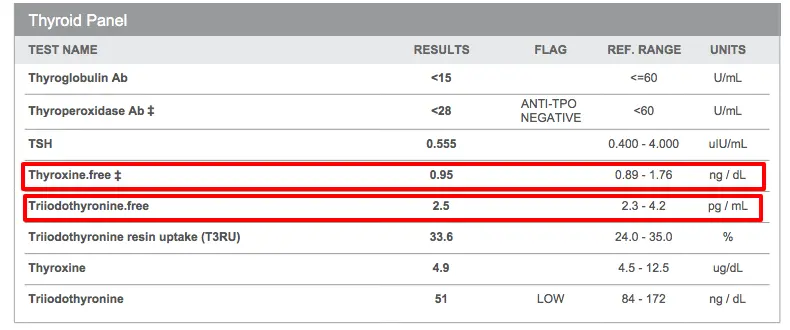
Low Free t3 and low Free t4

Above is a classic example of a patient suffering from Hypothyroidism with “normal” lab results, even though her labs are barely within the “normal” range. 

You can see that the Thyroxine free (A.K.A. Free T4) is a result of 0.95 and the range varies from 0.89 to 1.76 ng/dL.

While the 0.95 result is very close to being abnormal it is technically still within that broad range and, as a result, many physicians may opt against treatment. 

Unfortunately, most Doctors (including Endocrinologists) practice this way!

If you want to find a Doctor who doesn’t you will typically have to look outside of the traditional model. 

#6. Failure to Diagnose and Appreciate Nutrients Required for Thyroid Function

It’s silly but outside of the hospital doctors don’t appreciate the value of nutrients and supplements in treating disease.

Inside the hospital, your Doctor is intimately familiar with something as simple as magnesium: it serves to help stop pre-term labor (13) and it can even bring your heart back into a stable rhythm when given intravenously (14).

Outside of the hospital, however, it’s another story entirely!

The truth is your thyroid needs several different nutrients (that are commonly depleted in most people) to function at 100%.

Some of the most common include:

  • Iron – To check the iron status you’ll need to obtain ferritin (15), serum iron, and TIBC. Iron deficiency results in decreased thyroid function. 
  • Zinc – This nutrient helps T4 to T3 conversion (16) and acts as an anti-inflammatory agent, and may help improve your immune system. A deficiency in zinc leads to a hypothyroid-like syndrome which is ameliorated with zinc supplementation. The best way to determine if you are zinc deficient is with a trial of zinc supplementation. 
  • Selenium – This nutrient also helps with T4 to T3 conversion, may help decrease autoimmunity (17) and antibody levels in Hashimoto’s, and is required for thyroid hormone production. 
  • B Vitamins including B2 and B6 – Activated B vitamins are required for thyroid hormone production and the production of adrenal hormones. Stress and other lifestyle factors can increase the demand of B Vitamins and may lead to a deficiency. 
  • Vitamin D – Low levels are associated with an increased risk (18) of autoimmune disease and may also contribute to fatigue (19). 
  • And many more which you can read about here

If your “thyroid” labs look normal, but you still aren’t feeling great make sure to check out these common nutrient deficiencies which may also play a role. 

#7. Not appreciating the effects that Endocrine Disrupting Chemicals have on Thyroid Function

Endocrine-disrupting chemicals have been shown to reduce T4 to T3 conversion, and lower T3 levels in the serum all while NOT affecting the TSH (20). 

How To Tell If It's Really Your Thyroid: Get My Hypothyroid Symptoms Checklist

Get the PDF. Check off your symptoms. Find out in 60 seconds if it's your thyroid (or something else).

Nowadays, detox really needs to be part of your treatment regimen.

At the very least you should actively be avoiding these chemicals that may potentially cause thyroid problems. 

I would go a step further and recommend that you not only actively avoid these chemicals, but that you also try to eliminate them from your body!

You can do this by following some very simple steps:

  • Drinking from filtered water only
  • Avoid plastics of any kind – especially avoid microwaving your food in plastics!
  • Eat organic, hormone-free foods
  • Drink out of glass containers, and store your food in glass containers
  • You can find more tips on how to eliminate and detox here.

Conclusion & What to do next

If, after reading this, you believe you may not be getting the appropriate treatment I would recommend you seek out a Functional Medicine Trained practitioner for further assistance. 

When it comes to thyroid health, I would generally recommend that you find someone skilled at both prescribing thyroid medication and someone that is knowledgeable in treating the thyroid naturally.

Your goal, whenever possible, should be to get off and stay off of prescription medication – but realize that isn’t always the case.

And some patients may feel significantly better with the right medication to get the ball rolling.

I’ve created a resource here that you can use to find a doctor if you are struggling with your current medical plan. 

Now I want to hear from you: 

Do you feel like you’ve been properly diagnosed and treated?

Are you experiencing hypothyroid symptoms despite having “normal” lab tests?

What information do you have to share with others who are in the same position as you?

Leave your comments or questions below! 

Scientific References

#1. https://www.ncbi.nlm.nih.gov/pmc/articles/PMC5422478/

#2. https://www.ncbi.nlm.nih.gov/pmc/articles/PMC4401150/

#3. https://www.ncbi.nlm.nih.gov/pmc/articles/PMC5763098/

#4. https://www.ncbi.nlm.nih.gov/pubmed/16131331

#5. http://www.ncbi.nlm.nih.gov/pmc/articles/PMC2492977/

#6. https://www.ncbi.nlm.nih.gov/pmc/articles/PMC3169863/

#7. http://www.ncbi.nlm.nih.gov/pmc/articles/PMC3520819/

#8. https://www.ncbi.nlm.nih.gov/pubmed/25995404

#9. http://www.ncbi.nlm.nih.gov/pubmed/9846161

#10. https://www.ncbi.nlm.nih.gov/pmc/articles/PMC4802023/

#11. https://www.ncbi.nlm.nih.gov/pmc/articles/PMC377492/

#12. https://www.ncbi.nlm.nih.gov/pmc/articles/PMC2605414/

#13. https://www.ncbi.nlm.nih.gov/pmc/articles/PMC5690360/

#14. https://www.ncbi.nlm.nih.gov/pubmed/11105328

#15. http://www.ncbi.nlm.nih.gov/pubmed/16500878

#16. http://www.ncbi.nlm.nih.gov/pubmed/8157857

#17. http://www.ncbi.nlm.nih.gov/pubmed/23046013

#18. http://www.ncbi.nlm.nih.gov/pubmed/17699936

#19. https://www.ncbi.nlm.nih.gov/pmc/articles/PMC4158648/

#20. https://www.ncbi.nlm.nih.gov/pmc/articles/PMC5751186/

normal thyroid lab tests explained

picture of westin childs D.O. standing

About Dr. Westin Childs, D.O.

Hey! I'm Dr. Westin Childs, a former Osteopathic Physician (D.O.) who transitioned from traditional clinical practice to specialize entirely in helping people like YOU overcome thyroid problems, hormone imbalances, and weight-loss resistance. I am passionate about researching and sharing evidence-based solutions, and I formulate specialized thyroid supplements that have been trusted by over 100,000 patients over the last 10 years. You can read more about my own personal health journey and why I am so passionate about what I do.

P.S. Here are 4 ways you can get more help right now:

#1. Get my free thyroid downloads, resources, and PDFs here.

#2. Need better symptom control? Check out my thyroid supplements.

#3. Sign up to receive 20% off your first order.

#4. Follow me on Youtube, Facebook, TikTok, and Instagram for up-to-date thyroid tips, tricks, videos, and more.

138 thoughts on “7 Reasons your Thyroid Lab Tests are Anything but “Normal””

  1. Hi Dr. Westin,

    First off, thank you for this excellent information.

    I just recently received my lab results back for Tsh, free T3, and free T4.

    Tsh: 1.8 (normal range)
    free T4: 0.6 (range 0.7-2.5 ng/dL)
    free T3 was 2.3 (range 2.4-4.2 pg/mL)

    TPOab was low and the results said Hashimoto’s was very unlikely.

    I suffer from many symptoms associated with hypothyroidism such as hair loss and dry hair, exhaustion, some mood swings/depression, some irregularities in menstrual cycle in the past few months, low basal body temp, often cold, and brain fog, difficulty losing weight despite a whole food diet and fairly regular exercise.

    Here’s my question: Based on my lab results above, and the fact that my free T3 and free T4 levels are slightly below normal range, would you say I do have hypothyroidism and that I would benefit from thyroid medication?

    I really appreciated how you mentioned the interplay between estrogen and progesterone and how that ties in with the thyroid–I have felt for some time that I am estrogen dominant, due to lack of sustained temps in luteal phase of menstrual cycle.

    My other question is this: if I go on medication for my thyroid and get T4 and T3 levels up, do you think that in itself will also help with my suspected low progesterone levels? Or do you recommend I look into progesterone supplements in addition to thyroid medication?

    Thank you in advance.

  2. Thank you for this article! I have had a lot of issues since 2016 and I am concerned that my doctors are not taking my complaints seriously. Here is my timeline:

    05/2015-10/2016
    gained 40 lbs and have been struggling to get below 190 lbs for over a year even though I eat, sleep, and exercise as best as I can.

    7/29/2016
    pulmonary embolism after 4 months on birth control-TSH 4.5 the highest so far

    8/2016-1/2017
    warfarin therapy. Felt awful the whole time. Dr. not concerned about my thyroid or bodily aches and brain fog.

    5/2017 –
    Began experiencing chronic fatigue, cognitive issues (memory, speech, processing information), dry/brittle hair and nails (pitting and Beau’s lines), hair loss, constipation, and a mix of hypo and hyperthyroid symptoms. Labs revealed normal TSH and some minor inflammation (sed rate 39, C-reactive 1.1, and stool 72.) negative for rheumatoid and celiac

    11/2017 –
    I developed something like ulnaris tendinitis in my right wrist, ring, and pinky finger. X-ray is normal. It has improved but if I ‘overuse’ it immediate regression. I have weird flashes of pain in my knees, ankles, thighs, hips, lower back, and I had gout like pain in my right toe for 4 days in February of 2018. No redness or swelling though. My lower back, hips, and thighs hurt going upstairs or uphill but hips X-ray is normal.

    01/2018
    Low iron: 32 ferritin, 331 TIBC, 10% saturation, 34 total iron
    Low vitamin d- 30
    Low vitamin B12- 303
    FT4 0.69
    FT3 3.3
    RT3 12
    TSH 2.41
    TPO >900 (I had to request this one)
    Healthy CBC and CMP
    I was diagnosed with Hashimoto’s but doctor didn’t seem concerned about my high TPO and RT3 or my low T4. I started iron( Ferrous gluconate) vitamin d, zinc, glucosamine sulfate supplements. My iron has improved by 50% as of 3/22/18.

    I am still waiting for my most recent thyroid labs to come back.

    I saw an Endo recently and he insisted that TSH is the best test and since my TSH is normal didn’t consider the other labs. I am in the process of giving saliva and the Overnight Dexamethasone Suppression Test. I asked if I should wait to do the test until my bupropion and zinc are out of my system and he said no. This goes against what I have read about this test.

    I believe I am experiencing tissue level hypothyroid symptoms (I have been keeping a symptom journal since February of this year) and since my TSH is ‘normal’ no one seems to believe it’s as bad as it feels. I know there are still many things to cross off the list, but I really want to expedite my diagnosis. I am not convinced the wait and see approach is the right treatment for me given my long list of symptoms.

    I apologize for the lengthy post but I would really appreciate your input.

    Thank you!

  3. Very interesting reading. When I was born my body was not producing any thyroid at all, and unfortunately, it took Dr’s a few years to figure it out. I took Synthroid for 35 + years and started to experience weird heart symptoms. I switched to Armour thyroid which I like much better. Just today at a follow-up appt for recent labs the results showed my TSH and T3 both high… TSH 6.33 and T3 is 235.0. My Free T3 is 6.4. Dr wants me to see a specialist. Any suggestions as to the cause?

  4. Alright man… So I tested my Thyroid a few months back and turns out it was low. As per what Defy Medical said.

    But I had a lot of symptoms of what a low thyroid would entail for a dude semi acting like low Testosterone. Very cold at times and sluggish. But wasn’t any evidence of an immune system issue. Went on naturethroid and some symptoms cleared up.

    At the same time, I stopped running a business that was completely stressing me out. So stress levels are a lot lower.

    But this Naturthroid shit is “boiling me” to death almost and racing my heart at night. And I just dropped down to less 1/4 grain.

    Anyway, there are some benefits I’d like to keep if I dropped the meds, and def some I’d like to get rid of.

    So if I have most of the hormonal panels, although they would be skewed with the Naturthroid,

    How can I try to do this the more natural way?

    What nutrient tests do I need to try to fill in the gaps that way?

    And best way to taper off?

    Thx in advance.

  5. Where is a link to find a functional med trained practitioner that you reference? I’m literally desperate. Huge weight gain. Seems like every symptom yet even though my labs are at the high end of the scale my gyn and reg Dr say “normal”. 3 kids. Always energetic and bounce back to 140 at 5’7 and now 50 lbs overweight. Please answer.

  6. Hi Dr. Childs,

    I need help with my 16 yr old daughter. She is 5’4″ and 156 lbs. She is on NP Thyroid 60mg for a few months now. We were on the keto diet and she was starving all the time and gaining weight. She had knee surgery in August and is better now with that, but a lot of hanging in the bed for almost a year now. She’s doing pilates reformer 4/ wk. Her last labs as of 4/13/18 were:
    Glucose 104H
    ALT 37H
    Free T4 1.0(1.6)
    TSH 0.135 (<1)
    TPO 12
    Free T3 5.1(4-5)
    Reverse T3 15.7
    Ferritin 67L(80-100)
    DHEA-S 289.8H(150)
    VitaminD 80.6
    Progesterone 0.2L
    Estrone 103H(<50)
    She is a ballet dancer and this year has been a hard one. Last year she weighed 125lbs. Please help!!!!! Thank you so much!!!!!

  7. This is a great article!! I just had my physical yesterday and my doctor and I have worked on getting me a slew of tests to see where I’m at! Yay! But, the problem I’m running into, especially when looking into testing the “sex” hormones, is finding out when during my cycle I should have them done. I am doing blood, not saliva, testing… Do you have any insight on that? Thank you!

  8. Thank-you so much for sharing so much information. My story is lengthy, but my main reason for writing is to ask about T3 test results when taking Cytomel. My family doc has been working with me. He agreed to place me on 25mg Cytomel to help resolve a problem I was having with a high RT3. When I first started taking the Cytomel, my T3 results went from 4.9, 4.0, 5.2, and most recently – a drop to 2.8! Is this considered normal when taking Cytomel?? The RT3 has successfully dropped, but is it normal for the T3 level to drop as well, even while taking Cytomel? I’m just trying to understand. Again, thanks so much for all the information!

  9. Dear Dr. Westin,
    Thank you so much for your very informative article!
    I have hypothyroidism and chronic adrenal fatigue and am on natural thyroid and adrenal treatments. Have been taking compounded T3 and T4 (over 3 grains daily), iodine 2 x daily, and adrenal glandular pills 3-6 times a day, plus a lot of vitamins, proteins, and minerals. I am an active 70-year-old woman.
    In the past 3 mos though, the compounded thyroid med did not seem to be working well. Was on nature thyroid before December. Hair thinning now, nails breaking, etc. So my new doctor ordered a blood panel, which she said shows that I am now in hypERthyroid mode and must take a very low dose of nature thyroid — 1/2 grain by her calculations! Nature thyroid did work better with 3+ grains, but this big change scares me! So I said if I am hyperthyroid, why do I still exhibit almost all the signs of hyPO?? Big bags under eyes, sometimes fatigue even with the adrenal pills, plus thinning hair, etc. She claimed this can happen even with hyPERthyroid. But I do not have a racing pulse or any of the hyPER symptoms at all.
    I am very confused by these blood test results and do not want to make a move until I have all the facts. What would you recommend I do, Dr. Westin?

  10. Dr. Westin,

    I am a 63-year-old woman that had a total thyroidectomy (cancer) about 6 years ago. It took 3 years to actually get my body well again and levels right, thanks to my regular Dr. that is willing to try natural ideas.

    Last year I lost 20 pounds, exercised regularly and healthy and felt brand new! I was in Colorado taking care of my sick mother, but I also took care of me.

    My mother got better and I came home to Tennessee and got a job at a Memory Care unit in an assisted living. I was doing excellent from June 2017 – December 2017. Then the job became VERY STRESSFUL, my body started aching and hurting and sleep was very restless.

    I found you online and went to the Dr. and asked for the tests that you said I should get. To my surprise, my TSH was 35.84/ my T4 was .82(lowest range of normal) my reverse T3 12.9 (9.2-24.1) and my SHBG was 162.6! Wow, I was in shock.

    I am currently taking Nature Throid 130MG, and have been taking this for several years without any elevations or issues. The Dr. upped my dose to 146.25MG for 6 weeks.

    I sure hope you read this because I need your expertise. Do you think high cortisol is the culprit to all this thyroid madness?

    I have maintained my weight, but I am sure I have lost muscle. I sleep poorly and ache a lot. Since I started feeling really poorly, I cut back to part-time at 24 hours a week at my job. I have done this work for 20 years, but I need to take care of me again.

    Any suggestions?

  11. My naturopath says that when taking just Naturethroid your FT4 will always be at the bottom of the range but all that I am reading says that optimal FT4 is in the top 1/3 of the range. How do you get you FT4 up? I was on 1.25 grains then 1.50 grains and also 1.75 grains and my FT4 has never moved from the bottom of the range.

    • Hi Jennifer,

      It is true that some people notice a suppressed T4 when taking NDT but this is not necessarily considered to be a problem unless you are symptomatic.

  12. Thank you for all this information. It is very eye opening. A lot of Doctors I have seen do not know how to read the levels. It is heart breaking.
    Thank you
    Jen

  13. Hello, I had a Total Thyroidectomy Oct 3rd 2017. I have been taking Synthroid 88mcg and I had my last checkup in March. My levels were “normal” and they sit up an appointment for a year from that time. I’ve recently been feeling off and had more blood work done today. They called and said I’m “normal” but I feel off. I’ve been trying to get back in to see my doctor but I feel like they think I’m crazy. I feel depressed. Agitated. Hungry but feel sick when I eat. Exhausted and not myself. Any advice for me? I know my body and it doesn’t feel right. I’m 31 years old and I feel like I can’t lose any weight.
    Thank you,
    Brandi

    • Hi Brandi,

      The best thing you can do is look into adding T3 to your current medication. T3 tracks better when it comes to symptom management compared to T4 only and there are many studies which show this. You may need to seek a second opinion with someone who is more willing to work with you and alter your medication.

  14. Can you please help me. I am 29 years old. I feel very sick. My hair is falling out. I had to drop out of college due to being so sick. After comparing my lab ranges to optimal ranges some are very low. Last “functional” doctor told me everything was normal. But I do not feel normal. I have spent so much money seeking answers. But do not know where to turn now. This full panel was done in September. What do I do?

    THYROID
    T4, TOTAL (7.9) 4.5 – 12.5 mcg/dL
    THYROID STIM. HORMONE (1.60) 0.34 – 5.60 mIU/L
    ANTI-THYROGLOBULIN AB. (0.1) 0.0 – 5.0 IU/mL
    T3, FREE (2.9) 2.39 – 6.79 pg/mL
    T3, TOTAL (0.69 L) 0.8 – 2.0 ng/mL
    T4, FREE (0.88) 0.58 – 1.64 ng/dL
    T3, REVERSE, SERUM (20) 8 – 25 ng/dL *2
    THYROID PEROXIDASE AB. (1) 0 – 60.0 U/mL

    My results are in parentheses. The lab ranges are beside them.
    Thank you,
    Jen

  15. Hi, Thanks for all the advice on your posts.
    I’m 57 years old and have been on Thyroxine for about 20 years, constantly having my dose altered. I’m suffering with all symptoms of fibromyalgia, but these seem to be very similar to thyroid issues and after joining several online groups really don’t think I have FM. I’ve asked many times for a T3 check and finally my doc said that my T3 is low, but said that they won’t do anything about T3, as T4 and TSH are within range. And my inflammation levels are high, but as they’ve always been high won’t do anything. Yet for years I’ve complaining of brain fog, tiredness, dry skin, hair loss, weight gain, severe cramps, joint issues, muscle pain and the list goes on. I do pilates, swimming and dancing every week. Is there anything that you would recommend for me please.
    Thanks Karen.

  16. Dr Westin, have been very enlightened and informed with the info you provide. Not on any medications. BP & cholesterol very good.
    I am a 57yo post menopausal female currently 25kg overweight and been struggling with weight for decades despite trying lots of things. Recent blood tests have me with a TSH of 23.9 (range 0.5-4) and a free T4 of 11 (range 10.0 – 19.0) no reverse T3 done. Negative for Diabetes. GP has advised retesting in 6-8 weeks but recommends I may need Thyroxine ongoing.
    I would prefer to fix anything naturally. Your recommendations would be appreciated. Sharon from Australia

  17. Can you clear something up for me Dr Childs. I am getting conflicting advice on T3 medication. I am supplementing T4 meds with a small amount (10mcg) of T3 daily. It has been mentioned to me that the body senses the extra T3 and stops converting similar amount of T4 to counter. Could that be true?

    • Hi Susan,

      If anything T4 would be reducing T4 to T3 conversion through upregulation of the D1 enzyme.

  18. Hi I have been told by family I have Thyroid issues.. Fatigue I have had it for many years. I can walk 10 feet and just want to die. I have changed many doctors because they think they are always right.My THS T3 and T4 are always normal. This new doctor has finally tested me for the THYROID PEROXIDASE ANTIBODIES and came back with the number 85 which seems extremely high. I have not seen my doctor yet my appointment is on the 24th… IS there anything I should ask her? Anything I should be worried about? I am 40 pounds overweight, cholesterol off the charts, have cysts all over my kidneys, ovaries, armpit, ears (not sure if this is part of thyroid issues), IBS, the list goes on I am 41 I feel like I am 81 and I need to get on the right track.

  19. I want to cry reading your post. I almost am. I was looking at a patient portal result from two years ago, remembering going to three different endocrinologists, and all three times being told I was “normal”. My ranges on three tests across three years to me scream problem. On my T4 free. But oh no it’s normal and I’m just fat and trying to find some excuse because being right on the bottom end of normal and .01 points or even .1 points below is just fine it’s not “that bad”. I have almost every single symptom. I had some of it when I hit puberty, and after having a baby, my whole body broke. I am so sick of doctors at this point that I hate them and I am not that kind of person. How can they say it’s not that bad when they are not feeling what I am so they have no way of knowing? And they sit there and google instead of doctoring and they still say I am wrong when I print it out just like they are? I have been in poor financial situations for the past fifteen years, and how could they not see, knowing my income and family situation, that I am spending my precious dollars to find an answer? See I’ve been suffering the worst from the horrible depression and anxiety, as well as debilitating fatigue, that even put me in the hospital. It feels like a deep dark pit of no hope. And then I read a blog like yours and I want to force all doctors to read it! Unfortunately, they would not believe it. Something else that upset me? The one endo did say well ok I’ll try you on a med, after seeing these results. And gave me a med for my T3 which is normal! And I call the nurse up who proceeded to say well I have no idea what to do for you because she gave ME one for T4. My TSH is also normal. The first thing I saw when I have been researching is that this can mean a pituitary problem, even a tumor. Well, I guess I’m not dead yet, so I guess I’m fine? It’s not like they cared to even mention that possibility based on the tests. It’s not their life that sucks after all, to the point where they don’t even care if they die in their sleep and in fact wish for it almost every day.

    You seem like a great guy but I wasn’t surprised to see that the fee for talking with you is about equal to what my pay is for half of a month. I guess that’s why the rich enjoy life more eh?
    Oh and I’ve tried supplements before but I know I would need a doctor to help me because my body is really sensitive to things and I have borderline personality disorder also not related to my thyroid and add.

  20. Hi Dr. Childs:

    I have been working with Dr.’s for over 25 years and my meds, Levothyroxine and Liothyronine have gone up and down often. Only tests my Dr.’s will do are the TSH, FT3 and Free T4. I have asked about the others you have suggested and they both said it is not necessary.

    I was just seeing a GP and of course everything was always normal, even though he continued to raise my Levothyroxine numerous times (From .25 to 1.0 mcg.)

    I asked for a referral to an Endocrinologist and have been seeing her for the last 3 years. Unbelievably, she told me that my issues including weight gain are from genetics (my parents) who neither had thyroid issues, and that America causes the issues because of the food we eat?? My husband and I sat there with our jaws on the floor at the things we were being told.

    I am in Columbus, Ohio and would like to know if there is Dr. in this area that you are aware of that is able to work with Hypothyroid issues and testing. I am at the point of looking for an Integrated/Functional Medicine Dr. even though insurance does not cover their services.

    Would appreciate any information you might have for me.

  21. Hi,
    My FT4 and FT3levels are in the lower quartile and I feel better when they are at least over the 50% mark. My endo, insists that b/c I take cytomel and Levothroxine, I must be subclinically hyperthyroid. Even tho’, ….my body temp is low 96, my RHR is 60 ish, and BP in am is 90/60 or lower!Am 66, 140llbs, fit , v.active ( Racketball , cyclingetc.and eat v well. Have found another Dr. who will prescribe T3 and T4, but TSH is always less than 0.01, and I’m told that is too low, but can’t raise it! Only take 15mcg cytomel-is it safe to have no TSH? Thanks!

  22. I too live in Columbus, Ohio. My doctor is an internist with Ohio State, Dr. Ines Aranguren. I am on NP thyroid with her and she is sensitive to patients’ thyroid issues. Previously, I was with Dr. Vasanthy Rajah, internist, at COPC. (I had to change due to Medicare). She also had no problem with my using NDT (at that time Armour, but I’ve since found it has a coloring I’m allergic to). I found both women sensitive to patients’ problems and willing to try other options.

  23. I’ve found doctors willing to try things but they usually put me on something and I know within two weeks if it’s not working and I spend the next 4 – 6 barely functioning while we wait to test snd then start the whole thing over again.I understand they want to see what’s happening but I feel like I’m never moving forward. And then with testing estrogen and progesterone one of them always sinks and factors in too. How do you handle that?

    • Hi Lynn,

      My experience suggests that many patients start on the right therapies but due to the inexperience of the doctor (or the patient), they abandon the treatment too early. It’s highly likely that one of the things that you’ve tried was the thing that would have worked had you kept with it or increased the dose, etc.

  24. Hi Dr. Westin, I was wondering if you ever have had a patient who had low thyroid symptoms (dry skin, cold extremities, fatigue, depression, very low basal body temp, etc) but who could also eat A LOT, was always hungry, and struggled to gain weight? Then, when they finally got diagnosed after years of asking for thyroid labs and being told everything was normal (when it was not), started on NP Thyroid and had their appetite virtually disappear, and gained weight/can’t lose weight, when before the meds, it always came off easily. It seems to be an aberration as most hypothyroid patients have slow metabolisms and struggle with being overweight, not underweight. My endo can’t explain it, but I’m just trying to figure out how it all fits together. Since starting meds, my basal temp has come up a little, my extremities aren’t as cold, my energy is better, depression/anxiety are improved…but I rarely feel hungry, and I am 25 pounds overweight and not losing (despite not over eating) and I’ve always been too skinny if anything, so being overweight is rather baffling to me. Have you ever run into this before?

    • Hi Autumn,

      Yes, I’ve seen similar situations. You’ll want to look at your fat storing hormones like leptin and appetite hormones as the source of the issue.

Comments are closed.

0