- Elevated reverse T3 acts as a brake on your metabolism at the cellular level. If your body is in chronic stress from illness, infections, or emotional trauma, it creates this anti-thyroid metabolite to conserve energy.
- Calculate your free T3 to reverse T3 ratio using your lab results. A ratio below 0.20 means too much reverse T3 is blocking thyroid function, and this is the most sensitive way to catch early thyroid problems.
- You can lower reverse T3 fastest by taking T3-containing medications like Cytomel or liothyronine, which directly suppress the T4 your body converts into reverse T3.
- Insulin and leptin resistance drive T4 to reverse T3 conversion. Treating these hormone imbalances is essential for keeping reverse T3 down long term, not just temporarily with T3 medications.
- Sleep 7-8 hours, manage your stress, exercise regularly, and eat whole foods. These four foundations matter more than supplements when it comes to lowering reverse T3 and restoring thyroid function.
Reverse T3 could be the missing link to finally explain why you still have hypothyroid symptoms despite taking thyroid medication.
The crazy part is that most doctors don’t even order reverse T3 and, even if they do, most aren’t sure what to do with the results.
This means it’s up to you as a thyroid patient to understand what this lab test is, how to interpret your results, and how to manage high levels (if present).
High reverse T3 has the potential to slow down your metabolism, reduce thyroid function at the cellular level, and result in full-blown symptoms of hypothyroidism.
It may seem like a daunting task to learn all of this information but don’t worry, it’s not as hard as you think, and learning about it now can pay dividends to your future self.
Today you are going to learn…
- How to tell if you have too much reverse T3 in your body
- The name of the blood tests you need to have ordered
- How to calculate your free t3:reverse T3 ratio (and why this is important)
- What causes elevated reverse T3
- And how to “flush” out or lower high levels of reverse T3 and how I treat patients with Thyroid resistance and high levels of reverse T3 in my office
Let’s jump in.
What is Reverse T3 Anyway?
What it boils down to is this:
Reverse T3 is a hormone metabolite that is created from the T4 thyroid hormone (1).
T4 thyroid hormone, of course, is the primary thyroid hormone that your body produces directly from the thyroid gland.
Your body then takes T4 thyroid hormone and eventually breaks it down into T3, T2, T1, and sometimes reverse T3 through something called thyroid conversion.
A simplified version of that conversion process can be seen below:
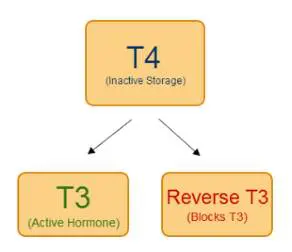
This conversion process is incredibly important to the body because it allows fine-tuning of thyroid hormone function throughout all of your cells.
And this is something you definitely want to happen, at least when it’s working correctly.
When it isn’t working correctly, the conversion process can slide down the wrong path which leaves you with the wrong types of thyroid hormone metabolites, namely reverse T3.
Unlike T4, T3, T2, and T1, which all have pro-thyroid effects, reverse T3 can be thought of as an anti-thyroid metabolite.
While T4, T3, T2, and T1 promote thyroid function, reverse T3 antagonizes thyroid function at the cellular level.
For people without thyroid disease, this conversion process works perfectly.
But if you have thyroid disease, especially for those taking thyroid medications, you can inadvertently alter this conversion process and lead to the creation of anti-thyroid metabolites which can act to make your thyroid function less efficiently.
Easy so far, right?
Why Does Your Body Even Have Reverse T3?
That’s a great question and answering it will help you understand why, in certain situations, your body creates it.
The fact is we aren’t 100% sure why reverse T3 exists in the body but we can make some general assumptions about why it exists.
The prevailing thought, and one that I am in agreement with, is that reverse T3 is meant to act as a brake on your metabolism (2) during times of extreme stress.
Let’s look at chronic illness as an example:
When your body is recovering from an illness (like pneumonia or a bloodstream infection) does it make sense for your body to increase its metabolism and provide energy to your muscles?
Of course not!
It makes far more sense to conserve your energy and metabolism by slowing down energy production and providing energy to vital organs and your immune system to take care of the immediate threat.
This is a protective mechanism designed by the body to ensure that it can weather illnesses.
What may surprise you is that it has a name and is well-documented in medicine.
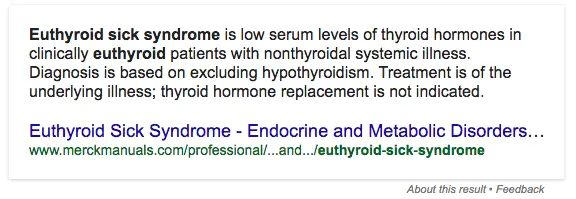
It’s known as euthyroid sick syndrome.
Patients who are under stress develop this condition by altering thyroid hormone metabolism through the conversion process I mentioned above.
Stress results in a typical change in thyroid lab tests manifested as low free T3, high reverse T3, and normal T4 and TSH levels.
I want you to take another glance at those lab tests mentioned above and even compare them to your results.
Do you see any similarities between your lab tests and the lab pattern typically seen in euthyroid sick syndrome?
If you are like many thyroid patients reading this then there’s a good chance you do.
But how can this be? Wouldn’t your doctor notice it?
You would think so but that isn’t the case!
Even though every doctor should have learned about euthyroid sick syndrome in medical school they believe that it’s a condition that only exists in extremely sick patients seen in the hospital or ICU.
Unfortunately, we are seeing more and more patients with multiple chronic medical conditions present with the same thyroid lab tests as those who are hospitalized which leads me to one important conclusion:
Maybe doctors are missing something about our current lifestyle, the increasing rates of illness and chronic medical conditions, and the impact that these have on reverse T3 and thyroid lab tests.
There are studies like this one (3) which can shed light on this very issue.
They show that other situations aside from being hospitalized can lower free T3 levels, increase reverse T3 levels, and cause changes in thyroid function that resemble “sick euthyroid syndrome“.
And it’s small things like this that may explain why so many thyroid patients walk around with hypothyroid symptoms despite being told they are “normal”.
Are You Pooling Reverse T3? High Reverse T3 Explained
Now that you better understand why you want reverse T3 levels to be as low as possible the next thing you need to understand is what causes them to be elevated.
Before we jump into the causes, though, let’s briefly go through some of the symptoms associated with an elevated reverse T3.
As you might suspect, the higher your reverse T3 the more hypothyroid you will feel.
Patients with high levels of reverse T3 tend to have one or more of the following symptoms:
- Decreased metabolism
- Lower than normal body temperature
- Cold intolerance
- Weight gain without changing eating habits
- Fatigue or low-energy
- Pain in the joints, muscles, or tendons
- Depression, anxiety, or bipolar disorder
- Other symptoms of hypothyroidism
These are the most common symptoms but realize that each person will present in a different way from the next.
For instance, I’ve seen people with high levels of reverse T3 present with a complete inability to lose weight and with severe depression without manifesting the other symptoms mentioned.
Others may experience issues primarily with their body temperature and even others still may have a mix of all of those symptoms.
There’s obviously a significant overlap between the symptoms I mentioned above and other medical conditions which is why reverse T3 testing is very important (we will discuss this topic soon).
But first:
What causes elevated reverse T3 levels, and what should you look out for?
- Calorie-restricted dieting – Especially HCG-based diets or VLCD (very low-calorie diets). These diets (4) have been shown to reduce metabolism and increase reverse T3.
- Chronic illness and infections – This includes viral infections like infectious mononucleosis (5), bacterial overgrowth syndromes like SIBO, and even chronic illnesses like cancer, cardiac/heart disease, arthritis, diabetes, and even obesity.
- Chronic Inflammation – Any cause of inflammation can result in decreased T4 to T3 conversion (6) and higher levels of reverse T3.
- Chronic untreated Gut infections – Up to 20% of T4 (7) is converted to T3 in the gut, which means if you have gut issues you may be missing out on up to 1/5th of your conversion power. Gut imbalances that thyroid patients deal with include SIBO, dysbiosis, reflux/GERD, yeast overgrowth, history of chronic antibiotic use, and inflammatory bowel disease.
- Emotional and physiological stressors (8) – This includes social issues like the death of a loved one, family problems, divorce, etc. It also includes psychological (PTSD) and physical trauma (motor vehicle accidents, TBI, or otherwise) (8).
- Some Prescription Medications – The most common medications causing elevated reverse T3 include blood pressure medications, diabetic medications, anti-seizure medications, narcotics, and antidepressants. A common example is the use of beta blockers which can be used to treat the symptoms of hyperthyroidism (9) in addition to elevated blood pressure (10).
What You Need to Know About Reverse T3 Testing
Reverse T3 testing is actually pretty straightforward.
There is a serum marker for reverse T3 that most standard lab companies can run.
What isn’t always straightforward is interpreting your results, but even that is not as difficult as it may sound.
Before we talk about interpreting your results, it’s important to understand how reverse T3 testing fits into a complete thyroid lab panel.
There are no fewer than 4 standard lab tests that need to be run to adequately assess thyroid function and each of these lab tests provides you with different information.
You never want to just order one lab test without the others because you won’t get the information you are looking for.
This applies to reverse T3 just as much as it applies to TSH testing.
This means if you are planning to really understand your thyroid, you will need to get the following thyroid lab tests: TSH, free T3, free T4, reverse T3, and thyroid antibody levels.
Obtaining these other lab tests will help you put your reverse T3 level into context, especially when combined with your symptoms.
One of the most powerful use cases for reverse T3 is in catching early thyroid disease.
Take a look at this image to see what I mean:
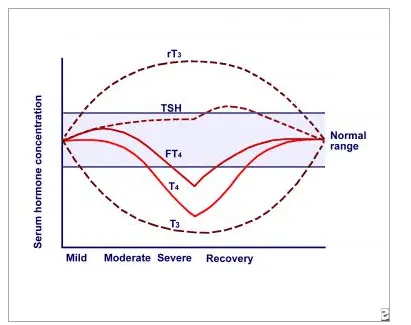
This image demonstrates the severity of the disease state on the X-axis and the concentration of thyroid hormones on the Y-axis.
Basically, it shows what happens to thyroid lab tests and when they become abnormal in relation to the severity of your disease.
What should stand out to you is the fact that reverse T3 (abbreviated as rT3) and T3 (abbreviated as T3) are the earliest markers of thyroid dysfunction.
They become abnormal much sooner than the other thyroid lab tests which makes these lab tests sensitive for diagnosing early thyroid problems.
What’s more, is that the difference between these two lab tests is more dramatic and pronounced than any other thyroid lab test.
For this reason, these two lab tests are critical in evaluating thyroid function.
You can determine the spread between these two values with a simple calculation which will give you the ratio of reverse T3 to free T3.
This ratio is called the free T3:reverse T3 ratio and is something that every thyroid patient should calculate using their own thyroid lab tests.
In an ideal world, you want your free T3 levels to be as high as possible (generally upper 1/2 to 1/3 of the “normal” reference range) and you want your reverse T3 levels to be as low as possible.
To calculate your free T3: reverse T3 ratio simply divide the numbers.
Your ratio should be > 0.20.
Any ratio < 0.20 indicates too much reverse T3 to free T3 and means that you should focus on either increasing your free T3 or reducing your reverse T3.
In order for this calculation to work, your units must be the same.
The units used in the United States for free T3 are pg/mL and the units used for reverse T3 are ng/dL.

Using the example above, if you divide 2.8 by 14.4 you are given a value of 0.19 which is less than that <0.20 level mentioned above.
If your free T3 and reverse T3 lab tests are not in these units, you can easily convert them and then make the calculation with some simple tools available online.
If you want a down-and-dirty way to assess your reverse T3 then you can also just look at the absolute value.
In most patients, a reverse T3 level of less than 15 ng/dL is ideal.
Values higher than this tend to start causing problems, especially if associated with a low free T3.
How to “Flush” Out Or Lower Reverse T3 Levels
So you’ve found out that your reverse T3 level is elevated, what now?
Your next step should be to try and drive that level as low as possible.
This is sometimes referred to as lowering reverse T3, treating reverse T3 pooling, or flushing reverse T3 out of your system.
These are all different names used to describe the treatment of high reverse T3.
What I want you to be aware of is that treatment should focus on
What you need to be aware of is that the treatment will focus primarily on the underlying cause (11).
Because of this, there really isn’t a one-size-fits-all treatment program that I can recommend.
I can and will give you recommendations for common causes, but you will still need to tailor that to your specific situation.
With this in mind, let’s talk about 5 different ways that you can lower reverse T3:
#1. T3 Containing Thyroid Medications
The fastest and easiest way to get rid of excess reverse T3 is with bioidentical hormone formulations that contain pure T3 thyroid hormone.
This would include medications like liothyronine, Cytomel, or sustained-release T3.
The reason this approach works so well is that when you give your body T3 hormone directly it automatically suppresses T4, which reduces the substrate that your body uses to create reverse T3.

In essence, you’re starving out the ‘food’ source your body uses to make reverse T3.
Naturally what will happen with T3 medication use is that your T4 levels will decrease, your free T3 levels will increase, and your TSH will decrease.
While on T3 thyroid medication it’s important to monitor reverse T3 closely, at least once every 6 to 8 weeks.
Typically within 2 months (and assuming your dose of T3 is high enough), your reverse T3 should drop to less than 10.0.
This is definitely the fastest way to reverse T3, but it doesn’t take into account the underlying cause.
So if you use T3 to reduce your reverse T3 without making any other changes, it’s likely that your reverse T3 will just jump back up once you stop taking T3 medication.
Is NDT Helpful for Reducing Reverse T3?
It certainly can help but there are a few things to realize if you want to use this class of medications to treat reverse T3:
- Each grain of NDT has about 38 mcg of T4 and 9 mcg of T3, which means that NDT still primarily consists of T4.
- In order to flush out the reverse T3, you must lower the substrate of T4 which generally means lowering your total dose of T4. In some cases, you may have to drop your NDT dose in favor of pure T3 medications.
- NDT dosing is static meaning you can’t individually alter the concentration of T4 and T3 unless you add additional thyroid medications.
You can still treat elevated reverse T3 with the use of Natural Desiccated Thyroid, but it’s generally not considered the best option.
#2. Supplements Can Enhance T4 to T3 Conversion
In addition to medications, every thyroid patient should also consider utilizing nutritional supplements.
The reason is simple:
The hypothyroid state sets the body up for certain nutrient deficiencies and since most thyroid patients are under-treated, most also have these deficiencies.
This is for 2 main reasons:
The first is that low thyroid states lead to low stomach acid which leads to decreased absorption of nutrients across the board.
The second is that low thyroid states also increase your risk of developing gastrointestinal imbalances which may further impair the absorption of minerals and nutrients.
You can check out this post here for more info about which supplements you should consider using and how to check to see what your body needs.
If you are trying to support the conversion of T4 to T3 with the use of supplements then there are a few you should pay special attention to.
The two primary supplements that you should focus on are zinc and selenium. Both of these supplements have been shown in some clinical studies (12) to increase T4 to T3 conversion, thereby potentially decreasing reverse T3.
In addition to zinc and selenium, I’ve also seen great success with guggulsterone or guggul extract.
We aren’t as concerned about supplements that promote thyroid hormone production (such as iodine and L-tyrosine), but they can still be helpful in some cases.
In addition to these supplements, you can also check out some natural therapies that have some good data behind their use as effective tools for naturally improving T3 levels and reducing reverse T3 levels.
#3. Reversing Hormones that promote T4 to Reverse T3 Conversion
As you are probably aware your hormones all work in tandem with one another.
This means that as one system slows down it may drag down other systems or cause an increase in other hormones to make up for the deficit.
This relationship holds true for thyroid hormones and their impact on leptin and insulin levels.
The link between these hormones is clear:
This is very important because hypothyroidism leads to a state where developing both insulin and leptin resistance becomes much easier.
Why do we care?
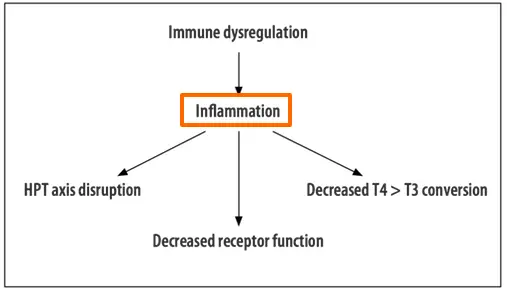
Because insulin and leptin resistance both cause inflammatory states which contribute to T4 to reverse T3 conversion.
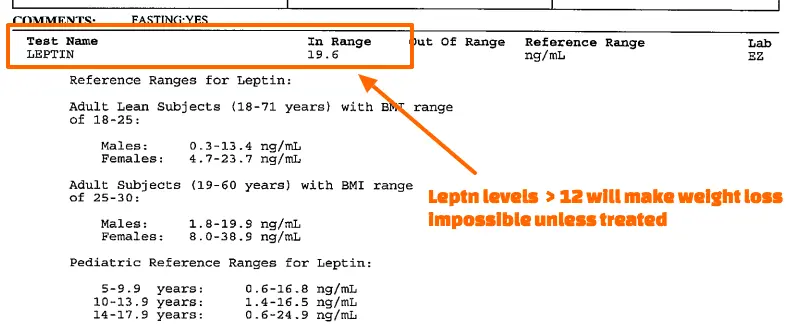
Not only do they contribute to high reverse T3 levels but they also make weight loss very difficult.
Patients with high reverse T3 levels almost always have high fasting insulin and high fasting leptin levels.
In fact, I don’t think I have ever seen a patient with a reverse T3 greater than 25 with a normal insulin or leptin level.

You can see examples from several patients above showing abnormal reverse T3 levels, high fasting leptin, and high fasting insulin levels.
These values may fall within the “normal” range but they are far from normal and will lead to symptoms of hypothyroidism, weight gain, and weight loss resistance.
Another big reason I want to talk about these hormone imbalances is that doctors don’t frequently run tests to check for either of them.
Doctors will routinely check hemoglobin A1c but rarely order fasting insulin and fasting leptin levels.
This means that if you have known thyroid conversion problems, it’s probably going to be up to you to request these additional hormone tests.
Treating and reversing both insulin and leptin resistance is very important for not only lowering reverse T3 but maintaining low levels over time.
To learn more about how to address these hormone imbalances please see the following case studies below:
- Victoza weight loss: 40 pounds lost with Victoza + LDN
- Byetta weight loss: 42 pounds lost over 3 months
- Hashimoto’s weight loss: 55+ pounds lost over 9 months with before/after pictures
These case studies provide a step-by-step walkthrough of how to approach leptin and insulin resistance including which medications, hormones, and supplements are most effective.
If you know you have insulin resistance then you can consider using these supplements to help lower your levels:
- Berberine: Helps reduce cholesterol, improve fasting glucose, and may help with weight loss.
- Alpha Lipoic acid: Helps sensitize the body to insulin and may help to reduce nerve damage in certain patients
- Chromium: Helps improve insulin sensitivity to cells and may help reduce cardiovascular disease in certain patients.
If you prefer the natural approach to treating leptin levels you can find more information here.
#4. Addressing Inflammatory Levels and “Cooling Off” Your Body
Everyone knows inflammation is bad for the body (15), but very few people understand how it makes things worse and, more importantly, how to address it.
Part of the reason for this is that the markers we use for inflammation are non-specific.
That means most of the time we know inflammation is present, we just don’t necessarily know what’s causing it.
Sure, in the presence of other abnormalities we might be able to take a guess, but we will rarely ever know with 100% certainty.
And this is a problem because inflammation is a known contributor to thyroid conversion problems.
We know that inflammation directly promotes the production of reverse T3 (16) by pushing your body down the T4 to reverse T3 conversion pathway.
So if you have high reverse T3 levels you need to be actively searching for sources of inflammation and treating the underlying cause.
You can easily test for inflammation by ordering these lab tests:
- CRP: You want this to be as low as possible but definitely < 1.0 for optimal thyroid function.
- ESR: Another non-specific marker of inflammation (17), for optimal thyroid function this should be < 10.
- Ferritin: Both a marker for iron stores and an acute phase reactant (18), this marker can be used in certain instances to help isolate non-specific inflammation in the body.
If you know that you have both high levels of inflammation and high levels of reverse T3 then you can safely assume that the inflammation is likely worsening your thyroid function.
The next step is to find where it’s coming from.
In hypothyroid patients it’s usually in these three places:
- Hormone imbalances (especially insulin and leptin resistance)- Please refer to the section above to understand how to both diagnose and treat these conditions.
- Undiagnosed gut imbalances like SIBO and SIFO – Both of these gut issues promote inflammation (19) in the GI tract and lead to increased intestinal permeability. You can find more about both here.
- Undiagnosed food sensitivities – These sensitivities promote inflammation (20) and further food sensitivities unless treated.
Bottom line?
If you have both high reverse T3 and elevated serum markers for inflammation you should be looking at the 3 main causes above and treating those if applicable.
If you don’t know where the inflammation is coming from you can still do some good by taking supplements designed to help reduce inflammatory levels and promote the “clean up” of breakdown products in the liver:
- Milk thistle + MSM: Designed to help improve liver function and promote proper phase 1 and phase 2 elimination of medications, supplements, and other products that need elimination in the liver. This combination may also help reduce AST and ALT levels (21)(if you have fatty liver).
- Omega 3 Fatty Acids: Omega 3 fatty acids can help reduce inflammation by reducing inflammatory cytokines.
- Curcumin: This well-studied herb activates PPAR-gamma levels (22) helping to reduce inflammation in the body.
- Quercetin & Bromelain: Particularly helpful in patients with digestive issues and those with chronic sinus/upper respiratory illness-like symptoms (post nasal drip and chronic stuffy nose).
This approach isn’t ideal but it’s better than simply ignoring it.
#5. Lifestyle changes to Balance Hormones and Promote Thyroid Function
Never underestimate the power of these 4 major areas when it comes to improving your thyroid:
- Getting 7-8 hours of quality sleep per night
- Reducing and managing your stress
- Daily low-intensity exercise and episodes of high-intensity exercise 1-3x per week
- A well-balanced diet full of real, whole foods
If you don’t practice these 4 basic things it doesn’t matter what you do, you won’t get better.
These are particularly important for those with high reverse T3 levels.
Remember that your body is a network of systems and hormones that all interact with one another.
When one system isn’t working properly, it will bring other systems down.
These areas are so important that many thyroid patients can see significant improvement in their thyroid symptoms by optimizing them without the need for additional treatments or medications.
The only problem is that most thyroid patients take them for granted and would prefer to take a supplement and call it a day.
Don’t fall into this trap!
Take that supplement if you want, but make sure you are also paying attention to your diet, exercise routine, sleep schedule, and stress levels.
Final Thoughts
Elevated reverse T3 is a serious issue for many thyroid patients and it’s a problem that is often ignored by many conventional doctors and endocrinologists.
The best way to evaluate your reverse T3 is by testing for it along with free T3 and free T4 levels.
To get a better idea of how reverse T3 is impacting your body, you can measure your free T3:reverse T3 ratio.
If your free T3/reverse T3 ratio is < 0.2 you have too much reverse T3 in your body.
The fastest most effective method for optimizing reverse T3 is with the use of pure T3 thyroid medication.
Now I want to hear from you:
Is this the first time you’ve heard about reverse T3?
Have you had your levels checked? If so, was it high or low?
What type of treatments have you tried to lower your reverse T3?
Have you tried medications that contain T3 like Cytomel or liothyronine? Did they work for you?
Leave your questions or comments below!
Scientific References
#1. https://www.ncbi.nlm.nih.gov/pubmed/3428867
#2. https://www.ncbi.nlm.nih.gov/pubmed/7355063
#3. http://www.ncbi.nlm.nih.gov/pubmed/12055988
#4. http://www.ncbi.nlm.nih.gov/pubmed/12055988
#5. https://www.nlm.nih.gov/medlineplus/infectiousmononucleosis.html
#6. http://www.ncbi.nlm.nih.gov/pubmed/11716958
#7. http://www.ncbi.nlm.nih.gov/pubmed/3049061
#8. http://www.ncbi.nlm.nih.gov/books/NBK28/
#9. http://www.ncbi.nlm.nih.gov/pmc/articles/PMC3475282/
#10. https://www.ncbi.nlm.nih.gov/pmc/articles/PMC5369873/
#11. http://www.ncbi.nlm.nih.gov/pubmed/16399020
#12. https://www.ncbi.nlm.nih.gov/pubmed/8157857
#13. https://www.ncbi.nlm.nih.gov/pmc/articles/PMC3608008/
#14. https://www.ncbi.nlm.nih.gov/pmc/articles/PMC3356957/
#15. https://www.ncbi.nlm.nih.gov/pmc/articles/PMC3492709/
#16. https://www.ncbi.nlm.nih.gov/pmc/articles/PMC3978663/
#17. https://www.ncbi.nlm.nih.gov/pmc/articles/PMC4653962/
#18. https://www.ncbi.nlm.nih.gov/pubmed/24549403
#19. https://www.ncbi.nlm.nih.gov/pmc/articles/PMC3099351/
#20. https://www.ncbi.nlm.nih.gov/pmc/articles/PMC1774228/
#21. https://www.ncbi.nlm.nih.gov/pubmed/17548789
#22. https://www.ncbi.nlm.nih.gov/pmc/articles/PMC2234255/


Hi
I have Hashi and also T4-T3 conversion issues from my ongoing blood tests. My endo has put me on 10mcg T3 but when I asked him to do a lab for Reverse T3, he qouted me this”Reverse T3 is not a test recommended by the American Thyroid Association, The Endocrine Society, or Kaiser Endocrinologists to monitor the treatment of hypothyroidism. I cannot order this test”. And this is a guy whos the Chief of Endo clinic at my hospital.
I showed him your website and he simply said private docs will order anything and everything to grab a patients $$$$.
Hi S.singh,
I’m sure there are some private physicians out there only interested in money, but here in the US, we don’t get any extra money for ordering lab tests. You can read more about the controversy surrounding thyroid treatment here: https://www.restartmed.com/thyroid-controversy/
Hello Dr. Childs! I tried your suggestion to take thyroid at night but if I take my blood test, should I skip the night before and take the following night after the blood test? or switch to the morning and it will be 24 hrs when I take a blood test?
Hi Myrna,
I usually check labs about 23-24 hours after the last dose.
Hello Dr. Childs โ Iโm confused about after reading your information here. My recent lab results for Free T3 &
Reverse T3 are:
Free T3 = 3.2pg/mL (0.32ng/dL), โStandard Rangeโ stated as 2.0-4.4pg/mL
RT3 = 22.0ng/dL (220pg/mL), โStandard Rangeโ stated as 9.2-24.1ng/dL
The labs give results using different measurements which isn’t helpful, but after doing the math conversion and using your formulas, I get the following:
Free T3/Reverse T3 = 0.32 ng/dL / 22.0 ng/dL = 0.0145 (You state the ratio should be > 0.20 which I’m FAR below.)
The BEST ratio thatโs possible using numbers within the โStandard Rangeโ as I currently understand this is:
0.44ng/dL / 9.2ng/dL = .05 (still far below your ratio recommendation).
Please clarify what I may be doing wrong. Iโve been dealing with extreme fatigue for several years (despite being on a PAP machine for the last 9 months as well), and this is currently my target for understanding what may be wrong as all my other blood work (which is considerable) is โnormal.โ
Thanks!
Data similar to Bob’s above:
On NDT (NP Thyroid) 225MG
Suppressed TSH
RT3 = 33 ng/dl (8 – 25)
FT3 = 3.7 pg/ml (2.3 – 4.2)
FT4 = 1.2 ng/dl (0.8 – 1.8)
FT3/RT3 = 0.011
Selenium = 144 mcg/l (63 – 160)
MAG RBC = 4.7 g/dl (4.0 – 6.4)
FERRITIN = 45 ng/dl
% SAT = 35
IBC = 379 mcg/dl
T.IRON = 131 mcg/dl
Leptin 7.9 ng/ml
Uric Acid 6.9 mg/dl (4.0 – 8.0)
SHBG 55 nmol/l (22 – 77)
Thoughts and comments?
Thanks,
omi
Dr. Childs, The D.O. I go to told me she was going to start me on 15 mg NP Thyroid and 5 mg of Cytomel. I have a history of hypothyroid symptoms and was diagnosed as Hashimotos but never had antibodies out of range, so doctors said I do not have it. The DO now said she is going to just give me the cytomel because I am so detailed when I talk to her, and I don’t know what that has to do with prescribing for me, either you need it or you don’t. Listening to this video, and my symptoms being that I have the fat I can’t lose, tired all the time, many hypo symptoms, should I go on the Cytomel first, my RT3 is 19.5 Reference range: 9.0 to 27.0 ng/dL. I also wonder how much of a difference in the optimal range and how important is it to follow that rather than the reference range? I took 60 mg NP thyroid for 2 days once and then went off because it was making me not sleep and my facial collagen decreased giving me hollows under my eyes. I don’t want that to happen again. I’m using a hyaluronic acid serum and it is helping from that and then I took dhea with adrenal herbs and it made deep hollows on both sides of my nose like women weightlifters get. Everything I have tried to help myself hasn’t improved anything. I’m afraid to go on the 5 mg T3 now, is that the lowest dose you recommend and could it also cause collagen collapse if I go off or decrease the dose?
After a TT 7 years ago, and being hypo, and constantly tired, this has been the best thing I’ve ever read! I can now begin to understand what is happening.
Hi Lesley,
Thanks for sharing and I’m glad you found it helpful!
Hi Dr Childs:
I left a message on Aug 1 but haven’t received a reply, so here’s the info again in case you missed it.
Iโm confused about after reading your information here. My recent lab results for Free T3 &
Reverse T3 are:
Free T3 = 3.2pg/mL (0.32ng/dL), โStandard Rangeโ stated as 2.0-4.4pg/mL
RT3 = 22.0ng/dL (220pg/mL), โStandard Rangeโ stated as 9.2-24.1ng/dL
The labs give results using different measurements which isnโt helpful, but after doing the math conversion and using your formulas, I get the following:
Free T3/Reverse T3 = 0.32 ng/dL / 22.0 ng/dL = 0.0145 (You state the ratio should be > 0.20 which Iโm FAR below.)
The BEST ratio thatโs possible using numbers within the โStandard Rangeโ as I currently understand this is:
0.44ng/dL / 9.2ng/dL = .05 (still far below your ratio recommendation).
Please clarify what I may be doing wrong. Iโve been dealing with extreme fatigue for several years (despite being on a PAP machine for the last 9 months as well), and this is currently my target for understanding what may be wrong as all my other blood work (which is considerable) is โnormal.โ
Thanks!
Hi Bob,
You’ll want to focus on bringing down your reverse T3 and bringing up your free T3. As you do this your ratio will “normalize”. You can do this by addressing steps which may be limiting T4 to T3 conversion in your body and/or by taking T3 thyroid medication directly.
You can use these resources:
– T4 to T3 conversion: https://www.restartmed.com/t4-to-t3-conversion/
– Using Liothyronine: https://www.restartmed.com/liothyronine/
– Increase free t3 naturally: https://www.restartmed.com/increase-free-t3-naturally/
These should help get you started on the right track!
Dr Child’s:
Thanks for your reply and links.
Can you please address what you’d compute my T3/RT3 ratio is using my lab results.
Thanks!
Dr. Childs,
Bob and myself must be brothers:)
Same issue.
I am on NDT
RT3 was at 33.
Cut NDT back to clear the RT3.
RT3 = 16 ng/dl
FT3 = 2.2 pg/ml
About the same ratio of 0.013.
So only impact was to lowering all values with no impact at all on the ratio.
So am I looking at conversion issues and should I talk to my PCP about adding in T3 on top of the NDT?
Hi Omi,
That would be a reasonable approach. You may also benefit from looking at factors which would be limiting conversion in the peripheral tissues including genetic defects.
Dr. Childs,
Thanks for the response.
I have done 23andme so I have the genetic data. Can you identify what specific items I might check on (type of genetic defects?)
Thanks,
omi
Hi Omi,
You can find a list of genetic defects and how they impact thyroid function at the end of this post: https://www.restartmed.com/thyroid-deiodinase/
Dear Dr. Childs, I’d like to ask if I have excess reverse T3 from using Levothyroxine wrongly because of really having an autoimmune problem, not a real hypothyroidism, would the reverse T3 leave my body if I stop using the Levothyroxine? And under what time frame? And how quickly would the reverse T3 leave my body if I also take Chromium Zinc and Selenium?
Looking forward to your answer.
Hi Emily,
It might help reduce your reverse T3 but it will almost certainly make you feel worse as your body reduces the total number of free thyroid hormone.
Hi Dr. Childs,
Thanks for all your wisdom and the sharing of it.
I will see my endo tomorrow and I’m wondering what I should ask for.
Here are my labs from Sonora Quest
TSH HS-1.03 (.045-4.50)
T4-Free-1.3 (0.8-1.7)
T3 Free-3.5 (2.0-4.8)
TPO Anti-<10 (<34)
Thyroglobulin Anti-<20 (<40)
Rt3-24 (8-25)
Any Advice? Thanks in advance
Hi Dr Childs,
You mention about balancing your hormones and was wondering if menopause has an affect?
I’m currently on 2mg of oestrogen and was wondering if that helps or hinders my TSH, FT4, FT3 & RT3.
I had my thyroiod removed due to cancer.
Thanks in advance
Hi Nerida,
Yes, menopause appears to impact thyroid function but the association is not clear. Estrogen will impact SHBG which may alter free testosterone levels. You can read more about that here: https://www.restartmed.com/shbg/
Hi, once starting on T3 while on Synthroid for high reverse T3, how long are you supposed to stay on it? Is it lifelong if you do not have a thyroid gland and are on Synthroid?
Hi Aimee,
It really depends. Some people only need it for a short period, some for others, and some do better on it for an extended period of time (for life). There is no one-size-fits-all approach.
Thank you for this protocol. I’m a healthcare provider and I’ve been struggling with my own thyroid stuff for years. Although I’m considered an expert with thyroid issues, I’ve not found the magic individualized combo of tricks for myself yet. I need a bit more guidance. I followed your protocol and got my reversed T3 down and my hair finally stopped falling out. It’s been falling out for years. Lately I had been going through a huge hair loss experience. Looking terrible, and I’m on big stages, so I’m more self-conscious now. So it stopped for a bit. Exciting! Then I retested my thyroid panel (all 10 markers) and my TSH was 180, and everything else was way low, below lab low. Did I just not do enough srT3? I stopped the tirosint (T4) per your instructions for the process. I began the Tirosint again (TSH at 180 plus antibodies were way up again- I had them down to 0 and 50) and continued on the srT3 and my hair is falling out again, a lot. I’m heading to the lab tmw to see what is going on, but I’m frustrated and would deeply appreciate a bit more guidance. How much srT3 do you suggest while you go off the T4 and clear the reverse T3? How do I stop it from accumulating again? I’m doing all the “right” things. My diet and life are cleaner than anyone I’ve ever met or worked with. Are you open to a phone conversation to help me solve this mystery? Deep Gratitude, Kristin Grayce McGary
Hi Kristin,
Great questions! Unfortunately, I would have to sit down and really dig into your labs to give you any definitive information regarding your situation. I normally spend over an hour with each person to try and piece together the puzzle and comments on the internet don’t quite allow for the same intimacy!
I found your article very interesting. I have had thyroid problems since I was a young teen. Recently, I had a full thyroid panel done with reverse T3 and free T3. My reverse T3 was 27. I was put on cytomel in addition to my levothyroxine. After two months my reverse T3 remained normal. My fasting insulin is low and well within normal range at a 9. My nonfasting insulin is also very good. I saw in your article that you said that all of your patients have high insulin levels with reverse T3. I happen to be an anomaly I guess. Cytomel is causing my TSH to get pretty low – .04. Therefore, my doctor is cutting me back on my levothyroxine so I can stay on cytomel. I am confused why my reverse T3 is not reducing with the cytomel.
Hi Janean,
It’s not reducing because your dose is not high enough or because your dose of T4 is too high.
Hello Dr. Childs,
I’m a holistic healthcare provider as well. I love your work and how you’re guiding people. Although I’ve helped hundreds of patients with thyroid issues I’m having challenges dialing my own in. I had high reverse T3. I followed your guidelines and sure enough they came down and my one painful symptom (major hair loss) stopped!Yippee. And then I tested a full panel (all 10 markers) and my TSH was 180. My T4, and T3 were all below lab norms, not to mention way below functional ranges. I was beginning to feel some fatigue, but just the slightest bit. I’m an energizer bunny, in a good and balanced way so when I feel “crashy” my word for thyroid fatigue, I can tell something is off. So I increased Tirosint and srT3 meds. And my hair began falling out again. I just ran another panel 6 weeks after increasing my meds. TSH is down to 4.9 now, T4 is slightly low, T3 slightly low. antibodies are still elevated. I had gotten down to 0 and 50, now they are 170 and 1.0. When I stopped the T4 (Tirosint) to clear the RT3, I wasn’t sure just how much T3 should I take? I was up to 9mcg am and pm, but was getting symptoms of speediness, so would cut back to as little as 7. Now it didn’t help my TSH at all. YIkes it was so high. I had a goiter before from having high TSH and it disappeared with treatment. I don’t want that again. I’d love the hair to stop falling out. I’ve done everything you can think of. Many things help a little, but nothing really has solved the mystery. I have a strong reaction to iodine, it can cause a hoshi flare and put me in bed. I can do a drop or two no my skin and follow my intuition on when and how often to do this. Some weeks 3x, other weeks not at all. I’ve done neural therapy, homeopuncture, biological medicine, EAV testing, mercury detoxing for years (worked with Klinghardt), acupuncture, herbs, homeopathy, api therapy (yes bee venom, bee stings- amazing and then it stopped working) and even stem cells. I have EBV in my system but no other symptoms. Gut has always been an issue and one of my specialties so I believe I do a great deal to repair it. I’ve been diagnosed with Celiac Hoshimoto’s and worked with my friend and colleague Dr. Tom O’Bryan. I even have a book coming out on gut health so I dare to believe I understand the topic a bit. ๐ And I’m open to any new tools or advice? I have megaloblastic anemia and do B12 shots almost weekly or every other week. It hasn’t shown as pernicious anemia on tests. My predictive antibody test from Cyrex was a negative for that. I do biotin and basic things for hair. Any other ideas on how to stop the hair loss. My current RT3 level was 15, although considered normal, perhaps it’s still too high for my system? Insulin looks good 5.4. Leptin at 6.5. Cortisol 10.3 AM. Hormones- I’m perimenopause, so up and down. Blood hormones seemed ok. Estradial was up, but seemed right for where I was in my cycle. Hair Loss?? Help? Please and sincere gratitude for your time and expertise. I hope this can help others as well.
I had thyroidectomy due to thyroid cancer back in ’08. Ive been on synthroid 175mcg ever since. Ive never felt right since. All my labs come back as “normal” according to the Drs, and not one of them ever ordered a RT3 test.
My resting heart rate has been very low for me (47-60bpm) typically my normal resting heart rate is in upper 70s low 80s.
My current labs:
TSH 3.8
T4 8.1
T4 Free 1.47
T3 120
FT3 3.5
RT3 17
I want to try taking T3. I am constantly feeling hypo. tired, cold hands and feet, low heart rate.
What would be a good dose to start?
I have a bunch of 5mcg T3 from the past that I never took.
What would be a good dose to try?
I think 5mcg pills are way too low dose for me. I know people that take 25mcg T3 a couple times a day
I recently turned 60 and I have been having constant hot flashes, lack of sleep, weight gain for 10 years. I’m always cold for the exception of when I am flashing. I recently had a scan of my thyroid which reveals a 2.0 cm nodule, a solid heterogenous nodule which is 2.0×1.3×1.8 and a solid nodule that measures 0.8×0.3×0.6 cm. I’ve seen many doctors and they only ordered CBC blood work. After, so much frustration, I ordered my own Thyroid Panel test through an online company. Test results showed my Reverse T3 Serum at 30.5 High.
Thyroxine (T4) Free, Direct, S 1.12
TSH 1.920
Reverse T3 Serum at 30.5
Thyroxine (T4) 5.7
Thyroid Peroxidase (TPO) Ab 16
Triiodothyronine 2.3
I submitted this test to my physician and his response was we would just watch the nodules. Personally, I am concerned.
Your thoughts/recommendations?
Thank you
Hi Diane,
It sounds like you have 3 separate problems: thyroid nodules, hot flashes, and thyroid disease. Each will need to be treated separately. The nodules are most likely NOT causing the thyroid issues (it’s very rare if this happens). And hypothyroidism usually does not cause hot flashes so these are likely related to some other cause.
Hi
I was great on NDT 2 grain and 20 mcg Liothyronine for over a year. That was after I didn’t take any medication for 2 full weeks. After that, when I slowly started NDT again, my excess weight fell off pretty quickly, the hypo symptoms disappeared and I felt great. Then starting this year I started gaining weight again and got hypo symptoms back. I just learned my rT3 is in the upper part of the reference (201 ref 90-215).
My thought: Is it possible that I got rid of the rT3 without NDT for 2 weeks and that it then would have taken a whole year for rT3 to build up again with the low dose NDT+Liothyronine because I didn’t fix the underlying problem?
Hi Rebecca,
It is certainly a possibility, but it’s impossible to say for sure without a lot more information.
My wife had a Thyroidectomy 3 months ago due to a large mass that was borderline cancer. Since then her blood sugar skyrocketed. We waited in hopes it would go down it hasn’t. She is 130 pounds normal weight. TSH 1.48, Free T3 Normal, Total T3 .8 which is a hair low, FT4 Normal. Insulin is low at 2.6 and CPeptide normal range but low normal. She takes 75mcg of Levothyroxine and feels good otherwise. Not symptomatic with high blood sugar, but the Dr did a HGBAIC and it was 10% or 240. She started insulin this week and told she is now Type 1 Diabetic. This is shocking and hard to believe. I told the Dr we want Cortisol levels checked and Reverse T3. Should she try a T3 medication in combo with T4. Could this then lower her blood sugar if the Reverse T3 comes back high along with cortisol levels. Thank you for your website and any help offered!
Hi Larry,
I would take a look at this article for more information: https://www.restartmed.com/hypothyroidism-high-blood-sugar/
It would be a possible, but strange, coincidence that she would suddenly become a type I diabetic around the time of her surgery. It seems that further work-up is necessary.
Hello,
I stumbled upon this info in one of my Thyroid groups. I have been battling Hashi’s, adrenal fatigue and Leptin resistance for years. I now live in Spain and finding doctors and medications is a nightmare. My Rt3 is 22 and my Leptin is 88. Free T4 is low at 0.59 (0.78-1.80) and my Free T3 is also low at 2.35 (2.3-4.2) I’m on 2 1/2 grains of NDT and 25mcg of T3. Should I lower my NDT and raise my T3 meds? I tried intermittent fasting and that isn’t working due to AF. Plus, to add insult to injury, I am now going thru menopause. I need a good direction and a lot of help. Thanks I appreciate it.
Hello Dr. Childs,
New to the comment section of your great site. My husband is struggling with low T-3, high Reverse T-3. After 3 failed back surgeries he had a pain pump installed April of 2018. It unfortunately has not reach an optimal level of pain relief so he is still on some narcotics. He also had Radical Prostatectomy Aug 2017. From a short prescription of Bicalutamide prior to surgery he is still struggling with low testosterone. His PA who is practicing Functional Medicine has given him a low dose of testosterone with the Urologist’s approval. The PA how ever says he cannot give any Thyroid medication because it might cause Arrhythmia. His solution to most things is stay away from gluten which my husband does pretty well and VEGETABLES! Eat more, juice more. He hasn’t really seen improvement since going this route for 1 1/2 years.
Now for the question, you mention that you have never seen a patient with high Reverse T-3 that doesn’t also have high Insulin. Tests results we received in the appointment yesterday were Reverse T3 32.4 ng/dL; T3 Free 2.8 pg/mL; Insulin 1.6 uIU/ml. How would you classify this out of the norm reading.
Thank you!
Hi Anna,
You would need to also look at the hgb A1c and fasting blood glucose in order to figure out what is happening. The insulin result by itself doesn’t give much information.
Thank you. His A1c was 5.5; fasting glucose 77. TSH 1.77. Free T4 1.58. Thyroglobulin Antibody <1.0. TPO 22. Cortisol 15.8. This PA doesn't test for leptin. Not sure if that is specific for overweight patients. My husband is thin and fights to keep weight on.
Sincere thanks!
My ft3 to rt3 ratio is 0.14. I have been experiencing anxiety for the last 2 years, including panicky symptoms, which all kind of come out of nowhere. TSH 0.85 and ft4 1.4. Could this mean pooling or too much rt3 and can zinc and selenium supplements possibly help alleviate anxiety?
Thanks,
Jon
Hi Jon,
It’s certainly a possibility, but there are many factors which can cause high reverse T3 and anxiety outside of your thyroid.
Hello Dr. Childs,
I find your website reply procedure very cumbersome to use. Paging down numerous times to find the end can make a person weary. Perhaps it is my browser but I do not have the problem on other sites. I keep thinking there should be numbers to take one from the beginning to the end of the replies. Just wondering.
Hi Anna,
Unfortunately, this particular post has over 400 comments which all take time to load so they must be loaded slowly to improve performance. If they all loaded at the same time then the page would take over 40 seconds to load and I can’t imagine many people would be happy about that! Most other websites get around this by either not allowing comments or allowing them to slowly load. I prefer to have conversation on the blog so I let the comments load (just slowly). You can always post questions on various blog posts as well which have fewer comments (this one just happens to be very popular).
I had high RT3 (27.6) and low FT3 (2.3). Symptoms included severe fatigue, insomnia, high anxiety, headaches, dizziness, brain fog, constant muscle pain and poor memory to name the big ones. I was experiencing high exposure to toxic black mold and diagnosed with CIRS (Chronic Inflammatory Response Syndrome) related to water-damaged buildings. hsCRP also high (4.10). Removed myself from exposure, treated with Cytomel 5mg and all labs returned to normal within 3 months. A year later still recovering but nearly back to my normal. ๐ Sooo yes get to the root cause for sure! I see many of my chronically ill patients with high RT3. It is the body’s self defense mechanism but the root cause must be found. Great article I will share with my patients. Easy to read and understand. I am a Functional Medicine NP.
Hi Paula,
Glad you enjoyed it and I’m glad you are feeling better! Thanks for sharing your story.
Thank you for this information, Dr. Childs, very interesting. I have high RT3/Low Free T3 after a long period of intense stress – a year of very high-stress levels followed by a year of exhaustion with low cortisol levels. I am not on any thyroid medication and have only recently realized that thyroid is part of my problem (extreme fatigue, muscle pain and stiffness, air hunger and inability to exercise are my main symptoms). My question is if I treat my RT3 with T3 medication, will I be able to off thyroid medication and function normally again after treatment? Or do I risk damaging my thyroid and becoming dependent on medication? And how long will a person typically need to be on T3 (provided I follow a good diet and reduce my stress levels etc.)? Many thanks, Maia.
Hi Maia,
It’s not always advisable to go on T3 for a high rT3 which is due to some reversible cause like stress as it may cause HPA suppression and further issues down the line. The decision on whether or not to treat depends largely on your situation and a number of other factors.
Thank you for this interesting article. I have low free T3 and high reverse T3 after a long period of intense stress. I am practically debilitated from this with severe exhaustion and muscle pain/stiffness. If I were to treat my condition with T3, how long should I expect to be on it and would it normally be possible to wean off it at some point? Or should I expect to be on medication forever? Thank you.
Hi Maia,
Everyone is different. Some people can get on a low dose for a few weeks to months while others may need it for much much longer. The dose and length of treatment time vary from person to person.
Hi. Thank you for your well-written, clear article! I appreciate you! I had a RT3 test result of 35 with a ratio of 8 to my Free T3 which was 2.8. The blood work was done after a liquid diet the day before the blood draw and a COLONOSCOPY PREP done the day before the blood was drawn. In addition to that, the 4 weeks prior to the blood work, I had been on the Keto diet with very minimal carbs, <50 per day, and I'm wondering if these factors could have made the RT3 abnormally high. I am a 55 year old woman with normal iron, cortisol, zinc, pregnenolone, copper, T4 and homocysteine levels. My dr also ordered thyroid peroxidase and thyroglobulin antibody tests which were 1 and 2 respectively. Any advice would be appreciate. Thanks.
Hi Tammy,
Yes, but my guess would be that your diet probably contributed the most.
Hi Westin,
I fit with most of what you described in this article. I forget the number but my integrative doctor says my Reverse T3 is the highest she’s ever seen.
Histamine and free copper (and copper/zinc ratio) all super high too, so she suspects infection if some kind. I have hashimotos and we suspect lots of gut issues, as a stool test from a year ago by the previous doctor suggests. Also, check things like Lyme etc.
My question is this though. Besides crippling extreme fatigue, a lot of my symptoms don’t fit with what you describe. A lot of anxiety and adrenaline-related symptoms such as difficulty falling asleep and waking 4-5 am with racing heart, shakiness, anxiety (now controlled with anxiety meds propranolol, diazepam, olanzapine, and valdoxan). I also am having palpitations.
Initially, in September my old doctor took me off T3 (10mcg SR) because I had had increasing palpitations, I energy crashed several weeks later as I forgot I stopped taking it. Fast forward to now, I have taken several months to climb back onto T3 (whilst still on 50 mcg Thyroxine). Energy improved immediately even on 2.5mcg T3 but on 5 and 7.5 palpitations started again.
In all these medications for anxiety, the palpitations settled, and I was on 10 mcg T3, 50 T4. But after two weeks on 10 palpitations came back despite propranolol. I decreased asked back to 7.5 and stopped T4 completely. Palpitations got better. But now two weeks or so off T4 palpitations are getting increasingly worse again. Notice them especially come on if I try to take deeper breaths eg while meditating, or if hungry, or tired.
I’m also skinny and losing weight, not gaining. But am eating mostly Paleo so could be I’m just not eating enough. Can’t eat grains or I break out with pus-filled pimples (currently the case as I’ve been having gluten-free sweet potato wraps).
I’m. Mostly concerned about what’s causing the palpitations since I fit with everything else, and I honestly can’t be hyperthyroid. Any thoughts on the palpitations? And also should I be trying to increase T3 (only on 7.5 SR) despite them?
PS I know propranolol isn’t helping the RT3 but it stops me from waking at 4 am and helps with anxiety symptoms.
Hi Olivia,
It’s certainly a fact that T3 medication can cause heart palpitations even if you aren’t taking a high dose. It depends on how sensitive you are to the T3.
Good evening Dr. Childs. I have taken quercetin with bromelain in the past for inflammation and allergies and it seemed to be quite effective. However, I recently read some articles stating quercetin is a thyroid inhibitor and is contraindicated in persons with hypothyroidism. In your opinion, is there any validity to that?
I don’t know that this is relevant to my question, but I have taken cytomel only (50 mcg) for a couple years now. My doctor recently added 25 mcg synthroid because the T4 level is always so low. My labs typically are TSH and T4 both almost zero, with T3 being in normal range due to the cytomel.
Thank you so much for the time and effort you put into providing this information. It is extremely helpful!
Hi Angela,
I’ve never seen quercetin be a problem for thyroid patients, but there are probably some individuals who can’t tolerate it out there.
Hi Dr. Childs,
Quick question. You recommended Essenial Oils Oregano, Thyme and Barberine but didn’t state how much of each, how to take, how often, or how long you recommend to use.
Thanks you for all the great information.
Hi Charlotte,
Most of the specifics are dependent on the person and their situation, so it’s hard to give basic recommendations like that.
Hi
I have Hashimotos and hypothyroidism for around 10 years.
I was on levothyroxine about 6 years ago and gained 15kg so I changed to Armour. My weight stayed the same.
I have recently come off Armour because my body needed a break from all the medications. I started CBD oil just before I came off and became hyper. I havenโt been in any medication including CBD oil for 3 months to get a baseline.
I got my results and my TSH is 7.55 range is 0.4-4.4
Free t4 9 range 9-19
He didnโt do my t3 but before I came off medications it was 6.6 range 3.1-6.0
Tpo Ab 474.3 range <6
Tg Ab 5.0 range <4
Reverse t3 385 range 140-540
Can you tell me what all this means? I cannot lose weight! I am seeing a naturopath now that has got me on magnesium and vitamin b12 and a gut repair mixture. I have cut out wheat/gluten and have cut back on dairy and sugars. Iโm also a vegetarian and Iโm gaining weight!!
HELP!!
I began suffering from hypothyroid symptoms about 1.5 years ago following a period of oversupplementation with iodine. My labs are within normal ranges but I feel that some of them may still be rather high for a previously very healthy 36-year-old male (TSH is 1.98, reverse T3 is 17). I’m having trouble finding a doctor sympathetic to my concerns. I wonder whether you have any knowledge of similar cases involving iodine toxicity?
Hi Ben,
Yes, I’ve seen many people who present with hypothyroidism after using very high doses of iodine. There are also comments of others who have done the exact same thing on my blog and on my youtube channel.
Hi Dr. Childs,
If it’s impossible for me to have RT3 tested (I’m in France and I tried everything I could…). Would it be bad to give it a try by removing my T-caps 100 and go on with my Cynomel 0,25 for 12 weeks?
I’m 90% sure I have RT3 problems and I think it’s because of an emotional shock I had 2 years ago (+ stress, depression, anxiety, panic as a result…).
What do you think?
Plus, T3 only will drop T4. Isn’t it dangerous? And how do you explain people feel better with T3 only when their T4 is therefore very low?
By the way, some people are on T3 only for years and feel great. Why isn’t it more common?
Thank you!
Catherine from France and THANK you for that amazing blog full of resources and ANSWERS we’ve been looking for years.
Hi Catherine,
You’re welcome!
In regards to your question, I would caution against using T3 medication without the ability to follow at least free T3 and TSH levels. You might be able to make it work if you can’t check reverse T3 but it wouldn’t be an ideal situation.
Each person needs a different amount of T4 and T3, some can do fine on all T4 and some can do fine on all T3 and others fit somewhere in the middle.
Thank you!
Yes I can still follow Free T3, Free T4 & TSH (hopefully my doctor prescribe these labs) but how could it be relevant to make sure it’s worth being on T3 only?
I won’t be able to have RT3 tested, I’ve met lots of doctors they say it’s inactive and don’t care about the studies “Miss, you’re not a doctor”
and that’s the last thing I can try to get my life back…
Thank you for your help.
Dr. Childs, thank you for your very informative articles. After reading one on the switch from levothyroxine to tirosint for weight loss (due to the possibility of sensitivity to fillers) I requested my Dr switch me. I had spent 9 years on levo at which point I began gaining weight and spend those 9 years 30 pounds overweight in spite of my whole food diet and working out. After making the switch the weight fell off. I was elated. WOrth every penny! However, after seeing a new naturopath about some bio-identical hormones after menopause he thought my t3 looked a little low (it was lower end of “normal) and put me first on DT. I immediately started seeing fat back on my tummy in addition to feeling anxious. I went back on my tiosint which he added liothyronine to. The fat loss has continued in my tummy and thighs just like it started initially with the levo. I keep cutting back my t3 to where Im hardly taking any. I am wondering if it is possible I may be sensitive to the fillers in this as well? I am beside myself that I am putting on the weight that I finally lost after so many years due to s stupid drug. In this article you mention t3 only…should I not be taking any t4 with t3? I wish I’d never gone to the dr at this point. I’m also using only about 1/4 pump of the progesterone and 1/4 pump of the estrogen creams as I’m just wanting to be back where I was a few months ago! Please help! My email is deniseedenfield@gmail.com
Hi Dr Childs:
Iโve been experiencing significant daily fatigue (generally worst in the late afternoon & evening) for several years following two major surgeries. My most recent attempt to be diagnosed by an endocrinologist are presented below, along with the โoptimalโ ranges youโve suggested.
* FREE T4, THYROXINE 1.24 ng/dL (Optimal 1.4 โ 1.77) (Normal 0.82 – 1.77)
* FREE T3 3.2 pg/mL (Optimal 3.8 โ 4.4) (Normal 2.0 – 4.4)
* REVERSE T3, SERUM 22.0 ng/dL (Optimal <15.0) (Normal 9.2 – 24.1)
* TSH โฆ. 2.140 uIU/mL (Optimal 0.5 โ 1.0) (Normal 0.450 – 4.500)
I was not tested for Thyroglobulin Antibody or Thyroid Peroxidase Antibody which you mentioned in a video. Numerous other blood tests were well within โnormalโ range, with one or two that were very slightly outside โnormalโ range.
I asked the doctor the following question:
Can you please provide me with more information on what hormone replacement therapy you might try to address my reverse T3 levels which is possibly causing my fatigue. Pros and cons, process, etc. Thank you.
Doctorโs reply:
I would initially use T4 and then some combination of T4 and T3 to suppressed TSH and low range normal, elevate T3, and potentially suppress reverse T3. Your own production thyroid would fall with of additional supplementation requiring probably 100% supplementation to achieve this end. The main side effect is possible thyrotoxicosis as we suppress endogenous thyroid function with superphysiologic levels of thyroid hormone.
Iโd appreciate your thoughts on my lab results and the endocrinologistโs proposed treatment.
Dr. Childโs,
Thank you for this article. I have long term chronic inflammation from multiple causes – mold toxicity, tick-borne infections, gut dysfunction, etc. Those with these illnesses get whole body dysfunction and often end up hypothyroid and have other hormone imbalance as well.
I just had labs done, and everything is in range except Reverse T3. I saw you mentioned insulin and leptin resistance. I donโt believe I have either. My fasting insulin is usually around 80. I have not had leptin tested, but I am not overweight. Iโm 4โ11โ and 91 lbs.
Correcting chronic inflammation is a long term process. I have been sick for years now have not made much progress, most likely due to the difficulty of not being able to sufficiently avoid mold exposure. In light of this reality, what would you suggest as far as trying to help the thyroid?
These are my lab results:
Free T3 – 2.62 (1.81 – 4.06)
Free T4 – 1.32 (.82 – 1.77)
TSH – 2.440 (.450 – 4.500)
Reverse T3 – 26.3 (high) (9.2 – 24.1)
Thyroxine (T4) – 7.6 (4.5 – 12.0)
Thyroid Peroxidase (TPO) – 7 (0 – 34)
Thyroglobulin Antibody – negative
I had blood test recently and found some of my results peculiar.
Hemoglobin A1C: 4.4% (Range: 4.-5.6)
Insulin: 3.3 uiu/ml (Range: 2.6-24.9)
Leptin, Serum: <0.5 ng/ml (Range: 3.2-28.9)
Primarily the Leptin result confuses me. Could you help explain this?
I have a goiter. Endo DR wl not run the Rt3 I ordered it with my dr. it’s 16.8. it’s not super high but I am told high.
I am doing well with a better diet ( was too low), stress reduction and sleep and you are right it’s difficult 6 months. I am on Kelp and 2 brazil nuts a day for selenium at this time my hypo symptoms — goiter tested not cancerous. Endo says ok wait but not willing to help. I see Naturalpath but I am doing all my own homework and joined a FB thyroid group of patients with lots of knowledge and stop the thyroid madness info.
Do you think 16.8 rt3 is too high?
My numbers are seemingly normal they want to take out my thyroid and I said no – I want to fix it — almost unheard of it seems for a patient to do this
TSH .83/ free t3 3.1 pg/ml / free t4 1.1 ng/dl / throid peroxidase antibody 11.0 (ulU/ml) / thyroxine-binding globin 18.9 UG/Ml.
Hello Doctor Childs,
I am a 76 y/o w/m. I have been taking 2 grains of Thyroid NP and I have weight gain that doesn’t respond to diet. I also have lack of energy and generally don’t feel well.
My RT3 is 20.9
TSH-.122
T4-5.1
T3-96
Do I need to take Reverse T3 only or RT3 plus Thyroid NP? Is it safe to take RT3 alone or do you have to also take T4?
Thank You,
Jack Mitchell
Hi Jack,
By RT3 only I am thinking you meant T3 only? There is no such thing as RT3 medication but there is T3 medication. And the answer to that question (if I understood it correctly) is that you don’t always or necessarily have to use T3 to drop your rT3.
My ratio is .16 so obviously, my RT3 is too high (23.4 in march). However, in the past, I did take Cytomel and it increased my alkaline phosphatase levels to very high levels. When I stopped the levels went down. Also, I understand that T3 causes a lot of hair loss, this is a major issue for me.
So what do I do? I currently take 1 grain NDT in the morning and I just stopped T4 (25mcg) at night, should I replace that with NDT?
Also, I read that zinc also causes high alkaline phosphatase levels. Should I just take selenium and not zinc for better conversion? I am very confused. What helps one thing harms another.
Dr. Childs,
Your theories about rT3 and its role as a metabolic brake make sense to me. However, many websites and forums claim the opposite; that is, that rT3 is completely inactive and won’t affect a hypothyroid patient’s wellbeing once on thyroid hormone replacement. Some say the role of rT3 is “not very well understood”. I was wondering if you have any links to reliable sources proving that rT3 does indeed play a metabolic role? Many thanks in advance!
Hi Anna,
There is a list of clinical studies at the end of this article which supports the claims that I make in it. To suggest that rT3 is not well understood would be correct in the clinical setting but to state that we do not understand how it works physiologically is simply inaccurate. We know that rT3 increases during times of stress, calorie restriction, illness, and during these times we also know that metabolism and thyroid function decline. We also know that rT3 competes at the cellular level for thyroid binding. If you put these two things together you arrive at my conclusion. Other people state that we need more information and make no claims about its function and yet it seems fairly simple to me when you look at it.
I should also point out that you are seeing the conventional mindset when you look on the internet (except sites like mine) which has failed thyroid patients up to this date and one which is augmented by google search results. If you care to dive deeper into that rabbit hole you can find more information here:
https://www.restartmed.com/breaking-down-the-verywell-health-thyroid-survey/
https://www.restartmed.com/is-google-suppressing-alternative-thyroid-information/
Hello
I have reduced my NDT from 1 grain to 1/2 and then introduced 3 mg Cytomel to reduce my very high rt3.
Unfortunately, since doing that I can’t sleep. It’s been 5 days now on zero sleep.
Why would cytomel cause this?
Any thoughts would be greatly appreciated.
Hello, I am very confused. My TSH is very low .011 My Free T4 is high 4.3 (range 1.4-3.8) and my Free T3 is solid mid range 3.1 (2.3-4.2) My T3R is high, 28 (8-25). My dr says my thyroid is overproducing T4 and wants to nuke it. I am not comfortable with that. I don’t know what to make of it as I feel completely fine. No symptoms other than shedding which is most annoying. I also have a large benign nodule 4cm. Thank you for your thoughts.
I am looking for feedback on my results, please. I had a TT on Jan 19.
Current dose:
1 x NDT
T3 50mcg
No meds for 15hrs prior to testing
Iron supplement discontinued since the last test.
No joy with saliva testing here in Thailand preferred ranges. I have researched extensively. I will need to wait until I next have overseas travel. Any feedback on available data is much appreciated.
Ft3 2.4 (1.71-3.71)
Ft4 0.50 (0.70-1.48)
TSH 0.009 (0.350-4.940)
Rt3 3.2 (10-24) Very low
Iron 119.90 (50.00-170.00)
Total Iron Binding Capacity 288.90 (250.00-400.00)
Trans Sat 41.50% (14.00-50.00)
Ferritin 60.0 (10.0-250.0)
Blood Cortisol am
13.1 (3.7-19.4)
Is it time to raise the T3? Or is it possible to raise NDT? (NDT is easier to source)
Great article and very informative. Recently I had completed 10 water lemon master cleanse (extreme low-calorie fasting). Upon restarting the food I experienced a MAJOR adrenal crash. Now I am still feeling very bad, low energy, etc. Something was really really bad. My doctor ordered all lab thyroid tests and adrenal saliva test. Adrenal saliva seems to be in the range. But reverse T3 is very very high 28, while free T3 is 3.7, &4 free 1.5.
Since I stopped fasting and returned to normal dieting is it possible for reverse T3 to regulate itself?
Hello,
I am on Cytomel to flush RT3 as you’re recommended in your post. it is going well. I just wonder how to stop the medication once my RT3 are back to “normal levels”.
Thanks
So how can I flush it out if I canโt tolerate even 2.5 mcg of T3..?
Iโve tried but it spikes my cortisol, pools in my blood and raises my A1C…
Just lower my T4 dose?
Hi Keeley,
Focus on the other factors which are CAUSING the reverse T3 to be in, to begin with, things like inflammation and so on.
Dr. Childs,
I am feeling sad for so many people, like myself, who desperate want energy; yet, find themselves searching for answers with too many doctors who seemingly don’t care about helping a patient figure out the root cause. Too many doctors don’t know the word doctor deeply means “teacher.” You are, Doctor, AKA Teacher! Thank you.
However, I have noticed a pattern of you not responding when lab numbers are present. So, let me avoid those specifics and just say:
I took levothyroxine for more than 20 years without having any thyroid symptoms.
Then in my early 40’s, I had so many symptoms but I contributed it to: hormones changing and high stress (with little sleep).
After learning from you (and battling for every test), I now know:
I have high reverse T3, high serum leptin…
sensitivities to cow dairy and gluten,
last test showed post menopausal, yet I have a light cycle every 60 or so.
I don’t look overweight but I have about 15 or 20 pounds of extra fat, all around my stomach; 15 of those pounds were gained in the last year.
Just over a year ago, started liothyronine… within a week, I felt my energy come back. Yet, that wasn’t the end of the battle.
Two weeks ago, I started taking berberine and omega 3 with each meal. I already feel more satisfied, more balanced between meals. I try hard NOT to snack, only 2 or 3 meals per day. To be continued… I plan to continue this for 6 months.
My question do you know of any research showing MOLD having an impact on the body taking T4 and converting it to Reverse T3, instead of the needed T3?
When all of my symptoms started, we lived in a mold house.
I am just finishing up on a mold detox, but I just have a feeling that this moldy house was the start of why my body started having high Reverse T3. I hope if I can address the leptin issue (probably insulin too), that my body will normalize.
Hi Cindy,
Yes, mold has been shown to negatively impact thyroid function and lead to a euthyroid sick like syndrome.
Maybe I should add that my mother passed away at 67 with Non-alcoholic Fatty Liver Disease. Growing up, I always remember her eating on a small plate and drinking diet drinks, yet she was very obese. I drink mostly water (never diet drinks) and eat big salads.
I also remember my mom’s daily words, “Oh, I have to get up and get something done.”
Like my mom, I struggle with not having enough energy.
I suspect my mom had the MTHFR gene (I did Smart DNA testing that showed I do with 70% reduced detoxification… so I work on that!).