

T4 to T3 conversion, sometimes referred to as peripheral thyroid conversion, is probably the most important thing happening in your body right now.
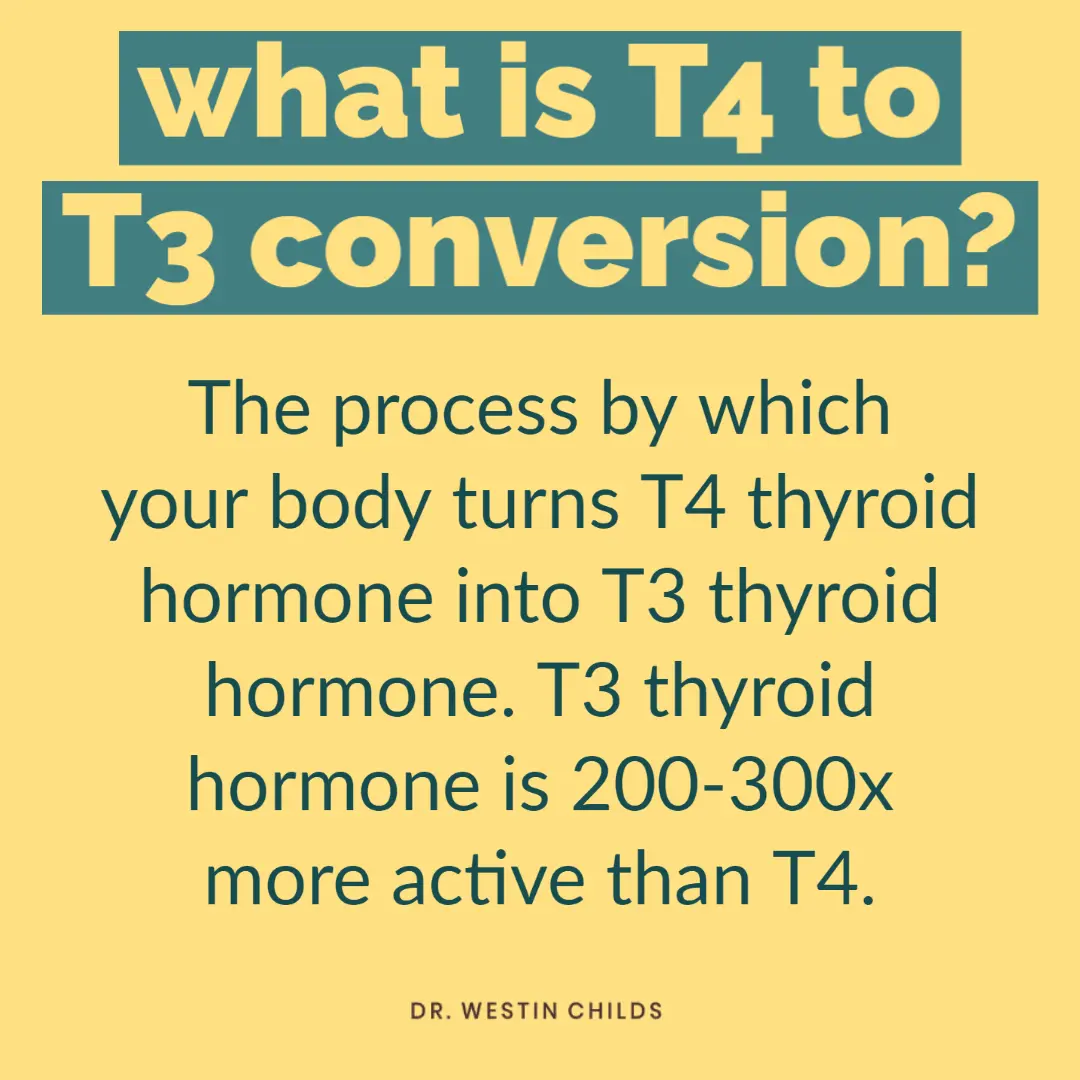
It’s the process by which your body meticulously activates thyroid hormone on an as-needed basis to provide your cells with exactly the right amount of thyroid hormone at exactly the right time.
What many thyroid patients fail to understand, though, is what happens when this process doesn’t work correctly.
Because if it doesn’t, you’re going to have a heck of a time feeling better.
Here’s what you need to know about this conversion process:
T4 to T3 Conversion Explained in Plain English

In this conversion process, your body takes T4 thyroid hormone, which it either produces on its own or that you’ve taken by mouth, and cleaves off a portion of the molecule which changes its shape and structure.
This change alters the hormone to T3 (triiodothyronine) which is the active thyroid hormone.
Why is this important?
Because the more T3 you have in your body the better your thyroid functions.
The less T3 you have in your body the more symptoms you will experience.
What that means for you is that you want this process to be working at 100% because if it isn’t then you will be producing less active thyroid hormone.
It turns out that the way that your body increases or decreases this conversion process is through the activity of special enzymes.
These enzymes, known as deiodinase, are responsible for “cleaving” off an iodine moiety on the T4 hormone.
T4 is named T4 because it contains 4 iodine portions on the hormone base.
Once it loses an iodine portion it now only has 3 and we call it T3.
Approximately 80% of the T3 in your body is created through this conversion process which means it’s very important for thyroid health.
This conversion process matters if you have a thyroid, if you don’t have a thyroid, if you have Hashimoto’s, if you have thyroid nodules, if you have thyroid cancer, and so on.
Basically, it matters for everyone.
Why?
Because even if your thyroid isn’t working you still have to take thyroid hormone by mouth and most thyroid medications contain T4 (not T3).
Factors that DECREASE T4 to T3 Conversion (These slow down thyroid function)
There are certain factors that can slow down the conversion of T4 to T3 by interfering with the efficiency of the enzymes responsible for this conversion.
These factors act as a brake on your entire thyroid system.
They slow down the amount of T3 that your body is able to produce and may make less efficient the medication that you are taking.
If you can address and reverse these issues then you can “release” the brake on your thyroid and finally start feeling better!
I’ve created a list of the most common factors that blunt this conversion process below:
- Dieting & Calorie restriction (slows down your metabolism) – Calorie restriction, as little as 1,500 calories per day for 3 weeks, is enough to blunt thyroid function and reduce T4 to T3 conversion (2). This might be the #1 problem for many thyroid patients who also tend to struggle with weight. They get trapped in a situation where they are overweight but try to diet to reduce the weight, only to further reduce thyroid function which leads to weight gain.
- Inflammation (from any cause) (3) – Inflammation is really nonspecific but inflammation from any cause (if systemic) can damage thyroid function. You can identify inflammation by looking for markers such as CRP and ESR. If elevated, these markers may be an early sign of inflammation.
- Lack of sleep (4) – If you are sleeping less than 8 hours per night then you may be reducing your thyroid function without realizing it.
- Intestinal issues (Dysbiosis, IBS/IBD, etc.) – A large portion of thyroid conversion actually happens in the GI tract or gut (5). If you have problems in the gut then this may limit your ability to convert T4 to T3. Problems such as intestinal dysbiosis (changes in gut bacteria), inflammatory conditions such as SIBO/SIFO/IBD, and other issues can all cause issues. Treating gut-related issues should be a priority if you have thyroid disease.
- Stress (emotional, physical, etc.) – Stress, from any cause, will limit thyroid function and block thyroid conversion (6).
- Chronic and acute infections – Acute infections such as pneumonia can cause issues but also more chronic infections such as viral or bacterial overgrowth syndromes can also cause issues.
- Medications – It is well known that certain prescription medications can block thyroid function (7). Included on this list are blood pressure medications, diabetic medications, seizure medications, iodine, PTU/Methimazole, steroids, and heart medications like amiodarone. It may not be possible for you to stop taking your medication but you should look for alternatives if possible.
- Endocrine-disrupting chemicals (those you come into contact with daily, some people are more sensitive than others) – Endocrine-disrupting chemicals are chemical compounds that humans come into contact with on a daily basis that look like real hormones but aren’t. These hormones can trick your body into thinking the real hormones are there and they may compete for binding on cellular receptors (8). EDCs are found in plastic bottles, receipts, foods, plastics, and many other items that you come into contact with daily. Limiting your exposure to these chemicals may help improve your thyroid function.
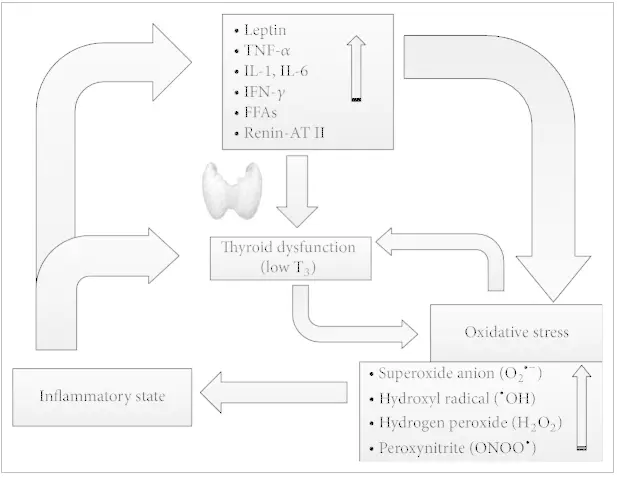
If you have any of these issues going on in your body then your thyroid function may suffer.
These conditions may lead to an increase in a metabolite known as reverse T3 (a topic for another time).
Reverse T3 is the metabolite created when your body is having trouble with the thyroid conversion process.
Therefore, it can be used as a marker of thyroid conversion in your body.
You can test for reverse T3 with a simple blood test.
Factors that INCREASE T4 to T3 Conversion (You can use these to improve how well your thyroid works)
So what are you supposed to do if you have any of the factors listed above?
This section will discuss some of the available therapies that you can use to potentially help improve T4 to T3 conversion.
- Fixing the problems listed above (you must know what is causing the issue!) – The first, and most important, option is to try and find the root cause of your issue and address that problem. This may require a physician to help but in many cases, it will not. For instance: if you know you are struggling with calorie restriction then the first step is to stop that behavior! If you have known gastrointestinal issues then you can address that problem with basic therapies such as probiotics or enzymes. If you are struggling with stress then adding yoga or meditation to your daily regimen can help. If you are having issues with sleep then you can focus on ways to improve that and so on. Some issues, such as the use of medications, may require that you find a physician to help (and even then you may not be able to adjust your medications). In many situations, you may find that you have a number of factors that are limiting your T4 to T3 conversion. Each of these factors may contribute 5-10% so you may have to address many issues to see noticeable improvement.
- The use of certain supplements – Another strategy to improve T4 to T3 conversion is to use certain supplements. Supplements such as zinc, selenium (9), and guggul may all help your body naturally improve this process. The use of minerals such as zinc and selenium will only help if you are deficient, but many people around the world most likely are due to poor widespread dietary patterns. I’ve included the most effective mix of nutrients and vitamins in my T3 conversion booster which has helped many people improve thyroid function. You can learn more about that supplement here.
- Exercise (the right amount for your body) – Exercise is one of the easiest ways to increase both T4 and T3. A moderate amount of exercise can improve thyroid hormone production from your thyroid gland while simultaneously increasing thyroid hormone levels. The only catch here is that you must be exercising enough while avoiding overexercising. Overexercising can actually cause the opposite effect and lead to decreased levels of both T4 and T3. Learn how much is enough in this guide.
- Diet – While your diet doesn’t directly influence thyroid conversion it can absolutely indirectly affect thyroid conversion. Consuming unhealthy foods can lead to things like low-grade inflammation and gut problems. Both of these variables can negatively impact thyroid conversion. Learn which foods to avoid and which foods you should be eating to promote healthy thyroid function in this guide.

Using these strategies can help you increase thyroid function naturally and may even help if you are taking medication.
Remember:
If you are taking thyroid medication your body still must convert T4 into T3.
So all of these factors still matter if you are taking thyroid medication or if you don’t have a thyroid at all.
The good news is that almost everyone with thyroid-related issues can benefit from this information.
Bypassing T4 to T3 Conversion with T3 Medication
Another strategy that we will discuss (briefly) is the use of T3 thyroid hormone to bypass T4 to T3 conversion.
We already discussed the importance of T3 and how it does pretty much all of the heavy lifting when it comes to thyroid function in your body.
Normally, thyroid medications that contain T4 must be activated to T3 before your body can really use them.
But you can skip out on this process by using T3 medications such as liothyronine or Cytomel.
If you ingest T3 medications then they do NOT require activation in the way that T4 medications do.
This allows you to bypass the conversion process and start feeling better almost immediately.
This doesn’t mean that you should skip out on all of the therapies listed above, but instead, combine them all together for maximum benefit.
I find that using medications that contain T4 + T3, using supplements designed to improve thyroid conversion, and addressing issues that blunt thyroid function all at the same time cause the best results clinically.
You can learn more about using T3 medications here.
Conclusion
The bottom line?
Addressing this tiny concept known as thyroid conversion may be one of the most important things that you learn about your thyroid.
Most of the time, patients feel helpless with their thyroid because so much depends on their doctor and what he/she is willing to do.
But if you understand your thyroid you can take steps to optimize whatever thyroid function your body is capable of producing.
Just remember:
This is a process and it takes time!
Don’t expect immediate results, but instead, give your body weeks to months to improve.
Now I want to hear from you:
Are you struggling with T4 to T3 conversion?
Have you tried therapies designed to improve this process?
Have they worked for you? Why or why not?
Have you tried T3 medications?
Leave your comments and questions below!
Scientific References
#1. https://www.ncbi.nlm.nih.gov/pubmed/6479377
#2. https://www.ncbi.nlm.nih.gov/pubmed/1249190
#3. https://www.ncbi.nlm.nih.gov/pubmed/27051079
#4. https://www.ncbi.nlm.nih.gov/pmc/articles/PMC2910542/
#5. https://www.ncbi.nlm.nih.gov/pmc/articles/PMC1411539/
#6. https://www.ncbi.nlm.nih.gov/pmc/articles/PMC3148770/
#7. https://www.ncbi.nlm.nih.gov/pmc/articles/PMC1070767/
#8. https://www.ncbi.nlm.nih.gov/pmc/articles/PMC5751186/
#9. https://www.ncbi.nlm.nih.gov/pubmed/25758370