
- Free T4 doesn't need to be in a magic normal range. What matters is whether your T4 is converting into active T3 properly. High T4 with low T3 signals a conversion problem that needs fixing.
- If you're on T4-only medication and your free T4 is high but you still feel terrible, look at your reverse T3 and free T3 levels. Your body may be converting T4 into reverse T3 instead of the active hormone you need.
- Adding T3 medication drops your free T4 level, and that's actually a good sign it's working. Don't panic if your T4 falls below normal once you start T3. Your symptoms matter more than lab numbers.
- Absorption of thyroid medication is huge and often overlooked. If your T4 level doesn't rise after increasing your dose, switch to Tirosint or use 50mcg tablets of levothyroxine, which have fewer inactive ingredients that block absorption.
- Test your complete thyroid panel including TSH, free T3, free T4, reverse T3, and antibodies together. Looking at only one or two values gives you an incomplete picture that leads doctors to miss thyroid problems entirely.
Chances are VERY high that your Free T4 level isn’t actually normal even though it may be in the “normal range”.
Most people tend to blow off their Free T4 level because it isn’t the ‘free and active’ hormone, especially when compared to free T3.
But that is a big mistake!
Free T4 still has a story to tell and it’s not something you want to miss out on.
For instance, your Free T4 level can actually help you determine how efficient your thyroid is converting T4 into T3 and may explain why you have a “low” TSH when you still feel terrible.
In this article, I’m going to help you understand what your Free T4 level means and teach you how to determine if it is really in the “normal range”…
Is your Free T4 Normal & Optimal?
Unfortunately, it isn’t quite that easy…
There is no magic number that your Free T4 level needs to be in order for you to suddenly start feeling amazing.
It is just one small piece of a larger puzzle that is your entire health.
I’ve seen patients with low Free T4 levels who are asymptomatic, and I’ve seen patients with Free T4 levels in the upper 1/3 range who feel terrible.
Like other tests in medicine, it needs to be used in conjunction with your symptoms and other lab tests.
But before we get into the nitty-gritty, let’s talk about how to look at your own Free T4 level…
Consider the example below:
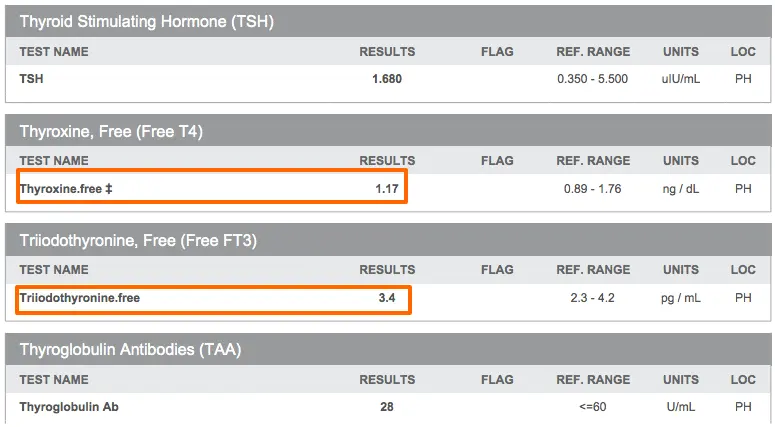
Going off of lab tests alone you can see that this patient’s Free T4 levels fall within the lower 1/3 of the reference range. (Ignore her other lab values, we will get into those later)
If your Doctor were to see these labs he would absolutely tell you that your lab tests were “normal”, but is that really the case?
In treating hundreds of patients I can tell you honestly that MOST patients feel significantly better when their Free T4 levels are towards the higher range, usually in the upper half.
And this correlates well with newer studies that show that patients with hypothyroidism require a higher free T4 to achieve a normal TSH (1).
This study showed that, while treating patients with hypothyroidism, the goal should be to obtain a free thyroxine level in the upper part of the reference range.
If you recall from basic Thyroid physiology, your Free T4 levels act as a reservoir or pool to draw upon when your body needs to create the active thyroid hormone Free T3.
So when thinking logically about this…
As your free T4 level increases, the more you can draw upon this pool to create the active hormone… right?
It turns out that this is the way that most Doctors (and subsequently patients) think about the thyroid.
Unfortunately, for at least 15% of the population, it isn’t true (2).
And that leaves us with a big problem:
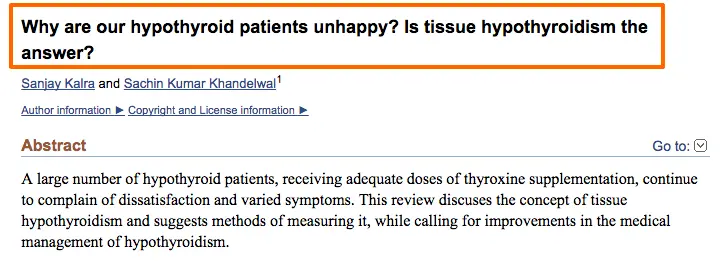
We are basing treatment recommendations on an incomplete picture and we are wondering why our thyroid patients feel terrible and are so unhappy (3).
Your Free T4 and Thyroid Function
Here’s where things can get a little bit tricky, and why many Doctors may actually be telling you that your thyroid is “fine” when it really isn’t.
I just said that high levels of Free T4 are good, right?
But that isn’t always the case.
Refer back to what I said before about Free T4 being a reservoir for Free T3.
What if you AREN’T converting T4 to T3? (What if your body isn’t utilizing that T4 correctly?).
Well, let’s just think about this logically again using this example:
I want you to think about your thyroid as a Dam.
Under normal circumstances, a Dam acts to hold back A LOT of water and only lets a certain amount of water go through in a controlled fashion.
In this example, the pool of water behind the dam is your Free T4 level, and the water going through is your Free T3.
What will happen to the system if you suddenly can’t let any water through?
It all backs up, and the water behind the Dam continues to grow and grow.
Well…
The same thing happens to your Free T4 level when there is a ‘kink’ in the system.
But instead of water, your Free T4 level goes higher and higher…
Do you see the problem now?
A kink in the conversion process may actually cause your Free T4 levels to RISE and make you think that your thyroid function is normal when the exact opposite is happening.
As your Free T4 level rises (because it can’t convert to Free T3) it shows up as high levels of Free T4 in the serum. These high levels of Free T4 actually act to suppress your TSH (because your pituitary doesn’t have the same deiodinases as the rest of the body(4)).
So your lab tests may look something like this:
- High Free T4
- Low TSH
- Low total T3 and free T3
- High reverse T3
Meanwhile, you are feeling terrible with every hypothyroid symptom in the book.
Does this scenario sound familiar?
Don’t worry…
If it is happening to you we are going to discuss how to correctly diagnose it, but first, we need to talk about how T4 can be beneficial.
Does Your T4 Even Matter?
It’s easy to think that T4 doesn’t mean much because it isn’t the active thyroid hormone in your body.
And it makes sense, but there is still some value in using and testing for it.
First:
T4 levels give you an idea about how you are converting T4 into T3.
In keeping with the analogy I described above, your T4 level helps you to understand how your body is processing your T4 and T3 thyroid hormones (5).
High levels of T4 with correspondingly low levels of T3 may indicate that you need to focus on improving your T4 to T3 conversion.
You can read more about how to naturally increase your T3 levels and thus thyroid conversion here.
Second:
T4 levels can give you an idea if you are properly absorbing thyroid hormone (6).
Another huge benefit of testing your T4 levels is understanding if your body is actually absorbing your thyroid hormone.
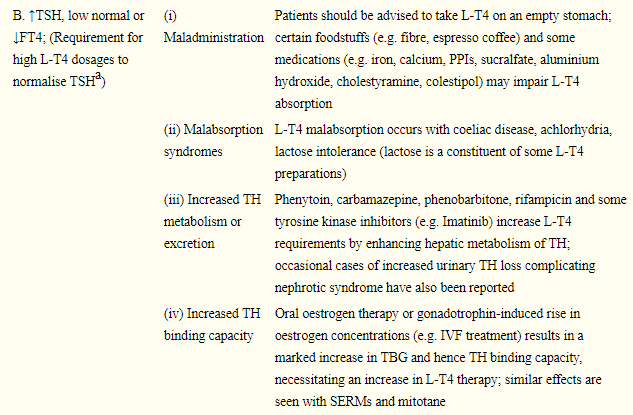
Naturally, your T4 levels should increase as you take thyroid hormone (though it is important to realize that your symptoms may not improve just because your T4 level increases).
By testing your T4 level both before and after you start thyroid hormone (this only applies to T4 only thyroid medication) you can get a rough idea as to whether or not you are absorbing the medication.
Believe it or not, absorption of thyroid hormone is a big deal and something that is frequently missed (7).
You can learn more about how to properly take your thyroid medication in this post which explains how changing the time of day you take your thyroid medication can actually improve thyroid absorption and thyroid function.
Third:
T4 levels can help you determine if you need to focus on improving your thyroid conversion vs increasing thyroid hormone production.
This is primarily helpful for patients who know that they have hypothyroidism, but whose physician is unwilling to treat them with thyroid hormone.
Most physicians are willing to at least test both TSH and free T4 levels which can give you, as the patient, a lot of information.
If you know that your T4 and T3 levels are low then you can focus on taking supplements and taking action to increase your thyroid hormone production.
On the other hand, if your T4 levels are high and your T3 levels are low – you as the patient can focus on taking supplements designed to boost T4 to T3 conversion.

Over 13 nutrients are involved in thyroid hormone production (8) and some supplements may help thyroid conversion.
It turns out that many patients (even those on thyroid hormone) have deficiencies in some of these nutrients which may lead to poor thyroid hormone production and conversion.
If you have Hashimoto’s then the supplements you should consider using are slightly different from the list above and you can find more information on which supplements are best for autoimmune thyroiditis here.
Fourth:
T4 levels can help you determine if you would benefit from adding T3 thyroid medication.
Let’s say that you are taking T4-only thyroid medication (like Synthroid) and your T4 level is high (so you know you are absorbing it) but your T3 level is still low and you are still having symptoms of hypothyroidism.
Even in the presence of a low reverse T3 (which means you are still converting thyroid hormone ok), this may indicate that you might benefit from the addition of T3 thyroid hormone.
Recall that T3 thyroid hormone is the most powerful thyroid hormone and is responsible for all of the good things that thyroid hormone does in your body.
So remember:
While T4 isn’t the best thyroid test, it can still give you plenty of helpful information – especially if your Doctor isn’t willing to order the complete thyroid panel.
How T4 Changes with Thyroid Medication
Another very important factor is understanding how your free T4 level changes with different types of thyroid hormone.
This is worth mentioning because it isn’t always intuitive and it can lead some patients into thinking that they are not heading in the right direction even though they might be.
T4 on Levothyroxine (Synthroid, generic Levothyroxine, Tirosint)
The way your T4 level changes when taking T4-only thyroid medication is actually quite intuitive.
Assuming you are absorbing enough thyroid hormone, your T4 level should increase as your increase your T4 dose.
Makes sense right?
Sometimes, though, this doesn’t happen and even if it does it doesn’t necessarily mean everything is “all good”.
As I mentioned above, your T4 level might NOT raise if your dose isn’t high enough and/or if you aren’t properly absorbing the medication you are taking.
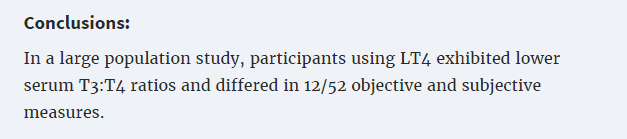
And, even if it does, there are studies showing (9) that patients who take T4-only thyroid medication show lower T3 levels than healthy populations – indicating that many patients just don’t do well on these T4-only thyroid medications.
There are ways that you can improve the function of thyroid hormone if you are taking T4-only thyroid medication and not feeling better:
1) Consider switching to Tirosint.
Tirosint contains 3 inactive ingredients and can help increase the absorption and effectiveness of thyroid hormone.
The case can even be made that you should consider switching over to Tirosint if you are currently taking Synthroid or levothyroxine.
2) Consider switching to 50mcg increments of Levothyroxine
The 50mcg tablet of levothyroxine contains the fewest inactive ingredients out of all of the other Levothyroxine dosages (For example the 100mcg tablet and so on).
Changing your dose from 1, 100mcg tablet of levothyroxine to 2, 50mcg tablets of levothyroxine may help increase absorption and reduce any symptoms you may be having.
3) Consider switching from Levothyroxine to Synthroid or Synthroid to Levothyroxine
While these medications may appear to be the exact same, studies have shown that they are not bioequivalent (10).
What this means is that your body may process them differently which may result in varying thyroid levels.
This is an easy test because all you have to do is switch from taking one medication to the other and you may notice a difference.
- Bottom line: If you are taking T4-only thyroid medication (Synthroid, Levothyroxine, Levoxyl) then your free T4 level should increase. If it doesn’t then you may have an absorption issue and you may benefit from switching to Tirosint.
T4 with NDT (Armour, WP thyroid, Naturethroid)
The way that T4 changes with NDT aren’t as straightforward as it is with T4-only medications.
Any thyroid medication that contains T3 thyroid hormone, at high enough doses, will generally cause your free T4 level to drop (11).
The degree of how much it lowers largely depends on the dose of T3 you are taking.

The higher the dose of T3 the lower your free T4 will go.
The reason for this has to do with how T3 and T4 influence pituitary function.
T3 thyroid hormone is 3-4 times more potent at lowering the TSH (12) than T4 is alone.
As your TSH lowers your body produces less T4 thyroid hormone by itself (and becomes more reliant upon medications to supplement thyroid hormone levels).
As long as you have a functioning thyroid gland (assuming it isn’t taken out or destroyed by radioactive ablation) then your thyroid will be producing SOME T4 and T3 even if you are taking thyroid medication.
But as you increase the dose of T3 you are taking then that amount your thyroid produces drops.
This will usually result in a decrease in your Free T4 level.
As you know NDT (natural desiccated thyroid) contains mostly T4 and some T3.
This ratio is close to 80% T4 and 20% T3, which means that the medication is still mostly T4 thyroid hormone.
But even that small amount of T3 is enough to shoot up T3 levels and drop T4 levels in the body.
One mistake I see patients (and doctors make) is increasing the NDT dose while trying to get to some mythical and optimal T4 level in the serum.
In some ways this is futile, as you increase your NDT dose it will drive down your T4 level in the serum which leads to higher and higher levels of NDT.
This can actually backfire and result in high levels of reverse T3 and very high levels of free T3.
If you are taking 4+ grains of NDT and still experiencing symptoms of hypothyroidism, then this may be happening inside your body.
- Bottom line: With lower doses of NDT your free T4 level may actually drop somewhat. Higher doses of NDT (greater than 4 grains) will usually cause the free T4 to increase but this isn’t necessarily helpful.
T4 with T3 Medications Like Cytomel and Liothyronine
This is where things get really interesting.
Taking T3-only thyroid medication like Cytomel or liothyronine will cause your free T4 to drop below the “normal” range completely and even flag as low.
This has to do with the fact that you are suppressing the TSH with the T3 and so endogenous production of T4 decreased dramatically.
Taking T3-only thyroid medication also causes reverse T3 levels to drop too low levels as well (this is usually a good thing).
To recap what happens on T3-only thyroid medication:
- TSH level falls
- Free T3 level increases
- Free T4 level decreases
- Reverse T3 level drops
What you really need to get out of all of this is the fact that your free T4 levels do not necessarily need to be in some magical “optimal” range for you to feel good.
Basing your treatment on these ranges may lead to suboptimal treatment as you chase all the wrong results.
Instead of laser focusing on your free T4, make sure that you look at your T4 in context with other thyroid lab tests.
- Bottom line: Taking T3-only thyroid medication will dramatically reduce your free T4 level and this isn’t necessarily a bad thing.
Symptoms of Low T4 & T3
Low free T3 and free T4 levels may indicate low thyroid function, but they may also indicate a condition known as euthyroid sick syndrome or low T3 syndrome.
This condition is very similar to hypothyroidism, but some patients with it may not experience symptoms, whereas all patients with hypothyroidism will experience symptoms.
If you suffer from low T3 and/or low T4 then you are also very likely to experience all of the symptoms of hypothyroidism, but with some other slight changes.
Symptoms of low T3 and low T4 include:
- Constant fatigue
- Reduced response to T4-only thyroid medications
- Weight gain (even while on thyroid medication)
- Low resting heart rate
- Low body temperature
Many of these symptoms result from low T3 levels directly or from the reduced conversion of T4 to T3.
Patients who are taking thyroid medication (who still have low T4 levels) may experience many of these symptoms (13) which should spark a further investigation by your physician.
If you fall into that category make sure that you properly evaluate how effective your conversion is, and how effective your native thyroid hormone production is (use examples above).
Why you need the Complete Thyroid Panel
Because testing for thyroid hormone levels isn’t always intuitive, it’s very important that each time you check your thyroid levels you obtain a complete panel.
While not all lab tests may be necessary EACH and every time you get blood work, it’s still a good idea to get all of these tests to create baseline values that you can compare further testing to.
Let’s go back to the initial example we used at the beginning of this post:
At first glance, you may be thinking that this patient is completely normal.
Her TSH is in the 1-2 range, her Free T3 is in the mid-range, and it’s only her Free T4 that is in the low range.
But she is actually quite hypothyroid and I know this because I treated her!
It isn’t until you order her Reverse T3 level that you finally get a better picture as to what is happening…

Once you see and understand her Reverse T3 level you begin to understand her thyroid physiology.
You see:
The only reason her Free T3 levels even look moderately normal is that her Reverse T3 levels are inappropriately blocking any Free T3 that she has.
Remember that Reverse T3 and Free T3 both compete for cellular binding (14).
If you take into account her high Reverse T3 level, her Free T3 level suddenly starts to make more sense.
In her case, her Free T4 level never got into the ‘optimal high’ range, but you can definitely tell that it is also inappropriately high for her, given that she can barely convert T4 to T3.
The bottom line:
You need a Complete Thyroid Panel if you want to have ANY idea of what is going on with your thyroid.
That means you need the following tests:
- TSH
- Free T3
- Free T4
- Reverse T3
- Total T3
- Thyroid Antibodies
- Sex hormone-binding globulin
And remember:
Just ordering the tests isn’t going to be enough.
You need to make sure that you and your Doctor know how to actually interpret them so you don’t fall victim to the trap I just showed you above.
Conclusion + Recap
Your Free T4 levels can give you amazing insight into how well your Thyroid is functioning, but you need to remember that they are only a small piece of an even larger puzzle.
It is possible that your Free T4 levels may be inappropriately elevated and that isn’t always a good thing.
If your Free T4 levels are high and you still feel terrible, then you need to make sure you are also checking your Free T3 levels and your Reverse T3 levels.
Using these lab values together, in combination with your symptoms, will help you to understand how well your thyroid is functioning.
So what should your T4 levels be?
If you aren’t taking thyroid hormone, then optimal levels are generally in the upper 50% of the reference range.
If you are already taking thyroid hormone then the upper 50% of the reference range doesn’t always hold, instead, you need to be focusing on other factors.
Now I want to hear from you:
Are your free T4 levels high but you still feel terrible?
Is your doctor willing to order the RIGHT tests?
What has helped you feel better in this situation?
Leave your comments or questions below!
Scientific References
#1. https://www.ncbi.nlm.nih.gov/pubmed/18753096
#2. https://www.ncbi.nlm.nih.gov/pubmed/19190113
#3. http://www.ncbi.nlm.nih.gov/pmc/articles/PMC3169863/
#4. https://www.ncbi.nlm.nih.gov/pubmed/6595194
#5. https://www.ncbi.nlm.nih.gov/pmc/articles/PMC3887425/
#6. https://www.ncbi.nlm.nih.gov/pmc/articles/PMC3857600/
#7. https://www.ncbi.nlm.nih.gov/pubmed/28153426
#8. https://www.ncbi.nlm.nih.gov/books/NBK285550/
#9. https://academic.oup.com/jcem/article-lookup/doi/10.1210/jc.2016-2660
#10. https://www.ncbi.nlm.nih.gov/pmc/articles/PMC3565118/
#11. https://www.ncbi.nlm.nih.gov/pmc/articles/PMC5873391/
#12. https://www.ncbi.nlm.nih.gov/pubmed/402379
#13. https://www.ncbi.nlm.nih.gov/pubmed/29381251
#14. https://www.ncbi.nlm.nih.gov/pmc/articles/PMC5869352/



I had Hashimoto’s, my glands became fibrous and were removed. No after care took place. I am now on 175mg of thyroxin. I have put on a lot of weight and feel all the symptoms. I would like to go on your weight loss program. I am vegetarian. Is your program suitable for me?
Hi R. Walia,
Unfortunately, the program is not really designed for vegetarians/vegans as many of the recipes contain animal products.
I had my thyroid removed in December of 2012: the endocrinologist is treating it with armour thyroid due to the issues I have with levothyroxine. I recently had my TSH level checked in April 2018 which was .08 ulU/ml and my T4 Free was also checked that was .86 ng/dl. I just went to see my pcp in may and she did a complete workup she had my TSH and T4 Free checked the information is as following TSH .09 ulU/ml and T4 Free is now .75 ng/dl is this something I should be worried about? I’ve never had my T4 free in low range any thoughts? My t3 free was checked in 2016 and was in normal range.
Hi Alice,
You only really need to worry if you are also symptomatic (meaning experiencing the symptoms of hypothyroidism).
Hi Dr,
I had a baby about 7 months ago. Since then I’ve just felt off. At first I felt hot, sweaty and tired and now I’ve been so tired and my I go through periods when my feet will be freezing but hot. My temp sometimes gets a little higher then my usual temp. In the 98’s. Had all kinds of blood tests and scans done. I just had a tsh test and free t4 test done. TSH came back at 1.33 and Free T4 came in at 0.9. Are these considered the normal ranges? I had my tsh done in January as well which came back as 1.9.
Hi Lindsay,
I would take a look at this article which may explain what you are going through: https://www.restartmed.com/postpartum-thyroiditis/
Hi Dr. Childs,
I was diagnosed back in 2002 with hypothyroidism and adrenal fatigue. I’ve also had a weight problem since I was a child and have been on every diet known to man (Weight Watchers, Atkins, Rob Nevins, Herbalife, and Medical Weight Loss plan, just to name a few). Some worked for a period of time and some didn’t. While I lost weight on diets over the years, the weight always comes back on. I’m a 48 year old female and for the past 18 years I’ve become more vigilant in living a healthy lifestyle and to avoid Diabetes which runs in my family. I have successfully avoided Diabetes (at the moment) and while most of my lab results are great (even for an obese individual), I still struggle with finding that one thing that will help me lose weight and keep it off. Believe me I completely understand that everyone’s body responds differently to all the diets that are out and that there is no one cookie cutter program that works for everyone.
When I was initially diagnosed with being hypothyroid, I was given Levoxyl. After doing more extensive research on hypothyroidism, I asked to be switched to Armour Thyroid which I took for a long time up until the formula was changed. I am currently taking 162.5 mg. of Nature-thyroid and while I seemed to do better on this than the Armour. There have been production issues so it was not available for a period of time. When I first started on the Nature-thyroid prior to the production issue I did feel better. It has since been slowly coming back to the market but I can’t get the 162.5 mg just yet so I have to take 2 lower doses that equal the 162.5mg. I was also treated with Cortef for my adrenal fatigue and was on it for a period of time back in 2002. I do realize that there are some doctors out there that do not believe in adrenal fatigue but my previous endocrinologist and Naturopath do. My Naturopath tried to elevate my A.M. Cortisol level through natural supplements (AdreCor and Cytozyme AD)which I took for a period of time but with no success. I asked him if I should consider going back on Cortef for a while and he agreed. He would of prescribed it to me but the State of CT does not currently allow Naturopathic Doctors prescribing rights. I went to my previous endocrinologist and she was fine with me going back on Cortef. However, she retired last summer and in January 2018 I went to a new endocrinologist who does not believe in adrenal fatigue. She wanted me to wean myself off the Cortef as she does not treat patients that are taking that. I have since stopped taking Cortef and went for blood work recently to check my TSH and cortisol (A.M.) levels. I’m still hypothyroid and my cortisol levels have come down a little bit since being off the Cortef. I go for blood work quite often as I believe in partnering with my doctors to obtain optimal health. Last December my Naturopath decided to do a 2-hour fasting glucose test even though my fasting glucose has always been great. He wanted to take a deeper dive to see if the results would show something different. After he got the results he told me that while I’m not diabetic and that I did such a good job of avoiding this disease that I’m actually a non-diabetic hypoglycemic. He told me I should be eating constantly (every 2 hours) to keep my blood sugar levels from dropping too low. I’m currently on a 1,700-1,800 “diet” and I say “diet” because it’s not a negative for me, it’s a lifestyle. I basically eat healthy and tend to go with a higher protein diet and while I do have carbohydrates, I eat good carbs. I have switched from eating non-fat items such as yogurt to full fat as my Naturopath pointed out the non-fat items are often higher in sugar than full-fat foods. I keep my sugar intake to a minimum and use Stevia (about 1-3 packets/day)but I also get natural sugar from fruit that I eat. And still I cannot lose weight….no matter what I do! Below are my blood test results from over the last year…maybe you have some suggestions that may help me find a way to lose weight. I even tried working with a personal trainer at the gym to build more muscle because I know that will burn fat all day…but have not been successful with that.
June, 2017:
TSH = 3.07
T3 Uptake = 30
T3 Free = 3.1
Reverse T3 = 17
T4 Total = 5.6
Free T4 Index = 1.7
Cortisol (a.m.) = 9.3
August, 2017:
TSH = 0.67
T3 Uptake = 33
T3 Free = 4.0
Reverse T3 = 20
T4 Total = 5.7
Free T4 Index = 1.9
December, 2017:
TSH = 2.28
T3 Uptake = 30
T3 Total = 119
T4 Total = 5.5
Free T4 Index = 1.7
Cortisol (a.m.) = 15
July, 2018:
TSH = 3.34
T3 Uptake = 32
T3 Total = 143
T4 Total = 6.0
Free T4 Index = 1.9
Cortisol (a.m.) = 11.0
My previous endocrinologist felt that my body did better when my TSH level was around 1.0. I felt good with it there too but as you can see from the above results that last time it was anywhere remotely near 1.0 last August, 2017. It was actually below 1.0. My Naturopath explained to me that our bodies are not static so while readings may be one thing at a certain time period, they could change drastically in just an hour or two. I’m going for blood work in about 2 weeks so we can compare it to the blood work I had earlier this month.
I apologize for blabbing on and on…I just want some answers and honestly do not know where to turn at this point.
Regards,
Michele
Hello Doctor! My daughter (11yo) has Hashimoto’s and RA. She is on Euthyrox 75mcg daily. Her labs are a bit confusing: TSH 1.43; free T4- 2.2; total t3 – 2.22. TPOAb is up to 138 from 68 last year. Hemoglobin A1c is 5.2; IgA -91,5 and tgb an IgA – 3.3. Her cholesterol is 235 with ldl 170. Triglycerides are 99. She is on Kineret for RA (since 2014). She is been constantly gaining weight at a 2-3 lb/ month pace, which made her obese, is anxious, hungry all the time (this hunger makes her nauseous). She has a new endo who scratched her head to decide what tests to order. Meanwhile, my child has hypo symptoms, with hyper labs that alerted her pediatrician. I give her selenium, zinc, vit d3( she is constantly low), digestive enzymes, probiotics, fish oil, ca/mg. That is your opinion? Should I decrease the T4 a bit? What should I do? Thank you! Elena.
I got my TSH T4 and T3 done on the 21st of August and I just got the results back. My TSH is actually going up since June. *My Tsh 1.86 my range is 0.35-5.50.
*My T4(free)is 0.98 my range is 0.70-1.53.
*My T3 is 100 my range is 76-181.
My blood work shows TSH W/Reflex to FT4 is 8.84 H and my T4, Free is 1.2 and says In Range. What does this mean anyway?
Hi Nora,
Most likely it means that your body is having trouble producing enough thyroid hormone.
Dr. Childs, did I miss the answer on what to do with high ft4, low tsh,low ft3, and high rt3?? That is exactly my scenario right now???
Hi Kris,
I’m fairly sure I’ve gone over that pattern somewhere but I’m not sure if it’s on this post or not. It may be in this video: https://www.youtube.com/watch?v=-XPS5Rkgq-M
Most likely you are just taking too much T4 medication and it’s not converting well.
I have this same exact issue (although my RT3 is ok) – low TSH, high FT4 at almost top of range, Ft3 3.1, and having massive insomnia and can’t stay asleep. Hair falling out, frequent bathroom trips, heart palpitations and heart pounding were happening. I check the video that Dr. Childs posted but could not see this specific situation addressed, perhaps it is elsewhere. I think I am on too much T4 (only) med as I dropped the dose 3 days a week and symptoms abated a bit but not yet the insomnia.
Hi Dr. Childs,
I am on Naturethroid 1 grain and 5 mcg of Cytomel, my TSH came in at 2.11, FT4 at .7 and FT3 at 2.10. I want to increase my FT3 but the doc is concerned about lower than lab range FT4. According to this article that is now irrelevant but if I can get her to increase Cytomel holding Naturethroid at current level, how low can the FT4 go down without there being issues? How much would you recommend going up in Cytomel?
Hi, so I did the test and the results are:
Serum Free T3: 1.29 (normal: 1.2 – 4.2)
Serum Free T4: 0.86 (normal: 0.8 – 1.8)
Serum T.S.H: 2.8 (normal: 0.3 – 4.5)
My symptoms are constant fatigue, hair loss, joint pain, low blood pressure, headache, trouble concentrating, dizziness and constipation.
Are those results normal? if so, What other tests should I do?
Hi Noha,
I would check out this post which outlines all of the optimal ranges for all thyroid lab tests: https://www.restartmed.com/normal-thyroid-levels/
Im learning a lot from your articles. Thank you!
I have been having a lot of fatigue and body pain and weight gain. I had some blood work done and my thyroid tested and started on a compounded levothyroxine so I could keep it vegan. My MCV and MCH were both high and I wondered if they were connected to the thyroid issue.
These were my numbers and then I started taking the level thyroxine at 50 mg. My doctor is raising it up to 75 mg
TSH 4.1, 4.8, and then with meds 2.94
Ft3 3.6 and with meds 3.3
F t4 1.4 and then 1.2
I think i have absorbtion issues. I take my medicine at five in the morning and then don’t eat or drink anything for at least an hour. I take my other supplements about six hours later. Thank you for any ideas you might have. I’m hoping with the increase in the level thyroxine that I’ll feel better.
Hi Dr. Childs,
About 20 years ago I had a total thyroidectomy (due to an inconclusive biopsy on a nodule which turned out to be benign).. I have been on oral contraceptives since then as well and have just gone off (three months ago). Around the time I went off my TSH was in normal range. Since then I have experienced higher than usual anxiety, less sleep, (though I am also cold but probably because its winter). I just had a full panel done and everything is in “normal range” with the exception of TSH, which is now .065. Is there a reason why my TSH would be low and rest of panel shows normal ? (other than the fear of pituitary tumors?) In other words, perhaps something more benign? Could I be over replaced even with t4 and t3 in normal range despite the thyroidectomy?
Thanks,
Hi Valerie,
As far as I can tell, it’s simply not possible to correct all thyroid lab tests with one medication for patients without a thyroid. I’ll have to do a blog post in the future about this very topic.
How can I lower my free t4?
Hi Pam,
I will have to write a blog post on that particular topic, but it really depends on your situation. For instance, if you are taking thyroid medication then the answer would be to adjust your dose. On the other hand, the answer would be completely different if you are not taking thyroid medication.
Hi Dr. Childs,
I have a lot of respect for osteopathically-trained doctors/therapists; the best healthcare practitioner I ever had was a cranial osteopath, he used many different methods to diagnose illness and was so well-read, he moved to France and I really miss him! His name is Ivo van Gils.
Your website is extraordinary, I used to have a private endocrinologist, Dr. Gordon Skinner, he, unfortunately, passed away some years ago, so now I have to rely on my GP, who although extremely sympathetic, is not so knowledgeable with this stuff and is on a very tight budget.
I am on levothyroxine, just increased to 100 mcg. Dr. Skinner put it up to 200 mcg for a while, then reduced to a maintenance of 100 mcg, so I don’t think I have the optimum medication level yet.
My free T4 is at the bottom of the normal range, TSH now down to 0.22.
I have just started a supplement I bought called “Thyroid Complex” by SupplementsYou, from Jersey, UK (I live in SE England) and some berberine and turmeric, which is aimed at insulin/leptin resistance.
I have all the symptoms listed under your “Low T3 Syndrome” in addition to many others, so I am thinking about the following course of action.
I have some 25 mcg triiodothyronine which I bought some time ago, I haven’t taken it because I am due a repeat TSH/T4 test, and I was concerned that, although I am hoping the T3 will make me feel better, it will affect these lab results, leading to my GP reducing my dose of thyroxine.
From what I now read, I am wondering, is it safe to take 25 mcg per day of this in addition to my thyroxine and supplements, and is it more likely to drive down the T4, so not causing the doctor any concerns with my medication?
The Thyroid Complex is aimed at better conversion, I bought it after reading another website about this and ordered that from Amazon. This was before I came across your website, so that’s what I currently have.
IMPORTANTLY, I have severe fluid retention, especially my lower legs and face. I have had this for 3 years, following a parasitic infection which was severe and widespread and I believe caused my thyroid to malfunction again. I have been hypothyroid before, from about the age of 35 when it was picked up and treated by Dr. Skinner, I came off the medication myself, which was probably not a good idea and have now been on levothyroxine again for about 2 years.
Thanks for a fantastically informative website, it’s the best I have ever come across, including the book by Dr. Steven Langer.
Daniella Stewart
Hi Daniella,
Glad you find the information helpful! In regards to your question, yes, T3 will always drive down your free T4 level as well as the TSH and this effect is based on your dose. 25 mcg is enough, in most people, to both drop down the T4 and the TSH moderately to significantly. This may or may not freak out your current provider if they are unaware of T3’s impact on normal thyroid lab tests.
Hi
I take 132mcg. levothyroxine daily. My recent results are,
TSH 0.011 mIU/L (Range: 0.27 – 4.2)
Free T3 5.07 pmol/L (Range: 3.1 – 6.8)
Free Thyroxine 23.000 pmol/L (Range: 12 – 22)
Autoimmunity
Thyroglobulin Antibodies 115 kU/L (Range: < 115)
Thyroid Peroxidase Antibodies 28.5 kIU/L (Range: < 34)
For the past few moths I have started suffering with panic attacks and agrophobia.
Could the high FT4 level be causing this?
Also I have been told I do not have hashimoto's but as my anti body level is 115 does this in fact mean I do have it.
Hello. Concerned about my 22 yr old daughter who has had symptoms of fatigue for years with depression. she’s seen psychologist and psychiatrist who have put her on antidepressants. She continually ask for thyroid studies, and the results always come back in “normal range” and no doctor addresses them. These are her latest results:
FT4-1.16
TSH 1.71
T4 7.3
T3 125
FT3 2.9
I would love your thoughts on these clues. To me, her Ft4 and Ft3 seem low or at should I say at least not optimal. Also, NONE of the antidepressants have done a thing to address or help her with the extreme fatigue. she also has dry ichy skin periodically along with irregular and painful periods. also c/o request constipation.
your thoughts would be so appreciated
not sure if you ever got that sorted out but it sounds a lot like my story. I was tired as a late teen and it progressed in my early twenties until I ended up with a goiter at 27, which led to a partial thyroidectomy. I also suffered from mysterious depression. At that time my TSH was only in the “2” ranges. If you haven’t already, try to seek out a Dr that’s a little more open minded, even an obgyn that treats hormone issues. It wouldn’t hurt to start her out on 25mcg of Levothyroxin for six weeks then test again. Every six weeks you move up to the next dose until she feels better. You have to keep an eye on nutritional stuff as well. Turns out I was low in iodine and B12 and more so my body wasn’t converting the Levothyroxin as well over time.
This has been so helpful! I’ve been experiencing excessive weight gain on top of depression, hair growth, and acne. I’ve been trying to navigate a combination of PCOS/Depression/Hypothyroidism. I am also a short female and feel like “normal” levels aren’t scaled for someone as short as me.
TSH – 1.8 and then retested at 1.94 mclU/mL (0.35 – 4)
Free T3 – Ordered because of this article
Free T4 -0.9 ng/dL (0.8 – 1.5)
Reverse T3 – N/A
Total T3 – N/A
Thyroid Antibodies – N/A
Sex hormone binding globulin – 25 nmol/L (12-137)
I’ve had so many tests ordered, my testosterone is in the upper half and my DHEA-S is off the charts high. And my doctor’s can’t figure out what it is. I’m hoping it’s something with the T3 levels that they can figure out. But really struggling with advocating for my care – even with fellow female doctors!
Hi Emmaleigh,
I would take a look at these articles for more information:
– https://www.restartmed.com/high-dhea-levels/
– https://www.restartmed.com/high-testosterone-women/
Hi! I’m so thankful to have stumbled upon your website. You described me perfectly in this article. I had the same experience with an endocrinologist 2 years and just knew she would help me find the missing pieces to this fatigue, brain fog, and weight gain…just to name a few. She gave me a complete thyroid panel but didn’t include Free T3 or Reverse T3!! She diagnosed me as Hyperthyroid (TSH was 0.06 and Free T4 was 0.68) reduced my dose of T4 (I was on 150 mcg). That was 2 years ago and I’ve been Hypothyroid for almost 10 years. I’m now working with my Internal medicine doctor since he has known me most of my life and telling him what I need tested and learning how to interpret. I just got these results while taking 50mcg of Levothyroxine.
TSH-1.49
Free T4-0.94
Free T3-2.97
Reverse T3-16.2
We are trying Cytomel and taking it slow. I sure hope this works! I’m a school teacher and it’s time to get busy.
Thank you for sharing your experience and wisdom!
Tired in Mississippi
Hi Stephanie,
It looks like there is certainly room for improvement in your labs. Thanks for sharing and keep us updated on your progress!
Hi, I am so glad I came across this article. I am trying to raise my T4 in order to do IVF. However, no matter what I do it’s always low. I’m on 1.5grains Naturethroid and 15mcg Cytomel. My T3 is 3.2, Tsh is 0.02, reverse T3 is 12 but free T4 is o.6. After reading this article it sounds like I’m never going to be able to get my T4 higher while on Cytomel. My RE is focused on T4 because that is what the fetus needs. Should I switch to something like Tirosint? I can’t find any answers and my Endo and RE have conflicting ideas. Thanks!
I have had Hashimoto’s for 20+ years, have gone through 10+ Dr’s. Finally found one that will test for Reverse T3. However, now she’s chasing the “optimal free t4”. I am taking 1 1/2 grain NP Thyroid and 105 of Liothyronine. My last blood work was
Free T4 .071
TSH .005
Reverse T3 11.4
(down from 27)
T3 540
Free T3 17.0
I am feeling okay, though I am not losing weight and not feeling hyper. I think I need to back off the T3 and maybe up my T4 but afraid I am pooling.
Sound optimal to you??
tsh 0.45 (.32-4)
ft3 3.2 (3.1-6.2)
ft4 11 (9-19)
Total t3 1.2 (1.2-2.7)
TPO 13. (<35). Rt3 11. (8-20)
Thyroxine Binding Globulin 270. (260-575
TRAB <2 (<10). Anti-TG 11 (<40)
B12 1500 (138-652) no supplements and no meat??
Thyroglobulin 8.0 (<60)
I’m hoping you can tell me if these are close to optimal. I feel terrible for about two years and seeing my second endocrinologist with no answers/diagnosis. I’m on zero medication for anything. Ty
Interesting. I have been on a compounded T4/T3 (115 mcg/37.5 mcg) medication for over a year. I am one of those who has trouble converting T4 to T3. My energy levels are good, and I feel well BUT my latest lab tests are concerning. Free T4 is low (0.7 ng/dL), TSH is normal (1.69 mlU/L), Free T3 is in the low range of normal (2.5 pg/mL). Did not test for reverse T3. I have noticed that I am cold at night a lot. Pretty sure my doctor is going to adjust my meds next time I see her. What should we do? Increase the T4? Would appreciate any insight.
Hi, I’ve had most hypothyroid symptoms for approx 30 years. Now that lab results are available online, I see that when doctors have said my thyroid was fine, maybe it wasn’t. I’ve had my T3, T4 and TSH tested 3 times in the past 18 or so months. My free T3 is middle of the range, but free T4 is at the bottom of the range. The lab reference range is 9-19, my result is 9. TSH lab range is o.32-4.00, my result is 0.81. My family doctor says my thyroid is perfectly fine. What?? I’ve asked her to do a full panel, she says no, there is no reason when my results are fine. I gave her a symptom checklist with almost everything checked off, she still says I’m fine. I’ve mentioned that it is odd that both T4 and TSH are right near the bottom and now she has decided to text those same 3 again. Since all my labs have been either 9 or 10 and .81, 1.1 and .9, what will these same tests show?
Is it odd to have these results for free T4 and TSH, all these symptoms and be considered fine? I am a 53-year-old female.
This web site is very informational however it is extremely hard to navigate. I have posted questions and can’t find where they were to get the answer. You tend to favor the people who do have thyroids and forget about those of us who don’t. Information is not specific to those who battle problems with NO THYROID. I will continue to find other sites who’s information is easier to obtain.
Hi Kathie,
I do talk about both problems but what most people without a thyroid don’t realize is that the information for those who have hypothyroidism is nearly the exact same for those who don’t have a thyroid. Once your thyroid is removed, for any reason, you automatically have hypothyroidism and that’s what I talk about all the time. So if it applies to hypothyroidism it applies to you if you don’t have a thyroid. This is why you will never see a resource dedicated to those who don’t have a thyroid because it’s just not necessary. But you are welcome to continue your search!
It’s been 2-3 years I have not felt “right” I had thyroid cancer so I have had a total ablation of my thyroid bed.
Todays test
TSH 4.89
T3 0.98
RT3 2.18
T4 10.8
My physician had mentioned testing the T4 and adding Cytomel (?)
Your article did help to understand why I struggle with hyperthyroidism ailments even though the doctor seems to think everything is normal.
Don’t you just love that when it comes to the Thyroid it IS the land of opposites? -Appreciated your posting on this subject and I understand my weight gain!
If you can answer this question Id be so happy! I am looking to do Bio-Te a bio identical hormone replacement therapy. Will that at all interrupt my thyroid medication? I would guess not if its identical to what my body once produced?
Thank you! Michelle
Hi Michelle,
It would interfere slightly with your medication but I would encourage you to read this article for reasons why I don’t recommend pellets: https://www.restartmed.com/hormone-pellets/
Dear Dr. Westin,
I would appreciate your input on the actual preparation/timeline for having thyroid panel bloodwork testing done. What criteria should I follow to receive the most accurate assessment of serum thyroid levels?
What time in the morning? Why not in the afternoon.
Fasting or not?
Take T3 or T4 or combo T3/T4 meds prior, (2 hours?) to testing or wait on taking medication after blood is drawn.
I am under the belief, perhaps misguided, that TSH half life is 7 days and T3 half life is 9 hours and peaks in 2 hours after ingestion.
Thankyou for all the work that you do. Your work has been very helpful to me.
The word “Doctor”, means, “Teacher”and you are a rare example of a Doctor that educates not only your paying patients but anyone that needs your help. You exceed and excel and surpass the definition of “Doctor”.
Hi Judy,
I would check out this article which answers all of your questions: https://www.restartmed.com/thyroid-testing/
Your articles have been helpful and I’ve enjoyed reading the comments and replies. My FT4 levels on generic 88mcg Levo were always on the higher end, anywhere from 1.6-1.88, anything lower and I was not functional. The only thing that made me feel terrible was the eventual decline of the conversion of T4 to T3. Never had the reverse T3 tested. TPO under 1 and TGA is 4, which was just recently tested.
I’ve been experimenting with NP Thyroid for about 4 months and it makes sense that you’ll never have a high FT4 level, afterall you’re getting less T4. I took 90mg and my FT4 was 1.0, FT3 was 2.6, TSH .94 so I was quite tired with muscle aches. I bumped up to 120mg for two weeks and my FT4 was 1.2, FT3 was 3.6, and TSH was 0.05. I became very dizzy and started having blood pressure issues. I went back down to 90mg for two weeks but super tired again. I’m going to try something in the middle like 105mg.
Do you think it’s okay to add on a little T4 to Np Thyroid instead of increasing the NP Thyroid? Seems like giving your body a little extra T4 to convert on its own while getting some T3 from the NP isn’t a bad idea. I can’t take too much more added T3. I’ve tried Cytomel in tiny doses but it makes me feel terrible.
I agree, with natural desiccated you can’t chase these optimal levels of T4. From my experience you’ll end up overdosing yourself on T3 in the process. Currently I’m taking two supplements. One has iodine, zinc, selenium etc and the other is a B12/folate/intrinsic factor supplement, as my iodine was 50 and B12 was under 400. That’s what I’m doing so far.
I’m confused about the t3 only medication vs. having a low t4.
I have a functional doctor.
All labs I have are optimal but I still struggle with weight going up and down regardless of being strict paleo for 3 years & im tired!.
I am on mostly t3 meds… small doses of ndt ….
My free t4 is super low and this is literally the only thing my doctor and I can find to pin point the fatigue…. I’m at a total loss and I’m frustrated…. any more info you can steer me toward?
from personal experience, yes, low T4 can keep you tired. You didn’t say how much T4 or T3 you’re getting. If you’re on T3 mostly then maybe you’re not getting enough of it to replace the missing T4? All you can do is either add more T3 or more T4 and see what helps. Mostly T4 regimen might keep you scraping by on T3 and you’ll be tired. Mostly T3 regimen will keep you tired if it’s not enough T3. Hope that helps. good luck
Interesting being a male 67 years of age and taking levothyroxine of .75 mcg for 9 months and before that was .50 mcg levothyroxine. Noticed this past summer 2020, I started felling cold, chill and I live in the Phoenix area and had over 100 days of triple digit weather. However I was either wearing a sweater or jacket along with dry skin and hair dry even brittle in some cases. My last labs where as follows TSH- 1.80, T4 free 0.94, T3 3.0. Testosterone 601, in which I will say I do a weekly HRT treatment half a vial of 200mg. Im concerned that my dosage is still low. A year ago August 2019, my TSH was 0.646, T4 0.75, T3 3.1. How concern should I be or even be or am I overreacting??? I just do not feel the .75 mcg is enough, something not right.
What are the optimal T4 levels for Levo and T3 combo? If the reference range for T4 is .89-1.76 and the T3 levels are low regardless of being at 1.4, 1.5, and 1.6 and the TSH isn’t suppressed below 1 then how does a Dr or patient know when to start adding T3? For example if your TSH is 1.5, FT4 is 1.6 and FT3 is 2.6 then do you bring the T4 down to 1.3-1.4 and then add T3? I think most people need T3 and would like to know what are the optimal ranges of T4 to start adding T3.
I’ve been on Eutroxin(?) for about 8 years now. I test in the normal range but no reduction in symptoms, in fact they got worse.
Checked, supposedly 3mths after correct dosage to get some reduction in symptoms.
2 years ago it got to the point of looking like I had goiter.
My response, stop taking the tablets the way they were supposed to be taken.
My stomach doesn’t actually work well for the first 2 hours after I get up ,s o I may not have been absorbing them.
I now take them with breakfast, including coffee and fibre powder. Which going on what I’ve read should screw up absorption.
3mths after I started this, I had my yearly test and it again came back in the normal range. The difference was 1 which was normally on a 1-20 range(about 15 usually) was now 18.
I had lots of reduction in symptoms and felt normal (for me) for the first time in a long while.
Last year the same test was 13 but all others ok.
This year I changed my diet and I’ve been losing weight without calorie counting or extra exercise. 7kgs in 2mths.
no hunger, no sugar cravings, no fatigue.
compared to 8kgs in 6mths before changing(with diet and daily aerobic exercise)which I gained straight back again.
AS I kept telling the doctors at each yearly check, just because it’s in the normal range, doesn’t mean it’s normal for me.
If I can stay awake long enough to type…. I feel asleep at 5:30pm and woke up at 7:30 am. And take about two hour naps almost daily…. I just had my NP to check my Thyroid levels and she said all was good. I asked for a copy of report and the levels are as follows:
TSH 2.740 0.450-4.500
T4 5.9 4.5-12.0
T3 uptake 24 24-39
Free Thyroxine index 1.4 1.2-4.9
Reverse T3 12.4 9.2-24.1
Thyroid Peroxidase 123 0-34
Thyroglobulin Antibody 268.0 0.0-0.9
I’m just not sure everything is so good like she is saying. Can you please help?
Sincerely,
Selena
My NMD just switched me to Tirosint from Armour. I have very low numbers altogether, My TSH is 1.95 up from 0.23, T4 is up a little 0.8 and t3 is 2.2. Have 10 pound weight gain despite carb free diet and exercise. Sleep 10 hours and can’t wake up! At 68 have been on thyroid meds for over 30 years. Have lowered A1C from 6.2 to 5.7 but just can’t seem to get thyroid under control. Told I’s hyperthyroid!
Am I the only one who has a hard time understanding all of this? LOL
Total T3 = 74L
Reverse T3 = 8
Thyroglobulin Antibodies = <1
Thyroid Peroxidase Antibodies = <1
Free T4 = 1.1
TSH = 4.04
Free T3 = 2.9
Does any of this indicate Hashimoto's? I'm so confused. Desperately trying to figure out WHY I can't lose weight and feeling like garbage all the time.
Hi Dawn,
Losing weight if you have low thyroid is very difficult unless you optimize thyroid function. Please see this post for more information: https://www.restartmed.com/normal-thyroid-levels/
Hello,
Im glad I came across your article. I’ve been diagnosed with hypo since 2019, but my pcp os the one who has been managing it and would never order a full thyroid panel. I went to an endocrinologist once for an assessment for cushings, and was sent back to my pcp. I am going to a different endo in March and kind of felt bad that I was pushing for testing so much. I don’t feel bad anymore after reading this article. My ft4 is 0.68 with a tsh 1.715, been on levothyroxine for at least 2 years, and have very mixed symptoms.
Hi Tracy,
You should never stop advocating for your own health if you aren’t feeling 100%! Your doctor doesn’t know what it feels like to be you.
Hi Dr Childs, your post has been extremely informative. Im someone on hrt and ever since I started experiencing estrogen dominance my tsh levels have dropped into the very low but “normal” range while my t4 is high but still in “normal” range. Ever since then taking my hrt medication has the effect of testosterone almost. My shbg also wont rise very high despite my high levels of estrogen. Can hypothyroidism interfere with things like this or control how the body processes hormones? Also, I saw you mentioned we should get the shbg checked too, is that linked to the thyroid as well? Any feedback would be extremely appreciated, thank you so much
Hi Natalia,
Absolutely, thyroid hormone has some impact on just about every hormone including sex hormones like estrogen, progesterone, and testosterone. I have articles that outline these effects that you can check out including things like SHBG: https://www.restartmed.com/shbg/
I would recommend using the search function on my site as there are over 490+ articles on just about every topic relating to the thyroid.
I am confused about my test results and think my Dr. is not taking me seriously. About 5 years ago I started going through “The Change” my monthly visitor became irregular and stopped and then came back. At the time I was 41 years old and thought that I was young for the change to happen to me. My Aunt had had this happen to her and it had been discovered that she had Hypothyroidism, and that had caused her to go into false early Menopause. She started taking Thyroid meds and her monthly came back; overall she felt better. I requested Thyroid testing but was told it was normal 3 times now. , I am not sure this is right. Apparently, I have been post-menopause for 2 years, but I am not sure this is right. 5 months ago I had a regular period, just out of the blue, after not having one for 23 months! My doctor told me this can happen, that you can have a very last one to get rid of leftover stuff. It was a regular real full period no different from any of my other ones. He told me that my blood work was fine and not to worry about it. I am not saying that it isn’t possible I really did go through early menopause; however, there are other weird things as well that don’t add up! I still get my Period warning signs (every woman has certain things that happen that lets them know they are going to have their monthly) I still get all of mine every month! PMS, Cramps, Depression, Acne breakout, and some others. My doctor has told me this is normal, all my tests are supposedly normal.
My TSH is 4.09 and my T4, Free is 0.8
Should I be worried or am I wrong to worry?
Hi Sarah,
Based on new ranges, that TSH is likely higher than it should be. I would recommend checking out this article which outlines the difference between optimal thyroid lab tests and normal thyroid lab tests: https://www.restartmed.com/normal-thyroid-levels/
Hi,
I was switched from Tirosint to Armour Thyroid a little over a year ago. Taking 60 mcg and free t4 remains low with some hair loss and missing menstrual cycles. I was bumped up to 90 mcg and hair loss slowed and menstrual cycle came back heavy. But labs showed TSH was now hyperactive and free t4 in normal range.
I was recently switched back to 60 mcg of Armour Thyroid and free t4 is low again with hair loss and missed menstrual cycles.
Wondering if I should possibly try WP Thyroid or go back to Tirosint.
I had read a medicine journal that Tirosint can cause early onset dementia and Alzheimer’s. Any thoughts or suggestions?
Thanks in advance!
Hi Kim,
You can learn more about the connection (if any) between Alzheimer’s disease and thyroid medication in this article: https://www.restartmed.com/synthroid-cause-alzheimers-disease/
That article is about Synthroid and Alzheimer’s but it would apply to all thyroid medications including Tirosint.
I was diagnosed with hypothyroidism many years ago. I see a naturopathic doctor who specializes in hormonal disorders. They tested me for all things you said except antibodies. My free t3, t4, tsh was in a normal range but my reverse t3 was very high, outside the range actually so they put me on t3 only from a compound pharmacy. Now my TSH is in normal range-1.050, my free t3 is normal-2.4, low t4-0.39, low reverse t3-5.0; all outside of the range. My doctor that treats me says it is fine but I disagreed and suggested we decrease my hormone by 10 MG. I would like a second opinion?
Hello, Dr Childs I’m from Serbia Europe. I found your youtube channel, and was facinated by all of the information about thyroid disorders. I wanted to ask you for your opinion about my hormones.
My ft4 is 11.5 range is 9 – 22
ft3 is 4.5 range is 2.43-6.01
tsh is around 2 (range 0.35-4.94) although it sometimes gets to 3.5
I have trouble with weight loss, and also insomnia.
I hope you can help me understand my results better.
Thank you in advance.
Hi Dr. Childs,
Curious to get your thoughts:
3 months ago, my tsh were a little out of range (4.3) and my pretty for were within range but on the low end (.88). My doctor wanted me to come back and retest 3 months.
So, across the past 3 months, I’ve tried to implement some of the changes your site recommends and things that I’ve been reading. Doing things to naturally up my selenium levels natural sources of iodine, but not too much, working on good health and just eating healthily, etc.
It’s niw been 3 months and I took the new test.
My free T4 seems to have improve (1.01 now vs. 88 then ) but my TSH levels have also continued to rise (5.5 now vs 4.3 then).
Any thoughts? Hoping to continue to keep moving on the right path, so that I can see the free T4 get to more optimal level, while getting my TSH levels down to a more optimal level as well.
Thx!
Hi LG,
If you have a specific question I’d be happy to help.
Thanks for the response. I guess my question is: given that my TSH has unfortunately increased, but my FT4 has also improved, does this indicate that Im moving in the right direction and is it possible to get my TSH levels back within normal range without medication?
My doctor’s recommendation is that I begin low dose levothyroxine. I don’t have any symptoms and would love to be able to prevent the need for medication, but I understand if that’s not possible.
Thank you!
Hi LG,
That really depends on whether or not your thyroid lab tests are accurate. You need to make sure you can trust the results before drawing conclusions: https://www.restartmed.com/thyroid-testing/
Hi Weston,
Thank you for all of your helpful advice.
I had Graves, then I took RAI, now I have no Thyroid function.
I have reflux disease, fibromyalgia & osteoporosis too. So mixed bag.
I cannot tolerate the dose of Levothyroxine I was told to take. I was lucky enough to stumble across you, Yay! & able to get my GP to let me try T3.
I was taking both at the 20/80% ratio for a few weeks before weaning myself off the T4 & only taking T3 of 20mcr per day for 6/7 weeks.
My TSH rose from 51 up to 74
T4 dropped from 12 down to 2
T3 rose from 2.2 up to 3.3
back on both now 12.5mcr T4 & 30mcr T3 & My GP has moved away now. So back to exactly where I was after the RAI treatment. Feeling upside down. Please can you help Me.