
- Free T4 doesn't need to be in a magic normal range. What matters is whether your T4 is converting into active T3 properly. High T4 with low T3 signals a conversion problem that needs fixing.
- If you're on T4-only medication and your free T4 is high but you still feel terrible, look at your reverse T3 and free T3 levels. Your body may be converting T4 into reverse T3 instead of the active hormone you need.
- Adding T3 medication drops your free T4 level, and that's actually a good sign it's working. Don't panic if your T4 falls below normal once you start T3. Your symptoms matter more than lab numbers.
- Absorption of thyroid medication is huge and often overlooked. If your T4 level doesn't rise after increasing your dose, switch to Tirosint or use 50mcg tablets of levothyroxine, which have fewer inactive ingredients that block absorption.
- Test your complete thyroid panel including TSH, free T3, free T4, reverse T3, and antibodies together. Looking at only one or two values gives you an incomplete picture that leads doctors to miss thyroid problems entirely.
Chances are VERY high that your Free T4 level isn’t actually normal even though it may be in the “normal range”.
Most people tend to blow off their Free T4 level because it isn’t the ‘free and active’ hormone, especially when compared to free T3.
But that is a big mistake!
Free T4 still has a story to tell and it’s not something you want to miss out on.
For instance, your Free T4 level can actually help you determine how efficient your thyroid is converting T4 into T3 and may explain why you have a “low” TSH when you still feel terrible.
In this article, I’m going to help you understand what your Free T4 level means and teach you how to determine if it is really in the “normal range”…
Is your Free T4 Normal & Optimal?
Unfortunately, it isn’t quite that easy…
There is no magic number that your Free T4 level needs to be in order for you to suddenly start feeling amazing.
It is just one small piece of a larger puzzle that is your entire health.
I’ve seen patients with low Free T4 levels who are asymptomatic, and I’ve seen patients with Free T4 levels in the upper 1/3 range who feel terrible.
Like other tests in medicine, it needs to be used in conjunction with your symptoms and other lab tests.
But before we get into the nitty-gritty, let’s talk about how to look at your own Free T4 level…
Consider the example below:
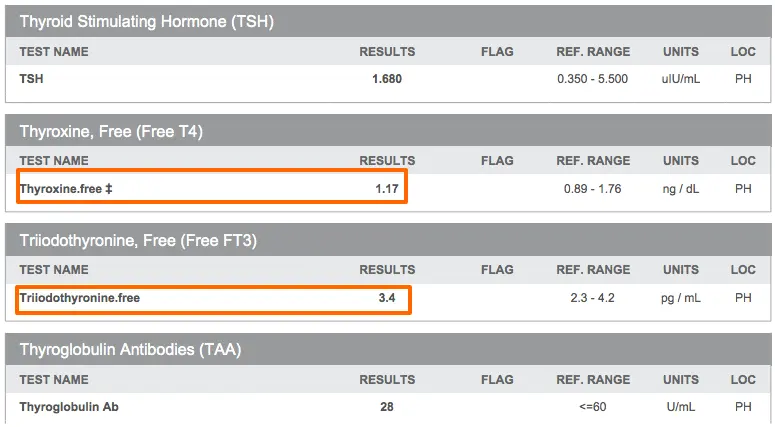
Going off of lab tests alone you can see that this patient’s Free T4 levels fall within the lower 1/3 of the reference range. (Ignore her other lab values, we will get into those later)
If your Doctor were to see these labs he would absolutely tell you that your lab tests were “normal”, but is that really the case?
In treating hundreds of patients I can tell you honestly that MOST patients feel significantly better when their Free T4 levels are towards the higher range, usually in the upper half.
And this correlates well with newer studies that show that patients with hypothyroidism require a higher free T4 to achieve a normal TSH (1).
This study showed that, while treating patients with hypothyroidism, the goal should be to obtain a free thyroxine level in the upper part of the reference range.
If you recall from basic Thyroid physiology, your Free T4 levels act as a reservoir or pool to draw upon when your body needs to create the active thyroid hormone Free T3.
So when thinking logically about this…
As your free T4 level increases, the more you can draw upon this pool to create the active hormone… right?
It turns out that this is the way that most Doctors (and subsequently patients) think about the thyroid.
Unfortunately, for at least 15% of the population, it isn’t true (2).
And that leaves us with a big problem:
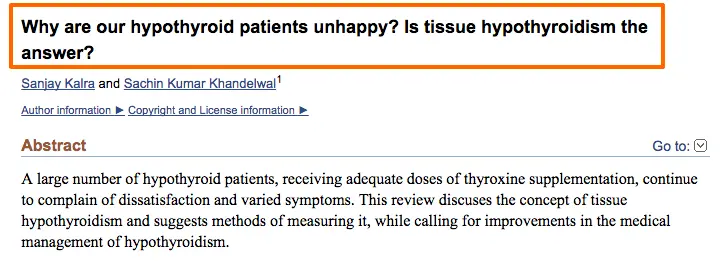
We are basing treatment recommendations on an incomplete picture and we are wondering why our thyroid patients feel terrible and are so unhappy (3).
Your Free T4 and Thyroid Function
Here’s where things can get a little bit tricky, and why many Doctors may actually be telling you that your thyroid is “fine” when it really isn’t.
I just said that high levels of Free T4 are good, right?
But that isn’t always the case.
Refer back to what I said before about Free T4 being a reservoir for Free T3.
What if you AREN’T converting T4 to T3? (What if your body isn’t utilizing that T4 correctly?).
Well, let’s just think about this logically again using this example:
I want you to think about your thyroid as a Dam.
Under normal circumstances, a Dam acts to hold back A LOT of water and only lets a certain amount of water go through in a controlled fashion.
In this example, the pool of water behind the dam is your Free T4 level, and the water going through is your Free T3.
What will happen to the system if you suddenly can’t let any water through?
It all backs up, and the water behind the Dam continues to grow and grow.
Well…
The same thing happens to your Free T4 level when there is a ‘kink’ in the system.
But instead of water, your Free T4 level goes higher and higher…
Do you see the problem now?
A kink in the conversion process may actually cause your Free T4 levels to RISE and make you think that your thyroid function is normal when the exact opposite is happening.
As your Free T4 level rises (because it can’t convert to Free T3) it shows up as high levels of Free T4 in the serum. These high levels of Free T4 actually act to suppress your TSH (because your pituitary doesn’t have the same deiodinases as the rest of the body(4)).
So your lab tests may look something like this:
- High Free T4
- Low TSH
- Low total T3 and free T3
- High reverse T3
Meanwhile, you are feeling terrible with every hypothyroid symptom in the book.
Does this scenario sound familiar?
Don’t worry…
If it is happening to you we are going to discuss how to correctly diagnose it, but first, we need to talk about how T4 can be beneficial.
Does Your T4 Even Matter?
It’s easy to think that T4 doesn’t mean much because it isn’t the active thyroid hormone in your body.
And it makes sense, but there is still some value in using and testing for it.
First:
T4 levels give you an idea about how you are converting T4 into T3.
In keeping with the analogy I described above, your T4 level helps you to understand how your body is processing your T4 and T3 thyroid hormones (5).
High levels of T4 with correspondingly low levels of T3 may indicate that you need to focus on improving your T4 to T3 conversion.
You can read more about how to naturally increase your T3 levels and thus thyroid conversion here.
Second:
T4 levels can give you an idea if you are properly absorbing thyroid hormone (6).
Another huge benefit of testing your T4 levels is understanding if your body is actually absorbing your thyroid hormone.
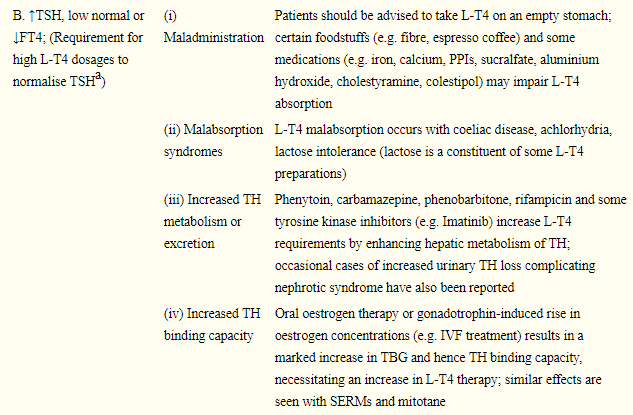
Naturally, your T4 levels should increase as you take thyroid hormone (though it is important to realize that your symptoms may not improve just because your T4 level increases).
By testing your T4 level both before and after you start thyroid hormone (this only applies to T4 only thyroid medication) you can get a rough idea as to whether or not you are absorbing the medication.
Believe it or not, absorption of thyroid hormone is a big deal and something that is frequently missed (7).
You can learn more about how to properly take your thyroid medication in this post which explains how changing the time of day you take your thyroid medication can actually improve thyroid absorption and thyroid function.
Third:
T4 levels can help you determine if you need to focus on improving your thyroid conversion vs increasing thyroid hormone production.
This is primarily helpful for patients who know that they have hypothyroidism, but whose physician is unwilling to treat them with thyroid hormone.
Most physicians are willing to at least test both TSH and free T4 levels which can give you, as the patient, a lot of information.
If you know that your T4 and T3 levels are low then you can focus on taking supplements and taking action to increase your thyroid hormone production.
On the other hand, if your T4 levels are high and your T3 levels are low – you as the patient can focus on taking supplements designed to boost T4 to T3 conversion.

Over 13 nutrients are involved in thyroid hormone production (8) and some supplements may help thyroid conversion.
It turns out that many patients (even those on thyroid hormone) have deficiencies in some of these nutrients which may lead to poor thyroid hormone production and conversion.
If you have Hashimoto’s then the supplements you should consider using are slightly different from the list above and you can find more information on which supplements are best for autoimmune thyroiditis here.
Fourth:
T4 levels can help you determine if you would benefit from adding T3 thyroid medication.
Let’s say that you are taking T4-only thyroid medication (like Synthroid) and your T4 level is high (so you know you are absorbing it) but your T3 level is still low and you are still having symptoms of hypothyroidism.
Even in the presence of a low reverse T3 (which means you are still converting thyroid hormone ok), this may indicate that you might benefit from the addition of T3 thyroid hormone.
Recall that T3 thyroid hormone is the most powerful thyroid hormone and is responsible for all of the good things that thyroid hormone does in your body.
So remember:
While T4 isn’t the best thyroid test, it can still give you plenty of helpful information – especially if your Doctor isn’t willing to order the complete thyroid panel.
How T4 Changes with Thyroid Medication
Another very important factor is understanding how your free T4 level changes with different types of thyroid hormone.
This is worth mentioning because it isn’t always intuitive and it can lead some patients into thinking that they are not heading in the right direction even though they might be.
T4 on Levothyroxine (Synthroid, generic Levothyroxine, Tirosint)
The way your T4 level changes when taking T4-only thyroid medication is actually quite intuitive.
Assuming you are absorbing enough thyroid hormone, your T4 level should increase as your increase your T4 dose.
Makes sense right?
Sometimes, though, this doesn’t happen and even if it does it doesn’t necessarily mean everything is “all good”.
As I mentioned above, your T4 level might NOT raise if your dose isn’t high enough and/or if you aren’t properly absorbing the medication you are taking.
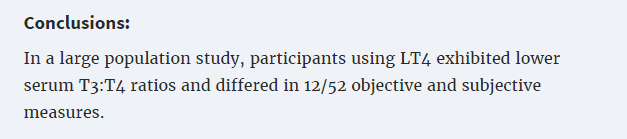
And, even if it does, there are studies showing (9) that patients who take T4-only thyroid medication show lower T3 levels than healthy populations – indicating that many patients just don’t do well on these T4-only thyroid medications.
There are ways that you can improve the function of thyroid hormone if you are taking T4-only thyroid medication and not feeling better:
1) Consider switching to Tirosint.
Tirosint contains 3 inactive ingredients and can help increase the absorption and effectiveness of thyroid hormone.
The case can even be made that you should consider switching over to Tirosint if you are currently taking Synthroid or levothyroxine.
2) Consider switching to 50mcg increments of Levothyroxine
The 50mcg tablet of levothyroxine contains the fewest inactive ingredients out of all of the other Levothyroxine dosages (For example the 100mcg tablet and so on).
Changing your dose from 1, 100mcg tablet of levothyroxine to 2, 50mcg tablets of levothyroxine may help increase absorption and reduce any symptoms you may be having.
3) Consider switching from Levothyroxine to Synthroid or Synthroid to Levothyroxine
While these medications may appear to be the exact same, studies have shown that they are not bioequivalent (10).
What this means is that your body may process them differently which may result in varying thyroid levels.
This is an easy test because all you have to do is switch from taking one medication to the other and you may notice a difference.
- Bottom line: If you are taking T4-only thyroid medication (Synthroid, Levothyroxine, Levoxyl) then your free T4 level should increase. If it doesn’t then you may have an absorption issue and you may benefit from switching to Tirosint.
T4 with NDT (Armour, WP thyroid, Naturethroid)
The way that T4 changes with NDT aren’t as straightforward as it is with T4-only medications.
Any thyroid medication that contains T3 thyroid hormone, at high enough doses, will generally cause your free T4 level to drop (11).
The degree of how much it lowers largely depends on the dose of T3 you are taking.

The higher the dose of T3 the lower your free T4 will go.
The reason for this has to do with how T3 and T4 influence pituitary function.
T3 thyroid hormone is 3-4 times more potent at lowering the TSH (12) than T4 is alone.
As your TSH lowers your body produces less T4 thyroid hormone by itself (and becomes more reliant upon medications to supplement thyroid hormone levels).
As long as you have a functioning thyroid gland (assuming it isn’t taken out or destroyed by radioactive ablation) then your thyroid will be producing SOME T4 and T3 even if you are taking thyroid medication.
But as you increase the dose of T3 you are taking then that amount your thyroid produces drops.
This will usually result in a decrease in your Free T4 level.
As you know NDT (natural desiccated thyroid) contains mostly T4 and some T3.
This ratio is close to 80% T4 and 20% T3, which means that the medication is still mostly T4 thyroid hormone.
But even that small amount of T3 is enough to shoot up T3 levels and drop T4 levels in the body.
One mistake I see patients (and doctors make) is increasing the NDT dose while trying to get to some mythical and optimal T4 level in the serum.
In some ways this is futile, as you increase your NDT dose it will drive down your T4 level in the serum which leads to higher and higher levels of NDT.
This can actually backfire and result in high levels of reverse T3 and very high levels of free T3.
If you are taking 4+ grains of NDT and still experiencing symptoms of hypothyroidism, then this may be happening inside your body.
- Bottom line: With lower doses of NDT your free T4 level may actually drop somewhat. Higher doses of NDT (greater than 4 grains) will usually cause the free T4 to increase but this isn’t necessarily helpful.
T4 with T3 Medications Like Cytomel and Liothyronine
This is where things get really interesting.
Taking T3-only thyroid medication like Cytomel or liothyronine will cause your free T4 to drop below the “normal” range completely and even flag as low.
This has to do with the fact that you are suppressing the TSH with the T3 and so endogenous production of T4 decreased dramatically.
Taking T3-only thyroid medication also causes reverse T3 levels to drop too low levels as well (this is usually a good thing).
To recap what happens on T3-only thyroid medication:
- TSH level falls
- Free T3 level increases
- Free T4 level decreases
- Reverse T3 level drops
What you really need to get out of all of this is the fact that your free T4 levels do not necessarily need to be in some magical “optimal” range for you to feel good.
Basing your treatment on these ranges may lead to suboptimal treatment as you chase all the wrong results.
Instead of laser focusing on your free T4, make sure that you look at your T4 in context with other thyroid lab tests.
- Bottom line: Taking T3-only thyroid medication will dramatically reduce your free T4 level and this isn’t necessarily a bad thing.
Symptoms of Low T4 & T3
Low free T3 and free T4 levels may indicate low thyroid function, but they may also indicate a condition known as euthyroid sick syndrome or low T3 syndrome.
This condition is very similar to hypothyroidism, but some patients with it may not experience symptoms, whereas all patients with hypothyroidism will experience symptoms.
If you suffer from low T3 and/or low T4 then you are also very likely to experience all of the symptoms of hypothyroidism, but with some other slight changes.
Symptoms of low T3 and low T4 include:
- Constant fatigue
- Reduced response to T4-only thyroid medications
- Weight gain (even while on thyroid medication)
- Low resting heart rate
- Low body temperature
Many of these symptoms result from low T3 levels directly or from the reduced conversion of T4 to T3.
Patients who are taking thyroid medication (who still have low T4 levels) may experience many of these symptoms (13) which should spark a further investigation by your physician.
If you fall into that category make sure that you properly evaluate how effective your conversion is, and how effective your native thyroid hormone production is (use examples above).
Why you need the Complete Thyroid Panel
Because testing for thyroid hormone levels isn’t always intuitive, it’s very important that each time you check your thyroid levels you obtain a complete panel.
While not all lab tests may be necessary EACH and every time you get blood work, it’s still a good idea to get all of these tests to create baseline values that you can compare further testing to.
Let’s go back to the initial example we used at the beginning of this post:
At first glance, you may be thinking that this patient is completely normal.
Her TSH is in the 1-2 range, her Free T3 is in the mid-range, and it’s only her Free T4 that is in the low range.
But she is actually quite hypothyroid and I know this because I treated her!
It isn’t until you order her Reverse T3 level that you finally get a better picture as to what is happening…

Once you see and understand her Reverse T3 level you begin to understand her thyroid physiology.
You see:
The only reason her Free T3 levels even look moderately normal is that her Reverse T3 levels are inappropriately blocking any Free T3 that she has.
Remember that Reverse T3 and Free T3 both compete for cellular binding (14).
If you take into account her high Reverse T3 level, her Free T3 level suddenly starts to make more sense.
In her case, her Free T4 level never got into the ‘optimal high’ range, but you can definitely tell that it is also inappropriately high for her, given that she can barely convert T4 to T3.
The bottom line:
You need a Complete Thyroid Panel if you want to have ANY idea of what is going on with your thyroid.
That means you need the following tests:
- TSH
- Free T3
- Free T4
- Reverse T3
- Total T3
- Thyroid Antibodies
- Sex hormone-binding globulin
And remember:
Just ordering the tests isn’t going to be enough.
You need to make sure that you and your Doctor know how to actually interpret them so you don’t fall victim to the trap I just showed you above.
Conclusion + Recap
Your Free T4 levels can give you amazing insight into how well your Thyroid is functioning, but you need to remember that they are only a small piece of an even larger puzzle.
It is possible that your Free T4 levels may be inappropriately elevated and that isn’t always a good thing.
If your Free T4 levels are high and you still feel terrible, then you need to make sure you are also checking your Free T3 levels and your Reverse T3 levels.
Using these lab values together, in combination with your symptoms, will help you to understand how well your thyroid is functioning.
So what should your T4 levels be?
If you aren’t taking thyroid hormone, then optimal levels are generally in the upper 50% of the reference range.
If you are already taking thyroid hormone then the upper 50% of the reference range doesn’t always hold, instead, you need to be focusing on other factors.
Now I want to hear from you:
Are your free T4 levels high but you still feel terrible?
Is your doctor willing to order the RIGHT tests?
What has helped you feel better in this situation?
Leave your comments or questions below!
Scientific References
#1. https://www.ncbi.nlm.nih.gov/pubmed/18753096
#2. https://www.ncbi.nlm.nih.gov/pubmed/19190113
#3. http://www.ncbi.nlm.nih.gov/pmc/articles/PMC3169863/
#4. https://www.ncbi.nlm.nih.gov/pubmed/6595194
#5. https://www.ncbi.nlm.nih.gov/pmc/articles/PMC3887425/
#6. https://www.ncbi.nlm.nih.gov/pmc/articles/PMC3857600/
#7. https://www.ncbi.nlm.nih.gov/pubmed/28153426
#8. https://www.ncbi.nlm.nih.gov/books/NBK285550/
#9. https://academic.oup.com/jcem/article-lookup/doi/10.1210/jc.2016-2660
#10. https://www.ncbi.nlm.nih.gov/pmc/articles/PMC3565118/
#11. https://www.ncbi.nlm.nih.gov/pmc/articles/PMC5873391/
#12. https://www.ncbi.nlm.nih.gov/pubmed/402379
#13. https://www.ncbi.nlm.nih.gov/pubmed/29381251
#14. https://www.ncbi.nlm.nih.gov/pmc/articles/PMC5869352/



Hi, I just got my test results back and my tsh is .638 and my free t4 level is .97. What does this mean? I have a family history of hypothyroidism and many symptoms of it also. I’m constantly tired, have unexplained weight gain, dry hair, dry skin, my hairstylist says i have some hair loss but i haven’t noticed anything. Should i see a specialist instead id my regular doctor?
Hi Doctor,
I am 51 yrs old and my bloodwork is always I would say perfect, I just had bloodwork done and my TSH was 6.38 and T4 was 1.23, doctor said after this one bloodtest that I have hypothyroid and wants me on medicine for the rest of my life. I have no systems of hypo and I feel terrific so should I get more specific bloodwork done by a specialist instead of 1 doctor just diagnosing after 1 simple bloodtest.
Hi Kathy,
It’s probably a good idea to retest your TSH in a few weeks to see where it lands. 1 test is not really enough to diagnose hypothyroidism in the face of zero symptoms.
Good afternoon Dr. Thank you for the informative article. I’ve been struggling with the same issues for years and my PCP, and an endocrinologist have said labs are normal,but my TSH seems to fluctuate often. For example in Oct 2016 my TSH was 2.07, Dec 1, 2016 it was 0.80 and in March 2017 it was 1.41 references being 0.40-4.50. The complete labs in Dec 2016 were the following: thyroid <1 (reference <9)… T3 Total = 89. (Reference 76-181)….. T4, Free = 0.9 ( reference 0.8-1.8). .
TSH = 0.80. (Reference 0.4-4.5)..
I'm a 45 year old female, with thinning hair, depression, foggy thinking, tiredness, joint pain in fingers and growing facial melasma. Are these numbers really normal? Thanks in advance.
Hi Noemi,
Labs only show part of a very complex picture and the set of labs that you have isn’t complete. You would benefit from a complete evaluation plus a complete set of hormone + thyroid labs.
Hi, I just got my test results back and my tsh is .638 and my free t4 level is .97. What does this mean? I have a family history of hypothyroidism and many symptoms of it also. I’m constantly tired, have unexplained weight gain, dry hair, dry skin, my hairstylist says i have some hair loss but i haven’t noticed anything. Should i see a specialist instead of my regular doctor?
hello Doctor. Before writing, I really want to thank that still exist doctors like you. You don’t know how happy I felt at reading your article. I’m 28 and I’m colombian and In the period of July-oct 2016, I started to take Synthroid (25 mcg) due to a high level of TSH (6.0) and High Free T4.
After I started to take it, i noticed I started to present symptoms like High Heart Frequency, my hands were shaking a lot and the most horrible things were the imsomnia and loss of weight that I went trough. I was really scared and Didn’t know what to do. I took again the thyorid profile exams in oct 2016 and I stopped taking the synthroid when I looked that my TSH was in 2.6 uU/Ml, however, My free t4 was High (1.8 ng/dl). four months later, my free T4 was like today, in a value of 1.55 (i think is still high because imnsomnia has came back and also, some minor shaking of hands).
My last results with Free T3 included are the next:
TSH: 2.7 uUI/ml
Free T4: 1.7 ng/dl
Free T3: 4.62 pmol/l
and the results for the examens taken in may 2017 are the next:
TSH: 2.2 uUI/ml
Free T4: 1.55 ng/dl
Unfortunately, I didn’t take the Free t3 Exam
What do you think about them? do you think the cause of my loss weight, imsomnia and minor hand shaking is that the free T4 is still high?
If so, what can i do to dropp it?
thank you so much for your answers.
I’m glad I found this article. I have countless symptoms of hypothyroidism that occurred around 4 months after giving birth to my youngest daughter. I’ve lost tracked of the symptoms. I’ve had blood work done on several occasions. I’ve long suspected hypothyroidism, but my blood work has come back in normal ranges. My doctor didn’t seem too worried about pursuing further testing, so I plan to order the tests myself and visit another another.
I had blood work done back in March. I’ve been dealing with chronic fatigue, body-wide joint and muscle pain, numbness and tingling in arms and hands, hair loss, weight gain, cold and heat intolerance, night sweats, brain fog, etc., for 2.5 years. I dropped out of my graduate program because it was difficult to stay on track with coursework.
In March, my TSH levels were 1.88 and free T4 .88. The free T4 was flagged as abnormal/low. I just want answers, and the two doctors I’ve seen have all said things look normal. I don’t feel normal. The chronic fatigue, aches and pains are debilitating.
Hi Aeona,
You need a much more comprehensive evaluation than just assessing your thyroid. You need to look at inflammatory markers, nutrient deficiencies, hormone imbalances, viral infections, etc. You are not likely to find this kind of work up in conventional medicine, however.
Hi Dr. Childs,
Thanks for responding to my comment. I appreciate it. I’ve been tested for RA and Lupus, and it came back negative. My vitamin D and B12 levels are in the upper range due to taking supplements over the years. I was told two years ago that my symptoms could be related to insufficient vitamin D, but since then I’ve been taking high levels of it and still feel the same. My symptoms have actually progressed since then. I did have blood work done that showed elevated ESR, but the doctor said it could be anything and wasn’t alarmed by it. The only other test that was in abnormal range on my most recent blood work was higher cholesterol levels.
Hi, I have been battling hypothyroidism for the last 5 years, I am currently 30yrs old. Still working on feeling better- my prescription changes every 4-6 weeks, usually an increased dose. I am currently on 1.25mcg of Levothyroxine and even though some symtoms have disappeared I am still feeling fatigued, hair is constantly falling out, cold all the time, back and forth constipation/diarrhea and horrible weight gain even though I have cut out all gluten, processed foods, salt and sugar.
My current test was
Thyroid Stimulating Hormone [TSH] 1.69
hyroxine Free [Free T4] 17
My Dr says these are normal results but I still don’t feel good. Is there anything else I can do to help?
KAYLA
Hi Kayla,
You can find more tips about increasing thyroid function in this post: https://www.restartmed.com/increase-free-t3-naturally/
Hi Dr.Childs! I wish you were accepting new patients! I am a mess! Was diagnosed with Hashi’s in 2014 and currently on 3 grains of westhroid which I split the dose 2x per day. I also have PCOS and diabetes in superb control for many years. Seems my case is complex and I am at a stand still in Treatment. I have done the AIP diet for a few yrs and then just hit a wall w weight loss and fatigue even though my TSH is 0.1! My anti-thyroglobin antibodies are ALWAYS >1000! TPO fluctuates currently 21.7 I lost 89 lbs bk in 2009 and have kept it off but CANT get under 200 lbs! I just was on the ketogenic diet for 3 months faithfully and only lost 3 lbs!! I just purchased your hormone & weightloss mastery guide the other day and am confused as where to begin because of fatigue, pcos and hashi’s! I feel overwhelmed and I need to feel better and lose weight.its mandetory that I lose 20 lbs before my tummy tuck the December! My goal is 50lbs.my labs are so confusing to me free t4 0.9 free t3 4.1. My head just spins with all of this because all I want to do is sleep.
Hi Heather,
Losing 20 pounds shouldn’t be an issue, just make sure you start with the recommendations in the guide and then you can tweak it as you go based on how you feel. It’s almost impossible to start out with exactly what you need just by guessing, and most people take a while to figure it out – the good part is you should be losing weight as you do this.
Hope you can help me, about to be retested, but my last results are this:
TSH 1.16 /mL
T4 7.3 /dL
T3 109 ng/dL
Free T4 1.13 ng/dL
Free T3 3.2 pg/mL
Reverse T3 12 ng/dL
T uptake 1.02 TBI
Antibody 17
Hi Linda,
Looking at a set of labs without context is largely useless. For instance you need to interpret them in the setting of your current symptoms, your change in symptoms, other hormone abnormalities, nutrient deficiencies, etc.
So I can’t really give you any opinion on those labs.
Hello Sir,
I hope that you can help me regarding my thyroid problem.
I have delivered baby boy on 01/06/2017 with C-section. I had thyroid test on 06/01/2017 and result are given below
1. THYROXINE, FREE (FT4) – 0.46
2. TSH W/RFX TO FREE T4 – 6.500
Please have a look my results and suggest me.
Note: Prior pregnancy i did not have thyroid, tested on 02/08/2016
Hey Doc! I am just beginning my journey concerning my thyroid. I’m a 45 yr old female dealing with extreme fatigue regardless of amt. of sleep, severe hand and face dryness and 10 lb weight gain in past year. I recently had my TSH (2.55) and Thyroxine Free (.79) tested. My PCM said my numbers looked good, all normal. My Vitamin D was low and subsequently am taking 1000/day. I realize some of my symptoms could be from perimenopause, or just “older age” and I have chronic lumbar pain (bulging disc, arthrosis, and bone spurs) which prevent extensive exercise. My Mom also diagnosed in 60’s with Hypo. However, the more I read, the more I think I need to pursue more testing and perhaps a referral to an endocrinologist if PCM won’t go along??? Any suggestions to pursue a full thyroid panel and subsequent consult? Or any other ideas from just these 2 results? One other thought, I looked back on testing from 2012-1.42, 2014-1.12, 2015 1.98, 2017-2.55) if this rising trend helps?
Thanks for any assistance you can offer.
Hi Tia,
You should absolutely pursue a full thyroid lab panel. If you don’t have a full panel then you really can’t make assertions about relative cellular thyroid levels, peripheral conversion status, etc. It’s worth pointing out that asking an endocrinologist for these tests will likely be futile, given that they generally follow a “TSH or nothing” mentality (much like most physicians).
Will you do a video on Graves Disease and/or RAI? That was the start of my Thyroid problems when I turned 20 (2008). Gained 30 lbs in 2 months, was also very petite, athletic, skinny – worked out 2 hours a day. Then I was hit with Graves and my world ended. Had radioactive iodine treatment the summer of 2009, was put on levothyroxine 112 mcg. Only lost half of the weight I put on. In 2015 was lowered to 100 mcg of levo and I’ve gone back up in weight and have felt terribly fatigued and exhausted since the start of 2017. My doctor never listened to my complaints of being tired and weight gain I think because he was a older man set in his ways and didn’t really care about how I was “feeling” if my levels were “in range”. I just made an appointment with a new Endo hoping that since she’s younger and a female she will be more open to new methods and thinking outside of the box as your YouTubes reflect in the way you do things. I am interested in going the Armour Thyroid route and hope she is able to work with me on that, and if not, at least direct me in a different way with supplements that may help in my conversion if that is actually the problem. Thank you again for making these videos and I appreciate any feedback on my situation or if you are in fact going to do a YouTube on Graves and/or RAI.
Hi Brittany,
You can find more information about Graves’ and weight gain in this post: https://www.restartmed.com/hyperthyroidism-weight-gain/
This post explains what I’ve been experiencing for the last 2-3 years! I’ve been increasing my NDT hoping that would increase my FT4. But my FT4 has always remained at 0.8-0.9 (bottom of the range) while the TSH is very suppressed at 0.006 (!). Will it be wise then to decrease my dosage and aim for a higher TSH (say 0.5-1) since the FT4 won’t really increase on NDT?
Also, I’ve been trying to get pregnant but afraid to do so because my FT4 is low, and supposedly that’s what the baby needs (as opposed to FT3) at least during the first semester. Will a FT4 of 0.8-0.9 affect the baby?
Thanks!
Hi L.V.,
Low thyroid hormone may negatively impact both fertility and potentially fetal development, it’s not advisable to undergo pregnancy unless your thyroid is treated adequately.
Hi.
I got my thyroid results and do not understand them.
TSH 1.14 0.27-4.2 mIL/u
Free t4 12.7 12-22 pmol
Free t3 5.5 3.1-6.8 pmol
My symptoms are tiredness and lethargy
Why is t4 so borderline but every thing else is in good range.
My eyes feel constantly tired. It’s horrible.
Any ideas? Would I benifit from taking t4?
Thanks
Dr. Childs, I read through this post, but did I miss your treatment plan? How did you treat this patient in the end?
What was your treatment for the woman in the example with high rt3?
My tsh is 7.5, ft4 1.3 and ft3 2.6 with reverse t3 of 28
A doctor gave me cytomel at the lowest dose possible in place of my 25 mcg synthroid and it made my heart feel weird. Any suggestions?
Hello Dr. Childs,
Thank you for this article. I found it very insightful, and quite close to my current situation. I have been struggling with hypo symptoms for about 10 years now. The muscle inflammation was so bad at one point that it felt like my connective tissue had fused. I literally could not lift myself out of bed; I could only get out by rolling my entire body.
Of the several doctors I had in that time period, none would test beyond TSH, and I even had one laugh at me saying “thyroid issues are something that happens to women.”
I decided to fire my previous doctor after I told him that I have a family history of endo issues. My grandmother, and father both being hypo, my aunt and mother both having type 1 diabetes. He literally said, “I’m not concerned. We need to lower your cholesterol however…”
This year, I was very lucky. After interviewing a couple doctors, I found an NP that understood that I was tired of throwing pills at the symptoms, that I wanted to find a primary cause. For the first time in 10 years. I got a full panel. What we found is very similar to this article. I have an appointment to discuss RT3 treatment next week.
The results came back as:
TSH: 1.58 Range .45-4.5
FT4: 1.72 Range 0.86-1.77
FT3: 3.3 Range 2.0-4.4
RT3: 31.5 Range 9.2-24.1
TPO: 14 Range 0-34
SGBH: 79.5 Range 19.3-76.4
Calcium: 10.4 Range 8.7-10.2
Calcium has been consistently high on all my tests. I’m pushing for further testing for hyperparathyroidism.
Any insights you could give that would help with communicating with my new NP would be greatly appreciated.
Thank you so much!
Just wanted to followup. I have an amazing NP. He prescribed 25 mcg of Cytomel to bring up my FT3 and flush out the RT3. Told me that even though it’s clear I have a hypo issue, that getting too wrapped up in lab numbers wasn’t what was important. Treatment, and eliminating symptoms should be our focus. We’ll still observe the numbers only to make sure treatment hasn’t made anything go absolutely haywire.
We’re looking at PTH and calcium in tandem now.
Thanks again…
Hi, Dr.
Your article is the most thorough I have found. I am still confused though, I know that my doctor doesn’t know how to interpret the thyroid tests when I moved here, she took over medication prescribed in previous state and continued dosage. I am on 200mcg of Synthroid which for someone only 120lbs is a tremendous dose. I saw an endocrinologist who insisted I had Hashimoto’s without any further testing my thyroid levels and said dosages may go as high as 300mcg depending on the person. The only two blood tests that have ever been checked are currently .52 TSH and Free T4 1.8, I have symptoms of being over-medicated. If I am looking for a good endocrinologist what questions should I ask prior to scheduling an appointment to know whether or not they are not going to waste my time, or am I stuck doctor hopping until I can find someone who will listen to me that I know my own body?
Thank you!
Portia
Good evening. Over active, under active thyroid runs in our family. I was diagnosed with over activethyroid about 16 years ago. After I had my first son 17 years ago my thyroid was results showed normal. Then a few years ago I started taking eltroxin again. After my 3rd child about 8 yrs ago it became normal according to the blood results from my doctor. He said I don’t have to take any medication anymore. Drew blood yesterday to test thyroid because my eyes looks about big and loosing weight. Results show T4 11.9 and TSH 2.06 . Iso this normal. My mother still taking her medication. It became so bad that she went for the radiation treatment. Pls help. I feel tired. Sleepless night. Sometimes hard to breath
I’m so confused. My free t4 is .72 ng/dl. My total t3 is 170 ng/dl. My Tsh is 2.7. My reverse t3 is 43.3 ng/dl. I CANNOT lose weight despite strict diet and exercise. My endo says Nothing is wrong. I feel like so much is wrong. What
do I do?
Lately I have been reading that NDT should be dosed by a persons weight? and that is states this in the RX info? Curious as to your thoughts on this – I have not been dosed that way (ever)
I have familiar histor of hyperthyroidism. I asked my doctor to do a full workup. Here are my results:
TSH 1.76
T4Free .69 Flagged as Low
T3Free 2.31
Anti-TG <0.2
ATPO <0.2
I have typical symptoms of hypothyrodism. I feel tired after having slept 8 hours, weight gain, irregular periods, burst of energy at night.
My doctors note to me read: "The thyroid is not quite normal: THERE ARE NO ANTIBODIES, but the amount of measurable thyroid hormone in your blood is a bit low. Please consider checking this again in about one month, no fasting needed to determine if this represents a trend. If the level is low again, or lower, a small dose of synthroid would be appropriate. If on repeat the level is normal, no treatment would be indicated"
What does NO ANTIBODIES MEAN??
I am really confused about the No Antibodies. Is this a good thing, Does this mean I do not have hashimoto but do have just hypothyrodism?
Hi Michelle,
Generally the lack of antibodies is taken to be a good thing but not always. For instance, in late stage Hashimoto’s antibody levels fall because there isn’t substrate left to attack. You can read more about it here: https://www.restartmed.com/anti-tpo/
Hello!
I am on NDT and cytomel. My numbers look great except my T4s. According to your article I need to reduce the amount of cytomel I am taking in order to bring my T4s up?
Hi Tara,
Not necessarily, reducing your T3 will naturally bring up your T4 but it doesn’t mean that you have to do this, it’s just a fact that it will happen.
Hello Dr. Childs,
I have been following all of your posts religiously as I am desperate to get some answers. My body seems to be responding atypically to NDT. I had “normal” ranges yet I was having many devastating miscarriages, hair loss, stubborn weight gain, fatigue & cognitive decline. I finally found an MD that would prescribe me NDT based off my symptoms.
Before NDT-
TSH: 2.63 mIU/L
T4 FREE: 1.0 ng/dL
T3 FREE: 2.9 pg/mL
REVERSE T3: 16 ng/dL
SHBG: 42 nmol/L
After NDT 32.5 mg twice a day
TSH: 0.46 mIU/L
T4 FREE: 1.1 ng/dL
T3 FREE: 2.5 pg/mL
After NDT 32.5 mg three time per day
TSH: 0.016 mIU/L
T4 FREE: 1.14 ng/dL
T3 FREE: 3.0 pg/mL
REVERSE T3: 19.4 ng/dL
SHBG: 118.6 nmol/L
My TSH plummeted from 2.63 to 0.016
T3, T4 and Reverse T3 ALL steadily climbing
SHBG jumped from 42 to 118.6
I’m experiencing more energy, better memory, better cognitive function BUT more hair loss, eyebrows falling out, pressure behind eyeballs & joint pain. : (
My MD now has me taking 32.5 mg twice a day of M, W, Th and 1 pill on all the other days of the week. I was going to ask her about whether or not I need additional T3 but after reading this last article, I’m not so sure that’s the solution.
Hi Dianna,
Each person will require a different amount, type and ratio of T4/T3 for optimal health. Lab tests can only help guide you into determining where to start or how to adjust, but they don’t give enough information to come up with the answer on their own.
I haven’t been feeling well lately. Eyebrows thin on the outside and hair thinner than it was in one spot. I am freezing most of the time. I have had thyroid since I was21 I am now 75. My test this time was TSH 1.59 t4 – 0.65 and t3 2.24. I take Armour 120mg and 30mg again of Armour. As they do not have 150mg. My doctor said this is good but I cannot understand why I feel sad and feel like crying a lot.
Hi Marsha,
Make sure you get a full thyroid panel including reverse T3, free t3, free t4 and thyroid antibodies.
I have a majority of hypothyroid symptoms but my doctor insists that my thyroid function is normal.
One year ago she only tested TSH, which was 1.26. My symptoms have gotten worse, so this time she tested TSH and Free T4; TSH 1.03; Free T4 1.12. All the other tests done to identify the cause of my symptoms came back “normal” as well, except a slightly lower Vitamin D level, but fixing my Vitamin D never helps (also, I take daily vitamins with Vitamin D to maintain “fixed” levels but it doesn’t help).
Do I need more testing, and which test/s?
Hi Becky,
You can find a list of thyroid lab tests in this post: https://www.restartmed.com/thyroid-symptoms-in-women/
Hi Dr Childs,
I came across your article about Free T4 level. I had a lone afib in this late August. The blood test in ER shows my magnesium is 2.6 mg/dL (range 1.4-2.4 mg/dL), Free T4 1.78 ng/dL (range 0.89-1.70 ng/dL), TSH 2.692 mUnit/L (range 0.550-4.780 mUnit/L). My cardiologist said I might have thyroid problem.
A blood test was done by my primary doctor two and half weeks after the afib episode. This time, TSH 1.87 (range 0.40-4.50 mIU/L), Total T4 8.3 (range 4.5-12.0 mcg/dL), Free T4 Index 2.2 (range 1.4-3.8), Free T4 1.2 (range 0.8-1.8 ng/dL), Free T3 2.8 (2.3-4.2 pg/mL), Total T3 103 (range 76-181 ng/dL), T3 Uptake 26 (range 22-35%). Primary doctor concludes that my thyroid function is normal. But my cardiologist said sometimes it’s hard to catch hyperthyroidism by just a simple blood test.
From the above result, can you tell if my thyroid is normal?
Great thanks!
Steve
My tsh was 10.11
My t4free was 0.76
Dr. Put me on 25mcg levothyroxine. I feel yucky
Hello-
I’m a 47 year old female. I’m currently taking Armour 60mg. My latest blood test are listed below:
Free T4 Direct .80
Hemoglobin A1C 5.5
TSH 1.630
Total T3 126
I’ve recently gained about 20 pounds in a couple of months. I have brain fog and I’m tired. Do you have any suggestions on further blood test or any recommendations in general. Thank you.
My blood work that was done 10/23/17 showed my T4f was. 92 and my TSH was .74 I have all the symptoms of hypothyroidism but I also had a hysterectomy keeping both ovaries in Feb of this year my doctor says my thyroid function is fine but I do not agree with him. I was wondering what your thoughts are. My MCV was 96 and my MCH was 32.
Greetings Dr. Childs,
I have a lot of symptoms of a underfunctioning thyroid. The constant fatigue, brain fog, freezing rather easily. I’m quite miserable as this has been going on for over a year. My Dr. has checked my TSH 1.36 Free T4 1.27 and Free T4 1.29. I received a call to come in for more testing due to being in the low normal range. I’d like your opinion if you can spare the time. I would greatly appreciate it. Thank you Sir!
Good morning Doctor. I am female 77 years of age play golf 3 times a week and attend the gym twice. I have had thyroid problems since 30 years of age. 100 mcg of eltroxin daily. Lately I have become very tired and weight has increased by 3kg in 3 months with no dietary changes also brain fog. I have a 30 hour per week voluntary job and need to be fit and alert. Only test my dr does is T4 13.0 and TSH 2.20 tests are labelled normal? Your comment would be really appreciated thank you. Sharon
Hi Sharon,
By many new standards a TSH of > 2.0 would not be considered normal. This is a matter of how you evaluate labs and what research you look at, however. Depending on your symptoms it may be worth getting a second opinion.
Hi Dr. Childs,
I have been struggling to manage my graves disease for the past 2.5 years and it has wreaked havoc on every aspect of my life. I have been told a total thyroidectomy is my only option due to the challenges I’ve encountered with finding the correct methimazole dosage to manage my thyroid hormone levels. I seem to be highly sensitive to the methimazole, in that my Free T4 levels skyrocket quickly (it’s gone up to over 6), while my TSH levels remain severely low at 0.01. They say this means I am still hyperthyroid, despite my symptoms severely changing with the meds (increased hair loss, weight gain, constipation, irritability, fatigue, lethargy, etc.). I feel like they need to examine my T3 levels, but just getting them to test my blood levels beyond the Free T4 every 3 months has been difficult. My previous provider in PA had me do blood work every 2 weeks and checked all 3 levels, each time. Any insight into what may be going on? Should I suggest they try managing my T3 levels? I often feel like they minimize my concerns and thoughts about my treatment, so I am hesitant to say anything and feel pressured to rush into surgery as soon as possible. Is that really the only solution?
Thank you for your time and consideration.
– Jenny
Hi Jenny,
In most cases it’s easier to treat hypothyroidism than hyperthyroidism. Taking out your thyroid will put you in the former group which may be part of the reason they want to remove it.
In regards to your lab tests you probably won’t be able to get them to change how they manage or which tests they look at because they are looking at your labs through a completely different lens than what I discuss here. You can read more about this idea here: https://www.restartmed.com/tsh-levels/
Hi, are there any doctors in South Africa who understand and are able to interpret these different thyroid tests results adequately? All the doctors I’ve been to only ever order the TSH test, and when it falls within the normal range, then they immediately rule out any thyroid issues.
I am 34 and have every symptom of under active thyroid for years now, and both parents have also had thyroid issues (mother even had it in her 30’s). Multiple doctors have done numerous tests over the past 4 years and could not find any other medical condition, and hence I currently have all the symptoms, yet no diagnosis of any kind, and battling with symptoms that no one is able to treat.
Thanks.
Hi Rene,
I’m sure there are physicians around the world who agree with what is written here, but I personally don’t know of any in that area.
Hi Dr. Childs
I’m 31 y/o mom with a kid from Malaysia. I got most of the hypothyroid symptoms (especially weight gain, depression, anxiety, fatigue,irritability & memory loss too). However when I did the thyroid function test, the doctor told me that it falls within the normal range & did not write a referral letter for me, thus I cannot set an appointment with the specialist. I would really appreciate if you can give me some advice
Here is my result :
T4: 64.5 nmol/l
Ref. range: 64.0 – 167.0
TSH: 1.25 uIU/ml
Ref. Range : 0.38-5.33
Free T4: 9.14 pmol/L
Ref. Range: 7.46 -21.10
Free T3: 5.67 pmol/L
Ref. Range: 3.8-6.0
Tq in advance ❤️
Hi Dr. Childs!
My doctor ordered some tests for me and test results are:
TSH: 0.2 uIU/ml (0.35-5.30)
Free T4: 8.14 pmol/L(7.37 -21.05)
Could you explain what can be a reason for low TSH and Free T4? Is there any chance that the test results are incorrect?
Also, I found “TSH with Reflex to FT4” lab test https://www.findlabtest.com/lab-test/thyroid-testing/tsh-with-reflex-to-ft4-quest-36127. May I order it? Or should I order TSH and FT4 separately?
I am having the hardest time figuring out what is going on with my thyroid and a doctor to actually help. First let me give you my TSH numbers 2012 1.029, 2016 .595, 9/17 <.008, 12/17 .942, and 2/18 1.701.
Now my T3 12/17 2.3 and 2/18 2.3
Last my T4 free 9/17 1.7, 12/17 .8 and 2/18 .9.
In Sept of 2017 I was diagnosed with Graves disease and put on methlmazole. I did not believe it was graves as I was gaining weight and fast, so I did not take the medication. When I had the follow up blood work done the DR office called and suggested I lower the dose of the medication. I explained I never took the med. They recently sent me for another follow up and my numbers but quite a bit again.
I am still gaining weight no matter what I try. I have a hard time sleeping yet I am tired a lot, my nails are brittle, my hair has changed texture. I am positive something is going on but now the DR said lab work is fine so no need to follow up.
I feel like crap. Just got the results of the tests back and have an apt to see what I HOPE is a good Functional Medicine Dr next week. I want to go in prepared. Here are my results. Minus the saliva test as those results went directly to the Dr I do not have access to them.
TSH 1.660
Free T3 2.6
Free T4 .9
FSH 38.6
Insulin 9.0
HGB-A1C 5.2
Avg Glucose 102.5
I truly don’t have a clue what any of this means but, I’m tired of feeling exhausted, crabby, and this unexplained weight gain the past two years.
Any advice or help would be appreciated SO VERY MUCH!!!
Thank you,
Marcie R
Hi could you please tell me does the half life differ in synthetic T3 to the T3 contained in whole thyroid .Synthetic does not agree wih me and its take a week or more to come right .Thanks Desley
Apparently labs often decide to skip the T4 test IF the TSH falls inside the “normal” range (“Reflex Free T4”).
Presumably your doctor must order – I mean “request”! – a Free T4 test WITHOUT an accompanying TSH.
Hi Kat,
Yes, that is correct. Many conventional Doctors order a TSH with reflex to T4 which means that the T4 will only be ordered if the TSH is abnormal.
In order to get all of the tests they must be ordered individually.
My doctor did that, but the lab didn’t accede to her “request”. It seems they either ASSUMED they knew better or were following directives handed down from someone/somewhere else. Frustrating!
Hello Dr. Childs
I have had a worsening of all the hypothyroid symptoms over the past 6 years. Over the last year my hair has rapidly thinned, especially my eyebrows. The rest of the symptoms are also quite prominent, including now; a constant feeling of pain in my ankles when ever i get out of bed in the morning or sit for long.
My doctor ordered the usual thyroid test. My FT4 is below range, but others are ok. What would you advise? Take an FT$ only medication?
Hello Doctor,
I was diagnosed with Hypothyroidism since 5 years and currently I’m on levothyroxin 100mcg.
TSH 2.300 uIU/mL
T4,Free(Direct) 1.74 ng/dL
Triiodothyronine (T3) 101 ng/dL 71
Thyroid Peroxidase (TPO) Ab 125 High IU/mL
I have TPO antibodies which resulted in ALopecia Areata with Chronic Telogen Effluvium . My doctor has put me on Rogain 5% foam and Biotin 5000mcg but its been 7 months and I do not see any hair growth on the patched and my hair is thinning out alot.My iron levels are normal and Vit D is normal. Please advise . I’m completely concerned about my Hair growth .
I’m trying to avoid wheat from my diet. Is there anything else I need to follow in diet to reduce my antibodies?
Hello, so I’ve had hypothyroidism for about 8 years now and I’ve been quite normal for many of those years on .75mcgs dosage. Well, I just had a recent blood tests only for TSH and Free T4 Which is what usually is done and it came back 1.08 for TSH and 1.1 for FT4. My doctors nurse called me before I got my results (she saw them) and said I needed to be raised to 100mcgs. Now, I’ve been having symptoms of a low (hypo) thyroid again but those results don’t seem to warrant a med change, do they? I’ve sent her messages and she won’t respond so I don’t know why. If you understand something I don’t please let me know!
I have Hashimoto. Currently, I am not happy with my PCP and endo. what other dr.s can help me? I’m afraid I’m going to be doing this run around for a long time.
Hi Dianna,
You can learn more about how to find a thyroid doctor who can help you in this post: https://www.restartmed.com/thyroid-doctor/
Hi,
My lab results are
TSH- 1.82
Free T3- 2.7
Free T4- 1.18
Reverse T3- 22.7
Thyroperoxidase AB- 14
Thyroglobulin AB- <1
I have a lot of the symptoms of hypothyroidism and I just want to feel better. Do you think that I am a candidate for treatment or should I be looking at other causes of my symptoms?
My symptoms are fatigue, foggy brain, dry skin, hair loss, weight gain, abnormal menstrual cycle, low libido.
Thank you!
Good Dr. Childs,
thanks so much for this article. You really break it down in terms that are understandable.
I truly understand the reason for having the whole panel checked and the difference between LT4 and other meds. Where is your practice?
Thanks so much.
Hi Tisha,
Unfortunately, I’m not taking any new patients but you can find out more information on how to find a doctor here: https://www.restartmed.com/thyroid-doctor/
Hi Dr. Childs,
I have been working to try to reverse my sluggish thyroid, as I think mine is a result of overactivity/undereating due to adrenal fatigue. First of all, my doctor is not supportive of testing T3, she says this, “Testing TSH and T4 are common, testing T3 not as much but we can certainly check it once. Reverse T3 testing is actually used to look for things other than thyroid disease.” How can I convince her to test my reverse T3 and Free T3 levels? I’ve been her patient for years, but should I look at switching to a new doctor?
Also, I’ve been working to reverse this as I mentioned. I cut down cardio, increase my food intake (to an extent, as I can’t do too much without gaining weight due to my low thyroid function), I’ve tried Gluten-free, dairy-free, whole food-plant based, etc. I’ve started taking Ashwagandha, eating small meals frequently, etc. Just had my labs drawn, and Free T4 was only 0.7 (Range: 0.6 – 1.6 NG/DL) so still on the really low end. Can I ever fix this/heal my body?
Please help!!!
Thanks,
Veronica
Dr. Child’s,
Are there any additional supplements for competitive athletes whose optimal blood levels may need to be outside of the normal range? I am a collegiate student-athlete (sprinter), who 18 months ago was taken off Naturethroid because T4 Level was “normal” and given Cytomel. I gained weight and ran horribly. I went to an endo last month and was placed back on Naturethroid.
Also, I am considering ordering the T3 Conversion supplement but am not sure if this is the recommended supplement rather than the Adrenal/Thyroid Restart supplement.
T4 is 1.1 (0.8-1.4 range), T3 is 2.7 (3.0 – 4.7 range) and TSH is 2.19. I was taking 3/4 grain of Naturethroid daily and was increased to 1 grain daily as a result of the labs above. I am not sure which to order. Thoughts?
Thanks for any recommendation you can provide!
Hi Private,
There really aren’t too many ways to naturally improve thyroid function so your best bet is to start with supplementation (anything with adrenal adaptogens with your activity) and ensure that you are optimizing sleep/stress/diet/etc. This will probably give you the biggest bang for your buck.
Dr. Childs,
I am 69, had my thyroid removed by radioactive iodine. I can not lose weight (the 25 lbs that I seemed to gain in about a month after). I have a blood test every 6 mos. but never seem to have much energy, and I am depressed. last test results: T4 1.6 ATL 29 u/l TSH 1.24I AST 24 any suggestions? Thank Iris
P.S Levothyroxine 135 MCG
Hi Iris,
This article explains why most people gain weight after RAI. I would recommend reading it to get a better idea how to proceed with your treatment: https://www.restartmed.com/hyperthyroidism-weight-gain/
Hi!
For the past couple of months, I have been having symptoms that would seem more like hyperthyroid (which grandma and aunt both had on the paternal side, and my daughter had thyroid cancer). I have night sweats, high pulse rate, and feel really nerved up most of the time. My weight is normal. I had my thyroid checked, and my results were TSH: 1.13, Free T4: 0.924, Free T3 3.4. Ideas? The docs here seem to only believe in “normal TSH means normal thyroid….Must just be anxiety.” I am so frustrated. I am in Michigan. Can you help? Thanks!