
- High testosterone in women often signals PCOS, thyroid dysfunction, adrenal stress, or insulin resistance, so identifying which is driving yours is essential for proper treatment.
- These hormone systems talk to each other, so fixing high testosterone alone without addressing insulin resistance or thyroid problems usually leads to recurring symptoms.
- Your excess androgens may stem from your body's insulin resistance signaling your ovaries to make more testosterone, making metabolic support your first intervention.
- Addressing the root cause (whether thyroid, adrenal, or metabolic) matters more than trying to suppress testosterone with medications that ignore the underlying dysfunction.
Weight gain, acne, or hair loss.
Are you experiencing any of these symptoms?
These are only a few of the symptoms of high testosterone in women, but the real question is this:
Why do women have high testosterone, to begin with, and what can you do to lower it?
Unfortunately, many Doctors may tell you that you have high testosterone but rarely ever will they offer any advice on how to lower your levels to help you feel better.
That’s why it’s important to have an understanding of what is going on in YOUR body so you can figure out how to get back to normal.
The important thing to realize about high testosterone is that usually (95% of the time) it is caused by something else like another hormone imbalance.
So the way to fix the problem is by tackling and reversing the issue causing your high testosterone…
Symptoms of High Testosterone in Women
Before we jump into the causes of high testosterone and the treatment, we really need to understand the symptoms of high testosterone.
Symptoms are very important because each person is different in terms of how much is TOO much for their body.
I have seen plenty of women with “high normal” ranges of testosterone but ALL of the symptoms.
In these patients, it’s obvious they have too much testosterone, but their numbers make them look relatively “normal” but they still benefit greatly from treatment.
Use this list below to help guide you…
Symptoms of High Testosterone in Women:
- Weight gain or inability to lose weight (especially if weight gain is unexpected)
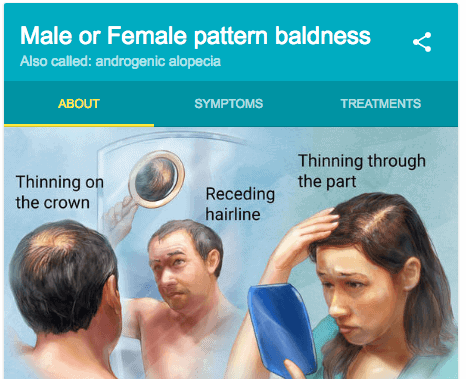
- Hair loss (especially if thyroid function and other hormones are normal and if the hair loss is “male-patterned”)
- Acne, changes in complexion or very oily skin (deep cystic acne is also common with high androgens usually in the jaw-line)
- Changes in mood including depression, irritability, or anger
- Imbalances of other hormones including estrogen/progesterone ratio, other androgens like DHEA, and thyroid hormone
As you will probably notice many of these symptoms are non-specific.
Meaning that there will be some crossover with other hormone imbalances in your body.
For instance: thyroid issues can cause weight gain and hair loss, but it usually isn’t male-patterned baldness.
Thyroid issues can also lead to acne, but it usually isn’t cystic or on the jawline.
Using these specific clues can help you determine WHERE exactly your hormonal issues are coming from.
But, because there is a crossover I always recommend you ALSO test your serum levels.
Testosterone Lab Tests for Women
Ok so let’s talk about what abnormal testosterone tests look like.
First, let me show you an example and then explain:
Below you have example #1 which is a female with high FREE testosterone and high “normal” total testosterone.
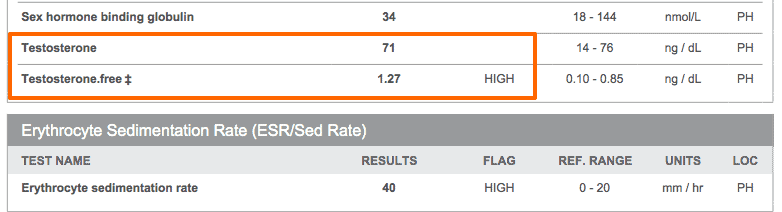
From this example, you can see that only the “free” is marked as high but in reality, this patient definitely has high testosterone levels.
How do I know?
Because she presented with hair growth on the face, acne, and weight gain.
I want to take a second and explain that this pattern is VERY common and one of the most commonly missed forms.
You see:
Free testosterone is the ACTIVE form of testosterone, so this particular patient has high levels of ACTIVE and FREE testosterone floating around causing all of the symptoms listed above.
In her case, it was caused by insulin resistance, and by treating that problem her testosterone levels (and therefore symptoms) went away.
Here is example #2:

Again, you can see that her free testosterone is HIGH but her total testosterone is within the “normal” range.
This patient was missed by conventional Doctors because she presented with very slight hair growth and slight weight gain but with very prominent mood swings and irritability.
This is why it’s so important to match symptoms to lab tests to make sure you don’t miss the diagnosis.
I also wanted to show you an example of low testosterone for comparison:
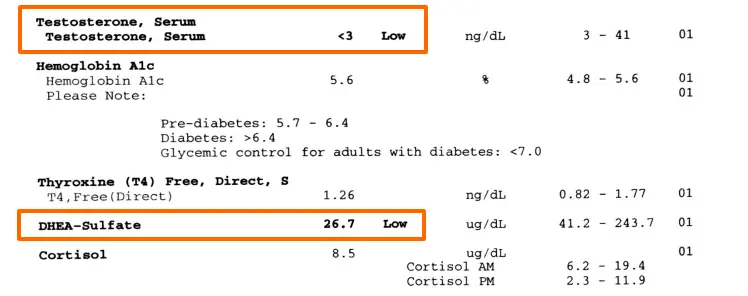
Above you can see the serum testosterone levels are off the chart low (<3) and I also included in the picture her Hgb A1c which shows this patient with insulin resistance as the main cause of her issue.
Remember:
High levels of insulin can cause BOTH high testosterone and low testosterone – it just depends on the patient.
You can read more about the causes and treatment of low testosterone in this article.
So now that you know HOW to diagnose high testosterone levels and what symptoms to watch out for the next step is to find out HOW to treat it…
6 Causes of High Testosterone in Women
In this section, I’m going to go over the most common causes of high testosterone.
It’s important to remember that this list is NOT the complete list, it’s just the most common presentations that I have seen in my practice and the most commonly missed diagnoses.
I also want to spend some time on each to help you determine if you actually have these abnormalities because most Doctors tend to gloss over each of them.
When it comes to high levels of hormones in the body it can be difficult to treat because it requires some digging to find the “root cause”.
Compare this to LOW levels of hormones, which usually can just be “replaced” to achieve symptomatic relief.
High hormone levels require more knowledge and more advanced treatment plans.
1. Insulin Resistance
As I mentioned previously in this article the link between insulin resistance [1] (high blood sugar) and testosterone is VERY strong.
High insulin levels cause both LOW testosterone and HIGH testosterone.
In men insulin resistance typically causes low testosterone, but in women, it can cause both.
But, what is the best way to determine how it’s affecting your testosterone?
Simply check both your Hgb A1c and fasting insulin levels in addition to free and total testosterone.
If you have high testosterone levels + high levels of insulin then insulin is certainly contributing to your hormone imbalance.

(Example of elevated insulin in the serum, your fasting insulin should be < 5)
Women who tend to get HIGH testosterone levels with insulin resistance fall on the PCOS spectrum [2].
Meaning that as insulin increases, testosterone increases, estrogen increases, and progesterone decreases.
Some women can get away with some mild hair growth on the face, while others face serious symptoms like darkening of the skin, abdominal/visceral fat deposits, and extreme mood swings.
Generally, the higher your fasting insulin levels are the worse your symptoms will be.
2. Estrogen and Progesterone Imbalances
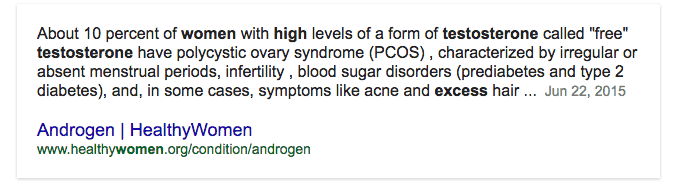
ALL hormones in your body interact with one another.
Think of them like a spider web, you can’t pill a string in isolation.
Moving one strand of the web will move the entire web, to some degree.
The same concept is true with your hormones.
They all play together.
So when one hormone is imbalanced it will ultimately drag down (or up) other hormones in the body.
This concept is true for sex hormones in women (estrogen and progesterone).
The exact mechanism isn’t clear, but there is definitely a correlation between progesterone/estrogen and testosterone.
Take for example women with PMS and PMDD, conditions caused by elevated estrogen levels (AKA Estrogen dominance).
These patients have been shown to have increased levels of both DHEA and testosterone [3].
Compare this to menopause (a complete lack of progesterone with low levels of estrogen) and women generally end up with LOW testosterone levels.
One thing is clear:
Changes to estrogen/progesterone somehow affect testosterone levels.
3. Low Physical Activity
think of exercise as an extra way to help prevent your body from developing high testosterone levels.
So lack of exercise doesn’t directly cause high testosterone levels, but exercising does help PREVENT high levels, to begin with.
This is most likely due to the effects of exercise on insulin levels [4].
Exercise helps lower insulin levels by sensitizing your cells to insulin.
Low insulin = normal testosterone levels.
High insulin = high testosterone levels.
It’s also worth pointing out that exercising can actually balance testosterone [5] levels to boost libido and muscle mass.
Exercising can also help prevent the abnormal fat distribution that comes with high/low testosterone levels (fat in the upper body and upper arms area).
4. Adrenal Conditions and High DHEA
This condition is less common, but anything that cranks up adrenal production can ultimately lead to high testosterone levels.
To understand you need to see how testosterone is created in the body:
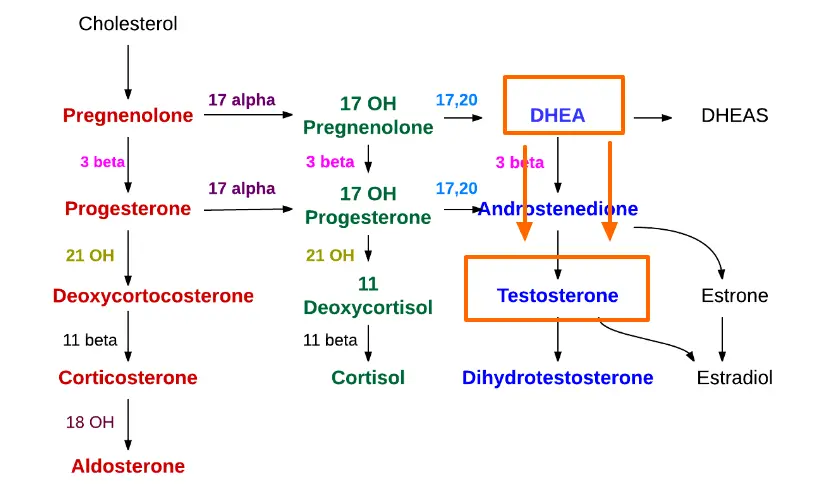
Using this diagram below you can see that testosterone can be created from precursors like DHEA, pregnenolone, progesterone, and androstenedione.
Anything that increases any of these hormones (even if you take these as supplements!) can increase your total testosterone.
There are also several medical conditions that can lead to elevated DHEA and testosterone through this pathway including adrenal hyperplasia[11], high stress (adrenal fatigue), excess supplementation of progesterone/pregnenolone/DHEA, and insulin resistance [6].
Obviously, the most common causes of high DHEA include increased demand for adrenal production (high cortisol and high DHEA levels) and excess supplementation (which can be a big problem as well).
For this reason, it’s a good idea to always check serum levels of DHEA in addition to cortisol levels when evaluating testosterone levels.
Remember that hormones do NOT operate in isolation, altering one will also alter others.
5. High Leptin Levels
Leptin is the hormone that just might be making it impossible for you to lose weight and keep it off.
If you aren’t familiar with leptin please read this article which outlines how exactly it causes weight loss resistance.
But briefly here is the story:
Leptin is a hormone secreted by fat cells and it’s supposed to control your appetite, and metabolism and tell your brain to burn fat.
When you have leptin resistance guess what happens?
Your brain doesn’t get the signal and instead of doing all of those things it instead causes the EXACT opposite.
That means your metabolism slows down, your brain makes you think you are constantly hungry and your body refuses to burn fat.
AND…
In addition to causing weight loss resistance, high levels of leptin are also associated with high testosterone levels [7].
High leptin levels also are seen in women with PCOS [8] and many women with leptin resistance also have insulin resistance (which further worsens testosterone levels by itself).
So high insulin levels = high leptin levels = high testosterone levels.
High insulin and leptin levels make it impossible to lose weight and high testosterone levels cause all of the side effects listed above.
6. Weight Gain or Obesity
It turns out that excess fat [9] can also cause high testosterone levels by itself.
Fat cells themselves actually increase levels of androgens in females.
Studies show that this is caused by the upregulation of an enzyme known as 17beta-hydroxysteroid dehydrogenase type 5 [10].
Forget the long name of the enzyme and just focus on the fact that fat cells themselves increase testosterone levels.
But, in addition to fat cells increasing testosterone levels…
Fat cells also increase insulin resistance which also leads to further androgen excess (high testosterone).
The moral of the story here is that you need to lose weight in addition to adding the other therapies above to normalize testosterone levels.
And don’t let that freak you out because the next section is all about treating high testosterone levels…
How to Lower Testosterone in Women
When attempting to lower your testosterone levels it is critical to know WHY you have high levels, to begin with.
This is because there are multiple “treatments” for the condition, but the theme is always the same: treat the root cause.
Below I’m going to go over some ways to treat high testosterone levels if you have the conditions listed above…
If you have high insulin levels AND high testosterone levels then consider the following treatments:
Addressing Insulin Resistance
- Add in high-intensity interval training or weight training – building muscle mass sensitizes tissues to insulin levels.
- Decrease carbohydrates (especially refined carbs like sugar/bread/pasta/etc.): consider diets like nutritional ketosis.
- Consider the use of T3 hormone to boost thyroid function and sensitize cells to insulin levels.
- Consider insulin-sensitizing medications: SGLT-2 inhibitors, metformin, GLP-1 agonists, and alpha-amylase inhibitors.
- Consider supplements to lower insulin levels: berberine (1,000-2,000mg per day), alpha lipoic acid (600-1,200mg per day), magnesium, chromium, and glucomannan – all of these supplements have been shown to reduce blood sugar and insulin levels.
- Note: Treating insulin resistance will take more than 1 treatment as indicated above. I also find that insulin resistance is very common among women with weight loss resistance. Do not ignore this hormone!
Addressing Estrogen and Progesterone Imbalances
- Ensure that your thyroid is functioning optimally – hypothyroidism causes estrogen dominance and low progesterone levels
- Ensure your excretion and metabolism of estrogen is optimal – that means proper liver function and optimal methylated B vitamins and nutrients
- If menopause consider using bio-identical hormone replacement, especially if symptomatic (Bioidentical progesterone and estradiol/estriol combo in the form of biest work particularly well)
- Consider supplements to help estrogen metabolism: Vitamin B12 (preferably methylcobalamin), 5-MTHF, DIM or indole-3-carbinol, milk thistle, MSM, bio-identical progesterone (20-40mg transdermally on days 14-28 of your cycle)
- Note: The best way to check for estrogen/progesterone imbalances is through DUTCH testing, NOT serum levels. If you feel you have estrogen dominance but “normal” serum labs, then make sure to check via DUTCH (urine testing). Also, put special attention on thyroid function because imbalances in thyroid hormone can cause both low progesterone and high estrogen levels.
Addressing Adrenal Conditions
- Increase consumption of salt (Himalayan pink salt or Celtic sea salt)
- Manage stress levels with relaxation techniques like yoga, meditation, spiritual prayer, time outside or in nature, etc. (see audio clip below for more info)
- Cut caffeine and alcohol consumption way, way down
- Avoid other stimulants like amphetamine-based medications (Adderall, Concerta, Phentermine, etc.)
- Get 8 hours of sleep each night and avoid high-energy tasks later in the evening. Make sure to also avoid taking naps during the day.
- Consider the following supplements: Adrenal adaptogens, Adrenal glandulars, Vitamin B6, Vitamin C, and low doses of melatonin (if you are having issues with sleep)
- Note: Adrenal-related issues can be very complex to treat, so if you suspect adrenal issues are playing a large role in your high testosterone levels you would likely benefit from seeing a practitioner to help guide you. It’s also worth noting that the best way to test for cortisol/cortisone levels is again with a series of 4 urine tests throughout the day (DUTCH urinary testing).
Addressing Leptin Resistance
- Consider an intermittent or prolonged fasting program.
- Cut carbohydrates and fructose consumption (both make leptin levels worse).
- Treating underlying thyroid resistance and insulin resistance if present (use steps above) -> If you don’t balance these hormones treating leptin resistance will be almost impossible.
- Add high-intensity exercise with weight training.
- Consider leptin-sensitizing medications: Byetta, Victoza, Bydureon, or Saxenda.
- Consider supplements (there are no specific supplements to treat leptin resistance that work consistently): Insulin-sensitizing supplements (above), fish oil, zinc, and leucine.
- Note: Leptin resistance can be very difficult to treat and in order to treat it you must treat conditions that also make it worse (like insulin resistance and thyroid resistance). In my experience treating leptin resistance usually requires the assistance of medication (as listed above) and, when used correctly, weight loss and other hormone-balancing effects can be profound.
Finding the Cause of High Testosterone
Treating high testosterone levels is possible but it requires the right approach which means finding and treating the underlying cause.
If you are able to properly diagnose and treat the underlying cause you should be able to reduce your symptoms dramatically!
Most causes of high testosterone are due to one or more of the following: insulin resistance, leptin resistance, imbalances in estrogen/progesterone, imbalances in adrenal function, and poor diet/lifestyle.
If you are serious about treating your high testosterone levels make sure you find a doctor who understands hormone balancing and is willing to do some digging to get to the cause of your problem.
Now it’s your turn:
Do you have high testosterone levels?
What have you done to treat it?
What has worked for you?
Leave your comments or questions below!
Scientific References
1. Corbould A (2008). Effects of androgens on insulin action in women: is androgen excess a component of female metabolic syndrome?. Diabetes/metabolism research and reviews. doi:10.1002/dmrr.872.
2. Sheehan MT (2004). Polycystic ovarian syndrome: diagnosis and management. Clinical medicine & research. doi:10.3121/cmr.2.1.13.
3. Eriksson E, et al. (1992). Serum levels of androgens are higher in women with premenstrual irritability and dysphoria than in controls. Psychoneuroendocrinology. doi:10.1016/0306-4530(92)90058-f.
4. Borghouts LB, et al. (2000). Exercise and insulin sensitivity: a review. International journal of sports medicine. doi:10.1055/s-2000-8847.
5. Nindl BC, et al. (2001). Testosterone responses after resistance exercise in women: influence of regional fat distribution. International journal of sport nutrition and exercise metabolism. doi:10.1123/ijsnem.11.4.451.
6. Mino D, et al. (2002). Relationship of insulin resistance and overweight with cortisol and dehydroepiandrosterone-sulfate levels. Archives of medical research. doi:10.1016/s0188-4409(02)00400-9.
7. Pehlivanov B, et al. (2009). Serum leptin levels correlate with clinical and biochemical indices of insulin resistance in women with polycystic ovary syndrome. The European journal of contraception & reproductive health care : the official journal of the European Society of Contraception. doi:10.1080/13625180802549962.
8. Chakrabarti J (2013). Serum leptin level in women with polycystic ovary syndrome: correlation with adiposity, insulin, and circulating testosterone. Annals of medical and health sciences research. doi:10.4103/2141-9248.113660.
9. Pasquali R (2006). Obesity and androgens: facts and perspectives. Fertility and sterility. doi:10.1016/j.fertnstert.2005.10.054.
10. Quinkler M, et al. (2004). Androgen generation in adipose tissue in women with simple obesity–a site-specific role for 17beta-hydroxysteroid dehydrogenase type 5. The Journal of endocrinology. doi:10.1677/joe.1.05762.
11. MedlinePlus. Congenital adrenal hyperplasia.