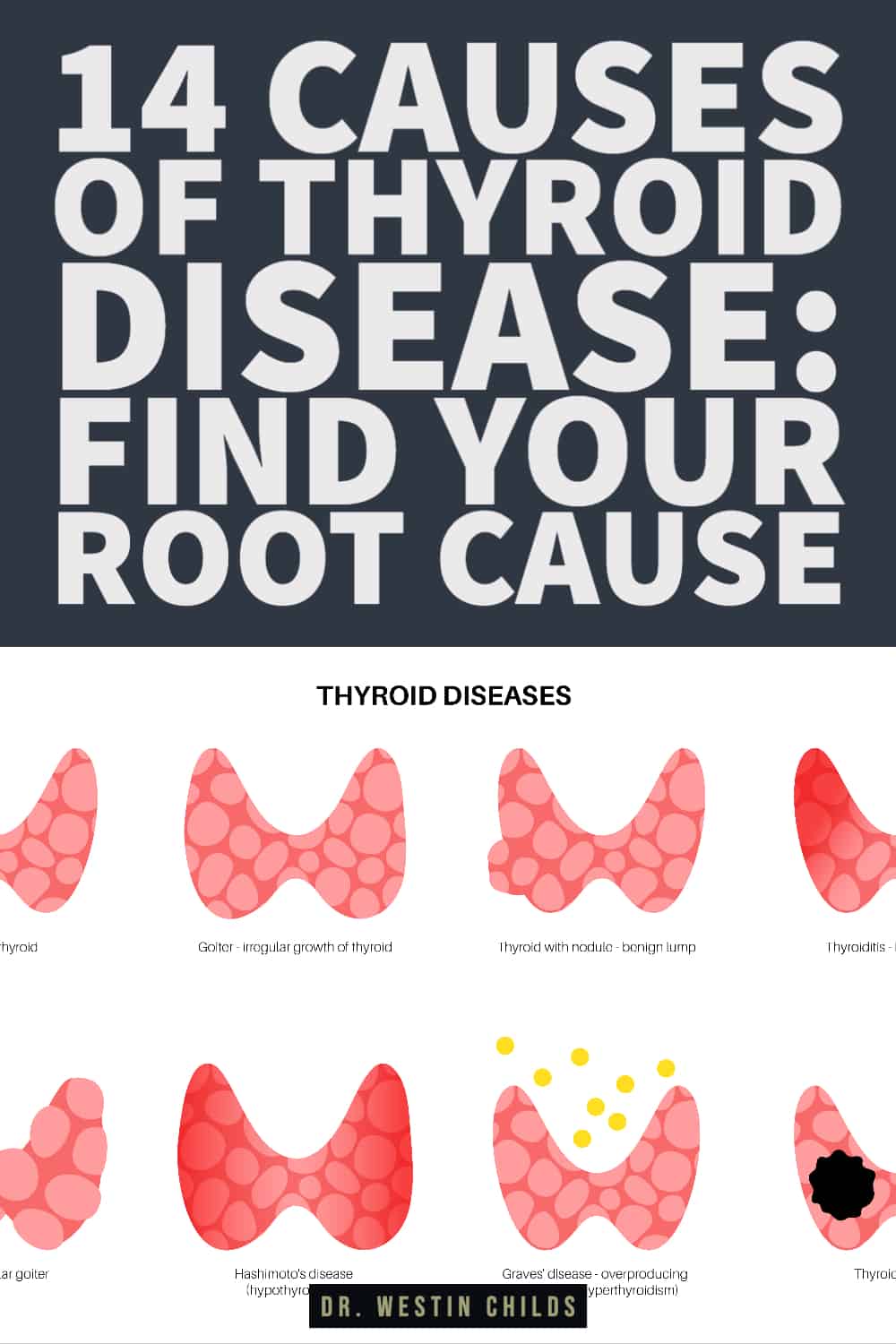



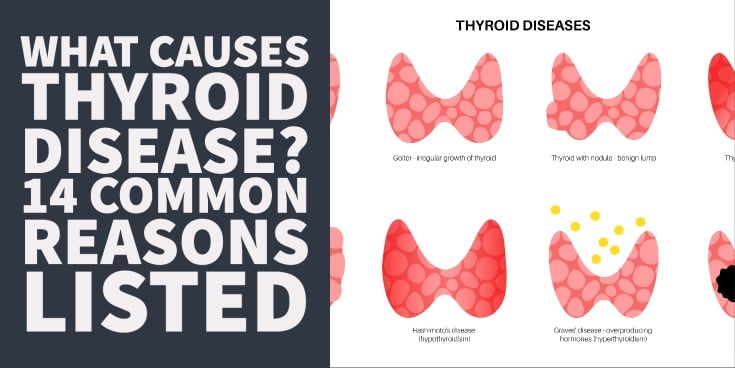
It is estimated that up to 10% of people have a thyroid problem (1).
But what is causing thyroid disease in all of these people?
It turns out that there are many causes of both reversible thyroid disease and irreversible thyroid disease.
But which type do you have?
In this post you will learn the most common causes of thyroid disease, how to spot problems that may impact thyroid function in your body, and what to do about these problems:
What Does it Matter What Causes Thyroid Disease?
The main reason you should be interested in the cause of your thyroid disease is that it can help you target your treatment!
And, it may surprise you to know, that most physicians are not concerned about the cause of your disease.
Doctors are trained to find the name of diseases, but they don’t always look for the root cause of those disease states.
It may be depressing to hear this, but there’s really no other way when a Doctor only gets to spend on average somewhere around 15 minutes with each patient with only around 5 minutes on each “topic” or problem (2).
5 minutes is not a sufficient amount of time to find the cause of a disease, so it’s much faster to “name” a disease and then treat it with medication.
But this approach is not ideal, especially if your condition can be reversed!
For these reasons, it’s important for you to have a basic understanding of your thyroid so that you can learn what is happening in your body and attempt to fix or reverse that issue.
Thyroid Dysfunction vs Hypothyroidism
When we discuss the causes of thyroid disease we really need to differentiate between two important conditions: thyroid dysfunction and hypothyroidism.
Thyroid dysfunction is a condition that results in disordered thyroid hormone signaling (3).
This means that you can still create thyroid hormone but the hormone that you create isn’t working as intended by your cells or by your body.
Thyroid dysfunction is often a result of some other condition and can usually be reversed!
Hypothyroidism, on the other hand, is a condition that results in a DECREASE in the amount of thyroid hormone that your body produces.
Those with hypothyroidism usually have problems with their thyroid gland itself, or with their pituitary/hypothalamus, and their thyroid disease is their primary problem.
Hypothyroidism may or may not be reversible so it’s very important to distinguish between thyroid dysfunction and hypothyroidism if you are experiencing hypothyroid symptoms.
These conditions can often be confusing because they may both present with similar symptoms and with similar thyroid lab tests.
But, with the right information, you can easily distinguish between these entities.
Causes of Thyroid Dysfunction
#1. Obesity
Obesity may be one of the most “silent” causes of thyroid dysfunction out there today.
If you are overweight by even as few as 10 pounds you may have some element of thyroid dysfunction.
Emerging research and studies have shown that obesity may be a CAUSE of thyroid dysfunction, not the other way around and this is why it’s so important.
If you are overweight you may be causing damage to your thyroid which will make weight loss more difficult until you treat that problem.
People who are overweight often have lower than normal free T3 levels compared to healthy adults (4) and you can check for this with a simple blood test.
#2. Calorie restriction or Dieting
Calorie restriction of as few as 1,500 calories per day can cause long-term damage to your metabolism through your thyroid.
As you restrict your calories your body will respond by reducing free T3 and by increasing reverse T3 (5).
This signals to the body that you are burning too many calories compared to what you are eating and this is how the body responds to stop that process.

This process is also referred to as starvation mode and it is probably the main reason why people gain weight after they undergo a diet.
If you are doing this make sure you STOP, even if it means temporarily gaining some weight.
#3. Nutrient Deficiencies
There are more than 10+ vitamins and minerals that are required for proper thyroid hormone creation and conversion.
As people become more reliant upon unhealthy snack foods found in the Standard American Diet, it’s not uncommon for people to have many sub-optimal nutrient levels.
These minor deficiencies typically do not cause a tremendous problem but they can definitely make you feel run down or sluggish and prevent you from feeling at 100%.
Some of these nutrients, especially Zinc and Selenium, are involved in the T4 to T3 conversion process with your thyroid.
Taking certain supplements can help replete these levels in your body and may help you feel much better!
#4. Insulin & Leptin Resistance
Both insulin and leptin resistance, which are quite common, have been shown to interfere with thyroid hormone signaling (6).
Both of these conditions can lead to weight loss resistance (the inability to lose weight) which can further complicate thyroid function.
If you have thyroid disease AND you have either of these conditions then you can focus on treating these which may improve your thyroid.
#5. Chronic Illness and Chronic Infections
Chronic illness refers to medical conditions that are with you for life and conditions that often require the use of medications to treat them.
Conditions such as high blood pressure, cardiac disease, high cholesterol, chronic pain, fibromyalgia, and so on all result in stress to the body.
Small stressors day in and day out may result in thyroid dysfunction (7) which you may feel as fatigue, weight gain, or depression.
In addition, these medications often also require the use of medications which is #6 below.
#6. Prescription Medications
It is well known that many commonly prescribed medications may cause problems with thyroid function at all levels (8).
Medications can interfere with thyroid hormone creation, TSH production, and thyroid conversion.
And the medications which cause these problems are actually used by many patients!
Medications that fit into this category include:
- Beta-blockers and other medications for high blood pressure
- Diabetic medications and medications that control blood sugar
- Anti-seizure medications
- Narcotics and pain medications
- Antidepressants and bipolar medications
#7. Inflammation
Lastly, any cause of inflammation in your body will also result in decreased thyroid function.
This is because inflammation slows down the T4 to T3 conversion process (9) and results in smaller amounts of free circulating active thyroid hormone.
Inflammation is really a non-specific entity but, in hypothyroid patients, this type of condition is most often caused by intestinal-related issues such as gut dysfunction and intestinal overgrowth syndromes.
Causes of Hypothyroidism
#1. Hashimoto’s Thyroiditis
Perhaps the most common cause of hypothyroidism in the United States is the autoimmune disease known as Hashimoto’s thyroiditis.
This condition, if untreated, results in complete destruction of your thyroid gland over a long period of time.
As your thyroid gland is slowly destroyed your ability to produce thyroid hormone is compromised and you will begin to experience the symptoms of hypothyroidism.
It is estimated that anywhere from 50-90% of patients with hypothyroidism may have Hashimoto’s to blame for their disease.
#2. Thyroiditis
While Hashimoto’s thyroiditis is a cause of thyroiditis it is certainly not the only cause.
Thyroiditis simply refers to inflammation of your thyroid gland and this can be caused by other conditions such as infection or trauma.
Any inflammation in your thyroid gland may reduce the function of the gland in the process which will leave you feeling symptomatic.
These conditions are often easy to diagnose as long as you understand them and you can learn more about them here.
#3. Treatment for Hyperthyroidism (Thyroidectomy and RAI)
Would it surprise you to know that another very common cause of hypothyroidism is the treatment of hyperthyroidism?
Hyperthyroidism is the exact opposite condition of hypothyroidism but the treatment often entails either the complete removal of the thyroid gland or the destruction of the thyroid gland with radioactive iodine.
If you have either of these procedures done you will become reliant upon thyroid medication for life.
Why?
Because your thyroid gland will no longer be functioning.
Even medications for hyperthyroidism, such as Methimazole, may result in hypothyroidism if they are used in excess.
#4. Pituitary & Hypothalamic Issues
Your pituitary and hypothalamus can be considered the master regulators of your hormones and that includes your thyroid.
These organs are located in your brain and then sense what is happening in the body and respond by telling your body how much thyroid hormone you need.
If they are damaged, for any reason, your thyroid may not get the signal and may not produce enough thyroid hormone.
Even if your thyroid gland has the capacity to function correctly it won’t if it doesn’t get the signal.
Conditions such as tumors (prolactinoma) (10) and extreme stress or trauma (11) can cause damage to the HPT axis.
These are not very common causes but they should always be considered.
These conditions are usually not reversible.
#5. Iodine Deficiency
The only way that you can get iodine is from your diet and if you don’t get enough you may develop a condition known as a goiter.
This is because iodine forms the backbone of all thyroid hormones floating around in your body.
If you don’t have enough iodine then your body won’t be able to produce enough thyroid hormone (12).
One of the problems with iodine consumption is that we really only get it from very special foods such as sea vegetables and iodized salt.
Your body needs up to 150-200mcg of iodine each day and if you don’t get enough you may be at risk for iodine deficiency.
The good news is that this condition is readily treated once you give your body back what it needs!
You can learn more about iodine supplementation here.
#6. Pregnancy & Lactation
Pregnancy and lactation don’t necessarily cause hypothyroidism by themselves but they lead to it indirectly.
Both conditions put an increased strain on your body to produce more thyroid hormone because you are effectively producing it for two people!
So, if you have any minor deficiencies or problems, these issues may be exacerbated by lactation or by pregnancy.
As they are exacerbated you may start to experience the symptoms of hypothyroidism even though you technically have enough thyroid hormone for “you”.
These conditions can usually be treated with thyroid hormone while you are pregnant or breastfeeding and the medication can usually be stopped afterward (13).
#7. Congenital Issues
Occasionally, someone may be born without a thyroid or with an issue relating to thyroid function.
These problems are not reversible but luckily they are quite rare and they can be treated with thyroid medication.
How to Focus Your Treatment
So what are you supposed to do if you have thyroid disease?
The first step is to try and find out what is CAUSING the issue.
You can do this by ordering a complete set of thyroid lab tests designed to look at all stages of thyroid function.
The complete thyroid panel will give you information about how your brain is functioning, and how your thyroid gland is functioning and give you insight as to how well thyroid hormone is working at the cellular level.
During this process, you may also need other tests such as insulin, leptin, and other sex hormones.
Don’t let this seem intimidating!
If it does then you should actively seek out a physician who is willing to help guide you along the way (you can find resources on how to do that here).
If you can find out what the main cause of your symptoms is then you can usually determine if you have hypothyroidism or simply thyroid dysfunction.
In your workup, you may find that you have multiple causes of thyroid dysfunction, which isn’t uncommon, and areas that you need to treat.
If this happens to you then you can pick one and treat that issue and then systematically move down the list until you’ve “fixed” all major issues.
As you do this you should feel better and better.
Conclusion
There are many different causes of both thyroid dysfunction and hypothyroidism.
Finding out the cause of your thyroid disease is probably the single most important step you can take to feel better.
Finding this information will help direct your treatment and may allow you to reverse your condition (in some instances).
Now I want to hear from you:
Are you suffering from thyroid dysfunction or hypothyroidism?
Do you know which issues may be causing your thyroid disease?
Have you taken steps to address these issues?
Why or why not?
Leave your comment or questions below!
Scientific References
#1. https://www.ncbi.nlm.nih.gov/pubmed/7641412
#2. https://www.ncbi.nlm.nih.gov/pmc/articles/PMC2254573/
#3. https://www.ncbi.nlm.nih.gov/pubmed/6479377
#4. https://www.ncbi.nlm.nih.gov/pmc/articles/PMC4911848/
#5. https://www.ncbi.nlm.nih.gov/pubmed/12055988
#6. https://www.ncbi.nlm.nih.gov/pmc/articles/PMC377492/
#7. https://www.thelancet.com/journals/lancet/article/PIIS0140-6736(74)92070-4/abstract
#8. https://www.ncbi.nlm.nih.gov/pmc/articles/PMC2784889/
#9. https://www.ncbi.nlm.nih.gov/pubmed/27051079
#10. https://www.ncbi.nlm.nih.gov/pubmed/27105040
#11. https://www.ncbi.nlm.nih.gov/pubmed/16020927
#12. https://www.ncbi.nlm.nih.gov/pubmed/16704348
#13. https://www.ncbi.nlm.nih.gov/pmc/articles/PMC2425446/