
- Tirosint contains only 4 ingredients (1 active T4, 3 inactives) versus levothyroxine's 9+ fillers and dyes. This superior absorption means you get more usable hormone in your body, producing real symptom improvement.
- Switch to Tirosint if you have GI problems like low stomach acid, SIBO, reflux, or food sensitivities. Studies show Tirosint absorption isn't affected by stomach acid, making it ideal for patients with absorption issues.
- T4-only therapy works best when combined with T3 medication like Cytomel. Adding T3 multiplies symptom reduction beyond Tirosint alone.
- Most doctors readily prescribe Tirosint because it fits the current T4-only paradigm, making it easier to obtain than NDT or combination T4/T3 therapy while still providing measurable improvement.
You’ve probably heard from other patients that switching from levothyroxine to Tirosint made all the difference.
Considering that they are both T4-only thyroid medications, what is the difference between these medications?
Why do some patients have decreased symptoms, lose more weight, and feel better on Tirosint but not on levothyroxine?
Is there a difference between this thyroid medication compared to the others?
It turns out that many patients actually do much better on Tirosint (but not everyone).
In this article, I am going to discuss who might do better on Tirosint, why most thyroid patients will probably do better on this medication, and make a case for switching thyroid medications…
*Special note: I have no affiliation with the makers of Tirosint or receive payment from them in any way. I am simply sharing my experience using this medication in hopes of helping others.
Tirosint the T4 Only Thyroid Medication
As mentioned previously Tirosint is a T4-only thyroid medication.
That means that it contains only the T4 thyroid hormone known as thyroxine.
T4 thyroid medications are the most commonly prescribed medications used to treat hypothyroidism and other medications in this class include Synthroid, levothyroxine, and Levoxyl.
So, what makes Tirosint different?
The primary difference between Tirosint and other T4 medications is not in the active ingredients but in the inactive ingredients.
This medication contains the fewest inactive ingredients compared to all other formulations.
We’ll talk about why this is important in a minute but first, let’s spend some time talking about T4 medications in general.
If you’ve read my blog before you probably know that I’ve spent a lot of time and energy writing about how T4-only thyroid medications generally don’t work well for many patients.
And this general unhappy feeling is not just seen on my blog (1).
Why is that?

Well, T4 thyroid hormone is not an active thyroid hormone.
The only active thyroid hormone is T3 otherwise known as triiodothyronine.
And in order to create T3, your body must use T4 as a substrate and precursor hormone.
So, many health providers give patients T4 thyroid hormone with the hope that the body will be able to naturally take care of this conversion process.
The problem with this logic is that under special circumstances the body will actually produce reverse T3 (the antithyroid metabolite) instead of T3 hormone.
This is the primary reason that many thyroid patients simply don’t do well on T4-only thyroid medications.
But this isn’t the whole story.
It turns out that many patients would probably do well on T4 thyroid medication IF (and this is a big if), it was being absorbed properly, and if they don’t have any negative reactions to the fillers/inactive ingredients in the thyroid medication.
And that’s where Tirosint comes into play.
You see:
All T4 thyroid hormone medications contain the active ingredient T4, what they differ in is the inactive ingredients.
And many people are sensitive to these inactive ingredients.
It’s these inactive ingredients that change the absorption of the hormone or simply cause reactions themselves.
This reaction can trick patients into wrongly believing that their medication doesn’t work or that hypothyroidism isn’t the cause of their symptoms.
But what if you could take a thyroid hormone medication with very few inactive ingredients that would almost ensure proper absorption and assimilation? (2).
This would remove the conversion variable and give you clear insight as to whether or not T4-only thyroid medication works for you.
Well, that’s exactly how Tirosint works.
Tirosint contains the fewest inactive ingredients (3) out of all of the T4-only thyroid medications and many patients have reported an improvement in overall symptoms when switching (4).
Why do you think these patients notice an improvement when switching?
Is this medication magically better than levothyroxine or Synthroid?
No, it’s a matter of absorption in the GI tract of the thyroid hormone and a reduced risk of negative reactions to the fillers.
And much of this change has to do with the ingredient list (including both active and inactive).
Tirosint vs Levothyroxine vs Synthroid
To illustrate this point let’s go over the ingredient list of these medications quickly.
Ingredients in Tirosint include (both inactive and active ingredients):
- Levothyroxine (this is the T4 thyroid hormone) <— Active ingredient
- Gelatin <— Inactive ingredient
- Glycerin <— Inactive ingredients
- Water <— Inactive ingredient
As you can see Tirosint has 1 active ingredient and 3 inactive ingredients for a total of 4 ingredients total.
Compare this to levothyroxine:
- Levothyroxine (this is the T4 thyroid hormone)
- Butylated hydroxyanisole
- Silicon dioxide
- Crospovidone
- Magnesium stearate
- Mannitol
- Cellulose
- Povidones
- Sodium lauryl sulfate
- Sucrose
- And color additives include dyes (more below and depending on the strength)
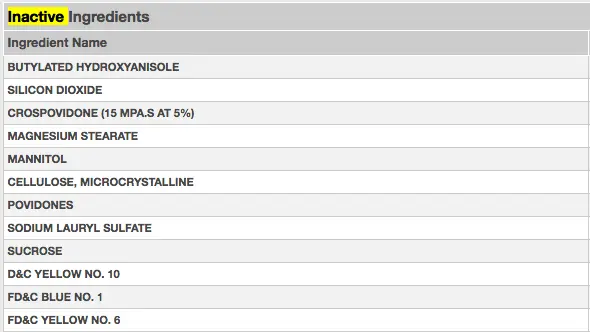
As you can see levothyroxine has a huge list of inactive ingredients.
It is these inactive ingredients that alter absorption and therefore influence the amount of thyroid hormone that makes it into your body.
These variables make it difficult to determine if any negative symptoms you may experience with a thyroid medication are due to the hormone or due to the inactive ingredients.
Special note:
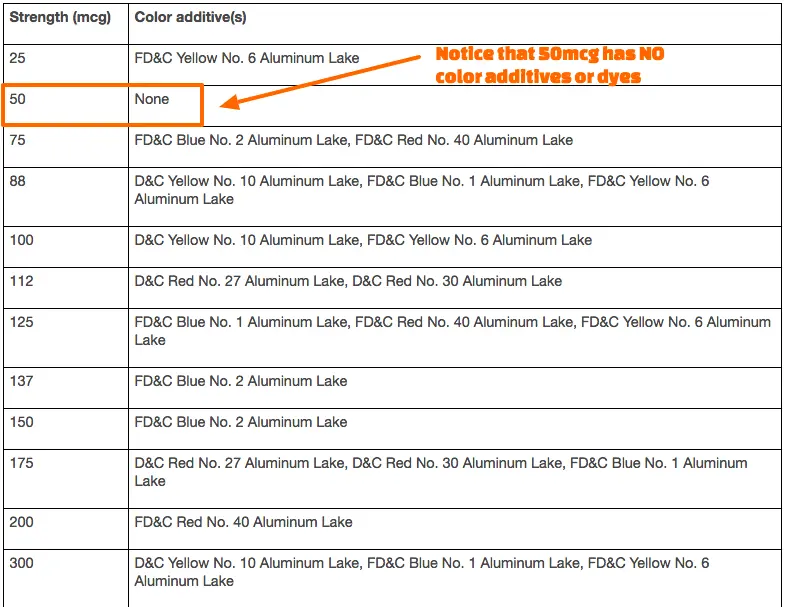
Below is the list of fillers, dyes, and additives to each dose of levothyroxine.
You can see that the 50mcg dosage does not have any extra dyes, so if you can’t switch medications from levothyroxine to Tirosint (due to price or some other reason), it would be worth a trial of switching to a 50mcg dose.
In fact, when I dose levothyroxine I almost exclusively use the 50mcg dose because of this.
If you are on 125mcg of levothyroxine then using 2.5 tablets of 50mcg may improve your symptoms versus using the 125mcg tablet.
This may require that you take more than 1 tablet, but it’s worth the price if you start to feel better.
Who Should Consider Using Tirosint?
Does this mean that every patient on levothyroxine who is still feeling symptomatic should switch to Tirosint?
No (nothing is ever that easy!), but there are a few patients who should strongly consider making the switch to Tirosint if they are on levothyroxine or Synthroid.
If you fall into any of the following categories then Tirosint may be a better option for you than levothyroxine/Synthroid and/or Levoxyl:
- Patients with gastrointestinal issues include (but are not limited to): Low stomach acid, acid reflux, SIBO/SIFO, IBS, IBD, and any GI-related surgery (including gastric bypass).
- Patients who don’t tolerate Synthroid, levothyroxine, or Levoxyl, or who have experienced any of the likely negative reactions to inactive ingredients.
- Patients taking acid-blocking medications such as proton pump inhibitors (6) – Tirosint has been shown in studies to not be affected by changes in stomach acid.
- Patients who have undergone bariatric surgery (7).
- Patients with multiple food allergies or sensitivities to multiple foods.
- Patients with gastroparesis or damaged intestinal motility (8).
- Patients with increased intestinal permeability.
- Patients who don’t tolerate NDT medications or are too sensitive to T3-containing medications.
- Patients who are extremely sensitive to medications and supplements or who react to these substances at very low doses.
- Patients who have experienced some improvement of levothyroxine or Synthroid but still have room for improvement.
- Patients who can’t take levothyroxine on an empty stomach or who drink coffee in the morning (9).
This list should serve as general and broad guidelines for who should consider switching to Tirosint.
One important point I want to expand on is the implication that gastrointestinal problems have on thyroid hormone (and other nutrients).
Hypothyroid patients (yes even those already on thyroid medications but still with symptoms) are in a tricky situation.
Thyroid hormone is required for proper stomach acid (HCL) production (10) and HCL is required for proper thyroid (and other nutrients (11)) hormone absorption.
This means that if you are being undertreated then there is a chance that you are also not fully absorbing thyroid hormone and/or other nutrients – making your problem worse.
This general lack of stomach acid can also worsen or create other intestinal problems which make absorption even worse.
This may explain why some studies show that up to 50% of hypothyroid patients have SIBO (12), or why up to 40% of hypothyroid patients have vitamin B12 deficiency (13).
The point is that these GI problems are very important and contribute to a reduction in the absorption of not only oral thyroid hormone medications but also nutrients which can worsen symptoms.
It’s worth taking some time to point out that replacing thyroid hormone doesn’t necessarily reverse these conditions and taking extra steps to treat these GI problems if present will be necessary for many patients.
Does Tirosint Cause More Weight Loss Than Levothyroxine or Synthroid?
I get this question from many patients in some form and the answer is that yes, it might cause weight loss in some individuals.
This is only true if your body has no issues with the conversion process of T4 to T3 and if your problem with levothyroxine was a lack of absorption.
If the change from levothyroxine to Tirosint results in an overall increase in thyroid hormone in the body, and the conversion of T4 to T3, then yes, Tirosint may result in weight loss.
This makes the huge assumption that your body has no issues with converting T4 to T3 and this is a very big assumption to make.
We’ve spent time focusing on the absorption issue, but in reality, this general lack of absorption and reaction to inactive ingredients probably represents 20-30% of patients.
Another 30-40% of patients simply need T3 added to their T4 dose for optimal results, and altering T4 dosing won’t necessarily change this.
You can read more about why levothyroxine can actually contribute to weight gain here, and you can read more about how to use Synthroid and levothyroxine for weight loss properly here.
Combining Thyroid Medications (T4 + T3)
This is probably the best way to use Tirosint and this is how I use it effectively in my practice.
Switching from Tirosint to levothyroxine
Tirosint by itself usually results in a reduction of overall hypothyroid symptoms due to superior absorption, but this effect is multiplied by the addition of T3-containing thyroid medications like Cytomel or liothyronine.
Other thyroid hormones and medications can safely be added to Tirosint, but remember that general rules for taking thyroid hormones still apply.
That means don’t take Tirosint with food, avoid taking supplements or vitamins at the same time as Tirosint, and so on.

One of the best parts about switching to Tirosint is that most providers won’t argue with you about the change.
Tirosint is still a T-only thyroid medication and using this medication fits into the current paradigm of thyroid treatment (however flawed this paradigm might be).
Compare that to trying to get your provider to switch you to NDT, which is infinitely more difficult.
Nowadays it’s also becoming more commonplace for providers to add lower dosages of T3 to T4 thyroid doses.
So switching from, say, 125mcg of levothyroxine to 100mcg of Tirosint + 5-10mcg of Cytomel is becoming more commonplace than say switching from 125mcg of T4 to 2-3 grains of NDT.
Tirosint Dosage vs Levothyroxine Dosage
Is there a difference in dosages between these two medications?
While both contain equivalent dosages and concentrations of thyroid hormone, some patients do find that switching over may result in almost hyperthyroid-like symptoms.
In my opinion, this results from increased absorption and a flush of thyroid hormones into the body.
If this does occur in you, simply slightly reducing the dose is usually enough to control these symptoms.
But, in general, the dosage between these thyroid hormone medications is equivalent.
FAQ & Recap
The bottom line is that many patients stand to benefit from switching to Tirosint from levothyroxine or Synthroid (and even other forms of thyroid medications).
This improvement is felt to be due to increased and superior absorption in addition to a reduction in symptoms related to inactive ingredients.
Remember that Tirosint has 1 active ingredient and 3 inactive ingredients making it the “cleanest” thyroid hormone medication.
Special interest should be taken in certain patients with gastrointestinal symptoms as these patients tend to have low stomach acid and other nutrient deficiencies.
Another huge benefit of Tirosint is that this medication fits the current thyroid treatment paradigm and because of this many providers are more willing to prescribe this medication over other formulations.
At the end of the day, you are a unique patient and it may take a combination of time and trial and error to find your optimal dose, but don’t give up! With persistence, you will get there.
Below I’ve also included some frequently asked questions that I receive from patients regarding Tirosint.
You can use this list if you don’t feel that your questions or concerns were answered in the information above.
If you have any other questions or comments please don’t hesitate to leave them in the comment section below as I check these frequently and I want to keep the conversation going.
Is Tirosint a T4-Only Thyroid Medication?
Yes, Tirosint is a T4-only thyroid medication.
It does NOT contain T3.
Medications that are T4-only thyroid medication include levothyroxine, Synthroid, Tirosint, and Levoxyl.
Medications that contain T3 only include Cytomel, liothyronine, and SR T3.
Medications that contain both T4 and T3 include Armour thyroid, NP Thyroid, and Adthyza.
Will it Work for Me?
There is no way to know for sure if Tirosint will work for you.
In my experience, I’ve found that most people do subjectively experience a reduction in hypothyroid symptoms when switching to Tirosint even when switching from levothyroxine to Tirosint or Synthroid to Tirosint at the same dose.
That doesn’t mean it will work for you, but it’s certainly worth a 1-2 month trial in most cases, especially if you don’t feel well on your current regimen.
When trying to optimize and reduce your symptoms it’s important to take into account other factors like T4 to T3 conversion, inflammation, and other hormone imbalances.
These other factors may be playing a role in why you are or aren’t doing well on your current regimen.
Can Tirosint Cause Weight Gain?
Like other T4-only thyroid medications, Tirosint can potentially and indirectly lead to weight gain.
This usually occurs from improper thyroid conversion and the production of too much reverse T3.
Recall that reverse T3 is the antithyroid metabolite and directly competes for binding and cellular activation with T3.
The more reverse T3 you have in your body the more likely you are to experience hypothyroid-like symptoms (even with a normal or low TSH).
Many patients on T4-only thyroid medications also may experience a condition known as low T3 syndrome which is felt to be due to a variety of reasons including lack of thyroid conversion (though this condition doesn’t always have high levels of reverse T3).
How Do You Take It?
Like other thyroid hormone medications, Tirosint should be taken on an empty stomach in the early morning. You should also avoid supplements and the intake of food for at least 60 minutes after taking it.
Some patients opt to split the dose and/or take this medication at night, but these are advanced techniques and depend on symptoms.
It is worth mentioning, however, that some studies have shown that Tirosint can be taken with foods (14) which makes it unique among other thyroid formulations.
These studies show that taking Tirosint in the morning with food does not impact its absorption.
Tirosint can and should be considered, in cases where you may be experiencing nausea when taking your thyroid medication on an empty stomach.
Even though it can be taken with food doesn’t necessarily mean that you should take it with food, but it’s certainly worth considering in certain situations.
Can it be Used with Other Thyroid Medications?
Yes, Tirosint can safely be combined with other thyroid hormone medications.
It is often best used in combination with Cytomel, liothyronine, or SR T3.
Can Tirosint be Taken with Supplements or Vitamins?
If you are taking vitamins or minerals then it’s best to consume these supplements 30-60 minutes after you take your medication.
Doing this will help enhance absorption in the gastrointestinal tract.
It’s also best to avoid taking Tirosint directly with supplements that contain iron or calcium as these may directly bind up the active thyroid hormone.
You can see a list of other substances that interfere with thyroid hormone absorption here.
Does Tirosint Have Any Side Effects?
Like other thyroid hormone medications Tirosint (if used in high doses) can result in hyperthyroid-like symptoms:
- Heart palpitations
- The feeling of anxiety or jittery sensation
- Rapid weight loss
- The sensation of overheating or feeling too warm
- Anxiety, depression, or other mood changes
- Insomnia or change in sleeping patterns
These would be considered adverse or serious side effects and if you experience any of these you should seek medical care as soon as possible.
Because of the small list of inactive ingredients, many patients tolerate Tirosint quite well and generally don’t complain of minor side effects like headaches, rashes, flushing, etc.
This doesn’t mean that you can’t or won’t experience any negative side effects from this medication, but it does mean that the chance of this happening is low.
Any minor symptoms associated with using Tirosint are usually self-limiting which means they tend to resolve on their own within a few weeks.
If you are ever worried about a side effect you feel is related to your medication then it’s best to contact the doctor who prescribed the medication for you.
Can Tirosint be Taken with Food or Coffee?
Believe it or not, Tirosint is one of the only thyroid medications that CAN be taken with food (and even with coffee).
As you probably know, thyroid patients are told that they should take thyroid medication on an empty stomach and avoid eating or taking supplements for at least 1 hour afterward.
While this rule technically still applies to Tirosint, some studies have shown that eating food right after taking it, and even drinking coffee while you take it, do not alter how much is absorbed into your body.
This is potentially great news if you are someone who has to have coffee in the morning.
While I typically don’t recommend drinking coffee before you take your thyroid medication, this might be an alternative for those people with schedules that don’t really allow for a 1-hour rest after eating or right after waking up.
But remember:
If you take levothyroxine or Synthroid, you should absolutely avoid coffee when taking your medication. Drinking coffee can speed up your intestinal tract (from the caffeine) and reduce thyroid hormone absorption.
If this sounds like you then you may want to consider switching to Tirosint.
How Much Does Tirosint Cost?
Because Tirosint is a newer formulation of T4 thyroid medication the price tends to be more expensive than other generic brands.
You can see a list of cash prices below using goodrx.com:
Without insurance, and for the 100mcg dose, Tirosint will cost around $122 (depending on your location).
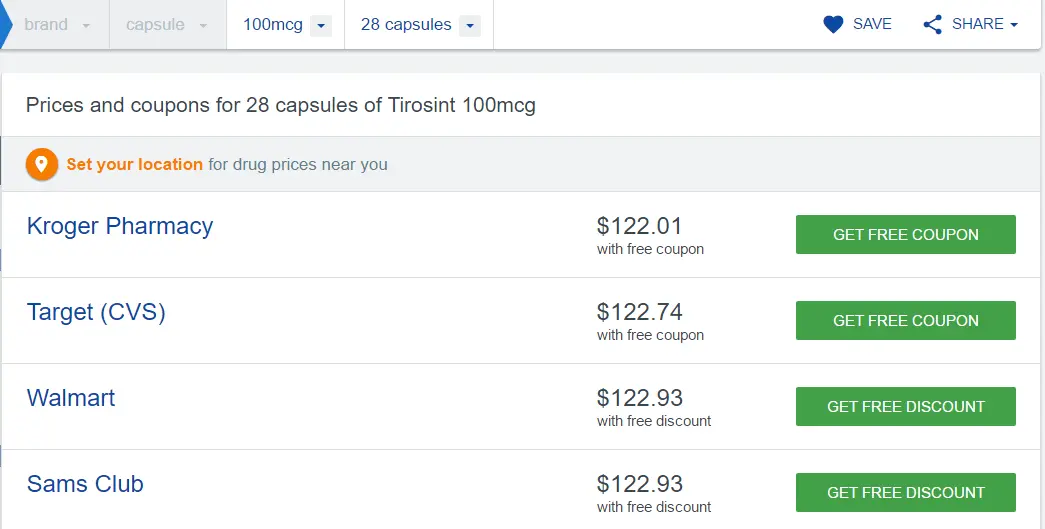
You can use goodrx.com to get a discount on medications (even other formulations of thyroid hormone and other medications).
If your insurance won’t cover the cost and if the cash price is too high you still have one last option:
A manufacturer coupon.
Tirosint does have coupon codes as well which can help reduce the cost to around $35 per month.
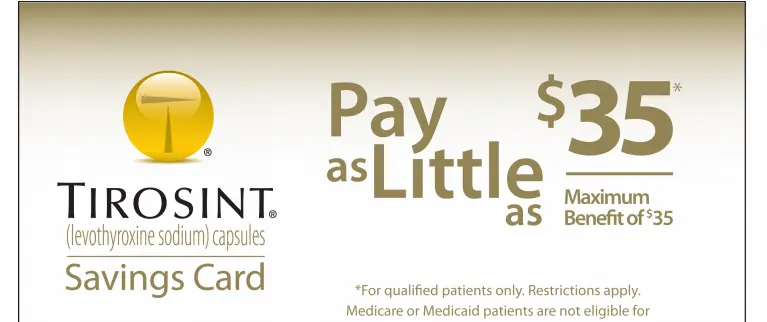
You can find more information about the coupons here.
At the end of the day, paying up to $100 per month may be expensive but if it improves your quality of life the price may be more than worth it.
Now I want to hear from you:
Are you doing well on your current thyroid medication?
Have you considered switching to Tirosint?
Is your doctor willing to work with you to switch medications?
What other strategies have you tried?
Leave your comments or questions below!
Scientific References
#1. https://www.ncbi.nlm.nih.gov/pmc/articles/PMC3169863/
#2. https://www.ncbi.nlm.nih.gov/pmc/articles/PMC3726924/
#3. https://www.ncbi.nlm.nih.gov/pmc/articles/PMC5581367/
#4. https://www.ncbi.nlm.nih.gov/pmc/articles/PMC5318319/
#5. https://www.ncbi.nlm.nih.gov/pmc/articles/PMC1440339/
#6. https://www.ncbi.nlm.nih.gov/pubmed/24246350
#7. https://www.ncbi.nlm.nih.gov/pmc/articles/PMC3726924/
#8. https://www.ncbi.nlm.nih.gov/pmc/articles/PMC4884855/
#9. https://www.ncbi.nlm.nih.gov/pubmed/22932947
#10. https://www.ncbi.nlm.nih.gov/pubmed/12754530
#11. https://www.ncbi.nlm.nih.gov/pmc/articles/PMC1552819/pdf/gut00693-0062.pdf
#12. https://www.ncbi.nlm.nih.gov/pmc/articles/PMC4056127/
#13. https://www.ncbi.nlm.nih.gov/pubmed/18655403
#14. https://www.ncbi.nlm.nih.gov/pmc/articles/PMC3873683/



Any suggestions on what is good if your thyroid has been removed, I’m on Snythroid 112
Hey Paula,
If you poke around my blog you will find thorough articles explaining how to use all forms of thyroid medications including combinations of T4 + T3 and so on. There is no “perfect” medication for any one person and finding the best medication for you will take a combination of trial and error and symptom management. The most important thing you should focus on is trying to find someone local to help guide you through this process.
Hello Dr Childs, Your articles are informative & answers many questions. I switched from Levoxyl to Tirosint approx 1 yr ago. My dose was reduced from 200mcg down to 175mcg daily. I feel so much better without the inactive ingredients. My first year s/p RAI I stayed hypothyroid r/t the additives. Please continue your writing & research. This retired nurse enjoys you hard work!
Hi Donna,
I don’t have any plans to stop! Glad you found what works for you and thanks for sharing.
Does armour thyroid have enough T3 and T4 to help me lose weight easier/ faster and feel better altogether? Cause my Dr just told me to stop taking levothyroxine, which I’m glad, cause no matter how well I eat and how much I work out I can’t lose any weight while being on levothyroxine, please be blunt, thank you
Hey Stephanie,
Potentially, but it’s much more complicated than a yes or no answer.
Hello I’m presently on erfa desiccated thyroid and there seems to be a serious problem with the potency like they have ruined the formulation all my low thyroid symptoms have come back I’m dead in the water. Others have noticed this too. What do you suggest.
Hi Paula,
You can use a combination of T4, T3, and T2 or something like T4 + T3 + thyroid gland powder, or some similar combination: https://www.restartmed.com/thyroid-medications-that-work/
thinking about switching from Naturthyroid to tirosint/cytomel. I have taken synthroid and cytomel and switched about 3 years ago to naturethyroid. My labs have always been pretty lackluster – low in the range, or below. I have recently felt more symptomatic (hashimotos’) – fatigue, weight gain,etc. any specific things to be concerned about making the switch?
I switched to Tirosint with my cytomel and I feel 100% better. Lost weight, more energy, etc. definitely worth the switch.
Hi Janette,
Great! Thanks for sharing your story.
I’m on Medicare. Can I use it for buying? I can’t afford $100 a month.
Hi Gerry,
I would look into using a generic version of Tirosint (gel cap) instead of the brand name. But there are also many coupons and discounts available from the manufacturer that you could look into as well. These options make it more affordable.
Hi Dr Westin, I am on 90 mg armour, and want to switch to WP thyroid as I have some gluten issues (hashis) but just read up on tirosint! MY BIGGEST ISSUE right now is my weight (30 lbs) that I need to lose. Perhaps i should try the tirosint? Thoughts?
I’m switching back from Tirosint to Levothyroxine purely because of the cost benefits. Three months of Tirosint is $366 compared to $12.96 for three months of Levothyroxine. When I started taking Tirosint a few years ago it was approximately $30 a box. The price has steadily increased since then. Same product and same packaging. I can’t say if I’ve done better or worse on it but for now I prefer to keep that money in my pocket. We’ll see if I notice a big difference on the Levothyroxine.
Did you notice a difference when switching from Tirosint back to Levothyroxine & if so can you please describe in detail what they were?
I would really appreciate if you could share your experience which could help me & a lot of others out there trying to get there life back from thyroid issues. Thank you.
Hi Isabelle,
While it is important to see that Tirosint can help other people, it’s important to remember that even if it did work for her it may not work for you or vice versa. Thyroid medications are very personal and what you need will be different than what other people need.
Hi Dr,
I was on Synthroid for 20+ years (125 mcg). Turned slightly hyper after Covid. My GI system inflamed and became sensitive to lactose and gluten. Changed to TIROSINT 125mcg. It’s MUCH MORE POTENT. Turned hyper within 6 weeks – major hair loss and jitters. Dropped to 112mcg then 100mcg. Now looking into 75mcg TIROSINT as my insomnia has gotten awful and muscle twitching. Only thing that changed was to TIROSINT. Suggest you post a recommended dosing chart for folks switching to ensure people realize it’s not 1:1 due to fillers and how quickly it absorbs / breaks down in the system. What’s strange is the symptoms were strong but my blood work never really adjusted much. Thanks, Michelle
Hi Michelle,
That information is included in the article under the section “Tirosint Dosage vs Levothyroxine Dosage”. Given that many people can start with a conversion of 1:1 without any issues and given that many thyroid patients are already underdosed on levothyroxine at baseline, I don’t think it makes sense as a general recommendation to start out with a dose that is less than your current levothyroxine dose.
You can always adjust it as needed afterward and there’s very little risk involved with temporarily taking a few doses that are higher than normal.
As always, there will always be people who are more sensitive than others to doses of thyroid medication but they are usually the exception to the rule.
Dear Dr Childs – you are one of my favorite doctors on youtube! I want to know this: I live in Denmark, and my MD here put me on 25 mcg of Tirosint, because I have bad symptoms with levothyroxine that I have taken for 16 years. I have hashimotos – my levels were400% too low (16, or something), so I can probably never get off my medicine.
My heart palpitations are reduced, when I take 150 mcg of levothyroxine, and when I switched to 25 mcg of Tirosint as per my doctors recommendation, I felt incredible for 2-3 days, much less brain fog, less depression, much more prone to sweating profusely, though, and the suddenly one night it felt as if my heart was going berserk! I called my MD in the morning and said that I did not dare take that medicine, but I now wonder, if I was on the right dose: from 150 mcg of Levo to 25 mcg of Tirosint? Is that not a strange jump??
We have strangely rigid regulations in my country, and there are numerous medications that one can get in the US, but not here. Eg Armour thyroid.
Best regards from
Lennie Jorgensen in Denmark
My biggest complaint has been my hair loss. Over the past year I am experiencing extreme fatigue, moodiness, depression and overall feeling horrible. My “levels” have low but still within “optimal level”. My last results my T4 has decreased. I was originally started on Levothyroxine and my hair loss was worse with chest pain. I was switched to Armour and had extreme swelling in face, hands, abdomen and feet. I was given Tirosint to try however I’ve been worried to start it due to all of the reviews are stating more hair loss and heart palpitations. I Have had gastrointestinal problems for years and I’m concerned of more problems related with that. I don’t understand why I’m being given a T4 only medication when my biggest concern has been hair loss. My doctor does not seem to be listening to the issues I’m having because she feels my levels are not low enough to be causing these problems, even telling me to try Rogaine. My family is worried about me because of the drastic change in my personality, depression and overall state. I just don’t want to start another medication that is going to cause anymore hair loss. Any recommendations on other tests I can have done, information that I can give to my Dr., if compounds are an option or should I just try Tirosint and see if helps.
Hi Shannon,
You might find this article helpful if hair loss is your issue: https://www.restartmed.com/thyroid-hair-loss/
Hi. I’ve been taking levothyroxine for years and it’s been fine. However I’ve stated getting an angry red itchy rash across my chest, up to my ears, down my arms, etc. Could I have become allergic to it after years? I really can’t think of anything else it could be.
Sarah-
I recently was having hives, rashes, itching, skin breakouts from Levothyroxine. Went totally off it and all symptoms disappeared. Won’t go back to it.
I had been on Levothyroxine/Synthroid for more than 12 years with no results.
I think my body said, “I’ve had it with these medications” when the breakouts, itching started.
Horrible advice
Did the generic your pharmacy carries change? I had mine change and my throat broke out in a rash, so I just switched to brand-name Synthroid. More expensive, but I know I’m getting the same thing. My best guess it was one of the inactive ingredients.
I’m wondering if switching will help my IBS. It’s seems like it hasn’t gotten worse this last year right about the time my levothyroxine pills started looking a little different. Is their gluten in levothyroxine ?
Hello,
In desperate need of help (& a good doctor who could listen). I’m a patient 42 yr old woman but feel stuck. Had my thyroid removed 9 years ago after a tumor close to it contained embryoic thyroid tissue & cancer, leading to complete removal. 9 years of on again off again of feeling mostly hypo. Never did well on synthroid or generic. Brain fog always remained. Last June started generic levothyroxine come January felt awful. I was on 150mcg and new endo switched me to Tirosint 150 mcg, 2 weeks into it never felt better. No brain fog for first time in 9 years! Week 3, awesome. Week 4, energy off the wall, up at 5:30, go all day till 11:00, hard time sleeping. Week 5 & 6 heart palpitations, feeling like I’m going to faint, dizzy spells throughout the day. Bloodwork done and TSH at .07, shaking hands. Doctor lowered dose to 137, 3 days later I called and said I feel anxiety and heart racing. I’m far from a paranoid person, practice yoga and exercise regularly and eliminated gluten like he requested. Next day needed up in ER with BP 157/100, thought I was fainting. Called endo and he said sounds like inner ear problem or anxiety, definently not meds which surprised me. I was scared to take Tirosint again, he gave me Synthroid 137mcg. 2 weeks later my fog is back, stomach hurts and TSH at 5.
I feel he started me too high. I feel Like Tirosint could have been for me but I don’t know what dose would be good. Sorry for long story, but feel so lost. I eat healthy and balanced, 5”5 137 pounds. Bottom line, would a dose of 100 be better for me to start? Endo pretty much asks me what I want. Thank you for any advice at all.
I am recently diagnosed with hashimotos after suspecting for several years. My dr started me on naturethroid, 1 grain- after 8 weeks had slight weight loss and feeling better , but antibodies increased and my t4 became low/ started tirosint a week ago and feel I am gaining weight and water retention! Water retention is one of my biggest problems with hashis so I am very discouraged. Do I wait it out? Or does this mean my body is reacting negatively to the T4? Thank you for any feedback!
I have been on thyroid meds for about 12 years. I was on Levothyroxine for many years, switched to Armor for a year (which gave me palpitations), and have been on Synthroid for the last 3 years. Approximately 3 years ago, I started having severe heat intolerance issues. I’ve had extensive testing done, been to the Mayo Clinic, many doctors and no one can find a cause. Yesterday, my ends switched me to Tirosint to see if that might help alleviate my heat intolerance issues. I understand that Tirosint is the cleanest of the T4 meds, but lists heat sensitivity as a possible side effect. Is it worth me even trying Tirosint vs. Synthroid since they both lost heat issues as possible side effects?
Hi
I am so glad to hear that you two have a heat intolerance. I play a lot of golf and find that I cannot cope with humidity or heat when everyone else seems to be able to cope. I take to resent and I also take levothyroxine, so I now believe that the teacher sent is what is causing my heat intolerance. Thank you for your message you have answered all of my questions.
I have had HT for 12 years (from dx ). I gained 10 pounds before I was diagnosed and I was never able to go back to my 122 pounds, in spite of “great” TSH, T4, free T3, etc. values all along and even training for a marathon (and completed it). Many symptoms definitely improved and I just accepted by new weight. However, my doctor recently switched me from synthroid to tirosint only to see a horrendous 12 pounds of weight gain and water retention in about 2 months! I don’t even know where it is going as I fit well in my clothes. I am also on BHRT, and started LDN 2 weeks ago, tons of magnesium, selenium, Myer’s cocktaiils, vit D drops . I really dislike this very much. I have a very clean GF diet, exercise regularly … The only culprit seems to be the tirosint (she also added Naturethroid first and then switched me to cytomel ). I am really shocked and sad. What else could be at stake? I am a 48 female.
Hi Mara,
Weight gain can be from numerous different issues so you would need to sit down and figure out a timeline of what was given and when and then try to figure out what caused it.
I have been on Tirosint (112) for about 6 months and now I am having issues again. Just went back to my Endocronologist 3 weeks ago, had my levels checked and they said I was in the low normal range but was having side effects like palpatations, jitterness, heat tolerance, so I was just lowered to 88 mcg last week. Started yesterday 6/4/17 with freezing, and still having issues of jitterness, (not so much the palpatations) but kind of like tightness and my diabetes (sugar levels) have gone higher and the endo has upped my diabetes medicine. I have had thyroid issues over 30 years. I’m 61 years old and keep having issues of my thyroid meds having to be changed over and over again. The reason I tried Tirosint was cause I was allergic to the fillers in the other meds like Levoxyl, Synthroid, Nature Thyroid. The only other alternative is that the endo said maybe I would have to have a compound pharmacy make the right dosage for me…..I’m at the point where I don’t think any of these meds are working at all……What is the next step if I’m allergic to everything I take. Would like your opinion. Can Tirosint be interacting with my diabetes meds (Glipized and Tradgenta) Thanks.
The formula was changed. I was using 88 mcg of levo in a tiny round blue pill – it was all of $10 a month and worked fantastic.. hair was getting thick and healthy, facial complexion improved, nice weight.. then they changed to an oblong pill and I developed horrible hives.. found out the new one contains shellfish.
I think since the Tirosint was changed to the blister pack, it also contains shellfish fillers as the hives are back bigtime, my hair is falling out, I am gaining weight and I dont feel well, very fatigued.
Why do the mess with someone that was working ?
its all about money…. not about health
Hi! I started Tirosant a few months ago after trying all the natural meds ( w/ the T3)and synthetic brands. Nothing really made any significant changes over the course of almost 10 years. I decided to try the Tirosant as a last hope. I liked that it only has four ingredients in it, so it was a similar make up as the natural med’s. I also like that its absorption differed from the pill version and hoped that would make a difference. So far it seems to be somewhat effective, my skin isn’t terribly dry like it became with taking Synthroid, and my scalp feels somewhat normal compared to the way other meds made it feel. I had to stop taking the natural meds because my T3 was becoming really high and if my does had to increase my T3 would have gone over the norm. So my doctor and I have started all over again, staring wit the lowest does of Tirosant and working up. I was just tested while on the 25mcg for a few months now, my labs look ok, my TSH is 1.82, it was over 4 before I started Tirosant, and we are increasing the does by 13mcg to see is we can get the TSH closer to 1.30 where I think would be a good range for my body. My T3 hover is now within the normal level but in the low end. I still suffer from hair loss, and fatigue and weight gain and I’m wondering is that has anything to do with the T3? Even when I was getting the T3 though I still felt the same. My question is if I add Cytomel ( I think that’s what it’s called) is that as pure as the Tirosant? I imagine it will add additional ingredients I’m trying to avoid.
Thank you for this information, and any insight you can offer.
Hi Maryellen,
Cytomel is not as “clean” as tirosint. The only way to reduce inactive ingredients is to get your T3 compounded.
Dr. Childs can you tell me where to get a “clean” T3 as most pharmacies I talk to are still diluting with microcrystalline cellulose which I do terrible with. Also, what ratio should the tirosint/cytomel be for good dosing?
Hi, would you mind talking with me about how you work out your dose with Tirosint? I’m currently having this issue. I switched from Armour thyroid at 60 mg over to tirosint at 112mcg which I felt that was too high because I was having headaches and loopy feeling and they reduce my dose to 88 but it still feels like it’s too high cuz I’m having headache still and upon waking up this morning at my headache was pretty bad. I noticed that in your comment above your doctor started you over with the lowest dose? How often did you get your Labs pulled? I’m lucky that I have a naturopath path that I’m working with.
No one’s ever told me that because this was a liquid form it probably absorbs a lot quicker than the pills of the other t4 medications not a lot of doctors know about this it seems like I’m curious to see what your battle has been.
I’m in the same boat. I liked NDT but I needed a certain amount of T4 yet everytime you increase you get an increase of T3 but adding T4 to it never seemed to work. I never felt stable on it without getting that certain amount of T4 but then I’d overdose on T3.
My T3 was always at the low end(2.5ish) too despite optimal T4 levels and I felt terrible. I had all the symptoms you described. If your T4 is (maybe1.3)1.4-1.8 and your T3 is on the low end then I’d add a tiny bit of cytomel. If your T4 is below those optimal ranges then you could increase your T4 slowly. I’d say if you get your T4 and T3 into optimal ranges and you still have those symptoms then maybe explore other hormones or nutrient issues. I had low B12/folate, iodine and iron.
Cytomel has calcium sulfate, corn starch, gelatin, stearic acid, sucrose and talc. Basically, the stuff everyone tries to avoid. From my experience in taking it the side effects are mostly due to using too much, like dizziness. HOnestly, I don’t recall having any specific side effects on the generic cytomel. If I have to use T3 again I’ll probably ask my Dr to prescribe a compounding slow release formula in very tiny increments.
I just started Tirosint today.
just want to add I’m not a professional and these suggestions are based upon my personal experiences and no way medical advice. 🙂
I just read your article on Tirosint. I do not have a thyroid, it was removed partially due to Grave’s and then radioactive iodine took out the rest. (80’s).
I loved Tirosint when it first came out, I felt better on it than any other med. Recently, I tried natural since I felt the different T hormones included in this branch of thyroid meds would be beneficial. I really liked WP the best. However, my doctor kept having to ratchet up the dose. Eventually my weight kept going up and up. This is after trying a 1250 calorie diet and exercise and then thinking that was not enough calories, switching to 1500-1600. When I say exercise I mean jogging 8 miles a week and I can cycle 18 miles in one spin class. I still gained weight to the point I became insulin resistant. After a brief time on glucophage and back to Tirosint, I’m losing weight.
Hi Amy,
If you read some articles on my site you will discover how that kind of diet damages your metabolism long term. You definitely want to avoid further calorie restriction because it may cause some short term weight loss temporarily, but it will always result in weight gain long term and then it makes future weight loss more difficult. This process continues until eventually calorie restriction isn’t enough to cause any weight loss at all.
So Dr. Childs, for complete disclosure, please offer an in-depth explanation of your relationship, interests, holdings, etc. in Akrimak. Thank you.
Hi John,
The information you are looking for is public and you can find more information here: https://thinkprogress.org/you-can-now-find-out-how-much-big-pharma-is-paying-your-doctor-8fce60189464
I don’t want to spoil the surprise but you won’t find any information 🙂
Certainly Doctor! So that you are aware, there are certain items of fact to which I am privvy. I personally anticipate no surprises! Good Day!
I do okay on NDT but still have some hypothyroid symptoms and don’t feel quite stable. My Free T3 hovers around 73% of the range; I can’t seem to tolerate more than so it was recently suggested I add some Synthroid to bring up my Free T4 which is around 20-30% of the range. Would adding Synthroid to NDT be completely crazy or might there be some benefit? I’m open to the idea but I’m not sure how to proceed i.e start taking Synthroid and decrease NDT at the same time or is there a better way? You seem to be one of the only doctor who considers everything and doesn’t preach NDT only or vice versa and I really appreciate that so any input you have would be fantastic.
I’ve been on this medication for 1 week an already feel the difference, I have hyperthyroid an they had to take it out, an was on leve. An was sluggish an no energy an I work building cars an need the energy, when I made the switch, I felt it within 2 days energy came back an mood changed an not as nervous anymore. But did have swelling ankles the first week but soon stopped. I prayer this medication does better for me as the other gave me headaches an irritable.
Help! I was on Levothyroxine for 7 years for hypothyroidism. I never really felt any improvement in my fatigue or cold intolerance. Suddenly, I developed severe premature ventricle contractions. I went to the cardiologist, wore an event monitor and was have over 25000 pvcs a day. I also started gaining weight and gained 35 lbs. I stopped the levothyroxine and the pvcs went away. I have been to doctor after doctor and they continue to tell me that the levo had nothing to do with pvcs. I tried Armour and Westhroid and the same problem…pvcs. All the while my thyroid hormones all showed normal levels. I stopped all thyroid medications and again the pvcs went away. I finally went to an endocrinologist, told him the problems I was having with pvcs while on levothyroxine. He as did every other doctor said levo was not the cause of my cardiac symptoms. Then he prescribed me .75 mcg of you guessed it…levothyroxine. The pvcs returned. He refused to try any other thyroid meds. I went to another doctor who prescribed 19 mcg of a t3 compounded med. My heart rate went up from 69 bpm resting to around 100 bpm and the pvcs started again. My thyroid hormones are still in the normal range. Why am I having hyperthyroid symptoms when on medication when my tests reveals normal thyroid ranges. I am losing hope. I’ve gained 30 lbs, my hair is falling out in handfuls, I have no energy, joints and muscles ache. Someone please help. I’m desperate and was wondering if maybe tirosint may be the answer.
Hi Jackie,
Sometimes the side effects that patients experience when taking thyroid medications may be due to inactive fillers/dyes and not the actual thyroid hormone in the medication itself.
I read your post about your difficulties taking Levothyroxine and pvcs. I am not having that issue but after taking Synthroid for 20 years, it’s like I’ve become intolerant to it. I get horrific palpitations on just a 1/4 of a 50mcg tablet. I use to take a 50 mcg tablet but stopped and started it at a lower dose and now, down to just a 1/4. I ended up having to take it a beta blocker just to reduce the cardiac issues. I’ve had lots of blood work that all seems normal except the hypothyroidism. My heart checks out Ok but I know thyroid medicines can overstimulate the heart. I am going to have my cortisol and adrenal levels all checked as well. I am looking for an answer to the palpitations, too. I’ve been to the ER twice, a cardiologist, endocrinologist and GP. It all seems to center around the thyroid medicine. If you find a solution for yourself, I would like to know what you ended up doing. Thanks, Elaine
Hello, I am a thyroid cancer patient-thyroid removed. I was on levothyroxine(generic) with no complications until I was treated with radioactive iodine therapy. Since I react to every medication including synthroid dye free, tirosint. My symptoms did improve slightly on tirosint until they stopped my thyroid meds altogether prior to annual cancer scan. Allergic to thyrogen. Upon restarting Tirosint, I had facial/tongue/throat swelling, major joint pain swelling, irritability, insomnia etc(none of these occurred while tking before)Dr then switched back to Synthroid dye free 50mcg- same reactions. Now Dr wants to try Compounded Pure Levothyroxine. my question is- Does this make sense when all the meds tried and failed are “levothyroxine”? Am I recting to the levo? Dr’s ( i’m now on #3) all refuse NDT. I am a severly Dysfunctional individual. My TSH is where they want it but I am unable to function as a human being. please help to guide me towards asking the right questions to make them believe it’s their idea!
P.S. My cancer was papillary, follicular and medullary with invasion of lymphovascular system.
After a thyroidectomy 22 years ago, and levothyroxine for all these years, I just switched to levoxyl. Is levoxyl about the same as levothyroxine as for as excipients go? I have all sorts of problems that fit right into the low T3 list. Thinking maybe I should jump to the combo therapy. Tirosint/T3
Hi Jewell,
The “cleanest” of the T4 medications is Tirosint which only has 4 ingredients. You can read more here: https://www.restartmed.com/tirosint/
Bonjour! I have hashimoto, my thyroid is not functioning anymore, or close to, I also have Raynaud’s syndrom, a heart failure with mitral leak, and lots of family (aging parents) stress. I am more or less on AIP diet since June 2014. Besides that, I love champagne and fun! 😉 After trying everything on earth but Tirosint, I am now on WP + Cynomel, split in 4 times/day. It is not totally ok as I still have hypo flares, but it is the less worse combo so far. However I am now in France taking care of the mentioned parents, and WP is out of stock at the US lab, plus it is forbidden in France (All animal hormones are)! I am running out of WP, therefore I am wondering if I could not switch to Tirosint. The question is: What are the rules to match dosage between the 2 meds? I take 3 WP 65 and 2.5 Cynomel 0.025 per day. Merci beaucoup. I sent your article to my endo in Oakland!
Hi Cat,
There really isn’t a way to convert the dose when you are using NDT and/or T3. You’d be switching from a medication that contains a fair amount of T3 to a T4 only medication. You also have to consider that switching to Tirosint may alter absorption which further clouds the picture.
Merci Westin!
Your blog ate my first long answer. :p In a nutshell:
Merci for your help!
As I have no other choice being stuck in France until January, and with WP out of stock in the US anyway, I will try to figure out how much t4 I take now with the WP, add some more t3, and see. I still have hypo flares anyway, and no other synthetic or natural meds have worked for me. Tirosint is the only one I never tried…
Could you please tell me what you mean with “further absorption issues”?
Wish me luck! I shall report. 😉
Cat
I just switched from Synthroid brand to Tirosint. For the past two years I have either been testing hypothyroid or hyperthyroid. I’m hoping this medication keeps me more stable.
Hi!
I had a total thyroidectomy, non cancerous this past July.
My Endo has lowered my dosage of Synthyroid from 175mcg to 125mcg.
She says I don’t need anything for my T3?
I’ve had panic attacks every morning since the surgery along with other side effects.
She’s now saying that Torosint maybe better for me?
Your thoughts?
I also take generic celexa 40mg and generic klonopin .05mg daily and 1.0mg at night.
I have been on levoxyl for 2 yrs’ thyroidectomy was performed 2 yrs ago with para transplant. my tsh levels are at a 30 and i am totally symptomatic. just switched to tyrosint. how long before you see results.
Hi Simone,
If it’s working for you then you should notice results in probably 4-6 weeks (potentially sooner).
Thanks for another great article Dr. Childs. I’ve been following your blog and your guides for the last year and a half and your information has been invaluable.
Upon your advice when I queried about having to push my endo to consider combination t4/t3, I sought out a new doc and recently came under the care of a fantastic doctor who just switched my t4 to tirosint (was not optimal nor stable with levothyroxine or Synthroid). I’ve noticed a positive difference in symptoms that I’d bet is due to the clean profile of Tirosint. I’m also taking her advice and switching several of my suppliments to the pure encapsulations, which I believe you also recommend for their clean profiles.
Thanks again – your blog has been an excellent resource and guide, helping me make drastic gains in my health!
Cheers,
~Z
I want to start taking Levothyroxine 50 mg because of what you wrote about the ‘no fillers.’ How do I know its the correct Levothyroxine med? My Rx says Levothyroxine, generic for Levoxyl. Is Levothyroxine the generic for all T4 meds? Hopefully this makes sense?!?
I had a total thyroidectotemy 5 years ago and have tried every available replacement therapy avaliable in Canada (Synthyroid, Cytomel, Armour, Compounded T4/T3…) and still just don’t feel well (have addressed everything under the sun from metals to gut). Feel stongly issues are still correlated to thyroid replacement. I would like to try Tirsonsit any suggestions on how to obtain from a US pharmacy (I know this is not yet been approved in Canada and company wishes to do a trial in the US in advance of expanding into Canada)? Any direction would be greatly appreciated.
I have had hyper thyroid disease for years. When I was finally diagnosed in 2002, I was put on synthroid. I haven’t been Right since my face breaks out ( I’m 60) and lasts for months. My skin is dry and I love the cold but can’t take the heat. I’ve even been to Cleveland clinic, to a doctor who dyes the my levels are fine and just turned me away. I have had treatment like this from many doctors. But I know my body. My skin was always healthy and so was my hair. Never in my life do I have breakouts. Please give me some advice on what may be causing all this and how to fix it. I just don’t know where to go when they tell me that my levels are within normal range.
Hi Kwandi,
I would check out this post for more information on how to address acne related to your hormones (thyroid and sex hormones): https://www.restartmed.com/hypothyroidism-acne/
Hi Dr. Childs,
Thanks for the great article! I recently switched from 130mg (2 grains) of WP Thyroid to Tirosint as an experiment because my Hashimoto antibodies that I had gotten down to 20 began to rise as I increased the WP. My doctor and I weren’t sure of the proper conversion so I tried 75mcg of Tirosint. It was way too much, as I experienced all of the horribly hyper symptoms… I then tried 39mcg for two days and had horrible diarrhea and stomach pains. I didn’t take any for two days and now am starting to take the lowest dose of 13mcg. Is it possibly that the 75mcg made me hyperthyroid and I should’ve just not taken anything for a week or so before restarting? I’m nervous about restarting but I know I need to.
Thank you so much!!
Dr. Childs, this was very helpful insight on the comparison of medications. My daughter had success on Tirosint, clinical trial at her Endocrine office, but due to cost, I had to remove her and put her back on generic levrothyroxine. I am once again going to lobby for her to be back on this medication, Tirosint, because of the lack of fillers. She is gluten sensitive, not celiac, and has GI issues. If I cannot gain success with doctor or insurance company, the most valuable information you have shared is that 50mcg does not have any additives. I would rather give her 2.5 pills vs 1 (she takes 125mcg) in hopes of change. Thank you so much for taking the time to write this article. And I am so happy to have found it. Not one doctor has ever told me what you have today. I don’t think they are concerned with “quality of life”, they are only concerned with a life long patient, they can keep charging the insurance company. Three to four times a year, plus labs, can be quite the paycheck, times the number of people who suffer from thyroid issues.
My new endocrinologist is trying to switch me to Tirosint from Levothyroxine after 5 years. I’m having no issues other than my hair is getting thin. I have been a vegetarian for over 28 years. The Tirosint is made with gelatin?
Hi Dr. Childs,
I requested that my Dr. switch me from Levthyroxine to Tirosindt- due to the ‘fewer ingredients factor.’ I am starting my 3rd month and for the most part, I’m feeling better. The past 2-3 yrs my levels have fluctuated taking me from hypo to hyper… e.g. within 3 months, I went from tsh-39 to tsh- 0.01. My concern/question is that, my tsh is still low 0.04, bbt has also been consistantly low- 96-97 F. So although both of these values are low, I am experiencing the typical HYPOthyroid symptoms…? My original diagnosis (26 yrs ago) was Hashimoto’s related Hypothyroidism. Hope to hear from you soon. Thank you for sharing your wisdom!
Hi Dr. Childs,
My problem is I have Graves disease, IBS, mild Crohns, lots of medication allergies. I had Graves a long time before it got severe enough for someone to do a TSH test. By that time I was so hyper that I had no time to try the meds and had to have RAI (double dose) to destroy the gland. Then I went severely hypo (TSH 73) on 25 mcg Levoxyl and it gave me a rectal prolapse from terrible constipation. 88 mcg brought me into range but I have hyper symptoms again including loose BMs which is no good for my prolapse. I believe it is not the range for me. I am also having a hard time gaining back the weight I lost as I am mostly on the BRAT diet. I know most folks complain about not being able to lose weight but I was only 112 lbs, to begin with, and need to gain it back. Any suggestions would be helpful. I begged to go back on 75 mcg as even tho my TSH was 13 then I felt pretty good and BMs were normal. Any suggestions would be helpful.
Thank you and I appreciate your site as it is very helpful.
I changed from longtime Synthroid use to Tirosint at the same dose in hopes of improved absorption. My carpal tunnel, slight headaches & depression vanished. However, I developed fatigue, dark circles all around both eyes, difficulty maintaining weight & anxiety over these new symptoms.
I changed back to Synthroid & need to work religiously on gut health. I am completely overwhelmed with all the information out there. I just need a few key points to anchor myself on. Thank you for any assistance.
Hi doctor Childs,
Thank you so much for the blog about the Tirosint medication. I will be switching to Tirosint from Levothyroxine which doesn’t work for me for 8 yrs.
Again, thank you!
I will let you know the result after few weeks taking it.
Dr. Westin Child’s
I’m on (2) 50mcg (synthyroid) and I take them every morning at the same time and I sweat like crazy 30 mins after I ingest them and then I’m cold this sweating and cold go on throughout the day and night, each episode last for 2-4 minutes “except” in the morning when I take the synthyroid that last for about 30 mins. Does this mean I’m having allergic reaction to synthyroid even though it’s the pure synthyroid and I’m also on 15mcg Cytomel that I take 2 pills 3 hours after synthyroid and 1 pill later in afternoon.
Can you explain the sweating and cold, my Endo says I’m fine?
Thanks, Grace
I had a total thyroidectomy due to cancer and also a history of gastric bypass. I take 300 mcg of tirosint every day and it is the only thing that has worked to get my numbers to the low end of the scale. It has been a lifesaver!
Hi Dr. Childs,
Have you had patients who get headaches when trying to add T3 to Tirosint? I was up to 75mcg of Tirosint and got headaches when trying to add 2.5 or 5mcg of Liothyronine. My doctor then had me try T3 only for a few weeks but I had headaches the entire time, so I’m going back to Tirosint. My T3 went down to 2.5 but TSH and T4 were good. I’ve revently bought your T3 conversion supplement to try!
Thanks so much!
Christine
On Synthroid for 3 yrs due to Hashimoto’s, diagnosed after months of idiopathic urticaria/hives. It kept the hives away but took me 3 months of experimenting to determine that my acid reflux/GERD was caused by Synthroid. It was so bad I was moaning and groaning, leaning over in pain and breathing like a fire-breathing dragon. Then I was living on GERD medication on top of my Synthroid. I hate to take pills unless I have to. I wanted to determine what was the cause of the GERD, not just keep taking pills. I asked my doctor about other Synthroid options and was given Tirosint gelcaps. I am CURED of GERD ever since! I have been on the same level of Tirosint for 4 years now with no GERD problems.
Now the bad news – I may now be experiencing brand new insomnia due to the Tirosint, but am still investigating/ experimenting. PLEASE listen to your bodies and do what is right for you. Doctors don’t always know everything and you know your bodies best, but if I listened to them all the time, I’d probably be a walking, itchy zombie now.
Hi, Dr child’s I got diagnosed about 5 years ago with a hypothyroid they have also said hashimotos. I tried brand and generic of Synthroid and levothyroxine and can not take them I have taken the lowest dose and have every side effect possible it was horrible! I have a super hard time taking any medication and usually have a reaction to anything I take.they prescribed me they said the lowest dose of Tirosint 13.9 mcg but I I’m terrified to try it after the way the other medication made me feel. I am very symptomatic from my hypothyroidism it really effects me a lot except with weight I’m actually very thin but I need to take a medication to try and help with the other symptoms. I was wondering if you could give me your thoughts and if the 13.9 mcg of Tirosint would be equal to 25 mg of levothyroxine? If I will have fewer side effects from The Tirosint or if there is a lower dose then 13.9 that I should try?
Hi Lori,
Synthroid, Levothyroxine, and Tirosint all have the same amount of T4 in them so the conversion would be the same. 25mcg of Levothyroxine = 25mcg of Tirosint. You may not tolerate the same dose due to absorption or other variables, but the conversion is the same.
Hello! Thanks for the info. My Levothyroxine dose was lowered from 100mcg to 75mcg 6 mos ago because of a low (1.2) TSH. Since then I have had hair loss that will not quit! (My TSH is now 3.3)
I have a history of hair loss since being on T4 medication, but this is depressing. So – with that being my main concern, would I benefit from Tirosint?
Also, combining T3 & T4 seems like a good idea. Do people usually take two meds or a combination like Armour?
As additional information , I have gluten and dairy allergies, eat very well, take supplements, and exercise daily.
I know I’m asking a lot but ANY input will be helpful.
Thank you!! Penny
Ps- I’m 64 yrs old and have been on HRT and T4 since 2003… and losing hair since then, too!
Hi Penny,
I think these articles and references will definitely help you further if hair loss is your main issue:
https://www.restartmed.com/thyroid-hair-loss/
https://www.restartmed.com/product/thyroid-hair-regrowth-complex/
I love Tirosint. I took 150mcg Levothroid for several years before it was discontinued. My dose of Tirsoint is 125mcg bc I absorb it so much better. I also take Compounded T3 SR at 23mcg. I had papillary thyroid cancer 10 years ago this month. I am doing great! I am thankful for this medication. I had rashes with Synthroid and Levoxyl and I will not use generic thyroid meds bc they aren’t consistent in their doses.
Hi Carrie,
Awesome! Thanks for sharing your story and glad it is working well for you.
Dear Dr Childs, your site is incredible. I need your advice & would like to have a phone consult. Would you be willing? I have a child who I believe has t3/t4 conversión issue. He’s begun treatment on Tirosint and added liothyronine with amazing positive impact but is now having twitches & facial spasms & dr doesn’t know if it’s from the t3 med or the Tirosint. His last levels came back mid-normal range “perfect” svc to his functional endo, but no one knows why he’s having this scary reaction. Are you familiar with this as a side effect of tiro or liothyronine? He’s on 1/4 pill of liothyronine & 13&13&25 Tirosint now…we’ve gone up and down and he’s also on a small dose of Cortef for mild adrenal insufficiency. I’d be so grateful for your input. I’d also happily pay for a consult. Thank you.
Hi Pamela,
Thanks for reaching out! Unfortunately, Dr. Childs is no longer accepting patients! We are sorry about that. I’ve never seen spacial spasms or twitches from either thyroid medication, but you can look into magnesium supplementation (if you aren’t already!).
Started getting swift hair loss from generic levothyroxine. My doctor told me 60% of her patients, including women, got hair loss from levothyroxine. Not a symptom I’m ok with (and hair loss is an external sign of something else wrong).
Going to try Tirosint, levothyroxine had my TSH and thyroid values right but joint pain and other symptoms not worth my time.
Hi Kaden,
I’m not sure that I agree that 60% of patients have hair loss from levothyroxine. Many women do suffer from hair loss due to hypothyroidism, but the primary cause of this hair loss is from being underdosed, not from the medication itself. It is, however, true that levothyroxine can cause hair loss independently but this seems to be less common in my experience.
HI – I wont go into my long, complicated issues except to say I got very ill a few years back and stopping my (very high) dose of NDT cleared up a few of my acute symptoms within a week. I have been on Levo since and have suffered with histamine intolerance. I have only just found research suggesting that the Levo might be the cause. I know I had a change in symptoms after I went on it. I fixed terrible my reflux with aloe vera and probiotics, but then the multiple food intolerances started. 3 years later there are only a handful of foods I can tolerate, mostly meat and veg, and I still get mild symptoms with those (blocked ear, PND, tickly throat, mild wheezing (with wheat, rice, corn, oats, etc). I have tried and stopped every recommended thing like quercetin, milk thistle, etc, but can’t tolerate them. The one consistent thing through this whole time is the Levo I have been taking. So, I have just restarted NDT at a very low dose. The thing is, I am worried that the T4/T3 ratio in NDT is too high (1:4 rather than the 1:10 our bodies produce) and the only way for me to improve it is to add Levo. Tirosint is not available in the UK. Is there anything you can tell me to reassure me about using NDT only? Thank you.
Hi Rose,
Many people do well on NDT but I don’t subscribe to the idea that one type of thyroid medication is the “best”. I use whatever works best for the patient.
You alluded to seizure meds having negative effects on thyroid meds absorption. I looked around your pages and could not find a further explanation of this. Many patients take gabapentin for peripheral neuropathy. Is this a med that must be taken away from thyroid meds?
Hi Susan,
Anti-seizure medications interfere primarily with thyroid metabolism (such as T4 to T3 conversion or thyroid hormone synthesis) as opposed to thyroid hormone absorption. Gabapentin doesn’t have this same effect but it should still be taken away from thyroid medication by at least 1 hour.
Hi Dr. Westin,
Just found your website, while conducting research on Tirosint. I am a Cushing’s Disease survivor (grateful!), who has been on thyroid meds since the brain surgery.
Due to extreme side effects (presumably caused by the fillers) from the brand name T-4 meds (Synthroid and Levoxyl), I have been on levothyroxin for some time.
Recently, the manufacturer changed the formula for my levo, so I had to switch to the Mylan brand. My health has rapidly declined, to include a 20-lb. weight gain (I am active – kick-boxing, daily walk/hikes, etc. and lead a gluten-free lifestyle.)
Looking to switch to Tirosint, in the hopes that the purity of the formula will restore my metabolism and health.
The addition of liothyronine (2 X daily) to my levo a few years ago improved my health greatly. (Honestly don’t believe the T-4 on its own accomplished anything.)
Just wanted to post for others who are suffering – will include update, upon start of Tirosint.
Thank you so much for the time and effort you put into helping all of us with these horrific thyroid disorders. Few people understand how our quality of life is impacted by these debilitating diseases.
God bless you!
Hi Em,
You are very welcome! I’m glad you found it helpful.
Dr. Childs,
My mother took Levothroid and did well for 35 years. Since it has been discontinued, her life is not worth living. She has severe reactions to all commercial thyroid medications, including Levoxyl and Tirosint. We have tried about 5 different compounding pharmacies to no avail. I am wondering if the quality of the levothyroxine sodium might be the problem with the compounding pharmacy, which has been tested to be highly accurate in dosing.
I’ve been on several doses of generic levothyroxine since being diagnosed with hypothyroid in 2013, and then Hashimotos in 2017. My doses are always going up and down and at my lowest my TSH was 0.6, highest was 5.6. Despite these non-extreme numbers I still have so many symptoms. I also have what has been diagnosed as IBS as no other GI tests have found anything. I went to my first endocrinoligst appointment last week and although he wouldn’t put me on T3, because he says it’s a last resort for him because it causes cardiac problems?? But he recommended trying Tirosent because he said many of his patients have benefitted. My insurance covered the whole cost and I’ve been on it about 2-3 days now. I’m hopeful that this will at least help some!
Hi Caitlyn,
T3 does not cause cardiac problems unless it is dosed incorrectly. That’s like saying water is bad for you because you can drown in it. Of course, you can but you also need some of it to survive 🙂 You just need to find the right amount.