- The best thyroid medication regimens right now combine T4 and T3 in separate medications, giving you full control over each dose. Tirosint + SR T3 or Tirosint + Cytomel are the top-performing combos.
- Tirosint is the cleanest T4 medication available with only 4 ingredients. Its gel cap form means better absorption and fewer issues with fillers, dyes, and lactose that plague other formulations.
- NDT brands have struggled with recalls and reformulations in recent years. If you still do well on NDT, Armour thyroid or NP thyroid remain options, but be aware of ongoing quality concerns.
- Using separate T4 and T3 medications lets you individually adjust each dose to match your body's needs. Two patients with similar histories may require completely different ratios of T4 to T3.
- If you are on levothyroxine alone and still have symptoms, switching to a T4+T3 combination is one of the most impactful changes you can make. About 70 to 80% of thyroid patients do better on combination therapy.
It’s been a tough few years for thyroid patients.
Within the last 3-4 years you have had to deal with changes in the formulation of several types of NDT medications, recalls of various types of thyroid medications (including NP thyroid [1] and levothyroxine [2] recalls), and problems with shortages with several types of NDT.
I’d be lying if I said that these problems didn’t affect me, and I know that they certainly affected you guys.
I see almost daily reports from thyroid patients who continue to have problems with thyroid medications that USED to work well for them.
These problems have even caused some people to declare statements like “all NDT formulations are terrible”.
And while I do agree that the current state of thyroid medication is certainly not optimal, it doesn’t mean that there aren’t options available that still work.
And I’m not someone to let changes such as these prevent me from helping thyroid patients, so with that in mind, I want to talk about thyroid medications and formulations which I am still seeing GREAT results with.
Yes, I’ve had to change some of my preferred combinations but these new combinations are working quite well and can still help most thyroid patients feel better.
Thyroid Medication Regimens I Recommend
My preferred combination of thyroid medication has always been a combination of T4 and T3.
I occasionally have patients who require T4-only or T3-only thyroid medications but these patients represent the ends of the extremes and are certainly not “typical”.
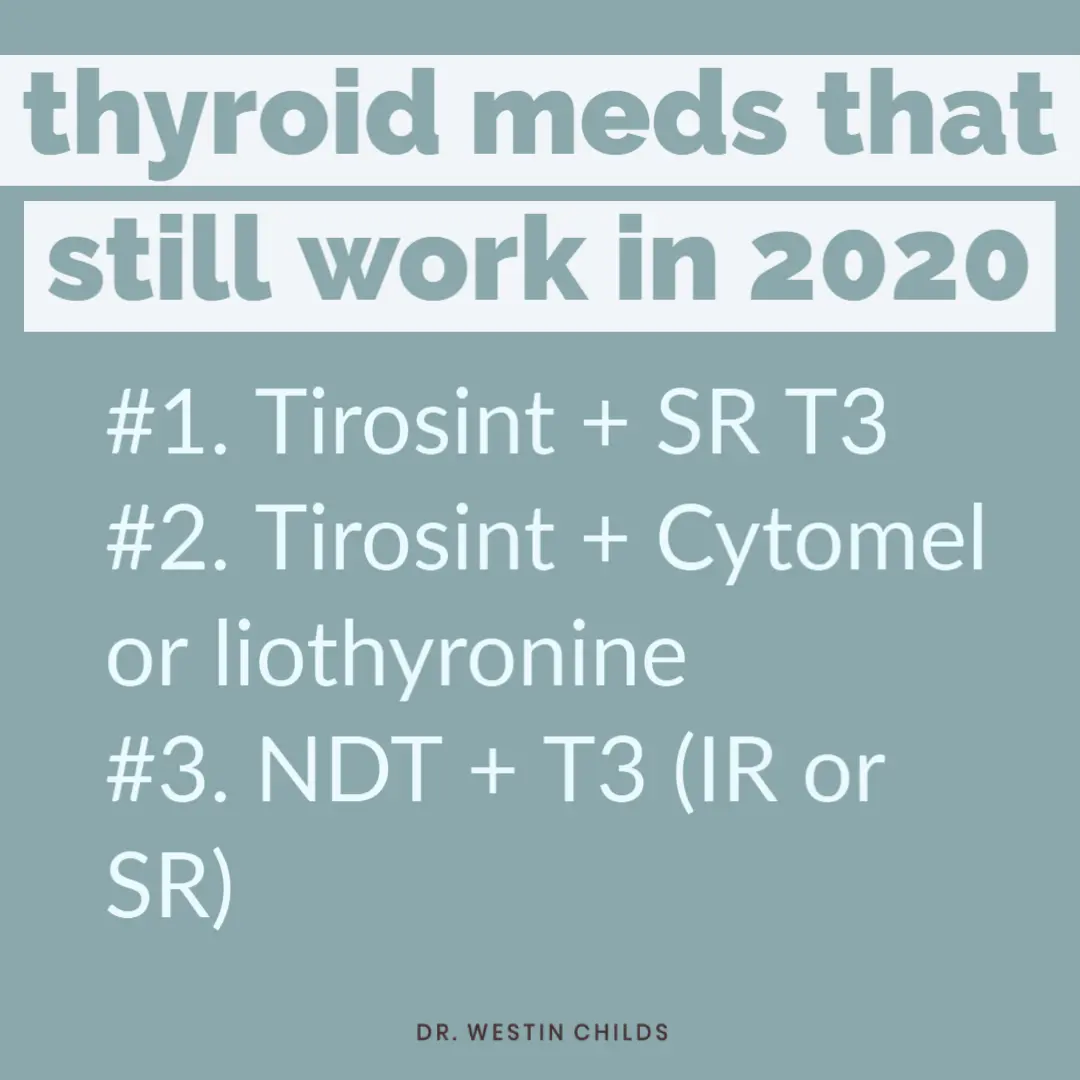
At any given time, I see these recommendations working for probably around 70-80% of thyroid patients:
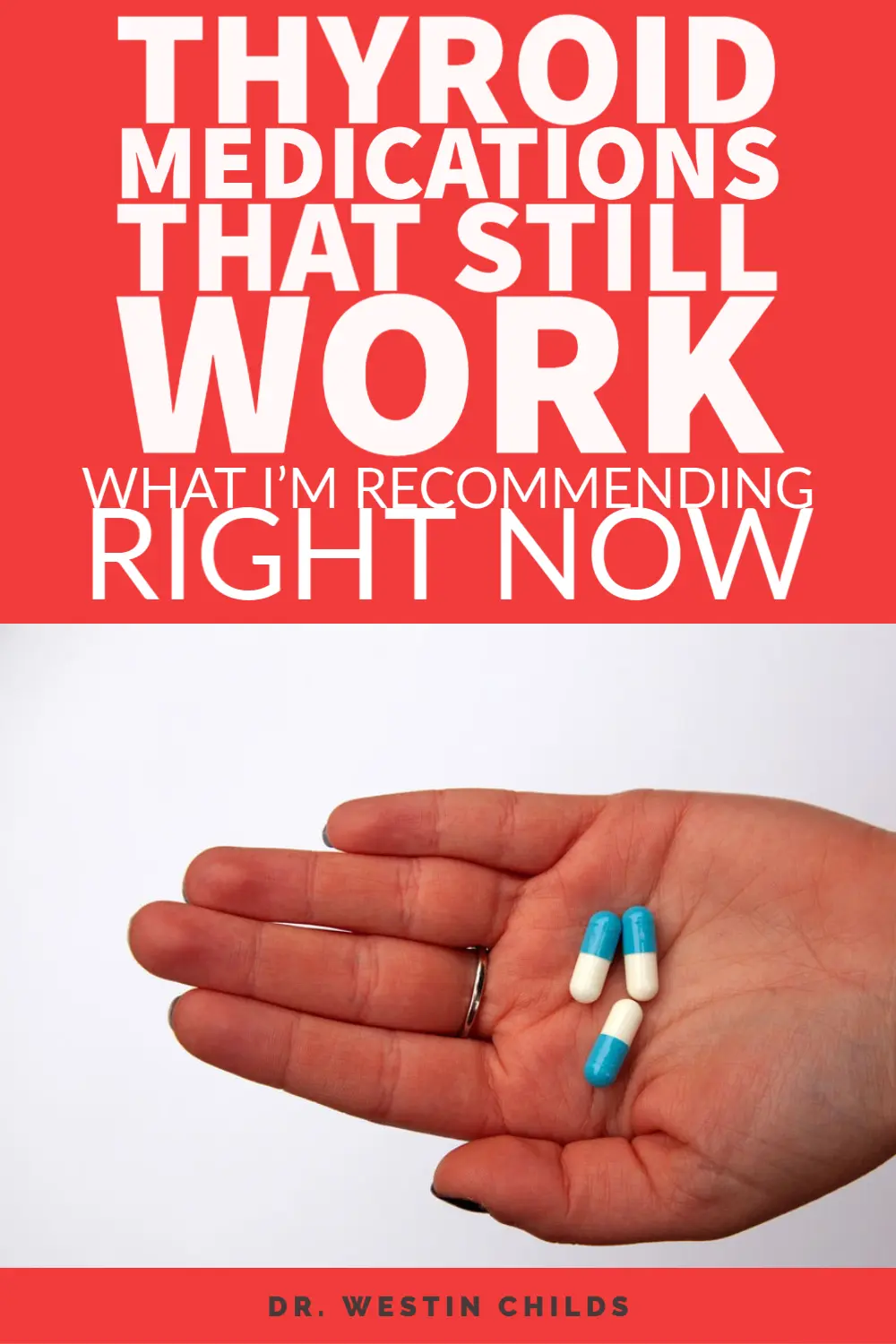
- Option #1: Tirosint + SR T3 – Tirosint is a T4-only thyroid medication in a gel cap that is highly absorbable. SR T3 is a sustained-release T3 thyroid medication that comes from a compounding pharmacy.
- Option #2: Tirosint + Cytomel/liothyronine – This combination replaces SR T3 (sustained release T3) with an immediate release version of T3 in Cytomel and/or liothyronine.
- (Potential option for some) NDT + Cytomel/liothyronine – Finally, if you are someone in whom NDT is still working well, you can use the combination of immediate release T3 in conjunction with your NDT dose. I find the most success with NP thyroid but I still see that Armour thyroid can work for certain people. Currently, Nature-throid and WP thyroid are not available so your only options are Armour thyroid or NP thyroid. If (and when) WP thyroid comes back into stock, it will likely take the place of Armour thyroid as my primary recommendation.
If you are new to the thyroid game, then these medications might look completely foreign to you.
The medications that I recommend are often not prescribed and may not even be anywhere on the radar or in the wheelhouse of traditionally trained doctors such as endocrinologists and family practice doctors.
Having said that, there are still ways that you can get them as long as you go to the right type of doctor.
Why I Recommend These Combinations
Let me go into a little more detail on why I like these particular combinations of thyroid medications.
#1. Ability to titrate individual T4 and T3 levels
One of the biggest benefits of using individual T4 and T3 thyroid medications is that you can easily adjust the dose of each one.
I find that the T4 and T3 levels that each person needs vary quite a bit.
I have seen two people who are very similar in terms of their history need completely different doses of T4 and T3.
Someone might be able to get away with 75mcg of T4 and 25mcg of T3 while another person may need 25mcg of T4 and 5mcg of T3.
The good news is that you can easily adjust doses on each thyroid medication to accommodate.
Individual tweaking of Tirosint and SR T3 allows for adjustments and titrating for thyroid patients.
#2. These thyroid medications are cleaner than many alternatives
One of the biggest problems in recent years is the contamination of thyroid medications with fillers which can cause serious problems for thyroid patients.
For instance:
- Lactose monohydrate is found in levothyroxine and Synthroid which cause problems for people with lactose intolerance
- Lactose is now found in WP thyroid and Nature-throid when these medications used to be some of the cleanest forms of NDT available
- Changes in the inactive ingredients in NP thyroid [3] have caused problems for many thyroid patients recently
Even small changes in these inactive ingredients can result in inflammation in the gut, inflammation in the body, and reduced absorption of thyroid medication in sensitive patients.
For this reason, I often recommend just starting right away with Tirosint because most patients feel much better.
SR T3 is not the most easily absorbed thyroid medication out there but it is cleaner in terms of inactive ingredients.
The reason is, the inactive ingredients can be closely controlled by the pharmacy which compounds the medication.
The combination of SR T3 and Tirosint means you get fewer inactive ingredients which can interfere with your gut and thyroid medication absorption.
#3. Tirosint is highly absorbable compared to other thyroid medications
Another benefit of using Tirosint is that you don’t have to worry as much about interference in thyroid medication absorption.
Tirosint is a T4-only thyroid medication but is the second cleanest thyroid medication on the market (second only to Tirosint-Sol).
It only contains 4 ingredients in total.
Thyroid patients are conditioned to constantly think about when they need to take their thyroid medication and what other things may interfere with its absorption.
If you are taking Tirosint then these issues are not nearly as important.
Because Tirosint contains so few inactive ingredients, and because it comes in a gel cap, it’s highly absorbed compared to typical formulations like levothyroxine.
We even have studies showing that Tirosint can be fully absorbed even if taken with food [4] or with coffee.
This isn’t true of SR T3 or liothyronine/Cytomel, but if you end up using Tirosint you don’t have to worry as much about when you eat/drink after you take your medication.
This also applies to supplements, by the way (with the exception of iron and calcium)!
#4. NDT formulations may contain lactose and other fillers which can limit their effectiveness
You may be wondering why I am bearish on NDT compared to other formulations and the reason is simple:
NDT formulations have seen a continual decline in terms of effectiveness over the last 5-6 years.
As I mentioned above, it doesn’t mean that they don’t work or that they are completely useless but it does mean that their quality has been dramatically reduced.
I used to regularly recommend NDT as first-line therapy for most thyroid patients but I have since stepped away from that type of recommendation.
There are well-documented problems with NP thyroid, WP thyroid, Nature-throid, and even Armour thyroid.
It also doesn’t seem like the pharmaceutical companies that are in charge of these medications take the problems very seriously and are willing to revert the changes they have made thus far.
Thyroid Medication Availability and Alternatives
At the time of this writing (in 2025, both Nature-throid and WP Thyroid are still “temporarily unavailable” per the manufacturer’s website.
As a result, many thyroid patients using these medications had to switch to either Armour thyroid or NP thyroid.
This switch has resulted in many issues with the resurgence of many low thyroid symptoms that were previously controlled.
This sort of thing is not uncommon for thyroid patients because they will often find that one thyroid medication (even in the same class of NDT) works better for them compared to others.
If you happen to be someone who does well on Armour thyroid or NP thyroid then you are in luck.
If not, then it may be time to seek out synthetic thyroid medications, at least for the time being.
You can create an NDT-like blend using some unique ingredients including:
- Thyroid glandular supplements – Thyroid glandular supplements
- T2 thyroid hormone – You can get T2 thyroid hormone over the counter in supplements like this. This supplement provides a higher dose of T2 compared to what is found in each NDT grain.
- Synthetic T4 & T3 thyroid medications – You can add any combination of synthetic T4 and synthetic T3 in the doses you require.
This blend gets you pretty close to what is included in NDT formulations like Nature-throid and allows you to more finely adjust the dosing of each.
Choosing a Thyroid Medication Regimen
You should know that just because I am recommending these thyroid medications doesn’t mean that you HAVE to use them.
It also doesn’t mean that other formulations aren’t working, because they definitely still are.
I know from experience that thyroid patients are feeling great on all types of formulations of thyroid medications including NDT.
When I recommend medications to thyroid patients I am always thinking about what will work BEST for the thyroid gland.
On a general blog post like this, I can’t really take into account important factors such as cost or availability.
These factors may be incredibly important in your case and may limit your ability to use these recommendations.
Tirosint, for instance, is not covered by most insurance plans and is quite expensive if you are paying out of pocket.
But just because it’s expensive doesn’t mean it should be avoided, because I feel that the expense is worth it for most thyroid patients.
It also might not be possible to get certain NDT formulations or T3 formulations depending on which country you live in.
I know, for instance, that getting T3 thyroid medication is hard in the UK but relatively easy in the US.
So remember these considerations as you read this!
But now I want to hear from you:
What type of thyroid medication(s) are you using right now?
Are they working well for you? Would you recommend them to others?
Have you had any recent issues with medications that USED to work but which are now not working?
If so, share your story and experience below!
Scientific References
1. Acella Pharmaceuticals, LLC Issues Voluntary Nationwide Recall of Certain Lots of NP Thyroid® (Thyroid Tablets, USP) Due to Super Potency | FDA.
2. Westminster Pharmaceuticals, LLC. Issues Voluntary Nationwide Recall of Levothyroxine and Liothyronine (Thyroid Tablets, USP) Due to Risk of Adulteration.
3. NP Thyroid current product information. The original product-update page is no longer available.
4. Bernareggi A, et al. (2013). Oral liquid formulation of levothyroxine is stable in breakfast beverages and may improve thyroid patient compliance. Pharmaceutics. doi:10.3390/pharmaceutics5040621.