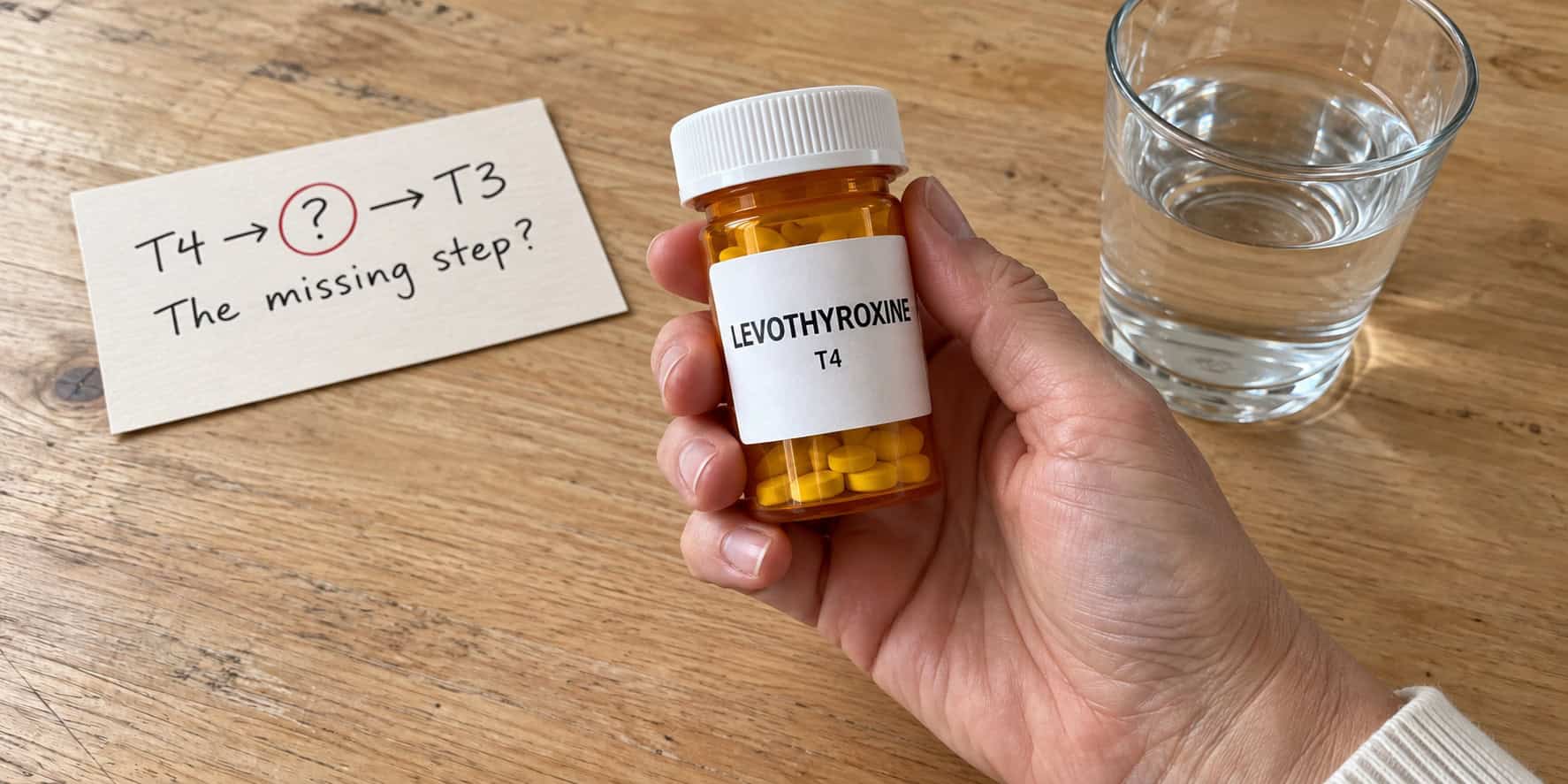

Go grab your thyroid medication right now and look at the label.
If it says levothyroxine, Synthroid, Tirosint, Unithroid, Levoxyl, Euthyrox, or any generic version of levothyroxine, you’re taking T4 thyroid hormone.
And in case you didn’t know, T4 is an inactive thyroid hormone.
On its own, it doesn’t do much. Before your cells can use it, your body has to convert it into the active thyroid hormone known as T3[1].
The step between taking it and using it
Your body converts T4 into T3.
Simplified illustration of normal thyroid hormone conversion. American Thyroid Association
This small, simple step is the reason that so many thyroid patients feel poorly despite having been told their labs are normal.
Because if your body can’t do it, you can take all of the medication you want, but it won’t get inside your cells and turn on the cellular functions that control your metabolism, hair growth, energy, and mood.
This conversion step is well documented and proven in research studies, but there’s one big problem:
The average endocrinologist or primary care doctor isn’t looking for it.
But you don’t need your doctor to tell you you have this problem.
You can look for these signs:
#1. You Have Normal Labs, But You Still Feel Hypothyroid
This is the most common sign, and it’s one that you probably didn’t even realize was a symptom.
If you’ve been told that your labs are “normal”, but you don’t feel like your old self, pay attention!
Your doctor is trained to check your TSH (and maybe your free T4, if you’re lucky) but only looks at whether you fall into the standard reference range.
This range is what is considered “normal” by lab testing companies, but it’s certainly not considered “optimal” for thyroid patients.
Here’s how we know:
For decades, thyroid patients and thyroid experts have been aggregating data from thyroid patients on various types of thyroid medications.
We know which thyroid patients feel their best and which don’t. And we also know what thyroid medications (and doses) are being used in both cases.
As a result, several patterns emerge:
Thyroid patients who take T4-only thyroid medications like levothyroxine, Synthroid, Tirosint, and so on, all feel worse compared to thyroid patients who take a combination of T4 plus T3 (two different thyroid medications together).
Doctors may be surprised to hear this, but patients aren’t. Especially when they figure out that a healthy thyroid gland produces about 80% T4 and 20% T3.
When a thyroid patient takes both of these hormones together, they are mimicking what the healthy thyroid gland does in people without a thyroid problem.
It’s not rocket science.
It’s a sign that your body is low on the most powerful thyroid hormone that exists in the human body: T3[2][3].
If this sounds like you and you’ve been told your labs are normal, but you have any of the signs on this list, think conversion problem.
In my experience of helping thousands of thyroid patients, I’ve found that patients feel better if their T3 level is in the upper 1/3 of the reference range.
What patients are reporting
Still taking medication. Still struggling.
In a UK survey of 1,251 adults taking thyroid hormone replacement, these were the most common top complaints besides fatigue:
Share choosing each as their most troublesome symptom other than fatigue. Online patient-support-group survey; 98% women. These are not prevalence estimates for all thyroid patients and do not establish the cause of symptoms. Grixti et al., European Thyroid Journal, 2025.
#2. You’re Miserable When You’re Cold
T3 is the hormone that sets how much heat your body produces [4].
You can think of your thyroid like your body’s thermostat. When T3 is low, that thermostat gets turned down.
Instead of your cells naturally producing energy and heat throughout the day while you eat, breathe, sleep, and think, everything is slowed down.
If you slow down everything in your body by even 10-15%, you’ll not only subjectively feel sluggish, you will also physically feel cold to the touch.
The name for this symptom is cold intolerance.
You’ll feel this as being cold when everyone else is comfortable, needing to wear socks to bed, or wearing a sweater in the middle of the summer.
Not only will you feel cold, but you will also be highly irritable.
This sign is also 100% testable. All you need is a basal body thermometer.
If you check your temperature and it’s below 97.8 degrees, it’s probably a conversion problem with low T3.
#3. You’re Gaining Weight, and It Won’t Come Off
It’s easy to blame weight gain on eating too much of the wrong foods, but for thyroid patients, that’s a sloppy explanation.
Do you think the average thyroid patient suddenly starts eating the wrong foods once they are diagnosed and that this is the cause of their weight gain?
Or do you think that the hormones that control metabolism are at least partly (if not fully) responsible for their weight gain and inability to lose weight?
If you’re eating well and exercising regularly and the scale still won’t move, this is a sign that you aren’t converting.
T3 is the hormone that sets how many calories you burn at rest.
And even small changes in T3 levels, all within the “normal” range, are linked to differences in body weight[5].
By the way, the solution to thyroid weight gain isn’t cutting your calories, as that can make your problem even worse.
It’s to optimize your T3 level first.
#4. You’re Tired All Day But Energized at Night
Does this sound familiar?
You wake up tired, even after a full night of sleep. You need coffee or caffeine just to get up and going. And by 2- 3 pm, you hit a wall.
But when you finally lie down at night, your mind won’t shut off, and you can’t get the rest that you need.
This pattern usually means two things are happening at the same time:
You aren’t converting your T4 into T3, and your cortisol is higher than it should be.
This is the stress-thyroid connection, and it happens when your body starts turning more of your T4 into reverse T3, which leaves less active T3 for your cells to use.
#5. Your Hair is Thinning, And You’re Missing Part of Your Eyebrows
T3 thyroid hormone acts directly on your hair follicles and helps keep them in the growth phase[6].
If your T3 is low, more of your hair follicles enter the dormant phase.
Fewer follicles in the growth phase and more in the dormant phase means your hair starts to thin, especially around the eyebrows.
But not your entire eyebrow, only the outer 1/3 area, on the tail end.
Doctors have used this as a sign of low thyroid for more than 100 years [7].
Why More Medication Isn’t Always the Answer
If you have these symptoms, you might be thinking that your next step is to raise your dose of thyroid medication.
And while this may help some people, it doesn’t help someone with a thyroid conversion problem.
If you take more levothyroxine that you can’t convert into T3, you’re just adding fuel to the fire.
Instead of creating T3, your body will take that T4 and create more thyroid-blocking reverse T3.
This is the cycle that thyroid patients get stuck in:
Endless increases and decreases in thyroid medication doses based solely on the TSH.
You can break this cycle by adding T3 thyroid medication to your regimen, but doctors really don’t like to prescribe this medication because they aren’t familiar with it.
And on top of that, T3 meds like liothyronine and Cytomel come with a long list of potential side effects if they aren’t dosed correctly.
But there is something that can help:
Critical Finding: What Helps The Body Convert T4 into T3
Putting back into your body the exact nutrients that it requires to create and convert T4 into T3 on its own.
It’s not a novel or crazy idea; it’s just giving back to your body the things that it needs to function on its own.
The thyroid conversion process depends on a few specific nutrients and on keeping both stress and inflammation under control.
Here’s what the research says about minerals and thyroid conversion:
Selenium
The enzymes that turn T4 into T3, known as deiodinases, require selenium to function[10][11].
The body stores and concentrates selenium in the thyroid gland, where it gets used up in cases of thyroid dysfunction and thyroid gland inflammation.
If you’re low in selenium, T4 to T3 conversion will be slowed, and your gland will be less able to protect itself against oxidative damage.
Zinc
Zinc helps your thyroid gland create T3, and it’s required for thyroid hormone to bind the nucleus of your cells and to turn on genetic transcription[8].
In a 12-week trial of overweight women with hypothyroidism, zinc raised free T3 and improved the ratio of free T3 to free T4, which is a direct marker of conversion [12].
Two minerals. Two important jobs.
Make T3. Then respond to it.
These are normal nutrient roles, not a measured response to supplementation. Sources: selenium and zinc.
Guggul
Guggul is a resin from a tree native to India.
In animal studies, it increased T3 production and helped reverse low thyroid function [13][14].
Thyroid patients who take it also report an improvement in thyroid-related symptoms like cholesterol, acne, and weight.
Ashwagandha
Ashwagandha is an adaptogenic herb that helps your body respond to cellular stress and cortisol.
In an 8-week placebo-controlled trial of patients with elevated TSH, ashwagandha lowered TSH and raised both T3 and T4 [15].
It’s thought to work directly on mitochondrial energy production to support energy and in the brain, where it can help support brain fog.
Vitamin A
Vitamin A helps to regulate the hypothalamic-pituitary-thyroid axis.
It’s required to form the retinoic acid receptor, which attaches to the thyroid hormone receptor and allows thyroid hormone to turn on the cell.
In other words, it helps the thyroid hormone you have in your body work more effectively.
In a 4-month trial, women who took vitamin A saw their TSH go down, and their T3 increase [16].
Iodine
Your thyroid uses iodine to make both T4 and T3 [17].
The key to using iodine correctly is all about the dose.
Taking an excessively high dose can make some thyroid conditions worse[9].
You could buy all of these separately and try to figure out the right doses yourself, or you can take one formula that combines them:
T3 Conversion Booster
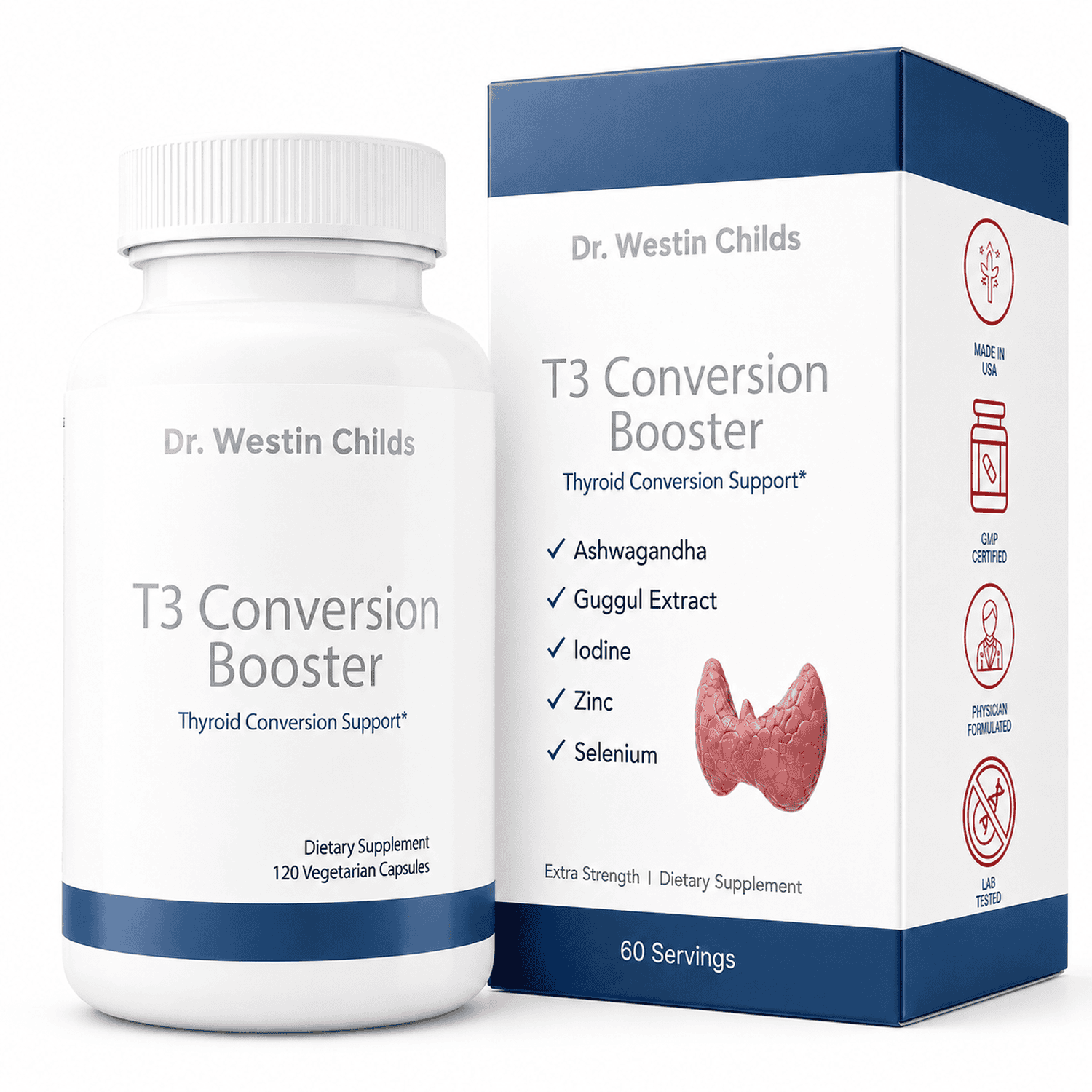
I put every one of these nutrients into a single formula made for thyroid patients.
Here’s exactly what’s in each 2-capsule serving:
- Guggul extract (500 mg): the herb that increased T3 production in the animal studies above.
- Ashwagandha root extract (200 mg, 2.5% withanolides): helps your body handle stress and cortisol, which push more of your T4 toward reverse T3.
- Selenium (100 mcg, as L-selenomethionine): the mineral your conversion enzymes need to work.
- Zinc (5 mg, as zinc citrate): helps your body make T3 and helps your cells respond to it.
- Vitamin A (450 mcg, as retinyl palmitate): helps the T3 you make work inside your cells.
- Iodine (75 mcg, from organic kelp): a small dose, well under the 300 mcg upper limit.
- Vitamin E (33.5 mg, as d-alpha tocopheryl succinate): an antioxidant that helps protect your thyroid gland.
- Rosemary leaf extract (50 mg, 5% rosmarinic acid): another antioxidant, with anti-inflammatory effects.
- Vitamin D3 (5 mcg, 200 IU): a small daily amount.
It’s also:
- Third-party tested. Every lot is tested for heavy metals, pathogens, bacteria, mold, and yeast.
- Free of common allergens. No wheat, gluten, soy, dairy, eggs, fish, shellfish, peanuts, or tree nuts.
- Free of anything artificial. No artificial colors, sweeteners, or preservatives.
- Made in the USA.
Here’s how to use it:
- Take 2 capsules each morning, any time before noon.
- If you take thyroid medication, take it 30-60 minutes before or after your dose.
- It can be used with levothyroxine, Synthroid, Cytomel, liothyronine, and NDT like Armour Thyroid and NP Thyroid.
Thyroid Patient Outcome Reporting from T3 Conversion Booster
Based on internal reporting of T3 Conversion Booster, here’s what thyroid patients report when using T3 Conversion Booster:
- 87.2% were satisfied with it overall
- 70.4% reported relief from thyroid symptoms like fatigue, brain fog, or feeling cold
- 48.4% said they felt like themselves again
- 34.8% have taken it long-term
You can read the full Patient Outcomes Report.
What Thyroid Patients Are Saying
“This product has been life changing. Most of all I notice help with brain fog and afternoon fatigue. I notice a MAJOR difference when I have forgotten to take it a couple days in a row.”
“After 3 months of using, my thyroid bloodwork came back improved, my T3 was higher. I have more energy and the afternoon slump has decreased. My doctor said keep taking it.”
“I have not had an elevated T3 in over two decades. I cannot take Cytomel. I have not had consistent energy on a daily basis in over two decades. I can never stop taking this.”
“My experience has been fantastic. I have way more energy, no hair shedding and I overall feel 100% better. I just ordered three more months of the T3 Booster.”
“The biggest change is having the energy to do more than the absolute essential tasks. It is enjoyable to be with friends now rather than wanting to go home and take a nap.”
Try it with confidence
60 days. 100% money-back guarantee.
I’m here to help thyroid patients, which is why every purchase of T3 Conversion Booster comes with a 60-day money-back guarantee.
It either works and helps you finally start to feel better, or you can return it for a full refund with a few clicks.
No hoops to jump through and no long phone calls required. If you don’t like it, for whatever reason, you just find your order on our online returns page, and with a few clicks, you’re done.
Is T3 Conversion Booster Right For You?
If you’ve been told your labs are “normal,” but you still feel terrible…
If you’re cold, tired, and losing hair even though you take your medication every day…
If you’ve cleaned up your diet and the scale still won’t budge…
Then your body may not be converting your thyroid medication, and T3 Conversion Booster can help.
One bottle is a 60-day supply for $43.99, which works out to about 73 cents a day.
You can get started here:
Scientific References
1. Nussey S, Whitehead S. (2001). The Thyroid Gland. In: Endocrinology: An Integrated Approach. BIOS Scientific Publishers.
2. Gullo D, et al. (2011). Levothyroxine monotherapy cannot guarantee euthyroidism in all athyreotic patients. PLoS One. doi:10.1371/journal.pone.0022552.
3. Saravanan P, et al. (2002). Psychological well-being in patients on ‘adequate’ doses of l-thyroxine: results of a large, controlled community-based questionnaire study. Clinical Endocrinology. doi:10.1046/j.1365-2265.2002.01654.x.
4. Silva JE. (2006). Thermogenic mechanisms and their hormonal regulation. Physiological Reviews. doi:10.1152/physrev.00009.2005.
5. Knudsen N, et al. (2005). Small differences in thyroid function may be important for body mass index and the occurrence of obesity in the population. Journal of Clinical Endocrinology and Metabolism. doi:10.1210/jc.2004-2225.
6. van Beek N, et al. (2008). Thyroid hormones directly alter human hair follicle functions: anagen prolongation and stimulation of both hair matrix keratinocyte proliferation and hair pigmentation. Journal of Clinical Endocrinology and Metabolism. doi:10.1210/jc.2008-0283.
7. Tekiner H, et al. (2026). Eugene Hertoghe (1860-1928): Pioneer in endocrinology and the treatment of hypothyroidism. Journal of Medical Biography. doi:10.1177/09677720241307877.
8. Betsy A, et al. (2013). Zinc deficiency associated with hypothyroidism: an overlooked cause of severe alopecia. International Journal of Trichology. doi:10.4103/0974-7753.117690.
9. Markou K, et al. (2001). Iodine-induced hypothyroidism. Thyroid. doi:10.1089/105072501750362730.
10. Köhrle J. (2015). Selenium and the thyroid. Current Opinion in Endocrinology, Diabetes and Obesity. doi:10.1097/MED.0000000000000190.
11. Ventura M, et al. (2017). Selenium and Thyroid Disease: From Pathophysiology to Treatment. International Journal of Endocrinology. doi:10.1155/2017/1297658.
12. Mahmoodianfard S, et al. (2015). Effects of Zinc and Selenium Supplementation on Thyroid Function in Overweight and Obese Hypothyroid Female Patients: A Randomized Double-Blind Controlled Trial. Journal of the American College of Nutrition. doi:10.1080/07315724.2014.926161.
13. Panda S, Kar A. (1999). Gugulu (Commiphora mukul) induces triiodothyronine production: possible involvement of lipid peroxidation. Life Sciences. doi:10.1016/s0024-3205(99)00369-0.
14. Panda S, Kar A. (2005). Guggulu (Commiphora mukul) potentially ameliorates hypothyroidism in female mice. Phytotherapy Research. doi:10.1002/ptr.1602.
15. Sharma AK, et al. (2018). Efficacy and Safety of Ashwagandha Root Extract in Subclinical Hypothyroid Patients: A Double-Blind, Randomized Placebo-Controlled Trial. Journal of Alternative and Complementary Medicine. doi:10.1089/acm.2017.0183.
16. Farhangi MA, et al. (2012). The effect of vitamin A supplementation on thyroid function in premenopausal women. Journal of the American College of Nutrition. doi:10.1080/07315724.2012.10720431.
17. Zimmermann MB, Boelaert K. (2015). Iodine deficiency and thyroid disorders. The Lancet Diabetes and Endocrinology. doi:10.1016/S2213-8587(14)70225-6.