

- Your symptoms are just as important as lab numbers when assessing whether your levothyroxine dose is adequate. If you feel hypothyroid despite normal TSH, your dose likely needs adjustment.
- Monitor free T3 and free T4 levels, not just TSH, because TSH alone misses cases where your body cannot properly convert T4 to active T3.
- Tirosint or Tirosint-Sol may work better than generic levothyroxine if you have absorption issues, histamine sensitivity, or persistent symptoms despite adequate dosing.
- The timing and form of levothyroxine matters for absorption. Taking it 30-60 minutes before breakfast on an empty stomach and avoiding certain supplements and foods in that window improves effectiveness.
- If levothyroxine alone does not resolve your symptoms despite dose optimization, adding T3 medication or switching to a combination therapy may be necessary.
How do you know if you are taking the right dose of levothyroxine?
The most simple way is to simply evaluate how you are feeling.
If your thyroid symptoms are 100% controlled then you know there’s nothing to worry about.
But if you are like thousands of other thyroid patients who continue to feel poorly despite taking their thyroid medication faithfully then there’s a good chance you aren’t taking enough.
What if you fall into that category? That’s where the information in this article steps in:
Are you on Levothyroxine and Still Experiencing Hypothyroid Symptoms?
It’s never normal for you to experience hypothyroid symptoms despite taking your thyroid medication.
But, what exactly is levothyroxine?
Levothyroxine is a form of thyroid hormone replacement medication and it is the most common medication used to treat hypothyroidism (low thyroid function).
This thyroid medication contains the inactive thyroid hormone T4 (also known as LT4 and Thyroxine).
If you are taking this medication to treat your sluggish thyroid, but still experiencing symptoms, then there may be a problem with your dose.
What do I mean by symptoms?
The symptoms of hypothyroidism include any or all of the following:
- Fatigue or exhaustion even after sleeping 8+ hours at night
- Weight gain or weight loss resistance (no matter how much you exercise or how little you eat)
- Depression, anxiety, or mood swings
- Problems with PMS, menstrual cycle, or low sex drive
- Chronic pain in the muscles and joints
- Cold extremities (hands and feet)
- Chronic constipation
These are the symptoms I am referring to whenever I mention the symptoms of hypothyroidism and these symptoms should be going away or reducing if you are taking thyroid medication such as levothyroxine or Synthroid.
In many cases, it’s not uncommon for patients to experience persistent symptoms of hypothyroidism despite using thyroid hormone medication.
But why is this?
This very problem exists as a result of how thyroid disease is managed.
The management of thyroid dysfunction is based largely in part on focusing on one single lab test known as the TSH.
This approach is fraught with problems and doesn’t allow for the variability required to treat each patient as an individual (2), but more on this later.
If you are frustrated with your current medical condition, frustrated with how you are feeling, or just plain confused about what is going on in your body, then this is the post for you.
We are going to discuss how you can start feeling better and how you can properly adjust your dose of levothyroxine to start feeling like “yourself” again.
How to Determine if your T4 Dose is Sufficient for Your Body
Each one of you has a different demand for thyroid hormone in your body.
And the demand for thyroid hormone depends on multiple factors including how much stress we are under, how much inflammation we are suffering from, the type of medications we are using, and so on.
Each of these will alter the amount of thyroid hormone that is necessary for our body and will, therefore, influence how much medication we need.
These factors must be taken into account when evaluating the dose of thyroid hormone that you will need.
So why do we treat every patient with thyroid disease in the exact same way?
Does it make intuitive sense that an 80-year-old patient would need the same amount of thyroid hormone as a younger individual in their 20s or 30s?
The answer is obviously no, but this is exactly how your doctor was trained to treat thyroid dysfunction.
Unfortunately, most doctors base all of their treatment recommendations, including the dosage of thyroid hormone on one single lab test known as the TSH.
TSH, which stands for thyroid stimulating hormone, is a marker secreted from your brain (the pituitary gland).
A High TSH is usually associated with hypothyroidism and poor thyroid function.
Most doctors base both diagnosis and treatment on this value.
But the problem is that newer studies are emerging that show that the pituitary TSH level is not a satisfactory mirror representation of thyroid hormone status in the body (3).
In addition, other factors, including the activity of deiodinase enzymes (4), may be more biologically active in certain individuals.
These studies finally shed light on what patients have been saying for a long time and why they are so unhappy with current thyroid treatment guidelines.
While this may sound confusing, don’t let it be, because the moral of the story is this:
You can’t create a one-size-fits-all treatment plan for all patients with thyroid dysfunction because each person is unique and may require a different dose and type of thyroid medication.
This sounds perfectly logical when we talk about it like this, but, for some reason, this logic doesn’t extend to all physicians and practitioners.
So how do you find your dose?
The best way to determine your “ideal” dose is to combine several different factors together to help paint a clear clinical picture of what is happening in your body.
These 3 steps will help you get started:
#1. Check Your Metabolism
Your Thyroid gland helps control your metabolism (5) (about 60% of it anyway) and can be used as a surrogate marker for thyroid function.
The lower your thyroid function the lower your metabolism will be.
This effect stems from how thyroid hormone (especially T3) influences the mitochondria in your body which influence how much energy you will burn at rest (6).
If you struggle with hypothyroidism you may have noticed that it is difficult to lose weight.
Weight loss resistance stems from a lower-than-normal metabolism and may be part of the reason you can’t lose weight.
So, if thyroid hormone is involved in regulating your metabolism, doesn’t it make sense that taking thyroid medication should improve your metabolism?
The answer is a resounding YES!
Following this logic, then, it makes sense to check your metabolism as you take thyroid medication to determine if it is working, right?
But the question is:
How do you do it?
A quick and easy way to test your metabolism is to check what is known as your basal body temperature each morning.
Your basal body temperature is a reflection of how much energy or heat you are producing at any given time and this can be used, indirectly, as a crude measure of metabolism (7).
But, let me be clear:
It’s not a perfect way to assess your metabolism and there may be other factors that influence your body temperature including your cycle and even certain medications.
But it’s better than nothing and it’s relatively cheap and easy to test which makes it worth looking into.
All you need is a thermometer and a pen and paper by your bed to measure it each morning.
The best way to check your basal body temperature is first thing in the morning right after you wake up.
As you take thyroid hormone your body temperature should increase over time, but it may take up to 1-2 months to notice the difference.
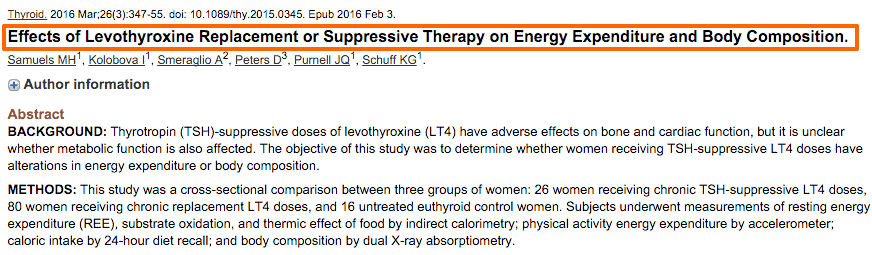
Some studies have shown that despite using levothyroxine (8) (and suppressing the TSH) resting energy expenditure (a measure of metabolic function) does not “normalize” to healthy adult levels.
If you find that this is happening to you, then it may be an indication that you either need to alter your dose or consider altering which medication you are taking.
#2. Follow Your labs (Including Free Thyroid Hormones)
While the TSH may not be the most valuable lab test to evaluate your thyroid that doesn’t mean that other lab tests don’t have value.
In fact, it is just the opposite.
When you are treating your thyroid with medication you should periodically evaluate your free thyroid hormone levels.
You can do this by ordering Free T3, Free T4, and Total T3 (9).
These lab tests provide a window into your body and can help you determine if your dose is sufficient.
The hallmark of hypothyroidism is a reduction in Free T4 and an elevation in TSH (typically, but not always the case).
As you take levothyroxine your Free T4 should increase.
Why?
Because levothyroxine contains the same thyroid hormone that your body produces naturally.
If you are taking thyroid medication and you only see a drop in your TSH without a simultaneous rise in your free T4, then your medication dose may not be sufficient.
It’s critical that your body has sufficient Free T4 levels because it uses T4 to create T3 through the conversion process.
Low levels of T4 may result in decreased T3 and further issues down the road.
It may seem obvious to you that it’s necessary to look at the free hormone concentration in your body, but it’s not always obvious to doctors.
But it should be, especially if you think about it.
When we evaluate all other hormones in our bodies we always look for the direct hormone concentration in the bloodstream (10).
Hypothyroidism is the only hormonal condition in which we evaluate the pituitary marker instead of the free thyroid hormone.
Take for instance testosterone:
If you have low testosterone and you take testosterone medication, doesn’t it make sense to check your testosterone levels to see if they have improved?
It makes perfect sense and that’s exactly what your doctor should be doing.
#3. Monitor Your Symptoms
Another tool you can use to determine if your dose is sufficient is how you are feeling otherwise known as your clinical symptoms.
The symptoms of hypothyroidism occur as a result of decreased circulating thyroid hormone in the cells of your body.
Symptoms such as hair loss, fatigue, weight gain, depression, and constipation all occur directly because of low thyroid hormone.
What does this mean for you?
It means that as you replace this lost hormone these symptoms should subside and completely go away over time.
In this way, you can utilize them as a very useful marker to determine if your dose is sufficient.

Your symptoms represent another crude way you can monitor your dose and they should correlate directly with your lab tests and your basal body temperature.
It’s important to realize, though, that there may be some overlap in some of your symptoms with other medical conditions.
For instance:
Fatigue is a very non-specific symptom that can be associated with many medical conditions (11).
The same is true for constipation and hair loss.
But when you put all of these symptoms together (the more you have the more likely you can be sure they are caused by your thyroid) and you are experiencing all of them you can be more certain they are related to your thyroid and not to some other medical condition.
By evaluating all three of these important factors you can easily monitor your “success” and determine if your dose of thyroid hormone is adequate for your body.
As you go through the motions, you may realize that the amount of thyroid hormone that you need is different from other people.
That’s okay and it is to be expected.
Levothyroxine VS Armour Thyroid VS Liothyronine
As you probably know there are several different types of thyroid hormone medications that are currently available.
Unfortunately, most doctors give out the same medication: levothyroxine or Synthroid.
Both of these medications contain the inactive thyroid hormone T4 and in order for it to be active in your body, it must be converted to the active T3 thyroid hormone (this process is known as T4 to T3 conversion).
So why haven’t you ever heard of this before?
Doctors operate under the assumption that all patients convert T4 to T3 at an equal rate which means that they don’t feel this conversion process should be taken into account.
But there is one problem with this philosophy:
It’s not true. In fact, up to 15% of people have been shown, due to their genetics, to have a problem with this conversion process (12).
As a result, many patients are taking the wrong type of medication which may explain why they don’t feel well and aren’t experiencing any improvement.
And that’s where the other thyroid medications come in…
Many patients do very well using combination thyroid medications that contain both T4 and T3, not just T4 medication alone.
And I’m not just saying this from experience, most patients also agree that medications containing T3 are superior…
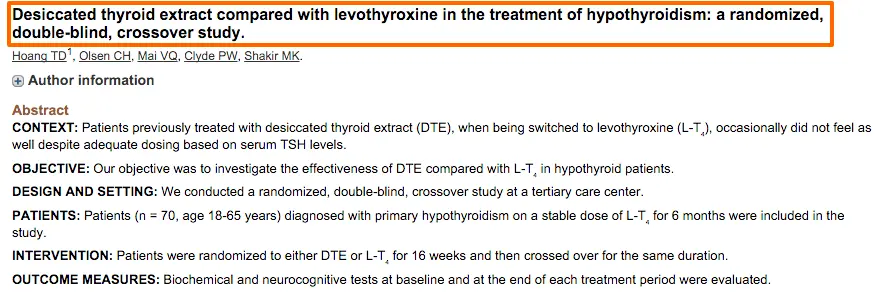
In clinical studies, many patients prefer natural desiccated thyroid hormone (13) (thyroid hormone that contains T3) over T4 medication alone.
The study shown above highlights why this is the case.
As patients switch from taking LT4 medication to thyroid extract they tend to experience a better quality of life and more weight loss.
This is felt to be secondary to the increase in free T3 and free T4 levels which can remain low even if the TSH is considered to be normal (14).
I’ve personally also found this to be the case in my practice as I transfer patients from LT4 medications over to NDT and T3 thyroid medications.
The patients who make the switch tend to experience more energy, less hair loss, more weight loss, and so on.
What to do if you have Hypothyroid Symptoms on Levothyroxine
So what should you do if you are taking levothyroxine or another T4 medication and your body temp is low, your heart rate is low and you are still symptomatic?
The good news is that there are several tips and tricks you can follow to make your current dose more effective (even if you can’t switch medications entirely).
When it comes to levothyroxine, this medication is actually quite difficult for your body to absorb and this may account for a significant number of problems when taking it (15).
So, even if you are taking your thyroid medication faithfully, it doesn’t matter unless you are also absorbing it in your gastrointestinal tract.
There are several steps you can take to improve the absorption of levothyroxine which may have an effect on how you feel.
At best you absorb about 80% of the thyroid hormone that you ingest (16).
But this number rapidly reduces in the setting of GI-related problems, inflammation, low stomach acid, and other intestinal issues.
Anyone who is suffering from constipation, gas/bloating, acid reflux, diarrhea, abdominal pain, gastric ulcers, low stomach acid, etc. may have reduced absorption of their medication.
This is complicated further by other medications and supplements which may reduce thyroid hormone absorption if not taken at the correct time.
So let’s talk about how you can impact the absorption component and get more “bang” for your buck so to speak.
#1. Levothyroxine 50mcg tablet
The 50mcg tablet of levothyroxine may be better absorbed and assimilated compared to other doses.
Why?
Because each dose of levothyroxine contains different colors, dyes, fillers, and otherwise inactive ingredients.
These fillers may act to cause symptoms by themselves (17) (which can be confused with hypothyroid symptoms), but they also reduce the absorption and effectiveness of thyroid hormone in your body.
The 50mcg tablet of Levothyroxine is special in that it is white and contains the fewest amount of fillers and additives when compared to the other dosages.
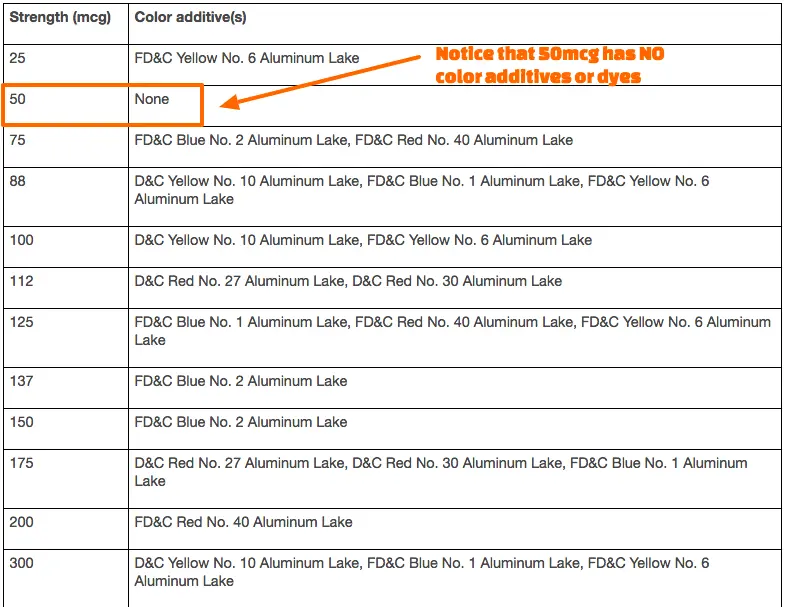
This presents a unique opportunity where you can switch your current dose of levothyroxine to 50mcg increments to potentially benefit from this.
Let’s say you are currently taking 150mcg of levothyroxine.
You could easily switch to taking 3 of the 50mcg tablets of levothyroxine which would be the same equivalent dose and get rid of all of the fillers/dyes in the process.
Make sense?
Something as simple as this change can actually improve how you are feeling.
Even better is that most physicians won’t have a problem with switching your dose.
#2. Consider switching to Tirosint or Tirosint-Sol
Tirosint and Tirosint-sol are two new T4-only thyroid medication alternatives.
Compared to levothyroxine, they are special because they contain the fewest inactive ingredients out of all available thyroid medications.
Tirosint contains a grand total of 4 total ingredients (3 inactive and 1 active) and Tirosint-sol contains a grand total of 3 total ingredients (2 inactive and 1 active).
The net result is that both are very easy to absorb and highly bioavailable (18).
Many patients report an improvement in their symptoms simply when making the switch from levothyroxine or Synthroid to Tirosint.
Compared to other thyroid medications (I’m looking at you, NDT formulations), it’s relatively easy to get your doctor to prescribe Tirosint medications because they are more similar to levothyroxine.
#3. Increasing Absorption of Thyroid Hormone And When to Take Your Thyroid Medication
If you are unable to switch to 50mcg increments of levothyroxine or if your provider isn’t willing to switch you to Tirosint there are still other steps you can take to improve absorption.
The first is to simply change the time of day that you take your thyroid medication.
Studies have shown that taking your thyroid medication at night can actually increase serum thyroid levels (19).
This is most likely due to the speed of your GI tract at various times of the day.
In the morning your GI tract is sped up which may limit the absorption of thyroid hormone.
At night your GI tract slows down which may allow for higher absorption.
In addition, your cortisol levels peak at 8 am in the morning (when most patients take thyroid hormone) which may also influence thyroid hormone metabolism.
It’s certainly worth a discussion with your current physician to determine if taking levothyroxine at night may help you.
The second option is to treat any GI-related problem that may be limiting your absorption.
By addressing conditions such as low stomach acid, SIBO/SIFO (very common in hypothyroid patients), and other GI-related problems you may be able to increase thyroid hormone absorption.
Do you need T3 medication?
By now you might be asking, do I need to be on medication containing T3?
The answer really depends on you, but I can help you figure it out…
In general, patients who should consider using Natural Desiccated thyroid hormone or T3-containing medications include:
- Those who don’t feel better on T4 only containing medications even after tracking their metabolism, symptoms, and lab tests
- Those who have not lost weight on levothyroxine or Synthroid
- Those who notice their symptoms getting WORSE despite increasing their dose of T4 medication
- Those with low serum-free thyroid hormone levels (low free T3 and low free T4)
If you fall into any of the above categories then it would be worth talking to your doctor about switching your medication to something that contains T3.
And don’t sweat it if your doctor isn’t willing to use Natural Desiccated thyroid because he/she may be open to using Liothyronine instead.
Liothyronine or Cytomel both contain pure T3 medications and can simply be added to your current dose of levothyroxine.
So let’s say you are taking 100mcg of T4 and you aren’t feeling well at all.
Instead of switching to 1-2 grains of NDT, you can simply add 5-10mcg of liothyronine or Cytomel to your current dose of levothyroxine.
Your regimen may look something like this:
- Levothyroxine 100mcg per day
- Liothyronine 10mcg taken twice per day for a total of 20mcg per day
This allows for roughly an 80/20 ratio of T4 to T3 which is similar to what the thyroid produces naturally.
Levothyroxine Dosage Chart and Comparison Table
So, what if your doctor isn’t willing to change medications or you really like being on levothyroxine?
Then make sure you are on the right dose!
Your dose should be based on the 3 step system I outlined above: Lab tests, symptoms, and your metabolism.
You can get to this dose by starting out with a low dose (around 25mcg per day) and then slowly increasing your dose and monitoring each of the steps.
From there you can check your lab tests every 6-8 weeks to follow your TSH, free T3, free t4, and reverse T3.
Dosing varies quite a bit based on the person but a typical dose may range between 25mcg and 250mcg of levothyroxine or Synthroid per day.
If you have continued to increase your dose beyond 150mcg and haven’t noticed ANY improvement in your symptoms then that may be a sign to consider switching medications.
If your doctor still isn’t willing to try NDT or T3-containing medications then you can also try other forms of T4 with fewer fillers like Tirosint and continue increasing your dose slowly over time.
If you are switching from T4 to another medication this comparison chart may be helpful:
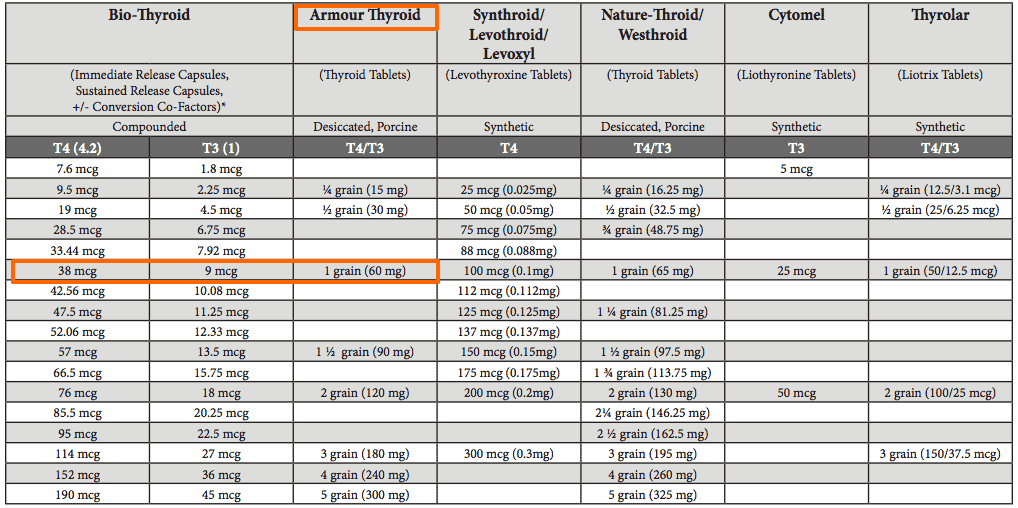
This chart isn’t perfect but it is a good starting place.
I find that the conversion from T4 to NDT or natural desiccated thyroid is too low (meaning you usually need more NDT to make it equivalent to the T4 dosing).
In my experience, 2 grains are closer to 100mcg of T4 than 1 grain, but it is important to start out slowly if you are switching medications because T3 can be VERY stimulating to some people.
Final Thoughts
Believe it or not, your dose of levothyroxine depends on multiple variables, all of which need to be considered to help reduce symptoms and help you feel better.
Remember that levothyroxine absorption plays a big role in how you may feel.
By switching your dosage to 50 mcg increments of levothyroxine or switching to Tirosint altogether you may improve your thyroid hormones.
Another option is to consider changing the time of day that you take your thyroid medication.
Lastly, you should also consider treating any GI-related problems that may be limiting your absorption as well.
If these options fail then you might consider the addition of T3-containing thyroid medications.
To get these medications you will need the assistance of a physician who is knowledgeable about thyroid function.
Now I want to hear from you:
Are you currently taking levothyroxine?
Do you feel that your dose is sufficient?
Have you attempted to use other thyroid medications?
What has worked for you? What hasn’t?
Leave your questions or comments below!
Scientific References
#1. https://www.ncbi.nlm.nih.gov/pmc/articles/PMC4267409/
#2. https://www.ncbi.nlm.nih.gov/pmc/articles/PMC5763098/
#3. https://www.ncbi.nlm.nih.gov/pmc/articles/PMC5763098/
#4. https://www.ncbi.nlm.nih.gov/pmc/articles/PMC1578599/
#5. http://www.ncbi.nlm.nih.gov/pubmed/24692351
#6. https://www.ncbi.nlm.nih.gov/pubmed/11174855
#7. http://www.ncbi.nlm.nih.gov/pubmed/19375759
#8. http://www.ncbi.nlm.nih.gov/pubmed/26700485
#9. https://www.ncbi.nlm.nih.gov/pubmed/22997973
#10. https://www.ncbi.nlm.nih.gov/pmc/articles/PMC4255853/
#11. https://www.ncbi.nlm.nih.gov/pmc/articles/PMC2766938/
#12. https://www.ncbi.nlm.nih.gov/pmc/articles/PMC3219766/
#13. http://www.ncbi.nlm.nih.gov/pubmed/23539727
#14. https://www.ncbi.nlm.nih.gov/pmc/articles/PMC5763098/
#15. https://www.ncbi.nlm.nih.gov/pubmed/19942153
#16. https://www.ncbi.nlm.nih.gov/pmc/articles/PMC4659333/
#17. https://www.ncbi.nlm.nih.gov/pubmed/26748887
#18. https://www.ncbi.nlm.nih.gov/pmc/articles/PMC3726924/
#19. https://www.ncbi.nlm.nih.gov/pubmed/17201800



Hi, my tsh was normal but my ft4 was high & my doctor refuses to test anything other than my tsh & ft4. Currently on 100mcg of levo. But still feel horrible & have all the classic hypo symptoms, what advice can you give me so I can better communicate with my doctor & start feeling better
Hello Dr Westin,
My experience with T4 only Doctors has been debilitating. I was a former cycling champ with no hypo symptoms to talk about. I averaged 12% @ 175 lbs during this time, up to age 54. My Doctor decided that due to a TSH OF 5.5 that I needed to be on syntroid for the rest of my life. Note: No other test contributed to this conclusion. Within 2 weeks of taking 100mcg Levo. I started to gain weight. After 2 months I was 20 pounds heavier @195 lbs and feeling like crap. I continued for over a year, and just kept getting worse. The whole time my Dr was saying that my numbers were perfect. I don’t recall a TSH of 2.0 perfect. I went to 2 other Endos, all from the same T4 only list of doctors because my Dr refused anything else. Finally I went to Bodylogic, at my own expense, $3900 worth of no results with a compounded T4/T3. I gave up hope on being normal so I discontinued all medication, but not the bike riding od an estm. 200 miles a week. One year I totaled 8500 miles riding to work and back, all year long. I still gained weight, and felt like crap with body temps going down to 91F. I average 96.5F first thing in the morning, and have yet to see 98.6 unless I have a fever. I am also very heat intolerant. My Dr sent me to a cardiologist last year, and he didn’t want to hear about a thyroid issue, he took a blind eye to it. I was given a stress test within a couple weeks, but the results were not posted on my patient account like all the other Drs that have posted results. I feel like a LAB RAT being used to make a profit and that I was deliberately pushed into a medically induced state of Hypothyroidism so that this medical facility can profit on the side effects. I have read about T3 ONLY and other therapy like Armour, but finding any Doctor is almost impossible, and going outside my Insurance will once again cost me $$$. By the way, my Doctor call these alternative Doctors, QUACKS! I beginning to wonder who the quacks really are. Now my Doctor want’s me on statin drugs . My answer to all his suggestions for the moment is that until he puts me back to normal, his services/advice will not be considered. Snake oil salesmen need to look for another job, people are hurting due to complications from their actions.
What advice do have?
I was a hyperthyroidism sufferer and I had my total thyroidectomy in early 2015. However, I’ve been feeling great but my TSH seems to disagree with my overall feelings. According to my lab result, my TSH level is about 8.0 (US scale). My physician increased my medication to 150 mcg. I really do wonder what is going on in my body. I feel happy and content. My period is regular including vitals. What do you think I should do? Refuse to take my new dosage?
Hi Jent,
As a rule of thumb your physician should never just treat your lab numbers, he/she should evaluate you in context based on a combination of all factors including your symptoms, labs, etc.
Good day,
I suffer with hypothyroidism and i have been on Lthyroxine tablets for the past 3-4 years. I was on 50 mcg per day then eventually on 100 mcg. I also take omez tablets for acid reflux on a daily basis. Since last year i have gained weight and its becoming very troubling for me. I did not change diet, I try to exercise when I can. I do still get symptoms of feeling cold, constipation at times, depression, insomnia. I was even thinking of to stop taking the Lthyroxine for awhile and see what goes on. I attend clinic for this every 6 months or so, I am due for a visit next month. When I do go, I wanted an idea of questions i should ask the doctor or if I could suggest to them what other blood test can I take to see if the medication is working properly for me. I am really bothered by the weight gain as I was at a constant weight for a number of years.
Could you please assist me with some advice/suggestions in my matter. Thanking you in advance… Regards….
Hi Rowena,
I have the appropriate tests listed on several blog posts on my site, if you poke around you will be able to find them. Just realize that if you have to ask your doctor for the tests there is a high chance that he/she will not be able to help you.
I was on Levothyroxine for 20 years. Now, I have Hashimotos. Started WP thyroid, got a lump in my throat in two days. Now, I am working with an ND who put me on Eco-Thyroid 125, and I have a lump in my throat. Increased by 39 mg and I still have a lump in my throat. TSH on 100 mcg Levo is 6.1, Antibodies are high. I am gluten and dairy free.
So frustrating!
Hi! I am currently drinking Novotiral which contains 100mcg of levothyroxine and 20 mcg of liothironine. The doctor told me the dosage is according to your weight. I gained weight and now I weigh 112 pounds so I don’t know if my dosage should go up.Thank you
Hello,
I want to make sure I am understanding your chart correctly. My doctor recently switched me from NDT to levo and liothyronine because my antibodies were increasing with the NDT. I was on two grain and she switched me to 100mcg of T4 and 25 mcg T3. If I understand your chart correctly my T3 medicine should be more at 50mcg and 200mcg levo. Am I correct? Thanks!
Hi Courtney,
The chart is more of a guideline than anything else, some people might have to reduce their dose when switching due to sensitivity to T3, etc. At the end of the day it’s more important to evaluate thyroid dosing based on labs and symptoms and not pre set ranges. Unfortunately there is no “perfect” dose equivalent.
I had an afib incident (first and only time). During the testing it was found my TSH level is 8.6. It was 4.0 three months earlier. I was prescribed 88mcg Levothyroxine. It should be noted at the time of my afib I felt fantastic. I working out 5 days a week and was in good shape. I have been on Levo for 4 1/2 weeks and I feel awful. My hands tremble. I feel faint several times a day. My arms and legs feel weak. And I can feel my heart poumding in my chest. My doctor told me she was starting me on the lowest dosage. Obviously that wasn’t true. I cut a pill in half (44 mcg instead of 88) today and I already feel better. Do you have an opinion on what is happening?
Hi Jeff,
It sounds like your physicians were assuming that your a fib episode was, at least in part, caused by the hypothyroidism. I generally don’t recommend treatment for hypothyroidism with thyroid hormone based on 1 TSH reading in the setting where someone is asymptomatic. Your current symptoms may be consistent with taking too much medication, but I’m not really in a position to make that assertion.
Thank you for the reply. I suspected diagnosing me as hypo after a single TSH test was premature. I am getting a new blood test in a week and I will request the T3 and T4 testing as well as the TSH. Thank you again.
I am currently being treated by a single payer system, the VA. Because of this I have little or no say about which doctors I see or what they do.
I had my thyroid removed 14 months ago due to cancer. I have been sleeping 16 to 26 hours at a time since then. I am and have been taking Levothyroxine 0.2 MG per day and Liothyronine 5MCG per day. The last doctor I saw for this said that was the max they could do because any more medication would cause bone damage and refuses to do anything else. I am not even 60 and can not see spending the rest of my life sleeping. This problem has caused me to have a bankruptcy because I can not work. If I go outside the VA, I will still be stuck with the same doctors because of the area I live in, so I need some alternatives that I can take to then and I need to know if they are just BSing me as far as the medication levels.
I hope you can take some time to help me with information I can present to the doctors at the VA that may help.
Thanks,
Roy
I have a diagnosis of hypothyroid I currently had a increase in levothyroxine due to my levels being high. however I was taking Levothyroxine 112 MCG Monday through Saturday and 2 tabs on Sunday equaling 896 MCG per week I know am taking 125 MCG daily which equals 875 MCG which is less then I was getting weekly. Does taking a higher dose daily improve your levels or could this be a error.
I have been on pig thyroid, synthroid and now levothryn my blood work is now in range on a 75 and on a 150 and on 137 but I have Afib pretty regularly from the higher dose of 137 and 150 but very rare on the 75(I was cutting 150s in half) I get terrible fluid retention with my dosing off and have absolutely zero weight loss with a very strict diet. They also diagnosed me with Hoshimotos due to my antibodies number. My brother had hypo and hyperthyroidism but now requires no medicine. Any thoughts?
What would be the downside to taking half the dosage of levothyroxin if you feel your dosage may be to high? My doctor increased my dosage to 88mcg because I did not feel I was obtaining the desired result. Turns out that the symptoms I was having was corrected by simply drinking more water. So my thinking is by simply breaking breaking my pills in half would get me back closer to where I was before the increase. Then when I get my new refill prescription I’ll just go back to my normal mcg. Thanks, Doug
I have been on Synthroid since I was 18 years old. I am now 48 and taking 200mcg daily. With an extra 100mcg a week. A year ago my insurance company stopped covering synthroid so I was changed to levothyroxine. My latest labs however are TSH 9.9 and t3 and t4 normal. I’m having issues with weight gain and tiredness. And I do get occasional palpitations which started after increasing to 200 from 175. I have acid reflux and was taking a multivitamin and Pepcid at same time as my synthroid daily. What I don’t understand is why my TSH continues to run high even on such a high dose of synthroid. Any help would be appreciated.
Hello,
I’m currently on 125 mcg levothyroxine, my dosage increased from 75mcg to 125mcg after sudden weight gain of 15lbs and worsening symptoms. It’s been about 6 weeks since I started the new dosage and not much has changed. I’ve been using levothyroxine for 15 years and my dosage keeps increasing because every few years my symptoms worsen and sudden weight gain and then my dosage increases and I generally improve, but not this time. On 75mcg my tsh level was 3.08, I’m getting blood work today to see how the increased dosage had effected the levels. What are your recommendations?
I was diagnosed with thyroid tocsicosis at the age of 18, that was 38 years ago at the age of 21 I had a thyroidectomy that was 35 years ago.
I have been fighting all these years to try and sort this iam at the end I have no energy I feel I am dieing and the doctor still saying my labs are fine. I have an appointment to see an endocrinolcoli gest if he won’t sort or at least try to sort my medication then I will have to buy it on the Internet, please advice I am taking 175mg per day levothroxine
I was on 100 MCG Levothyroxin and felt wonderful. I moved and found a new doctor. He ran a TSH but not a T3 or T4 test. The TSH 0.098 so he reduced my medication to 88MCG. I feel horrible! I can’t believe it makes that much difference. He wants me to take this dosage for 3 months. I haven’t even made it through a month. I called with my concerns and all he said was come see me in 2 months and keep taking that dosage.
Dear Dr Childs
I switched from 75 mcg of Synthroid to 75mcg of Tirosint. 3 Months later I started developing sever muscle spasms, twitches and tremor in my right hand. 6 months later I switched to Levoxyl also 75 mcg but still have the same symptoms. MRI shows no problems. Soon after taking my T4 the overall body shaking, twitches and spasms start. I am too sensitive to take T3 as it seems to increase an adrenaline response. Should I lower my T4 intake, I am 5 feet 2 inches and weigh 104 pounds, have no weight issue but for sure develop severe adrenal issues when using NDT or T3. Thanks
Hi Dr Childs
I am taking 50mg of Euthyrox which is Levothyroxine-Natrium here in Switzerland. I have Hashimotos. Since taking it I experience anxiety. Will this pass in time or should I try to switch medication? Thanks for any advice.
HHello, I have been dignosed with hyopthyroidsm for about 18 years. I am taking 100mg of snythroid, and 10mg of cytomel. I have been on this same dosage for about 10 years now, give or take a year. I am feeling all the symthoms that you have described in this article. I have been a small framed person all my life, and now I am about 30 lbs over weight. I have had my 4th child, and have lost weight only to gain it back again. I am tired all the time, and I am depressed. Some nights I stay up all night, cause I can’t sleep, and end up sleeping in late in the day. Other days I go, go, go all day because I have kids ranging in age from 14 to 3, and I have no choice but to go go go. By the afternoon I am ready for a nap, and I feel like I haven’t slept for days. I am at an endless cycle. I want to be myself again, and not get out of bed every morning feeling like I am 90 years old with body aches, and pains, and tired all the time. On top of that I want to lose this 30 pounds. I am a very active person, and the last 5 years I am to tired all the time to be this way. What can I do.
I have been on Synthroid/Levothyroxine for over 25 years. I am still gaining weight, even when I eat healthier and exercise, I gain … doesn’t matter what I do. I have asked my doctor multiple times to try a different thyroid med and he refuses. The last year has been very stressful and isn’t likely to change anytime soon, but for the last 6 months, I have felt like crap … and it’s getting worse. I ache all the time now. I hate feeling this way, but it is difficult to find a doctor who is willing to help me try other types of meds. What questions should I be asking or where should I be looking to find a doctor in my area that has a more open mind about getting me off of Levothyroxine and on to something that helps? Please help!! Thanks!
Hello Doctor,
I was diagnosed with Hashimoto’s that lead to hypothyroidism a year ago. I started with 50, in June this year my TSH was 0.03, T3 and T4 were at the desired levels.My doctor decreased the dosage to 25 and 50 alternatively. However, I took only 25.Today TSH is at 5.02 and T4 at 0.88, T3 is again at desired levels.
what is the appropriate dosage that you suggest? I am 40 and trying to conceive, I have also had a miscarriage in 2015 and that was before I was diagnosed with Hashimoto’s. Please advise.
Hi Dr.Childs: I have a great story to tell about my hypothyroidism journey.
3years ago my doctor diagnosed me as hypo with only 6 points out of range.
She gave me script for 25 mcg’s levo. At first it made me feel great. About
6 months in I started in with shakes, shivers, low temp and significant eye
issues. I thought my weight was stable. I was wrong. It came on slowly and
in 2 years I was 25 lbs higher.
I am referred to as the ‘witch doctor’ by my family and friends as I have studied and used alternative medicine for about 30 years. My son got quite sick at 2 years old and Ped could not tell me what was wrong after 3years of
sickness for him a homeopathist told me he probably had parasites and sure
enough he did. He was cured by homeopathics and then tested after a year by
his Ped and was clear. I’ve studied alternative med since. So I researched
and spoke to a few nutritionists and added Selenium and L Tyrosine daily starting last September along with the levo. I did change my diet also as I
detox twice a year but would go back to the poor ways of eating and feel
decrepit after a few months. So reduced fat no bread, a mix of good protein
and alittle carbs with low coffee and alcohol. And I’ve lost 22 lbs and am
still losing. Almost all symtoms are gone except my hair is thinning on the
levo. I do feel alittle reved up so I may reduce the L tyrosine (which also
has Iodine added to the supplement I forgot tomention. I occasionally have
minor eye issues, light sensitivity, watering, but no gritty feeling. I
am going to take my temp again at your suggestion as it was very low years
ago. I am 70 years old and look a healthy 50. I work out, walk 5 miles every
week. I would love to stop my hair from thinning. Do you have any suggestion?
There are a lot of allopathic Doctors that practice alternative medicine in
every state. I know of several in Pa. New York and New Jersey and California.
They do know about the things you are writing about. I am surprised that you
say you are the only one. There are medical societies of all kinds that could
help patients looking for a doctor in their state.
Mary
Hi Mary,
Thanks for the comment and for the story! I am sure there are other providers out there, I just don’t them personally so I can’t make recommendations.
In regards to your hair you might find the information on this page helpful: https://www.restartmed.com/hair-growth-vitamins/
You can also try my hair regrowth supplement here: https://www.restartmed.com/product/thyroid-hair-regrowth-complex/
I was “scare-tacticed” into thyroid surgery this winter for follicular carcinoma that had not spread but was contained to a few nodules, not impairing my quality of life. I was also being treated for a pituitary adenoma diagnosed by high prolactin/mri that fall. I finally was feeling normal (less brain fog and fatigue) and losing weight 1 month before surgery after being on cabergoline for a couple months prior. Then they told me I had to have thyroid surgery. I only let them take half the thyroid (not going to go back for another surgery 3 days after the first). They assured me my thyroid would function normally but it hasnt. My tsh was .7 in ’14, 1.1 in ’16, 2.3 after surgery, 1.5 in May and in July I noticed more brain fog, falling asleep while driving and being tired. My weight has continued to skyrocket despite once being an elite athlete–145lb (normal weight) in 2005 after birthing 1 child, and now Im close to 175 after having a 2nd child in 2007–i havent seen the 150s in 8-9 years. I bike close to 300mi/wk, swim 2-3xs/wk, play soccer 1/wk, and just started another round of strength training which I used to do only in the winter but now do spring and fall to try to lose weight. I was hoping to compete in pro cycling races but my health has put a stop to that and you cant race elite 30lbs overweight.
I finally called the doc after i couldnt take it anymore (i ruined my triathlon wetsuit i had fit into for 7 years prior because I had gained so much weight) and physically could not exercise anymore or eat less to lose weight or feel better.
I just got my labs back and my TSH is 2.03. They would not test anything else even though I asked for t3. Of course they wont call me back with what to do. Ive been on 50mcg of levo since April which i take between 1am-3am to make sure it is absorbed and used. I hate taking this medication. I take a ton of herbal stuff and supplements too but it doesnt help anything.
Am I doomed to be fat and tired the rest of my life? How does one get a provider to listen and afford the all the medical bills from it all (esp if you need 10-12 hrs of sleep and cant hold a normal hr job due to all the sleep needed)? 🙁 i found your article interesting and am going to try to up my levo myself and see what i can do.
Hello Dr.Westin, l,m 76 have been taking levothroxine (150mcg) since my 40,s because my thyroid apparently destroyed itself.My GP recently reduced my dosage to 125mcg citing recent lad tests.What could prompt this reduction in my dosage? Thank you.
I had a thyroidectomy 2 years ago leaving 3 small pockets of cancer in my lymph nodes. Dr says as long as tsh under .1 which it has been, all is good I lost 30 lbs then my tsh went to 4.29. Dr changed levothryxon from 137 to 150 and came down after 10 weeks to 2.39. I now have a afib needing a cardioversion and ablation. I think tsh is causing it Dr doesn’t think so.
I had thyroid removal 10/16. After 8 months on Levothyroxine 75 mcg, I still felt lethargic and about 10-15 pounds over my normal pre-surgery weight. My TSH was then 1.83, T4 was 1.32 . My endocrinologist changed me to Levothyroxine 50 mcg & liothyronine 5 mcg . Now, 2 months later, I feel better, but still not as good as I used to feel consistently; and am still the 10 pounds overweight. My TSH is now 3.04, T4 free 1.12, T3 triiodothyronine is 117. I don’t have an earlier T4 free and T3 as she didn’t test for it.
My doctor says that is all she can do, get a second opinion if I don’t like it. I do not wish to take the desiccated animal thyroid if possible. Any thoughts?
Hi there
I was put on Thyroxine when I was about to start IVF and my TSH was 5.2 and needed to be 2.5 or lower. I am on 75 daily but recently have put on about 2lb a week and am feeling tired and down all the time. Do you think i just need more Thyroxine or also T3? It’s hard to get T3 in the UK now unless you buy it from abroad.
My tsh was .39 in beg May and Dr chgd my synthroid from 112 mcg to 100 mcg. Been on 112 for quite some time. Only prob was harder to lose wgt, but had been maintaining. Now wgt increase and trbl sleeping since dose chg and end of may recheck, tsh 1.12. Still not feeling well, tsh recheck now is 3.29 and requested t3/t4 checked. Says normal, but I felt btr on 112mcg, but won’t let me go back, wants on 100 mcg. So not helping complaints and then what, in 3 mos, tsh triples agin and add another 10 lbs to 10 already gained and no good sleep??? HELP!!!
Hi Sue,
The best thing you can do is find a provider who is more willing to work with you. Alternatively, if that isn’t an option, you can find further information about steps you can take to improve your thyroid function naturally: https://www.restartmed.com/thyroid-support/
Hi doctor. I had ensiphilitus last year and was overdosed with steroids leading me to have a 14 TSH level. My symptoms are confusion,short term memory problems,cold hands,tinnitus and a few more. First,can high TSH levels cause these symptoms and 2nd is this hypothyroidism? My T3 and T4 are normal only TSH is high at 14. Thanks
Hi Dr. Westin, I am 72 years old and have been on levothyroxine 100mcg for 7 years. Having moved to Ecuador the medication brand changed to Eutirox, since this change I am experiencing more hair loss. Medication is over the counter and I am considering increasing my dosage. Do you recommend adding a T3 medication and how much dosage increase would be acceptable?
Thanks, looking forward to a reply.
Hi Dr. Childs,
In the past 3 years, I beat stage 3 uterine cancer and now have ME/CFS which seems to be from Epstein Barr and other infections plus low IgG – am on IVIG.
I have Hashimotos, was originally on all T3, then on 75mcg each T3 and T4 and felt fine. However, I’m actively losing bone – all tests say so. My PCP moved me to 100mcg T4 and 62.5mcg T3. That feels fine and my temp has been 97 to 97.7F consistently and heart isn’t racing or pounding.
Saw an endo specializing in bone health and he thinks I should go to 125mcg T4 only, even though he calculated my dose equivalent to 350mcg T4. My TSH has been less than .1 for 6 years.
I can’t have my bones dissolving, but I’m not buying that the 125mcg T4 is going to keep me functioning. Every time I’ve tried dropping my dose, I’ve gotten cold and crashed.
Any thoughts?
Much appreciated…
Hi Sharon,
Many things may contribute to osteoporosis so it’s worth evaluating other causes. From the history you provide it sounds as if someone believes that your osteoporosis is secondary to a suppressed TSH (which is possible but the data is inconclusive). If you are menopausal it may be secondary to a drop in estrogen/progesterone, but your history of uterine cancer would likely remove you as a candidate for HRT.
My thyroid was removed over 2 months ago due to Thyroid Papillary Carcinoma. Two weeks after surgery, I went on a low iodine diet so I could receive radioactive iodine treatment. It took my body 8 weeks for my TSH to get to 31 before I could get treatment. I started on 125 MCG’s of Levothyroxine 6 days ago. My endocrinologist said that my Total body scan after treatment was negative and also told me to make an appointment in eight weeks for blood work and a visit, even though my initial paperwork said 6 weeks. I feel terrible. I am exhausted, have muscle and joint pain, I can’t think straight, I am moody,and I am still losing hair. I am a mother of two and I teach full time. I am concerned and think 8 weeks is too long to go in. Is it too soon to tell if the medication is or isn’t working? Could it get better over time? I almost feel worse then when I had no thyroid at all.
Hi Krista,
Usually if you are reliant upon thyroid medication (post thyroidectomy) then you notice changes to your thyroid dosing very quickly.
I was on Levothyroxine 125 mcg for years and I felt pretty good. We moved to a different town and a new doctor. My problem is within 2 months my doctor lowered my dosage to 100 mcg and then again to 75 mcg. My acid feflux has returned and I am so tired after getting plenty of sleep. I know I need to consult with my doctor, but what do I tell her.
Thank you
Diana
Hi Diana,
You can mention exactly what you mentioned here. Acid reflux may be related to thyroid function both from a reduction in HCL production in the stomach and from a reduction in intestinal motility which may promote acid reflux and SIBO.
I was on 125 mcg. I’m under the care of a VA Doctor. She has dropped me to 37mcg per day.
I have loose bowels and I am cold I don’t remember things which is frustrating. Been this dosage since 9-13-17. Don’t know what to do.
Hi Bruce,
If you are symptomatic after the change then it’s probably best to ask your doctor to recheck your thyroid lab studies and then go from there.
Hi Dr. Westin,
I am 59 year old male. I am a Veteran. I had an Acute Aschemic Stroke at 53 years old (2010). I was treated at the WLA VA- (Los Angeles) and the Sepulveda Amblatory Hospital VA in the SFV. They did several MRI’s with contrast and determined that I had approximately 30 percent defused white matter on my brain- (Short Term Memory Loss). I was in a mixadema coma for two weeks. And there is more. But I am just capping on the major points here.
The results were from a diagnosis of Hashomoto’s Disease and Binwinger’s Disease determined by multiple specialist determining the diagnosis. Later it was diagnosed that I had a 80% blockage in my right renal artery, so I have a stent now. My thyroid completely shut down and I was within two hours of death. I have HBP (160/95 typically), and High Cholesterol (268 LDL currently). My thoughts of Statins is They almost killed me when they put me in Stage 4 Acute Renal Failure, so I do not like Statins. I tried Niacin and both Stanols and Sterols with no success, so I will be going back on the Statins against my better judgement. I take .137 mcg Levothyroxine, 20mg Benazapril, 25 mg Hydro Cloro Thyazide, and a 81 mg aspirin. I went into the WLA VA ER at over 200 lbs. My B/P was 200/150. I had a team of 12 VA physicians working together to save my life. When I left the VA Hospital, I weighed 163 lbs. I have stayed that way for 7 years, until recently. I am now back up to 195 lbs. I have several symptoms that you have mentioned that I surmise my Synthroid is not working anymore, or not absorbing properly?
I have contemplated that it is my metabolism that is the problem. I have researched this extensively to determine if my free T3 and free T4 are the root of the cause. My primary care physician tells me my lab test are normal- TSH, Limpid Panel, Thyroid Panel, Comprehensive Chemistry Panel, Hepatic Panel, PSA, Thyroperoxidase Antibody, CEA, CBC, etc. But I am putting on weight regardless. I eat healthy/exercise, and I am still gaining weight. I am 6 feet tall, and I got up to 220 lbs. I do not know what my BMI was, but I am sure it was above 30. I feel comfortable about 160/170 max, not 195+. I can drink only water and still gain weight. My thoughts are that I could use a T3 supplement to compliment the T4 Synthroid. Do you concur?
I realize it is almost impossible to diagnose an individual without examining them. I am aware of that fact. I have had some of the this countries leading SME’s in their fields from both USC MD/Professors, and UCLA MD/Professors, including Cedars Sinai physicians examine me and say my labs are normal. And my one Endocrinologist is the Department Head Professor at UCLA Endocrinology Department, and my other Endocrinologist is also considered a SME in her field of Endocrinology also, and they saved my life. Any suggestions? Where are you located? I have Veterans Choice, and TriCare, so I can go outside the VA to private practice, and did so for three years. I would have no problem to come to you to find the solution to this. I am frustrated. Thank you!
Hi I’ve been diagnosed with hypothyroid after having hyper thyroid for 13 years. They radiated it to shrink it so my levels are now hypo. They started me on 75 mcg three days ago when should I expect to see results?
Hi Erin,
If you are on the right dose you shouldn’t notice improvement within 4-6 weeks (or sooner).
Hi,
I had a Thyroidectomy for (cancer) a year ago and for the past few months Ive had a burning/stinging sensation off and on through out my body and oddly only one numb big toe and horrible feet pains that cripple me at times.
My Endo has me on 125mg synthroid and 5mg Cytomel and I still feel off and he won’t listen to my complaints says I should talk to a professional about my stress and now I suffer in silence.
Is this random burning/stinging sensation have something to do with my lack of thyroid or something else?
Hi Grace,
It’s hard to say because no less than 20 different conditions can cause burning/stinging ranging from vitamin deficiencies to nerve damage and so on. The best thing you can do is find someone who is willing to take your complaints seriously and at least try to help diagnose the problem.
My TSH was 3.2 in dec 2016, then skyrocketed to 7.6 in June 2017. Started on 50 levothyroxine, just took 8-week blood tests, TSH dropped to 3.0. However, endo wanted to bump me up to 75. Can I try 75 and if there’s no difference, go back to 50?
I feel ok, some occasional acid reflux, some mild tiredness and some problems sleeping. And haven’t lost any weight.
Can dosages change, particularly decrease, with no issues?
Thank you! Your article was a great read and very helpful.
Hi Cindy,
I’m not really sure of what you are asking. A high TSH is indicative of hypothyroidism and the TSH should drop down as you take thyroid medication. Some studies suggest that a healthy TSH is around 1.0 or so (depending on the literature). If you drop your dose your TSH will increase and may make your symptoms worse.
If you want to take a natural approach, as opposed to using medication, then you can find more info in this post: https://www.restartmed.com/increase-free-t3-naturally/
Hi again
One more quick question about water retention is it common for people without a thyroid to carry 4-6 pounds of water weight?
No I don’t have heart related issues and I know for a fact I drop the 4-6 lbs because I take HCTZ/TRIAM 25mg for Meineres disease prior to my thyroidectomy I use to only take it once in a great while during hearing attacks now that my thyroid has been removed I need it more often and I can drop 4-6 lbs of water. When I had a thyroid and took this pill I would only drop a pound or less of water.
I do a low sodium diet for my ear disease I just never had this much fluid build up. Is this common and what should we do to fight this type of fluid build up and What causes this?
Thanks, Grace
Dr. Westin,
I’ve been going in circles for 5 years trying to figure out why my energy level is so low. I finally figured out I was very low in ferritin and have been working on that. My B12 wasnt great so I corrected that, D wasn’t optimal so I fixed that. Then I went to a functional doc and they decided to put me on Naturethroid. After about 10 days I was wigging out and had a high pulse and heart palps so I stopped taking it. For a year I took ashwaghanda. My thyroid labs never got better… slowly got worse. Then I tried a supplement with zinc, selenium, iodine, tyrosine, etc… it didn’t help. So I finally tried to get back on NDT but very slowly. A half of a 1/4 grain every other day and built it up to half of a 1/4 grain everyday. I felt so much better but still with the side effect of that anxious, over caffeinated feeling. I got very sensitive to my morning coffee and sometimes found myself talking pretty rapidly haha! So I finally decided to go to an endocrinologist. He was not against NDT at all but he said in my case I’m too sensitive to the T3 so he put me on synthroid/levo (25mcg) and said to get off the NDT right away. I’m also having fertility issues. 2 years and not pregnant. So anyway about 4 days after the medication switch I feel like death. I’m wondering if I just need to give it some time? I feel like I’m walking through mud, I’m moody, weepy, bloated. Does it just need a chance to get working in my system? HELP! Thank you so much.
My OB GYN noticed after blood test were drawn that my thyroid levels were off. He prescribed me with Levothyroxine 0.025MG. After knowing this be the cause of my fatigue, weight, etc. I went through my old blood test from my primary doctor and noticed my thyroid levels have always been off slightly, not sure why my primary doctor never thought this was an alert! After taking this pill for almost two weeks, I noticed couple days ago my left thumb (only finger) that constantly twitches. I couldnt find anything on the internet for this side effect. I am unsure if the dosage is too high (I know 0.025 isn’t much) or is to low. I still haven’t seen any changes in my weight and I do eat a lot healthier than I did before. Not knowing what is actually going on is very frustrating if you can provide any clarity for this will be a great help!
My OB GYN noticed after blood test were drawn that my thyroid levels were off. He prescribed me with Levothyroxine 0.025MG. After knowing this be the cause of my fatigue, weight, etc. I went through my old blood test from my primary doctor and noticed my thyroid levels have always been off slightly, not sure why my primary doctor never thought this was an alert! After taking this pill for almost two weeks, I noticed couple days ago my left thumb (only finger) that constantly twitches. I couldnt find anything on the internet for this side effect. I am unsure if the dosage is too high (I know 0.025 isn’t much) or is to low. I still haven’t seen any changes in my weight and I do eat a lot healthier than I did before. Not knowing what is actually going on is very frustrating if you can provide any clarity for this will be a great help!
Just had my labs done. Dr. had decreased my levothyroxine from 150 mcg to 125 mcg because my levels were to high. Now they say my levels are to low, & are lowering my dose to 100 mcg. This seems completely wrong to me. They tell me Thyroid meds are confusing and insist this is right. Your thoughts please, before I start a new dosage. I have been on thyroid meds since the early 1980’s, & I am 65 years old.
Thank You!!
I had my thyroid removed in June, 2017 – no cancer. five days later I was hospitalized for extremely low calcium. My starting dosage was 137 mg, then it was reduced to 125 mg, then 112 mg, and just recently 88 mg. My symptoms are worsening. I’m fatigued all day, experiencing cold sensitivity ( I wear two sweaters usually, and at hope have a blanket while watching television) have gained weight although my appetite his decreased. I’ve been told the meds must be lowered as my TSH is still elevated. Have been referred finally to an endocrinologist as my doctor is stumped however, there is only one endocrinologist in my area and the wait to see him is 6 to 9 months. I really need some relief and explanation why my dosage is repeated reduced and my symptoms are worse.
Any information would be greatly appreciated.
Hi Doctor Childs. I was diagnose with Graves disease in my 30s with it. I did radioactive iodine. I am on levothyroxine, I’m 58 now. My Doc up my med from 50 mg to 88mcg. He said because my numbers are a little off. It’s a green tab.my question is, he say the thyroid is still ok but why did the numbers go off. The new med makes me feel that it’s turning back to the other way that it was before I drank the radioactive iodine. Is it possible, I need to drink it again. Thanks Pam
My endo refuses to prescribe anything other than the generic synthroid. He’s also got me on victoza and metformin for my type 2 diabetes. I’m losing weight while also following a keto type diet. My hair is thinning and my skin is dry. This happened before when I was on synthroid. My GP prescribed nature throid in the past, but a very low dose. I’m on 112 mcg synthroid, and I’d like my GP to refill my nature throid so I can get off the synthroid, but how to know what the correct dose would be. Any suggestions?
Hello Dr. Childs,
I have am an RN diagnosed with hypothyroidism since I was 14 years old. I am 60 now. Taking synthroid 0.075mg daily.
I don’t have Hashimotos, no antibodies against thyroid.
I still have a lot of hypo symptoms. Fibromyalgia, hair loss, insomnia, anxiety and others.
I did a lot of research on my options and wanted to try a product called Thyrovanz. Comes from grass fed cows from New Zeland.
Have you have any experience switching patients from Synthroid to this particular product?
I respect you and your work greatly!!!!
I wish I had a Doc like you!!
Regards
Rosa Bazzani RN BSN IBCLC
Hi, I am a 61 year old taking 150mg levothyroxine. I suffer from insomnia and migraine. By chance, I ran out of my supply of thyroxine and took a spare pack of 25mg I had and took 6@25mg per day for a week.All my symptoms disappeared, I felt great and I slept for 6 hours – first time in years.
I reran this test 3 times – always same result. Symptoms come back within 48 hours of old higher dose pills.
As both doses add up to 150mg how can this be?
I wrote to the 3 manufacturers supplying the thyroxine but they won’t give any advice.
Dear Doctor Childs,
Since 2000 I was on Levoxyl 225mcg and I was feel brain fog, hard time to articulate and other bad symptoms. My doc switched me to Armor and it was the BEST thing since slice bread 2008. I was able to articulate and brain fog was gone. Words flow easy. Now this year I gained weight 30lbs and my wife as well gained weight. Both on Armour. She went to the Houston ENDO and doctor switched her to Synthroid and Cytomel a year ago. She lost 50 lbs and told me you feels good and her food craving was gone. Now I am taking 50mcg Synthroid and 2 grains armor and still have significant cravings. I really need assistance as what to do. I made an appt to go see her doctor. The Endo Dr says taking Armour makes you eat like a crack addict because you are taking too much T3. He say the human body is 90/10 T4/T3 ratio and armor is 80/20. I am all confused. I was going to ask my primary doctor to switch be from the Synthroid 50mcg Armour 2 grains combination to 150 mcg synthroid and 25mcg cytomel
Please please what do you recommend? Your help is significantly appreciated.