

- Your symptoms are just as important as lab numbers when assessing whether your levothyroxine dose is adequate. If you feel hypothyroid despite normal TSH, your dose likely needs adjustment.
- Monitor free T3 and free T4 levels, not just TSH, because TSH alone misses cases where your body cannot properly convert T4 to active T3.
- Tirosint or Tirosint-Sol may work better than generic levothyroxine if you have absorption issues, histamine sensitivity, or persistent symptoms despite adequate dosing.
- The timing and form of levothyroxine matters for absorption. Taking it 30-60 minutes before breakfast on an empty stomach and avoiding certain supplements and foods in that window improves effectiveness.
- If levothyroxine alone does not resolve your symptoms despite dose optimization, adding T3 medication or switching to a combination therapy may be necessary.
How do you know if you are taking the right dose of levothyroxine?
The most simple way is to simply evaluate how you are feeling.
If your thyroid symptoms are 100% controlled then you know there’s nothing to worry about.
But if you are like thousands of other thyroid patients who continue to feel poorly despite taking their thyroid medication faithfully then there’s a good chance you aren’t taking enough.
What if you fall into that category? That’s where the information in this article steps in:
Are you on Levothyroxine and Still Experiencing Hypothyroid Symptoms?
It’s never normal for you to experience hypothyroid symptoms despite taking your thyroid medication.
But, what exactly is levothyroxine?
Levothyroxine is a form of thyroid hormone replacement medication and it is the most common medication used to treat hypothyroidism (low thyroid function).
This thyroid medication contains the inactive thyroid hormone T4 (also known as LT4 and Thyroxine).
If you are taking this medication to treat your sluggish thyroid, but still experiencing symptoms, then there may be a problem with your dose.
What do I mean by symptoms?
The symptoms of hypothyroidism include any or all of the following:
- Fatigue or exhaustion even after sleeping 8+ hours at night
- Weight gain or weight loss resistance (no matter how much you exercise or how little you eat)
- Depression, anxiety, or mood swings
- Problems with PMS, menstrual cycle, or low sex drive
- Chronic pain in the muscles and joints
- Cold extremities (hands and feet)
- Chronic constipation
These are the symptoms I am referring to whenever I mention the symptoms of hypothyroidism and these symptoms should be going away or reducing if you are taking thyroid medication such as levothyroxine or Synthroid.
In many cases, it’s not uncommon for patients to experience persistent symptoms of hypothyroidism despite using thyroid hormone medication.
But why is this?
This very problem exists as a result of how thyroid disease is managed.
The management of thyroid dysfunction is based largely in part on focusing on one single lab test known as the TSH.
This approach is fraught with problems and doesn’t allow for the variability required to treat each patient as an individual (2), but more on this later.
If you are frustrated with your current medical condition, frustrated with how you are feeling, or just plain confused about what is going on in your body, then this is the post for you.
We are going to discuss how you can start feeling better and how you can properly adjust your dose of levothyroxine to start feeling like “yourself” again.
How to Determine if your T4 Dose is Sufficient for Your Body
Each one of you has a different demand for thyroid hormone in your body.
And the demand for thyroid hormone depends on multiple factors including how much stress we are under, how much inflammation we are suffering from, the type of medications we are using, and so on.
Each of these will alter the amount of thyroid hormone that is necessary for our body and will, therefore, influence how much medication we need.
These factors must be taken into account when evaluating the dose of thyroid hormone that you will need.
So why do we treat every patient with thyroid disease in the exact same way?
Does it make intuitive sense that an 80-year-old patient would need the same amount of thyroid hormone as a younger individual in their 20s or 30s?
The answer is obviously no, but this is exactly how your doctor was trained to treat thyroid dysfunction.
Unfortunately, most doctors base all of their treatment recommendations, including the dosage of thyroid hormone on one single lab test known as the TSH.
TSH, which stands for thyroid stimulating hormone, is a marker secreted from your brain (the pituitary gland).
A High TSH is usually associated with hypothyroidism and poor thyroid function.
Most doctors base both diagnosis and treatment on this value.
But the problem is that newer studies are emerging that show that the pituitary TSH level is not a satisfactory mirror representation of thyroid hormone status in the body (3).
In addition, other factors, including the activity of deiodinase enzymes (4), may be more biologically active in certain individuals.
These studies finally shed light on what patients have been saying for a long time and why they are so unhappy with current thyroid treatment guidelines.
While this may sound confusing, don’t let it be, because the moral of the story is this:
You can’t create a one-size-fits-all treatment plan for all patients with thyroid dysfunction because each person is unique and may require a different dose and type of thyroid medication.
This sounds perfectly logical when we talk about it like this, but, for some reason, this logic doesn’t extend to all physicians and practitioners.
So how do you find your dose?
The best way to determine your “ideal” dose is to combine several different factors together to help paint a clear clinical picture of what is happening in your body.
These 3 steps will help you get started:
#1. Check Your Metabolism
Your Thyroid gland helps control your metabolism (5) (about 60% of it anyway) and can be used as a surrogate marker for thyroid function.
The lower your thyroid function the lower your metabolism will be.
This effect stems from how thyroid hormone (especially T3) influences the mitochondria in your body which influence how much energy you will burn at rest (6).
If you struggle with hypothyroidism you may have noticed that it is difficult to lose weight.
Weight loss resistance stems from a lower-than-normal metabolism and may be part of the reason you can’t lose weight.
So, if thyroid hormone is involved in regulating your metabolism, doesn’t it make sense that taking thyroid medication should improve your metabolism?
The answer is a resounding YES!
Following this logic, then, it makes sense to check your metabolism as you take thyroid medication to determine if it is working, right?
But the question is:
How do you do it?
A quick and easy way to test your metabolism is to check what is known as your basal body temperature each morning.
Your basal body temperature is a reflection of how much energy or heat you are producing at any given time and this can be used, indirectly, as a crude measure of metabolism (7).
But, let me be clear:
It’s not a perfect way to assess your metabolism and there may be other factors that influence your body temperature including your cycle and even certain medications.
But it’s better than nothing and it’s relatively cheap and easy to test which makes it worth looking into.
All you need is a thermometer and a pen and paper by your bed to measure it each morning.
The best way to check your basal body temperature is first thing in the morning right after you wake up.
As you take thyroid hormone your body temperature should increase over time, but it may take up to 1-2 months to notice the difference.
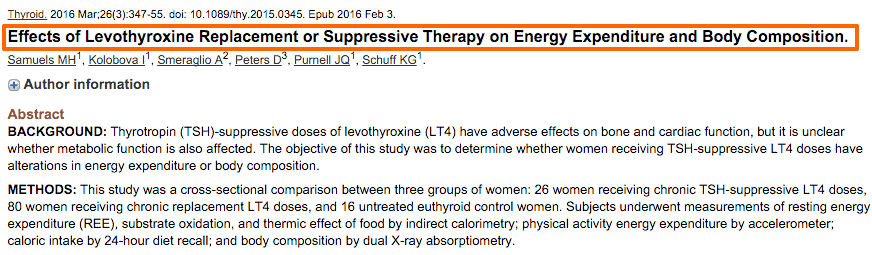
Some studies have shown that despite using levothyroxine (8) (and suppressing the TSH) resting energy expenditure (a measure of metabolic function) does not “normalize” to healthy adult levels.
If you find that this is happening to you, then it may be an indication that you either need to alter your dose or consider altering which medication you are taking.
#2. Follow Your labs (Including Free Thyroid Hormones)
While the TSH may not be the most valuable lab test to evaluate your thyroid that doesn’t mean that other lab tests don’t have value.
In fact, it is just the opposite.
When you are treating your thyroid with medication you should periodically evaluate your free thyroid hormone levels.
You can do this by ordering Free T3, Free T4, and Total T3 (9).
These lab tests provide a window into your body and can help you determine if your dose is sufficient.
The hallmark of hypothyroidism is a reduction in Free T4 and an elevation in TSH (typically, but not always the case).
As you take levothyroxine your Free T4 should increase.
Why?
Because levothyroxine contains the same thyroid hormone that your body produces naturally.
If you are taking thyroid medication and you only see a drop in your TSH without a simultaneous rise in your free T4, then your medication dose may not be sufficient.
It’s critical that your body has sufficient Free T4 levels because it uses T4 to create T3 through the conversion process.
Low levels of T4 may result in decreased T3 and further issues down the road.
It may seem obvious to you that it’s necessary to look at the free hormone concentration in your body, but it’s not always obvious to doctors.
But it should be, especially if you think about it.
When we evaluate all other hormones in our bodies we always look for the direct hormone concentration in the bloodstream (10).
Hypothyroidism is the only hormonal condition in which we evaluate the pituitary marker instead of the free thyroid hormone.
Take for instance testosterone:
If you have low testosterone and you take testosterone medication, doesn’t it make sense to check your testosterone levels to see if they have improved?
It makes perfect sense and that’s exactly what your doctor should be doing.
#3. Monitor Your Symptoms
Another tool you can use to determine if your dose is sufficient is how you are feeling otherwise known as your clinical symptoms.
The symptoms of hypothyroidism occur as a result of decreased circulating thyroid hormone in the cells of your body.
Symptoms such as hair loss, fatigue, weight gain, depression, and constipation all occur directly because of low thyroid hormone.
What does this mean for you?
It means that as you replace this lost hormone these symptoms should subside and completely go away over time.
In this way, you can utilize them as a very useful marker to determine if your dose is sufficient.

Your symptoms represent another crude way you can monitor your dose and they should correlate directly with your lab tests and your basal body temperature.
It’s important to realize, though, that there may be some overlap in some of your symptoms with other medical conditions.
For instance:
Fatigue is a very non-specific symptom that can be associated with many medical conditions (11).
The same is true for constipation and hair loss.
But when you put all of these symptoms together (the more you have the more likely you can be sure they are caused by your thyroid) and you are experiencing all of them you can be more certain they are related to your thyroid and not to some other medical condition.
By evaluating all three of these important factors you can easily monitor your “success” and determine if your dose of thyroid hormone is adequate for your body.
As you go through the motions, you may realize that the amount of thyroid hormone that you need is different from other people.
That’s okay and it is to be expected.
Levothyroxine VS Armour Thyroid VS Liothyronine
As you probably know there are several different types of thyroid hormone medications that are currently available.
Unfortunately, most doctors give out the same medication: levothyroxine or Synthroid.
Both of these medications contain the inactive thyroid hormone T4 and in order for it to be active in your body, it must be converted to the active T3 thyroid hormone (this process is known as T4 to T3 conversion).
So why haven’t you ever heard of this before?
Doctors operate under the assumption that all patients convert T4 to T3 at an equal rate which means that they don’t feel this conversion process should be taken into account.
But there is one problem with this philosophy:
It’s not true. In fact, up to 15% of people have been shown, due to their genetics, to have a problem with this conversion process (12).
As a result, many patients are taking the wrong type of medication which may explain why they don’t feel well and aren’t experiencing any improvement.
And that’s where the other thyroid medications come in…
Many patients do very well using combination thyroid medications that contain both T4 and T3, not just T4 medication alone.
And I’m not just saying this from experience, most patients also agree that medications containing T3 are superior…
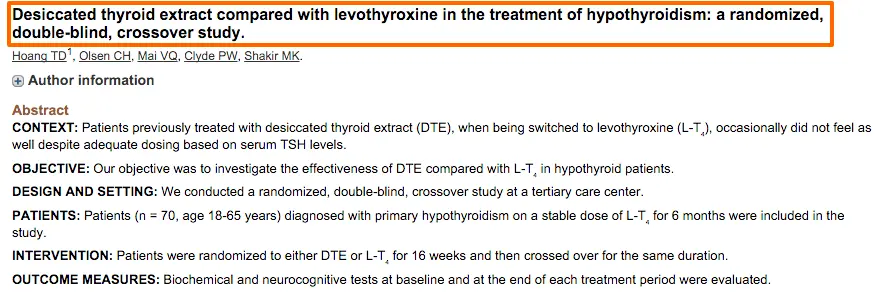
In clinical studies, many patients prefer natural desiccated thyroid hormone (13) (thyroid hormone that contains T3) over T4 medication alone.
The study shown above highlights why this is the case.
As patients switch from taking LT4 medication to thyroid extract they tend to experience a better quality of life and more weight loss.
This is felt to be secondary to the increase in free T3 and free T4 levels which can remain low even if the TSH is considered to be normal (14).
I’ve personally also found this to be the case in my practice as I transfer patients from LT4 medications over to NDT and T3 thyroid medications.
The patients who make the switch tend to experience more energy, less hair loss, more weight loss, and so on.
What to do if you have Hypothyroid Symptoms on Levothyroxine
So what should you do if you are taking levothyroxine or another T4 medication and your body temp is low, your heart rate is low and you are still symptomatic?
The good news is that there are several tips and tricks you can follow to make your current dose more effective (even if you can’t switch medications entirely).
When it comes to levothyroxine, this medication is actually quite difficult for your body to absorb and this may account for a significant number of problems when taking it (15).
So, even if you are taking your thyroid medication faithfully, it doesn’t matter unless you are also absorbing it in your gastrointestinal tract.
There are several steps you can take to improve the absorption of levothyroxine which may have an effect on how you feel.
At best you absorb about 80% of the thyroid hormone that you ingest (16).
But this number rapidly reduces in the setting of GI-related problems, inflammation, low stomach acid, and other intestinal issues.
Anyone who is suffering from constipation, gas/bloating, acid reflux, diarrhea, abdominal pain, gastric ulcers, low stomach acid, etc. may have reduced absorption of their medication.
This is complicated further by other medications and supplements which may reduce thyroid hormone absorption if not taken at the correct time.
So let’s talk about how you can impact the absorption component and get more “bang” for your buck so to speak.
#1. Levothyroxine 50mcg tablet
The 50mcg tablet of levothyroxine may be better absorbed and assimilated compared to other doses.
Why?
Because each dose of levothyroxine contains different colors, dyes, fillers, and otherwise inactive ingredients.
These fillers may act to cause symptoms by themselves (17) (which can be confused with hypothyroid symptoms), but they also reduce the absorption and effectiveness of thyroid hormone in your body.
The 50mcg tablet of Levothyroxine is special in that it is white and contains the fewest amount of fillers and additives when compared to the other dosages.
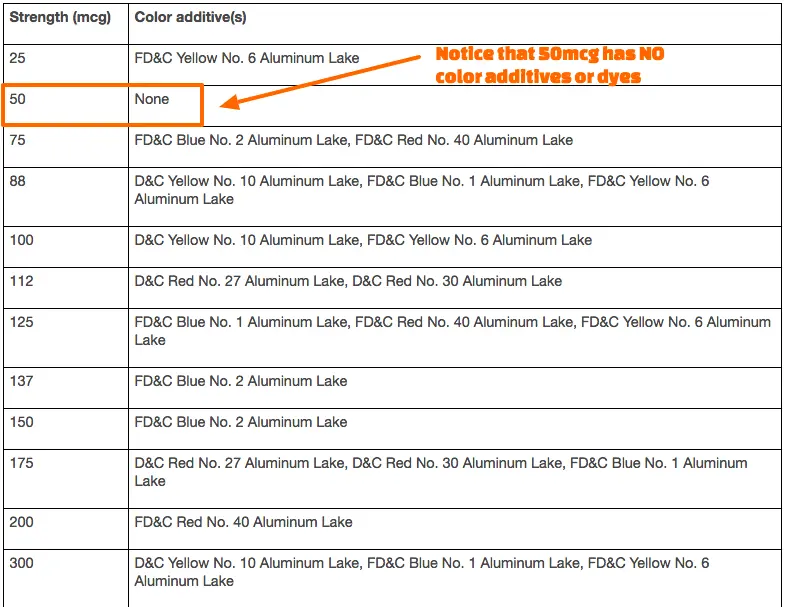
This presents a unique opportunity where you can switch your current dose of levothyroxine to 50mcg increments to potentially benefit from this.
Let’s say you are currently taking 150mcg of levothyroxine.
You could easily switch to taking 3 of the 50mcg tablets of levothyroxine which would be the same equivalent dose and get rid of all of the fillers/dyes in the process.
Make sense?
Something as simple as this change can actually improve how you are feeling.
Even better is that most physicians won’t have a problem with switching your dose.
#2. Consider switching to Tirosint or Tirosint-Sol
Tirosint and Tirosint-sol are two new T4-only thyroid medication alternatives.
Compared to levothyroxine, they are special because they contain the fewest inactive ingredients out of all available thyroid medications.
Tirosint contains a grand total of 4 total ingredients (3 inactive and 1 active) and Tirosint-sol contains a grand total of 3 total ingredients (2 inactive and 1 active).
The net result is that both are very easy to absorb and highly bioavailable (18).
Many patients report an improvement in their symptoms simply when making the switch from levothyroxine or Synthroid to Tirosint.
Compared to other thyroid medications (I’m looking at you, NDT formulations), it’s relatively easy to get your doctor to prescribe Tirosint medications because they are more similar to levothyroxine.
#3. Increasing Absorption of Thyroid Hormone And When to Take Your Thyroid Medication
If you are unable to switch to 50mcg increments of levothyroxine or if your provider isn’t willing to switch you to Tirosint there are still other steps you can take to improve absorption.
The first is to simply change the time of day that you take your thyroid medication.
Studies have shown that taking your thyroid medication at night can actually increase serum thyroid levels (19).
This is most likely due to the speed of your GI tract at various times of the day.
In the morning your GI tract is sped up which may limit the absorption of thyroid hormone.
At night your GI tract slows down which may allow for higher absorption.
In addition, your cortisol levels peak at 8 am in the morning (when most patients take thyroid hormone) which may also influence thyroid hormone metabolism.
It’s certainly worth a discussion with your current physician to determine if taking levothyroxine at night may help you.
The second option is to treat any GI-related problem that may be limiting your absorption.
By addressing conditions such as low stomach acid, SIBO/SIFO (very common in hypothyroid patients), and other GI-related problems you may be able to increase thyroid hormone absorption.
Do you need T3 medication?
By now you might be asking, do I need to be on medication containing T3?
The answer really depends on you, but I can help you figure it out…
In general, patients who should consider using Natural Desiccated thyroid hormone or T3-containing medications include:
- Those who don’t feel better on T4 only containing medications even after tracking their metabolism, symptoms, and lab tests
- Those who have not lost weight on levothyroxine or Synthroid
- Those who notice their symptoms getting WORSE despite increasing their dose of T4 medication
- Those with low serum-free thyroid hormone levels (low free T3 and low free T4)
If you fall into any of the above categories then it would be worth talking to your doctor about switching your medication to something that contains T3.
And don’t sweat it if your doctor isn’t willing to use Natural Desiccated thyroid because he/she may be open to using Liothyronine instead.
Liothyronine or Cytomel both contain pure T3 medications and can simply be added to your current dose of levothyroxine.
So let’s say you are taking 100mcg of T4 and you aren’t feeling well at all.
Instead of switching to 1-2 grains of NDT, you can simply add 5-10mcg of liothyronine or Cytomel to your current dose of levothyroxine.
Your regimen may look something like this:
- Levothyroxine 100mcg per day
- Liothyronine 10mcg taken twice per day for a total of 20mcg per day
This allows for roughly an 80/20 ratio of T4 to T3 which is similar to what the thyroid produces naturally.
Levothyroxine Dosage Chart and Comparison Table
So, what if your doctor isn’t willing to change medications or you really like being on levothyroxine?
Then make sure you are on the right dose!
Your dose should be based on the 3 step system I outlined above: Lab tests, symptoms, and your metabolism.
You can get to this dose by starting out with a low dose (around 25mcg per day) and then slowly increasing your dose and monitoring each of the steps.
From there you can check your lab tests every 6-8 weeks to follow your TSH, free T3, free t4, and reverse T3.
Dosing varies quite a bit based on the person but a typical dose may range between 25mcg and 250mcg of levothyroxine or Synthroid per day.
If you have continued to increase your dose beyond 150mcg and haven’t noticed ANY improvement in your symptoms then that may be a sign to consider switching medications.
If your doctor still isn’t willing to try NDT or T3-containing medications then you can also try other forms of T4 with fewer fillers like Tirosint and continue increasing your dose slowly over time.
If you are switching from T4 to another medication this comparison chart may be helpful:
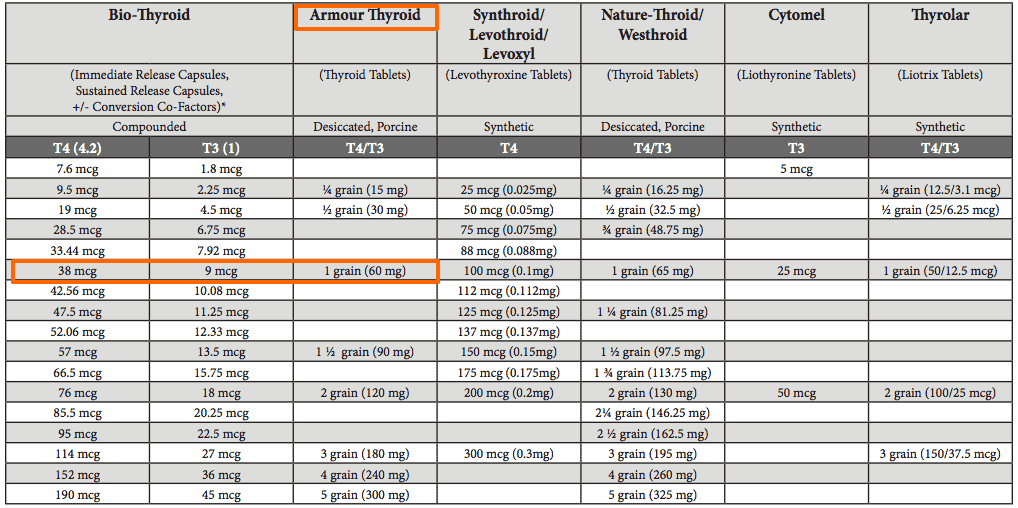
This chart isn’t perfect but it is a good starting place.
I find that the conversion from T4 to NDT or natural desiccated thyroid is too low (meaning you usually need more NDT to make it equivalent to the T4 dosing).
In my experience, 2 grains are closer to 100mcg of T4 than 1 grain, but it is important to start out slowly if you are switching medications because T3 can be VERY stimulating to some people.
Final Thoughts
Believe it or not, your dose of levothyroxine depends on multiple variables, all of which need to be considered to help reduce symptoms and help you feel better.
Remember that levothyroxine absorption plays a big role in how you may feel.
By switching your dosage to 50 mcg increments of levothyroxine or switching to Tirosint altogether you may improve your thyroid hormones.
Another option is to consider changing the time of day that you take your thyroid medication.
Lastly, you should also consider treating any GI-related problems that may be limiting your absorption as well.
If these options fail then you might consider the addition of T3-containing thyroid medications.
To get these medications you will need the assistance of a physician who is knowledgeable about thyroid function.
Now I want to hear from you:
Are you currently taking levothyroxine?
Do you feel that your dose is sufficient?
Have you attempted to use other thyroid medications?
What has worked for you? What hasn’t?
Leave your questions or comments below!
Scientific References
#1. https://www.ncbi.nlm.nih.gov/pmc/articles/PMC4267409/
#2. https://www.ncbi.nlm.nih.gov/pmc/articles/PMC5763098/
#3. https://www.ncbi.nlm.nih.gov/pmc/articles/PMC5763098/
#4. https://www.ncbi.nlm.nih.gov/pmc/articles/PMC1578599/
#5. http://www.ncbi.nlm.nih.gov/pubmed/24692351
#6. https://www.ncbi.nlm.nih.gov/pubmed/11174855
#7. http://www.ncbi.nlm.nih.gov/pubmed/19375759
#8. http://www.ncbi.nlm.nih.gov/pubmed/26700485
#9. https://www.ncbi.nlm.nih.gov/pubmed/22997973
#10. https://www.ncbi.nlm.nih.gov/pmc/articles/PMC4255853/
#11. https://www.ncbi.nlm.nih.gov/pmc/articles/PMC2766938/
#12. https://www.ncbi.nlm.nih.gov/pmc/articles/PMC3219766/
#13. http://www.ncbi.nlm.nih.gov/pubmed/23539727
#14. https://www.ncbi.nlm.nih.gov/pmc/articles/PMC5763098/
#15. https://www.ncbi.nlm.nih.gov/pubmed/19942153
#16. https://www.ncbi.nlm.nih.gov/pmc/articles/PMC4659333/
#17. https://www.ncbi.nlm.nih.gov/pubmed/26748887
#18. https://www.ncbi.nlm.nih.gov/pmc/articles/PMC3726924/
#19. https://www.ncbi.nlm.nih.gov/pubmed/17201800



Hello, I am on 175 mcg and I am still having all the thyroid symptons, you have described in this article. I have spoke to my doctor about them an he keeps reassuring me my labs are perfect. And my body says differently. I was also wondering is there a special kind of diet that needs to be followed. I have heard gluten free is the best way to go. I would greatly appreciate any advice that you can give me.
Thank you so much, Jacqueline
Hey Jacqueline,
I would encourage you to take a look at this article for more info on diet: https://www.restartmed.com/diet-low-carbohydrate-high-fat/
Diet is definitely important, but some people really need the change in medication to really feel the best.
I have no thyroid due to cancer last year in Feb
I’m all over the place with a mount of levo. I am 69
What would be a typical amount I need.
I weigh 51 kilos
I have no support from endo
Hi Gill,
There is no “typical” amount of thyroid hormone as it depends on multiple factors.
Hello I had my thyroid removed June 4 2021 and was after surgery placed on calcium 500mg for 14 days then 9 days after surgery I was placed on Levothyroxine 100mcg due my labs of TSH 15.10 and T4 free 0.7 Fthyroglobulin antibodies 8 and Fthyrogloulin 8.9 my endocrinologist doesn’t review much and just hands over a prescription.
I had base of tongue cancer that spread to my lymph nodes, been on levoxthyroxin 88mcg since 2005…! My doctors tell me my thyroid levels look good, I just gained 10 pounds in 2 days, enough of my doctors Bullshiit, I’m going to go to an endocrinologist
Hi Jerry,
Unfortunately, you probably won’t get far with your endo either for the reasons listed here: https://www.restartmed.com/endocrinologist-for-thyroid/
What if I don’t have a thyroid gland since it was removed over 25 years ago based upon a diagnosis that it was pre-cancerous? This means I am hypo. I have been on 125 mpg synthroid or its generic per day and lately have developed hypo symptoms.
Hi Dale,
This information is relevant to those with and without a thyroid.
Hi Dale,
I had the same experience and it turned out that the medicine was sensitive to heat in my bedroom, so a months dose had gone off. If you had this issue in the summer you should get a new bottle and keep in the fridge. Also avoid walnuts , dairy and iron (like in supplements or supplemented cereal) for two hours after you take the pill because they interfere with absorption.
I’m on Levothyroxine following a TT for follicular carcinoma. I’ve been on Levothyroxine for the past year and still don’t feel good – many of the hypothyroid symptoms you list. I asked my doctor about the possibility of trying a different medication containing T3 like you have suggested. The doctor looked at my Free T3 level and said it was normal so dismissed my request. Does my Free T3 level effect whether something like NDT is suitable? What information can I give my doctor to support my case? Thank you.
Hey Lynda,
No, your free T3 isn’t necessarily the best indicator of whether you need T3 or not. But you are wasting your time trying to bring information to your doctor. Imagine someone trying to tell you you’ve been doing your job wrong your entire life and to change because you know more than them (even if you are right) – this is the futility of trying to get your Doctor to listen to you.
I went from 60mg Armour down to 30mg with 5mcg Liothyronine and was feeling completely exhausted with heart racing on occasion. Now I’m taking 1/2 tablet of 75mcg Levothyroxine wth 25mcg Liothyronine and my hair is falling out and I’m still exhausted. I wanted to avoid Levothyroxine because of the fillers (I have Hashimoto’s) but my doctor chose this route instead. Clearly, it’s not working. The weight & fatigue is not budging and I’ve always been able to manage my weight until now.
Hey Diana,
Your hair falling out is probably due to the T3.
How does the T3 effect the hair?
Hey LaToya,
You can find more information about hair growth/hair loss and thyroid function in this detailed post: https://www.restartmed.com/thyroid-hair-loss/
Hi Dr Child’s,
I’ve had Hashimoto’s for 15 years and always struggled with my weight. About 5 years ago I had my daughter and made some huge changes to get in shape. I lost 50lbs and put on a ton of muscle. Was feeing great! I had my son almost 2 years ago and have been struggling ever since. I have been eating right and working out and am VERY educated in this area, but have not lost a pound or an inch in over a year now. Although I am back to pre pregnancy weight, I can’t lose any fat. I’m exhausted and feel terrible every day. I’m on 150mcg of Levo, and my dr won’t change my medication. I’m not sure where to go from here.
Hey Lea,
The best place to start is with a Doctor or provider who can help. My blog has some helpful tips that you can try, but if they aren’t working then I would recommend you seek professional help.
Could you recommend a physician in North Louisiana that would try your way and dosage charts for me???
Hi Trena,
Unfortunately we don’t have any recommendations for anyone in that area.
Hi Dr Child’s, I was diagnosed with a very under active thyroid about March time after reading your articles on fibromyalgia and under active thyroid. I had been feeling very ill for some time and just put it down to my fibro.. But I was having other symptoms that didn’t make any sense or relate to my fibro loosing my hair was one of the big ones and gaining weight after reading your article I discovered I had about 42 of the symptoms of U/A thyroid. I went armed with a list of blood tests you recommend had them done on the Thursday afternoon, my Gp rang me first thing Friday morning to say my thyroid was dangerously low and started me on 125mg levothyroxine. I was thrilled as now I thought I would feel a lot better.
Sadly not I felt so much worse in every way did lots of research on your website.. Kept going back to Gp’s who lowered dose I felt suicidal I felt so ill. After a few months I decided to take the plunge and self medicate on Ndt and was amazed at how much better I was all the pain went my hair stopped falling out gained some energy felt human again. BUT I still can not loose any weight though I have stopped gaining weight I think now.
I desperate to loose weight but I do have other medical issues ie lower back problems so I’m not as active as I could be.
Is there anything you can recommend.
I live in the uk so ndt is only available to me through the Internet as don’t prescribe it over here.
Sorry it’s so long winded the message.
Many thanks Clare
Hey Clare,
Unfortunately you are in a tough position, you will definitely need some guidance from a competent physician locally who can fix what has happened in your body. I know that in the UK there are some private doctors that are willing to prescribe NDT, I would recommend you seek one out.
Dr Childs,
Thanks for a great article! I’m on Liothyronin 30 mcg in the morning and 20 mcg in the afternoon. I still suffer from constipation and impossible to loose weight. However my doctor worries that my TSH is low as well as my free T4. He talks about risk of heart diseases. I don’t feel a raised heartbeat. My resting pulse is
Continues since I accidentally submitted… My resting pulse is around 55. Do I need T4? Is there a risk of heart disease? Do I need to worry? And how do I get rid of my constipation and problem to loose weight? I thought that maybe I should try adding Levo as you suggest above with 80-20 ratio.
Thank you!
Hey Therese,
You will need to get the full thyroid evaluation and a complete hormone panel to say for sure. Many things can impact resting heart rate, so I don’t recommend basing any decisions off of that alone.
Do you have a list of practicing doctors in different states?? That practice like you. I have called 10 doctors in my area. My current doctor wont change my dose, stating my labs are fine. In the meantime i keep gaining weight,despite all my efforts not to,my hair is falling out, and I’m exhausted all the time, even when i sleep 8-9 hrs. I have been taking 250 mcg of levo for 2 years now. How do i get help??
Hey Becky,
Unfortunately I don’t know anyone that practices like me. There is no training for this type of medicine, so everything I know is self taught.
Hey Dr. Childs,
i followed your blog for a time now. It’s full of precious Informations on the subject. It helps me a lot. Thank You so much for that. One thing confuses me, though. You wrote: “This allows for roughly an 80/20 ratio of T4 to T3 which is similar to what the thyroid produces naturally.” In most of the Publications i read, it says the T4/T3 ratio should be 10:1 to 13:1 or even 16:1. Is it Your practice that leads You to the 80/20 (4:1) ratio or the fact that natural Thyroid has that Ratio (because it’s from Pigs) or something else? I look foorward to Your answer. Thanks in advance and greetings from germany.
My last reading was 7 and 8 weeks on its 17.8, I have an underactive and have been advised to take 100mg for 3 says and 75mg the rest of the time, I feel awful, so tired, heart races and hot flushes, cold sweats, how can it change so much in 8 weeks, I was beginning to feel ok.
Just got an increase on Levothyroxine to 75 mg and still don’t feel any better and weight isn’t coming off. Really frustrating!
Hey Terri,
Most people DON’T lose weight on levothyroxine, and most in general don’t lose weight on any thyroid medication. Thyroid is usually only responsible for a small amount of weight gain and when you optimize your thyroid function it usually only results in 5-15 pounds of weight loss. The rest is usually from insulin and/or leptin resistance.
Hello, I live in the UK and need a lot of help and will be subscribing to your program as I have just found you and think your website is amazing! I’m taking 100mcg Levothyroxine daily (one tablet )-I also am using Saxenda -on the starting dose of 0.6 should I be on a higher dose ?what is the best time of day to take both and the best dosage of Saxenda to get the maximum weight loss benefits ?? -I’ve read that Levothyroxine can affect efficacy of Saxenda ( do no have a history or family history of thyroid cancers etc) I’m just really confused about the timings each day please help.
I tried getting my endocrinologist to switch me from synthetic to tirosint and refused. I’m currently taking 175 for 6 days a week making it a 150 dose. And I just feel like crap. since I don’t have health insurances it makes it hard finding a good doctor that will listen to me.
Hello,
My recent lab work revealed that my TSH levels were abnormal (0.006) while taking 150 mcg of Levothyroxine. My endo lowered my dose to 137 mcg. Through a very low carb and working with a personal trainer, I’ve lost 50 lbs over the past 5 months. I inquired as to whether the lowered dose would create any weight gain and she simply said it was possible, but offered no alternatives or recommendations to avoid such a scenario. Do you have any recommendations to ensure that my current weight loss progress is not derailed by the adjusted dosage? Any help that you can provide is appreciated.
Thank you,
April
Hey April,
Really the only thing you can try is to promote T4 to T3 conversion from what T4 is in your system, if your body is reliant upon medication as a source of thyroid hormone then there’s not much you can do.
I am 32 just diagnosed with hypothyroid and was prescribed with levothyroxine 125mcg. I have over 30 of the same symptoms still. I have changed diet, exercise, rest. Everything. I also have migraines so I take amitripilyn daily. Also have high pulse at resting, I am on verapamil for the Bp and high pulse. I am not too sure where to go from here. Thanks
Hey London,
You may simply not be tolerating the T4 only medication, so you should talk to your Doctor about NDT or other thyroid medications.
I was diagnosed with hypothyroidism 7 weeks ago and placed on Levo of 25 mcg for a week then increased to 50 mcg for a week then 75 mcg but I recently noticed that the 75 mcg causes me to have heart palpitations, anxiety and fatigue. My original labs were T4 3.1 and TSH 1.110 and after being on the Levo for 7 weeks my T4 is now normal at 7.3 but my TSH is now at 0.405 and although I’m not as exhausted as I was before the medication I am still tired and cannot lose any weight with healthy eating. My doctor would not switch my medication but I cannot continue taking the 75 mcg. I’m pretty sure I started having problems with my thyroid in january of this year as I suddenly started gaining weight and by May I started feeling exhausted to a point where I was falling asleep all day. HELP!!!
Hey Betty,
If you are experiencing symptoms related to your medication then you need to see your Doctor, he/she is the only one that can make the necessary changes. If he/she is unwilling to change your medication then it might be worth looking for someone who is more willing to work with you to change medications, etc.
It sounds like your symptoms may be due to too much thyroid hormone or because you titrated your dose too quickly.
Hey Dr. Childs,
i followed your blog for a time now. It’s full of precious Informations on the subject. It helps me a lot. Thank You so much for that. One thing confuses me, though. You wrote: “This allows for roughly an 80/20 ratio of T4 to T3 which is similar to what the thyroid produces naturally.” In most of the Publications i read, it says the T4/T3 ratio should be 10:1 to 13:1 or even 16:1. Is it Your practice that leads You to the 80/20 (4:1) ratio or the fact that natural Thyroid has that Ratio (because it’s from Pigs) or something else? I look foorward to Your answer. Thanks in advance and greetings from germany.
Sorry for the possible double post. But i think something went wrong the first time.
Hey Dirk,
Sorry I missed your initial comment.
I’m basing that statement off of previous studies, my own personal experience treating post thyroidectomy patients and expert opinion. I can’t dig up the studies right now but I did do a quick search and found this: http://www.endocrineweb.com/endocrinology/overview-thyroid
I am generally not a fan of NDT due to the fixed ratio of T4/T3 but I have found NDT + T3 to be a powerful combination because most people do need more than physiologic doses of T3 due to a number of reasons.
Hello Dr.
Just a question: you say to increase the Levothyroxine dose every 10-14 days and the majority of Doctors say to wait 6 weeks between doses increases.
Why the faster increase?
Thank you for this amazing site!!
Hey Lucas,
This is anecdotal based off of my experience in treating patients, most patients appear to have receptor sensitivity issues if the dose remains stable too long – either that or it’s a thyroid conversion issue.
Hello Dr!
Due to fact I have following results:
TSH:2,04
FT4:1,660NG/DL,
FT3: 3,690 PMOL/L,
ATPO,173,70 UI/ML,
D3: 35,56,
LEPTIN:14,6,
INSULIN: 31,4 ,which dosage would recommend me?As you can see after results it’s appear that I have leptin resistance and insulin resistance.
I’ve been taking Levothyroxine 100 mcg/day since 2001.
Thank you for recommendation.
Hey Anna,
You really need a full comprehensive evaluation and treatment plan, I can’t treat you unless you are a patient of my practice and what you really need are some medications short term to fix the issues you have.
Hi I have recently been put on T3 I take levethyroxine 25mg in the morning along with 5mg T3 then 5mg T3 at night I feel Better than i did just on levethyroxine 75mg but i dont seem to be able to continue loosing weight i can loose 7 pounds then the second week its back on and i am so frustrated i dont know what to do and am desperate for help
Hey Linda,
I would recommend you check out this video for more help on how to lose weight: https://www.restartmed.com/thyroid-video-1/
Hello I had a cancerous tumor the size of a golf ball on my thyroid about 14 years ago. I had to get most of my thyroid removed and have been on and off thyroid medication since then. Currently I am on 200 mg and I still feel bad I am constantly gaining weight and have gained over 60 lbs over the course of two years. I have tried to diet and excersize and can’t seem to loose any of the weight in fact it just seems like I am just gaining more. I have recently switched states and has asked my current doctor to look at my results she has told me that they look fine and sent me a copy my TH lvl was at 54 is that low? I thought it was and I don’t know what to do. I want to feel better and I want to loose weight and be able to have the energy to get out of bed and hanging out with my kids. I was on a dosage of 250 at one time before I moved and felt great and lost the weight. I tried telling my current doctor but she says no I don’t need it. What do you think??
Hi, I was on .050 feeling fine, lots of energy, my Dr increased my dose to .075, gained 20 pounds in two months, have absolutely no energy, tired all the time. I keep telling him how I feel and he wants to increase it again! My labs keep coming back good.
Hey Genny,
You may want to consider looking for a new provider if your current provider isn’t willing to work with you.
I’ve been on levithyoroxine for 16 yrs and have gained 80 lbs. and am constantly tired and hair falling out and on 137 mcg of Meds. I have never experienced feeling better or weight loss. I always weighed 140 lbs until the hysterectomy and then thyroid quit working and I’ve been gaining ever since . I’ve been to specialists in thyroid problems and they just tell me levels are normal which I fight with them about not to lower it . My number is .02 right now and still gaining
Hey Joyce,
Levothyroxine won’t work for everyone, so if you’ve tried several different doses and it still isn’t working then you probably need more T3 in the form of liothyronine or NDT.
Are you still experiencing weight gain?
Although levothyroxine saved my life and improved the truly horrible overt symptoms I was suffering before starting T4 therapy the closer I got to an ‘optimised dose’ the more acutely aware I became that I did not feel at all well. I stuck it for two years and concluded my life was not worth living and I had nothing to loose by trying NDT. I am so glad I did as I have felt immeasurable better on this medication. I took 125mcg Levo and never really felt better I now take 2.25 grains of NDT and have seen great improvements in my well being. Not perfect, but good enough to retrain in a new profession, hold down full time work and succeed in it.
I’m glad that you are doing better on the NDT, thanks for sharing your story!
Hello DR. I was on levoxyl for the first few years and then i switched to levothyroxine 0.025mcg ever since 2003 and been on this same dosage since then but still feeling tired and hair falling out my weight has been up and down but like many others are saying my lab works always come out good but i will save this article and show my regular doctor and the thyroid speacilist and see what they think, hopefully they will put me on something different. I mean i watch what i eat and workout but still feel the same way. Thank you
Hey Misty,
No problem and I hope you find it helpful!
Thanks for the article! I’m a little confused by the two different conversion charts. In the example of someone who is taking 125mcgs of levothyroxine, which conversion chart would you recommend to convert it to Armour? Thanks!
If someone is taking 125mcgs of Levothyroxine how much Armour would you recommend they take? I’m a bit confused between they conversion charts. Thanks!
The conversion process isn’t perfect and should just be used as a guideline. If you switch from levothyroxine to armour but you don’t tolerate armour then it wouldn’t necessarily apply to you. It’s helpful if used as a guide for converting medications if you remain symptomatic after the switch. The tolerance of T3 containing medications varies drastically from individual to individual.
my daughters tsh is 18.64, t4 10.7 ad free t3 2.9, family doctor will not adjust meds, wants her to see an endocrinologist. can’t get in to see one until end of Feb. how can I help her now
Hey Maureen,
Unfortunately I can’t provide medical advice about her because she isn’t my patient. It would probably be a good idea to have her antibody levels checked, however to make sure she doesn’t have Hashimoto’s thyroiditis.
Hey doc, have you ever treated anyone that has done the radioactive iodine treatment? I had the radioactive iodine treatment a few months ago and haven’t felt normal since. I’m currently on 100mcg of levothyroxine. I feel fatigued all the time, have a brain fog, and can’t seem to get into deep sleep.
Hey James,
Yes, I have several patients who are post RAI. Treatment is largely the same except these patients generally require more T3 in addition to T4.
Hey doc,
Thank you so much for replying. I have another question. I was wondering just by seeing the levels below if you can determine if my body is having problems with absorbing/converting Levothyroxine.
10/13/16:
Started taking 1 Levothyroxine 75 MCG after RAI(Aug. 3)
TSH: 4.15
Free T4: 1.0
11/18/16:
Still taking 1 Levothyroxine 75 MCG
TSH: 21.05
Free T4: 1.1
12/06/16:
Started taking 100 MCG Levothyroxine
TSH: 25.24
Free T4: 1.1
Total T3: 58
12/22/16:
Still taking 100 MCG Levothyroxine
TSH: 11.15
Free T4: 1.6
01/11/17::
Still taking 100 MCG Levothyroxine
TSH: 18.66
Free T4: 1.5
Do you think I am having problems with absorbing/converting the Levothyroxine or is it too early to determine that? Thank you so much doctor.
Your web site is most informative and have “hit my nail on the head” on many levels. You have given me more than something to think about. I am on Levothyroxine .75 and have narrowed this down to my weight gain (185 to 206), this is significant in my book. Not to mention dealing with constipation for nearly a year…
My next approach I assume is to get my previous lab results and start comparing the numbers since I was diagnosed with Hashimoto’s disease and having Hypothyroidism.
V/R
David Johnson
Hey David,
I’m glad you found it helpful. In your case I would also consider evaluating other hormones including testosterone (both free and total). Males usually require higher doses of thyroid hormone and more T3 in general due to higher metabolic rates and more muscle mass. If you haven’t already you can check out a case study I recently wrote up on a 61 year old male hypothyroid patient here: https://www.restartmed.com/testosterone-weight-loss/
Hi Dr. Childs,
Thank you for your posts. They have been very informative. My issue is that I was diagnosed with Hypothyroid about 4 years ago. I went on Armour and felt a lot better. About a year and a half ago, I was under a lot of stress and eating terribly and my body went hyperthyroid. I lost about 10 pounds, which is quite a lot on my frame. Since then, the doctor put me on Levothyroxine and I gained 15 pounds. I am doing a January cleanse (which I do every year). Usually I lose about 5-7 pounds. This year I am gaining weight. My Dr. says I am too old for Armour. I am 60 years old, but I felt so much better on it. My symptoms right now are weight gain, heavy legs, dry skin, constipation, consistently low basal temperatures (around 96.8) and low energy. I am alternating 88 mgs and 100 mgs. but the increase has not been helpful. Any suggestions?
Hey Janet,
There is no age restriction on T3 or Armour thyroid :). I have many patients your age and even older on some combination of NDT and/or T3. Your current symptoms are consistent with either hypothyroidism and/or metabolic damage.
Hi Doctor , iam planing to take t3 medicines … iam on thyronorm 25mcg and it has been no good, i dont have any symptoms of hypothyrodism apart from the over weight and hair fall, i have been on using thyronorm …since 9 months and i see no loss in weight nor my hair grown , i excercise a lot and i eat clean
please help me
Dr. Childs, I have a complicated medical situation, but your information sounds like exactly what I need.
Here are my particulars: I am 56 years old and weigh 235 lbs. At age 36 I was diagnosed with Congestive Heart Failure and am on many meds: Coumadin, Coreg, Entresto, water pills and potassium. I also have been taking Paxil 20 mg for the same amount of time. (I’ve gained most of this weight since starting the Paxil and being diagnoxed with CHF). Hysterectomy at age 49. And, yes my A1C is a little high, but I keep it down with exercise so I don’t have to go on insulin.
Even though many doctors in the past have suspected hypothyroidism, only recently has the test come back showing it. So I’ve been on Levothyroxin for a few months now. It definitely helps my fatigue and at first it felt like I lost a little weight, but the last week or two, I feel myself gaining out of control. I am truly hungry often and usually have to eat just before bed or I won’t fall asleep.
Knowing all of these facts, do you think any/all of your products would be safe for me?
Hey Lori,
The supplements and dietary guides should really only help in your situation.
p.s. Also, I can feel the tightness in my throat/neck come and go and I’m sure it is my thyroid gland enlarging or something.
Also, I do have mild bi-polar with family history of it.
Thanks.
Hi,
I had my thyroid removed and I’m trying to find a correct dosage. I’ve been taking T4 long before the surgery and never have felt any better. After my thyroidectomy I tried 175mcg T4 + 1,5 grains NDT, but felt still bad. After that only 3grains NDT without T4, no luck. Now I want to switch to T3 + NDT. What should be the ratio? Can I take T3 after I wake up and NDT before going to sleep?
Thanks
Hey Michael,
There is no specific ratio to take, you have to determine your dose based on a number of factors including T3/reverse T3 ratio and symptoms.
Hi Doctor,
I had a total thyroidectomy January 2016 because of cancer, I was started on 137 mcg Levothyroxine, the doctor lowered my dosage each time of my appointment (every 6 weeks or so), due to tsh levels. At a dosage of 112mcg, I started to lose weight (10 pounds in a few weeks) had energy, no more digestion problems, yet my tsh was too low still so they continued to lower my dosage. At 88 mcg I started feeling terrible, but they still lowered one last time to my current dosage of 75mcg levothyroxine. Te doctor said all my labs look good now and in range. However I continue to feel terrible. I feel tired all the time, palpitaions, digestion problems, can not loose weight, and severe depression and anxiety. I convinced the doctor to try to see if adding t3 would help. Reluctantly, she has started me on 5 mcg of liothyronine once a day, keep taking the 75 mcg of Levothyroxine for 6 days and not take one on the 7th day. Her main concern is I could have a heart attack. Its been 6 weeks and I feel worse than ever. I am 55 years old, weigh 173. was always very active before this. Thank you so much for listening, I hope you know a solution for me.
Hey Lynne,
T3 won’t give you a heart attack, it sounds like you may need to find a provider more knowledgable in thyroid management if you want to feel optimal.
Good day Dr.Childs; I was on 75mcg Levothyroxine 2 months ago but after getting my lab test results last month showing that i am hypothyroid my doctor increased my dose to 88mcg. Is this normal..? I mean, my thyroid dose going fromdoen then up..? I still feel tired, my balance is affected, ang my hair loss is getting worst. Thanks so much Dr Childs for any advice…
Hey Cynthia,
You can learn more about TSH and why it isn’t the best way to assess thyroid levels here: https://www.restartmed.com/tsh-levels/
Hello, I’m on 100 mcg a day, I am very tired, sleep all night and need to rest in the afternoon as well,
I don’t have much energy, push myself to do things.
I golf, and like to swim, and walk, as well as housework, meals and everyday chores.
I am 72 years old, and am tired, shaky, nervous, cry easy, depressed, . I don’t think I should feel this way.
I’ve tried taking it in morning and switched to taking at night.
Could I be getting enough? Or not enough?
I take other precritions, and vitamin D and vitaminB and C
Still tired. What should I do??
I feel the same 100mg so tired even after 8 hours sleep , headaches, moody cold take vit D I am 82 I hate feeling this way do not want to go any place or shop , my Dr said your old he does test says all is good Why do I feel like crap Hoaw are you doing have you done any thing different on meds?
I had a thyroidectomy last March due to cancer. I felt great while I was on 50 mcg of cytomel and the 2 weeks I was off of it for the Rai treatment. Also the surgery got rid of my debilitating stomach aches and years of female problems. Since then I’m still trying to get on the right dosage of medication. I’m currently taking 50 mcg of unithroid and 25 cytomel. I suffer constipation and pain all over,(muscle?). Is Unithroid the same as Synthroid? Could the pain be from that or low thyroid? I keep wanting to get back to the beginning when I felt great. Why would I feel great on nothing? My doctor is stumped about that! I’m currently getting my vit.D checked. What should be done next? Also I feel like I have a noose around my throat from time to time. ENT Dr. said it was from acid reflux, Really? Not low thyroid?
I do not believe my thyroid medication is helping, but I cannot get an appointment with my doctor for a few weeks. Should I stop taking my medication all together, or continue to suffer on 137 on Levothyroxine?
Hi Dr. Childs, I have been trialing different dosages of levothyroxine and tirosint for the past 3 years. I am constantly bouncing in and out of good lab results ranges and symptoms and my Dr. has just moved me to 175mcg of a new brand (not familiar with the name yet). My Dr. says we have to keep upping the dosage until we find what works for me, and although I trust her, I am growing weary and would like to see if you might have any suggestions. Also, when I was on 100mcg all my symptoms seemed to be gone, my labs were at 3.5, but the next result came in at 6, and even though I was still symptom free we upped the dosage to 125mcg. Thanks for any thoughts.
I am on total thyroid replacement as I had my total thyroid gland removed as a child. I am overweight, pre-diabetic and low energy. I was taking75 mcg of Levothyroxine and struggling to lose weight but slowly making some progress. My doctor changed my dose to 88 mcg. I don’t feel any better and have gained weight and feel hungrier and possibly more tired. on the 75 mcg my T-4 free was 1.4mg/dl and my TSH was 1.89 mcIu/mL. I haven’t had blood drawn since he switched me to 88mcg, but based on how I feel I’m going back down to the 75. Would appreciate your thoughts.
I’ve been taking levothyroxine 0.100mg for 27 yrs….when treated for BC in 1991, I was experiencing numbness in arms at night….after multitude of onocology tests,they realized and I was diognosed with hypothyroidism. In the last 6-8 months I’m experiencing many old symptom (joint pain,constipation, fatique and including great weight gain)My recent thyroid test showed reading almost 10! My primary is monitoring it,BUT on same dosage. I feel I need to try another higher dose or different medication. What are your thoughts? I will try taking med’s at night.
Hi Sandi,
You should also check other thyroid lab tests like reverse T3 and free T3 to see where you are at.
Hello,
I was on 0.05 mg Synthyroid for awhile after being on the 0.025 mg dose for about a decade. My govt clinic will only check TSH and it was around 2.4. My PA and dr didn’t believe me when I complained of anxiety and irritability. In fact my PA admitted that “these were symptoms of hyperthyroidism.” I was admonished to continue the higher dose. I have been on the lower dose 0.025 mg for over a week and feel great. I don’t have the frenzied need to keep moving or being irritable with my family. At the end of the month I have an appointment with a new PA to have a new lab. I eat a balanced vegan diet and take 1000 units of D3 and 500 mg Folic Acid I don’t have a weight concern and exercise 7 days a week. What do you suggest?
Hello Dr. Childs,
I am 56 years old and I was recently diagnosed to have subclinical hypothyroidism with TSH levels of 6.00. When the TSH levels were 4.0 my doctor said I am normal but I was having such a struggle to lose weight. Now he put me on Levothyroxin (50 mcg) and I am feeling worse. I rapidly gained 8-9 pounds, I feel that my stomach is bloated as it increased in size and I don’t get sleep and I feel tired and sleepy all the time. When I mentioned to my doctor he asked me to increase the Levothyroxine dosage.
I would like to ask my physician to change my medication.
1) Should I increase the dosage of Levo?
2) Should I increase the dosage of Should I first do the lab tests and then decide what medication to switch to?
3) Should switch to NDT or T3 only medication?
I am from New York city area. Would it be possible to suggest me physicians who will treat hypothyroidism like you do? I will be grateful for your advise and help.
Hello doctor
I’m 27 years old I’ve been taking levothyroxine for the past 3yrs , I stared with 50 mg took it for a year and after that my doctor decided to give 100 mg I’ve been taking it for 2 years already but I recently staring to feel weekness my legs feel weak and my back really hurts plus dizziness and a lot of gain weight and hair loss .. my lab work are normal all the time and I really think is the medicine that’s causing me all does symptoms.. I spoke to my doctor but she said that my thyroid problem cannot be causing me that or the medicine .. what do you think is causing me that doctor can it be the medication ??? Please help I’m so stress out I want to feel normal again
Hi
Looking for some much needed advice. My Mum was diagnosed with an Over Active Thyroid many years ago, she had Iodene treatment which then turned her thyroid into Under Active. Since then she has been on Thyroxine. Ranging from 50mg – 75mg.
She had a routine yearly levels check and the GP telephoned the house to say that her levels were too high & to stop her Thyroxine for 6 weeks & then have her levels rechecked. Just short of the 6 weeks wee awoke one morning to my Mum having a seizure in her bed, we telephoned for an ambulance and they took her into resus and did all sorts of tests on her, Lumber Puncture, x-ray, CT Scan & various bloods. They came back to tell us they had done all these tests on my Mum & couldn’t find out why she was having the seizures & that they didn’t think she was gonna pull through. At this point, they asked us if my Mum had been unwell? We said no, but the only thing was that my Mum had had her levels checked 6 weeks ago & was told by the GP to stop her Thyroxine. So they checked her levels & it turned out my Mum was in Thyroxine Crisis!
To cut a long story short, my Mum ended up on a Ventilator for 6 weeks, during this time, she contracted MRSA & Sepsis Pneumonia. Thankfully, my Mum is an amazing woman & a fighter & she is luckily enough to still be here. On being discharged from hospital, she was on 100mg of Thyroxine. She was a little tired, but I’d say that was to be expected due to everything she had been through. But on the ehole was doing good. She’s had reviews at clinic & each time, been told that her levels are too high & it’s been reduced, 75mg, then 75mg/50mg alternative days and now on 50mg. She has steadily got worse & is now at the point where she gets up in the morning, lays on the couch all day resting & goes to bed at night! I recently requested her GP test her T3 but have been told her levels are “normal” I phoned her Endocrine Consultant to be told that if she was more tired, then to contact her GP (which i already did & that’s why I was contacting him) and that he didn’t want to increase her Thyroxine as it could cause her to be more tired & be more dangerous if her levels where too high!! I know my Mum is just not right, she is 73, but I don’t think that should be a major factor in the way she is feeling. I feel as though I am banging my head against a brick wall & feel she deserves better care than this!
I look forward to hearing your thoughts.
HI, I had my thyroid removed two years ago. Still fighting with my dosage. I am curious if someone without a thyroid needs T3 added? i am on 200 mcg of Levothyroxine. My endocrinologist dropped seeing me after he got my numbers in range. I do have a general doctor who is willing to work with me to help me feel better.My biggest question is if i need T3 added. I am very interested too in switching to the 50 mcg. When they raised me to high levels i started having horrible eczema. Never had before. Thank you for all this information.
Hi Neysha,
All of this information is relevant for those with a thyroid and for those without a thyroid.
Hello,
I’m 42-year old, 6’3” male taking levothyroxine the past couple years (every morning on empty stomach). Tests kept coming back to increase. Went all the way up to 300mcg, but now back down to 275mcg. Haven’t had tests done in over 6 mos.
I have had all the typical thyroid disorder symptoms over time, and they have steadily gotten much worse lately (puffy face and jaw, unexplained weight gain , fatigue, waking up throughout the night , heart palpitations and chest fluttering, irritability, depression, aching joints, heartburn/GERD, etc).
I’ve researched a lot of info on my symptoms and possible solutions that echo what you talk about…malabsorption issues, not on the right type of medication, etc.
My previous family doctor retired and I want to make an appointment with a new one. My concern is he/she will just take another panel and look at my numbers and say they’re in normal range…to which I don’t feel anywhere near a person should…and I’m seeing many other people seem to get the same frustrating diagnosis.
Do you have any suggestions or what are some key points I could address or stress with a new doctor that may help he/she being open-minded to this medication is NOT working for me as intended?
Hi Paul,
There is really very little you can do to try and convince a doctor to practice in a different way. It would be the equivalent of someone on the street telling a major CEO how to fix their business, even if you are right they just aren’t going to listen. Instead it’s much easier and more effective to find a like minded physician so you don’t waste time or energy trying to convince them.
Men are also different from women in that they tend to both need more T3 and tolerate T3 better than women.
Hi Dr Childs
I am a 60 yr 5ft.2 122 lb female just diagnosed with hypothyroidism and was put on 25 mcg of Levothyroxine. I have only been on it 2 days so I really don’t know how I will handle it, but I have a fear of the chance of weight gain that I have been reading about. For 23 yrs from 20-43 I was bulimic and although I have been free of that for 17 yrs and have learned how to keep my weight down (122) in a good way I truly do not want to gain weight. Is this going to be a problem for me. If so what do you recommend.
Thank you Dr. Childs
Sincerely
LaVonne Mitchell
Hi Lavonne,
It shouldn’t cause weight gain at such a low dose.
Just starting with Levothyroxine 50mg today so a really informative read. I know doctors in the UK are not the best at handing low thyroid function particularly with using T3 so this has given me good guidance should my dosesge not work.
Hi Beverly,
I hope it helps and keep us updated on your status!
Hi Dr. Westin
I was taking 50 mcg levothyroxine and 12.5 mcg liothyronine for a year or two and my free T4 and T3 are always on the low end of theIR ranges. My TSH is below the given range and my free T3 to reverse T3 ratio is 0.23 and should be about 20.
Is it OK to increase levothyroxine from 50 mcg to 100 mcg, or should it only be increased in 25 mcg increments? Also, do you have any other suggestions on how to get my free T4 and free T3 into the upper part of their ranges?
I have Hashimoto’s and I am staying away from wheat and grains. I have put on 18 lbs in the last few years and it keeps creeping up no matter what I do.
Thanks and I look forward to your response.
Regards
Gail
I am already on thyroid medication (levo), so what is the average and optimal range for that?