

- Your symptoms are just as important as lab numbers when assessing whether your levothyroxine dose is adequate. If you feel hypothyroid despite normal TSH, your dose likely needs adjustment.
- Monitor free T3 and free T4 levels, not just TSH, because TSH alone misses cases where your body cannot properly convert T4 to active T3.
- Tirosint or Tirosint-Sol may work better than generic levothyroxine if you have absorption issues, histamine sensitivity, or persistent symptoms despite adequate dosing.
- The timing and form of levothyroxine matters for absorption. Taking it 30-60 minutes before breakfast on an empty stomach and avoiding certain supplements and foods in that window improves effectiveness.
- If levothyroxine alone does not resolve your symptoms despite dose optimization, adding T3 medication or switching to a combination therapy may be necessary.
How do you know if you are taking the right dose of levothyroxine?
The most simple way is to simply evaluate how you are feeling.
If your thyroid symptoms are 100% controlled then you know there’s nothing to worry about.
But if you are like thousands of other thyroid patients who continue to feel poorly despite taking their thyroid medication faithfully then there’s a good chance you aren’t taking enough.
What if you fall into that category? That’s where the information in this article steps in:
Are you on Levothyroxine and Still Experiencing Hypothyroid Symptoms?
It’s never normal for you to experience hypothyroid symptoms despite taking your thyroid medication.
But, what exactly is levothyroxine?
Levothyroxine is a form of thyroid hormone replacement medication and it is the most common medication used to treat hypothyroidism (low thyroid function).
This thyroid medication contains the inactive thyroid hormone T4 (also known as LT4 and Thyroxine).
If you are taking this medication to treat your sluggish thyroid, but still experiencing symptoms, then there may be a problem with your dose.
What do I mean by symptoms?
The symptoms of hypothyroidism include any or all of the following:
- Fatigue or exhaustion even after sleeping 8+ hours at night
- Weight gain or weight loss resistance (no matter how much you exercise or how little you eat)
- Depression, anxiety, or mood swings
- Problems with PMS, menstrual cycle, or low sex drive
- Chronic pain in the muscles and joints
- Cold extremities (hands and feet)
- Chronic constipation
These are the symptoms I am referring to whenever I mention the symptoms of hypothyroidism and these symptoms should be going away or reducing if you are taking thyroid medication such as levothyroxine or Synthroid.
In many cases, it’s not uncommon for patients to experience persistent symptoms of hypothyroidism despite using thyroid hormone medication.
But why is this?
This very problem exists as a result of how thyroid disease is managed.
The management of thyroid dysfunction is based largely in part on focusing on one single lab test known as the TSH.
This approach is fraught with problems and doesn’t allow for the variability required to treat each patient as an individual (2), but more on this later.
If you are frustrated with your current medical condition, frustrated with how you are feeling, or just plain confused about what is going on in your body, then this is the post for you.
We are going to discuss how you can start feeling better and how you can properly adjust your dose of levothyroxine to start feeling like “yourself” again.
How to Determine if your T4 Dose is Sufficient for Your Body
Each one of you has a different demand for thyroid hormone in your body.
And the demand for thyroid hormone depends on multiple factors including how much stress we are under, how much inflammation we are suffering from, the type of medications we are using, and so on.
Each of these will alter the amount of thyroid hormone that is necessary for our body and will, therefore, influence how much medication we need.
These factors must be taken into account when evaluating the dose of thyroid hormone that you will need.
So why do we treat every patient with thyroid disease in the exact same way?
Does it make intuitive sense that an 80-year-old patient would need the same amount of thyroid hormone as a younger individual in their 20s or 30s?
The answer is obviously no, but this is exactly how your doctor was trained to treat thyroid dysfunction.
Unfortunately, most doctors base all of their treatment recommendations, including the dosage of thyroid hormone on one single lab test known as the TSH.
TSH, which stands for thyroid stimulating hormone, is a marker secreted from your brain (the pituitary gland).
A High TSH is usually associated with hypothyroidism and poor thyroid function.
Most doctors base both diagnosis and treatment on this value.
But the problem is that newer studies are emerging that show that the pituitary TSH level is not a satisfactory mirror representation of thyroid hormone status in the body (3).
In addition, other factors, including the activity of deiodinase enzymes (4), may be more biologically active in certain individuals.
These studies finally shed light on what patients have been saying for a long time and why they are so unhappy with current thyroid treatment guidelines.
While this may sound confusing, don’t let it be, because the moral of the story is this:
You can’t create a one-size-fits-all treatment plan for all patients with thyroid dysfunction because each person is unique and may require a different dose and type of thyroid medication.
This sounds perfectly logical when we talk about it like this, but, for some reason, this logic doesn’t extend to all physicians and practitioners.
So how do you find your dose?
The best way to determine your “ideal” dose is to combine several different factors together to help paint a clear clinical picture of what is happening in your body.
These 3 steps will help you get started:
#1. Check Your Metabolism
Your Thyroid gland helps control your metabolism (5) (about 60% of it anyway) and can be used as a surrogate marker for thyroid function.
The lower your thyroid function the lower your metabolism will be.
This effect stems from how thyroid hormone (especially T3) influences the mitochondria in your body which influence how much energy you will burn at rest (6).
If you struggle with hypothyroidism you may have noticed that it is difficult to lose weight.
Weight loss resistance stems from a lower-than-normal metabolism and may be part of the reason you can’t lose weight.
So, if thyroid hormone is involved in regulating your metabolism, doesn’t it make sense that taking thyroid medication should improve your metabolism?
The answer is a resounding YES!
Following this logic, then, it makes sense to check your metabolism as you take thyroid medication to determine if it is working, right?
But the question is:
How do you do it?
A quick and easy way to test your metabolism is to check what is known as your basal body temperature each morning.
Your basal body temperature is a reflection of how much energy or heat you are producing at any given time and this can be used, indirectly, as a crude measure of metabolism (7).
But, let me be clear:
It’s not a perfect way to assess your metabolism and there may be other factors that influence your body temperature including your cycle and even certain medications.
But it’s better than nothing and it’s relatively cheap and easy to test which makes it worth looking into.
All you need is a thermometer and a pen and paper by your bed to measure it each morning.
The best way to check your basal body temperature is first thing in the morning right after you wake up.
As you take thyroid hormone your body temperature should increase over time, but it may take up to 1-2 months to notice the difference.
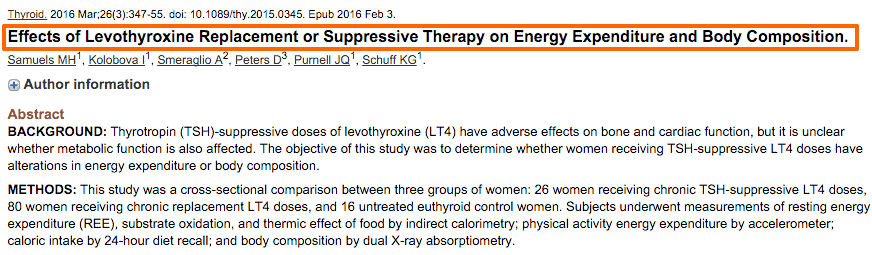
Some studies have shown that despite using levothyroxine (8) (and suppressing the TSH) resting energy expenditure (a measure of metabolic function) does not “normalize” to healthy adult levels.
If you find that this is happening to you, then it may be an indication that you either need to alter your dose or consider altering which medication you are taking.
#2. Follow Your labs (Including Free Thyroid Hormones)
While the TSH may not be the most valuable lab test to evaluate your thyroid that doesn’t mean that other lab tests don’t have value.
In fact, it is just the opposite.
When you are treating your thyroid with medication you should periodically evaluate your free thyroid hormone levels.
You can do this by ordering Free T3, Free T4, and Total T3 (9).
These lab tests provide a window into your body and can help you determine if your dose is sufficient.
The hallmark of hypothyroidism is a reduction in Free T4 and an elevation in TSH (typically, but not always the case).
As you take levothyroxine your Free T4 should increase.
Why?
Because levothyroxine contains the same thyroid hormone that your body produces naturally.
If you are taking thyroid medication and you only see a drop in your TSH without a simultaneous rise in your free T4, then your medication dose may not be sufficient.
It’s critical that your body has sufficient Free T4 levels because it uses T4 to create T3 through the conversion process.
Low levels of T4 may result in decreased T3 and further issues down the road.
It may seem obvious to you that it’s necessary to look at the free hormone concentration in your body, but it’s not always obvious to doctors.
But it should be, especially if you think about it.
When we evaluate all other hormones in our bodies we always look for the direct hormone concentration in the bloodstream (10).
Hypothyroidism is the only hormonal condition in which we evaluate the pituitary marker instead of the free thyroid hormone.
Take for instance testosterone:
If you have low testosterone and you take testosterone medication, doesn’t it make sense to check your testosterone levels to see if they have improved?
It makes perfect sense and that’s exactly what your doctor should be doing.
#3. Monitor Your Symptoms
Another tool you can use to determine if your dose is sufficient is how you are feeling otherwise known as your clinical symptoms.
The symptoms of hypothyroidism occur as a result of decreased circulating thyroid hormone in the cells of your body.
Symptoms such as hair loss, fatigue, weight gain, depression, and constipation all occur directly because of low thyroid hormone.
What does this mean for you?
It means that as you replace this lost hormone these symptoms should subside and completely go away over time.
In this way, you can utilize them as a very useful marker to determine if your dose is sufficient.

Your symptoms represent another crude way you can monitor your dose and they should correlate directly with your lab tests and your basal body temperature.
It’s important to realize, though, that there may be some overlap in some of your symptoms with other medical conditions.
For instance:
Fatigue is a very non-specific symptom that can be associated with many medical conditions (11).
The same is true for constipation and hair loss.
But when you put all of these symptoms together (the more you have the more likely you can be sure they are caused by your thyroid) and you are experiencing all of them you can be more certain they are related to your thyroid and not to some other medical condition.
By evaluating all three of these important factors you can easily monitor your “success” and determine if your dose of thyroid hormone is adequate for your body.
As you go through the motions, you may realize that the amount of thyroid hormone that you need is different from other people.
That’s okay and it is to be expected.
Levothyroxine VS Armour Thyroid VS Liothyronine
As you probably know there are several different types of thyroid hormone medications that are currently available.
Unfortunately, most doctors give out the same medication: levothyroxine or Synthroid.
Both of these medications contain the inactive thyroid hormone T4 and in order for it to be active in your body, it must be converted to the active T3 thyroid hormone (this process is known as T4 to T3 conversion).
So why haven’t you ever heard of this before?
Doctors operate under the assumption that all patients convert T4 to T3 at an equal rate which means that they don’t feel this conversion process should be taken into account.
But there is one problem with this philosophy:
It’s not true. In fact, up to 15% of people have been shown, due to their genetics, to have a problem with this conversion process (12).
As a result, many patients are taking the wrong type of medication which may explain why they don’t feel well and aren’t experiencing any improvement.
And that’s where the other thyroid medications come in…
Many patients do very well using combination thyroid medications that contain both T4 and T3, not just T4 medication alone.
And I’m not just saying this from experience, most patients also agree that medications containing T3 are superior…
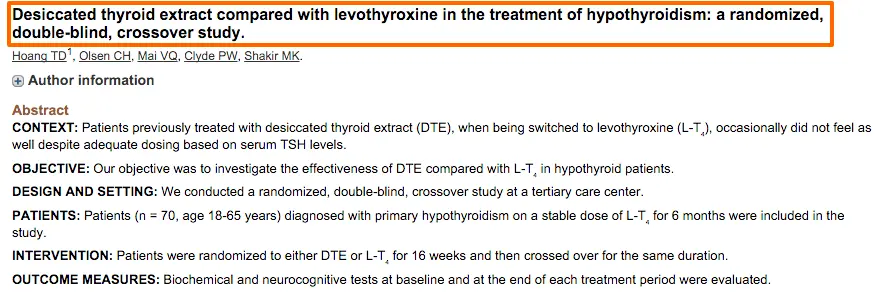
In clinical studies, many patients prefer natural desiccated thyroid hormone (13) (thyroid hormone that contains T3) over T4 medication alone.
The study shown above highlights why this is the case.
As patients switch from taking LT4 medication to thyroid extract they tend to experience a better quality of life and more weight loss.
This is felt to be secondary to the increase in free T3 and free T4 levels which can remain low even if the TSH is considered to be normal (14).
I’ve personally also found this to be the case in my practice as I transfer patients from LT4 medications over to NDT and T3 thyroid medications.
The patients who make the switch tend to experience more energy, less hair loss, more weight loss, and so on.
What to do if you have Hypothyroid Symptoms on Levothyroxine
So what should you do if you are taking levothyroxine or another T4 medication and your body temp is low, your heart rate is low and you are still symptomatic?
The good news is that there are several tips and tricks you can follow to make your current dose more effective (even if you can’t switch medications entirely).
When it comes to levothyroxine, this medication is actually quite difficult for your body to absorb and this may account for a significant number of problems when taking it (15).
So, even if you are taking your thyroid medication faithfully, it doesn’t matter unless you are also absorbing it in your gastrointestinal tract.
There are several steps you can take to improve the absorption of levothyroxine which may have an effect on how you feel.
At best you absorb about 80% of the thyroid hormone that you ingest (16).
But this number rapidly reduces in the setting of GI-related problems, inflammation, low stomach acid, and other intestinal issues.
Anyone who is suffering from constipation, gas/bloating, acid reflux, diarrhea, abdominal pain, gastric ulcers, low stomach acid, etc. may have reduced absorption of their medication.
This is complicated further by other medications and supplements which may reduce thyroid hormone absorption if not taken at the correct time.
So let’s talk about how you can impact the absorption component and get more “bang” for your buck so to speak.
#1. Levothyroxine 50mcg tablet
The 50mcg tablet of levothyroxine may be better absorbed and assimilated compared to other doses.
Why?
Because each dose of levothyroxine contains different colors, dyes, fillers, and otherwise inactive ingredients.
These fillers may act to cause symptoms by themselves (17) (which can be confused with hypothyroid symptoms), but they also reduce the absorption and effectiveness of thyroid hormone in your body.
The 50mcg tablet of Levothyroxine is special in that it is white and contains the fewest amount of fillers and additives when compared to the other dosages.
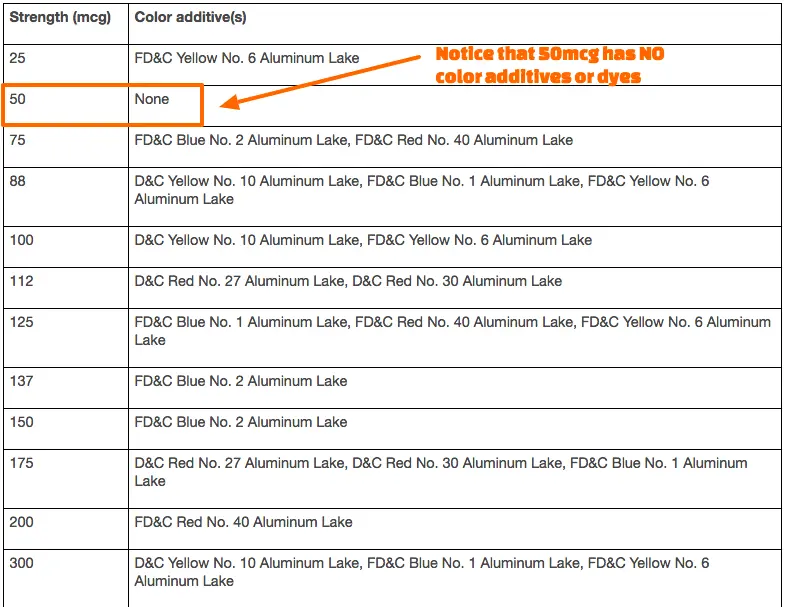
This presents a unique opportunity where you can switch your current dose of levothyroxine to 50mcg increments to potentially benefit from this.
Let’s say you are currently taking 150mcg of levothyroxine.
You could easily switch to taking 3 of the 50mcg tablets of levothyroxine which would be the same equivalent dose and get rid of all of the fillers/dyes in the process.
Make sense?
Something as simple as this change can actually improve how you are feeling.
Even better is that most physicians won’t have a problem with switching your dose.
#2. Consider switching to Tirosint or Tirosint-Sol
Tirosint and Tirosint-sol are two new T4-only thyroid medication alternatives.
Compared to levothyroxine, they are special because they contain the fewest inactive ingredients out of all available thyroid medications.
Tirosint contains a grand total of 4 total ingredients (3 inactive and 1 active) and Tirosint-sol contains a grand total of 3 total ingredients (2 inactive and 1 active).
The net result is that both are very easy to absorb and highly bioavailable (18).
Many patients report an improvement in their symptoms simply when making the switch from levothyroxine or Synthroid to Tirosint.
Compared to other thyroid medications (I’m looking at you, NDT formulations), it’s relatively easy to get your doctor to prescribe Tirosint medications because they are more similar to levothyroxine.
#3. Increasing Absorption of Thyroid Hormone And When to Take Your Thyroid Medication
If you are unable to switch to 50mcg increments of levothyroxine or if your provider isn’t willing to switch you to Tirosint there are still other steps you can take to improve absorption.
The first is to simply change the time of day that you take your thyroid medication.
Studies have shown that taking your thyroid medication at night can actually increase serum thyroid levels (19).
This is most likely due to the speed of your GI tract at various times of the day.
In the morning your GI tract is sped up which may limit the absorption of thyroid hormone.
At night your GI tract slows down which may allow for higher absorption.
In addition, your cortisol levels peak at 8 am in the morning (when most patients take thyroid hormone) which may also influence thyroid hormone metabolism.
It’s certainly worth a discussion with your current physician to determine if taking levothyroxine at night may help you.
The second option is to treat any GI-related problem that may be limiting your absorption.
By addressing conditions such as low stomach acid, SIBO/SIFO (very common in hypothyroid patients), and other GI-related problems you may be able to increase thyroid hormone absorption.
Do you need T3 medication?
By now you might be asking, do I need to be on medication containing T3?
The answer really depends on you, but I can help you figure it out…
In general, patients who should consider using Natural Desiccated thyroid hormone or T3-containing medications include:
- Those who don’t feel better on T4 only containing medications even after tracking their metabolism, symptoms, and lab tests
- Those who have not lost weight on levothyroxine or Synthroid
- Those who notice their symptoms getting WORSE despite increasing their dose of T4 medication
- Those with low serum-free thyroid hormone levels (low free T3 and low free T4)
If you fall into any of the above categories then it would be worth talking to your doctor about switching your medication to something that contains T3.
And don’t sweat it if your doctor isn’t willing to use Natural Desiccated thyroid because he/she may be open to using Liothyronine instead.
Liothyronine or Cytomel both contain pure T3 medications and can simply be added to your current dose of levothyroxine.
So let’s say you are taking 100mcg of T4 and you aren’t feeling well at all.
Instead of switching to 1-2 grains of NDT, you can simply add 5-10mcg of liothyronine or Cytomel to your current dose of levothyroxine.
Your regimen may look something like this:
- Levothyroxine 100mcg per day
- Liothyronine 10mcg taken twice per day for a total of 20mcg per day
This allows for roughly an 80/20 ratio of T4 to T3 which is similar to what the thyroid produces naturally.
Levothyroxine Dosage Chart and Comparison Table
So, what if your doctor isn’t willing to change medications or you really like being on levothyroxine?
Then make sure you are on the right dose!
Your dose should be based on the 3 step system I outlined above: Lab tests, symptoms, and your metabolism.
You can get to this dose by starting out with a low dose (around 25mcg per day) and then slowly increasing your dose and monitoring each of the steps.
From there you can check your lab tests every 6-8 weeks to follow your TSH, free T3, free t4, and reverse T3.
Dosing varies quite a bit based on the person but a typical dose may range between 25mcg and 250mcg of levothyroxine or Synthroid per day.
If you have continued to increase your dose beyond 150mcg and haven’t noticed ANY improvement in your symptoms then that may be a sign to consider switching medications.
If your doctor still isn’t willing to try NDT or T3-containing medications then you can also try other forms of T4 with fewer fillers like Tirosint and continue increasing your dose slowly over time.
If you are switching from T4 to another medication this comparison chart may be helpful:
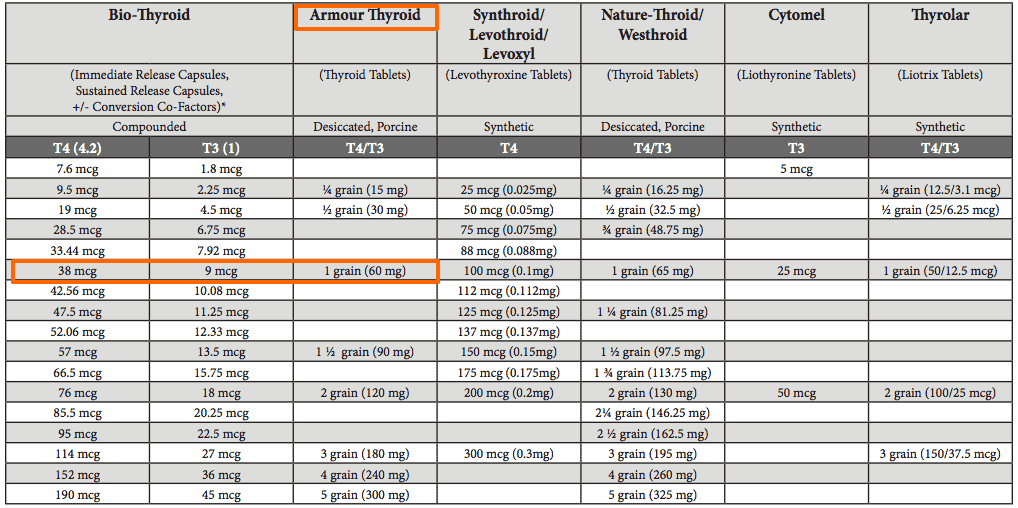
This chart isn’t perfect but it is a good starting place.
I find that the conversion from T4 to NDT or natural desiccated thyroid is too low (meaning you usually need more NDT to make it equivalent to the T4 dosing).
In my experience, 2 grains are closer to 100mcg of T4 than 1 grain, but it is important to start out slowly if you are switching medications because T3 can be VERY stimulating to some people.
Final Thoughts
Believe it or not, your dose of levothyroxine depends on multiple variables, all of which need to be considered to help reduce symptoms and help you feel better.
Remember that levothyroxine absorption plays a big role in how you may feel.
By switching your dosage to 50 mcg increments of levothyroxine or switching to Tirosint altogether you may improve your thyroid hormones.
Another option is to consider changing the time of day that you take your thyroid medication.
Lastly, you should also consider treating any GI-related problems that may be limiting your absorption as well.
If these options fail then you might consider the addition of T3-containing thyroid medications.
To get these medications you will need the assistance of a physician who is knowledgeable about thyroid function.
Now I want to hear from you:
Are you currently taking levothyroxine?
Do you feel that your dose is sufficient?
Have you attempted to use other thyroid medications?
What has worked for you? What hasn’t?
Leave your questions or comments below!
Scientific References
#1. https://www.ncbi.nlm.nih.gov/pmc/articles/PMC4267409/
#2. https://www.ncbi.nlm.nih.gov/pmc/articles/PMC5763098/
#3. https://www.ncbi.nlm.nih.gov/pmc/articles/PMC5763098/
#4. https://www.ncbi.nlm.nih.gov/pmc/articles/PMC1578599/
#5. http://www.ncbi.nlm.nih.gov/pubmed/24692351
#6. https://www.ncbi.nlm.nih.gov/pubmed/11174855
#7. http://www.ncbi.nlm.nih.gov/pubmed/19375759
#8. http://www.ncbi.nlm.nih.gov/pubmed/26700485
#9. https://www.ncbi.nlm.nih.gov/pubmed/22997973
#10. https://www.ncbi.nlm.nih.gov/pmc/articles/PMC4255853/
#11. https://www.ncbi.nlm.nih.gov/pmc/articles/PMC2766938/
#12. https://www.ncbi.nlm.nih.gov/pmc/articles/PMC3219766/
#13. http://www.ncbi.nlm.nih.gov/pubmed/23539727
#14. https://www.ncbi.nlm.nih.gov/pmc/articles/PMC5763098/
#15. https://www.ncbi.nlm.nih.gov/pubmed/19942153
#16. https://www.ncbi.nlm.nih.gov/pmc/articles/PMC4659333/
#17. https://www.ncbi.nlm.nih.gov/pubmed/26748887
#18. https://www.ncbi.nlm.nih.gov/pmc/articles/PMC3726924/
#19. https://www.ncbi.nlm.nih.gov/pubmed/17201800



I have a question. My dr about a year ago changed my Levothyroxine dose from 50mcg to 25mcg. Since then I became lethargic. Tired all the time and at times unable to wake so I sleep all day. Good thing I’m permantely disabled or is been fired already. Guess a good point to make would’ve been to mention I’ve been on Levothyroxine for quite a while at the 50mcg dose. My original cardiologist passed away and his colleague became my dr. He is the one that made the change to half the dose I was originally on. Isince the change I have gone downhill I’m inactive now I rarely leave the house. I have just gone down hill to the point of I ended up with a rash on my body which the dermatologist said was eczema and I have had a high level of histamine and ige. My eyelids have been swelling up to the point of my eye almost being shut closed. My dr said my thyroid labs came back and n normal range. How they determine normal really ticks me off because anyone that’s looked at thyroid normals has seen the range of normal is pretty big. Could it be possible I just need to get my dose back tomorrow 50mcg. My dr won’t budge but he’s also not the one that feels left me crap. Not the mention I’m 46yo with copd and have a artificial heart valve and was not super active but in the gym 5 days a week on a light workout to keep my lung strength up and my body strong. Could the change in dosage be the cause of my terrible state of life?
Dear Dr. Childs, I had a thyroidectomy in 2014 due to thyroid cancer. I also have been diagnosed with celiac disease. I follow a gluten free diet without fail. My Doctor has put me on Synthroid starting at 175 and has been decreasing to 150 in July and now 125 in September. He seems more worried on lowering the dosage than anything else. I have not noticed any difference since the medication is being decreased other then weight gain (20 lbs in 3 1/2 months). I have severe chronic muscle and joint pain and the doctor says it is not related although I have had multiple MRIs, CTs and bone scans. I have tried every kind of treatment such as physio, accupucture, massage, athlete therapy, chiropractic. Do you have any suggestions? I am at a lose, I am 49 years old in fairly good shape and feel like an 100 year old.
Hi Stacey,
I would recommend that you read this post for more information: https://www.restartmed.com/hypothyroidism-chronic-pain/
Hello. I think your information is excellent and easy to read. Where to start, I am 67. Been on Meds since 32 History of hypo in the family. Early on could not tolerate synthroid as it made my heart race and insomnia. Have a,ways been a poor sleeper. Found a doctor I loved for 30 plus years. Only took cytomel. 25 x 2 and felt fine, he said I did not convert t4. He retired and my GP just continues that dose, eventually I began to feel awful. No sleep sweating. Etc. so went to a new doctor. Now it has been a year and the worst roller coaster. Her first statement is that only prescribing T3 is insane and it goes against her oath of do not harm. When I first saw her my T3 was almost 6 so you can see why I felt awful. I have tried all combos. Armour 75. Then. Armour 60 was only sleeping 3 hours a night. Finally went to 50 of Tirostint. Felt better but still sluggish. Last labs T4 .8. T 3 4.87. TSH .61. But still not feeling right. So went to Tirostint .88 and added cytomel .5 x 2. As it does not come in a .10. NO SLEEP. So stayed on the Tirostint dose and cut cytomel to .5. Sleeping better but now have muscle aches and some fatigue and stomach aches. I have a hietal hernia and take 40 of nexium and have struggled to space the dosages apart. Also take 300 XL Wellbutrin. I am thinking that taking Tirostint at night could be a game changer. I go for blood work again in about 2 weeks She really wants me to take 100 Tirostint. She says that very few people can’t convert and that I do not know what normal feels like because I was at such a high level of T 3. I don’t disagree with that. Ok. I know there is more info I should be giving but any thoughts you could give me would be appreciated Thank you
3
I have been on 50 mcg of levothyroxine and cytomel.for years. I have gained a lot of weight over the years and exercise 5 times a week meaning 5 days a week eat healthy and cannot lose weight for nothing in fact I just keep gaining. I’ve talked to my doctor have gotten blood test regular and she says I’m always in the right level I’m. I’m very frustrated. I’ve tried different ways of eating with no results. Have added more cardio and still no results. The only thing she says to me is I’m getting older and weight tends to settle in the middle. I walk out of there every time with no answers. My breasts have increased in size also for no apparent reason. I’m going to try going off the medication entirely and see what happens do you have any suggestions?
Hi. My daughter (34) had had hypothyroidism since infancy. She is now on 300mcg of levothyroxine. She decided several months ago she was fed up with all the ill side affects she was experiencing and quit taking her medications. We had a myxedema crisis. She almost died. Now 3 months out and she is still recovering. She is so miserable. Her hair is falling out in handfuls! She’s so tired and has either constipation or horrible bouts of diarrhea. She has dark pigmentation around her neck and hasn’t had a menstruation in over 2 years (never has been regular) She’s been trying to get back to work but hasn’t the energy to work for more than a couple hours a day. WE live in a very rural community and don’t have access to an endocrinologist. I am very scared for her. She has started again having the symptoms that led to her stopping the medicine. Mainly exhaustion and palpitations. She says it feels like all of her engery just drains suddenly. I know more needs to be done but no one knows what. I diagnosed the myxedema. They had no idea what was going with Her! The ER kept saying she had sleep apena! Her TSH was 79 when they finally tested it! Her GP said she still isn’t on enough but her dosage is too high. Can you please give me a jump off place I can talk with her doctor about. Once I suggest something they do investigate. They admit to being out of their element when it comes to her. Any help at all is greatly appreciated!
Hi Kandace,
You might have better luck traveling out of your rural area and looking into more specialized physicians in a larger city. If her quality of life is that poor then it may make sense to try and make the sacrifices necessary to find a new physician.
I hope you can help me. I am 70 and I had a total thyroidectomy January 2017, am seeing an endocrinologist but still up and down with levels and having problems with sore joints, leg muscles, eyes and feeling terrible. I am other wise very very health and active. I have my whole life had trouble with even taking an aspirin sensitive to drugs of any kind, luckily I’ve never been on anything til now with Levothyroxine. I am on 88 mcg now and feel worse and also on my own figured out the inactive ingredients bother me a lot. My question is why do all these different doses have to have so many fillers that creates problems in our bodies, and my doctor doesn’t think that is my issue, and I do, I feel sick when I take my pills in the morning and by later in the night feel better. Thank you for your time
Hi Cheryl,
Each person reacts differently to the fillers and binders and a lot of that just depends on their body and their genetics. I can’t really answer why your physician doesn’t take this into account, however, but you might feel better switching to a medication such as tirosint if that is the case.
Dr. Westin
Why do endocrinologist insist that your lab numbers are perfect and that the weight gain and horrible tendon pains are not the result of your thyroidectomy and medication even though these this were never an issue prior to thyroidectomy and offer diet pills instead of changing med dose? I’m fed up with being told my labs are perfect and still feel like my body has been invaded by an alien….awful feeling awful all the time.
It’s been suggested that I should NOT take my synthtiod or Cytomel the morning of my blood test in order to get a better result. Would you recommend this if not why?
Hi Grace,
Most physicians recommend against taking medication prior to the lab draw because it makes the labs look “worse” because serum T3 levels spike about 3 hours after ingestion. In addition they want to see what your thyroid levels look like 24 hours after dosing because that’s the “lowest” point your serum levels will be prior to taking another dose.
Dr. Westin
Why would taking your t4 and t3 meds prior to your blood test make your numbers worse instead of better ? I thought taking you thyroid meds prior to testing you would get you better results not worse.
Thanks,
Grace
It has to do with the way that the medications raise serum levels of thyroid and how that influences the way that your doctor alters your dose in response to those changes. It’s a complex topic but I would recommend you read this post for more information which may help make sense of it: https://www.restartmed.com/hypothyroidism/
This topic can also be confusing for patients because they assume that blood levels perfectly represent the status of thyroid hormone in your body and it assumes that these tests are 100% accurate, neither of which are true.
Hi Dr. Childs,
Quick question – I have started taking Cytomel with my synthroid (which I’ve been taking for 5 years alone) because I thought it would help my hair get back to what it was pre-thyroid issues and medication. Unfortunately it has caused balding on my hairline (or a severe miniaturization of hair follicles to the point it becomes skin and very high forehead). I’ve been on it for about 4 months and see no sign of improvement. My labs are excellent, and have tested the entire thyroid panel. I am at a healthy weight (130lbs, 5’4″). What is the next step you would recommend to address this issue? I was thinking of slowly waning off cytomel from 5mcg to 2.5mcg.
Any thoughts or advice would be much appreciated! Thank you for your thorough and informative articles!
– F
Hi F,
I would recommend you read this post for more information about hair loss: https://www.restartmed.com/thyroid-hair-loss/
There are many reasons that thyroid patients may lose weight ranging from their medication to nutrient deficiencies and so forth. That article will give you a good idea of where to start and how to evaluate your hair loss.
I am currently on Levothyroxine 100mcg and Liothyronine 10 mcg, my last blood work came in at Free T3 6.0 pg/ml and Free T4 at 2.2 ng/dL; TSH 0.0 uIU/mL and my Thyroglobulin Ab at 10.7 IU.ml, Thyroperoxidase at 2.2 IU/mL.
My doctor wants me to increase the Levothyroxine to 150mcg, I am worried that it may be too much and cause weight gain. I already have all the symptoms of Hypothyroid, and it has never gotten better being on the medications. Should I increase my Levothyroxine dosage to the 150mcg??
Hi Jamie,
It might be a good idea to evaluate your reverse T3 before increasing your hormones further, but you should definitely discuss this with your current doctor before you make any changes. In general it’s not a good idea to suppress the TSH with T4 medication as it may lead to long term consequences in certain people.
Hi Doctor,
I have all of the symptoms you mentioned above and have been on Levothyroxine 50 mcg for a little over two years now. I keep telling my gp and endo I do not feel well but they only test my tsh. I finally got them to test my tsh with ft4 and my ft4 is 0.993 right on the low range of normal, however my tsh is 1.27. Does this mean I am not absorbing enough ft4 from my Levothyroxine? Would you recommend trying to switch to Tirosint or a drug with t3?
Thank you,
Mary
Hi Mary,
You would need a free T3, total T3 and reverse T3 to assess peripheral thyroid conversion and obtain a clear picture as to what is going on.
I just wanted to say thank you ! I found your article to be very informative .
Hi Dr.Childs
My Endo recently changed my synthyroid from 125mcg to 112mcg after a day on the 112mcg I developed a horrible burning skin sensation that at first would come and go but on the 2nd day this burning sensation increased to involve burning sensation on my face,neck,tongue,forearm and hands by the 3rd day I had all the same burning and now on top of burning I had severe sweating with teeth chattering coldness and a red welt on my neck the size of a half dollar. I took a benadryl and within 30 minutes all my issues disappeared.
I had simular issues while taking the 125mcg synthyroid it just wasn’t as bad as the 112mcg and it never occurred to me I could be allergic.
If this is an allergic reaction to synthyroid will this reaction cause me to absorb less of the medication? Why does no one talk about being allergic to synthroid or anything else for that matter?
I have no thyroid and multiple immune system issue to boot. My Endo is now putting me on 50mcg synthroid (2) a day for 6 days and (300mcg) on the 7th day along with 15mcg Cytomel. Does this seems like alot of synthyroid (300mcg)for one day?
Thanks
Grace
Hi Dr. Childs,
My daughter is 9 and has Hashimoto’s. When it was discovered her TSH levels were over 100! She was 7 years old. She is on Synthroid (100 mcg.) She still gets migranes although not nearly as many, and tells me several times a week that she’s really sad (she says her heart hurts). I’m curious to know what the average mcg. for children her age is? Thank you so much for your time!
Good morning,
I just had my thyroid, a mass and lymph nodes on the left side of my neck removed due to cancer. They have started me on 100 mg a day of the levothyroxine. Overall, I feel pretty good, but the biggest thing I have noticed is that I am hungry all the time and I am having cravings for sweets some kind of awful. Is this due to lack of thyroid? Is the medicine supposed to help this and if so is the dosage not right? Please any advice would be greatly appreciated.
Thanks,
Missy
Hello, I was recently prescribed 0.025 synthroid but my symptoms seem to be getting worse. The one that I am worried about the most is my heart. I’ve been experiencing pain/tightness in the left side of my chest and angina every once in a while. I did experience these symptoms before starting synthroid but happens more frequently. Can your symptoms get worse if the dosage is too low? Or is it probably because I have poor t4-t3 conversion? Thanks for your help.
My son had thyroid cancer and they removed the entire thyroid last spring. They started him on levo at a very low dose and have slowly increased it. They have not settled on 175mcg. After some research online, I’m concerned that is a relatively high dose. Since this will be a life long medication, should we consider other meds or is levo relatively safe for life long use? Thanks so much! (My son is 19yrs.)
I have been on Leboxthorine for 3 years and my results haven’t stabilised at all. Every few months my dose gas been changed. Symptoms are ever present (anxiety, fatigue, sleeplessness) and weight loss IMPOSSIBLE. I have been trying to get my Dr to add T3 medication and they refuse to consider it. They even told me today that it is not possible to have this medication in Australia. I’m so frustrated that I’m considering ordering NDT elsewhere without Dr help!
Hi Dr.Childs
Can you point me in the right direction for how much Cytomel you should be taking based on how much synthyroid your taking? I’m on 100mcg synthyroid and 15mcg Cytomel and curious if I should be on 20mcg cytomel, my Endo recently reduced my synthyroid by 50mcg per week and left me taking 15mcg cytomel and I’m starting to have fluid retention in my lower extremities that cause terrible leg pains.
Hello Dr. My TSH is 37.93. My endo keeps insisting that I’m not taking my meds but I am daily. My med is 200 mcg levothyroxine. What can I do?
Hi Kristen,
You should look into other medications such as Cytomel and evaluate GI function for things like Celiac disease which may be limiting your absorption. You can learn more about taking thyroid medication and how it influences your serum thyroid levels here: https://www.restartmed.com/take-levothyroxine/
Feeling fatigue, cold feet, pain in my hips. I have my yearly checkup next Monday. I will request to switch to Tirosint, if the Dr refuses to help, like she did last time, I will switch doctors. (On generic levothyroxine now) Please give advice on finding a better doctor. Thanks
Feet
Hi Tricia,
I would recommend checking out this post for further resources: https://www.restartmed.com/thyroid-doctor/
My TSH was 5.180. My PCP put me on Levothyroxine 50 mcg.No other thyroid testing was done and no physical exam.I have knots in neck and MANY other physical issues. Should additional tests be done,should I see endocrinologist?
Hi Donna,
I would check out this post which discusses the lab tests necessary for adequately evaluating thyroid function: https://www.restartmed.com/thyroid-tests/
Please help me I had a TT Nov 14 2017 and have felt awful since. Now I’m in despair I’m on just under 100mcg levythroxine. I feel there is no hope and the life is slowly draining from me. I beg you please ring me on 07783757986. Andrea
Hi Dr. Childs,
I was on 50 mcg Levothyroxine and yet lab results showed TSH level of 3.93. I was feeling fuzzyheaded, tired and sleepy. So, I increased my dosage of Levothyroxine to 75mcg two days ago. Now I feel hyperactive, with drastically reduced sleep, nervous with increased appetite although I don’t think I have gained weight. Should I reduce Levothyroxine dosage to 62.5mcg?
I’m 64 been on levothyroxine 75mcg a day for years my last blood put my tsh at 2.56 I’m tired all the time have short term memory probs and feel very lethargic all the time, just lately I yawn and take deep breaths all the time a feeling of not getting enough air in but sleep well should I up my dose my doctor always says blood is within normal range no action needed.
I use 100 mcg of levothyroxine and I am not losing weight but I begin with tremor.
Can I use 50 mcg in the morning and 50 mcg at night?
I am 60 and have taken levothyroxine for 30 years. 6 months ago, a routine med check showed abnormal and increased dose from 150 to 160, 2 months later, labs showed no difference and doctor increased to 160, then again 2 months later to 170 then to 175. When checked again and labs hadn’t changed the doctor reduced fade to 125. I’m about to go back in for another lab test but wonder if I should switch doctor? I’m healthy otherwise and take Adderall as only other med for add. I am 5’5 and 146 lbs. I have all the symptoms of hypothyroidism especially cold all the time.
Hi Sandy,
I would be sure to check out this post which outlines optimal levels for your thyroid: https://www.restartmed.com/thyroid-tests/
Recently diagnosed with Hypothyroidism, my doctor prescribed Levothyroxine 25mcg. I am still sick after a month, just had new blood work for dr. to analyze to perhaps increase the prescription. I am 82 years old on 4/14/18. Been healthy and active all my life and now I’m debilitated. Help! Thank you!
Hi, I am an 18-year-old and I have been diagnosed with hyperthyroidism, I took radioactive iodine, and now I have hypothyroidism since last year. My medication was 100 mg of Levothyroxine, but my doctor saw that levels were wrong so he made me take 125 mg daily. Since then, I started getting cystic acne around my lower cheek area, cheekbone, and forehead. I usually never get acne, but when it happens, it is because of menstruation. My hair also started getting dry for no reason. What do I do? I have thought about taking Accutane for my acne because it is getting out of hand, but it might affect my thyroid? What should I do?
Hello, Dr. Childs! I have hypothyroidism. My doc put me on 25mcg. I have only been on it for two weeks. I keep feeling super shaky and just last night my heart is racing. I am not sure what’s going on. Why is this happening? any advice would be appreciated! Thanks.
I need all the help I can get ….I’ve had Hashimoto’s for over 14 years and it hasn’t gotten better just worst. I can’t lose weight even when exercising and eating right. So I give up, I hate my life! If it wasn’t for my children I’d rather be dead. I can’t live like this.
Hi Dr. Childs,
I’m really hoping you still respond to this thread because I am at a loss! I was put on levothyroxine during pregnancy due to my thyroid lagging (started at 25mcg, went to 50mcg, and the third trimester was at 75mcg). I was retested on the 75mcg 6 weeks postpartum and my levels were TSH .051 and Free T4 1.85. Was told to stay on 75mcg and skip one pill a week. 8 weeks later my numbers were TSH <.006 and Free T4 1.33.
I was then bumped down to 50mcg. In the 4 weeks since being put on the 50mcg I have gained 14 pounds and am extremely lethargic and depressed, despite the same diet and actually adding exercise to my routine. Note: I am still breastfeeding my 4-month-old.
I feel like total dog doodie on the 50mcg-going in for blood work tomorrow because I asked my doctor for it but TERRIFIED she will say my numbers are good on the 50mcg dose and that I will have to stay on that dose feeling this terrible. I felt great on the 75mcg (aside from some trouble falling asleep). Any advice on what to say and how to advocate for my health?
Thank you so very much!
Hi Dr. Childs:
I have been diagnosed with hypothyroidism. I started on 12.5 mg. levothyroxine, went to 25 mg., then to 50 mg. I began to have heart palpitations, panic attacks, feel rageful, irritable, had headaches and body aches. So I stopped. I started 13 mg. of Tirosint. On day 14, I began waking up with some of the same symptoms of fluttery heart and extreme irritability. On day 15, I added 5 mg. of Cytomel and had a horrible headache the next day so I haven’t taken another. Today is day 20 on Tirosint (a Friday and I will call my Dr. on Monday) and those symptoms are getting worse. I need thyroid replacement but why does such a low dose make me feel like I’m hyperthyroid? What could be happening and what do you recommend? Thank you in advance.
I apologize – I just sent an email about having problems with low doses of levothyroxine and Tirosint – I meant .mcg, not mg. 50 of levo and 13 of Tirosint – such low doses are causing me heart palpitations and extreme anxiety and irritability. I am on day 20 of 13 Tirosint and those symptoms are getting worse. I tried 5 of Cytomel on day 15 and had a terrible headache the next day so stopped that. Why is such a low dose of Tirosint causing symptoms that seem like hyperthyroid? I will get with my doctor but wonder what your thoughts are and what do you recommend? Thank you.
Dr.Childs
I’m 64, at 40 my thyroid went hyperactive, treated with radioactive iodine, been on Levi (125) since. Diagnosed with stage 3 breast cancer, HR+,HER2+. Chemo, radiation, Herceptin and now taking Anastrazole daily. TSH levels have gone from 3.0 in 2016 When first diagnosed to 2.720 in 2017(1 year into treatment) now to 0.363 in 2018. My physician has changed my Levo from 125 to 112 and doesn’t seem too concerned about the change. Is decreasing the dosage the right thing. I am experiencing all the symptoms now of hypothyroidism. Thanks for your caring.
My doctor prescribed, as per my request, Levothyroxine 50mcg a year ago, when my TSH was at 3.25. I was re-tested 3 months later and it went down to 0.75. Now, 8 months later, after taking my pill every day at night, as instructed, my TSH test came back at 5.23. I don’t feel tired or depressed but I still struggle to lose weight and I continue to lose hair.
So what now? When I asked to have the T3 and T4 tested, I am told that it’s not necessary. Should I take a higher dosage of the same medication?
Thanks in advance.
Hi, can you comment a bit about dose adjustments in pregnant women, since the new recommendation is to be generally under 2.5 tsh in the 1st trimester and under 3 in the remaining trimesters? I went up from 25 to 50 preparing for pregnancy and was tested 1.93, but at 10 weeks the reading jumped to 2.69. I was increased to 75 mcg but I am so afraid the gap between 6 and 10-week reading that at some point went up could have harmed the fetus. How much damage could have been done not having it managed until I was urged to go up to 75 mcg? Thank you ahead of time.
Hi Ila,
You can find more information about thyroid and pregnancy here: https://www.restartmed.com/thyroid-and-pregnancy/
Hope this helps!
Hello Dr. Childs
I have gained 30lbs in 6 months. I have no idea what to do. I have a functional medicine doctor. She found my RT3 to be 16. She didn’t add or change any meds but she did increase my T4 (tirosint) and told me to get my labs drawn again in 8 weeks. Do you think i should be on a t3 medication? I have gained more weight since she increased my T4 medication (6 weeks ago)
Good day Dr, would be very grateful for some advice, I’m 44 year old male 73kg 5.8ft tall, I had thyroid cancer 2 years ago and had a total thyroidectomy. I was switched to 125mcg of levothyroxine after 3 months. After 2 years I waited for my body to adjust to the medication ( lab results where within range) I still had the same symptoms, pains in lower legs and arms (random would come and go) hair loss (patchy), severe anxiety and depression extremely low heart rate 46bpm, carpal tunnel syndrome in my right hand, my oncologist has now reduced my dose to 100mcg, I feel slightly better about myself but the carpel tunnel and hair loss persist. I’m confused as to whether I was on to high a dose or not enough. My symptoms indicate both, hair Loss and carpal tunnel etc, my dr said if after 2 months I’m not better they will add T3 liothyronine to see if that helps. What would be my best method of testing to see if I’m heading the right way? It’s confusing and frustrating ave gets me down at times, I’m in the UK btw. Thanks in advance Mark.
Hello
I was diagnosed in 2004 with hyperthyroidism, had the radioactive iodine in 2010. I am now hypothyroid. My doctor prescribed me with 50mcg two years ago and for about the last 8 months I have extremely dry skin and nails, fatigue, slow body movements, and anxiety. I become nauseous and lightheaded after taking the pill. Is this an allergic reaction? Please help.
Thank you
Hi Alesia,
It sounds like it may be more related to your dose of thyroid medication as opposed to an allergic reaction!
Hello, thinking of increasing my Levothyroxine dosage myself from 75mcg 100mcg. I’m also currently taking 5mcg Cytomel. (on Sunday I take a half of levothyroxine) I had a miscarriage last August and pregnant now. I firmly believe my diagnosis of Hashimoto’s was linked to my miscarriage. My endocrinologist said my levels were fine late April 2018. I just moved and have no Endocrinologist yet. The Nurse Practitioner (May 2018) recently told me the endo wouldn’t up my medication just monitor my levels. My Endo before I moved said if I became pregnant let her know so she could increase my meds. It will be a while before I get in to see a new Endocrinologist, and the NP said she hasn’t met a good endocrinologist yet and praised the Naturethroid and how it works for lots of people. I’m sure the levothyroxine I was taking before wasn’t enough and miscarried at 10 weeks. I’m about 2 weeks pregnant now. I’m 39, any suggestions?
osborne_leah@yahoo.com
Dr. Childs,
I am a Type 1 Diabetic (35 Yrs) on a insulin pump, and have had Hashimotos and Hypothyroid for 15 years. I am 46 YO and have been suffering from tachycardia (resting 85 daily average 108-130), weight gain, excessive sweating, numbness in my arms at night, depression, brain fog, chronic muscle pain and tension, extreme fatigue and NO sex drive… the list goes on. My doctor has been increasing my Synthyroid for years and added liothioine about a year ago. I am currently taking 200mcg of Synthroid and 10 mg of Liothione. However, I still feel awful all of the time. My husband thinks is it something I have control over and I cant get him to understand that my body is not working properly. My last 3 TSH levels were
0.03 – 07/17
0.05 – 11/17
Below 0.01 – 04/18.
T4 Free
1.07 – 07/17
1.10 – 11/17
1.16 – 04/18
T3
2.9 – 07/17
2.7 – 11/17
3.5 – 04/18
I need help!!! I just want to crawl into bed and stay there. Any advice would be greatly appreciated!
My doc recently lowered my levothyroxine from 125 to 120, because he said I was slightly over! I have been on 100 now for a few months but feel terrible. The blood test was bang in the middle, which he said was where I should be! So why do I feel so bad?
Hi Janice,
The short answer is because your TSH is not the single best marker to assess thyroid function and a better marker would be total t3/free T3. It sounds like your physician probably based your dose solely on the TSH.
Started with NDT…my TSH got worse. Dr moved me to the combo Levo/Lioth. I am gaining weight?!? (5lbs in 2weeks!) My resting heart rate has gone up (Fitbit). Will have blood drawn in 3 weeks… but don’t want to gain 15lbs before then! Any suggestions?
Hi Nancy,
Unfortunately, without lab tests or symptoms it’s difficult to say what is going on. I will say that it is not unusual for some people to gain weight while using levothyroxine.
mtborz@gmail.com
Hello, I have been taking 50mcg of Levothyroxine for over three years now. Instead of losing weight I have gained about 15 pounds without any significant changing my diet or physical activity. My concerns have gone unanswered or dismissed by my doctor. I know something is not right but don’t know what to do. Thank you.
Hi Mercedes,
Some of your symptoms may be explained by poor T4 to T3 conversion, you can figure this out with some simple blood work such as reverse T3, free T3 and free T4.
hi Dr Childs,
I have learned a lot here. I had Graves and had thyroid ablated in 2016. I was initially on Levo 112 but Dr switched me to NP Thyroid at 90 mg. I have been there ever since and do NOT feel well at all now. I am waking up at 2:30 every single night with severe adrenaline anxiety type issues, nauseated and shaky all day, cycles are now irregular, losing weight bc I can’t eat. I had lab done last week. TSH was .7 but that was all that was tested. I’m so overwhelmed and confused. Would love your advice. Thank you.
Hi Tamara,
If you have a specific question I’d be happy to try and point you in the right direction.
I have Hashimoto’s and am on 50mcg of L-Thyroxine each morning. Have had all the low thyroid symptoms for over 6 months and chalked it up to getting older. Made a goofy mistake and doubled up on med, one morning and one at night and was astounded to notice immediate difference in the way I felt. I know, too soon to tell, but I was so tired and cold and kept working out and fighting through, not making the connection until now. Can I continue this dosage and times?
Hi Colleen,
Unfortunately, I can’t provide specific medical advice unless you are a patient! Sorry about that.
Your article has helped me a lot.
Thyroid removed due to a false positive of cancer. Removed 5/10/18. I have Hashimoto’s. 125 mcg of Levo since surgery. Talked to endo, got blood work done yesterday, TSH is above 7.6. The highest it got before surgery was 5.9.
Not sure what my T4 is, but lab results are being mailed to me.
Levo got increased to 150 mcg starting tonight. I take it at 2am.
If this doesn’t work, I’ll ask to be put on the 50 mcg pills.
I realize this is going to take time and me keeping communication open with my endo. She’s fantastic and listens to my symptoms.
Hopefully, with what I’ve learned from your article, I’ll be feeling better sooner than later. 🙂
Hi Suzuki,
It sounds like you are on the right track! Keep us updated on your progress.
Yes, I do feel better since starting levothyroxine. I started on 25. But the pharmacy did not have so they gave me 50. I took the 50 and immediately began to feel better. After reading your article, I believe 50 is perfect. I respect my specialist, however, he isn’t up to listening much to your symptoms. He seems to be more into the basic everyone symptoms and not taking what you say as important. I will continue to advocate for or myself and read more about my condition. Thank you for sharing this east to read and understand article.
Hi Vivian,
No problem and glad you found it helpful!
Thanks for the information! 25 years in(levo 50mcg) and about 4 years ago I began losing hair, gaining weight, long bones ache so bad I need advil pm to sleep, get up and feel like the flu after 5-6 hours. Naps are my weekend routine. I’m going to begin taking my levo at night and see what happens. Elevated CK, low creatine. Had me stop taking my statin about 18 months ago and ck was temporarily normal, slowly increased and now back at 400 ul. Red ‘rash’ near my thyroid makes me think it may be time to increase dosage. Anyway, thanks for the information.
Hi Kevin,
Make sure you also check your thyroid lab tests as they will also give you valuable information. It sounds like you are on the right track!
Hi Dr.
I am 59 and have Hashimoto’s and have been on Levothyroxine for years. After my last blood test my endocrinologist lowered my Lthyroxine dosage from 100 mcg to 88 mcg. I started feeling a little joint pain and a little anxiety. I went back in six weeks for a follow up blood test thinking he would increase the dosage back to 100 mcg where I had no negative symptoms. Instead he decreased it again to 75 mcg. Now I have rotating joint and muscle pain, hot flashes, tingling in hands, and clicking noises in joints. Your article makes me think that my dosage is wrong even though my blood test say otherwise. What do you suggest that I do?
Thank you!
Carole
Hi Carole,
If you feel like your dose is not accurate you’ll want to start with a complete thyroid panel which includes free t3, total t3, reverse T3, TSH and free T4. The information you get from there can help you determine what changes need to be made.