

- Natural desiccated thyroid (NDT) contains both T4 and T3 hormones, giving your body active thyroid hormone immediately rather than requiring conversion from T4.
- Your dose depends on your individual body chemistry and symptoms, not just lab numbers, so finding the right NDT dose requires careful adjustment and symptom tracking.
- Some patients feel dramatically better on NDT after failing on synthetic medications because NDT mimics what a healthy thyroid naturally produces.
- Starting low and going slow with NDT dosing prevents overdose symptoms, but being too timid with dosing leaves you undertreated and continuing to feel terrible.
Update 3/30/26: Nature-Throid is still not available; however, this information is still updated and relevant and applies to other formulations of NDT.
Is Nature-throid the missing link to helping you FINALLY feel better?
The short answer: Maybe…
Like most things in life, the answer is never straightforward!
And that’s why I’ve created this guide.
I will show you which patients do best on Nature-throid when you should consider switching to NDT and what to do if Nature-throid isn’t enough for your body.
But first, we need to dive into some basics…
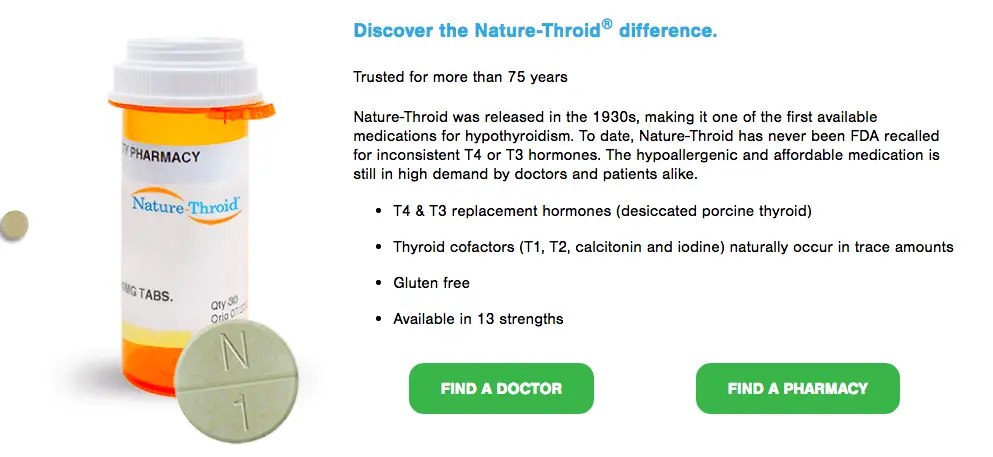
What Is Nature-throid?
Nature-throid is a medication used to treat Hypothyroidism.
This particular medication is unique among thyroid medications in that it is created from desiccated (or dried up) animal/porcine thyroid glands.
It contains a combination of T4 and T3 hormones which is why many people feel it is superior when compared to T4-containing medications (like Levothyroxine or Synthroid).
It also contains other hormones including minor amounts of Calcitonin, T1, T2, and even Iodine.
All of these ingredients are normally found in thyroid gland tissue (even the human thyroid gland) so it makes sense that they would all be in there.
In fact, it is widely believed that these extra ingredients found in thyroid extract may be why so many patients prefer this medication (1).
Nature-throid falls into the class of thyroid medications known as Thyroid extract or Natural Desiccated Thyroid (NDT for short) along with other medications which we will discuss in this guide.
One of the reasons you may have found this article is that you’re currently being treated with Levothyroxine and you have heard that Nature-throid or Armour thyroid might be a better option for you.
And that may be true for many people…
But we need to discuss why:
Is Nature-Throid Better than Levothyroxine?
Many people actually do better on Natural Desiccated Thyroid hormone instead of T4-containing medications.
Not only is that popular opinion on the internet, forums, and blog sites – it’s also been confirmed in clinical studies (2):
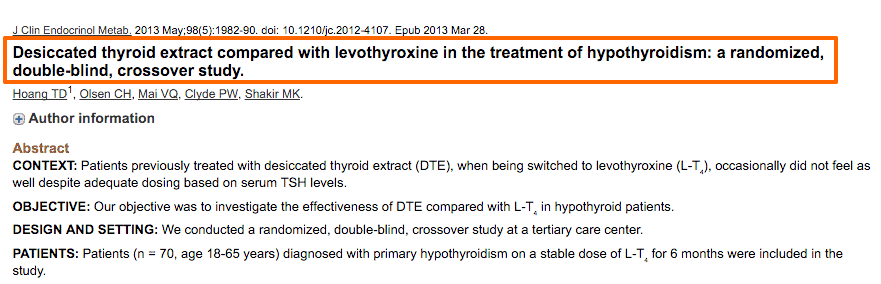
These various studies show that many patients actually prefer to be treated with NDT over T4-only thyroid medications.
Some of this preference may have to do with the fact that patients who switched from LT4 medications to NDT experienced greater weight loss.
The authors of this study did not conclude that the patients experienced an improved quality of life, but if you lost weight without exercising or changing your diet, wouldn’t you be pretty happy about that?

So why is that? Why do patients prefer these medications?
A big part probably has to do with the composition of thyroid hormones found in these desiccated thyroid extracts.
Nature-throid contains a combination of T4 and T3 thyroid hormone but more than that it contains it in a ratio of about 23% T3 to 76% T4 and this ratio is fairly close to the 20% T3 and 80% T4 that your thyroid gland produces naturally.
If you recall from basic thyroid physiology, T3 is the active thyroid hormone and T4 is the inactive thyroid hormone.
By providing your body with both sets of hormones you are re-creating normal thyroid physiology (or at least close to it).
This can be compared to treatment with T4-only thyroid medications which must be metabolized into the active thyroid hormone before they are usable by the body.
So why don’t Doctors use these medications more frequently?
Most Doctors believe that providing T3 to the body is unnecessary as the body will take T4 and convert it into T4 at a constant rate regardless of the individual or genetic makeup of the patient.
The hesitation to use Nature-throid and other thyroid extract medication stems from a fundamental disagreement in thyroid management philosophy and the current treatment paradigm.
Patients Who Should Consider Switching to Nature-Throid
If you are one of the many patients who isn’t feeling well on T4-only medication you’re probably wondering right now if Nature-throid will help you feel better…
And for many patients, the answer is yes (though not everyone!).
Certain patients tend to do better than others but the general theme is that if you are taking LT4 and not noticing a difference you may benefit from the switch.
In my experience, patients who fall into these categories tend to do well on Nature-throid or other forms of Natural Desiccated Thyroid:
- Patients who have not felt better on T4-only medications like Synthroid, Levothyroxine, or Tirosint (4)
- Patients with known or suspected DIO2 genetic defects (5)
- Patients with mild weight problems (6) or who are weight loss resistant
- Patients who have undergone thyroidectomy or RAI (7)
- Patients with low free T3 and low free T4 levels but with a relatively normal TSH (8)
If you fall into one or more of the categories above then there is a good chance that Nature-throid may be right for you.
Switching From Levothyroxine to Nature-throid
If you’re on Levothyroxine and would like to try switching to Nature-throid there are a few really important things you need to know.
The dosing, side effects experienced, and lab tests all differ dramatically when you switch from LT4 medication to thyroid extract.
If you (or your Doctor) aren’t familiar with these differences then you may falsely believe that something is wrong or that this medication isn’t working for you when the opposite is true.
Making sure you follow the steps below it will ensure that you’ve given Nature-throid a fair chance at working for you.
1. Titrate Slowly
When switching from T4-only medication to NDT it is VERY important that you start out slow with your dosing.
T3-containing medications can be very stimulating to patients who have never been on them before.
This means it’s best to start with less medication compared to the equivalent T4 dosing, at least in the beginning.
During this transition, and as you drop your dose, you may feel slightly worse until the dose gets ramped up and as your body acclimates to the new medication.

This process of titration may last for several months.
If you find that switching medication is too stimulating for you it may be best to split your dose.
You can split your total dose into 2 or 3 smaller doses (while keeping the total dose the same) taken throughout the day.
A sample dosing schedule may look like this:
- Take half of your dose first thing in the morning
- Take the other half of your dose in the afternoon or evening
- You can even split it up even further into 6 or 8-hour intervals if necessary
This helps reduce swings in T3 concentration in your bloodstream and, therefore, in your tissues.
Symptoms of too much T3 in your body include:
- Increased anxiety or agitation
- Heart palpitations or rapid heartbeat
- Heat intolerance or hot flashes
- Uneasy feeling or overall feeling worse
- Increased fatigue
- Dizziness or the sensation of being light-headed
If you have any of these symptoms it doesn’t necessarily mean Nature-throid is NOT for you, instead, it might mean you titrated too quickly.
Starting doses may be as low as 16.25mg to 32.5mg taken in the morning and/or in the afternoon.
If you experience the symptoms above they may resolve over time, or they may not – if they persist beyond 2-4 weeks, it’s likely that they will stay.
If this happens you may need to switch to T4 + T3 combination medication or back to LT4 medication.
2. Get Your Dose Right
Dosing is also very important when switching medications.
Any time you add T3-containing medications the TSH will always drop very quickly (9).
Because of this many doctors will unintentionally under-dose thyroid patients when switching from LT4 to NDT or Nature-throid and then use that as an excuse that the medication doesn’t work.
Of course, your TSH will rise when switching medications if you are under-dosed or if your new dosing is not equivalent to your old dose.
The only way to determine if your medication is sufficient is to follow TSH, Free T3, and Free T4 both before and after the transition.
If these values do not align afterward then you know your dosing is insufficient.
When switching medications it’s important to start low and titrate slowly.
That means a starting dose of 16.25-32.5mg with an increase every 10-14 days unless you experience symptoms of excess T3 (stated above).
Instead of basing dosing off of the TSH, dosing with T3 medications should be based on a combination of the following: lab tests (free t3/reverse t3/sex hormone binding globulin), subjective symptoms, body temperature, metabolism, and heart rate.
This approach creates space for differences among individuals including genetic differences, the presence of medical conditions, and other factors which may alter dosing at the individual level.
Newer studies have shown that in order to achieve normal free thyroid hormone levels, it is necessary, and safe, to lower the TSH to non-suppressive ranges (10).
Using this standard, the traditional dosing recommendations based on TSH may result in undertreatment for many patients.
3. Monitor your Symptoms
Whenever you switch to T3-containing medications I recommend that you follow both your resting heart rate and basal body temperature.
Both of these will increase when taking T3-containing medications (direct effect from thyroid hormone) and tracking them will help prevent accidentally overdosing.
In addition, make sure to track your symptoms of Hypothyroidism.
The rise in body temperature and heart rate usually indicates an increase in metabolism as your body produces more energy and more heat.
The rise in body temperature stems from an increase in energy production from improved mitochondrial function.
This is from the direct effect of T3 on your mitochondria (11).
Will Nature-throid Help You Lose Weight?
Many people want to know if Nature-throid will be the magical medication to help them lose weight.
The answer to that is almost always no.
While it is true that Hypothyroidism can damage your metabolism and lead to weight gain, at most this usually leads to an excess of 10-20 pounds of extra weight.
If you have gained more than that amount of weight it is almost always due to another hormone imbalance.
To explain this effect further I’ve elaborated on the combination of hormone imbalances that occur in hypothyroid states which contribute to thyroid weight gain.
Having said that, some patients will experience some weight loss after switching medication.
Patients more likely to experience this weight loss usually are those who don’t have problems with T4 to T3 conversion or who have relatively low reverse T3 levels.
Generally, the higher your reverse T3 levels and the more metabolic damage you have (from calorie-restricted dieting), the less likely Nature-throid will help you lose weight.
That doesn’t mean it won’t help you feel better – because even if it doesn’t help with weight loss it still is more likely to help reduce your symptoms when compared to levothyroxine or Synthroid.
But the weight loss you are most likely looking for may not occur unless you also address other factors such as hormone imbalances, damage to your metabolism, your diet, and so on.
Low thyroid hormone may lead to an increase in insulin resistance (12), leptin resistance, (13), and sex hormone imbalances (14) that may compromise more than just your thyroid.
You can find more tips to help you lose weight with hypothyroidism here. For tips on how to lose weight with Hashimoto’s please see this post.
How to Get Nature-throid
While many patients stand to benefit considerably from switching to Nature-throid (or other forms of NDT), unfortunately, it can be difficult to obtain, especially from conventional physicians.
Most Endocrinologists and Primary care providers are not comfortable prescribing Natural Desiccated thyroid or any medication which contains LT3.
A portion of this hesitation stems from the fact that NDT contains the active T3 thyroid hormone.
In addition, they also erroneously think that NDT results in unstable thyroid levels and concentrations throughout the day and that the exact dosages of T4 and T3 in each grain of NDT are not standardized.
The current standard of care and treatment paradigm within the insurance model is to treat hypothyroidism with T4-only thyroid medication and base dosing off of the TSH.
Unfortunately, this treatment usually results in persistent symptoms of hypothyroidism, consistent weight gain among hypothyroid patients, and overall a reduction in quality of life.
The takeaway here is that you may need to spend some time and energy searching for an open-minded physician who is willing to work with you.
Finding this kind of physician to help you may be difficult but is certainly worth the wait.
In my opinion, you can’t put a price on finally feeling healthy and getting your life back and the single most effective thing you can do is find someone to help guide you along the way.
Managing your thyroid is very complex and involves multiple hormone systems, so figuring this out on your own may be possible but will take a considerable amount of time.
Consider these resources to help find someone who may be able to help you further:
Note: Try to find providers who can prescribe medications including thyroid hormone replacement as these form the cornerstone of thyroid management.
How much does Nature-throid Cost?
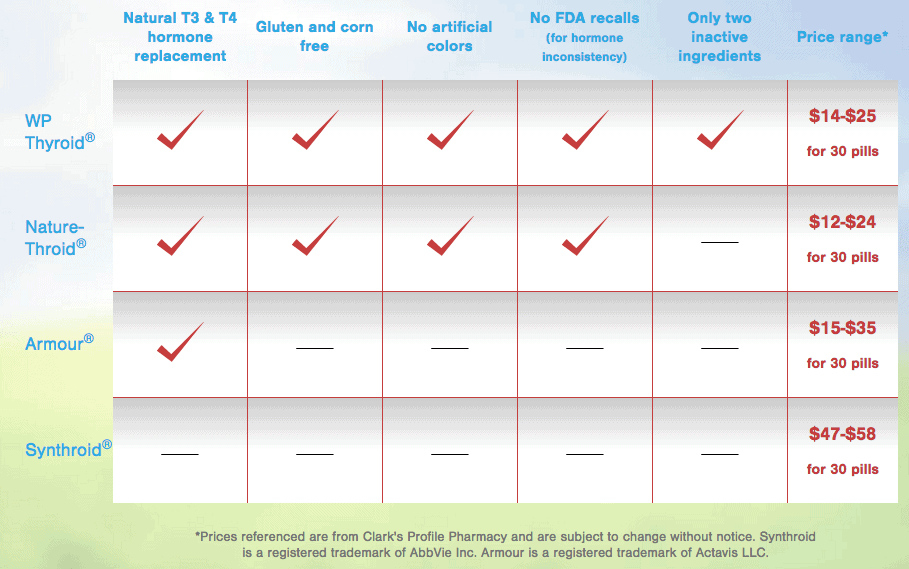
Compared to other forms of Natural Desiccated thyroid, Nature-throid is reasonably priced as you can see from the chart below:
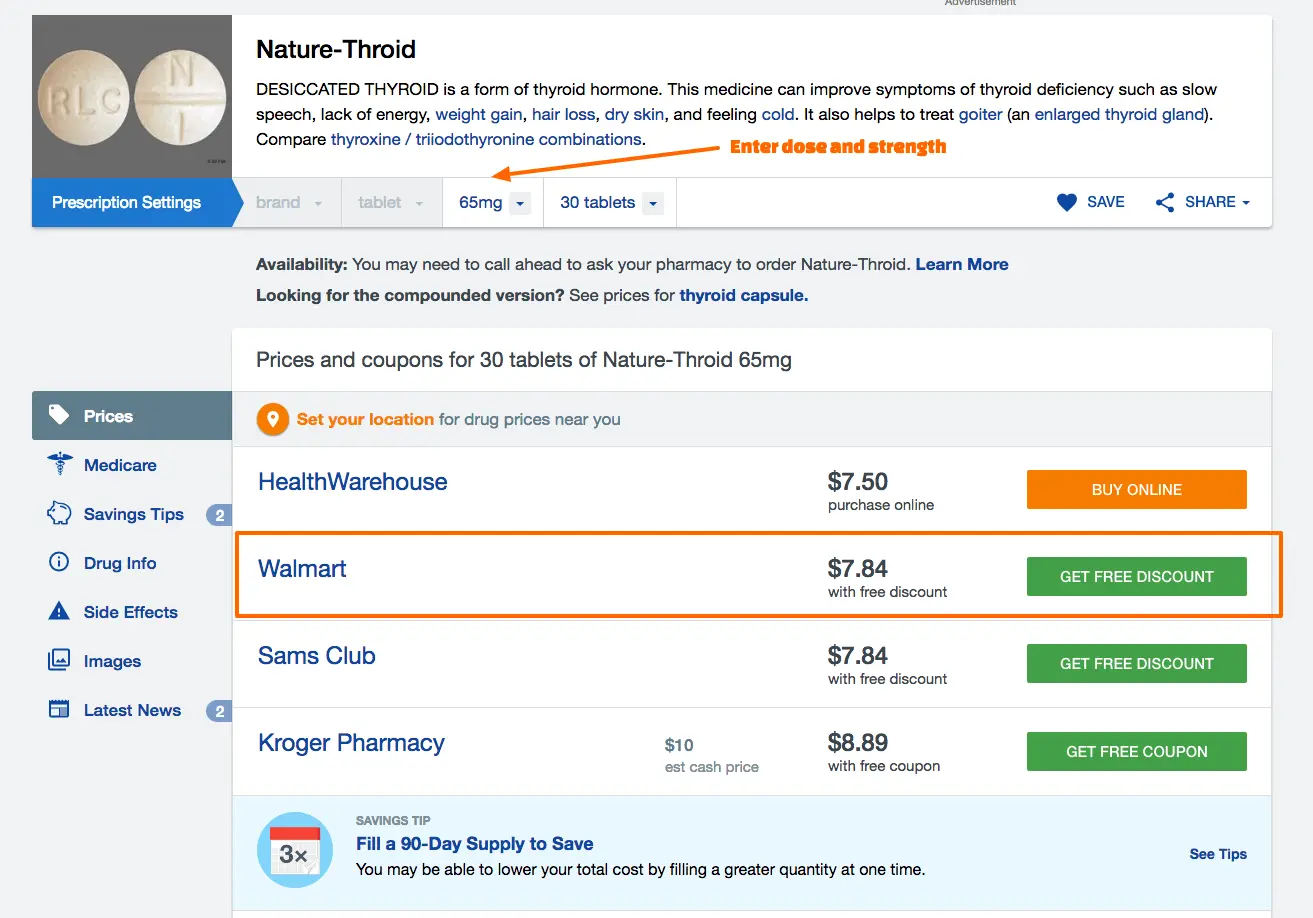
If your insurance will not cover Nature-throid you can use Goodrx.com to find the cheapest cash price near you.
Goodrx.com will provide you with a coupon you can use to take to your pharmacy to get a cash “discount” on medications (including other prescription medications you may be taking).
Simply go to the website and type in Nature-throid:

You will then be brought to this screen which will show you where the medication is cheapest and how to get your coupon for the discount:
You can even use Goodrx.com for other medications (including Armour thyroid, levothyroxine, etc.).
The average price of Nature-throid will depend on both your location and local pharmacies, but you should expect to pay no more than $10.00 per month for a 1 month’s supply.
What is in Nature-throid?
Are you a sensitive person that reacts to fillers/dyes/etc.?
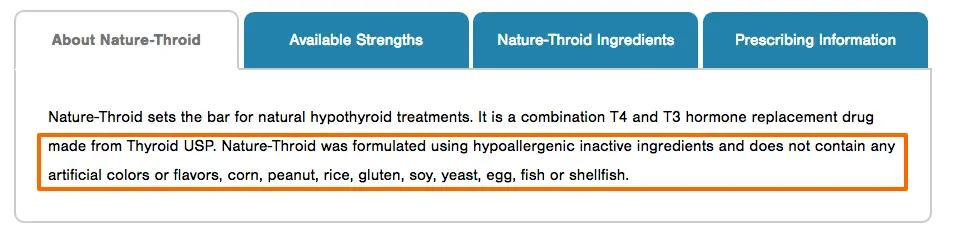
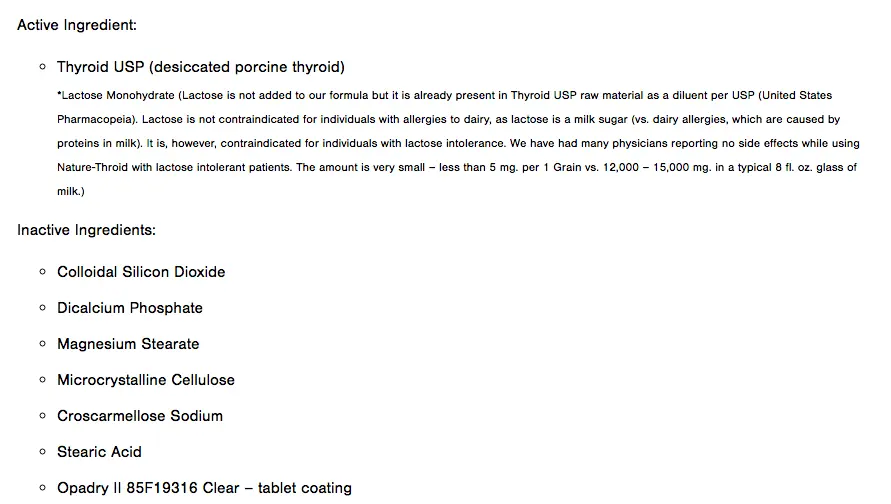
Nature-throid has a very limited amount of ingredients as you can see below:
Active ingredients include:
- Thyroid USP (desiccated porcine thyroid)
- Triiodothyronine at 9mcg per grain
- Thyroxine at 38mcg per grain
Inactive ingredients include:
- Colloidal silicon dioxide, Dicalcium Phosphate, Lactose Monohydrate, Magnesium Stearate, Microcrystalline Cellulose, Croscarmellose Sodium, Stearic acid, Opadry II 85F19316 Clear
Dosages and Formulations include:
- 16.25mg (1/4 grain)
- 32.5mg (1/2 grain)
- 48.75mg (3/4 grain)
- 65mg (1 grain)
- 81.25mg (1 1/4 grain)
- 97.5mg (1 1/2 grain)
- 113.75mg (1 3/4 grain)
- 130mg (2 grain)
- 146.25mg (2 1/4 grain)
- 162.5mg (2 1/2 grain)
- 195mg (3 grain)
- 260mg (4 grain)
- 325mg (5 grain)
It’s important to note that it is gluten-free and safe to use if you have Celiac disease or non-celiac gluten sensitivity.
It also does not include artificial flavors, artificial colors, fish, rice, soy, gluten, peanut, egg, or shellfish.
It does, however, contain porcine (pig), so if you don’t consume animal products you should take this into account.
It’s also important to note that WP Thyroid has even fewer ingredients, so if you react to Nature-throid you may want to consider WP thyroid as an alternative.
What to do if Nature-throid isn’t Working
While Nature-throid may be enough to alleviate the majority of your symptoms and issues it may not be enough to get you back to 100%.
If you have any of the following then you may need further treatment beyond thyroid medication:
- High levels of Reverse T3 ( >15 ) or signs of thyroid resistance
- Leptin resistance (Leptin level > 12)
- Diabetes, prediabetes, or insulin resistance
- Extremely low body temperature despite being on Nature-throid or NDT
- Personal history of bipolar disorder or a strong family history of mental health disorders
- Personal history of Fibromyalgia or Chronic fatigue syndrome (15)
In these instances, it may be beneficial to consider adding T3 (Cytomel or Liothyronine) to your Nature-throid or NDT.
Cytomel is a medication that contains pure T3 thyroid hormone and is the most powerful thyroid hormone medication available.
Use Caution if You Have Autoimmune Thyroiditis or Hashimoto’s Thyroiditis
Any patient with autoimmune thyroiditis or a known diagnosis of Hashimoto’s thyroiditis should be careful when using Nature-throid or any other form of Natural Desiccated Thyroid.
Why?
Because NDT is porcine-derived, meaning it is an animal product and may contain porcine tissue.
Even though the hormones themselves are bio-identical (meaning they are the same hormone your body would have produced naturally), components of the animal still remain in the formulation.
Like any piece of foreign tissue, it is possible for your body to create an immune response to it (16).
For this reason (and many others) some patients may actually feel worse when switching to Nature-throid and feel like their symptoms come back even though their TSH may be normal or low.
This leads patients and providers to believe that the medication doesn’t provide stable thyroid levels and this isn’t necessarily true.
It doesn’t mean you shouldn’t take Nature-throid if you have Hashimoto’s or autoimmune thyroiditis, but you should take this into consideration when switching medication and monitor for adverse effects.
If this does occur, you can check your thyroid antibody levels to determine if they raised in conjunction with starting Nature-throid.
If this occurs you may need to stop the medication.
Treating any GI-related issues like low stomach acid can improve your digestion and absorption of Nature-throid and may reduce any antigenic stimulus from the medication.
Nature-throid vs Armour thyroid
Even though Armour thyroid and Nature-throid are both forms of natural desiccated thyroid they are NOT the same medication.
Believe it or not, I’ve had many cases of patients who have simply switched from one form of NDT to another and have had many of their symptoms resolve spontaneously.
This same sort of effect is seen in patients switching from Levothyroxine to Synthroid or Synthroid to Levothyroxine even though they technically contain the same active ingredients.
Studies have shown that some individuals are exquisitely sensitive to minor differences in medications and that these medications cannot be considered bioequivalent for all patients (17).
I want to provide a word of caution to you, especially if you fall into this boat.
Don’t assume that ALL forms of NDT (Nature-throid, wp thyroid, Armour thyroid, etc.) won’t work for you if one of them isn’t currently working for you.
Much of this tolerance is likely due to the various fillers and binders used in each medication.
While all forms of NDT do contain the same amount of bio-identical thyroid hormone, they differ in these inactive fillers and binders.
In the case of Armour thyroid, the formulation was recently changed which reduced the amount of dextrose and increased the amount of methylcellulose in the formulation.
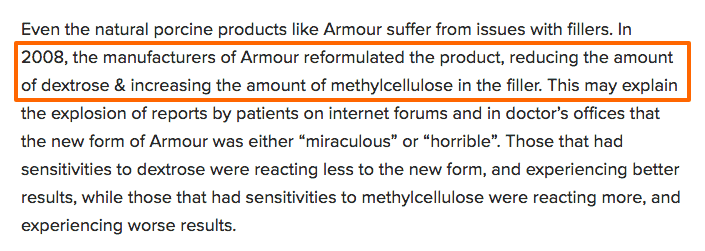
This change either dramatically improved or worsened the tolerance of the medication in some patients.
The binder methylcellulose acts like a “glue” in the body and delays the absorption of the medication.
This is the same binder that compounding pharmacies use for sustained-release T3.
This example really highlights the importance of these fillers and binders and helps to explain why some people do very well on certain types of medications.
If you are on Armour thyroid and it isn’t working for you, then it would be worth a trial of switching medication to see if the switch improves your symptoms.
You can find more information about Armour thyroid here.
Heart Palpitations with Nature-throid
One of the more concerning symptoms that patients may experience while taking Nature-throid is the sensation of a rapid heart rate otherwise known as heart palpitations.
These palpitations result from the T3 that is inside the medication.
Recall that Nature-throid contains a combination of both T4 and T3 thyroid hormones, compared to levothyroxine or Synthroid which contains T4 only.
T3 is the active form of thyroid hormone in your body and it activates certain receptors in all tissues in your body.
In your heart, T3 acts differently than it does elsewhere by directly activating calcium channel pumps (18).
This may lead to an increased force of contraction of the heart combined with an increase in the heart rate (19).
Because serum levels of T3 usually spike around 2-3 hours after ingestion of thyroid hormone, this is usually when patients experience heart palpitations.
These palpitations don’t necessarily indicate that the medication is harmful to your body, but they may mean that you are getting too much T3 too quickly.
You can combat these symptoms by changing how you take the medication.
Simply spacing your dose (take half in the morning and a half at night) may be enough to alleviate this problem.
Alternatively, taking your thyroid medication at night may improve your symptoms by altering how quickly your body absorbs it.
Many patients report heart palpitations in the middle of the night (usually 2-3 am) which likely stems from changes in cortisol levels and other hormones.
You can learn more tips and tricks on how to take your thyroid medication in this article.
Conclusion
Nature-throid is a medication that contains both the inactive T4 and the active T3.
Because of the active T3 and combinations of other thyroid hormones (listed above) many patients actually do much better on Nature-throid instead of T4-only medications like Synthroid and levothyroxine.
If you are considering switching to Nature-throid (especially if you are switching from T4-only medications) make sure to start LOW and titrate SLOW.
That means starting at a lower-than-normal equivalent dose but increasing your dose slowly every 10-14 days.
Doing this will prevent unwanted side effects from the T3 in the medication.
And remember that Nature-throid is not a magic weight loss pill, but it can help some individuals lose up to 10-20 pounds.
Now I want to hear from you:
Are you currently taking Nature-throid?
Did it work for you?
Do you believe you need different thyroid medication?
Why or why not?
Leave your comments or questions below!
Scientific References
#1. https://www.ncbi.nlm.nih.gov/pmc/articles/PMC4045230/
#2. http://www.ncbi.nlm.nih.gov/pubmed/23539727
#3. https://www.ncbi.nlm.nih.gov/pmc/articles/PMC5763098/
#4. https://journals.lww.com/co-endocrinology/Abstract/2017/10000/Persistent_hypothyroid_symptoms_in_a_patient_with.10.aspx
#5. https://www.ncbi.nlm.nih.gov/pubmed/19190113
#6. https://www.ncbi.nlm.nih.gov/pubmed/23539727
#7. https://www.ncbi.nlm.nih.gov/pubmed/17465862
#8. https://www.ncbi.nlm.nih.gov/pubmed/28056660
#9. https://www.ncbi.nlm.nih.gov/pubmed/494987
#10. https://www.ncbi.nlm.nih.gov/pubmed/27700539
#11. https://www.ncbi.nlm.nih.gov/pubmed/11174855
#12. http://www.ncbi.nlm.nih.gov/pmc/articles/PMC3041250/
#13. http://www.ncbi.nlm.nih.gov/pmc/articles/PMC377492/
#14. http://www.ncbi.nlm.nih.gov/pubmed/9846161
#15. https://www.ncbi.nlm.nih.gov/pmc/articles/PMC5869352/
#16. https://www.ncbi.nlm.nih.gov/pubmed/19869635
#17. https://www.ncbi.nlm.nih.gov/pmc/articles/PMC3565118/
#18. https://www.ncbi.nlm.nih.gov/pmc/articles/PMC2820695/
#19. https://www.ncbi.nlm.nih.gov/pmc/articles/PMC5746964/




I am hypothyroid and take 50mcg of Levo each morning. My MD says my TSH is now in range and that is all that matters although I still have many symptoms of underactive thyroid. But I also have an issue with keeping weight ON – which is not a typical hypo symptom. Would Naturethroid possibly help someone with a weight loss issue? Thanks.
Hey Jim,
If your symptom is due to a deficiency in thyroid hormone then naturethroid may help, but it’s impossible to predict at this point and without further information.
Dr. Childs,
What additional info would help you understand my situation?
Regards,
Jim
Hey Jim,
Unfortunately even if I had the information I wouldn’t be able to offer you any sort of medical advice unless you are a current patient of mine. The best thing you can do is find someone who understands the information in this article to help you further.
And that someone would most likely be an endocrinologist?
Regards,
Jim
Generally no, you will likely need to look outside of the insurance model.
Hi Dr Childs
Can I ask you a question please. Does an autoimmune thyroid condition react badly to ndt replacemnet. ie does immune system see ndt as the same baddie as it does the thyroid, and produce more antibodies to eliminate it? Would love to hear your opinion. Thank you.
Hey Karin,
Some people seem to react negatively to NDT with hashimoto’s and other autoimmune diseases. This is likely due to the fact that the medication is porcine sourced and may be antigenic to the body due to GI related issues.
I have been taking naturethroid for 4 years and it has been great – Blood tests never showed a problem so I tested myself with temperature test, and realize needed help. Went to alternative medicine and got naturethroid. Found I have multiple nodules but have ot increased in size and monitor with ultra sound once a year by a thyroid surgeon. Recently my eyelashes started getting sparse, and at first I thought the mascara, but with weight gain (no change in diet or exercise), drying and brittle hair, and sluggishly sleepy I realized it may be thyroid. My general dr down in the area I snowbird in took a blood test and it showed that thyroid levels fine. I don’t trust those tests, and wonder if am taking too much or not enough. How do I get an accurate reading?
Hey Rosalie,
The best thing you can do is find someone who is knowledgable about thyroid function and other hormones to help guide you. You should also get a full comprehensive thyroid panel (the one I recommend on my site) as a starting point.
Dr. Childs,
I am 64 year old female and have been on desiccated thyroid (except for a 6 month period on Synthroid) since age 26. I have had several heart tests this year and after the heart catherization experienced palpitations, supraventrical tachycardia. I have a heart monitor on now. I am questioned about my thyroid since my TSH is suppressed 0.02. I respond that the free T3 and free T4 are in normal range, but they think I am over-medicated. I cannot say if the SVT is thyroid related. My dosage is 1.5 grain or 97 mg Nature-throid. I noticed with the monitor that I am sensitive to chocolate. Could I have developed a sensitivity to the Nature-throid. I really do not want to risk the fatigue, depression, sluggish thinking that return when my thyroid is not at right dose. Can I assume the SVT will resolve itself? I will reschedule with my functional physician, but wanted to hear your thoughts. Thank you in advance.
Hey R,
I can’t comment on your situation because I know nothing about you or your health history, but in terms of thyroid and SVT in general – it needs to be evaluated and T3 can aggravate nodal pathways that may trigger and make worse the condition. In terms of myocyte activity, some patients seem to be particularly sensitive to serum levels of T3 which probably has to do with genetic differences in activity of calcium channel pumps.
I will be without my nature thyroid for 2 days. Is that going to be a problem?
Hey Madelaine,
It really just depends on your situation, but probably not unless you don’t have a functioning thyroid.
Two days ago I asked my doctor to switch me to NT from Synthroid/Lio and it seems to be to high a dose as I am getting jittery, racing heart, sweaty. I am getting a new lower dose tomorrow. If I am coming from 88mcg of Synthroid and 5mcg of Liothyronine-and my doctor said my tsh levels are still to high and needs to be reduced. She started me on 81.25mg NT and is giving me a lower dose. Is there a dose you recommend to start at? Thank you for all the information and guidance you provide, it is a blessing! I have not been happy with Synthroid and after reading all of your info I see it contains gluten which I’m not supposed to have and am very pleased to see NT doesn’t have all the “extra’s” that I need to avoid. Thank you, thank you, thank you.
Hey Hope,
No problem and I’m glad you found it helpful.
Hi Dr. Childs,
This is the 2nd time I am trying Naturethroid. I am starting, like last time, at 16.25. Last time, I stopped after a week due to increasing headaches. This time, prior to starting, I supplemented my iron due to low ferritin levels. I am not getting a headache, but I am feeling odd and dizzy. Is this something that will resolve?
Hi Michele,
Perhaps, though it’s also just as likely that you simply don’t tolerate the medication for a variety of reasons.
Hello,
I had been on synthroid for 22 years and recently switched bec was experiencing extreme hair loss and bloatedness. I had been taking armour thyroid for a month still not right. I have now been on nature throid for 3 weeks on 65 I have been experiencing acid reflux and my cycle is 12 days late. My dose of synthroid was 100 so same dose but switched a lot. I don’t have much hair loss but am exhausted still. Are those symptoms related to nature throid?
Hey Felicia,
Probably not, more likely due to your reduced dose from switching medications.
I was diagnosed with hypothyroidism about 6 years ago after gaining some 30 lbs – after a lifetime of never gaining an ounce and I’m a senior citizen. I was put on a synthetic but I felt worse than before and after research, convinced my doctor to switch me to Armour thyroid. That worked until they changed their format and I went to Naturethroid – 65 mg one day and 32.5 the next. I just received my test results on the tests that Medicare would allow them to run – TSH 1.02 – FreeT4 0.87 – FreeT3 – 230. I’ve not had the FreeT3 run before – was just the TSH and FreeT4.
I still have dry skin, thinning hair, and weight gain. Because I’m only 5’3″ and have arthritis in leg joints as well as myasthenia gravis (some 30+ years), I need to lose weight so the muscles and leg joints have less to carry around. I can’t find anything on line that gives information on test results while on medication – only to help diagnose it. My doctor says the results are good as long as they fall between the numbers the lab gives. Do the recent numbers indicate that the dosage is in a range that would appear to be appropriate since I still have symptoms and can’t lose weight no matter what I do.
Hey Gayle,
Thyroid dosing should be based off the approximation of tissue levels of thyroid hormone and that isn’t clear from standard thyroid lab values.
Dr. Childs,
Thank you for your work! I feel like I have a handful of problems that all need to be fixed a bit.. and I am not sure which comes first…
I am a 43 old female.
I am estrogen dominant. Seems to be getting worse, at least from symptoms. Haven’t had recent testing.
I have HPA Axis dysfunction – Hypercortisolism. I follow the healthy daily cortisol rhythms but my cortisol is just a little high.
I have low functioning Thyroid (TSH: 3.74, freeT3: 2.8, freeT4: .98, ReverseT3: 5.96)
I do not have any Thyroid autoimmune antibodies.
p.s. had gut dysbiosis and small yeast overgrowth – fixed both with antimicrobial supplements.
also – taking supplements for compound heterozygous MTHFR.
Lastly, my most recent CBC showed my SHBG to be 143.8. Two doctors didn’t know what to make of that number being out of range and told me not to worry about it. You are the first person that has mentioned that could be related to Thyroid health. What do you think of this number being high?
Because of my Thyroid panel, My doctor put my on Naturethroid, starting with 1/4gram. After a week (two days ago), I moved up to 1/2gr.
I am not feeling any better – still sooo sluggish.
How soon would I start to feel better?
I know you cannot comment on my specific situation but when you see patients with the above symptoms, what would you suggest they attack first?
THANK YOU SO MUCH!
Hey Amy,
Generally patients notice improvement within 4-8 weeks after starting thyroid hormone (usually sooner).
Hi Dr. Childs-
Wow how frustrating this is. And, after my last blood test results I’m really concerned. I was diagnosed with Hashimotos 15 years ago.I was on Synthyroid for years. I was finally tired of being sick and tired and feeling like crap so I requested that my new Endocrinologist change me over to Nature-Throid. Of course he’s another one of those “only treat via blood work results” kind of guys. I’ve been on 32.5 MG of Nature-Throid and.5 Cytomel for the past 15 weeks and when I received the results of my more recent blood work I couldn’t believe how high my TSH was.
Results were;
TSH 22.37
Free T3 2.37
Free T4 0.40
Reverse T3 5.0
Sex Hormone Binding Globulin 93.8
He raised my Nature-Throid to.65 and said to continue the .5 Cytomel however I don’t feel that’s the right call. Since I’ve raided the Nature- Throid my hair is starting to fall out. I’m at a complete lose with what to do.
What is your take on this?
Thanks so much
Hey Jill,
The best thing you can do is seek out someone who is knowledgable about thyroid management and NDT/T3 thyroid hormone replacement. You also need a more complete panel including nutrient testing to manage your other symptoms.
Dear Dr.
My head has been shaking for two years or more-I take Armour Thyroid 60.mg made by Actavis-and 15mg. made by Forest. I stopped taking the 60.mg. made by actavis and simply took five a day of 15.mg. made by forest-my head shaking has stopped-I’v been doing this for over a month–however-in tome my pharmacy will run of Forest products-should I wish to Natur-thyroid?
Before 2008 I was fine on Armour made by Forest- os should I have a compound pharmacy make up the 60.mg using the Forest formula?
Thank you very much . Sincerely,grandmadruskis@gmail.com
Hey Beverly,
I would recommend you take that question to your current provider, I don’t have all of the information necessary to help you.
Switched to naturethroid last summer and seemed to work very well … lost 10 pounds and a craving for sugar. Labs showed I might increase dosage which we did but I felt worse and Dr and I are now playing around with levothyroxine/naturethroid combination … which seems to be working ok. Next labs in 3 weeks.
I read this morning on several websites I have been in error because I’ve been taking levothyroxine in morning with my cups of coffee (I take naturethroid in afternoon, usually with a coffee as well). I drink about 4-5 cups a day, 2 when I wake up, 1 at morning break and 1 about 3 pm.
3 questions:
What are your thoughts on taking combination of natural and synthetic?
Do you think taking a natural and synthetic at the same time or diffferent time would be best?
Ibuprofen. How much time before and after dose?
After years at rigid kaiser I’ve found a doc willing to work with me and seems open and knowledgeable. Your thoughts most welcome. Thank you for your post and information.
Hey Mike,
Taking synthetic medication is fine, but I generally recommend against the combination of NDT + T4 due to the static T3 dosge in NDT.
Thank you. I will discuss with my doc. Does coffee negatively affect the thyroid meds as I’ve read?
I started taking Naturthroid on 1/14/17 after two years on Levo/Synthroid(88mg). I took half a pill for a week and started taking the whole pill each day after. I’m on 65mg once a day. I noticed about two weeks ago I started getting a red looking rash on my left breast, it seemed like it was only after a shower but now it is worse and is spreading but only on my torso and chest area. The only thing I’ve changed in the past few weeks was this medicine and I’ve started eating a hard boiled egg for breakfast, usually a good 3-4 hours after taking my Naturthroid. I’ve never had issues with eggs before so I can only think it would be the Naturethroid. Is this something to be concerned about or will it go away as my body gets used to the medicine? It doesn’t itch or seem to bother me, except for the fact that it is getting worse. I do not want to call the doctor quite yet because I don’t want him to make me stop taking it because I’m starting to feel better on it than with Levo. Thanks.
Hey Valerie,
You may be reacting to inactive fillers in the medication, not the thyroid hormone itself.
I recently started Naturethroid. I understand it should be taken at the same time every day and at least an hour before I eat.
To keep the time I take it consistent (I wake up at different times each day), can I wake up at the same time, take the medicine and fall back asleep? I don’t mind doing this but is there any harm in doing that?
Also I was told to wait an hour before eating to increase absorption of Naturethroid. Is it okay if the amount of time I wait before eating varies – some days it is 1 hour before I eat but some days is 3-4 hours before I eat (especially if I took it and then fell back asleep)?
Thanks so much!
Hey Ali,
You will have to take those questions to your current provider because multiple factors can influence absorption such as supplement routines and/or medications, etc. I don’t know your story/history/symptoms, all of which influence how I recommend patients take thyroid medication.
I’ve been on levothyroxine for 30 yrs. My dose before switching to nature thyroid was 137mcg. My naturopath converted my dose and I began taking 1 and 1/4 grain. I developed insomnia so she backed up my dose to 1/2 grain x 5 days, 3/4 grain x 5 days. I started to sleep again at 1/2 grain but now I’m stuck at 3/4 grain with insomnia again and feel unable to titrate up. Ive also gained 8 lbs since starting the nature thyroid. I initially started converting about a month ago. Ive never had enough energy on levo alone and I notice the change in energy levels and dont want to give up. Are we ramping up too fast? Would it help to see where my levels are at now before proceeding with a dose change? Do some patients need a combination of levo and natture thyroid?
Hey Neena,
I never put any patient on the combination of NDT + levothyroxine because you have much more flexibility with T4/T3 combinations compounded. The best thing you can do is find someone knowledgeable to help guide you because 10+ factors may be influencing your current symptoms.
Dear Dr. Childs, When I was on Forest Armour Thyroid-I was fine-then when Actavis took over my head started to have tremors-so for the last month I’ve been using up my 15.mg armour thyroid produced by Forest -instead of taking the 60mg. Actavis armout thyroid-i must have about 300 pills of the 15mg-so I take four to five a day-my tremors have stopped-so apparently the Actavis tablet did not agree with me-the pharmacy has always given me 60mg. of Actavis and 15mg. armour thyroid made by Forest-If I change to Nature -thyroid would that be better or should I have a compound pharmacy make up Armour thyroid using the Forest recipe?
I have never told my Doctor about the tremors-he isn’t one to prescribe medicine –
Thank you for any response.
Dr. Westin Childs,
Great article although it seems most people have a difficult time on T4 only and/or switching to NDT (myself included) which is very frustrating. I have been on Levothyroxine (175mcg) for about 7 years and never felt good. I tried NT once but the side effects almost put me in the ER. I don’t think that particular Dr knew what he was doing. I have found a new Dr that is willing to try NT with me once again but I am nervous about the transition. When I tried NT in the past I had all the symptoms mentioned above. I recently did an adrenal saliva test which came back normal but my reverse T3 was above normal. (on T4 only)
My main question would be, should one slowly wean off Levo while slowly adding NT? If my body is used to 175mcg of T4 daily, to simply cut that off and replace with an initial low dose of T4/T3 seems counterproductive. If I go 2 days w/o 175mcg of T4 I will crash hard and be extremely sick. Since even 1 Grain of NT has only 38 mcg T4, how do people transition properly and with the least amount of issues. I understand one will most likely be worse before they get better, but having the, “do I need to call 911” conversation is not an acceptable transition.
Thanks in advance for your insight.
Hey Jayson,
There are many ways to do this correctly but deciding which avenue to use depends largely on the patient. For your information, as long as you transition correctly, you really shouldn’t feel worse in the process.
Dr. Weston Child’s,
My doctor prescribed Nature-Throid one grain after my TSH was high on two different tests(15). After being on that amount for two months, I just got results of new blood test. Wow, the TSH went down to 2.27, which seems great. However, my total T4 went down from 5.8 to 5.5, and the free T3 went down from 2.7 to 2.2. Shouldn’t those numbers have gone up to mid normal ranges instead of dropping? Even though basal temp has improved, it is still low. Also my bowels are more sluggish than before. I do feel better when I arise each morning. I believe an increase in the meds would be helpful, but I haven’t heard from doctor’s office yet.
Could you tell me if this result is good? Will my T4 and T3 go up as I continue on this dosage over time, or Would a higher dose be beneficial? I want to understand, and I want to feel energetic and be as healthy as I can be. The lower numbers on thyroid hormones concerns me.
Thank you ahead of time for your suggestions.
Denise
Hey Denise,
Individual thyroid lab tests should be looked at in conjunction with other lab tests. Like other hormones in the body, thyroid lab tests change each day, which means that if you checked your lab tests 1 hour later or 1 hour earlier they would be different. Because of this (and other reasons) it’s more helpful to look at trends than individual lab values.
Good Evening. I am 22 years old and have been diagnosed with Hashimoto’s almost 11 years ago now. I was taking 120 mcg of Levothyroxine, then switched to Armour Thyroid and now I am on 130mg of Nature-Throid. I am gluten free and have a very limited dairy intake. I feel hopeless in this whole endeavor as my symptoms have gotten drastically worse. On my current dose of Nature-Throid I am experiencing the following symptoms: I am overweight by 10-20 pounds, thyroid gland is physically hurting even without touching it, fatigue, body aches and joint pain,and brain fog. I am concerned that I am doing something wrong, since my medicine doesn’t seem to be working. Are there any specific labs you suggest for me to ask my doctor to order to ensure that I am on the right medication as well as the right dose. I am supposed to go on my honeymoon in June and it sure would be nice to finally feel well after all this time.
Hey Ashley,
Make sure to evaluate your entire thyroid with emphasis on your free t3/reverse T3 ratio.
Very interesting! Thank you for this info. I started on Nature throid 65 mg and none of my symptoms improved. My physician then added Levorhyroxin 25. After a few months I felt better than I had in years. Muscle aches, gone. Energy, back. Clear thinking, improved mood, off the charts. My T3 levels at that time were on the high side but she left me at that dosage for 10 weeks. Over the last 3 weeks my symptoms have started to return. Especially muscle aches, lack of energy and moodiness. We just rechecked my levels and my T3 is now in the “normal” range. Based on how I am feeling, I was much better in the “high” range. Thoughts?
Hey Kim,
Thyroid levels change throughout the day, so unless you can account for every possible variable it’s not necessarily helpful to look at individual thyroid lab tests. Also, T3 by itself is not the best way to evaluate your thyroid function and base your dosing on.
My new labs show everything is in balance except my T3. Prior to meds I was at 2.9, with the combination in Dec I was at 4.5 – which is when I felt great. Now, same meds, I’m back down to 3.2 with similar symptoms as at 2.9. Dr. is at a loss of what to do…
Suggestions? I’m not a physician but it appears to me that we need to find the underlying reason if all my other labs look good.
Thanks so much, love the info you provide on this site.
I am new to hypothyroidism. Have recently started naturthroid. I’m about 2 1/2
Months in and my anxiety has shot through the roof. I’m also on Bioidenticals for hormone replacement. Could the anxiety be related to the thyroid med?
Anxiety could be related to your thyroid medication, but it could also be related to a number of other things as well.
Hello Dr. Childs, I’m a 59 year-old female. I’ve been on Levothyroxine since I was 27yrs old. I’ve finally have a Doctor who is willing to change my meds to naturthroid. I’ve been on a dose of 65mg and I do exactly what you mentioned earlier I cut it in half through out the day to not feel jittery. It seems to be working the only thing is my OBGYN has taken me off of my estradiol and I’m getting night sweats & some day ones too. Can you recommend something natural for my sweats.
Thank you!!!
Cyndy
Hi Cyndy,
Sure, you can find more information about how to manage estrogen in this post: https://www.restartmed.com/estrogen-supplements/
I have been on Naturethroid since 11/2016. Started on 32mg have increased to 97.5 this week. Feel terrible, sluggish, no stamina or energy, no motivation to do anything. My Reverse T3 was 19.3 in November. I am beginning to think this is the problem. Am I on the right track?
Hey Betty,
Possibly, it’s hard to say for sure without a complete evaluation but a high reverse T3 isn’t something you want to ignore.
I switched from Levo to NDT (Nautrethroid) about 7 months ago. At that time I had an amazing “honeymoon” period of a month. I felt incredible increase in energy and mental clarity. At this same time, I went gluten-free, soy-free, corn-free and mostly dairy-free. So, I assume both contributed to me feeling better/different. My dose has increased to currently fluctuating between 113.75 to 130 (2 grains) per day. I also have MTHFR and started high doses of Vitamin D and Iron due to a deficiencies. However, over the last couple of months, I have noticed an increase in “new” symptoms and I have been writing it off to a general progression of my Hashimotos or peri-menopause. My TSH remains super suppressed (0.03) but the T3 and T4 have remained in normal ranges (reverse T3 was 17 in AM), although my TPO slightly increased & my
TSI increased from 1.3 (12/15) to 4.4 (last month) after steadily decreasing since 2011.
I’ve read that a small percentage of Hashi patients who experience their immune systems attacking the porcine/thyroid glandular and actually making more antibodies. The most concerning symptoms are dizziness, anxiety, and eye pressure/super light sensitivity (as well as startling easily) for about two plus weeks now. I am wondering if I need to decrease my NDT – or – if there is an “average” dose is you see patients do well on? Are the symptoms I am experiencing from being overmedicated. I see a DO and he suggested RAISING my NDT, I am uncomfortable with that.
Hi Katie,
Yes, some people with Hashimoto’s do react negatively with an increase in antibodies and “flare” up symptoms when taking NDT – presumably due to the animal component.
In my practice each person is incredibly different in terms of their dosing and the amount of T4 to T3 that they take, so I couldn’t give you an “average” dose or anything like that because it depends on so many factors.
Hello my questions are for months ago my hormone doctor put me on armor thyroid 60 mg I don’t believe it worked I still felt like crap and I was always extremely cold . They recently changed me to nature thyroid aid 65 mg. I actually feel a lot better I have more energy the way is slowly coming off a little bit more but I am so cranky irritable and can’t sleep is that normal ? I thought maybe the dust was too high but that is the lowest one so I started cutting them in half to try to get used to it is that OK any suggestions to help that would be wonderful .
Hi Denise,
No – it’s not normal to experience negative mood changes and a lack of sleep on this medication.
A couple of wks ago my gynocoligist put me on Naturethroid. She said results of my bloodwork showed my thyroid is low. I am not educated on the subject of thyroid to know how low it even is, so I went along with it. 130 mg 2x a day, Basic Nutrient 2x a day, ADK10 and Iodine is what she prescribed. The Naturetrhoid bottle said once daily but paper from Dr said 2x a day. Pharmacist said 130 mg is not lowest dosage & not us usally prescribed 2X a day, insurance will only cover 1.5 a day. She called Dr to explain about ins., Dr said keep it 2x a day. I don’t have any follow ups w/ Dr. After doing a little research I am a little concerned that I should be somewhat monitored. I am nervous about taking the amount of medicine, especially if I don’t need it. I am thinking I should go see an endocrinologist.
Hey Amanda,
You should discuss these concerns with your current physician because there is always logic behind each decision (but sometimes they don’t explain it to you), but in general I have to say that most pharmacists do more harm than good because they are not clinicians. There are many times when I prescribe medications certain ways that pharmacists don’t understand which leads to questions on their part and confusion for the patient.
Thank for your reply Dr. I will definitely discuss these concerns with her & get a better explanation for her diagnosis & dosgae.
Hello Dr. Childs,
I was taking Amour Thyroid for almost a year (I unfortunately can’t remember the mg dose). I felt better in many ways: about 5 lbs of weight loss, bloated feeling went away and not as tired all the time. However, I was sweating like nobody’s business! During the day, and also at night, which kept me from having a solid night’s sleep. My naturopath switched me to Nature-throid (32.5mg) and my excessive sweating has gone away, and therefore, I am having a better night’s sleep. However, I’ve gained back that 5 lbs (and it’s climbing), am very tired again (despite the good nights sleep), and I have the heart palpitations you mention. So, I’m wondering what you think of this. I’m guessing it’s an easy fix – either back to the Amour, but maybe a lower dose (?), or a different dose of the Nature-throid. My goal is to go back to losing that 5+ lbs, no excessive sweating, sleeping through the night, no heart palpitations and not feeling so tired and bloated all the time. I am on the lower side of things when concerning hypothyroidism, but we thought we’d tackle it before it become more of a problem (both my mother and sister have always struggled with it). I look forward to hearing your thoughts. Thank you so much for your information on this page – it’s a gem!
I will be talking to my doctor again, but thought I’d see what you had to say, as well.
Thanks again!
Hey Maria,
Some people do better on one version of NDT over another. It’s always worth switching back to equivalent dosages of different versions of NDT to see how you tolerate it.
Is it safe to stop taking Naturethroid if your T3 is too high (4.8) and are experiencing hyper symptoms? I have both Graves and Hashi antibodies but have been treated for hypo for the past five years. After 7 months on NDT my TSI has increased and I am appearing hyper (TSH 0.001 and T3 and T4 high). My Doc suggested stopping NDT for a few days and resuming at a lower dose. Not sure if I dose was too high – or- I am experiencing a reaction to NDT.
Is it safe to stop NDT abruptly?
Hey Katie,
Because of how volatile changes to thyroid hormone can be you should make those changes under physician supervision. Generally it’s best to avoid making large changes all at once, but sometimes it is necessary – each case depends on the person and their situation.
Hi Dr Childs –
I’m a 50 yr old woman with a long and complicated medical history. The shortest re-cap I can give is: I received some vaccines in 1995, the day of I became incredibly ill, developed burning rashes on my skin, extreme fatigue, nausea and vomiting, and dizziness upon standing. I had four really sick years and never got a diagnosis. They told me had lupus then went back and forth with a whole host of other conditions and in the end said, yeah, probably lupus, not sure, good luck.
After all that I avoided doctors for years and just have lived my life always being sick.
About four years ago I started lactating (for no reason, I’ve never been pregnant and never delivered a baby) and all my hair has started falling out, plus the fatigue has been overwhelming. At this point I decided that despite the fact I’d be happy to never see a doctor again in my life, I better go in.
Another long story made kinda short I’ve now been diagnosed as narcoleptic and I’ve found out that I’m low in free T3 and T4. My western med doc refused to treat me for the thyroid issues and only wanted to give me some form of medical speed. I threw the speed away and I found a naturopath who is treating me with Nature Thyroid.
My question is: I’m still incredibly tired and I’m rapidly going bald – both things are causing me huge distress and I’m wondering if some people just don’t respond to Nature Thyroid? Are there other supplements I could/should be taking to help with my symptoms? Can Nature Thyroid actually increase the hair loss?
Thank you for whatever response you can give, I know this is a long question and honestly I feel like a hopeless case….
Sincerely,
Liz
Hey Liz,
I would take a look at this post which outlines the many causes of hair loss in thyroid patients and how to approach each one: https://www.restartmed.com/thyroid-hair-loss/
My son (7years old, Down Syndrome, Hypothyroidism) was on levothyroxine for a couple of years. In October we switched him to NatureThroid and we just repeated labs to see about dosing and his TSH is at 3 (we like to see it under 2) but his FT3 was elevated for the first time ever. Historically, his Reverse T3, FT3 and FT4 were always normal. My son is prone to anxiety which can lookalike restless body and sometimes aggression. He takes 32.5 in the morning and 16.25 in the evening. I want to see his TSH lower, but I’m wondering if the NatureThroid could be the reason his FT3 is elevated and does this mean it’s not the right medication for him? Because the symptoms of hypothyroidism can closely resemble the symptoms of DS, and because my son’s ability to articulate “how he feels” at this stage, I am somewhat reliant on labs. Any insight?
Hello
I am currently on 135mg of nature thyroid and I feel awful. I do think my adrenals are stressed but since I’ve switched to nature thyroid 2 years ago I immediately gained 15 pounds and now I’m up to 40. I’m very quick tempered as well. Im wondering if it’s time to switch back to t4 plus cytomel? I’m gluten dairy she refined sugar free… supplementing with probiotics and iron. .vitamin c..selenium.
Thank you so much for ask the info !
Hey Melissa,
I would look into your reverse T3 levels and other hormones before changing your medication to see how you are tolerating the naturethroid. You can learn more here: https://www.restartmed.com/reverse-t3/
I follow your website closely. I started Nature-Throid Nov. 2016. At that time my RT3 was 19.3 and FT3 was 2.4. I followed
the scale of increasing the dose every 2 weeks by 1/4 gr. Cannot tolerate 65 or 97.5 mg. Side effects are terrible. Feel
terrible on 48.75 also. Very tired and no stamina. I have concluded that my problem may be the RT3. Plan to decrease
NDT and add Cytomel. (My doctor is great and willing to help me but is not experience in this. We are following your
information.) How much lower should I decrease the NDT before starting Cytomel. Any suggestions we would
appreciate. thank you.
Hey Betty,
You may be intolerant to the T3 in the NDT in which case switching to cytomel may exacerbate the problem.
Does that mean take a T4 only med? And would that help my FT3 enough with a RT3 of 19.3?
I just found your article.. So in August my doc put me on 90 mg Armour for sub-clinical hypo. At the 5 week point, I began having panic attacks and the shakes. I stopped the Armour. I then did a saliva for Adrenals and results were very low morning cortisol levels and high eve, plus Dhea almost non existent. I started 20mg Cortef and then my doc put me on 20mg Cytomel. So now around 4-5 months later my Rt3 is low (8.1), Ft4 low (0.75), and Ft3 should be higher (2.5). It’s like it did nothing for me… Now doc is having me start Nature Throid. Is this what you would do? I read most people have problems with high Rt3, but not much is mentioned about when it is low.. Any insight is much appreciated. Blessings, Heidi
Hey Heidi,
Your reverse T3 is low because you were on T3 only thyroid medication, it will always do that. There aren’t any articles on low reverse T3 because it’s not felt to be a problem by itself.
I recently had my blood work done and all my numbers look good although TSH was very low. I have been taking naturethroid for a few years now and was currently taking three grains. I mentioned to the nurse practitioner that I had had some heart palpitations so she wanted me to decrease my dose to 2 1/2 grains. I took the lower dose today and felt awful not myself….rough day at work. Could that have made a difference so quickly just in one day, one dose? I think I might try what you mentioned in the above article about splitting my dose in half and continue on the three grain like I have been. For the most part I have been feeling pretty good
Thanks!
Hey Kim,
Changes in your energy level could be due to a bad nights sleep or a hundred other things including your thyroid dosing. I wouldn’t base your decision to change thyroid dosing on one day of symptoms. If this continued for several days to weeks then that would be a different story entirely.
Dr. Childs, If I have an intolerance to T3 would a T4 only med be enough to manage my T3 levels if my FT3 is 19?
Hi Betty,
If you are able to convert without a problem it should be fine.
Help! I started naturethroid about 2 months ago and increased my dose about to weeks ago to 48.75 mg. Since then I’ve felt so exhausted, all I want to do is sleep. I’ve also gained about 8 pounds since starting this medication. I was hoping for the opposite 🙁 Any idea what could be going on?
heres some numbers:
Pre treatment: free t4: 1.10 (.93-1.7)
TSH 1.090 (.27-4.2)
free t3: 2.54 (2.0-4.40)
Four weeks into treatment (she increased after this)
free t4: .96
TSH 1.17
free t3 2.63
Hi Andrea,
It’s most likely not the medication itself but your dose that is the problem.
If I am currently taking 100mcg of synthroid, what would be the appropriate dose of naturethroid?
thank you very much for taking time to address my question
Hey Margie,
There is not an “appropriate dose” necessarily, but generally dosages may range from 65mg to 130mg depending on tolerance, adrenal function, reverse T3 levels, etc.
2012 -Hyper
2013 – RAI removal of thyroid
Treated with Levothyroxine not very effective and lots of symptoms : constantly falling asleep, aching limbs, brain not always properly operating and steady weight gain (28 lbs). In addition a cardiac “event” resulting in two stents placed in cardiac arteries. Refused offer of 80mg Lipitor. T3 never tested by labs.
2016 October Had private full blood test. T3 at bottom of range. No T3 prescribed In UK. Decided with learning support from ThyroidUK forum to go it alone on Nature Throid which I import privately from NZ.
Started by combining 100 Levo with 1/4grain carefully reducing Levo and upping N T every two weeks. Now have been on 2 + 1/4 grains for 3 months. Feel normal again, have lost 10lbs and T3 is 5.8 (3.1-6.8) range.Thank you for this report. We amateurs need all the help we can get!
I’ve been hypothyroid for 20+ years. I had a thyroidectomy 2 years ago.(non cancerous nodules) Been taking naturethyroid for 1+ years. My TSH levels have been 0.59 – 1.02 last few lab draws. I can tell when my levels are off. I get my levels checked with self pay through Sonora Quest labs, since my doctor only does it once every 6 months. Todays level was 5.69. ??? I have taken my Naturethroid consistently. I take 195 mg 5 days a week, and 162.5mg 2 days a week. Gained 5 lbs this month! always a bit heavy….
I have had a lot of joint pain, hunger, low energy, heart palpatations, hot flashes in the last 2 months. How can my level jump that much? My endocrinologist is pretty useless, so I’m asking you instead. Sounds like you know your thyroid stuff. I take no other meds. Supplements I take: fish oil, VitD, daily multivitamin, biotin, occasional naproxen (joint pain..tendonitis), advil. Would appreciate insight.
Hi Tracy,
Thyroid function and status fluctuates over time and throughout the day. This sort of thing happens to my patients as well and is usually due to changes in metabolic function, liver clearance of thyroid hormone, improved metabolism, etc.
I have been taking Naturethroid for 8wks started with 1 grain for two weeks and was definitely undermedicated,then increased to 1 1/4 grains as advised by my Endo did have some palpitations and jittery spells so eased off for a day.My sleep improved and body temp however my Tsh had risen to 5.9 ! Endo advised increase to 1 1/2 grains for two weeks then 1 3/4 grain however I am struggling on 1 1/2 grains hot flashes, palpitations so should I go back to 1 1/4 ? I have Hashimoto’s thyroiditis.
Hi D.Clarke,
It would be a good idea to assess thyroid antibody levels and other thyroid markers before making further changes.
Hello, I was diagnosed by my endo as hypo due to Hashimoto thyroiditis after my internist said labs showed Tsh of 30. After 6 weeks on Nature Throid my labs were 0.38. I’m feeling better overall however I do feel bloated & weight will not budge despite watching what I eat & frequent exercising. I have noticed my appetite has increased since being on NT & have to carefully watch everything I eat. Actually my weight is at an all time high. Endo said hormones are to blame since I’m (fingers crossed) 1 month shy of reaching menopause. I have chosen not to take prescribed estrogen & only take chaste tree & Endo really had no other suggestion. I’m very tempted to go the phentermine route (which she would not prescribe) but with a history of anxiety & panic attacks am hesitant to try. Any suggestions for additional supplements to curb appetite/weight loss or help with my hormones would be greatly appreciated. Thank you for your time.
Hi Renee,
You can find more information on how to address weight loss in my guide here: https://www.restartmed.com/hormone-mastery/
I just was switched from Synthroid 50 mcg to WP Thyroid 16.25mg. It has only been five days but my symptoms of dizziness and tiredness has seem to return. I am uncertain if I have not gave the medication long enough or my dose might be to low. I am just looking for guidance before consulting my physician if I should just give it more time. Thank You for your response.
Hi Margie,
It’s difficult to say but your current set of symptoms may be related to your dose – thyroid lab tests should help guide you.
Hi, I am currently alternating 32.5mg & 48.75 mg Naturthroid monday thru friday, & saturday & sunday 32.5 mg.
Is it good for the body to have an alternating incease & decrease?
Thank you,
Sue
Hi Susan,
I am unaware of any research that suggests it is harmful.
Hi,
I was diagnosed with adrenal fatigue in feb 2015 and was only able to tolerate thyroid meds starting aug 2016 (without getting heart palps). Nature Throid (currently at 48.75) seems to lower TSH and raise T4 but Free T3 continues to go down. Added Cytomel 5mcg AM and Free T3 went down again to 2.2, it is now the lowest it has been. TSH=1.34 Free T4=1.10.
Tried adding another 5mcg of Cytomel at lunch time and got heart palps and stopped that dosage.
Any advice or guidance would be much appreciated.
Hi Susan,
Playing the “number game” with thyroid labs is not the best approach to treatment. You need to be looking at other factors such as your symptoms, basal heart rate and metabolism.
Hello, Thanks for the article 🙂
My mum has just been taken off Naturethroid 3 grains and Nutri adrenal 300mg daily for 6 weeks (with a referal to an endo and blood tests at 6 weeks) as she ended up with atrial fibrillation in A&E twice where they batteled to get her heart rate down.. BP was ok. Shes been off them for 2.5 weeks now and is starting to feel very hypo again (although palaptations and atrial fib have gone), i’m wondering if Naturethroid leaves the body more quickly than Levothyroxine?
I’m also concerned that her referral will take much longer than 6 weeks to come through and she is completely untreated hypo all this time.. She has Bi-polar too. i read in your article that T3 only is preferable for Bi-polar Px.. Why is this? If i manage to get her on T3, is it likely she will see a return of AF and assoc symptoms? She was on Levothyroxine for 2 years with no improvement and has a dysfunctional cortisol cycle.. low in morning, high at night, often leaving her awake for much of the night. Thanks
Hi Anna,
You can read more about using T3 for bipolar disorder here: https://www.ncbi.nlm.nih.gov/pubmed/19215985
My thyroid issues started 17 yrs ago with Graves. 9 months after diagnosis, RAI Followed by 15 yrs of synthroid, lexoyl, etc. Never felt great switched to armour for just under a year, not great, doc switched to nature thyroid, numbers are in good range, but I’m experiencing massive amounts of hair loss. Gained 10 lbs too. Doc thinking back to synthroid and adding T3. Any thoughts?
Hi Trish,
Synthroid + T3 does work for some people, it just depends on the person.
Hi Doc,
I’m totally on board with Nature throid looking at T3 supplementation. I have patients though that have low normal T3 and TSH (ie, a current patient with a 0.9 TSH, 0.8 T4, 2.6 free T3. She is a weight loss patient. Is it possible to start her on Nature throid and not throwing her ito hyperthryoidism as her TSH drops?
Hi William,
Yes, the vast majority of patients do well on NDT, but some patients will need smaller doses of T3 only medication. You will have to use trial and error to figure out who needs what (based on labs, symptoms, etc.)
I recently was on Armour thyroid and changed to Naturethroid. Since taking Naturethroid, I have headaches every day. Is this normal? 65 mg tablet. Thank you.
Hi Lelia,
No that is not normal, you should consult with your prescribing physician.
Hi Doctor Childs: So grateful for time and guidance in all these questions.
I was treated successfully on Armour 180 mg. Due to huge price increase, my doc switched me to Naturethroid- 195 mg. 5 months ago. Having eye pain and muscle cramps, hair loss, fatigue and 5 lb weight gain over the past 2 months- had been fine on it until then.
Now TSH is .008
T4 .079
T3 2.4
Doc wants to cut dose in half without weaning down.I am doing that with headaches and fatigue. Do you recommend a safer weaning down schedule and any comment on the normal T3 level with everything else being overtreated?
Thank you very much.
Hi Ibg,
Each person is different and may require different amounts of T3 and T4. Armour thyroid and other NDT preparations are static in their dosing schedule so they don’t work for everyone.