

- Natural desiccated thyroid (NDT) contains both T4 and T3 hormones, giving your body active thyroid hormone immediately rather than requiring conversion from T4.
- Your dose depends on your individual body chemistry and symptoms, not just lab numbers, so finding the right NDT dose requires careful adjustment and symptom tracking.
- Some patients feel dramatically better on NDT after failing on synthetic medications because NDT mimics what a healthy thyroid naturally produces.
- Starting low and going slow with NDT dosing prevents overdose symptoms, but being too timid with dosing leaves you undertreated and continuing to feel terrible.
Update 3/30/26: Nature-Throid is still not available; however, this information is still updated and relevant and applies to other formulations of NDT.
Is Nature-throid the missing link to helping you FINALLY feel better?
The short answer: Maybe…
Like most things in life, the answer is never straightforward!
And that’s why I’ve created this guide.
I will show you which patients do best on Nature-throid when you should consider switching to NDT and what to do if Nature-throid isn’t enough for your body.
But first, we need to dive into some basics…
What Is Nature-throid?
Nature-throid is a medication used to treat Hypothyroidism.
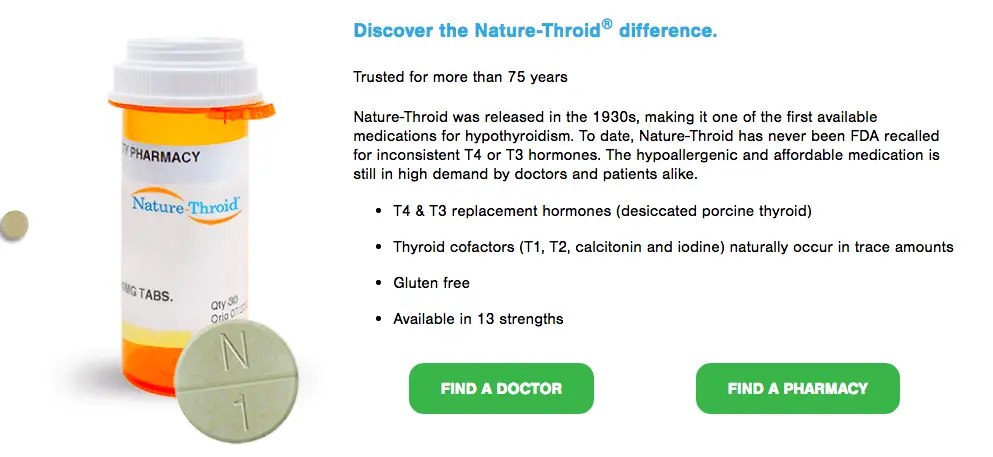
This particular medication is unique among thyroid medications in that it is created from desiccated (or dried up) animal/porcine thyroid glands.
It contains a combination of T4 and T3 hormones which is why many people feel it is superior when compared to T4-containing medications (like Levothyroxine or Synthroid).
It also contains other hormones including minor amounts of Calcitonin, T1, T2, and even Iodine.
All of these ingredients are normally found in thyroid gland tissue (even the human thyroid gland) so it makes sense that they would all be in there.
In fact, it is widely believed that these extra ingredients found in thyroid extract may be why so many patients prefer this medication (1).
Nature-throid falls into the class of thyroid medications known as Thyroid extract or Natural Desiccated Thyroid (NDT for short) along with other medications which we will discuss in this guide.
One of the reasons you may have found this article is that you’re currently being treated with Levothyroxine and you have heard that Nature-throid or Armour thyroid might be a better option for you.
And that may be true for many people…
But we need to discuss why:
Is Nature-Throid Better than Levothyroxine?
Many people actually do better on Natural Desiccated Thyroid hormone instead of T4-containing medications.
Not only is that popular opinion on the internet, forums, and blog sites – it’s also been confirmed in clinical studies (2):
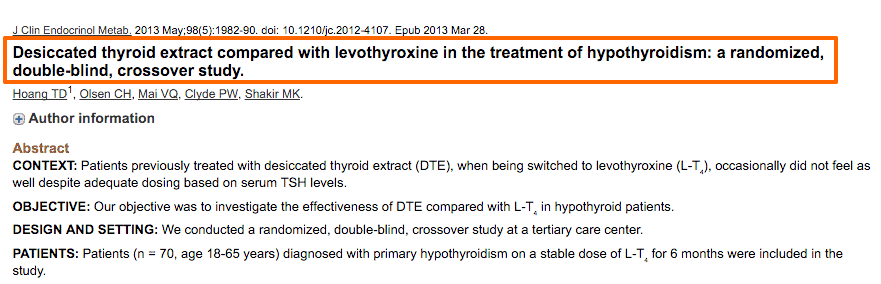
These various studies show that many patients actually prefer to be treated with NDT over T4-only thyroid medications.
Some of this preference may have to do with the fact that patients who switched from LT4 medications to NDT experienced greater weight loss.
The authors of this study did not conclude that the patients experienced an improved quality of life, but if you lost weight without exercising or changing your diet, wouldn’t you be pretty happy about that?

So why is that? Why do patients prefer these medications?
A big part probably has to do with the composition of thyroid hormones found in these desiccated thyroid extracts.
Nature-throid contains a combination of T4 and T3 thyroid hormone but more than that it contains it in a ratio of about 23% T3 to 76% T4 and this ratio is fairly close to the 20% T3 and 80% T4 that your thyroid gland produces naturally.
If you recall from basic thyroid physiology, T3 is the active thyroid hormone and T4 is the inactive thyroid hormone.
By providing your body with both sets of hormones you are re-creating normal thyroid physiology (or at least close to it).
This can be compared to treatment with T4-only thyroid medications which must be metabolized into the active thyroid hormone before they are usable by the body.
So why don’t Doctors use these medications more frequently?
Most Doctors believe that providing T3 to the body is unnecessary as the body will take T4 and convert it into T4 at a constant rate regardless of the individual or genetic makeup of the patient.
The hesitation to use Nature-throid and other thyroid extract medication stems from a fundamental disagreement in thyroid management philosophy and the current treatment paradigm.
Patients Who Should Consider Switching to Nature-Throid
If you are one of the many patients who isn’t feeling well on T4-only medication you’re probably wondering right now if Nature-throid will help you feel better…
And for many patients, the answer is yes (though not everyone!).
Certain patients tend to do better than others but the general theme is that if you are taking LT4 and not noticing a difference you may benefit from the switch.
In my experience, patients who fall into these categories tend to do well on Nature-throid or other forms of Natural Desiccated Thyroid:
- Patients who have not felt better on T4-only medications like Synthroid, Levothyroxine, or Tirosint (4)
- Patients with known or suspected DIO2 genetic defects (5)
- Patients with mild weight problems (6) or who are weight loss resistant
- Patients who have undergone thyroidectomy or RAI (7)
- Patients with low free T3 and low free T4 levels but with a relatively normal TSH (8)
If you fall into one or more of the categories above then there is a good chance that Nature-throid may be right for you.
Switching From Levothyroxine to Nature-throid
If you’re on Levothyroxine and would like to try switching to Nature-throid there are a few really important things you need to know.
The dosing, side effects experienced, and lab tests all differ dramatically when you switch from LT4 medication to thyroid extract.
If you (or your Doctor) aren’t familiar with these differences then you may falsely believe that something is wrong or that this medication isn’t working for you when the opposite is true.
Making sure you follow the steps below it will ensure that you’ve given Nature-throid a fair chance at working for you.
1. Titrate Slowly
When switching from T4-only medication to NDT it is VERY important that you start out slow with your dosing.
T3-containing medications can be very stimulating to patients who have never been on them before.
This means it’s best to start with less medication compared to the equivalent T4 dosing, at least in the beginning.
During this transition, and as you drop your dose, you may feel slightly worse until the dose gets ramped up and as your body acclimates to the new medication.

This process of titration may last for several months.
If you find that switching medication is too stimulating for you it may be best to split your dose.
You can split your total dose into 2 or 3 smaller doses (while keeping the total dose the same) taken throughout the day.
A sample dosing schedule may look like this:
- Take half of your dose first thing in the morning
- Take the other half of your dose in the afternoon or evening
- You can even split it up even further into 6 or 8-hour intervals if necessary
This helps reduce swings in T3 concentration in your bloodstream and, therefore, in your tissues.
Symptoms of too much T3 in your body include:
- Increased anxiety or agitation
- Heart palpitations or rapid heartbeat
- Heat intolerance or hot flashes
- Uneasy feeling or overall feeling worse
- Increased fatigue
- Dizziness or the sensation of being light-headed
If you have any of these symptoms it doesn’t necessarily mean Nature-throid is NOT for you, instead, it might mean you titrated too quickly.
Starting doses may be as low as 16.25mg to 32.5mg taken in the morning and/or in the afternoon.
If you experience the symptoms above they may resolve over time, or they may not – if they persist beyond 2-4 weeks, it’s likely that they will stay.
If this happens you may need to switch to T4 + T3 combination medication or back to LT4 medication.
2. Get Your Dose Right
Dosing is also very important when switching medications.
Any time you add T3-containing medications the TSH will always drop very quickly (9).
Because of this many doctors will unintentionally under-dose thyroid patients when switching from LT4 to NDT or Nature-throid and then use that as an excuse that the medication doesn’t work.
Of course, your TSH will rise when switching medications if you are under-dosed or if your new dosing is not equivalent to your old dose.
The only way to determine if your medication is sufficient is to follow TSH, Free T3, and Free T4 both before and after the transition.
If these values do not align afterward then you know your dosing is insufficient.
When switching medications it’s important to start low and titrate slowly.
That means a starting dose of 16.25-32.5mg with an increase every 10-14 days unless you experience symptoms of excess T3 (stated above).
Instead of basing dosing off of the TSH, dosing with T3 medications should be based on a combination of the following: lab tests (free t3/reverse t3/sex hormone binding globulin), subjective symptoms, body temperature, metabolism, and heart rate.
This approach creates space for differences among individuals including genetic differences, the presence of medical conditions, and other factors which may alter dosing at the individual level.
Newer studies have shown that in order to achieve normal free thyroid hormone levels, it is necessary, and safe, to lower the TSH to non-suppressive ranges (10).
Using this standard, the traditional dosing recommendations based on TSH may result in undertreatment for many patients.
3. Monitor your Symptoms
Whenever you switch to T3-containing medications I recommend that you follow both your resting heart rate and basal body temperature.
Both of these will increase when taking T3-containing medications (direct effect from thyroid hormone) and tracking them will help prevent accidentally overdosing.
In addition, make sure to track your symptoms of Hypothyroidism.
The rise in body temperature and heart rate usually indicates an increase in metabolism as your body produces more energy and more heat.
The rise in body temperature stems from an increase in energy production from improved mitochondrial function.
This is from the direct effect of T3 on your mitochondria (11).
Will Nature-throid Help You Lose Weight?
Many people want to know if Nature-throid will be the magical medication to help them lose weight.
The answer to that is almost always no.
While it is true that Hypothyroidism can damage your metabolism and lead to weight gain, at most this usually leads to an excess of 10-20 pounds of extra weight.
If you have gained more than that amount of weight it is almost always due to another hormone imbalance.
To explain this effect further I’ve elaborated on the combination of hormone imbalances that occur in hypothyroid states which contribute to thyroid weight gain.
Having said that, some patients will experience some weight loss after switching medication.
Patients more likely to experience this weight loss usually are those who don’t have problems with T4 to T3 conversion or who have relatively low reverse T3 levels.
Generally, the higher your reverse T3 levels and the more metabolic damage you have (from calorie-restricted dieting), the less likely Nature-throid will help you lose weight.
That doesn’t mean it won’t help you feel better – because even if it doesn’t help with weight loss it still is more likely to help reduce your symptoms when compared to levothyroxine or Synthroid.
But the weight loss you are most likely looking for may not occur unless you also address other factors such as hormone imbalances, damage to your metabolism, your diet, and so on.
Low thyroid hormone may lead to an increase in insulin resistance (12), leptin resistance, (13), and sex hormone imbalances (14) that may compromise more than just your thyroid.
You can find more tips to help you lose weight with hypothyroidism here. For tips on how to lose weight with Hashimoto’s please see this post.
How to Get Nature-throid
While many patients stand to benefit considerably from switching to Nature-throid (or other forms of NDT), unfortunately, it can be difficult to obtain, especially from conventional physicians.
Most Endocrinologists and Primary care providers are not comfortable prescribing Natural Desiccated thyroid or any medication which contains LT3.
A portion of this hesitation stems from the fact that NDT contains the active T3 thyroid hormone.
In addition, they also erroneously think that NDT results in unstable thyroid levels and concentrations throughout the day and that the exact dosages of T4 and T3 in each grain of NDT are not standardized.
The current standard of care and treatment paradigm within the insurance model is to treat hypothyroidism with T4-only thyroid medication and base dosing off of the TSH.
Unfortunately, this treatment usually results in persistent symptoms of hypothyroidism, consistent weight gain among hypothyroid patients, and overall a reduction in quality of life.
The takeaway here is that you may need to spend some time and energy searching for an open-minded physician who is willing to work with you.
Finding this kind of physician to help you may be difficult but is certainly worth the wait.
In my opinion, you can’t put a price on finally feeling healthy and getting your life back and the single most effective thing you can do is find someone to help guide you along the way.
Managing your thyroid is very complex and involves multiple hormone systems, so figuring this out on your own may be possible but will take a considerable amount of time.
Consider these resources to help find someone who may be able to help you further:
Note: Try to find providers who can prescribe medications including thyroid hormone replacement as these form the cornerstone of thyroid management.
How much does Nature-throid Cost?
Compared to other forms of Natural Desiccated thyroid, Nature-throid is reasonably priced as you can see from the chart below:
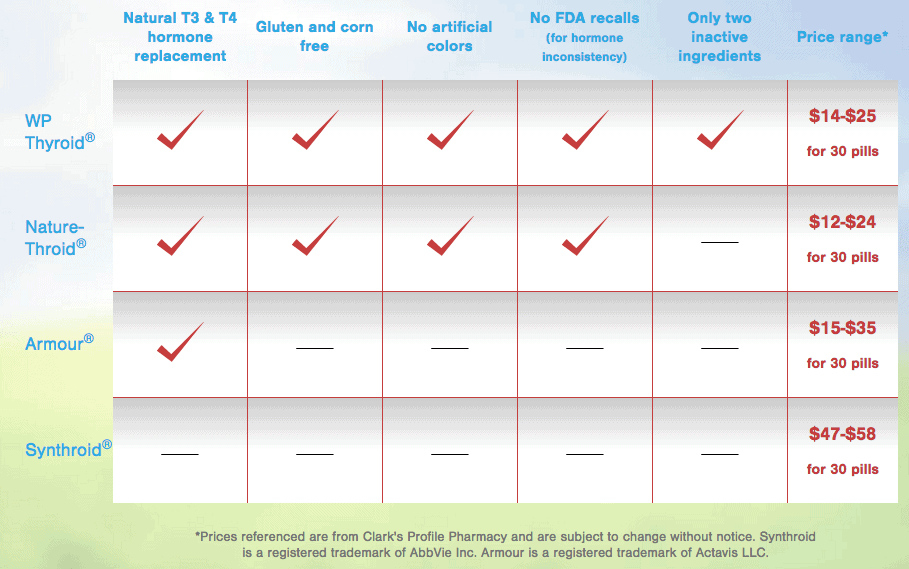
If your insurance will not cover Nature-throid you can use Goodrx.com to find the cheapest cash price near you.
Goodrx.com will provide you with a coupon you can use to take to your pharmacy to get a cash “discount” on medications (including other prescription medications you may be taking).
Simply go to the website and type in Nature-throid:

You will then be brought to this screen which will show you where the medication is cheapest and how to get your coupon for the discount:
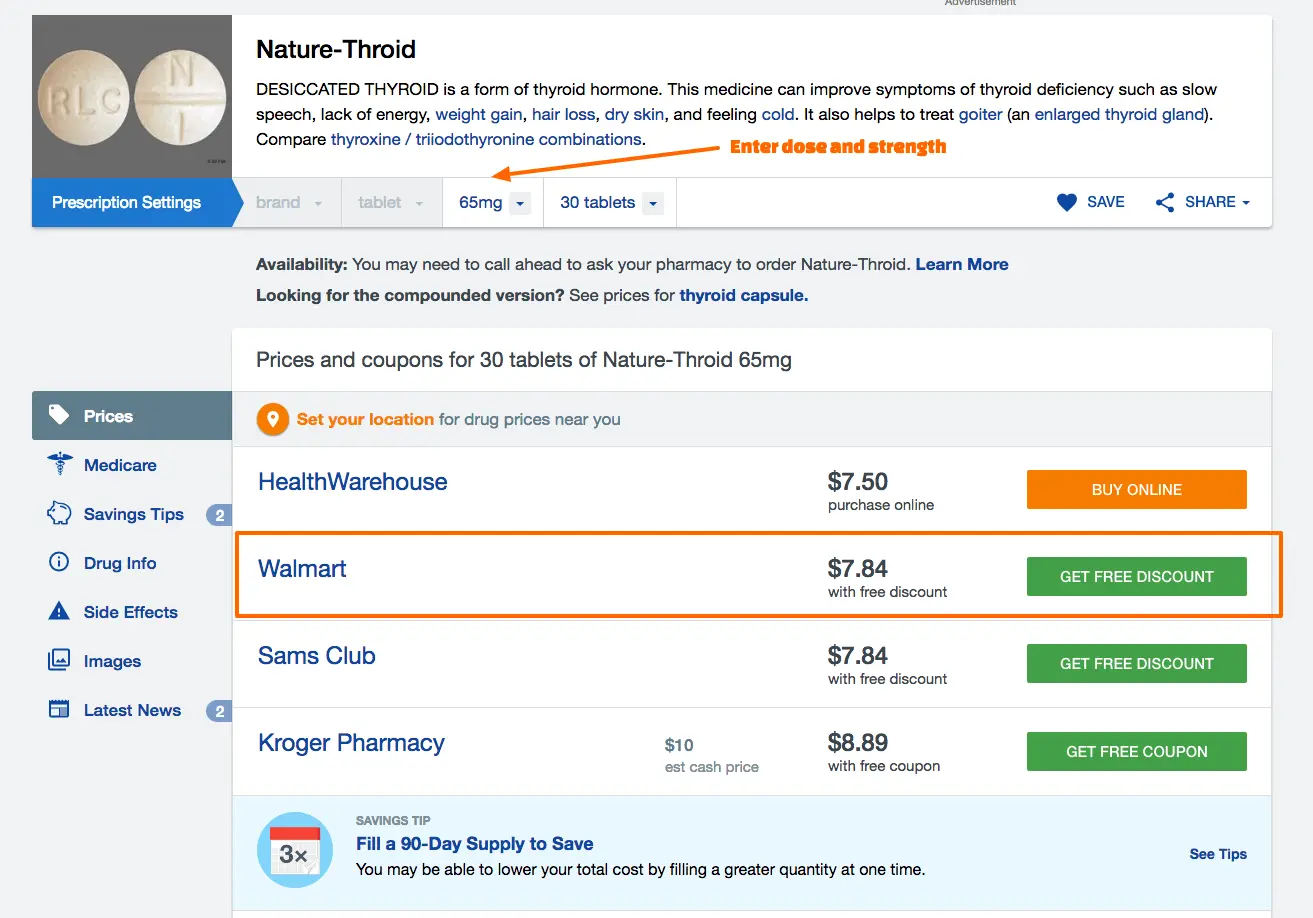
You can even use Goodrx.com for other medications (including Armour thyroid, levothyroxine, etc.).
The average price of Nature-throid will depend on both your location and local pharmacies, but you should expect to pay no more than $10.00 per month for a 1 month’s supply.
What is in Nature-throid?
Are you a sensitive person that reacts to fillers/dyes/etc.?
Nature-throid has a very limited amount of ingredients as you can see below:
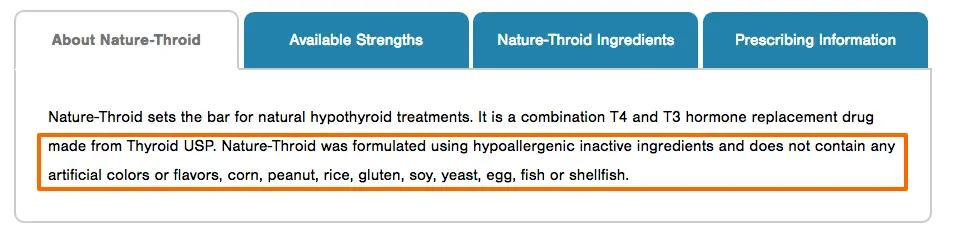
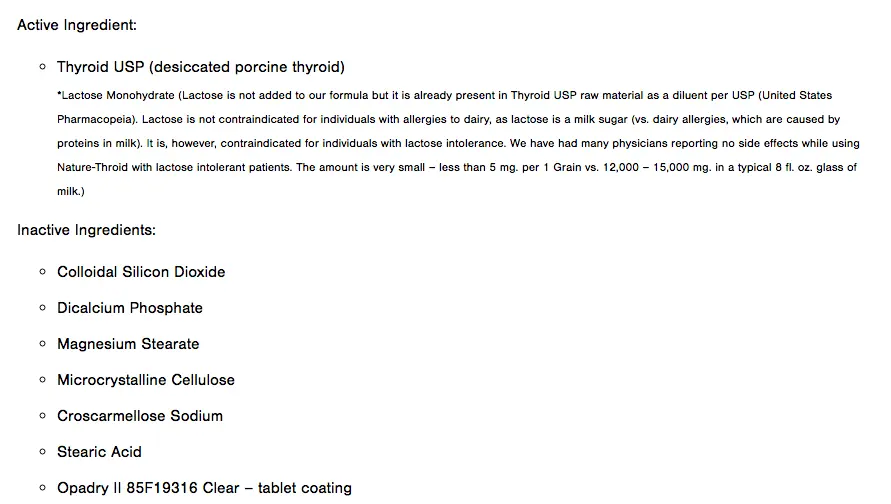
Active ingredients include:
- Thyroid USP (desiccated porcine thyroid)
- Triiodothyronine at 9mcg per grain
- Thyroxine at 38mcg per grain
Inactive ingredients include:
- Colloidal silicon dioxide, Dicalcium Phosphate, Lactose Monohydrate, Magnesium Stearate, Microcrystalline Cellulose, Croscarmellose Sodium, Stearic acid, Opadry II 85F19316 Clear
Dosages and Formulations include:
- 16.25mg (1/4 grain)
- 32.5mg (1/2 grain)
- 48.75mg (3/4 grain)
- 65mg (1 grain)
- 81.25mg (1 1/4 grain)
- 97.5mg (1 1/2 grain)
- 113.75mg (1 3/4 grain)
- 130mg (2 grain)
- 146.25mg (2 1/4 grain)
- 162.5mg (2 1/2 grain)
- 195mg (3 grain)
- 260mg (4 grain)
- 325mg (5 grain)
It’s important to note that it is gluten-free and safe to use if you have Celiac disease or non-celiac gluten sensitivity.
It also does not include artificial flavors, artificial colors, fish, rice, soy, gluten, peanut, egg, or shellfish.
It does, however, contain porcine (pig), so if you don’t consume animal products you should take this into account.
It’s also important to note that WP Thyroid has even fewer ingredients, so if you react to Nature-throid you may want to consider WP thyroid as an alternative.
What to do if Nature-throid isn’t Working
While Nature-throid may be enough to alleviate the majority of your symptoms and issues it may not be enough to get you back to 100%.
If you have any of the following then you may need further treatment beyond thyroid medication:
- High levels of Reverse T3 ( >15 ) or signs of thyroid resistance
- Leptin resistance (Leptin level > 12)
- Diabetes, prediabetes, or insulin resistance
- Extremely low body temperature despite being on Nature-throid or NDT
- Personal history of bipolar disorder or a strong family history of mental health disorders
- Personal history of Fibromyalgia or Chronic fatigue syndrome (15)
In these instances, it may be beneficial to consider adding T3 (Cytomel or Liothyronine) to your Nature-throid or NDT.
Cytomel is a medication that contains pure T3 thyroid hormone and is the most powerful thyroid hormone medication available.
Use Caution if You Have Autoimmune Thyroiditis or Hashimoto’s Thyroiditis
Any patient with autoimmune thyroiditis or a known diagnosis of Hashimoto’s thyroiditis should be careful when using Nature-throid or any other form of Natural Desiccated Thyroid.
Why?
Because NDT is porcine-derived, meaning it is an animal product and may contain porcine tissue.
Even though the hormones themselves are bio-identical (meaning they are the same hormone your body would have produced naturally), components of the animal still remain in the formulation.
Like any piece of foreign tissue, it is possible for your body to create an immune response to it (16).
For this reason (and many others) some patients may actually feel worse when switching to Nature-throid and feel like their symptoms come back even though their TSH may be normal or low.
This leads patients and providers to believe that the medication doesn’t provide stable thyroid levels and this isn’t necessarily true.
It doesn’t mean you shouldn’t take Nature-throid if you have Hashimoto’s or autoimmune thyroiditis, but you should take this into consideration when switching medication and monitor for adverse effects.
If this does occur, you can check your thyroid antibody levels to determine if they raised in conjunction with starting Nature-throid.
If this occurs you may need to stop the medication.
Treating any GI-related issues like low stomach acid can improve your digestion and absorption of Nature-throid and may reduce any antigenic stimulus from the medication.
Nature-throid vs Armour thyroid
Even though Armour thyroid and Nature-throid are both forms of natural desiccated thyroid they are NOT the same medication.
Believe it or not, I’ve had many cases of patients who have simply switched from one form of NDT to another and have had many of their symptoms resolve spontaneously.
This same sort of effect is seen in patients switching from Levothyroxine to Synthroid or Synthroid to Levothyroxine even though they technically contain the same active ingredients.
Studies have shown that some individuals are exquisitely sensitive to minor differences in medications and that these medications cannot be considered bioequivalent for all patients (17).
I want to provide a word of caution to you, especially if you fall into this boat.
Don’t assume that ALL forms of NDT (Nature-throid, wp thyroid, Armour thyroid, etc.) won’t work for you if one of them isn’t currently working for you.
Much of this tolerance is likely due to the various fillers and binders used in each medication.
While all forms of NDT do contain the same amount of bio-identical thyroid hormone, they differ in these inactive fillers and binders.
In the case of Armour thyroid, the formulation was recently changed which reduced the amount of dextrose and increased the amount of methylcellulose in the formulation.
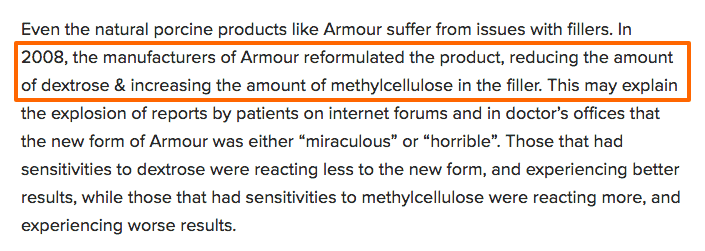
This change either dramatically improved or worsened the tolerance of the medication in some patients.
The binder methylcellulose acts like a “glue” in the body and delays the absorption of the medication.
This is the same binder that compounding pharmacies use for sustained-release T3.
This example really highlights the importance of these fillers and binders and helps to explain why some people do very well on certain types of medications.
If you are on Armour thyroid and it isn’t working for you, then it would be worth a trial of switching medication to see if the switch improves your symptoms.
You can find more information about Armour thyroid here.
Heart Palpitations with Nature-throid
One of the more concerning symptoms that patients may experience while taking Nature-throid is the sensation of a rapid heart rate otherwise known as heart palpitations.
These palpitations result from the T3 that is inside the medication.
Recall that Nature-throid contains a combination of both T4 and T3 thyroid hormones, compared to levothyroxine or Synthroid which contains T4 only.
T3 is the active form of thyroid hormone in your body and it activates certain receptors in all tissues in your body.
In your heart, T3 acts differently than it does elsewhere by directly activating calcium channel pumps (18).
This may lead to an increased force of contraction of the heart combined with an increase in the heart rate (19).
Because serum levels of T3 usually spike around 2-3 hours after ingestion of thyroid hormone, this is usually when patients experience heart palpitations.
These palpitations don’t necessarily indicate that the medication is harmful to your body, but they may mean that you are getting too much T3 too quickly.
You can combat these symptoms by changing how you take the medication.
Simply spacing your dose (take half in the morning and a half at night) may be enough to alleviate this problem.
Alternatively, taking your thyroid medication at night may improve your symptoms by altering how quickly your body absorbs it.
Many patients report heart palpitations in the middle of the night (usually 2-3 am) which likely stems from changes in cortisol levels and other hormones.
You can learn more tips and tricks on how to take your thyroid medication in this article.
Conclusion
Nature-throid is a medication that contains both the inactive T4 and the active T3.
Because of the active T3 and combinations of other thyroid hormones (listed above) many patients actually do much better on Nature-throid instead of T4-only medications like Synthroid and levothyroxine.
If you are considering switching to Nature-throid (especially if you are switching from T4-only medications) make sure to start LOW and titrate SLOW.
That means starting at a lower-than-normal equivalent dose but increasing your dose slowly every 10-14 days.
Doing this will prevent unwanted side effects from the T3 in the medication.
And remember that Nature-throid is not a magic weight loss pill, but it can help some individuals lose up to 10-20 pounds.
Now I want to hear from you:
Are you currently taking Nature-throid?
Did it work for you?
Do you believe you need different thyroid medication?
Why or why not?
Leave your comments or questions below!
Scientific References
#1. https://www.ncbi.nlm.nih.gov/pmc/articles/PMC4045230/
#2. http://www.ncbi.nlm.nih.gov/pubmed/23539727
#3. https://www.ncbi.nlm.nih.gov/pmc/articles/PMC5763098/
#4. https://journals.lww.com/co-endocrinology/Abstract/2017/10000/Persistent_hypothyroid_symptoms_in_a_patient_with.10.aspx
#5. https://www.ncbi.nlm.nih.gov/pubmed/19190113
#6. https://www.ncbi.nlm.nih.gov/pubmed/23539727
#7. https://www.ncbi.nlm.nih.gov/pubmed/17465862
#8. https://www.ncbi.nlm.nih.gov/pubmed/28056660
#9. https://www.ncbi.nlm.nih.gov/pubmed/494987
#10. https://www.ncbi.nlm.nih.gov/pubmed/27700539
#11. https://www.ncbi.nlm.nih.gov/pubmed/11174855
#12. http://www.ncbi.nlm.nih.gov/pmc/articles/PMC3041250/
#13. http://www.ncbi.nlm.nih.gov/pmc/articles/PMC377492/
#14. http://www.ncbi.nlm.nih.gov/pubmed/9846161
#15. https://www.ncbi.nlm.nih.gov/pmc/articles/PMC5869352/
#16. https://www.ncbi.nlm.nih.gov/pubmed/19869635
#17. https://www.ncbi.nlm.nih.gov/pmc/articles/PMC3565118/
#18. https://www.ncbi.nlm.nih.gov/pmc/articles/PMC2820695/
#19. https://www.ncbi.nlm.nih.gov/pmc/articles/PMC5746964/



Will it help with hair growth?
Hey Amy,
If you are hypothyroid then yes it most likely will.
Hi Dr. Childs,
I found your site last night and have been glued to it ever since. I’m fascinated with all your posts! You are the first doctor I have encountered that has a different mindset and who truly has an understanding of what sufferers go through instead of thinking it’s all in our heads.
One question about Reverse T3. I’m looking at my labs and can’t find Reverse T3 on there. Would it be called something different on my labwork? I see Triiodothyronine,Free,Serum; Thyroxine (T4) Free, Direct,S; Thyroid Peroxidase (TPO) Ab and then my thyroglobulin levels were also checked.
My second question is this. I had a TT almost 7 years ago so I’m always technically considered hypo. Do these posts about people suffering with hypothyroidism also apply to someone who has had a TT?
Thanks so much for all this information!!
Hey Amy,
I’m glad you have enjoyed the posts!
1. Reverse T3 is labeled as Reverse T3, so it’s unlikely that anyone has ordered it for you thus far.
2. Yes, these posts still apply to those without a thyroid. T4 still must be converted to T3, reverse T3 levels still matter, etc.
I take 97.5mg of Nature-Throid and still have symptoms. I read that having low cortisol (which mine is very low), decreases the T3 from enter into the cells. It effects the receptors. Is this true?
Hey Eileen,
Cortisol can definitely impact thyroid function and conversion. It’s also possible your dose is insufficient or you need a different medication.
Dr. Child’s, I am currently taking Armour thyroid 90mg. Blood tests: 4.24 Free T3, 0.77 freeT4, 0.01
TSH. The physician wants to change meds. Symptoms- fatigue. I want to stay with NDT. Would Naturethroid be the next step? I do not know Reverse T3 levels. More testing more appropriate? Thank you soo much for your time and videos/blog.
I have been on Levothyroxine (currently 125 mcg) for 20+ years. I’ve been feeling lousy the past few months with fatigue, muscle/joint aches, hair loss, brain fog, etc. My Dr. did labs and said my levels were perfectly “in range”. However, my TPO is at 224. I’m so frustrated! Your thoughts please??
Hey Marti,
You probably won’t get anywhere with a Doctor who treats based on labs alone. For more info on why they are inaccurate please check out this article: https://www.restartmed.com/thyroid-lab-tests/
Great read…thank you! So I gather that my TPO at 224 is quite high? What do you think could cause that? Is it an indication of Hashimoto’s?
I was on compounded thyroid when the dr decided to pulse the dose 70% very quickly. Of course I had every symptom you mentioned above. I stopped immediately. Is it possible to keep the numbers and symptoms in check strictly by diet. I feel that I screwed up my thyroid. I was able to lower my antibodies significantly by being gluten, dairy, sugar and soy free. Also what’s the best way to wean off of ndt?
Hey LB,
Some people can manage their thyroid function with lifestyle changes alone, but many cannot. I wouldn’t recommend weaning yourself off of NDT without physician supervision to prevent any negative side effects.
My Doctor asked me to come off NT To retest my bloods , I asked did I need to ween off it ? She said no just stop The medication right away?
Hey Suzie,
I can’t comment on why your physician made those recommendations, but as a general rule it’s better to slowly wean off of medication as opposed to coming off of it abruptly.
Am on Naturethroid X 8 months after a disastrous trial of Levo that left me feeling worse with increased fatigue and hair loss. Gradually titrated up t0 3.5 grains of Naturethroid and initially looked and felt great with nice weigh loss and cessation of hair loss with FT3 at 6 but FT4 unchanged. TSH suppressed as expected. In recent months I have been feeling symptomatic again with fatigue & ++ hair loss- FT3 has dropped to 4.6 again and not sure why? Reverse T3 has never been tested- the GP says she has never heard of this? Any ideas gratefully received.
Hey Sandra,
Happens all the time. Your body uses thyroid hormone like it does other hormones in the body – more during times of stress/illness/etc and less at other times. Demand for thyroid hormone is NOT static, it is dynamic. You could have an increased demand due to a variety of reasons or an increased amount of reverse T3 secondary to stress, etc.
Hi Westin,
This is interesting. If demand for thyroid hormone is NOT static then how do we manage symptoms with a prescription that is inherently consistent? If I have a week of high stress and my symptoms return because my current prescription is not sufficient for the increased need, I don’t have time to go through the process of seeing my doctor, getting tested and raising my dosage, which for that matter, may not even be needed after the week or two of stress passes. Is self-dosing the answer? This inability to adapt to the unavoidable waxing and waning of life seems like a major flaw in the paradigm of thyroid treatment. Please advise.
Hey Sarah,
The best patients are intuitive and understand their body. They dose based off of demand, stress and other variables in their life and use a combination of sustained release + immediate release formulations. It’s similar to the basal/bolus method of dosing insulin in type I diabetics.
So when you exercise very intensely, for example a hiking trip, do you need more thyroid? (I feel that I do, but have never had this technically explained)
I find this dosing according to the body’s symptoms and needs very appealing. By basal, do you mean tracking with am basal temperature? The prescription might not run out at the expected time and could be flagged as a medication abuse… Your thoughts on how to proceed in a discussion with doctor on intuitive dosing? Are sustained release capsules always compounded (expensive) or is there a pure company that sells T3 sustained release? Is that the Cytomel?
Thank you for the education. I know there are years and relationships that could have gone better for me if I’d have a better handle on thyroid and female hormones.
I get a constant headache when taking 1 grain or higher on NDT – I have only tried Armour and Nature-Throid. Seems to be worse with Armour. Does this mean I cannot take NDT at all?
Thank you.
Not necessarily, but some people do get headaches with T3 – I see it more commonly with liothyronine, but I have seen it with both armour and naturethroid. You could consider WP thyroid instead.
On Nature-throid for years and works well. Hashimoto symptoms returning and Dr. will not increase dosage because of my age (69). Currently taking 162.5MG. She is giving too much attention to THS 0.05. Says it is too suppressed. Since when do we pay attention to THS? Afraid I will have heart problems.
Your opinion and any studies I can refer to.?
Hey Lynne,
Most doctors ONLY pay attention to the TSH, that’s the “standard”. I’m not really sure which studies you are looking for?
I guess I had the wrong impression of you. TSH is useless but thanks anyway.
I think you’re confused… I don’t treat based off of the TSH, but I’m telling you that most Doctors do which means you need to find a new Doctor willing to help you out. To say that the TSH is completely useless is certainly not accurate, however using it to base dosing recommendations is obviously not a wise decision.
The TSH has the most value in determining the sensitivity of a patient to thyroid medication and with the initial diagnosis of hypothyroidism if it is > 2.0, but beyond that it’s not very helpful in management.
I think your problem is with your Doctor and their management, not how I look at and treat patients. If your goal is to take studies showing that the TSH isn’t helpful to your Doctor to hopefully “convince” them to change their mind, you are most likely wasting your time.
I have a doc that follows your ideas but…. I have been experiencing same ole Hashi symptoms and wanted a small increase in dosage. Doc said no because I am old (69) and could have a heart attack because TSH is suppressed. I have never had a heart problem and no history in family. How can I convince her to increase dosage?
I think her rationale is stupid as I have done research and can find no coherent finding to suggest an increase in dosage for an older person with no heart history and suppressed TSH would be detrimental.
Hi, I am a 52 year old female.
I have been on cytomel 5mg. for about 11 months. I experienced terrible hair loss. It is to the point that my scalp shows and causing major anxiety/depression. I recently had my labs redone by two different doctors. Labs were taken within 2 weeks of each other.
Labs came back:
TSH 1.720
T4 free – 1.6
Reverse T3 – 16.4
TPO AB- 8
Triiodothyronine, Free, Serum – 2.4
Dr. originally wanted to up the dosage but I expressed my concern about hair loss. Dr. also noticed major hair loss and suggested stopping the meds for two weeks to see what happens. I have been off of the meds for 5 days now.
Second lab results from Gyno.
T3 Free – 2.8
TSH – 0.900
Total T4 – 7.50
Thyroid Perox ab – Less than 10
Second dr. suggests taking Westhroid 65 Mg.
I am scared to death that the Westhroid might cause additonal hair loss. Have also seen some people have good results with hair recovery on this med.
Not sure why one dr. would suggest one and the other suggest something different.
Labs also indicate High Ferritin level and both indicate low b12 and low vit. D. May main concern is the massive hair loss. More like a hair shed.
Any insight would be greatly appreciated!
Thanks so much for you time!
Stephanie
Hey Stephanie,
Both scenarios might result in additional hair loss, if possible you need to figure out what is causing the issue prior to making changes.
Can you give me any insight on hair loss? All dr.’s I have been to say they do not deal in hair loss. Not sure if it is caused by thyroid meds, not enough thyroid, or low hormones.
Have been on the WP Thyroid now since September. Labs are still in the same range as above.
Any insight would be greatly appreciated.
Hi Stephanie,
You can find more information on hair loss and how to manage it here: https://www.restartmed.com/thyroid-hair-loss/
Hi Dr. Childs. I was on 162.5 naturethroid & found it was too high a,dose .can I go back to the 130 dose I used to be on to get the numbers normal or should it be gradual & start w the 146.25. which my new doctor just put me on.
Thank u for ur time.
Hey Jan,
Without labs or symptoms there is no way to answer that question.
I started Nature Throid 32.5 three days ago. I stopped levothyroxine .100mg at that time. Today I feel tired and some heart palpitations. Is this a good amount to start with? Do I need some time to adjust? My doctor said take this for 28 days, then increase to twice that much after that.
Hey Kathy,
It really depends on the person, some people can start high and others need to start low and go very slow.
Does anyone have a doctor reference in Chicago for me? I was just diagnosed with Hypothyroid and put on Levothyroxine 3 weeks ago and have insomnia, headaches and an appetite that won’t quit. I would like to try Naturethroid. My Endo won’t prescribe. Thank you!
Hey D,
Unfortunately I don’t know anyone in that area.
Hi. I am in Chicago area and see Dr. Rowena Chua in Evanston. She’s pretty amazing. Has me starting on Nature Throid .. I don’t have her number on hand but do look her up.
Hey Kelli,
Thanks for your comment. I obviously can’t speak to the treatment that this physician provides but if you are out of options it would certainly be worth a look. I would caution against providers who use NDT (such as naturethroid) in isolation without giving thought to T3 or reverse T3.
Dr Alicja Poleszek in Elmhurst. She is amazing and she is family medicine doctor but she also treats patients with autoimmune disease and thyroid disease. She prescribed WP thyroid for me.
I have been on naturethroid for 3 months an my tsh keeps going up instead of down it is 23.I have no thyroid. Can you help me figure this out. My anxiety is horrible.
Hey Sandy,
You may need more T3.
Hi,
I am fixing to start taking nature-thoid from my doctor,because of my low T3 levels.. this may sound minor, but I have read many things on the web about hair loss when taking this supplement. Is this true for many ??
My Dr. put me back on synthroid because all my levels were so bad on naturethroid. Now being back on that I don’t know what else I should take. Any help with be great. I am tired of feeling so bad. I do take mag. and vit d and b12 Thank you
After being on naturethroid for almost 4 mos. my levels were tsh 23.45 free t4 .02 free t3 2.40 I had thyroid removed 13 years ago for cancer with 3and a half parathyroids removed also,I have severe anxiety and have never felt good because they can’t get my numbers right. I don’t know what else to do. They just put me back on 100 synthroid because of bad levels.
Why is my tsh going up being on naturethroid It is up to 23
Hi Sandy,
This is most likely due to your dose, not due to the medication.
Hi Dr. Westin,
I’ve started on Nature Thyroid in June with 1 pill of 65 mg and then increased the dose slowly to 1 pill and 1/2 of 65 mg. I did my lab tests 1 month ago and my results are:
Tsh – 0.11 L
T4 Free – 1.0
T3 Reverse – 17
T3 Free – 3.3
My results are better but I still feel exhausted and I would like to increase the dose to 2 pills. The dr that prescribes them is my family doctor and she usually prescribes Sythroid and I convinced her to try the Nature Thyroid.
I would really like your opinion about it and if I should increase dose, what are the arguments for doing that with my dr. Unfortunately I live in a small town and I don’t have other doctors to go to.
Thank you,
Cristina
Hi Cristina,
A better option would be to look at other factors that may mimic thyroid disease or focus on therapies designed to reduce your reverse T3. You can find more information here: https://www.restartmed.com/reverse-t3/
I started Nature Throid (65mg) 3 months ago. Just had a follow up test and my TSH is 18.85 ! (range 0.27 – 4.20). Is this normal to have skewed results while to Nature Throid? My T4 free is 0.9 (range 0.9 – 1.7)
Hey Cathy,
No that is not a normal response, most likely you are under dosed.
Thank you for your response the endo I saw today was no help and wants me to stop the Nature Throid and go back on levo, which I took for 15 years wasn’t working for me. And to add Cytomel.
Instead I’m going to go back to the doctor that prescribed the Nature Throid initially and hopefully she will up my dose.
Good luck!
Hello,
If you have time, do you mind taking a look at my message above? I would really appreciate your feedback.
Thank you,
Cristina
Hi Cristina,
Sure, I just sent over an answer.
I have been on Naturethroid for the past 3 years. I started on 1.5grain and then went up to 2.5 grain and was wondering about raising the dose to 3grain or 4 grain and see how I feel because I am fatigue and brain fog. I do take mag/vit d3/with k2.
I know I don’t have my numbers here but wanted to know your input
Thank you
Hey Widalys,
I would never recommend the titration of medication without at least following lab testing. You shouldn’t base dose off of labs alone, but you also shouldn’t neglect them completely.
hello! First off thank you for the best article I’ve ever read on thyroid meds. Very helpful! I just started naturethroid this week. I’ve been on synthroid for 20 years after a diagnoses of hashimotos. In the last year I’ve developed a lot of food allergies which trigger my hashimotos and my heart rate goes crazy. I have a temperature of 96.9 to 97.4 depending on the time of day. Im losing my hair and I’m tired. A lot. I was on 150 mcg of synthroid and my dr put me on 165 of naturethroid. My heart rate goes up quite a bit as soon as I take it so tomorrow I’m going to take your advice and split it in 2. Smart. How long should I try this dosage – after reading your article it seems she might have started me on too much. Oh I’m a 40 year old woman – single mom of 5 kids. Thanks!
Hey Crista,
You are welcome but I can’t give you advice on how to titrate or dose your medication, unfortunately.
Hi,
My Doctor sent me to order nature thyroid because I have my T3 a little low on 2 and she wanted to increase to 4, I want to know in what grain I should start.
Thanks!
Hey Lisbeth,
You will have to discuss that with your Doctor, I can’t give you medical advice in this medium.
Hi, help!! Need your opinion: 4 weeks ago I switched from Levo to desiccated thyroid. I feel horrible (the fatigue is debilitating, my skin has broken out, and brain fog is bad). I was on 150 mg of Levo and when I stopped my doctor said I was in a hyper state. Now on the desiccated thyroid I just did my blood test and my TSH is 6.5. I started on 30 mg of the desiccated thyroid and worked up to 45 mg, 60 mg, 75 mg and now at the 4 week mark I am now at 90 mg (taking 60 in the am and 30 in the afternoon). I know it’s still early in the process but I feel so awful that I am wondering if I made a huge mistake switching medications and I am wondering how long of a chance I should give this? I switched from Levo because I thought that maybe I could feel optimal on the desiccated thyroid. I saw in your article that I may feel worse before I feel better on desiccated thyroid. Is there a typical timeframe that I can look forward to that will be around when I should start feeling my best? I literally feel like my body completely crashed as I went from hyper back to hypo in 3-4 weeks. My doctor has never prescribed desiccated thyroid so there is a bit of a learning curve, but I feel like giving up and going back to feeling semi okay on Levo than terrible on desiccated thyroid. Am I giving up too soon? I am just shocked at how drastically my health deteriorated in a month as I thought I would see subtle improvements each week.
Hey Mandy,
I can’t say because I don’t know your situation, some people just don’t do well on NDT and others do quite well it just depends.
Hello,
I was wondering if you’d come accross anyone who experiences dizziness/balance issues upon starting Naturethroid? I started three days ago. Day one I felt fine, day two and theee I can’t stand without holding onto something so I don’t fall. I’m not doing anything else different, so I will assume it’s the Naturethroid. Another thing, my heart rate won’t drop below 100, even while resting. I am only taking 32.5 (as I was on 50mcg of Levo before this). My anxiety has also increased and My throat feels right, as if I had a balloon in my thiroat. Seems like a lot of symptoms for such a small dose. Please advise.
Hey Romina,
You will have to take those symptoms to the Doctor who prescribed the medication, plenty of side effects can occur when starting a new medication and I don’t understand the intricacies of your case.
Hello,
I want to know if I can take two pills of 1/2 grain to make 1 grain of NatureThroid, or I need to take the one grain pill?
Thanks!
Hey Lisbeth,
You will have to take that question to the provider who prescribed you the medication, I don’t know anything about your history so I can’t comment.
I been taking Nature Tyroid for 8 weeks now a half grain in morning and I think it makes me more tired and exhausted. Any advice??
Hey Julie,
You will have to talk to the Doctor who prescribed it to you, I can’t direct you further if you aren’t my direct patient.
Hi,
I’m 45 Y/woman, diagnosed with Hashimoto and taking Synthroid for last 7 years.
My new endocrinologist gave me nature thyroid and I took it this morning for the first time. around noon I felt horrible but then i got better till tonight that I couldn’t sleep, heart palpitation, very dizzy that couldn’t walk. it’s 1:00 AM and i just took my Synthroid to call the doctor on Monday.
I would like to split it in half, as you recommended but the symptoms were so strong that i don’t know if i can even switch….
Hey Sheila,
Some people don’t tolerate NDT for a variety of reasons, it’s hard to say why you reacted the way you did without more information.
Hi Dr. Childs,
I switched from Levo to Naturethroid back in September because I was shedding hair and it had become very dry. My doc went from 75 mcg Levo to 65 mcg Naturethroid. Lost weight and had heart palpitations, so we scaled back to 48.75 in October. While weight has stabilized and I don’t have heart palpitations, It is almost December, and my hair loss continues. However, I am also seeing some new growth and my hair seems less dry. I don’t know whether to stick with Naturethroid at this dose, go higher, or go back to Levo. Any suggestions for next steps would be great. Thanks so much.
Hi Grace,
You can learn more about the influence of thyroid hormone medications on hair loss and what to do about it here: https://www.restartmed.com/thyroid-hair-loss/
Dr Westin,
About 2 months ago, my regular doctor took me completely off my naturethroid (I was on 32.5) cold turkey, and within 6 days I began experiencing pins and needles and burning in my feet and sometimes my hands. Found an endo who put me back on medication – 50mg of Synth and 12.5 of liothyronine. It has been just over a month. The symptoms have not gone away. Original labs were taken on 10/25/16 before the endo put me on the synthroid and liothyronine, and my numbers were TSH – 3.34, Free T4 1.12, Free T3 3.1, and Reverse T3 was 21. I am at a loss and not sure what to do. Of all the research i have done, it seems as if I am not getting enough T3 into my cells because of the RT3. I dont know what to do – my endo said she does not want to touch my meds and I am beyond frustrated.
Hey J,
You will probably need to pay out of pocket to find someone willing to give you more T3. I can’t really overstate the importance of having someone knowledgeable helping out on your case because no matter how much research you’ve done there’s a big chance you are missing something.
Did you find any answers to your thyroid med problem? I am on Armour Thyroid and no energy since they changed formula. Tried all the other NDTs but came back to Armour. Now I have prediabetes and take cinnamon and Bilberry and control diet and that helps Now heart feels weak at times and blood pressure goes up. I m older now 70. Go to an Endo but she has no idea
After switching to WP Thyroid I see hair growth back and overall feel better, however I am becoming insulin resistant. I use an insulin pump and have had to increase my basals by 10 units per day since going on WP. I also tried Naturethroid with side effects of rash at hairline. Why is WP causing increased blood sugar?
There is a relationship between T3 and insulin sensitivity but generally it works in the opposite way you are describing.
Hi. I saw for the first time a Naturophatic doctor, after being seen with so many doctors with no answers. The Naturophatic doc did a thyroflex test. The results were 153. She said is hypothyroidism. She gave me Nature Throid 65mg. But does this means Im hypo? I already have lost a lot of weight, and have tachycardia every single day, low and high blood pressure, headaches and fatigue. I haven’t started the nature throid. Will it help in my case?
Hey Diana,
You will have to take that question to your provider, too many variables can impact how your body reacts and I don’t have the information to answer it for you.
Hi. My Naturophatic gave me Nature thyroid after doing a thyroflex test. The results were 153. Is this means Im hypo? Im still waiting for labs results. I haven’t started nature thyroid. Should I take even though I don’t have my labs results. Im scared its first time they found hypothyroidism. I already have lost a lot of weight, have tachycardia every day headaches fatigue dizziness. Please reply back. Thanks.
Hi Diana,
It’s probably a good idea to confirm the diagnosis with lab tests prior to treatment.
WOW was this interesting reading, I saw an integrative doc, wow amazing doc, I am a mess and hopeful. I am taking Nature Thyroid 1gr morning/ 1/2 afternoon, and am having tight throat, lite headache, lite weird breathing which started immediately when I began 2 weeks ago after taking synthroid for 9 years, I have a goiter and Hash. I am hanging in there and hoping I adjust. I am excited to find a real doc. THANK YOU for this blog, wow have I learned a lot!!!!!!!!!!!!!!!!
Hey Cindy,
No problem and I hope you find it helpful.
I have been on Nature-Throid for years, I recently developed dizziness and I believe its attributed to this medication.
after taking it in the am I begin to feel dizzy? Does this make sense?
Hey Linda,
Yes and dizziness is a common side effect of taking naturethroid.
Is it dangerous to take a little T-3 25mcg Citomel along with the NatureThroid if you feel like your Naturethroid is not enough? I don’t have the money to see the doc again to get a higher dose, so can I use one Citomel in addition to the Naturethroid (I have Citomel left over from a previous doctor)… if I monitor my symptoms closely?
Hey Ingrid,
I wouldn’t recommend that you try to self dose with T3 because it can be dangerous if not done correctly.
Hello, I am currently taking 125mg synthroid and 15mcg compounded t3. I am wanting to switch to 2 grains of the WP thyroid. I know you say titration slowly, however since I’m already used to t3 do I still need to do that?
Thank you
Hey Shala,
I can’t give recommendations over this medium, but I approach each situation differently because each patient is unique. Some people react negatively to certain medications so I generally recommend slow titration.
I am currently taking 1.5 grains of Naturethroid and am experiencing vertigo/dizziness on a daily basis since I raised my dose. I still have hypo symptoms and my doc refuses to believe it’s thyroid related. How long should I wait this out? It’s been well over a month.
Hey Kari,
Many conditions can create thyroid like symptoms, it’s possible you are either under dosed or attributing some of these symptoms to your thyroid when they are related to something else.
I’ve felt bad on naturethroid and synthroid. I’ve gained 40 pounds since I started naturethroid. I’ve been on 2 1/2 grains. I feel awful. I have blood sugar problems. My legs are weak and I have heart palpitations especially at night. Now I’m so depressed. I’m trying to lower but that is hell too! Please help!
Thank you for any help!
Norms
Hey Norma,
The best thing you can do is find a provider locally who can help you sort through your symptoms to figure out where they are coming from. Not everyone does well on NDT in general and some reactions like you are experiencing are quite common – you just need someone who knows how to deal with the symptoms to help guide you.
Hello Dr. Childs:
I started out on 65 mg and not take double the dose. Why is it that the dose has to be increased increased over time? I switched from synthroid and had to increase the dose as well. Does it mean my thyroid function is deteriorating over time? I have hashimoto’s.
The main reason to start out slow is to allow your body to acclimate to the higher doses of T3 and to ensure that you don’t react negatively to the medication (including the inactive fillers). It isn’t necessarily a reflection of native thyroid function, though that may also play a role depending on the person.
I also meant to ask why do I have to keep going up on the dose every so often due to symptoms of hypothyroidism. For example, I started on 65 mg which was fine then my free t3 and free t4 dropped and had to inc the dose and had symptoms. If that happens does that mean my thyroid function is reduced to the autoimmune attack? My last anti TPO were 292.
after a thyroidectomy I was put on levothryroxine for past three years. felt awful on and off and switched to naturethroid two weeks ago. I had also been suffering from sudden gastric problems, which I thought to be viral about a month ago and am confused about what has been happening to me since I started taking nature throid as I don’t know if my current symptoms relate to switching medication or to something else I need to get checked .could it just be coincidence I feel worse than I’ve ever felt and have face and gum pain, and a rash has come up on my forehead and my face is a bit swollen and puffy. I was put on a dose of two grains of nature throid daily to be increased to 3 in a week’s time. please advise.
Hey Carol,
It’s hard to say because Naturethroid can cause those type of symptoms as well.
After almost 2 years of juggling medications, I am now on .75 mcg of tirocint and 1,25 of SR T3 and I do feel great!. The only concern is that the t3 is not covered by insurance(because it is a compound) and it iS $130/month. My doctor is all for starting me on NP thyroid and so am I but I am very nervous about the dosing. I don’t want to feel awful again until we get it regulated.. What is the closest dose to what I am taking presently.
Thank you for your assistance.
Hey Helene,
I probably wouldn’t recommend changing medications if you are feeling great. The risk of doing poor is too high for minimal reward, you can always find a different pharmacy with cheaper prices for the SR T3.
How much do you increase your NatureThroid after taking half of a 65 mg for 10 days?
Hey Heather,
It really depends on the person, what they were on before, what symptoms they have, what other hormone imbalances they have, etc. there really isn’t a cookie cutter answer because each person is so different. I would seek further assistance with whoever prescribed you the medication (hopefully they know and understand how to titrate it correctly).
Hi,
My natropath started me on 16.25 mg of Wp in July this year. My main concerns prior to starting were my hair loss/breakage and low end free t3 . She upped slowly..and now in December I’m on 1 grain well mybhair has never improved in fact it worsened in the months in Wp. Is it possible Wp isn’t for me? I didn’t have any thyroid symptoms prior to starting Wp other then the hair and after 5 months the hair is scary worse. High rt3 and antibodies now. Both of which I was fine with before Wp. I want to go off altogether but everyone says that’s impossible. Seeing my np in January but she isn’t much help wanted to know if it’s possible to come off Wp altogether and work on my high cortisol
Hey Tina,
You will have to take those questions to your current provider because the answer is not always straightforward.
I switched to naturthroid about 45 days ago after being on synthroid for about 21 year. My Synthroid dose was 0.112mg. My Nature-Throid dose is 113.75 mg. I received my blood work results and my TSH is low at 0.06, T4, free 1.27
T3 free is high at 8.7.
My gynecologist was the physician who wrote my RX to switch brands because my internist disliked any brands other than Synthroid. I need to change the dose but I don’t think my gynecologist has knowledge of how to regulate it properly. Can you provide me with assistance on correct dosage since thus far it hasn’t been managed very well?!
Thanks,
Lisa
Hey Lisa,
There is no way to accurately “guess” how much thyroid hormone a person will need, it takes a combination of lab tests, hormone levels, body weight, energy levels, metabolic rate, etc. The best thing you can do is find someone to help guide you through this process because it can be difficult (almost impossible) to figure it out on your own.
Have you found a link between low thyroid and hyperplastic gingivitis?
Hey Reba,
I have not, but there might be some association, you can read more here: https://www.ncbi.nlm.nih.gov/pmc/articles/PMC3636929/
I’ve just been put on nature throid having taken levothyroxine for past four years (150) following a thyroidectomy. started two weeks ago with 2 grains nature thyroid daily which upped to three a few days ago. have felt ‘spaced out’ and slighty queasy after taking and only noticeable difference so far is i’m sleeping longer at night.
also unsure if I need to leave time before and after eating when I take 2nd and third grains during the day.
where I live in England endos are like hen’s teeth and few gp’s know anything about nature throid. it’s been a pretty rough ride so far and i’d had frequent hypo symptoms for years.
Hey Carol,
Each person reacts different to thyroid medication so it does take some degree of trial and error to figure out how/when to dose your medication.
Carol, my story is the same as yours I’m in the UK too. Any luck with it now in April? I’m looking at Nature Thyroid but scared now. Louise.
I’m currently taking Naturethroid and my last test shows my TSH at .934, free t3 is 2.5 and freet4 is .87. Some are saying my freet3 is too low and I should add cytomel. Would this help? I’m still always tired, skin very dry, etc. thsnks!
Hey Deb,
You might benefit from the addition of T3 but it’s not as easy as determining by looking at lab tests alone so it’s hard to say with that information.
I started on 65 mg which was fine then my free t3 and free t4 dropped and had to inc the dose to double just to feel the same. Why would I need a higher dose just to feel the same at half the dose over a period of 2-3 months. If that happens does that mean my thyroid function is reduced to the autoimmune attack? My last anti TPO were 292.
Hey Lisa,
Much like other hormones in the body the demand for thyroid hormone changes based on multiple variables. You don’t ever need just a “static” amount of thyroid hormone throughout the day. Your body would naturally produce the amount based on numerous factors such as stress, hormonal changes, etc. Your demand may reflect any or all of these variables (including gland damage from autoimmune attack).
Hi Dr. Child’s,
I was diagnosed with Hashimotos about 7 years ago. For the past 5 years, my TSH has been consistently in the normal range by taking 75 mg of Synthroid once a day for 6 days and then taking double the dosage on the 7th day. I have battled fatigue the entire time and have some brain fog, so my doctor has switched me to 65 mg of Nature-throid once a day. After two months on the medication, I have begun having a racing heart, sleeplessness, some shakiness in my hands and weight loss. The brain fog seems much worse. I went to my doctor thinking perhaps my dosage needed adjusting. We thought due to the symptoms I might have become hyper. When the blood work came back it was the opposite. My TSH levels were high again. Are palpitations and a rapid heartbeat a known side effect of Nature-throid or the transition from Synthroid to Nature-throid? Is there any way to get rid of the brain fog regardless of what type of thyroid medication I take? Any advice you have would be so appreciated.
Hey Jennifer,
What you just described happens all the time. Providers switch patients from levothyroxine to NDT (or other T3 containing medications) and generally under dose them because they aren’t familiar with the medications. Usually they then say that the medication didn’t “work” because your TSH elevated. In reality they just switched medications and dropped your total dose.
The answer to your question is complex because palpitations could be a side effect of hypothyroidism, or secondary to the T3 or a combination of both. Because of the nuances involved in switching and managing medications I almost always recommend you seek out someone knowledgable to help guide you through the process.
Hi. im getting switched over to Naturethroid from Synthroid. My Doc told me to just switch right over to 162.5mg and not take it slow because i do not have a thyroid. Do you agree with this??
Thanks
Hey Alex,
I’m not really in a position to agree or disagree with your provider because you aren’t my patient and I don’t know your history. Having said that, you may react negatively to that dose of T3 if you aren’t used to it – but you might also be fine, it really just depends.
I am a physician that fad a large acoustic neuroma. I gave had t3 surgeries, spinal fusions etc. I am on narcitic medication. On bad days I take more for pain, but then become more hypothyroid. Yitrsting my medication is very hard. I’m on armor thyroid. Would any of the other medications benefit me more then at our. I have had to take a beta blocker for adverse effects of pvcs and pac s on armour thyroid. Can you help?
Hey Dr. Gomori,
Thanks for stopping by. As you correctly suggest the combination of beta blockers + narcotics will be blunting your native T4 to T3 conversion, but at least the narcotics will be necessary due to the chronic pain you are suffering from. The problem with armour thyroid in this setting is the inability to dose the T4 and T3 separately. One of the first things I would consider is adding Sustained release T3 and dropping your total dose of armour thyroid. The sustained release component will take demand off of your cardiac tissue (decreasing the need for beta blockers) and will decrease the substrate for T4 to reverse T3 conversion. This should help both areas at once.
Thank you for your answer. I apologize for the errors in my post. Tried to resend it. Is nature thyroid better then armour in terms of cardiac side effects? Second, what would you use as a sustained T3 medication. Would cytomel be acceptable. I don’t see endocrinologist for six months. There are few here. Very busy. I change doses via a family practioner, and do monitor lab. On synthyroid, I was getting terrible cold sweats. They were so bad, ruinined my life. When I switched to armour, they disappeared. It was a miracle. Now they have returned intermittently, not sure why. I try to stay on same dose of narcotic, but it is nearly impossible. Good and bad days. Was wondering if armour had run its course. Never had cardiac effects on synthyroid., was on it for 19 years with the last year being terrible. So much time in bed, lethargic, with those awful sweats. I will try a t3 med, and reduce dose of armour. Any suggestions as to which would be best? Thank you so very much.
Naturethroid is generally tolerated better than armour thyroid, but I usually prefer WP thyroid over other NDT formulations. Sustained release T3 is cytomel that is compounded to methylcellulose (usually) to delay GI absorption. Cytomel is rapidly absorbed which can lead to high serum levels and cardiac issues. In terms of which will be best for you personally it’s hard to predict and requires some degree of trial and error used in conjunction with lab tests.
Dear Dr, I did get my physician to switch me to nt from levothyroxine, and my dose of Lego was 100 mug daily and now he put me on 97.5 of naturethroid. I feel better but in the pm after dinner my ears start ringing and I feel a bit dizzy should I have added it in slowly like 50/50 and is that even possible?
Hey Chris,
I’ve pretty much have seen every and any reaction you can possibly think of, so yes anything is possible.