The Connection Between Chronic Pain and Hypothyroidism

The Connection Between Chronic Pain and Hypothyroidism

Is your intuition telling you that your hypothyroidism or Hashimoto’s is causing your chronic pain?

I’ve got news for you:

Your intuition may be right.

Low thyroid hormone can potentiate musculoskeletal pain that can be misdiagnosed as fibromyalgia. 

Even more important than that is many providers (and patients) don’t understand how to correctly diagnose, treat, or manage pain and fibromyalgia related to hypothyroidism.

In this post, I’m going to talk about how hypothyroidism causes chronic pain and fibromyalgia, how to correctly diagnose the condition, and other treatments that may help or benefit patients who suffer from this debilitating condition. 

To understand how this works you really need to understand the concept of Tissue Level Hypothyroidism…

The Connection Between Hypothyroidism, Chronic Pain, and Fibromyalgia

Youtube video

You probably know that your thyroid helps to control the metabolism of your entire body but did you know that it also has many more functions than just that? 

It’s common for patients who are hypothyroid to gain weight, but one of the other (many symptoms) of hypothyroidism includes chronic musculoskeletal pain.

In fact, it’s not uncommon for hypothyroid patients to present with back pain, joint pain, or multiple tender points deep in their muscular tissue (1).

While hypothyroidism can cause chronic pain and a fibromyalgia-like syndrome this doesn’t mean that ALL cases of fibromyalgia and chronic pain are due to hypothyroidism. 

That being said…

If you have either condition (chronic pain syndrome, fibromyalgia, or chronic fatigue syndrome) you absolutely should have your thyroid checked out.

And I don’t mean a cursory glance at your TSH, I mean a complete thyroid panel and thorough workup that includes ALL thyroid lab tests including markers for autoimmune thyroiditis. 

I hear patients all the time respond that their thyroid is “fine” only to find out upon closer look it’s anything but fine.

Before we talk about how to correctly diagnose thyroid issues we need to talk about how thyroid hormone can cause chronic pain and fibromyalgia.

Bottom line: Hypothyroidism can certainly cause and potentiate chronic pain and fibromyalgia. Standard blood tests and standard “interpretation” of thyroid lab studies are insufficient to correctly diagnose the problem. To properly evaluate for this condition you need a complete set of lab tests and proper workup.

Need More Help? Get My Perfect Thyroid Diet Meal Plan (+ Shopping List)

Join 200,000+ thyroid patients and get the plan by email right away.

Tissue Level Hypothyroidism Explained

So what can cause “normal” thyroid lab tests but all the symptoms of hypothyroidism?

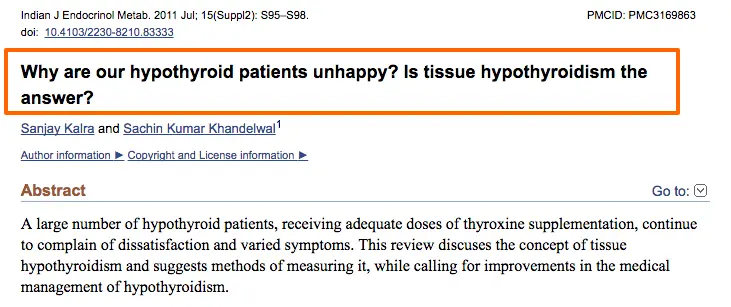
This condition is known as tissue-level hypothyroidism (2).

study outlining the definition of tissue level hypothyroidism

Tissue-level hypothyroidism may explain why there is widespread dissatisfaction with standard thyroid treatment and standard thyroid replacement therapy with Levothyroxine or Synthroid

It turns out that there are many patients currently being treated with thyroid hormone and yet they still have all of the symptoms of hypothyroidism, including chronic pain, hair loss, weight gain, and weight loss resistance. 

So what is tissue-level hypothyroidism and how does it cause these symptoms?

Tissue level hypothyroidism is the idea that you as the patient might have “normal” blood levels of thyroid hormone but due to a number of factors (including inflammation, weight gain, medications, chronic illness, etc.), that thyroid hormone can’t get into the cells to do its job. 

So it remains outside of the cell in the bloodstream making it look like your thyroid function is fine but in reality that thyroid hormone is almost inactive. 

This is also known as thyroid resistance and it is probably one of the most commonly missed thyroid conditions due to how thyroid diseases are diagnosed. 

Standard laboratory tests can only measure what is happening in the bloodstream. 

But…

When it comes to thyroid hormone, we don’t care what’s happening in the bloodstream because thyroid hormone has to get into cells to do its job. 

Thyroid hormone is active when it travels through the cell membrane and directly attaches to the nucleus to what’s known as a nuclear receptor (3).

shop thyroid support supplements that can help you get back to feeling 100% again

From there it directly changes your DNA, in a process called genetic transcription, and causes an increase in metabolism, changes in proteins, and an increase in oxygen consumption (4).

Pretty cool, right?

This means that in order to properly check if thyroid hormone is working, we really need to look at both the blood levels of thyroid hormone and markers to see if it is actually working in the cell. 

One of the best ways to do this is by looking at the complete thyroid blood panel

Bottom line: It’s possible for you to have “normal” levels of thyroid hormone floating around in your blood but that hormone is only active IF it can get inside your cells and turn on genetic transcription and change your DNA. Some patients have “normal” blood levels but that hormone can’t get into the cells to do its job – this is known as tissue-level hypothyroidism. 

The Link Between Fibromyalgia, Chronic Pain, and Hypothyroidism

Chronic pain and Fibromyalgia frequently accompany each other, however, no one seems to understand the exact connection.

But, if you look at the symptoms of Fibromyalgia and Hypothyroidism side by side you begin to see something very interesting:

Fibromyalgia and Hypothyroidism present with almost the exact same symptoms…

There are several studies to show this (which we will go over below) but first I want to talk about a researcher named Dr. Lowe who put this all together for us.

He linked tissue-level hypothyroidism as one of the main causes of Fibromyalgia. And he did this through a concept known as ‘deductively formulated theory‘.

This method of problem-solving takes all of the competing theories that cause disease and, by the use of mathematical analysis, pumps out the hypothesis that is most likely to be correct (this is the same logic that Albert Einstein used to come up with his hypotheses, like the theory of relativity (5)).

Not only did he link the two conditions together he also showed us how to effectively treat and even reverse Fibromyalgia and chronic pain symptoms through various research studies and even case studies.

Through his research, he found that the majority of patients who have fibromyalgia either have undiagnosed hypothyroidism or are inadequately treated with LT4-containing medications. 

His research showed that in order for patients to have complete remission of their pain most of them needed the active form of thyroid hormone known as T3. 

This can be assessed through routine blood work but it is not often ordered by most physicians. 

For this reason, you may need to specifically ask your doctor to check your free T3, total T3, and reverse T3 levels in order to accurately assess if your body has sufficient cellular thyroid hormone available. 

As a quick primer: 

T4 is the inactive thyroid hormone that must be converted to T3 to become active <—- This is what most Doctors prescribe for patients

T3 is the active thyroid hormone that turns on genetic transcription, increases metabolism, and helps thyroid patients feel better <—- Most Doctors do not prescribe this medication but many patients with chronic pain and fibromyalgia may need it

Dr. Lowe’s data showed that approximately 2/3 of patients improved on Natural Desiccated Thyroid Hormone (Medications like Armour thyroid and NP Thyroid) and another 1/3 required higher doses of T3-only therapy (Liothyronine or sustained release T3) to get symptomatic improvement. 

While thyroid hormone that contains T3 (triiodothyronine) was very important to treating and reversing fibromyalgia, it wasn’t the only therapy required to get complete remission. 

We will go over the rest of the treatment below, but first, let’s talk about some of the symptoms you might be experiencing if you have tissue-level hypothyroidism. 

Symptoms of Tissue-level Hypothyroidism & Fibromyalgia

As I mentioned previously blood tests are not 100% accurate in diagnosing hypothyroidism which leads to many undiagnosed and/or mismanaged patients. 

It turns out that using the combination of symptoms in combination with blood tests makes diagnosis much more reliable. 

Before the widespread use of TSH testing most patients were diagnosed by symptoms alone and their medication was also titrated based on their symptoms.

While there are hundreds of symptoms of hypothyroidism there are a few that remain very constant among patients who share both fibromyalgia and hypothyroidism which we will go over below: 

#1. Chronic Fatigue

This is the kind of fatigue that is debilitating. The kind of fatigue that keeps you from doing normal activities like household chores or going out. 

Patients frequently tell me that after they go out to do something simple like shopping they are almost bed-bound for 1-2 days.

Chronic fatigue is both a symptom of hypothyroidism and fibromyalgia, but how are they connected?

2 ways:

Thyroid hormone is involved in the production of Dopamine.

Dopamine helps your body to determine how much energy it is going to use and low levels have been associated with obesity (6).

If you have low levels of thyroid hormone you will have low levels of Dopamine which will result in the symptom of Chronic Fatigue.

Thyroid hormone helps your body convert Tyrosine to Dopamine, Norepinephrine, and Epinephrine.

You may know some of these hormones as adrenaline (7) which helps to set the metabolism of your body and is required for the “fight or flight” response.

The second way hypothyroidism causes fatigue is through decreased consumption of oxygen and thus decreased production of ATP. 

ATP is created in the mitochondria of your cells, if you have low production of ATP you will have the subjective symptom of fatigue. 

Thyroid hormone is involved in the metabolism of oxygen and oxygen consumption is required for proper ATP production.

#2. Weight Gain, Weight Loss Resistance & Inability to Lose Weight

Does it feel like you are constantly gaining weight, despite eating healthy or even exercising?

Many hypothyroid patients and fibromyalgia patients have difficulty with weight loss even though many of them are already restricting calories and exercising frequently. 

This isn’t a normal condition and it can be mediated through low levels of thyroid hormone in the body.

Under normal circumstances, thyroid hormone helps your body burn fat by increasing the effectiveness of lipolytic enzymes (8)(enzymes that break down fat).

When thyroid hormone is low, these enzymes are also low resulting in the inability to break down fat molecules – making it almost impossible to lose weight.

(Thyroid hormone increases enzymes that help you burn fat and when thyroid levels are low your cholesterol increases and your metabolism will slow down)

In addition, thyroid hormone is involved in mediating your basal metabolic rate or resting energy expenditure (9).

In other words, thyroid hormone helps regulate your metabolism. 

Patients with hypothyroidism frequently feel like their metabolism is damaged and may gain weight even when eating 1200-1500 calories per day (sometimes even less).

In order to fix this metabolic damage thyroid hormone must be replaced.

#3. Hair Loss

Many patients with fibromyalgia have symptoms of hair loss and/or hair thinning.

It is well known that thyroid hormone is required for both hair growth and proper pigmentation (10).

Now hypothyroidism isn’t the only cause of hair loss but it is definitely one of the more common causes. 

Chronic stress itself can lead to hair loss and let’s face it: having fibromyalgia is stressful. 

But hypothyroidism is still a leading cause.

Not only that but low thyroid hormone leads to low stomach acid which leads to nutrient deficiencies that make hair growth even more difficult. 

Deficiencies in zinc, B12, and iron cause both hair loss and are made worse by hypothyroidism. 

(Low thyroid hormone leads to hair loss by itself but also leads to deficiencies of nutrients required for hair growth – it’s a double whammy)

Just realize that replacing these nutrient deficiencies is a necessary and important part of reducing symptoms of both fibromyalgia and hypothyroidism. 

#4. Muscle Tension, Trigger Points & Muscular Pain

Tender points in the muscles are common in fibromyalgia. 

These tender points are caused by abnormal contractions in the muscular tissue that stays contracted over long periods of time causing changes in the fascia and potentiating pain. 

In order to relieve the pain, the tissue MUST relax, and in order for muscular tissue to contract, there must be enough energy in the form of ATP. 

Remember that thyroid hormone is required for proper ATP production?

In order for muscles to relax your body must produce ATP (11)(the energy currency in your body).

What you may not realize is that contracting your muscles does not use energy, it’s the relaxation portion that requires energy. 

Consider this as an example:

When someone dies all of their muscles contract and they become “stiff”, this is known as rigor mortis (12).

The reason for this contraction is a lack of energy production.

The same thing is happening (to a smaller degree) in certain muscles in patients with chronic pain, fibromyalgia, and hypothyroidism. 

This inability to relax your muscles results in trigger point formation and muscle tension/pain (13).

Treating these trigger points and tender points is required for the relief of pain and we will go over that below. 

#5. Delayed Relaxation Phase of Deep Tendon Reflexes

This symptom you may not even realize you have, but it can be a VERY sensitive marker for diagnosing tissue-level hypothyroidism.

When tissue levels of thyroid are low it results in the inability of your muscles to relax quickly which causes a slow relaxation phase when checking deep tendon reflexes (14).

Your reflexes have been tested whether you realize it or not:

Testing of the deep tendon reflexes happens when your Doctor hits your knee with his reflex hammer and your knee automatically “jumps”.

Patients with a low amount of thyroid hormone in their tissues have a slower response to the relaxation portion when this reflex is tested (15).  

This can be easily tested and there are even machines to help with the diagnosis.

How to Treat & Reverse Fibromyalgia & Hypothyroidism:

These recommendations come from treating many patients with chronic pain, fibromyalgia, and hypothyroidism. 

You can see an example of a case study in a patient with chronic pain who had a complete resolution in her symptoms, lost 40+ pounds, and reversed her diabetes here.

This treatment works (provided your symptoms are due to hypothyroidism) and has the potential to help many patients if done correctly.

For the best results make sure to follow each of the recommendations below – doing just one or two of them will not lead to long-lasting, significant results. 

Step #1: Get on the right type and dose of thyroid medication

For most patients, this means using some form of T3 thyroid medication. 

The majority of patients are already on T4-only medication (such as Synthroid, levothyroxine, or Tirosint) but in order to ensure that tissues are getting enough thyroid hormone, you will need T3 added to your regimen.

If you have a diagnosis of hypothyroidism you can follow these steps:

  • Add T3 (in the form of liothyronine or cytomel) to your existing medication – you can ask your provider for this medication (this is probably the easiest way to get T3)
  • Switch from levothyroxine to NDT —> This may be difficult but some providers are willing to do it. Make sure you follow this dosing guide if switching
  • Temporarily (or permanently) switch to T3-only medication <— This will be the most difficult to get but probably the most effective

If you don’t have a diagnosis of hypothyroidism then I recommend these steps:

Step #2: Exercise to tolerance

The important part of this step is to find the maximum that you can tolerate and exercise to that point. 

This will vary depending on your energy level, your weight, and your metabolism.

If you can only exercise for 5-10 minutes once per week, then that’s fine. On the other hand, if you can tolerate 20-30 minutes several times per week then you should do that. 

Focus on taking your body to its limits and exhausting the targeted muscle group of both glycogen and energy.

This can be done most efficiently by utilizing the idea of high-intensity interval training or high-intensity strength training (16).

Both exercises provide benefits over the traditional “cardio” type workouts where you sit on the treadmill for 45-60 minutes a few times per week.

The more intense your workout the better it is for muscular tissue, energy levels, and hormones.

It also provides a boost to weight loss.

Step #3: Eat a real, whole food, nutritious diet

Diet is an important part of treatment and the basics should include real, whole, and nutritious food.

The macromolecule breakdown of your diet should be tailored to your body, your activity level, and other specific medical problems you may have.

Real whole food diets include diets like whole30, the paleo diet, and even nutritional ketosis.

You can find more information about how to pick your diet in these posts:

If you are new to the idea of changing up your diet take it slow but use the recommendations in the articles above to help get you started.

Changing your diet will be required for optimal health.

Step #4: Manage muscular tension with these recommendations

As we discussed previously treating and “releasing” the tender points seen in fibromyalgia and chronic pain are required to reduce symptoms. 

Treating these tender points involves several therapies but universally some sort of mechanical force will be required to get rid of them.

I recommend and have used all of the following therapies for patients with fibromyalgia:

  • Manual massage (17) <—- This can be a deep tissue massage or medical massage.
  • Vibration therapy including handheld vibratory devices designed for musculoskeletal tension or whole-body vibration machines (18).
  • Trigger point injection therapy <— studies have shown (19) injection therapy to provide significant relief to pressure and pain points.
  • Myofascial release (20) and other soft tissue techniques.

Studies have shown (21) that various types of massages improve the quality of life in patients with fibromyalgia. 

How To Tell If It's Really Your Thyroid: Get My Hypothyroid Symptoms Checklist

Get the PDF. Check off your symptoms. Find out in 60 seconds if it's your thyroid (or something else).

Whatever you decide to do just make sure you remain consistent with the therapy while doing the other treatment recommendations.

Step #5: Replace nutritional deficiencies

Most people nowadays have some vitamin and nutrient deficiencies as a result of chronic stress and poor nutritional diet. 

Replacing these nutrient deficiencies is a vital part of the healing process and in most cases is required to thrive.

Hypothyroid patients (and fibromyalgia) are susceptible to certain nutrient deficiencies that may potentiate chronic pain and fatigue.

For instance, studies have shown (22) that fibromyalgia patients tend to have a low mineral content via hair analysis. 

You can read more about the list of nutrients that hypothyroid patients need to function optimally here.

Below I will also go over the most important nutrients required for energy and to reduce pain & inflammation:

  • B complex vitamins <—- B vitamins (specifically B6 and B12) are required for proper energy production and replacing them may improve energy levels and reduce fatigue. When replacing vitamin B12 make sure to consider B12 shots if you have issues with absorption. 
  • Zinc & Selenium <—- Zinc reduces inflammation and is required for proper immunity, it also helps boost T4 to T3 conversion and helps the thyroid function optimally.
  • Iron <—- Iron deficiency leads to hair loss, decreased energy, and even shortness of breath. Low levels are seen in patients with hypothyroidism, but be careful when supplementing not to get “too much”. You can follow iron storage in your body by assessing your ferritin level. 

Bottom line: Replacing nutrient deficiencies is a necessary part of recovering from chronic pain and fibromyalgia. Make sure to target your nutrient replacement to targeted deficiencies based on lab tests.

Conclusion

What’s the main takeaway here?

If you are suffering from chronic pain or fibromyalgia, and you also have hypothyroidism, then there may be a connection between the two. 

Due to how hypothyroidism is managed, however, your physician may not be aware of this connection and you may not receive adequate treatment. 

It appears that chronic pain can be made worse by low levels of circulating thyroid hormone. 

The treatment for this condition is to use thyroid medications that contain both the active T3 and the inactive T4 hormones. 

To ensure that you are getting enough thyroid hormone you need to get a full thyroid lab panel and look specifically at the concentrations of free thyroid hormone in your blood. 

Once you have this data you can then determine how to proceed with treatment!

In addition to using thyroid medication, you’ll also want to focus on repleting any lost nutrients, using a proper exercise routine and on eating a healthy and nutritious diet

All of these things, when combined, may help to relieve your pain. 

Now I want to hear from you: 

Are you suffering from chronic pain and/or fibromyalgia? 

Have you been able to overcome your symptoms?

Do you also have hypothyroidism?

Let us know what worked (and what didn’t work) for you so we can further the cause and help as many people as possible. 

Leave your comments or questions below! 

Scientific References

#1. https://www.ncbi.nlm.nih.gov/pubmed/24435355

#2. https://www.ncbi.nlm.nih.gov/pmc/articles/PMC3169863/

#3. https://www.ncbi.nlm.nih.gov/pmc/articles/PMC329808/

#4. https://www.ncbi.nlm.nih.gov/pmc/articles/PMC329808/?page=1

#5. https://www.ncbi.nlm.nih.gov/pubmed/365000

#6. https://www.ncbi.nlm.nih.gov/pubmed/22833718

#7. https://www.ncbi.nlm.nih.gov/pubmed/28077337

#8. http://www.ncbi.nlm.nih.gov/pubmed/3335609

#9. https://www.ncbi.nlm.nih.gov/pubmed/9100583

#10. http://www.ncbi.nlm.nih.gov/pubmed/18728176

#11. https://www.ncbi.nlm.nih.gov/pmc/articles/PMC3360099/

#12. https://www.ncbi.nlm.nih.gov/pmc/articles/PMC1393748/

#13. https://www.ncbi.nlm.nih.gov/pmc/articles/PMC3440564/

#14. http://www.ncbi.nlm.nih.gov/pmc/articles/PMC2492977/

#15. https://www.ncbi.nlm.nih.gov/pmc/articles/PMC2466474/?page=1

#16. https://www.ncbi.nlm.nih.gov/pmc/articles/PMC2991639/

#17. https://www.ncbi.nlm.nih.gov/pubmed/25457196

#18. https://www.ncbi.nlm.nih.gov/pmc/articles/PMC4553315/

#19. https://www.ncbi.nlm.nih.gov/pubmed/16454721

#20. https://www.ncbi.nlm.nih.gov/pubmed/25603749

#21. https://www.ncbi.nlm.nih.gov/pubmed/25457196

#22. https://www.ncbi.nlm.nih.gov/pmc/articles/PMC3192333/

is your chronic pain from your thyroid
Dr. Westin Childs

Dr. Westin Childs, D.O.

Thyroid specialist and supplement formulator

I left traditional clinical practice to work on thyroid problems full time. I research and write everything on this site myself, and I formulate the supplements I recommend, now used by more than 100,000 thyroid patients. You can read why I do this if you want the longer story.

P.S. Here is how I can help you right now:

Follow along:

303 thoughts on “The Connection Between Chronic Pain and Hypothyroidism”

  1. Hi, thanks so much for the great article and thankyou also engaging with all the various post commenters. I know from firsthand experience there are many confusing and contradictory views around this topic.

    Could I please get your opinion? I have had pain now for about 1.5 years mostly noticeable in fingers and toes but have had tight tendons / muscles in legs for a few years now. Last year I had my right shoulder pretty well tighten up in pain that I couldn’t use it (not frozen shoulder apparently) Both physios told me that they felt my muscles were not reacting to treatment as they should and they felt I had a systemic issue.
    I was sent for barrages of test and despite no markers the rheumatologist tried methotrexate and plaquinal just in case but to no effect. Brain fog and fatigue kicked in earnest late last year.

    At the start of this year (2017) they finally tested tsh which was mildly elevated at 7. Exercise was getting really tough to do by then and pain afterwards was huge. Was told to stop all exercise at that point.
    I was Started on thyroid usp (dedicated extract) and muscles (triggers etc) have improved since then (according to Physio) however the pain has not. If I work around the house for 60 mins I will be in pain for days (as an example) (I used to ride 200 miles / week and run 2 x half marathon/ week so this is not normal)
    I’ve been to 5 doctors with responses ranging from ‘ your numbers are fine’ to ‘I don’t know what’s wrong what do u want to do’.

    Most recently I think I have found a good doctor (who listens thinks and cares) and am trialling a combination of desicated thyroid extract and t3 ( four weeks so far)

    My question .. (after all that (sorry)).. given that pain was my first symptom and I suspect I have had a slow progression to hypothyroid (hashimoto actually) how quickly / slowly could it take for pain to subside?

    Thanks
    Martin

    • Hi Martin,

      If your pain is related to thyroid function then it should improve over 4-8 weeks after starting T3 medication. Usually pain is multifactorial, however, and does require more than just thyroid hormone replacement.

      • Ok thanks.

        When you say multifactoral do you mean something like rhumertoid arthritis or something less perminant? Could you recommend where to start looking for this at all as I suspect this may be my case?

        Thanks
        Martin

        • Yeah, or secondary to other hormone imbalances, nutrient deficiencies, systemic inflammation, etc. The best place to start is with a complete set of labs and a full history which will require a knowledgable physician.

  2. I have fibromyalgia and hypothyroid. How do you ask your Dr. About running complete panel for hypothyroid. My levels have always been in normal range. Never knew about having more test.

  3. Hi, I have lost the texture of food and partial taste, my jaws ache when I chew and have to stop and rest. a neorologist did blood work and found that my thyroid is to low it was at 16. something, then my regular doctor stated I was at 13 so today I had an ultra sound and will be seeing a thyroid doctor. currently i have lost about 30lbs, I have alot of energy except my back neck and lower back is were I usually have pain, is this common with hypothyroidism.

  4. The chronic pain was the reason I could no longer work. The pain had first started in my feet – it took it a very long time to develop, and then it abruptly became EXCRUCIATING almost overnight. I had to give up most of my physical activity and switched to yoga, gave up wearing high heels, and could no longer do some of my most favourite things to do (walking, dancing, shopping, looking at art in galleries, and attending museums and concerts).

    Then it was my arms. The never-ending nightmare made it impossible to work on the computer or write.

    Then it was my back.

    The latest one is my many times-broken tailbone: the actual trauma had happened around 25-30 years ago, but the excruciating pain only started 2 years back. Now I can’t sit for very long even with a special cushion, despite regular cortisone shots and heavy opiod painkillers 🙁

    Now, while all the drs are willing tonprescribe painkillers, they were completely baffled and helpless when it came to the debilitating fatigue that started 3 years ago and has been keeping me bed-ridden for 6 to 8 months at a stretch. Finding Dr.Izabella Wentz’s documentaries on Hashimoto’s has been a gods-sent eye-opener. I immediately started on her recommendations and – voula! – am no longer bed-ridden! Turns out, it wasn’t just fibromyalgia for me, just as I suspected all along. However, here in Canada they don’t do the full, proper thyroid panel, and my physician still regards all, y new-found wealth of info with a mix of dismissive irritation and skepticism.

    Do you have any ideas how I can get help from a thyroid-knowledgeable US doctor like yourself?

  5. I have been hypothyroid since 1978 -79. I was diagnosed as having depression, becoming a sleep walker/eater, and several other ridiculous conditions. I gained 40 lbs. in a month or two without changing my diet. I had all the classic symptoms of hypothyroidism but because my blood test came back as low-normal as possible, the doctor dismissed the idea that I had hypothyroidism. When I returned to the USA after living in Japan for 3 years, my best friend took me to see her father, who was a famous doctor and had known me since I was 6 years old. From across the room he said “Your thyroid died kid!” He ran more tests and diagnosed me as being hypothyroid and put me on Synthroid. I lost all the weight I had gained, my dry skin cleared up, my hair become fuller, my mood improved radically and I felt wonderful, energetic, happy, my old self.

    I am adopted but found my biological parents in 1981 and my mother, grandmother, aunts and female cousins all were hypothyroid.

    Things were fine until 2000 when my new PA decided that he thought my Synthroid dose was too high. I was asymptomatic but he started lowering my dose.

    I had quit smoking in Nov. 1999, was turning 52 in Feb. 2000 and probably was starting to go through menopause. I had a partial hysterectomy at 41 but still had my ovaries.

    As my PA lowered my dose of thyroid I began to put on weight without changing my diet. Within six months I had gained 80 – 90 lbs. Fast forward to 2017, I have never lost a lb. no matter what I try, I have hypothyroid symptoms, plus I have no energy, I am always tired, have very aggressive osteoarthritis that I has destroyed my hands, knees, hips, feet, neck and back. I have had bilateral total hip replacements, back fusion and the Hallux in both feet have been operated on and need to be fused in the near future. Both knees are bone-on-bone and need replacement and both thumbs need surgical intervention also. I was an Orthopaedic nurse years ago.

    I am virtually a “couch potato” because even water exercises, we have an inground pool, or trying to walk, makes my body ache for days. I was always active so this makes me very unhappy. I see an endocrinologist and have the “normal TSH & T3” labs done. My T3 was very slightly elevated, so we had a discussion about possibly needing to reduce my dosage. I asked them to please leave my dose the same and when it was retested 3 months later it was in the normal zone. Help! I have no idea what to do anymore.

  6. So glad i came across this site. All the years of my symptoms in one article.
    This gives me hope of a “NORMAL” life.
    Thank you

  7. I am 46 yrs old. I have always been told I was hypoglycemic.around 13 yrs ago, I had a car crush me, from a standing position. I suffered a broken back,left leg , having to have a fusion of t11 and 12, with rods,screws,etc.also a rod from knee to ankle,screws etc. I found out that my neck was fractured also, but my back was priority. I have been in chronic pain so much.but I can’t believe these injury’s can be this bad.another Dr found out that I have a hyperthyroid,way bad. I have tried to get the pain Dr to believe I hurt so much, but I have been told I need to see a shrink. I have panic attacks, I have fast heart rate, I sweat, and I’m so tired I can’t do anything with my kids. I hate going to the pain Dr to get told I need to do with out pain meds, and try to not be so nervous about everything.wow.please contact me and I want to get you to send me information about the thyroid and I want to share with my Dr. The signs are there. I feel like death sometimes.other times I am tired and hurting. I hope you get the world to realize it.Many blessings to you.

  8. Thank you for all of this information I have been on medic e since was 20 I’m now 52 I just went to my family doctor and she only did 3 of these test and I told her my synthroid should be upped so she did put it up. My question is I have an endocrinologist should I see him for these others test. I live in Florida and it’s so hard to find a good doctor.

    Thank you for your time

    • Hi Sandy,

      You could try going to an endocrinologist. In my experience it’s more about who you go to rather than what kind of specialist you go to.

  9. Hi. I was diagnosed with hypothyroidism AND Hashimotos disease last year. I’ve been taking Levothyroxine 75 mcg since. I’ve been doing a gluten free diet, eating meats and vegs and fruits. The last 2 to 3 weeks I’ve had tremendous pain in my legs from my hips to my feet. They just hurt/ache. Nothing gives relief. I just some of the comments here and I read your article. I was just wondering your input on this. Thanks for your time.

  10. Great article!I had 1/2 of my thyroid removed about 15 years ago, due to a nodule that was getting large, but biopsy was negative. Since then I’ve had fibromyalgia and have been taking meds for pain. I have a neurologist who gives me Tramadol for pain, and my regular PCP said all of my thyroid blood results are fine. I gained weight, have chronic fatigue, hair loss, all of the symptoms, by my thyroid is fine. When I mentioned your article to my doctor, he said, they are usually trying to sell,you something. No doctor will help me. No one believes my pain is real. I’ve been called a pill-popper, and suggested that I’m fat and lazy, and If I only lost weight, I wouldn’t have pain. It’s very frustrating when no one can help you.

  11. hi Doc, I have observed lot of acidity and gastric problem after I started to take levothyroxine. In my country i do not get other meds, I have to depend on levothyroixine and its causing lot of acidity and gastric problem, If i miss to take the tablet one day , i have not problem

  12. Thank you do much ! I tried so many things over the past 20 years…With several treatments. ..money. .. and therapeutic advice from different people /doctors/etc.

    But your blog is so true! It helped me to feel so much better!!!

  13. I had my thyroid removed is 12/2006 due to cancer. I am taking synthroid. I have chronic throughout my whole body. When you were mentioning muscle tightness you hit the nail on the head when describing my pain. Can a complete thyroid study be done when there is no thyroid?

  14. Hi!

    This information is super interesting to me. I was diagnosed with Hashimotos disease in March, but at the point I was not feeling any symptoms. Within the last month, I’ve been experiencing shooting pains all over my body – they predominantly started in my chest. I went to a cardiologist to check everything out and my EKG is normal (I’m supposed to be going back for a stress test in January). Since the onset of these pains started, I’ve now been experiencing them all over my body (arms, legs, shoulders, wrists, ankles, neck, etc.). Do you think there is a connection between Hashimotos and the pain I’m experiencing? I have not been on medication for my thyroid condition as my endocrinologist said it was manageable without taking anything at this point. So far, all of the doctors I have been to have dismissed the pain I’m having as anxiety, but I really do feel like there is more to this. I appreciate your help!!

  15. Also – one thing I failed to mention in my original post is that I am also a vegetarian. I was curious if you have seen a link with people with autoimmune diseases reducing symptoms by eating meat.

  16. Dr. Childs

    Wow. Just wow. This explains so much and confirms many of the things I have been doing right but still symptomatic. Brief history: Long term care giver to each parent. Health suffered from the stress. Diagnosed myself as most likely hypothyroid in 2014 and confirmed by blood tests. Had to fight for ND thyroid med. My endo is sort of the test TSH and adjust meds kind of doc. Continued heavy supplementation on my own, streamlined my diet while getting back to H.I.I.T. despite a degenerated ankle which was shattered in a 1984 MVA – and kept learning.

    Earlier this year I was diagnosed with anemia leading to MGUS. (Another strange story.) Nauseated for years and suddenly lost 18 pounds from ‘pseudo-anorexia’ and hard training. Finally found a GI doctor who agreed to test for SIBO. Bingo! 5 of 5 conditions I figured out I had. Started eating better again and absorbing my food. Felt almost 100%

    As soon as the temperatures turned cool, chronic pain hit with a vengeance! My PCD suspected fibromyalgia. On 12/11/2017 (my 55th birthday – people still think I’m 38/40) had initial consultation with a ‘pain doctor’. She explained how complicated figuring out the root cause(s) of chronic pain can be. So, of course, I began my research almost immediately.

    Providence lead me to your site. Virtually everything matches my experience. In my senior year in HS I wondered if I was ATP deficient. My senior picture looks like I’m 12 years old and I was tired since the 7th grade. This semi-scrawny-ness has followed me into manhood. Tissue Level Hypothyroidism explains it all – including ‘normal’ blood levels in my young adult life.

    The only thing not mentioned in your article is the rapid onset of joint pain in both my thumbs’ and great toes’ first joints possibly being related to TLH. I am serum negative for inflammatory markers, but my anti-inflammatory supplementation may have masked these. What do you think about this as a co-morbidity?

    As you may have perceived, I am very proactive about my own health, have been called ‘savvy’ by at least a couple of physicians, fired one and fired BY one (probably for those same characteristics). There is a reason why your information found me (or vice verse) and I felt compelled to both thank you and let you know that your detailed article with hyperlinks is a game changer for my last hurdle over chronic pain toward the health, wellness and longevity finish line – and instrumental to a new beginning! You ROCK, sir.

    • Hi Joel,

      Glad you found it helpful and thanks for sharing your story!

      In regards to inflammatory markers… I don’t pretend to assume that serum markers that assess for inflammation are perfect and what I mean is that there are plenty of patients that probably have low grade inflammation, perhaps at the cellular level, that don’t lead to spikes in serum markers. In addition and as you suggested, it’s also possible that certain supplements may mask the elevation of these markers which may cloud the picture.

  17. This is very interesting. My sister shared it with me. Our mother had chronic fatigue and fibro symptoms for years and we both do. Every point on my body feels like a bruise.

    I have been diagnosed with Hashimotos and take 30mg Armour. Dr. says that has it under control but I am exhausted, and in pain all the time and gain weight at about 1200 calories per day. I followed a keto plan of 600-900 calories per day and lost weight but would stall out if I got over 900, only to gain it back.

    I want off daily pain meds. I want brain fog to stop. I want energy and to feel good. I will check out your suggestions.

    Thanks

  18. This is the most informative article i have ever read. this sounds like a road map of my health. I suffer from debilitating pain, everyday. No energy, and an additional 40lbs that wont go away. I also suffer from potassium and magnesium defiencies.

  19. Me and my mom basically have same symptoms. Sounds like we have that. Do you do the testing or can you recommend one around tulsa Oklahoma

  20. I was diagnosed with hyperparathyroidism and had parathyroid surgery. I also have fibromyalgia. Is this connected to hypothyroid? After surgery the doctor said I would be great. I wasn’t. I have never been on thyroid medicine. How do I find a doctor who will do a full panel test like this?

  21. hi there, I am currently waiting to see my primary care dr who is also an osteopathic dr, but I had my obgyn do a thyroid panel, and these are the numbers I got back. She thinks my levels are fine, but every bit of research I’ve done since getting the results yesterday say that my numbers are not fine, and there is definitely something else going on.

    I also was diagnosed with Fibromyalgia 9 years ago, and that was only after 2+ years of seeing dr after dr and all of them saying they had no idea what was wrong with me. This post gives me hope and gives me things to tell my dr about tomorrow when I go to my appointment. I’ll also be bringing with me to that appointment a list of roughly 100 or so symptoms that I have had consistently for at least 10 years.

    here are my thyroid labs numbers.
    TSH = 1.980
    TRIIODOTHYRONINE,FREE,SERUM = 3.1
    THYROID PEROXIDASE (TPO) AB = 10
    T4,FREE(DIRECT) = 1.03
    CORTISOL = 8.2

    thank you,

    Maeve

  22. I have no thyroid due to cancer I take 225 mcg a day I have gained about 70lbs.since 2013 I have all these symptoms. I have endocrinologist should I be asking to be given t3 also? I need help really bad!

  23. I know I have hypothyroidism. My doctor tried me on synthroid and cytomel and I couldn’t take them. Made my heart rate go through the roof. She put me on progesterone and estrogen supplements and Endocrine supplements. I also developed stage three kidney disease. My left hip hurts so bad I can hardly walk on it. I told her and she said I didn’t have fibromyalgia. How do you test for it? Is it safe for me to take a T3 additive? If so which would you recommend?

  24. I have been diagnosed with hypothyroidism for years and cannot regulate it with medication. I’m currently on 150mcg of levothyroxine daily. I have been in constant body aches and pain for years. I’m only 40 years old, can’t lose weight. Please help!

  25. Thank you for such a great informational article. Have have struggled with many of these symptoms for over 16 years. In the last 4 months I have found a functional medicine doctor who has helped me turn the corner towards healing and better health. It’s only the tip of the iceberg. I feel 85% most days and look forward to getting closer to 100%. Life is becoming a joy rather than a struggle.

  26. Thank you for this post and other’s, especially about b12. I found them informative and very interesting. I have hypothyroidism and used to do really well on Synthroid alone. Now I take Synthroid and Cytomel, and even though my bloodwork looks good, I feel like the medications are not working anymore. I switched to Tirosint 2 weeks ago but don’t feel any difference yet. I recently found out that both medications are available as injections. Do you think injecting both would be more beneficial, since it would get directly into the blood? I would really like to know your thoughts on that. Thank you.

  27. Hi and thank you for your wonderful, informative posts.
    I am wondering if you know anything about chronic pain and Hashimoto’s? I was treated for hypothyroidism for several years with levothyroxin; then since 2010, with Naturethroid. In late 2015 I was tested using full panel and found I had mildly elevated antibodies (126) which my doctor diagnosed as Hashimoto’s. TSH normal all those years but now is at 2.63. I have suffered with chronic pain since my 20s; I’m 66 now. No one was ever able to help me with the pain except for the chiropractor, and doctors that prescribed NSAIDs which I finally took minimally for about 7 years before the onset of Hashimoto’s. Ruined my gut! So now I’m on Naturethroid and Levothyroxin, I follow Izabella Wentz’s protocol (diet, etc) and the pain has recently worsened. Can you point me in a good direction? Thanks!

  28. Hello,
    Thank you for confirming my theory. I was diagnosed with Hashimotos and juvenile thyroiditis when I was 11, and have had chronic pain and other anti inflammatory diseases since then. Including, fibromyalgia and CFS. I have always thought they were connected. It’s hard to get the medical field to accept this. Now maybe I have some hope!

  29. Dr.Childs
    Maybe this can help me.When I was 25 I had hyperthyroid, so I took a radiation pill to kill my thyroid out. At 48 years old, I’m now on a dose of 224mcg daily, with fibromyalgia, and major chronic pain with joint pain also the contracting muscles.I use a Tens unit to relieve some of the pain but doesn’t work very good, I currently take 60mgs of Cymbalta for the pain. I’m also very obese due to the lack of energy, can barely make it through the day.I don’t eat a lot usually dinner is my only meal.My life has changed drastically due to the low energy level I have, grocery shopping is absolutely excruciating for me. Any more recommendations that I could use, to help me feel “NORMAL”?
    Thanks so much for this very informative article.
    Shelly

  30. I do have high rt3 and all these symptoms you discuss even though my labs are optimal in tsh, ft3&ft4. My endo and I have tried adding cytomel several times, but I can’t tolerate even the tiniest amount. What else could I try beside a t3 med? I also could not tolerate Armour.

  31. I am a 50 years old female diagnosed with Rheumatoid Arthritis 2 years ago but have had symptoms for at least 20 years. I was taking methotrexate and Cymbalta, as well as infusions of Remicade, nothing worked for me. All my pain was from my waist down and certainly not something I can stand. The only treatment that has been successful has been the taking of RA herbal remedy I purchased from Best Health herbal center. I now wake up every morning without pain. I have been pain-free period for more than 4 months. I have regular blood tests and do not experience any of the side effects of taking the herbal remedy. Thank God this works for me. I feel great!.

  32. This article makes so much sense!! I have to go back in a few weeks for follow up lab work and I asked my doctor to add the complete thyroid panel to the list!

  33. Dr.Childs,
    I read your article and I get it because I’m living with debilitating pains but my recent test below my Endo keeps saying Im hyper and my thyroid levels have NOTHING to do with my 16 months of body pains. I did not have this level of pain until I lost this thyroid. I do supplement with zinc,Selinium,B12, Magnesium and Vit D I get no relief (I have chronic immune disease) Psoriasis and Im currently under treatment with Stelara NO DOCTOR seems really familiar with the biologic medicine and how it could be affecting my thyroid treatment.

    Do my numbers really reflect HYPER like I said earlier I don’t feel any symptoms of hyper BUT my Endo keeps calling it Silent hyper symptoms…. I WISH MY Endo would be silent. I’m currently on 100mcg synthyroid and 15mcg Cytomel SHE WANTS TO REDUCE my synthyroid to 88mcg and leave cytomel alone…. can you give your thought to this? For me it’s a NO since I did med reduction 2 months ago and Im more crippled with pain then before.

    Medical issues: Thyroid cancer and ovarian cancer(14yrs ago) w/chronic immune disease (psoriasis)….Sorry long winded I can’t fix my weight if I can hardly move and Endo is apparently deaf…..Thanks again.

    FT3 (2.0 – 4.4) 2.980

    FT4 (0.93 – 1.7) 1.23

    TSH (0.27-4.20) ……0.076 (L)

    Reverse T3 (9.2 – 24.1) 19.3

  34. Hi Dr Child’s, I just saw a comment from Grace and there may be something in it that I have been wondering about too.
    My short (Hashimotos) story is that noticed that in all my rt3 blood tests that my t3/rt3 ratio was always around 15 (I believe 20 is optimal). This is even when my t3 is in the mid normal range and t4 is at the bottom of the normal scale (10 (range 10-20) I am on NDT and still experience constant pain.
    I had been taking all the usual supliments (zinc, selenium ETC) And s omeone suggested that selenium can also assist rt3 conversion?

    So I recently went off selenium as an experiment (in the last week) and even though my t3 and t4 numbers havnt materially changed my tsh went from 1.4 to 5 in five days.
    Can you explain what is happening here at all?

    Should we be checking before we automatically supplement with things like selenium?

  35. Please recommend someone in Surprise, Arizona for me. I was on Armour Thyroid & Levoxyl, when I lived in Okla. & Colorado. But when we moved to South Carolina, it was like they don’t recognize Thyroid. They took me off of Armour and put me on just levothyroxine. I’m 70, and I was on Armour for years and felt great.

  36. Hi there,

    Thank you so much for this information!! I have Hypothyroidism, Fibromyalgia & my ferritin levels are 14. I started running 2 years ago & really struggle with my energy levels but also get pain in what I thought was my hips but I think its from weak glute muscles, according to a physiotherapist. I just feel absolutely exhausted and get so drowsy. I just want to feel good and run but cannot at the moment due to feeling so awful, and the pain I’m getting.

    I’m definitely going to request these tests from my GP as my TSH levels appear to be normal but they do vary but always stay within the ‘normal ranges’. Thanks for the info!!!

  37. I am 44 year old woman of previous excellent health diagnosed with fibro three years ago and underactive thyroid six months ago. I am 5 foot two and weigh around 7 and a half stone. Symptoms include chronic pain and tender points, tinnitus, dry skin, hair loss, brain fog, cluster migranes, ibs and palpitations and high resting heartbeat I have difficulty gaining weight which is confusing as normally it is the other way with an under active thyroid. I only take paracetamol for fibro, eat well but need to cut refined sugar out completely, I take q10, 5htp, b6, magnesium and zinc daily as well as evening primrose. I am active every day. I was put on levitheroxine but only took this for one month as I began to gain weight rapidly. I wish to resume thyroid meds but am afraid of level of weight gain adding to my list of symptoms.

  38. alanagarlington@yahoo.com I am hypothyroid. I’ve tried over six T-4 medications. With and without T-3. I’ve taken Dr. Lowes Thyroid Gold. My problem is I’ll be in optimal range and feel horrible for 10 months. Then I’ll get a break and feel great for 4-8 months. Then bounce back to feeling horrible. I’ve not had a full year of feeling decent in over 7 years. I’ve gone as long as 10 1/2 months with no desire to do anything. My Doc does the full panel T4, T/4 free, T3 etc. I’ve been tested for adrenals. Tried gluten free. Nothing has been of help. I take Colloidal minerals, Vit. D3, B complex. Any advise would be greatly appreciated.

  39. My rT3, T3, and SHBG are 18.9, 3.8 and 36.1. I asked my endocrinologist to prescribe me T3 but he told me that would shut down my TSH.

    • Hi Alex,

      T3 does not shut down the TSH and it can be dosed appropriately to avoid TSH suppression. It is true that T3 is more powerful than T4, but that doesn’t mean it can’t be used or that it’s necessarily harmful.

      • Dr. Westin, please pardon my hijacking of this conversation, it applies well to my situation.

        On the weight of the information you provided about muscle pain and supplemental T3 I asked my Endo to prescribe it for my chronic pain, tight cramping muscles and nagging fatigue. She would not accept a copy of your article and flatly refused to prescribe additional T3 alone on the basis that some of her other patients became psychotic from it, which I interpreted as ‘they became manic’. She did up my dose of ND Armor Thyroid a tad, which only slightly increased T3 along with T4. This doesn’t help much if I am not converting well!

        Back home, I asked for a referral from my PCP for a second opinion at another clinical venue, but they don’t accept thyroid patients on the basis of second opinion. There may be a third venue I could try.

        My questions are, 1)How does one find and get an appointment with a doctor who is agreeable to a patient’s legitimate requests for T3?

        2)Are there foods and supplements which aid or stimulate natural production of T3 in the body and subsequently ATP at the cellular level?

        3) Does low T3 along with low ATP levels contribute to greater susceptibility to injury, e.g. knee ligaments,and slower healing from relatively low intensity exercise?

        4)What *really* is the likelihood of becoming “psychotic” when titrating the optimal level of Cytomel (or whatever the current brand of T3 may be)? Frankly speaking, and a bit tongue in cheek, it would likely take quite a bit to only push me into hypo-mania, and that might actually be a good thing.

        Thanks for any insight you may provide.

        • Hi Joel,

          I have some resources that you can use here to try and find a knowledgeable doctor but just realize it can be quite difficult: https://www.restartmed.com/thyroid-doctor/

          In regards to your other questions:

          1. You might have luck increasing T3 using substances contained in supplements such as these (but they aren’t comparable to T3 medication): https://www.restartmed.com/product/t3-conversion-booster/

          2. I’m not sure if low cellular energy would increase susceptibility to injury but it’s plausible.

          3. There really isn’t a likelihood that T3 causes psychosis, in fact, it’s often used to treat bi-polar disease when all other medications have failed: https://www.ncbi.nlm.nih.gov/pubmed/19215985

          It’s also used to treat depression to improve cognition in cases of treatment-resistant depression: https://www.ncbi.nlm.nih.gov/pmc/articles/PMC5451035/

          If anything, it will likely improve cognition and mental clarity (not the opposite).

          This is a classic case of a physician who hasn’t spent time in the literature and is practicing based off how they were taught probably 15+ years ago. The more you push these physicians the harder they push back against you, however, so showing them the literature usually is futile.

  40. I was initially dx as Graves disease and was ablated which only partially worked, have ALL the symptoms of hypothyroid but bloodwork shows me ‘normal’do you recommend the name of a thyroid supplement?

  41. • Hello, Dr。 Childs,Thank you so much for the information. I am a long-time patient with hypothyroidism and muscular/joint pain/tender points. I have been taken synthroid 112ug a day for many years but still tired, cold, pain, catch cold/flu all the time….I have been taken Reserve(a Resveratrol formula) and lost some weight, reduced edema, gained some energy, but still not as healthy as other people.
    • In the meantime, I have allergy of my nose/sinus/eyes, feel like have infection/inflammation all the time, for most nights I feel cold/warm alternatively or at the same time. And the tongue is red and sore. nose easily blocked or watering/sneezing, and throat sore often. …
    • Are the inflammation and allergy are caused by hypothyroidism too? What should I do? Thank you so much for your help! It will be highly appreciated.

  42. Thank you for caring enough to take the time to help us!
    Oh yes I have chronic pain, hypothyroidism and have been using levothyroxine for more than 10 years. About 3 years ago: was diagnosed by a specialist with RA without doing proper tests on my thyroid… she put me on prednisone and methotraxate for 9 months! My hair, skin, teeth and nails went downhill. So I stopped her meds and went natural. Drinking cucumber and celery juiced every morning, taking Origin 8 and Bio Curcumin daily. Also did fasting. Cured me of the pain and inflammation for about 3 years. But now in terrible pain again. Very overweight and not exercising or eating properly. So back to the drawing board… this time with your articles as info and ordered your adrenal fatigue supplement. I now live in Malta and will have to find a Funtional/Integrated dr to help (any references?).

    • Hi Ronelle,

      Glad you found it helpful! Unfortunately, I don’t have anyone in that area to recommend or I would gladly do so. And, unfortunately, the medications you were on (especially prednisone) can cause some serious issues to your HPA system so it is a good thing you are taking adrenal support. You will probably need to support your adrenals for many months.

  43. My muscle pain worsens with my thyroid meds. I don’t understand why. I get very tight and lock up. I recently found an article in pain management that recommended creatine monohydrate and mentioned it was due to lactic acid build up. It does help. Also, I’m trying to understand this connection with damaged mitochondria and it’s problems with energizing the muscle, moving lactic acid out and oxygen in. This seems to be highly connected to chronic fatigue and fibromyalgia people, along with hypothyroid patients. Any insight or clarification would be great. Thank you.

    • I experienced the same problem, I started to realize that Armour was exacerbating my muscle and joint pain making them so tight, to the point that I couldn’t walk. I stopped taking it, now I am lost, not knowing what to do, so frustrating!

      • I too notice the medication increases the muscle pain. It was the same using different thyroid medication. I kept taking them and with time the pain subsided. I found using a good electrolyte drink helped. I believe, from my experience, thyroid meds dehydrate. I have no idea why but I felt like when I started using both the electrolyte and a low dose of SAM-e my dehydrated feeling subsided. I had to use a drink, taking magnesium and potassium tablets didn’t seem to help. I assume the liquid absorbed better.

  44. I suffer from chronic pain and/or fibromyalgia. It was the worst in my 35-45, probably due to stress from my plate overflowing with responsibilities. I started using thyroid medication at age 11. It helped somewhat, but I would lose faith in it and go off for a year and then back on because life sucked. Now at 60, I still have all the same issues, just my lifestyle has relaxed making it easier. I must add I now look back and realize that most of my fathers side of the family displayed similar problems, my mother side is totally full of energy. Although I think probably being around that high energy person contributed to stress because they thinks we are weak and lazy.

    I have been able to control my symptoms to a certain degree. It is a constant battle. I found when I had trouble getting thyroid medication from an MD, that I had to play researcher and doctor for myself. I read, an read, an re-read everything I could find. I felt I needed to understand what I was asking for. I found that when I told a MD that I had previously thyroid medication, years ago and want to try it again they said ok. Usually the MD prescribed what I asked for. I would say I was put on Armour and just did not stay with it but want to try again. It seems to me they fear making a diagnosis. If another MD already diagnosed it then they are fine with continuing to treat it. Maybe it releases them from the liability of being wrong if they think another MD made it. Medical offices only are required to keep records for 10 yrs, use a doctor’s name who has retired if asked. Usually they won’t ask.
    I have found relief using almost all of the supplements mentioned on this site. Nothing ever makes all symptoms go away. I learn to live with it. It is trial and error on your part, testing supplements. I found the best supplements for me (at this time in my life) are L-tyrosine, P5P, B vitamins, SAM-e. Liquid vitamin drops seem to absorb better. I take more supplements, these are the ones I really notice make a difference, probably some of the others do to just not real obviously. I seem to get dehydrated easily, aspirin, advil, ibuprofen leave me in worse shape. SSRI make me sleep and puke. I use a electrolyte drink regularly. I use wrist and thumb braces and heating pad on neck and shoulders at night so I can struggle but tolerate a yoga class. The yoga class is a beginners class and essential to staying flexible. I also drink a Keto Nootropic powder in coffee before I attend the class. I am not perfect but strive to remove all sugar and wheat flour from my diet. The diet change helped more than anything but it is hard to be 100% keto. I requested from my MD that I change my Armour to a T3 dosage and a lower Armour. Helped a lot. I presented the chart I found on this site, and already had it calculated what the dosage should be. No problem getting a new treatment. All my primary wanted was that I do the usual CBC, TSH, basic blood test once a year. I have saved various blood test results from the prior 20 yrs. I look at them, they rarely change. The MD’s I have seen are not interested in that history. I can see I have always had a low T3. If my MD says my TSH is too low, yet I FEEL better, I explain that I take biotin (which I do) for healthy hair and it affects this test (again, explained on this site).

    Do you also have hypothyroidism? yes first diagnosed at age 11 using the temperature method. On and off treatment until around 35 when I was in such bad shape I agreed to a sleep Apnea surgery (that did nothing) but gave me 6 weeks off of work with pay. I was exhausted and needed a rest. Afterward back into the fire, until I found myself divorced, struggling and ready to become a welfare mom because it was so bad. Sold my house, quit my $$$ job and started a new life with a new life. Love and emotional support helps a lot, settling for less money, less house, quieter, slower, life helped me. Listening to my true priorities in life and learning how to enjoy my life within my own constraints made a difference in how I felt.

      • I have fibromyalgia and had a ria in 1981. Continue to gain weight. Currently on levothyroxine and cytomel. Changed from endocrinologist to metabolic institute. They did extensive testing recently. My fm is still extreme. Should I change meds

        • Hi Kim,

          You may not need to change medications but you may need to increase your dose of Cytomel. It depends on what your dose is at, what type of improvement you’ve seen, how long you’ve been on it, and so on.

  45. I just recently went to my primary Dr. due to chronic pain all over my body. I am currently taking Synthroid (50mcg) and Cytomel (10mcg). My labs just came back Results: TSH REFLEX WITH FRT4 0.223 and T4, Free (Direct)1.25 ng/dL. Can these results still be causing this pain? I feel like I have been working out for months, sore all over, achy joints and very tender if touched. Nothing is touching the pain, no OTC or prescription meds help. He sent me for X-Rays and has ran 11 different blood test, so far all are normal except for the TSH level.
    Any advice would be greatly appreciated.

    • Hi Andreia,

      It’s impossible to tell if your results are associated with your pain, unfortunately. The thyroid is just one of many potential causes of chronic pain/fibromyalgia-like pain but there are many others. It often takes a lot of trial and error to figure out the cause.

  46. Hi Dr Childs
    I want to thank you for all of your incredibly helpful articles. I have hypothyroidism and suffer from very bad chronic pain which has flared up severely about a year ago and really affected my life. I have been taking NDT for six months and it has been fantastic for many of my symptoms, however my pain levels haven’t really improved. I’ve just been diagnosed with thyroid cancer and I’m having a total thyroidectomy in a months time. I’m curious, is there any evidence to suggest that this procedure might have a positive effect on my pain levels? I’m not sure entirely how the thyroid issue links to my chronic pain, except for potentially low oestrogen levels as it is a natural anti-inflammatory substance. However I’m also on the oestrogen patches for this last month which don’t seem to have helped. Could having my thyroid removed and relying entirely on NDT have a positive effect on my pain as far as your knowledge might indicate?
    I’m also really nervous about the surgery as I am a professional singer. Do you have any tips on optimal vocal recovery post surgery?
    Many thanks,
    Florence

  47. Great information, doc!

    Is it normal to have random days of bad fatigue and pain in joints/muscles (mostly lower body)? What causes the random bad days?
    Diagnoses hashimotos years ago. I’ve been taking your hashimotos bundle for a couple months, eat a gluten free high protein diet, and exercise. I’m getting my T3 panels checked next week, finally.

    • Hi James,

      Yes, that is normal. There’s certainly a cause for why the way we feel fluctuates day to day but the exact cause is hard to pinpoint and will require a fair amount of research and observation on your part to figure out.

Comments are closed.

0