The Connection Between Chronic Pain and Hypothyroidism

The Connection Between Chronic Pain and Hypothyroidism

Is your intuition telling you that your hypothyroidism or Hashimoto’s is causing your chronic pain?

I’ve got news for you:

Your intuition may be right.

Low thyroid hormone can potentiate musculoskeletal pain that can be misdiagnosed as fibromyalgia. 

Even more important than that is many providers (and patients) don’t understand how to correctly diagnose, treat, or manage pain and fibromyalgia related to hypothyroidism.

In this post, I’m going to talk about how hypothyroidism causes chronic pain and fibromyalgia, how to correctly diagnose the condition, and other treatments that may help or benefit patients who suffer from this debilitating condition. 

To understand how this works you really need to understand the concept of Tissue Level Hypothyroidism…

The Connection Between Hypothyroidism, Chronic Pain, and Fibromyalgia

Youtube video

You probably know that your thyroid helps to control the metabolism of your entire body but did you know that it also has many more functions than just that? 

It’s common for patients who are hypothyroid to gain weight, but one of the other (many symptoms) of hypothyroidism includes chronic musculoskeletal pain.

In fact, it’s not uncommon for hypothyroid patients to present with back pain, joint pain, or multiple tender points deep in their muscular tissue (1).

While hypothyroidism can cause chronic pain and a fibromyalgia-like syndrome this doesn’t mean that ALL cases of fibromyalgia and chronic pain are due to hypothyroidism. 

That being said…

If you have either condition (chronic pain syndrome, fibromyalgia, or chronic fatigue syndrome) you absolutely should have your thyroid checked out.

And I don’t mean a cursory glance at your TSH, I mean a complete thyroid panel and thorough workup that includes ALL thyroid lab tests including markers for autoimmune thyroiditis. 

I hear patients all the time respond that their thyroid is “fine” only to find out upon closer look it’s anything but fine.

Before we talk about how to correctly diagnose thyroid issues we need to talk about how thyroid hormone can cause chronic pain and fibromyalgia.

Bottom line: Hypothyroidism can certainly cause and potentiate chronic pain and fibromyalgia. Standard blood tests and standard “interpretation” of thyroid lab studies are insufficient to correctly diagnose the problem. To properly evaluate for this condition you need a complete set of lab tests and proper workup.

Need More Help? Get My Perfect Thyroid Diet Meal Plan (+ Shopping List)

Join 200,000+ thyroid patients and get the plan by email right away.

Tissue Level Hypothyroidism Explained

So what can cause “normal” thyroid lab tests but all the symptoms of hypothyroidism?

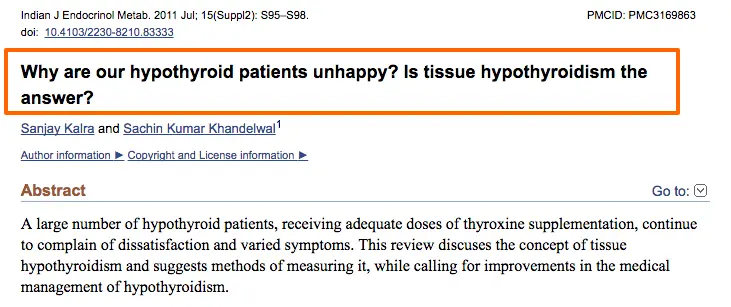
This condition is known as tissue-level hypothyroidism (2).

study outlining the definition of tissue level hypothyroidism

Tissue-level hypothyroidism may explain why there is widespread dissatisfaction with standard thyroid treatment and standard thyroid replacement therapy with Levothyroxine or Synthroid

It turns out that there are many patients currently being treated with thyroid hormone and yet they still have all of the symptoms of hypothyroidism, including chronic pain, hair loss, weight gain, and weight loss resistance. 

So what is tissue-level hypothyroidism and how does it cause these symptoms?

Tissue level hypothyroidism is the idea that you as the patient might have “normal” blood levels of thyroid hormone but due to a number of factors (including inflammation, weight gain, medications, chronic illness, etc.), that thyroid hormone can’t get into the cells to do its job. 

So it remains outside of the cell in the bloodstream making it look like your thyroid function is fine but in reality that thyroid hormone is almost inactive. 

This is also known as thyroid resistance and it is probably one of the most commonly missed thyroid conditions due to how thyroid diseases are diagnosed. 

Standard laboratory tests can only measure what is happening in the bloodstream. 

But…

When it comes to thyroid hormone, we don’t care what’s happening in the bloodstream because thyroid hormone has to get into cells to do its job. 

Thyroid hormone is active when it travels through the cell membrane and directly attaches to the nucleus to what’s known as a nuclear receptor (3).

shop thyroid support supplements that can help you get back to feeling 100% again

From there it directly changes your DNA, in a process called genetic transcription, and causes an increase in metabolism, changes in proteins, and an increase in oxygen consumption (4).

Pretty cool, right?

This means that in order to properly check if thyroid hormone is working, we really need to look at both the blood levels of thyroid hormone and markers to see if it is actually working in the cell. 

One of the best ways to do this is by looking at the complete thyroid blood panel

Bottom line: It’s possible for you to have “normal” levels of thyroid hormone floating around in your blood but that hormone is only active IF it can get inside your cells and turn on genetic transcription and change your DNA. Some patients have “normal” blood levels but that hormone can’t get into the cells to do its job – this is known as tissue-level hypothyroidism. 

The Link Between Fibromyalgia, Chronic Pain, and Hypothyroidism

Chronic pain and Fibromyalgia frequently accompany each other, however, no one seems to understand the exact connection.

But, if you look at the symptoms of Fibromyalgia and Hypothyroidism side by side you begin to see something very interesting:

Fibromyalgia and Hypothyroidism present with almost the exact same symptoms…

There are several studies to show this (which we will go over below) but first I want to talk about a researcher named Dr. Lowe who put this all together for us.

He linked tissue-level hypothyroidism as one of the main causes of Fibromyalgia. And he did this through a concept known as ‘deductively formulated theory‘.

This method of problem-solving takes all of the competing theories that cause disease and, by the use of mathematical analysis, pumps out the hypothesis that is most likely to be correct (this is the same logic that Albert Einstein used to come up with his hypotheses, like the theory of relativity (5)).

Not only did he link the two conditions together he also showed us how to effectively treat and even reverse Fibromyalgia and chronic pain symptoms through various research studies and even case studies.

Through his research, he found that the majority of patients who have fibromyalgia either have undiagnosed hypothyroidism or are inadequately treated with LT4-containing medications. 

His research showed that in order for patients to have complete remission of their pain most of them needed the active form of thyroid hormone known as T3. 

This can be assessed through routine blood work but it is not often ordered by most physicians. 

For this reason, you may need to specifically ask your doctor to check your free T3, total T3, and reverse T3 levels in order to accurately assess if your body has sufficient cellular thyroid hormone available. 

As a quick primer: 

T4 is the inactive thyroid hormone that must be converted to T3 to become active <—- This is what most Doctors prescribe for patients

T3 is the active thyroid hormone that turns on genetic transcription, increases metabolism, and helps thyroid patients feel better <—- Most Doctors do not prescribe this medication but many patients with chronic pain and fibromyalgia may need it

Dr. Lowe’s data showed that approximately 2/3 of patients improved on Natural Desiccated Thyroid Hormone (Medications like Armour thyroid and NP Thyroid) and another 1/3 required higher doses of T3-only therapy (Liothyronine or sustained release T3) to get symptomatic improvement. 

While thyroid hormone that contains T3 (triiodothyronine) was very important to treating and reversing fibromyalgia, it wasn’t the only therapy required to get complete remission. 

We will go over the rest of the treatment below, but first, let’s talk about some of the symptoms you might be experiencing if you have tissue-level hypothyroidism. 

Symptoms of Tissue-level Hypothyroidism & Fibromyalgia

As I mentioned previously blood tests are not 100% accurate in diagnosing hypothyroidism which leads to many undiagnosed and/or mismanaged patients. 

It turns out that using the combination of symptoms in combination with blood tests makes diagnosis much more reliable. 

Before the widespread use of TSH testing most patients were diagnosed by symptoms alone and their medication was also titrated based on their symptoms.

While there are hundreds of symptoms of hypothyroidism there are a few that remain very constant among patients who share both fibromyalgia and hypothyroidism which we will go over below: 

#1. Chronic Fatigue

This is the kind of fatigue that is debilitating. The kind of fatigue that keeps you from doing normal activities like household chores or going out. 

Patients frequently tell me that after they go out to do something simple like shopping they are almost bed-bound for 1-2 days.

Chronic fatigue is both a symptom of hypothyroidism and fibromyalgia, but how are they connected?

2 ways:

Thyroid hormone is involved in the production of Dopamine.

Dopamine helps your body to determine how much energy it is going to use and low levels have been associated with obesity (6).

If you have low levels of thyroid hormone you will have low levels of Dopamine which will result in the symptom of Chronic Fatigue.

Thyroid hormone helps your body convert Tyrosine to Dopamine, Norepinephrine, and Epinephrine.

You may know some of these hormones as adrenaline (7) which helps to set the metabolism of your body and is required for the “fight or flight” response.

The second way hypothyroidism causes fatigue is through decreased consumption of oxygen and thus decreased production of ATP. 

ATP is created in the mitochondria of your cells, if you have low production of ATP you will have the subjective symptom of fatigue. 

Thyroid hormone is involved in the metabolism of oxygen and oxygen consumption is required for proper ATP production.

#2. Weight Gain, Weight Loss Resistance & Inability to Lose Weight

Does it feel like you are constantly gaining weight, despite eating healthy or even exercising?

Many hypothyroid patients and fibromyalgia patients have difficulty with weight loss even though many of them are already restricting calories and exercising frequently. 

This isn’t a normal condition and it can be mediated through low levels of thyroid hormone in the body.

Under normal circumstances, thyroid hormone helps your body burn fat by increasing the effectiveness of lipolytic enzymes (8)(enzymes that break down fat).

When thyroid hormone is low, these enzymes are also low resulting in the inability to break down fat molecules – making it almost impossible to lose weight.

(Thyroid hormone increases enzymes that help you burn fat and when thyroid levels are low your cholesterol increases and your metabolism will slow down)

In addition, thyroid hormone is involved in mediating your basal metabolic rate or resting energy expenditure (9).

In other words, thyroid hormone helps regulate your metabolism. 

Patients with hypothyroidism frequently feel like their metabolism is damaged and may gain weight even when eating 1200-1500 calories per day (sometimes even less).

In order to fix this metabolic damage thyroid hormone must be replaced.

#3. Hair Loss

Many patients with fibromyalgia have symptoms of hair loss and/or hair thinning.

It is well known that thyroid hormone is required for both hair growth and proper pigmentation (10).

Now hypothyroidism isn’t the only cause of hair loss but it is definitely one of the more common causes. 

Chronic stress itself can lead to hair loss and let’s face it: having fibromyalgia is stressful. 

But hypothyroidism is still a leading cause.

Not only that but low thyroid hormone leads to low stomach acid which leads to nutrient deficiencies that make hair growth even more difficult. 

Deficiencies in zinc, B12, and iron cause both hair loss and are made worse by hypothyroidism. 

(Low thyroid hormone leads to hair loss by itself but also leads to deficiencies of nutrients required for hair growth – it’s a double whammy)

Just realize that replacing these nutrient deficiencies is a necessary and important part of reducing symptoms of both fibromyalgia and hypothyroidism. 

#4. Muscle Tension, Trigger Points & Muscular Pain

Tender points in the muscles are common in fibromyalgia. 

These tender points are caused by abnormal contractions in the muscular tissue that stays contracted over long periods of time causing changes in the fascia and potentiating pain. 

In order to relieve the pain, the tissue MUST relax, and in order for muscular tissue to contract, there must be enough energy in the form of ATP. 

Remember that thyroid hormone is required for proper ATP production?

In order for muscles to relax your body must produce ATP (11)(the energy currency in your body).

What you may not realize is that contracting your muscles does not use energy, it’s the relaxation portion that requires energy. 

Consider this as an example:

When someone dies all of their muscles contract and they become “stiff”, this is known as rigor mortis (12).

The reason for this contraction is a lack of energy production.

The same thing is happening (to a smaller degree) in certain muscles in patients with chronic pain, fibromyalgia, and hypothyroidism. 

This inability to relax your muscles results in trigger point formation and muscle tension/pain (13).

Treating these trigger points and tender points is required for the relief of pain and we will go over that below. 

#5. Delayed Relaxation Phase of Deep Tendon Reflexes

This symptom you may not even realize you have, but it can be a VERY sensitive marker for diagnosing tissue-level hypothyroidism.

When tissue levels of thyroid are low it results in the inability of your muscles to relax quickly which causes a slow relaxation phase when checking deep tendon reflexes (14).

Your reflexes have been tested whether you realize it or not:

Testing of the deep tendon reflexes happens when your Doctor hits your knee with his reflex hammer and your knee automatically “jumps”.

Patients with a low amount of thyroid hormone in their tissues have a slower response to the relaxation portion when this reflex is tested (15).  

This can be easily tested and there are even machines to help with the diagnosis.

How to Treat & Reverse Fibromyalgia & Hypothyroidism:

These recommendations come from treating many patients with chronic pain, fibromyalgia, and hypothyroidism. 

You can see an example of a case study in a patient with chronic pain who had a complete resolution in her symptoms, lost 40+ pounds, and reversed her diabetes here.

This treatment works (provided your symptoms are due to hypothyroidism) and has the potential to help many patients if done correctly.

For the best results make sure to follow each of the recommendations below – doing just one or two of them will not lead to long-lasting, significant results. 

Step #1: Get on the right type and dose of thyroid medication

For most patients, this means using some form of T3 thyroid medication. 

The majority of patients are already on T4-only medication (such as Synthroid, levothyroxine, or Tirosint) but in order to ensure that tissues are getting enough thyroid hormone, you will need T3 added to your regimen.

If you have a diagnosis of hypothyroidism you can follow these steps:

  • Add T3 (in the form of liothyronine or cytomel) to your existing medication – you can ask your provider for this medication (this is probably the easiest way to get T3)
  • Switch from levothyroxine to NDT —> This may be difficult but some providers are willing to do it. Make sure you follow this dosing guide if switching
  • Temporarily (or permanently) switch to T3-only medication <— This will be the most difficult to get but probably the most effective

If you don’t have a diagnosis of hypothyroidism then I recommend these steps:

Step #2: Exercise to tolerance

The important part of this step is to find the maximum that you can tolerate and exercise to that point. 

This will vary depending on your energy level, your weight, and your metabolism.

If you can only exercise for 5-10 minutes once per week, then that’s fine. On the other hand, if you can tolerate 20-30 minutes several times per week then you should do that. 

Focus on taking your body to its limits and exhausting the targeted muscle group of both glycogen and energy.

This can be done most efficiently by utilizing the idea of high-intensity interval training or high-intensity strength training (16).

Both exercises provide benefits over the traditional “cardio” type workouts where you sit on the treadmill for 45-60 minutes a few times per week.

The more intense your workout the better it is for muscular tissue, energy levels, and hormones.

It also provides a boost to weight loss.

Step #3: Eat a real, whole food, nutritious diet

Diet is an important part of treatment and the basics should include real, whole, and nutritious food.

The macromolecule breakdown of your diet should be tailored to your body, your activity level, and other specific medical problems you may have.

Real whole food diets include diets like whole30, the paleo diet, and even nutritional ketosis.

You can find more information about how to pick your diet in these posts:

If you are new to the idea of changing up your diet take it slow but use the recommendations in the articles above to help get you started.

Changing your diet will be required for optimal health.

Step #4: Manage muscular tension with these recommendations

As we discussed previously treating and “releasing” the tender points seen in fibromyalgia and chronic pain are required to reduce symptoms. 

Treating these tender points involves several therapies but universally some sort of mechanical force will be required to get rid of them.

I recommend and have used all of the following therapies for patients with fibromyalgia:

  • Manual massage (17) <—- This can be a deep tissue massage or medical massage.
  • Vibration therapy including handheld vibratory devices designed for musculoskeletal tension or whole-body vibration machines (18).
  • Trigger point injection therapy <— studies have shown (19) injection therapy to provide significant relief to pressure and pain points.
  • Myofascial release (20) and other soft tissue techniques.

Studies have shown (21) that various types of massages improve the quality of life in patients with fibromyalgia. 

How To Tell If It's Really Your Thyroid: Get My Hypothyroid Symptoms Checklist

Get the PDF. Check off your symptoms. Find out in 60 seconds if it's your thyroid (or something else).

Whatever you decide to do just make sure you remain consistent with the therapy while doing the other treatment recommendations.

Step #5: Replace nutritional deficiencies

Most people nowadays have some vitamin and nutrient deficiencies as a result of chronic stress and poor nutritional diet. 

Replacing these nutrient deficiencies is a vital part of the healing process and in most cases is required to thrive.

Hypothyroid patients (and fibromyalgia) are susceptible to certain nutrient deficiencies that may potentiate chronic pain and fatigue.

For instance, studies have shown (22) that fibromyalgia patients tend to have a low mineral content via hair analysis. 

You can read more about the list of nutrients that hypothyroid patients need to function optimally here.

Below I will also go over the most important nutrients required for energy and to reduce pain & inflammation:

  • B complex vitamins <—- B vitamins (specifically B6 and B12) are required for proper energy production and replacing them may improve energy levels and reduce fatigue. When replacing vitamin B12 make sure to consider B12 shots if you have issues with absorption. 
  • Zinc & Selenium <—- Zinc reduces inflammation and is required for proper immunity, it also helps boost T4 to T3 conversion and helps the thyroid function optimally.
  • Iron <—- Iron deficiency leads to hair loss, decreased energy, and even shortness of breath. Low levels are seen in patients with hypothyroidism, but be careful when supplementing not to get “too much”. You can follow iron storage in your body by assessing your ferritin level. 

Bottom line: Replacing nutrient deficiencies is a necessary part of recovering from chronic pain and fibromyalgia. Make sure to target your nutrient replacement to targeted deficiencies based on lab tests.

Conclusion

What’s the main takeaway here?

If you are suffering from chronic pain or fibromyalgia, and you also have hypothyroidism, then there may be a connection between the two. 

Due to how hypothyroidism is managed, however, your physician may not be aware of this connection and you may not receive adequate treatment. 

It appears that chronic pain can be made worse by low levels of circulating thyroid hormone. 

The treatment for this condition is to use thyroid medications that contain both the active T3 and the inactive T4 hormones. 

To ensure that you are getting enough thyroid hormone you need to get a full thyroid lab panel and look specifically at the concentrations of free thyroid hormone in your blood. 

Once you have this data you can then determine how to proceed with treatment!

In addition to using thyroid medication, you’ll also want to focus on repleting any lost nutrients, using a proper exercise routine and on eating a healthy and nutritious diet

All of these things, when combined, may help to relieve your pain. 

Now I want to hear from you: 

Are you suffering from chronic pain and/or fibromyalgia? 

Have you been able to overcome your symptoms?

Do you also have hypothyroidism?

Let us know what worked (and what didn’t work) for you so we can further the cause and help as many people as possible. 

Leave your comments or questions below! 

Scientific References

#1. https://www.ncbi.nlm.nih.gov/pubmed/24435355

#2. https://www.ncbi.nlm.nih.gov/pmc/articles/PMC3169863/

#3. https://www.ncbi.nlm.nih.gov/pmc/articles/PMC329808/

#4. https://www.ncbi.nlm.nih.gov/pmc/articles/PMC329808/?page=1

#5. https://www.ncbi.nlm.nih.gov/pubmed/365000

#6. https://www.ncbi.nlm.nih.gov/pubmed/22833718

#7. https://www.ncbi.nlm.nih.gov/pubmed/28077337

#8. http://www.ncbi.nlm.nih.gov/pubmed/3335609

#9. https://www.ncbi.nlm.nih.gov/pubmed/9100583

#10. http://www.ncbi.nlm.nih.gov/pubmed/18728176

#11. https://www.ncbi.nlm.nih.gov/pmc/articles/PMC3360099/

#12. https://www.ncbi.nlm.nih.gov/pmc/articles/PMC1393748/

#13. https://www.ncbi.nlm.nih.gov/pmc/articles/PMC3440564/

#14. http://www.ncbi.nlm.nih.gov/pmc/articles/PMC2492977/

#15. https://www.ncbi.nlm.nih.gov/pmc/articles/PMC2466474/?page=1

#16. https://www.ncbi.nlm.nih.gov/pmc/articles/PMC2991639/

#17. https://www.ncbi.nlm.nih.gov/pubmed/25457196

#18. https://www.ncbi.nlm.nih.gov/pmc/articles/PMC4553315/

#19. https://www.ncbi.nlm.nih.gov/pubmed/16454721

#20. https://www.ncbi.nlm.nih.gov/pubmed/25603749

#21. https://www.ncbi.nlm.nih.gov/pubmed/25457196

#22. https://www.ncbi.nlm.nih.gov/pmc/articles/PMC3192333/

is your chronic pain from your thyroid
Dr. Westin Childs

Dr. Westin Childs, D.O.

Thyroid specialist and supplement formulator

I left traditional clinical practice to work on thyroid problems full time. I research and write everything on this site myself, and I formulate the supplements I recommend, now used by more than 100,000 thyroid patients. You can read why I do this if you want the longer story.

P.S. Here is how I can help you right now:

Follow along:

303 thoughts on “The Connection Between Chronic Pain and Hypothyroidism”

  1. I have been fighting Hashimotos and Fibro for 3 years now. You are on to something for sure. I figured that same thing out and told my doctor my theory. I am on T3 only. My problem however is due to an extreme case of Hashitoxicosis, I am limited to how much T3 I can take. I take a METHAMIZOL to block my thyroid from producing but it doesn’t stop it entirely. I still have fibro-flares of extreme muscle pain when I encounter triggers … Mainly STRESS… and also when I cycle hypo to hyper my joints are affected. The brain fog, fatigue, and emotional symptoms have just become a way of life for me with no relief. Would you have any insite into my unusual case?

  2. Hello and thank you Dr Childs! I’ve been diagnosed hypothyroid but my Drs won’t treat me because I’m still in the “normal” range on blood tests. My latest issue is horrible pain in my hip joint and thigh. The joint hurts after only mild activity and if I stand too long or walk too much I become unable to move without severe pain. I recently had a hip x-ray which shows lucency and osteophytic spurring on the acetabulum and femoral head. I also had a similar issue in my shoulder joint but that never had an x-ray.
    Is it possible these are related?
    Thanks,
    Theresa

  3. I have fibromyalgia.l, diagnosed in 2006. For the past two years it has been getting worse and new symptoms have appeared. I show every characteristic of hypothyroidism. Yet all my blood work comes back normal. My Endo is worthless. She believes lab results are black and white. She recently diagnosed me with secondary hyperparathyroidism. The reason was because one of the blood tests fell one point out of range. She blamed it on the fact that I had gastric bypass. If I didn’t have gastric bypass 19 years ago and have felt fine up until now I would have accepted the diagnosis. However I simply can not. I have gone to at least 20 doctors this year. I know something is wrong yet they have all made me feel like a hypochondriac. I feel like I am in a no win situation with these doctors.

    • Hey Carrie,

      It might be time to look outside of the traditional insurance model to get better care, all conventionally trained doctors will look at you the exact same way and that is a huge part of the problem.

  4. I have been diagnosed with Hashimoto’s recently, although I think I’ve had it for years. My doctors finally decided to have an antibody test done and it came back positive. I have fibromyalgia, spinal stenosis and other disc problems causing chronic pain. I just started NDT at 1/4 grain and I feel like my body is flaring up from it (pain all over) although I haven’t noticed an increase in heart rate. I should add that a lot of my symptoms before starting NDT are hyperthyroid ones, such as a fast resting heart rate (99), sweating alternating with cold, insomnia, etc. I do not feel much fatigue either, like a lot of hypothyroid people. My free T4 and T3 were at the lowest normal and my Reverse T3 was at 12. My hair is falling out more and more every day and I’ve gained about 10 pounds but that’s probably due to inactivity. My question is whether this dose is too low start out on and when should I increase it? How do I know if NDT is adversely affecting me or if my body sees it as a “foreign substance” and produces more antibodies? Also, I will be starting low dose naltrexone soon to help with all of the above once I get the thyroid meds sorted out. Thanks for any help you can give with this.

    • Hey Kate,

      Your case is quite complex, I would recommend you seek out a provider who understands your situation to help you further.

  5. I have all those symptoms, my doc tells me it’s just diabetes though and refuses to check for anything else. I recently showed an abnormal thyroid blood test and he rechecked it and said it was fine, but I’m not getting better so what do I do ? Most doc’s don’t take medicare and medicaid and that’s the 2 insurances that I have. I want someone who heals holistically without all the pills cause they have such bad side effects and I’ve already felt that. What do I do?

      • What kind of doctor do I need to see and I will do that, because I always keep my weight within 5 pounds and it’s still climbing it went from 160 to 230 without me changing eating or routine and that’s not normal. Thank you for letting me know that’s what I need to do, that helps more than you know. Thanks, Peggy Driscoll

        • No problem! Unfortunately, there is no specific Doctor that learns this stuff in residency meaning they have to teach themselves this info which can make them somewhat difficult to find.

  6. I am 56 yo female. I have struggled most of my life with weight. Even tho i have been plant based almost no oil..processed…salt or sugar i have still been gaining weight. My basil temp runs about 95 to 96. My pulse around 55. My cholesterol numbers high but recently started coming down with addition of magnesium oil. My bp spikes at times. In feb my tsp had gone from 3 to 4 in 6 mo. My free t3 was 2.4 and free t4 also normal. I have started adding lugols iodine and vit c..atp co factor..selenium. i also inconsistantly take b12.i have read i should take 1/2 to 1 tsp of Real salt to help with iodine detox. What are your thoughts on this?

  7. What is a functional medicine dr and how do I find one? I am Canadian and live in Brighton, Ontario, which is near Toronto.

  8. Dr Westin, my name is Ken. I was undiagnosed with Lyme for twenty years due to unreliable bloodtests. I found a LLMD and received pulsed abx treatment in 2015. I was still left with muscular skeletal issues. I found I was iodine deficient after consuming higher level of iodine foods and water while on vacation in the Gulf side of florida. It sent me into an extreme hypothyroid condition. I started taking I/O PLUS IODINE supplement in march 2015. It helped some but I found I have severe trigger points in all areas of my body. I’ve been told I have chronic fatigue, fibromyalgia, MS and chronic lyme. I have studied my fascia release and made good progress with release. I am considering switching to Lugol’s iodine supplement and also using it transdermally in baths along with dead sea salt.
    I have not been able to convince my doctors to give me minimum dosage of Armour thyroid. My thyroid results fall within normal ranges so they refuse to treat.what do you recommend I do to get someone to give me treatment ?

  9. I was diagnosed with Chronic Fatigue at the age of 20. I have had the symptoms of fibromyalgia since age 18 but was not diagnosed until I was in my 30’s. I figured out on my own that I was hypothyroid also. Submitting a list of symptoms to my PCP, I persuaded him to put me on Synthroid even though my TSH was normal. Within 2 weeks, my eyebrows began to grow back in. Synthroid helped some of my symptoms, but not all. Eventually, my TSH levels tested low, even though I had been on Synthroid for years. I asked for Armour Thyroid and have been on it for about 6 years now. I am a bit more sensitive to it and can tell when my levels are slightly high, causing palpitations, and I back off of it for a day or two. My fatigue, dry skin and fibro pain are fairly constant to severe. I don’t have a regular exercise schedule, though I used to, due to multiple injuries (I don’t know if it’s related, but I seem to injure myself more easily than most.) But with fibro, movement is essential to keep the stiffness at bay. I eat whole foods, but do crave sweets and that is something I continually have to work on. I am now 65, having lived most of my life with this. Both of my daughters have many of the same symptoms (ages 28 and 41) and the same difficulty get diagnosis or treatment. The oldest just started on Armour Thyroid last month and has noticed increased energy, less dry skin and less hair loss. (Her TSH was normal also). Thank you for the information, which I found helpful.

    • Hey Diane,

      No problem, I am glad you found it helpful. Getting treatment can be tough and complete remission may not be possible, but even a reduction in symptoms by 50% I would call a win and a step in the right direction.

  10. I have been dealing with thyroid problems for over half my life. Hyper to hypo & then Hoshimotos eventually having a total thyroid lobectomy. I suffer from severe, chronic pain. Sitting, walking, lying down is all very painful. Some days worse then others. I am always tired since I am not able to sleep well because of the pain. I am at a loss.

    • Hey Margie,

      You should have your T3 (total and free T3) levels evaluated and treated if low, many patients in your situation have low T3 syndrome at least contributing to their symptoms.

  11. I have been diagnosed with fibromyalgia and thyroid I can not get anyone in my area to help me. I have such sensitivity to touch I feel bruised on the sides of my legs and arms and the pain in between my shoulders and my hips is terrible. I have been told that my thyroid levels are perfect taking Levothyroxine. I have been dealing with this for 13 years with no help other than being told if I had gastric bypass it would help. I do not believe this is all do to weight issues and if I did not hurt all the time I could exercise. Please tell me what to do next I am completely discouraged

    • Hey Ann,

      If you have absolutely no one to work with then you need to change what is in your ability to control: diet, lifestyle and stress. If you haven’t already adopted a whole food diet (paleo, whole30, nutritional ketosis, etc.) then that would be your first step. You can also then try various supplements as well. If you’ve done these things and still have no improvement then unfortunately your only option will be to find someone who can help you by searching outside of the insurance model (Doctors who focus on hormones generally are cash only).

  12. Thank you so much for all of the information. In have Fibromyalgia, In remission from Rheumatoid Arthritis, Diabetes, Osteoporosis in one hip, Osteoarthritis, Chronic Fatigue Syndrome and over weight. I recently started Nature Throid although my levels were normal my doctor felt because of the CFS I needed to take it. She also tested my harmone levels and started me on Biote Pellets. I do have more energy and, although I had Sinus Surgery, feel like I can breathe better. Also find I sleep better. I am having trouble losing weight but hopeful that will improve. I also have SVT and PVC’s. Hoping to get off of some of my meds eventually. Once, again thank you for the information.

    • Hey Eleanor,

      Thanks for the comment and I hope you found it helpful. I’m glad to see you are improving on the new medication, hopefully the improvement continues.

  13. Hi, love the long, concise article. One thing I’m wondering…if a person uses Selenium, and other important minerals, might they not improve conversion and not need added T3? And when I added T3 my hair loss drastically increased, although I felt so much better. Not sure where to go from here…

    • Hey Brenda,

      You can boost T4 to T3 conversion somewhat with the use of zinc and selenium, but that won’t necessarily work for everyone.

      Some hair loss after starting T3 often occurs but is usually transient and self limited.

  14. I felt terrible on synthroid. After lots of research, i wanted to try cytomel (t3) only and my GP agreed to let me try. I felt tons better. However she sent me to a endocrinologist and she refused to just do t3 and has me on a low dose of cytomel. I feel bad again. I can’t find a doctor who will treat me with t3 only and /or find one that will prescribe more than 5mg BID. Where can I find a dr. That will treat with t3 only and in correct dose? I have also recently heard about low dose naltrxone and really want to know more about that.

    • Hey Heather,

      The unfortunate truth is that most thyroid patients are being mismanaged and could potentially feel so much better if they found someone to help manage their condition. In my experience it’s almost impossible to find someone to correctly manage your thyroid inside the insurance model (the reason has to do with the standard of care). You’ll have much better luck if you pay cash because these physicians are less bound by time and standard of care. LDN is also great and something I prescribe frequently, you can learn more about it here: https://www.restartmed.com/naltrexone-weight-loss/

  15. Hi
    I am so glad that I found your write up. I found out almost 4 years ago that I have non toxic goiter . Been trying to get my regular doctor to send me to a specialist . He only does what he said is the require testing . A few months ago I found out I have fibromalgia , also Iodine deficient. and I am gulten sensetive as well. My SHGB is 37 ,TSH 1.68 Free T4 1.0 Reverse T3 30% T4 8.1 Vit D 25 . Sorry that I am unable to post the rest of my results . But I want to Thank you for most eye opening information.

    Sincerely ,Tama

  16. Hi Dr Child’s. I was wondering if I could get a copy of this article sent to me so that I could print it to bring to my doctor. I was diagnosed with Fibro 20 years ago and have hypothyroidism for which I am on a low dose of Levothyroxine. I have not had extensive thyroid testing done. My hair is falling out at an alarming rate. My skin is very dry, my nails are dry and brittle. I have been taking 10,000 mcg of Biotin daily for several years to no avail. I hope it will be possible to get a copy of this article as I think it will be very helpful. Hope to hear from you soon.

    Sincerely,
    Sandra

    • Hey Sandra,

      You can print the article from your browser or use the share function and more options to find a printer friendly version.

  17. I have been on thyroid medicine for 22 years. About 5 years ago, I started having muscle pain, especially when trying to sleep. It has gotten so bad that I can only sleep 3 or 4 hours a night. I am fine when I’m up and active, but even to sit and rest causes my muscles to start aching. I take .88 mcg of Levoxl daily. I am having difficulty losing weight which was never a problem before. I thought you article was very informative. What exactly should I ask my Dr. To prescribe for me? Would it be something in addition to the Levoxl or a completely different medication.

    • Hey Shawn,

      It’s important to consider that muscle pain isn’t always from hypothyroidism (that is just one of the causes). It’s fairly easy to experiment to determine if your muscle pain is from your thyroid as increasing your dose should reduce the pain. If it doesn’t then it may be related to something else.

  18. I have just been diagnosed with hashimoto’s and had a scan that showed my thyroid is not working at all, my antibodies are 1374, my TSH is 17.73, Free T4 is 0.97 and T3 is 0.1, I am currently on 137 synthroid, any ideas on what I can do to help me out? I am always tired, have a hard time concentrating and in constant pain. Thank You

    • Hey Cindy,

      I would start with the recommendations in this post, you can also find lots of information about supplements, diet, etc. on my blog for further help.

  19. Very enlightening info you’re providing!

    My thyroiditis was diagnosed in 2006. Much later I learned it’s autoimmune. I also have severe multi-chemical sensitivities.

    What do you think of basal body temperature testing first thing in the morning and then other times in the day to gauge hypo status? I have been feeling super-hypo recently.

    I’ve long had low basal body temperature, blood pressure, no reflexes in the doctors knee test, horizontally ridged and thin fingernails, one eyebrow is shorter on one side, inflammation, mood issues, plus countless other classic hashi symptoms that, over the years, have come and gone, based on lifestyle, ETC. I’ve tried T4, Armour and WP. Not all at the same time, you know 🙂

    Having been to countless doctors of all types over the years, I’m wondering if DIY basal temp moderating could be helpful. If so, how? Having read and followed directions carefully, my results range 94-96 degrees in the morning. Six hours or so later it goes up around .8 degrees. Recently, it has reached above 96.9.

    Thanks again for the amazing blog as mainstream healthcare is unable to sufficiently test all of us with autoimmune disease.

  20. Hello. Thank you for all above info. Been suffering from chronic muscle pain 18 mths. Hashimoto and multiple nodules 5 yrs but bloodwork always said “within range”. I’ve fought with Drs that maybe this isn’t my normal range as we had no beginning numbers to work from. Nodule was stable until past yr and it started growing fast. Just had half thyroid removed with egg size nodule. Bloodwork CH50 high for 2 yrs. Most recent Parathyroid Hormone H 77. Thyroid Peroxidase Antibodies H 23. Calcium increasing over past 6 months 9.5 to 9.8 to now 10.2.
    Total protein 7.0 6 mths ago to H 7.9 now. T3 free 2.9 T4 Free .91 TSH 1.564 vitamin D 29 C4 was H 46
    Any guidance appreciated .

    • Hey Denise,

      The best thing you can do is find someone who understands what I’m discussing on this page to help you further, fighting with physicians is never recommended and will only lead to frustration on both sides.

  21. I have had fibromyalgia for over 25 years I was managing it very well until a nodule was found on my thyroid in December of 2016 they removed my thyroid and put me on the levothroxine 175mcg once a day in the morning what you have. Said about t3 is so true I have been so sick they just say my hormones are taking along time to up take in my body it is not working it feels like my fibro has come on with a vengeance like 10 times worse my life is terrible I am always sick and in pain I do like my Dr but does not know what to do he is Dr Noel Stibor at Star Valley medical center in Afton Wyo 83110 I am 66 years of age I am afraid I will lose this connection so I can show it to him please help me I need your help or send your info on email and can show him please I so agree with what you are saying help me . Pam Fournier

  22. Finally, a doctor who understands.! was diagnosed with hypothyroidism and fibromyalgia simultaneously 25 years ago when I was in my early 40’s. I have always believed there is a connection between the two. I’ve seen many doctors over the years who have prescribed different strengths of Synthroid. I have also taken Armour Thyroid .I have frequent lab test (TSH) as well as T3 and T4. I never ” feel” as if I’m on the correct dose.. The FM is wicked and I suffer with migraines daily. My endocrinologist is near retirement and I have asked for a complete blood panel over the years and he assures me that my dosage of Synthroid at the time is appropriate. I have tried to press the matter but I get brushed off. What should I do? I have no quality of life.. I’m so sick and exhausted all the time.. The body pain can be unbearable and the migraines rule my life.. I am desperate and about to give up on ever having someone connect the dots.. Please help me.. Help all who suffer from this debilitating illness..

    • Hey Kathy,

      The best thing you can do is look for a provider who understands thyroid function. Usually PCP’s and endocrinologists are not the ones to prescribe the right type and dose of medication, and yet patients tend to stick with these providers despite how they feel.

  23. I had my thyroid removed last year with a positive cancer (papillary) biopsy. I am exhausted beyond belief. Used to be extremely energetic.I am currently taking Fluoxetine for my fybro and 137 Levothiroxine . My calves cramp when going a 6 step stair I am forgetful and gained weight. What can i do

    • Hey Monica,

      I would start with the recommendations listed in this article, if those aren’t working then I would have a complete thyroid panel.

  24. My naturopath has had me on Naturethroid 2 grains for the past 6 years. Before that I went through a “thyroid storm” on Synthroid from a conventional medicine doctor. Currently, Naturethroid @ 2 grains keeps the TSH around 1.0 which, for the most part, makes me feel best. I am also on “Meyer’s cocktail” IV therapy plus glutathione, plus a vitamin D shot (I don’t have a gallbladder any more). My TPO was 1300 two years ago. I was prescribed low-dose Natrexone @ 2 mg which brought the level down to 638. Eliminating raw milk brought the TPO 380. I have routine complete thyroid labs studies (in order to refill the Naturethroid Rx). Currently, he is mainly concerned about the TPO not coming down lower because all the other thyroid labs are optimal. I have many food allergies, sensitivities, and intolerances: all grains, eggs (white and yolk), nightshade vegetables, beans, milk products, and most nuts, so you cansee my diet is very limited. I keep track of my calories (carbs, fats, proteins, salt, and sugar) and water intake and exercise on a daily basis. Calorie intake is around 1100 per day. Walking for 40 minutes is about the only strenuous exercise I can do. I have more pain if I carry something while walking. I used to run 5 miles every other day for 12 years in my 20s, but at age 32, fatigue, aches and pains, and HUGE weight gain started abruptly. I had to stop running, and then I became pregnant. After the C-section, I was even more exhausted. I thought it was from the anesthesia still in my body. There was no mention of my TSH being out of wack at that time. I wasn’t diagnosed with Hashimoto’s until age 54 when my hair started falling out, facial skin peeling, chest pains/heart palpitations, MRSA boils resistant to all antibiotics, and could not get warm even on 106-degree+ temperatures during the Arizona summers. A conventional medicine doctor put me on Trimethoprim and sulfamethoxazole which did nothing for the boils. I would sit in the car with the windows rolled up to try to get warm. I had a woman lawyer set up a will for me because I thought I was dying. She recommended a naturopathic doctor. He put me through eight UBI treatments which cleared up the boils, and all my lab results returned negative for Staph thereafter. I was free of boils after fighting these for two years. I was no longer having long bouts of bronchitis. Even though that naturopathic doctor moved to Canada, I now see my current naturopath in Scottsdale. I have been to myofascial release therapists and this only provides temporary relief. My daughter’s roommate at ASU in Tempe is from India. She recommended that I drink heated coconut milk with 1 Tbs turmeric, 1/2 tsp grated ginger root, 1/4 tsp Saigon cinnamon, 3 peppercorns for the muscle pains…or to prevent colds and flu. This has given me pain relief on a daily basis. I have to drink it every day,otherwise the pain flares up in the wrists, upper arms, neck, shoulders, posterior ribs, and hip sockets. I don’t add honey because I am afraid of developing diabetes (family history). I recently read an article about lectins contributing to inflammation, but lectins are in everything. I haven’t talked with my naturopathic physician about this article yet. It seems the highest levels of lectins are in the same foods I have allergies/sensitivities to. I must be lectin resistant.

    I await your comments.

  25. Dr. Childs,
    This is extremely interesting information. I am wondering if all of this still applies if the thyroid has been completely removed, as well as having gastric bypass: BPD with a duodenal switch. How effective will this therapy work with the malnutrition aspect? Exactly what kind of physician should be seen if the Endocrinologist doesn’t take this seriously?
    Thank you very much for this info and for any additional information you can provide for these specific hurdles.

    • Hey Skye,

      Yes, the same principles apply if you are post thyroidectomy. Most of the time you will have to look outside of the insurance model if you want to get the type of care you see on this blog.

  26. Thank you for this article. I have taken levothyroxine for many many years and have al the issues you talk about. I asked a dr.once if I could have fibromyalgia and he laughed. I have serious skeletal issues and always have had, especially my spine. Drs blame all my pain and fatigue ln my lower back. That would not cause pain in my hands, arms, fingers, ankles, elbows and knees. I am on prolia for severe osteoporosis and I have osteoarthritis and possibly RA, but does not show on blood test, only high sedimentation rate. I am 5’5″ weigh 121 lbs. and will be 72 next month. What can I do to encourage my drs to check this out. I am too tired to ever go anywhere or do anything in mu house. My pain is constant, usually several things hurtin at once. Always my back and the rest varies. Hope you can reply. Thank you for teaching me this information.
    –Sharon L. Childs

    • Hey Sharon,

      You won’t be able to convince your current set of doctors to change how they think/evaluate you. Instead, it may be worth it to try and seek out someone who is more willing to listen and act on your concerns.

  27. I was diagnosed with hypothyroidism in ’96 and with Fibromyalgia in 2002. I had always felt that these two somehow had something to do with each other. I’m also bipolar and feel like this goes along with Fibro and thyroid issues. I’d like to know your thoughts on this. I thought I heard the doctor say something about depression in his interview but for some reason I can’t get that video to play again.
    Thank you

    • Hey Angie,

      Yes, there is a connection between thyroid hormone and bipolar disorder (and depression). Several studies have shown treatment with T4 even with normal thyroid doses to be effective. In addition studies have also shown that high doses of T3 only help patients with bipolard disorder even when they are resistant to multiple medications: https://www.ncbi.nlm.nih.gov/pubmed/19215985

  28. I do not have a thyroid, anymore, due to thyroid cancer. I am hoping to be two years, cancer free, very soon. I have extremely sore feet, ankles, and wrists, shoulders, and that’s about it. My feet are high arched…but I go to bed with foot pain and wake up with foot pain. I also am short a parathyroid, due to my surgery, so I suffer with very low calcium. Any tips? I am on my feet a lot, at my job and I also have a toddler, son. I enjoyed your article.

  29. I had a gastric bypass in 1982 that had to be revised 3 separate times. I lost 135# but now have regained and lost several times and now am about 50# from my highest weight again and can’t seem to lose no matter what. I have large fluid retention issues taking large doses of diuretics even though my BP has always been normal or even low before put on the diuretics. I can gain or lose 10-14# withing a day or 2. After trying to blame my weight on my thyroid..which was always “normal”, I gave up on that and low and behold I found myself hypothyroid with weight gain, hair loss, low energy. I was place on Levothyroxine for several years and in the course of moving and trying to find new MDs in new areas, I had run out of meds and had been off of them for sometime before we got settled and found a new MD. My TSH was now “normal” as was my Free T4 so was kept off the meds. I still have symptoms of hair thinning and weight gain and weightloss resistance but MD will not do anything else. I also have secondary hyperparathyroism with levels in the high 300s but changes frequently. I also have a “cyst” on my thyroid found by ultrasound so was sent to and Endo. He does a few tests and says see you in 6 months but I get no answers. I finally questioned him more on my last visit and he became VERY defensive, almost nasty, stating this was his specialty and if I didn’t like him to have my primary follow me. I also have very low vitatmin D levels and am on RX dosages of D3 and calcitracin, as well as B12 shots depending on how low can be as often as weekly. These are being attributed to the gastric bypass which I know will affect those levels. I have also had to have 2 separate rounds of iron infusions with Hgb in the 8.0 range and has been stable for last couple years but now in down to the low level of normal with a drop of over 3 gms in past year. I feel like I am being ignored by the MDs and don’t know what to do. We live in a small town now so not a lot of options for treatment. Nothing is being done about the thyroid cyst and when I question the Endo about it he gets nasty telling me that is his specialty and who am I to criticize him. I was only asking a question. I am so frustrated, especially with the weight gain and inability to lose. I have done just about every diet known includng weight watchers in which I lost 60# but I was quite ill with diarrhea for 3 months and ended up with pancreatitis which is now resolved and the whole 60# came right back on. Where do I go from here??? How can I go about finding an Endo that will answer my questions and DO something?

  30. I no longer have my thyroid due to possible cancer. I am currently taking 88 synthroid. I also have fibromyalgia and arthritis in all joints. Can they still check all those levels since I no longer have a thyroid?

    • Hey Jennifer,

      Yes, you can still check all of the recommended tests even if your thyroid has been removed.

  31. Where can I find a list or name of a provider who will agree to do these tests and treat with the treatments you describe?
    I’ve searched for years – requested full thyroid panels and been denied when my TSH comes back “normal”.
    I was diagnosed with FM over a decade ago, the flare ups, pain, and body seizes are unbearable at times.
    I just want to be treated but cannot find a provider….please help.

  32. This is excellent information about fibromyalgia/hypothyroidism. I want to tell everyone…Don’t give up on finding a doctor to help you! After 10 years and 8 different doctors I have finally found one who goes beyond the conventional (TSH) testing, listens to my symptoms and has helped my tremendously. Look for a thyroid specialist … you will most likely have to travel some distance and pay out of pocket. Hope this helps!

  33. I am going to my doctor today to get my blood work back on my thyroid. I am currently taking 250mcg of synthroid daily and I have no relief from the pain. Was DC with fibro years ago but I have yet to find a doctor willing to treat the pain. I am taking a copy of this to my doctor and I am going to ask her to run these tests. I pray that I find some relief so I can get on with my life

  34. Dear Dr. Child’s,
    I just tried sending you an email. It was lengthy but basically asked if you are still treating patient in Arizona? If so, how can I get an appointment?
    I’m suffering horribly & the docs I’ve seen are doing nothing for my Hypothyroid. I just found out after waiting 2mths to get my lab results my levels were high & this so-called office person had no idea what TSH even meant! The doc was out 6 weeks for paternity leave as his wife had their first child yet he had no one available to see patients while gone!
    My symptoms are a combo of chronic pain from 2 injuries plus recently diagnosed with OSTEOARTHRITIS & Hypothyroid just within this last year!
    Before accidents I was extremely healthy never sick quite active & worked out always. Since really
    relocation from AZ to Kennewick WA it’s all fallen down around me!
    Please please Dr. Child’s is there anyway you can fit me in as a patient? I can’t go through much more
    especially zero sleep which has me beyond exhausted all the time! I need your help!

  35. Thank you so much for this info I have been looking hard at this for awhile now. I asked my Dr. If I should use iodine supplement and she laughed and said no and would not do a full thyroid exam. I have fibro and hypothyroid and a fatty liver I have not worked in 20 years. I am not sure about liquid iron but will try. Thank you again could you tell us what kind of Dr. we need to go to for help with this.Mine thinks all is fine ivam losding my hair bad, I go out once every two weeks, I have no energy can barely get through the grocery store, I stopped pain meds and muscle relaxers after 20 years my husband is ill and I need to help him but well you get the picture. Sorry I talk too much but help would be most greatful. Debbie

  36. I have a question. I don’t have a thyroid anymore. Had to be taken out because it quit working and I had spots of cancer on it. I need to lose weight and it is impossible for me and I have fibromyalgia and hypothyroidism. Can I be helped?? I have a lot of health problems and I’m just 48yrs OLD. I’ve done CNA work for 25yrs and have done a lot of lifting and now I have 3 pinched nerves, arthritis, stenosis, 2 Ruptured discs in my lower back, spurs in my hip and arthritis. So, I need to lose weight bad… You have any suggestions? Thank you,Pam C.

    • Hi Pam,

      Yes, you can definitely be helped, but how much is always unknown. Patients in your current standing generally get at least 50% improvement in pain when following my recommendations (some more than others obviously and some less).

  37. What if I have a dr who treats my thyroid well, have taken NDT or T3 only (to reduce RT3) but my SHB is always very high. It’s around 169. Dr says this is due to using HRT for surgical menopause. Does that mean despite good thyroid levels that it’s just not being used correctly? How can I fix this? I am chronically exhausted and have fibromyalgia with 16/18 trigger points confirmed. ANy advice appreciated. I do have good levels of B12, omega 3, d3, etc.

      • So if SHBG is increased from taking thyroid hormones and estrogen and you need both – does that mean the thyroid never reaches the tissue correctly? Or what is the answer? Do I just ignore high SHBG levels? Have read that testosterone can bring it down but no luck so far. I am replacing all missing/deficient hormones except DHEA.

        • Hi Fig,

          You may need estrogen and thyroid hormone but you don’t want high SHBG because by definition it is binding up your sex hormones.

          • Please tell me what needs to be done then. I don’t know how to reduce SHBG. Surgical menopause necessitates HRT and Hashimoto’s results in thyroid replacement. My drs do not advise on how to lower SHBG but I don’t seem to process thyroid replacement as normal people do. Thanks.

  38. Hello i found this to be very helpful. i have suffered chronic left pectorial muscle pain since Jan 2012, left trapaizoid pain same time length. A combination of different types of headaches to include migraines 31+ yrs siezure disorder diagnosed in 2008. Lipoma brain tumor diagnosed in 1998. Depression 2000, suicidal 1988, bi- polar, multiple personalities, audio, visual hallucinations, insominia, brown circles around eyes, puffy bags under eyes, sore throat, raspy voice swollen vocal cords, sores and swollen tongue. lack of appitite, no sex drive, no desire for self hygiene. i also have muscle cramps and swollen joints. I have been diagnosed with sub clinical hypothyroidism but since my labs came back normal in dec 2017. the Doc wont listen when i tell them that something is wrong. Please advise

  39. My wife has had thyroid cancer and therefore her thyroids removed. She takes levothyroxine but after 5 years is still struggling with fibromyalgia and constant pain. She is always cold and her energy levels seem to be at an all time low. She is on a surprisingly low level of thyroxine considering her weight, height, age etc of only 100ug. Her GP has said that this amount keeps her within a normal range but I feel her deterioration is profound. What would you suggest is these circumstances please? Your post is extremely interesting and quite the eye opener. Many thanks.

    • Hi Stephan,

      The single best thing you can do for her is to find a practitioner who shares these philosophies. The conventional approach will be insufficient to help her.

  40. My name is Danielle,
    I have been diagnosed with Hypothyroidism for over 32 years at age 16. About 5 years ago, I had an ultrasound of my thyroid and it was not detected. The Dr. Was unable to find it, no other follow up was done for that.
    I have had chronic pain in my neck, low back and sciatic nerve for about 10 years.
    I have an autoimmune disorder called localized Scleroderma on my back since age 14.
    I was recently diagnosed with Fibromyalgia by my Rhumatologist.
    My thyroid levels have never been consistent.
    I have been on high doses of Levothyroxine for all of these years.
    I am finally being referred to see an Endocrinologist in late May, 2017.
    My chronic pain is debilitating and my only real successes each day are waking up my kids for school and preparing dinner.
    The rest of my time is spent in bed and in great pain and frustration.
    Thanks for any recommendations or advice.
    Danielle ~

  41. It’s like this article was about me! Been on every dose of Levothyroxine and feel awful. Dr refuses to discuss any other med. Devastating fatigue, pain, blurred vision, insomnia, weakness, extreme intolerance to heat, foggy headed, trouble with balance and the list goes on. I virtually have no life and can’t do even the simplest of things.

  42. I have hypothyroidism and I also have fibromyalgia and right now my thyroid is not functioning right I have went from 225mcg to 165mcg my muscles are absolutely killing me right now. They are as hard as a rock but some of them are stretched to far. My muscles feel like they are drying up. My stupid doctor thinks I’m her crazy mind that I want pain pills, I don’t want her stupid pain pills I want her to listen to me and help me find out y my muscles are doing this. Will you plz help me. Where
    do I go to what do I do. She isn a thyroid specialist should I have her to send me to one?

  43. My name is Victoria, I was diagnosed with low Thyroid around 2006, I have been on 15 mg of NDT, 3 x a day for 11 years. I also have low blood pressure, and my skin has been itchy in areas of my back between my shoulder blades, and on my abdomen for about 25 years (it was diagnosed as neurodermatitis) and nothing helps stop the itching feeling. My skin has turned brown in those areas caused by constant scratching. I have also had an itchy scalp and oily dandruff ever since I was a child. I am stating all of these symptoms because they might be related to Low thyroid.

    These might be other possible symptoms of Low thyroid:

    I started getting hip pain about 20 years ago, but it is not arthritis (I was diagnosed as bursitis – with an unknown cause). I got severe tendonitis in my forearms 7 years ago, which took a year to recover from, but re-occurance happens when I use my arms in strenuous circumstances. Just last year new symptoms started: pain in my sacrum, and lumbar region, and my hip pain was worse. And while walking around several hours a day, while on vacation, my lower legs started to hurt. I thought it was shin splints, but then both my entire lower legs began to hurt, calves, tendons, everything, and there is a lot of pain at night just from the pressure of the mattress on my legs. Physical therapy has not improved the situation.

    I want to get my thyroid function tested again, according to your protocol series of tests. Every time I get a thyroid test (which is not the series that you recommend – just a simple thyroid level test) to see if I need to change the formula, my thyroid level looks normal, but my symptoms say otherwise. My question is – before I get tested should I get off of the NDT(for a week or more?) and the bio-identical estrogen and progesterone, in order to get an accurate reading, or should the tests be taken with those supplements in my system?

    • You should look into adrenal insufficiency… especially when you say you have areas of brown skin and pain in your sacrum and lumbar region (SI pain is commonly associated with adrenal issues). I had similar and did lots of PT which didn’t help, once low adrenals were addressed, have not had any more SI pain. Low blood pressure is another low adrenal symptom as are fatigue, nausea, weight loss, etc.

      I don’t see why you would get off your thyroid meds (dangerous) or hormones to test levels. You just usually skip the morning NDT dose before the blood draw and take it after labs are drawn.

      • I had my adrenals tested and the test said they were fine. Is there also a different series of tests that we need to do for adrenals that the doctors don’t know about?

        • Did you do the saliva testing for adrenals? Where you collect 5 samples in one day and mail in for analysis? That’s the gold standard for adrenal testing vs a single cortisol level done via bloodwork. Many alternative drs or D.O.s will order this for you. Or you can order yourself online.

          • Hi Fig,

            Salivary testing for cortisol is not the gold standard. Urinary testing for cortisol and cortisone metabolites is much more effective at establishing cortisol levels in the body. You also have to understand that a normal cortisol test, even a normal urinary cortisol test doesn’t indicate that your cortisol status is indeed normal. There are receptor level issues that can cause resistance syndromes which are virtually undetectable with our current assays.

          • Dr. Westin, you didn’t answer my previous question about your recommended series of tests for hypothyroid.

            I take NDT for low thyroid. My question is – before I get tested should I get off of the NDT(for a day, a week or more?) and do I also need to get off the bio-identical estrogen and progesterone I am currently taking, in order to get an accurate test readings, or should the tests be taken with those medications in my system?

            Also, for the the adrenal test, if none of the tests are accurate, not even the urinary one that you suggest, then how do know what protocol to use to treat low adrenals?

          • I already know the tests that you recommend. My question is, do I get off of my NDT medication before taking the tests, and if so, for how long do I need to be off of NDT before taking the tests?

          • There is no need to stop taking your medication prior to your tests, but when you take your thyroid hormone in relation to those tests depends on your physician. In some cases I like to see the tests 2 hours after taking medication and in other situations I like to see a 24 hour result – it just depends.

  44. How is the testing done? Multiple times/day? I haven’t heard of urine testing for cortisol. Please tell me more about resistance syndromes…. I am intrigued…

  45. I had to have my thryoid radiated in 1981. My physicians always just put me on t4 only explaining that if those levels are normal than it is converting correctly. I still have all systems compounded with fibromyalgia digestive issues such as gastroparesis. Horrible weight gain and dealing with severe fatigue. I switched over to natural thyroid thinking that it was the way to get all my correct hormones. I took a dive. Now my thyroid is pronounced and undergoing cat scan. And went back on synthetic thyroid. Tired of hearing all of this is in my head. It is not normal to feel like this I am determined to get to the bottom of it. Very interested in your information.

  46. I have asked my Dr to check my T3 and Dr refuses. I have been on thyroid replacement for over 30 years and 1year ago was finally diagnosed with fibromyalgia. I have a service dog and no energy to do the things that I love. Kathleen

    • Hi Kathleen,

      Perhaps you can seek out another physician more willing to work with you.

  47. Hi Dr Child’s. Read your article and it is so me. I am hypo and also have fibromyalgia. My question to you is I try and take the Nature Thyroid meds but then my whole body is in worse pain. I tried 5 different thyroid meds and they do the same thing to me. What causes all of the pain with thyroid meds. When I first took it for 1 month I was fine then it just got worse. All over body pain and fatigue. I work with a Naturopath Dr also just trying different things. I also have side effects taking vitamins also. Help please

  48. I have debilitating fatigue and muscle pain. My endo has tried twice to add cytomel to my synthroid and I have not been able to tolerate it. My heart races and I have emotional (almost feel crazy) reactions. How else can I get my ft3 levels up to relieve my symptoms??

  49. I have had hypothyroidism for almost 20 years and changed over to natural thyroid medication because I was just getting worse. Since changing over last Christmas, I have noticed dramatic change and improved fatigue and have stabilised gut problems by being really restrictive in my diet. But I have noticed increasing muscle tightness, aching and joint pain. I did have RT3 out of balance but I think that came good after changing over. I was just about to see a specialist about this increasing muscle stiffness and pain and am curious about treatment options, any additional testing and management approaches. My iron has always been good, I take iodine, selenium (Brazil nuts), zinc and vitamin C (or I end up with continuous colds). I have been endeavouring to up the exercise but end up with chronic muscle overtightness, trigger points everywhere and still decreasing flexibility. I roll muscles, use tennis ball for trigger points and do a variety of stretches but I just cant seem to get improvement. Would appreciate any suggestions or explanations.

Comments are closed.

0