
- Free T4 doesn't need to be in a magic normal range. What matters is whether your T4 is converting into active T3 properly. High T4 with low T3 signals a conversion problem that needs fixing.
- If you're on T4-only medication and your free T4 is high but you still feel terrible, look at your reverse T3 and free T3 levels. Your body may be converting T4 into reverse T3 instead of the active hormone you need.
- Adding T3 medication drops your free T4 level, and that's actually a good sign it's working. Don't panic if your T4 falls below normal once you start T3. Your symptoms matter more than lab numbers.
- Absorption of thyroid medication is huge and often overlooked. If your T4 level doesn't rise after increasing your dose, switch to Tirosint or use 50mcg tablets of levothyroxine, which have fewer inactive ingredients that block absorption.
- Test your complete thyroid panel including TSH, free T3, free T4, reverse T3, and antibodies together. Looking at only one or two values gives you an incomplete picture that leads doctors to miss thyroid problems entirely.
Chances are VERY high that your Free T4 level isn’t actually normal even though it may be in the “normal range”.
Most people tend to blow off their Free T4 level because it isn’t the ‘free and active’ hormone, especially when compared to free T3.
But that is a big mistake!
Free T4 still has a story to tell and it’s not something you want to miss out on.
For instance, your Free T4 level can actually help you determine how efficient your thyroid is converting T4 into T3 and may explain why you have a “low” TSH when you still feel terrible.
In this article, I’m going to help you understand what your Free T4 level means and teach you how to determine if it is really in the “normal range”…
Is your Free T4 Normal & Optimal?
Unfortunately, it isn’t quite that easy…
There is no magic number that your Free T4 level needs to be in order for you to suddenly start feeling amazing.
It is just one small piece of a larger puzzle that is your entire health.
I’ve seen patients with low Free T4 levels who are asymptomatic, and I’ve seen patients with Free T4 levels in the upper 1/3 range who feel terrible.
Like other tests in medicine, it needs to be used in conjunction with your symptoms and other lab tests.
But before we get into the nitty-gritty, let’s talk about how to look at your own Free T4 level…
Consider the example below:
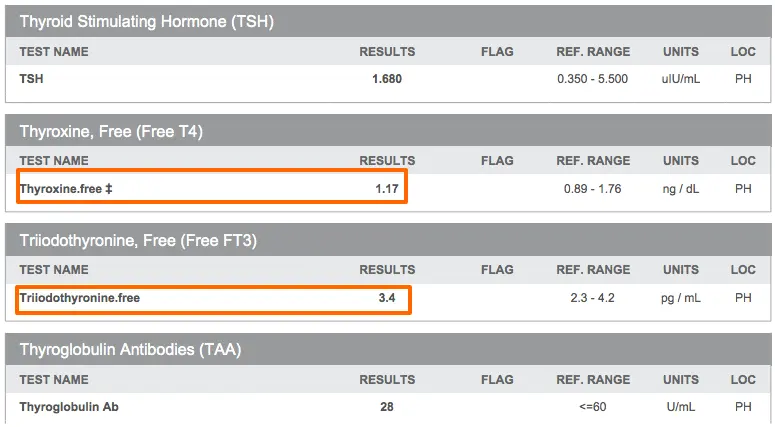
Going off of lab tests alone you can see that this patient’s Free T4 levels fall within the lower 1/3 of the reference range. (Ignore her other lab values, we will get into those later)
If your Doctor were to see these labs he would absolutely tell you that your lab tests were “normal”, but is that really the case?
In treating hundreds of patients I can tell you honestly that MOST patients feel significantly better when their Free T4 levels are towards the higher range, usually in the upper half.
And this correlates well with newer studies that show that patients with hypothyroidism require a higher free T4 to achieve a normal TSH (1).
This study showed that, while treating patients with hypothyroidism, the goal should be to obtain a free thyroxine level in the upper part of the reference range.
If you recall from basic Thyroid physiology, your Free T4 levels act as a reservoir or pool to draw upon when your body needs to create the active thyroid hormone Free T3.
So when thinking logically about this…
As your free T4 level increases, the more you can draw upon this pool to create the active hormone… right?
It turns out that this is the way that most Doctors (and subsequently patients) think about the thyroid.
Unfortunately, for at least 15% of the population, it isn’t true (2).
And that leaves us with a big problem:
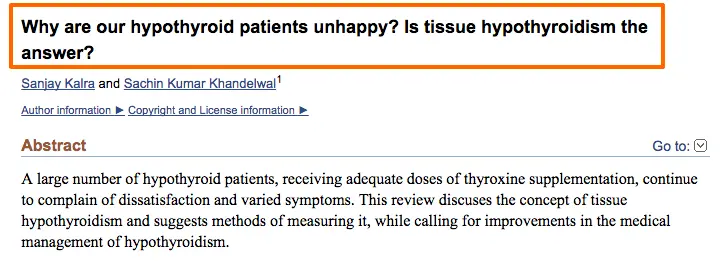
We are basing treatment recommendations on an incomplete picture and we are wondering why our thyroid patients feel terrible and are so unhappy (3).
Your Free T4 and Thyroid Function
Here’s where things can get a little bit tricky, and why many Doctors may actually be telling you that your thyroid is “fine” when it really isn’t.
I just said that high levels of Free T4 are good, right?
But that isn’t always the case.
Refer back to what I said before about Free T4 being a reservoir for Free T3.
What if you AREN’T converting T4 to T3? (What if your body isn’t utilizing that T4 correctly?).
Well, let’s just think about this logically again using this example:
I want you to think about your thyroid as a Dam.
Under normal circumstances, a Dam acts to hold back A LOT of water and only lets a certain amount of water go through in a controlled fashion.
In this example, the pool of water behind the dam is your Free T4 level, and the water going through is your Free T3.
What will happen to the system if you suddenly can’t let any water through?
It all backs up, and the water behind the Dam continues to grow and grow.
Well…
The same thing happens to your Free T4 level when there is a ‘kink’ in the system.
But instead of water, your Free T4 level goes higher and higher…
Do you see the problem now?
A kink in the conversion process may actually cause your Free T4 levels to RISE and make you think that your thyroid function is normal when the exact opposite is happening.
As your Free T4 level rises (because it can’t convert to Free T3) it shows up as high levels of Free T4 in the serum. These high levels of Free T4 actually act to suppress your TSH (because your pituitary doesn’t have the same deiodinases as the rest of the body(4)).
So your lab tests may look something like this:
- High Free T4
- Low TSH
- Low total T3 and free T3
- High reverse T3
Meanwhile, you are feeling terrible with every hypothyroid symptom in the book.
Does this scenario sound familiar?
Don’t worry…
If it is happening to you we are going to discuss how to correctly diagnose it, but first, we need to talk about how T4 can be beneficial.
Does Your T4 Even Matter?
It’s easy to think that T4 doesn’t mean much because it isn’t the active thyroid hormone in your body.
And it makes sense, but there is still some value in using and testing for it.
First:
T4 levels give you an idea about how you are converting T4 into T3.
In keeping with the analogy I described above, your T4 level helps you to understand how your body is processing your T4 and T3 thyroid hormones (5).
High levels of T4 with correspondingly low levels of T3 may indicate that you need to focus on improving your T4 to T3 conversion.
You can read more about how to naturally increase your T3 levels and thus thyroid conversion here.
Second:
T4 levels can give you an idea if you are properly absorbing thyroid hormone (6).
Another huge benefit of testing your T4 levels is understanding if your body is actually absorbing your thyroid hormone.
Naturally, your T4 levels should increase as you take thyroid hormone (though it is important to realize that your symptoms may not improve just because your T4 level increases).
By testing your T4 level both before and after you start thyroid hormone (this only applies to T4 only thyroid medication) you can get a rough idea as to whether or not you are absorbing the medication.
Believe it or not, absorption of thyroid hormone is a big deal and something that is frequently missed (7).
You can learn more about how to properly take your thyroid medication in this post which explains how changing the time of day you take your thyroid medication can actually improve thyroid absorption and thyroid function.
Third:
T4 levels can help you determine if you need to focus on improving your thyroid conversion vs increasing thyroid hormone production.
This is primarily helpful for patients who know that they have hypothyroidism, but whose physician is unwilling to treat them with thyroid hormone.
Most physicians are willing to at least test both TSH and free T4 levels which can give you, as the patient, a lot of information.
If you know that your T4 and T3 levels are low then you can focus on taking supplements and taking action to increase your thyroid hormone production.
On the other hand, if your T4 levels are high and your T3 levels are low – you as the patient can focus on taking supplements designed to boost T4 to T3 conversion.

Over 13 nutrients are involved in thyroid hormone production (8) and some supplements may help thyroid conversion.
It turns out that many patients (even those on thyroid hormone) have deficiencies in some of these nutrients which may lead to poor thyroid hormone production and conversion.
If you have Hashimoto’s then the supplements you should consider using are slightly different from the list above and you can find more information on which supplements are best for autoimmune thyroiditis here.
Fourth:
T4 levels can help you determine if you would benefit from adding T3 thyroid medication.
Let’s say that you are taking T4-only thyroid medication (like Synthroid) and your T4 level is high (so you know you are absorbing it) but your T3 level is still low and you are still having symptoms of hypothyroidism.
Even in the presence of a low reverse T3 (which means you are still converting thyroid hormone ok), this may indicate that you might benefit from the addition of T3 thyroid hormone.
Recall that T3 thyroid hormone is the most powerful thyroid hormone and is responsible for all of the good things that thyroid hormone does in your body.
So remember:
While T4 isn’t the best thyroid test, it can still give you plenty of helpful information – especially if your Doctor isn’t willing to order the complete thyroid panel.
How T4 Changes with Thyroid Medication
Another very important factor is understanding how your free T4 level changes with different types of thyroid hormone.
This is worth mentioning because it isn’t always intuitive and it can lead some patients into thinking that they are not heading in the right direction even though they might be.
T4 on Levothyroxine (Synthroid, generic Levothyroxine, Tirosint)
The way your T4 level changes when taking T4-only thyroid medication is actually quite intuitive.
Assuming you are absorbing enough thyroid hormone, your T4 level should increase as your increase your T4 dose.
Makes sense right?
Sometimes, though, this doesn’t happen and even if it does it doesn’t necessarily mean everything is “all good”.
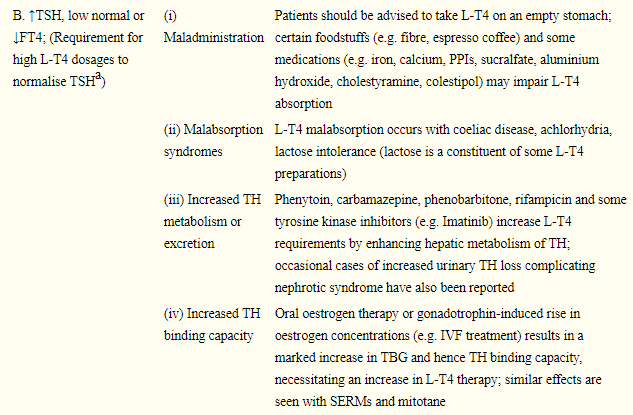
As I mentioned above, your T4 level might NOT raise if your dose isn’t high enough and/or if you aren’t properly absorbing the medication you are taking.
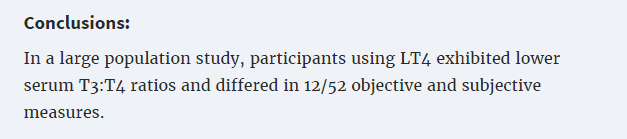
And, even if it does, there are studies showing (9) that patients who take T4-only thyroid medication show lower T3 levels than healthy populations – indicating that many patients just don’t do well on these T4-only thyroid medications.
There are ways that you can improve the function of thyroid hormone if you are taking T4-only thyroid medication and not feeling better:
1) Consider switching to Tirosint.
Tirosint contains 3 inactive ingredients and can help increase the absorption and effectiveness of thyroid hormone.
The case can even be made that you should consider switching over to Tirosint if you are currently taking Synthroid or levothyroxine.
2) Consider switching to 50mcg increments of Levothyroxine
The 50mcg tablet of levothyroxine contains the fewest inactive ingredients out of all of the other Levothyroxine dosages (For example the 100mcg tablet and so on).
Changing your dose from 1, 100mcg tablet of levothyroxine to 2, 50mcg tablets of levothyroxine may help increase absorption and reduce any symptoms you may be having.
3) Consider switching from Levothyroxine to Synthroid or Synthroid to Levothyroxine
While these medications may appear to be the exact same, studies have shown that they are not bioequivalent (10).
What this means is that your body may process them differently which may result in varying thyroid levels.
This is an easy test because all you have to do is switch from taking one medication to the other and you may notice a difference.
- Bottom line: If you are taking T4-only thyroid medication (Synthroid, Levothyroxine, Levoxyl) then your free T4 level should increase. If it doesn’t then you may have an absorption issue and you may benefit from switching to Tirosint.
T4 with NDT (Armour, WP thyroid, Naturethroid)
The way that T4 changes with NDT aren’t as straightforward as it is with T4-only medications.
Any thyroid medication that contains T3 thyroid hormone, at high enough doses, will generally cause your free T4 level to drop (11).
The degree of how much it lowers largely depends on the dose of T3 you are taking.

The higher the dose of T3 the lower your free T4 will go.
The reason for this has to do with how T3 and T4 influence pituitary function.
T3 thyroid hormone is 3-4 times more potent at lowering the TSH (12) than T4 is alone.
As your TSH lowers your body produces less T4 thyroid hormone by itself (and becomes more reliant upon medications to supplement thyroid hormone levels).
As long as you have a functioning thyroid gland (assuming it isn’t taken out or destroyed by radioactive ablation) then your thyroid will be producing SOME T4 and T3 even if you are taking thyroid medication.
But as you increase the dose of T3 you are taking then that amount your thyroid produces drops.
This will usually result in a decrease in your Free T4 level.
As you know NDT (natural desiccated thyroid) contains mostly T4 and some T3.
This ratio is close to 80% T4 and 20% T3, which means that the medication is still mostly T4 thyroid hormone.
But even that small amount of T3 is enough to shoot up T3 levels and drop T4 levels in the body.
One mistake I see patients (and doctors make) is increasing the NDT dose while trying to get to some mythical and optimal T4 level in the serum.
In some ways this is futile, as you increase your NDT dose it will drive down your T4 level in the serum which leads to higher and higher levels of NDT.
This can actually backfire and result in high levels of reverse T3 and very high levels of free T3.
If you are taking 4+ grains of NDT and still experiencing symptoms of hypothyroidism, then this may be happening inside your body.
- Bottom line: With lower doses of NDT your free T4 level may actually drop somewhat. Higher doses of NDT (greater than 4 grains) will usually cause the free T4 to increase but this isn’t necessarily helpful.
T4 with T3 Medications Like Cytomel and Liothyronine
This is where things get really interesting.
Taking T3-only thyroid medication like Cytomel or liothyronine will cause your free T4 to drop below the “normal” range completely and even flag as low.
This has to do with the fact that you are suppressing the TSH with the T3 and so endogenous production of T4 decreased dramatically.
Taking T3-only thyroid medication also causes reverse T3 levels to drop too low levels as well (this is usually a good thing).
To recap what happens on T3-only thyroid medication:
- TSH level falls
- Free T3 level increases
- Free T4 level decreases
- Reverse T3 level drops
What you really need to get out of all of this is the fact that your free T4 levels do not necessarily need to be in some magical “optimal” range for you to feel good.
Basing your treatment on these ranges may lead to suboptimal treatment as you chase all the wrong results.
Instead of laser focusing on your free T4, make sure that you look at your T4 in context with other thyroid lab tests.
- Bottom line: Taking T3-only thyroid medication will dramatically reduce your free T4 level and this isn’t necessarily a bad thing.
Symptoms of Low T4 & T3
Low free T3 and free T4 levels may indicate low thyroid function, but they may also indicate a condition known as euthyroid sick syndrome or low T3 syndrome.
This condition is very similar to hypothyroidism, but some patients with it may not experience symptoms, whereas all patients with hypothyroidism will experience symptoms.
If you suffer from low T3 and/or low T4 then you are also very likely to experience all of the symptoms of hypothyroidism, but with some other slight changes.
Symptoms of low T3 and low T4 include:
- Constant fatigue
- Reduced response to T4-only thyroid medications
- Weight gain (even while on thyroid medication)
- Low resting heart rate
- Low body temperature
Many of these symptoms result from low T3 levels directly or from the reduced conversion of T4 to T3.
Patients who are taking thyroid medication (who still have low T4 levels) may experience many of these symptoms (13) which should spark a further investigation by your physician.
If you fall into that category make sure that you properly evaluate how effective your conversion is, and how effective your native thyroid hormone production is (use examples above).
Why you need the Complete Thyroid Panel
Because testing for thyroid hormone levels isn’t always intuitive, it’s very important that each time you check your thyroid levels you obtain a complete panel.
While not all lab tests may be necessary EACH and every time you get blood work, it’s still a good idea to get all of these tests to create baseline values that you can compare further testing to.
Let’s go back to the initial example we used at the beginning of this post:
At first glance, you may be thinking that this patient is completely normal.
Her TSH is in the 1-2 range, her Free T3 is in the mid-range, and it’s only her Free T4 that is in the low range.
But she is actually quite hypothyroid and I know this because I treated her!
It isn’t until you order her Reverse T3 level that you finally get a better picture as to what is happening…

Once you see and understand her Reverse T3 level you begin to understand her thyroid physiology.
You see:
The only reason her Free T3 levels even look moderately normal is that her Reverse T3 levels are inappropriately blocking any Free T3 that she has.
Remember that Reverse T3 and Free T3 both compete for cellular binding (14).
If you take into account her high Reverse T3 level, her Free T3 level suddenly starts to make more sense.
In her case, her Free T4 level never got into the ‘optimal high’ range, but you can definitely tell that it is also inappropriately high for her, given that she can barely convert T4 to T3.
The bottom line:
You need a Complete Thyroid Panel if you want to have ANY idea of what is going on with your thyroid.
That means you need the following tests:
- TSH
- Free T3
- Free T4
- Reverse T3
- Total T3
- Thyroid Antibodies
- Sex hormone-binding globulin
And remember:
Just ordering the tests isn’t going to be enough.
You need to make sure that you and your Doctor know how to actually interpret them so you don’t fall victim to the trap I just showed you above.
Conclusion + Recap
Your Free T4 levels can give you amazing insight into how well your Thyroid is functioning, but you need to remember that they are only a small piece of an even larger puzzle.
It is possible that your Free T4 levels may be inappropriately elevated and that isn’t always a good thing.
If your Free T4 levels are high and you still feel terrible, then you need to make sure you are also checking your Free T3 levels and your Reverse T3 levels.
Using these lab values together, in combination with your symptoms, will help you to understand how well your thyroid is functioning.
So what should your T4 levels be?
If you aren’t taking thyroid hormone, then optimal levels are generally in the upper 50% of the reference range.
If you are already taking thyroid hormone then the upper 50% of the reference range doesn’t always hold, instead, you need to be focusing on other factors.
Now I want to hear from you:
Are your free T4 levels high but you still feel terrible?
Is your doctor willing to order the RIGHT tests?
What has helped you feel better in this situation?
Leave your comments or questions below!
Scientific References
#1. https://www.ncbi.nlm.nih.gov/pubmed/18753096
#2. https://www.ncbi.nlm.nih.gov/pubmed/19190113
#3. http://www.ncbi.nlm.nih.gov/pmc/articles/PMC3169863/
#4. https://www.ncbi.nlm.nih.gov/pubmed/6595194
#5. https://www.ncbi.nlm.nih.gov/pmc/articles/PMC3887425/
#6. https://www.ncbi.nlm.nih.gov/pmc/articles/PMC3857600/
#7. https://www.ncbi.nlm.nih.gov/pubmed/28153426
#8. https://www.ncbi.nlm.nih.gov/books/NBK285550/
#9. https://academic.oup.com/jcem/article-lookup/doi/10.1210/jc.2016-2660
#10. https://www.ncbi.nlm.nih.gov/pmc/articles/PMC3565118/
#11. https://www.ncbi.nlm.nih.gov/pmc/articles/PMC5873391/
#12. https://www.ncbi.nlm.nih.gov/pubmed/402379
#13. https://www.ncbi.nlm.nih.gov/pubmed/29381251
#14. https://www.ncbi.nlm.nih.gov/pmc/articles/PMC5869352/



Hi have hipothyroid from 11 years ago, I’m 36 and start having problems with mi hormones, my t4 1.2
T3 3.5 and tsh 0.01
Hey Aida,
You’ll want to check your reverse T3 levels and sex hormone binding globulin as well.
Hi Dr! I have gained 31 lbs in 10 months and have been unable to lose with diet and exercise. My PCP ordered TSH, FreeT3, and FreeT4 in July which were normal and told me that I was 35 and my metabolism was slowing down. I went back last week & he said my weight gain is abnormal because I continue to gain. I showed him your article and he agreed to order all of the thyroid labs and an ultrasound. So far only the TSH 0.95 (range .30-5), T3 total 144 (range 80-200) and Free T4 1.12 (range .93-1.7) results are in. When the reverse T3, globulin, and other come back, if they are normal how can I trust my PCP will know if there actually is hypothyroidism?
Hey Kali,
You can’t – which is why I generally recommend against using your PCP or endocrinologist for treatment, the single best thing you can do is find someone who is knowledgeable about what is mentioned in this article. Most people end up wasting many years trying to get their PCP or other physicians to treat them in the insurance model instead of looking outside of it for help.
Dr. Child’s,
What other resources would you suggest to help interpret lab results? As you mentioned PCP & Endo’s do not have this skill set. Who would you recommend?
Hi Ginger,
I have many resources and pages on my blog which can help: https://www.restartmed.com/normal-thyroid-levels/
Hi, I have Hashimotos and have ALWAYS been hypo despite being on 4 grains of NDT. My T4 WAS 0.8 Tsh 0.01. I recently started intermittent fasting and in 3 weeks my Free T4 jumped up to 6.4 Which has NEVER happened! So slowly I have been titrated down to 2 grains, which I have only been on for 3 days. I can’t sleep at night, I am NOT tired, I feel crawly like my skin is crawling and I feel like I restless leg syndrome suddenly! I have gained 20 lbs in the last year and CANT seem to lose it despite being on a plant based whole food diet. I am having some heart palpitations but its not too bad. I can’t find a doctor to properly treat me!
Hello.
My TSH is 2.08
T4 is 6.1
T3 is 2.3
All fall into optimal levels however my practioner put me on NP Thyroid to help make me feel better.
Should I take NP thyroid? I started with 1 60mg pill today. I don’t want to alter my thyroid and make me Hyperthyroidism.
I do have dry skin, shedding hair, mood swings.
This has become my life! I was diagnosed last August with Hashimotos Thyroiditis after a nodule biopsy. Since then it has been a nightmare!! Dozens of test & Dr’s all telling me my levels are normal! In the mean time my hair
Is falling out, The fatigue is so bad,I have brain fog, tightness in my throat, severe joint pain ,panic attacks and tingling in my head that brings on the panic attacks. I have recently developed swelling to my right temple. Going for a MRI I just feel like I’m not being heard! I went gluten free back in Oct. it has helped some but .. This has altered my life dramatically. I just want a Dr to know my struggle is real.
Hey Jodiann,
Unfortunately your story is not uncommon! Most doctors have been conditioned to ignore what they cannot explain or what doesn’t fit into the paradigm that they have created.
I am in the hospital now. 33 years old. I had a hypertensive crisis. My TSH came back as 4.91 and my free T4 came back as 0.99. Doctor said it came back fine. I’m having extreme fatigue and weakness upon exertion especially, I’m freezing all of the time, putting my heat up to 78 at home. Just don’t feel good most of the time to be honest. Have high blood pressure, nausea/diarrhea/occasional vomiting. Stomach swelling. Weight gain. I’ve went from 189 to 207. My highest weight ever. What can I do? More tests weren’t offered because he said it was fine.
Hi, Do all of your posts refer to people that have had their Thyroid removed also?
Hey Tracy,
The majority of the information presented here applies to patients with a sluggish thyroid and for those without a thyroid because thyroid physiology doesn’t change in the body, the main thing that changes is how your body gets the thyroid hormone (either endogenously or exogenously).
I feel very tired and have issues with blood pressure being low and blood sugar crashes which make me feel terrible and unable to stand without passing out. My T3 was very high (can’t recall the exact number), T4 was 0.07 and my TSH was 3.3. The doctor said I’m fine and to redo the tests in a few weeks. I asked him to check my prolactin levels as I was treated for high levels before and they were 18.8 which he said was normal. What on earth could be going on?
Hey Jeannie,
Hard to say what’s going on just from those numbers. You will need to look at more than just your thyroid, I would recommend looking at pituitary function as well as insulin and c-peptide.
These are my test results almost exactly!
T4 free 1.1
T3 free 3.5
Rt3 27
Tsh 1.07
Thyroglobulin level 45
I’m having such a hard time finding a local doctor that will work outside the “normal” labs 🙁
Hey Ashely,
Unfortunately you may have trouble finding a doctor in the insurance model who looks at the thyroid correctly. My advice is to find someone outside of that model who can actually help you, the results will be well worth it!
Can you say more about the type of doc you should look for? I have many many symptoms and have had for years, as well as strong family hx of hypothyroidism, but all my tests are “normal” (though not optimal – TSH 1.83, free T4 – 0.84, free T3 – 2.0) and I’m trying to figure out what referral to ask for or what “kind” of doctor to seek out. Thanks.
Hi Kristin,
Sure, I’ve elaborated on what to look for in this post: https://www.restartmed.com/thyroid-doctor/
Greetings,
I am a 61 yr old female having issues with fatigue and weight. I am 5’2′ and currently weigh 195. I have gained 25# in the last 3 years and I exercise lightly. These are my test results from Kaiser in Oct 2015.
T4 FREE Date: 10/24/2015
Value: 1.0 Ref range: 0.8 – 1.5 ng/dL Status: Final
T3 Date: 10/24/2015
Value: 107 Ref range: 58 – 159 ng/dL Status: Final
TSH Date: 10/24/2015
Value: 2.16 Ref range: 0.35 – 4.00 mcIU* Status: Final
CALCIUM Date: 10/24/2015
Value: 9.4 Ref range: 8.5 – 10.7 mg/dL Status: Final
PARATHYROID HORMONE INTACT Date: 10/24/2015
Value: 83* Ref range: 15 – 65 pg/mL Status: Final
Comment:
Pe Interpretation of Intact PTH results should take into account the serum
calcium concentrations and the physiological interplay between these two
elements in the various PTH/Calcium disorders.
The following levels of Intact PTH were determined by Nichols Diagnostics,
using a different assay.
NORMAL RANGE (n=253):
PTH of 15-65 pg/mL with Calcium values ranging from 8.5-10.5 mg/dL
PTH DEPENDENT HYPERCALCEMIA (n=88):
PTH 53-1180 pg/mL with Calcium values ranging from 10.5-16.3 mg/dL
NON-PTH DEPENDENT HYPERCALCEMIA (n=63):
PTH from undetectable to 22 pg/mL with Calcium values ranging from 10.5-17.6
mg/dL
HYPOPARATHYROIDISM (n=8):
PTH from undetectable to 21 pg/mL with Calcium values ranging from 6.3-8.5
mg/dL
Thank you!
Thank you for your help.
Sorry, I can’t interpret your tests unless you are a patient of mine. You should take these to your current doctor for advice or seek out a new one if you aren’t happy with your current treatment.
Sorry, but i don’t get it. The reverse T3 results in Your example aren’t that high (In the range). Why is it You still think it is too high? Did i miss something?
Hey Dirk,
It’s less about the reference range and more about how high it is relative to free T3. It’s the difference between the two that matters, not the actual number.
Hi Dr Childs,
Can you elaborate more regarding how to assess if the Reverse T3 is high relative to the free T3. I know your answer above mentions its more about the difference between the numbers, not the actual numbers, but I have almost identical lab results as your example of the hypothyroid patient (TSH .844, T4 1.17, free T3 3.3, reverse T3 16.4) that on a surface analysis of lab results looks normal.
My doctor read the results the same, everything normal, (Although I’ve gained a significant amount of weight the last few years (30-ish lbs). I’m trying to find a reference to provide to her, so she will take another look at my lab results, and see my T4 may not be converting my T3 well enough, possibly making me hypothyroid.
Hi Marissa,
You are in a patient population which needs to be very carefully assessed prior to treatment. While it may be true that you are indeed slightly hypothyroid at the cellular level, it also might be true that your lab results are an anomaly and your symptoms are due to something else. If that is true then treating you with thyroid medication would do more harm than good. Figuring out where you stand is very important and should be done by a competent physician. I will tell you that most conventional doctors would rather NOT treat in these situations for the reasons stated above. I would also say that most “integrative” physicians would tend to treat in this situation which may result in overtreatment of some patients.
Hi Dr. Childs.
How would one increase their T4 levels? I currently take 32.5 mg Naturethroid (sp?), was taking 97.5 mg WP Thyroid. Had weight gain on the 97.5 mg, lost weight on the 32.5. But blood levels now reflect T3 Free 2.3, T4 Free .7, TSH 1.82. From reading your articles, seems I need a higher T4 level.
I am going to buy your five suggested supplements and see how I feel. I do notice when I take Vit A, Zinc, and Vit E, I have more energy….
I appreciate any insight you can provide regarding the T4 increase.
Anna
Hey Anna,
I don’t really focus on free T4 or T3 levels when treating – blood levels of thyroid hormones don’t really help in understanding what the tissues need and what they are actually getting.
Dr. Childs,
So, according to this article, perhaps I should have the referenced tests ordered? I do believe my medical provider should be able to interpret the results. Do the add’l tests help one figure out what levels the tissue is getting? I’ve noticed more pain throughout my body on the lower nature-throid.
Would you recommend those 5 supplements in the meantime?
Thank you for your response.
Hey Anna,
I can’t say for sure because I don’t know your history. Getting those tests would be a good first place to start, but as I mentioned previously – most providers will probably just look at your results and tell you they are “normal”.
Understandable.
Thank you for such a great website though! Yes, a couple of my providers, one currently and my past PCP, say things are “normal.” But I know differently. Your articles are quite informative and helpful to those who do not understand what is going on.
Thank you again!
Thank you for the kind words and no problem! 🙂
Hi!
I have 3 months ago a radiactive therapy I’m going from t4 free of 2.4 to know .83 and my tsh in .012
My doctor said to wait 3 weeks and re-do the the test.
He is waiting for t4 free going in .70
My question is that I read articles saying this is danger, I start having irregular and long periods, tired, confusions and blow face. why i have to wait for start taking replacement hormones
Hey Sylvia,
I don’t know why your doctor wants you to wait, I would recommend you ask them – they might have a specific reason in your case.
I’d like to know how high free T4 can go, and at what level it can cause problems. TSH is on low end of normal range. I went to the doctor for something else and was surprised by a high T4 level.
If you are not able to answer my question because you can’t interpret results for me, I’d appreciate any links or articles that you think might be helpful.
Thank you!
I just got blood test report.
I agree your points and they help to understand my situation.
But I need your advise to review my case again to give more detail advise.
I got RAI treatment in 2009(I did the subthyroidtomy in 1999 about, but the thyroid gland grew back to the normal size 25gram). I started taking the levthyroxine 88mcg quite stable for a long time for all the number testing TSH, T3, T4 till last year Oct. 2015 my TSH was up to 4.7MIU/L. Doctor decided to adjust my dosage to 100MCG in Jan, 2016. After that, TSH is going down to 0.41 MIU/L in the test of March, 2016 and the free T4 is 1.5ng/Dl. In this month of July 21, 2016, I tested again and the result was 0.458 TSh and 2.03 for free T4. My doctor gone for vacation will come back Aug. 1st. Her partner Dr. talked to me about my Thyroid hormone is little bit high. He asked me alternative back to 88mcg(take 88mcg , next day take 100mcg, I am really not sure this is a good idea or not, looking for the natural way) instead of 100 mcg or take medicine before the meal about 10-15 mins. Then, I will need to test again in August with my regular doctor.
After, I read your article and I really thinking whether is something involve like you mentioned the reverse T3 or other stuffs affecting. Since last year, the house is doing the new construction works. The contractor drives me crazy and not responsible. Therefore I am getting pretty stress about this. I am thinking it might aftect my body metabolism. I just wonder whether you can give me some suggestion about how to maintain in a good happy balance life. Thank you.
Hey Jan,
If you haven’t already I would consider looking into NDT to replace or add to your current dose of T4. Many patients do much better when adding some additional T3.
Hi Dr Childs I did try to message you earlier today but I don’t think it went through. Im one of these people that cant take Liothyronine t3 No matter how low the dose is . High BP chest pains. Before I started T3 I was on 125mg of levothroxine which worked for quite a few months putting t3 up to 5.1 Then I started to get hyper . So I dropped back to 100mg of levo and added t3 . I have now gone back to just 100mg of levo but dont think its going to be enough. What dose would you recommend . as I have a problem converting t4 into.t3.
Last results T4 13.0 (7.0-16) TSH 0.15 (0.3-5.0) T3 4.5 (3.6-6.5) still had a little of the t3 in my system at this stage. Regards Desley.
Hi I have 37 of thyroid UK hypothyroidism symptoms and am trying to convince my gp to trial thyroid meds. My tsh levels r 2.23 my FT3 is 4.9 my FT4 is 10.5 and TPO anti is <1.0 should I continue to try and persuade a trial I'm 53yrs old and feel like 73 please help, they just say I'm depressed!!!
Thanks
Hey Sharonne,
I can’t say because I don’t know your symptoms, labs are only a small part of the picture.
Hi
My symptoms are fatigue, in explained weight gain even though I trudge through an exercise programming 3/4 times weekly, painful calf and thigh muscles, loss of libido,cold all the time even when I’m hot I shiver, constant headaches burning feet memory loss poor concentration, loss of drive, wanting to be alone, nervous, anxiety and lack of confidence to name a few.
Thanks
Hi I messaged earlier but cannot find a copy of my question…..??
All comments are moderated, so they take some time to show up.
Hi, I was diagnosed with hyperthyroidism a month ago due to being over medicated.I recently got my labs done to see if my levels have improved. I was told that my labs were good but my t4 was still high but still in the normal range.I have no thyroid, so I’m confused why if my t4 is high why would it be in the normal range.
Sharonne – August 4, 2016
Hi
My symptoms are fatigue, in explained weight gain even though I trudge through an exercise programming 3/4 times weekly, painful calf and thigh muscles, loss of libido,cold all the time even when I’m hot I shiver, constant headaches burning feet memory loss poor concentration, loss of drive, wanting to be alone, nervous, anxiety and lack of confidence to name a few.
Thanks
Hi docter,
My thyroid result is seems to be normal(tested 2 years back)
FT4 – 1.2 ng/dL
TSH – 0.8 uiU/ml
Yesterday i met an entocronologist to check my thyroid and other hormones, since we are strugling to conceive(9 years of marriage). She did an ultrasound of my thyroid gland and said that there is slight swelling. And prescribed levothyroxin natriy 50 mcg per day.
I have’nt shown her my previous result. But without checking my blood, she prescribed the medicine. Since i have the language issue, i couldn’t ask much to her.
Is it ok to administer this dose??
Hey Nadi,
Unfortunately I can’t answer that question for you. You will need to take it to your physician. All I can say is that hypothyroidism is a very common cause of infertility.
I recently had blood work done as my doctor is suspicious of thyroid issues. For as long as I can remember I have been enemic and constantly battle fatigue. Recently I lost my dad and that has sent me in a downward spiral for depression, but am being treated for that and am feeling better everyday mentally, however this fatigue is just constant. I could sleep 24 hours and still be tired. I am also battling cognition issues, short term memory issues, and focus issues. I cannot seem to retain information as of late – again chalk it up to depression. My weight has been a challenge as well. I used to work out regularly, but did not lose much. I will admit to not eating the best so do need some work there, however when I do diet and exercise I don’t see much of the weight coming off. Here are the recent results of my blood work:
T4, Free = 0.919
TSH = 2.73
Both are at the lower range. My doctor states more tests need to be down and that it appears my thyroid is slightly underactive. Any further insight you can provide? I don’t know much about thyroid activity, my brother has hypoparathyroidism.
Hey Heather,
If someone presents to me with symptoms consistent with hypothyroidism + labs similar to yours I would say the thyroid is not functioning optimally.
Hello,
I had a thyroidectomy about 6 months ago and recently my endo, who I trusted, has left Kaiser. My new doctor checking my levels about every 6 – 8 weeks and adjusting as need be, but they are only looking at TSH and Free T4. Currently my levels are 2.64 for TSH and 1.2 FreeT4. I feel sluggish and have have migraines almost every other day. The last time my headaches were this bad, was when I was undiagnosed with Hashimoto’s. Should I be asking Kaiser to do more tests? It is hard to find what target values are for a person who had their thyroid removed because of Hashimoto’s and not cancer. Before it was removed, I only felt well when TSH was in the low 1s. But Kaiser rarely did any of the tests you mentioned in your article.
Thank you!
Hey KR,
You are certainly welcome to ask for more labs but you will most likely be blown off. If your doctor didn’t order them to begin with then they don’t put priority on the labs themselves and even if you do get them to order the tests they won’t know what to do with them. My recommendation is to find someone who can help you further.
I had a total thyroidectomy over a year ago, they’ve had me on synthroid every since ..100 then 150 and now 137.5 . I have never felt good since this operation and every endo I get referred to says the same thing ‘within range’ so I keep going to others. Why is it none of them so far will even try armour or cytomel with the synthroid? I’m so tired, migraines, muscle aches and pains , swelling in hands feet and eyes ..I’ve begged them to change this medicine. Any ideas on where to begin to find someone that will listen?
Hey Bobbi,
It can be difficult to find someone willing to change medication and listen, the best thing you can do is look outside of the insurance model because all physicians in that model will treat you the same way.
My menstrual period is hyper abundant on days 2 and 3 of menstruation. This lasts a few days and again at 24 days. The worst are the moments where the jet indented leaves. I take levothyroxine 31,5 because if I more I can not sleep well. Since taking t4 I have no overall fatigue or constipation. But I have some tiredness after eating. Because I sleep less deeply and less hours before taking the T4. I sleep about 6 or 7 hours a day. I need a little more sleep in the afternoon. Currently I have tsh T4libre 1.39 and 0.89. Dr. Says I should take more T4 to have the highest T4libre.
Hey V,
Increasing T4 might be worth looking into.
I’m sorry for my previous rambling letter. Here’s a shorter version of what I wrote earlier. On 125 mcg of synthroid, these were my lab results:
TSH-6.45 Reference Range (0.34-5.60)
T4 Free-1.1. Reference Range (0.6-1.1)
So, am I to assume that if I increase my dosage of synthroid to 150 mcg, my TSH will get lower and my T4 Free will get higher than the normal range, thus making me feel like hyperthyroidism? Because that is what I’ve been feeling on higher synthroid dosages even though my TSH is well within the normal range. Thank you.
Hey Frank,
Not necessarily, but maybe – it depends on what “hyperthyroid” symptoms you feel you are experiencing.
Hi, I used to be on 175 mcg Levothyroxine but my endo decided to introduce some T3 so now I’m taking 30mcg of Liothyronine & 25mcg Levothyroxine. My latest blood result shows that my THS is 6.65 & free T4 is 2.4, what does that mean? Doctor never bothered testing for anything else.
My endo apt is on 3rd October , I’m going to ask him to put me on T3 only medication , what should be the ideal THS on T3 only. And lastly we are trying to have a baby, is T3 only medication safe during pregnancy?
Regards, Ruby.
Hey Ruby,
I doubt your endo will put you on T3 only medication but it’s worth a shot – you will likely need much more than what you are currently on if your TSH is 6.6 on 25mcg of T3.
In regards to safety during pregnancy you will need to talk to your Doctor about that, but most are not comfortable using T3 during pregnancy.
Hello Dr. Childs
First let me say thank you for taking the time to answer so many questions and sharing your knowledge with us. I come from a long line of familial thyroid and pituitary issues, most of which were hard to diagnose. I have discussed the difficulty of family member’s diagnosises with my primary caregiver only to be assured that TSH is the most accurate test for thyroid function. I expressed concern that I may suffer from hypothyroidism and was assured I do not and if anything am more on the hyper side, despite numerous symptoms that point to the opposite. I have had significant weight gain in the last three years (45 pounds to be exact), memory loss/brain fog, complete loss of libido, daily headaches with three or more migraines per week, gastrointestinal issues, fatigue, hair loss and vision changes. My most recent labs ordered only included TSH which was .97
Prior labs
TSH of 2.10 T4 .8
TSH 1.45 T4 .9
I do not have any labs in the last 3 years that include T3
Can you weigh in on this or do I need to provide more lab results?
My concern is not only for myself, but my daughter as well. She too has many of the same symptoms, has had one doctor say based on labs she may have hypothyroidism but tested just her TSH 6 months later and said it was within the normal range. I’m wondering how much we need to push and what other tests to request. Thank you for any guidance you can give!
I just had my blood work done, not the entire thyroid panel as you suggest but my Free T4 showed low at .7 and my TSH showed normal at 1.52. I have to repeat my labs in 3 months so will ask for the Free T3 and the Reverse T3.
Hey Carrie,
If you have to ask for the tests then the chances of your doctor knowing how to treat with them is probably slim to none.
Hi Dr.
All of the Drs. I have seen tell me nothing is wrong, that I have anxiety. Maybe it is true but I have felt off so requested the blood tests to check for perimenopause and thyroid. Everything comes back “normal”, yet I continue to not feel 100%. I have only a couple symptoms of hypothyroid but that low number I received worried me. Thank you for your response.
TSH .27
FT4 .8
FT3 3.2
T3R 12
I have Hashimoto’s. Doc says fine, but I feel hypo. Is this possible. I have been tired, tingling in hands an feet, slight weight gain, and some low grade headaches, and muscle fatigue.
Hi Doctor , I am varsha.Thank you for such a good article. I was on Homeopathy earlier when I got my thyroid at the age of 18. I used it for 6 months with yoga and good lifestyle i could cure it. Since then my TSH levels were between 4-5.
After my marriage because of my lifestyle disturbance and hormonal imbalance the TSH level shooted up to 8. Since then it was shuttling between 8-10 inspite of using homeo. Now that we were planning for lids I has to reduce my TSH. So since last month i am using Thyronorm 50mg. surprisingly now my test report is as follows TSH-0.08 FT4-6 And AMA negative. I am not sure how to analyze if good or bad.
Kindly Help me doctor.Now i am 25.
Where can you find a miracle doctor who listens. I’m 61. I have been fighting hypothyroid symptoms my entire life. Every doctor I get will not listen. When I try to discuss anything they get angry and tell me to stop reading articles. (The inference is that I am too stupid to understand them anyway.) My current doctor finally ordered a few more tests after talking down to me for an hour and explaining how the thyroid works with a very basic little drawing that wasn’t even completely accurate. (She spelled pituitary for me like I was 4 years old!) When those extra tests (free T$ and free T3 plus antibodies came back abnormal, she confessed that I might have “extra problems” and switched me to Armour, “to heal my thyroid”. I don’t see a lot of difference, but some. Where can I find a really good thyroid doctor? I live in Central Missouri. BTW, my 24 year old daughter in Ann Arbor is having lots of symptoms too. She tried to get testing. They refuse to test anything but TSH.
Hey Beverly,
Generally you will have to look outside of the insurance model if you want to find the best quality of care.
This describes me exactly! about 5 years ago a very good doctor figured this out for me and had me on small doses of T4 and T3. My doctor moved and so did I so I was seeing a different doctor for a spin which at that time she decided to take me off from my medications to see how I did. They did tests that kept coming up with my T4 higher than normal but not unusually and everything looks normal! Normal was a nightmare to say the least. My hair was all laying in a pool on the floor, in the shower, rolling down my arms in hunks, I couldn’t piece together my thoughts, I was exhausted to the core, my skin and nails were so brittle they would just crumble, and so many more issues that were just out of the blue after going off the medications. I also was catching every virus and cold that came along, which I tend to not fight that stuff really well to begin with but it was unusually bad. I am happy to say I am back on my medications and doing just fine.
Hey Lucy,
Thanks for the comment and I’m glad you are back to feeling better.
I am wondering if I am having an issue with Hypothyroidism or Hashimoto’s. I currently have all of the symptoms, but also have recently been diagnosed as having PCOS. My endo did a TSH and Free T4. My TSH was very low at .01 and my free T4 was regular at 1.1. I also have a 4cm nodule on my left lobe and a 1mm nodule on my right lobe. I had the larger one biopsied, but it was found to have insignificant atypical cells. Any insight? I am beginning a Hashimoto’s diet, but would also love answers as we are dealing with fertility issues as well. Thanks!
Hey Nina,
Hard to say without complete labs, but I’ve never really seen anyone who had PCOS who didn’t also have thyroid issues.
Wow, finally an article that makes sense to me and talks about more than just TSH. I had my thyroid removed almost 20 years ago when I was 20 years old. I am a diagnosed Celiac so I ham strict gluten free for the last 6 years. I have been fairly stable through out the course of treatment until this past year when I gave birth to my second son. It seems like I just do not ever feel normal anymore. My endo orders all of those tests (except reverse T3). I just had bloodwork done again last week and everything is “normal” but I feel like crap constantly. I am in Canada so our numbers are a bit different, but I will give you what I have.
free t3 – 3.5 pmol/L
free T4 – 11.4 pmol/L
TSH – 0.35 ug/L
TPO – 27
I mean according to this if I went by TSH only I would be considered almost hyperthyroid. But I don’t feel hyper. To be honest I have symptoms of both hyper AND hypothyroidism. It is the strangest thing.
Are there any other tests you would recommend for me to have done? I have been reading a bit about this pituitary function but I can’t seem to see what the treatment is for it if it is suppressed, so I am a bit lost. Thank you for any advice or suggestions you can give me. 🙂
Hi!
My T4Free was .85 & my TSH 1.44 but they did not check T3Free. I still have symptoms that suggest there is still an issue even though my Dr told me the levels are in normal range. What should I do?
I just got my blood work back and my dr. wants to decrease my medication. I have graves disease and have been feeling very anxious so I had blood work done.
T4 Free 1.20
Tsh 4.78
Triiodothyronine, Free Serum 2.6
TSI 380
Im having a hard time keeping weight on and lowering my dosage of methimozole will make it harder to keep weight on. I left a message with my concern but haven’t heard back.
Do these numbers seem like I should be losing weight?
Hey Deb,
Your lab values have very little correlation with weight gain/weight loss, it’s more about other factors.
A very enlightening article! I have been newly diagnosed with hypothyroidism, however, they only checked my Free T4 and TSH levels.
Free T4 1.0 ng/dL (not flagged by the lab as low – lab range 0.9 – 1.7 ng/dL)
TSH 8.35 mcIU/mL (flagged as high – lab range 0.34 – 5.60 mcIU/mL)
I’ve started taking levothyroxine and am due for follow up labs in 6 weeks. After reading your article, I’m wondering if the labs done so far are not telling the whole story. Should I call my Dr. and ask to get a baseline for my Free T3? I’m concerned that the issue could be more related to the conversion of T4 to T3 rather than low T4 levels. Is that a reasonable concern? There also hasn’t been any discussion of trying to figure out WHY my TSH levels are elevated – would it be normal to try and figure out the cause of the elevated levels: to check for nodules or confirm a diagnosis for Hashimoto’s? Thanks for any advice you can offer. Trying to figure this new diagnosis out and the best way to self-advocate.
Thanks!
Hey Dawn,
Getting those numbers as baseline is a good idea, but you will find that many physicians don’t order those tests because they don’t know how to interpret them correctly. As a result getting them will not likely change treatment for you from that provider.
you mention that ideally free t4 should be in the high end and that if they are and tsh is low that could be a conversion problems and involving reverse t3.
Do you have an article on low end of t4 with high tsh insights?
I am on low end of free t4, low end of t3 and tsh of 7
thanks
Hey Dan,
High TSH levels with low free T4 would indicate low thyroid hormone production. Low thyroid hormone production seems to mask conversion problems because substrate for conversion is also very low.
T3, Reverse
20 ng/dL
T3, Free
2.7 pg/mL
TSH
1.21 uIU/mL
FT4
1.0 ng/dL
I’m a little confused by the use of the words “high” and “low” because I think that higher numbers indicate lower functioning of the thyroid? But, my numbers above seem to match almost exactly the profile of the woman you analyze above…if so, I will print out and take to my naturopath. My mother and sister both have low thyroid and all three of us have the exact same symptoms but my thyroid always come back “ideal” yet I don’t feel “ideal.” Thanks!
Hey Ann,
Thyroid lab values can be confusing to interpret which is why I recommend that you see a specialist to help you. Your confusion comes from the TSH, where high levels generally indicate low thyroid. This is not true of the other thyroid lab values (although they are not necessarily straight forward either). To the untrained eye your lab tests may look fine, so if you’ve been told that previously you probably need to find a new provider to help you further.
I had Hypothyroid for past 20 years. Since last year my TSh levels are <0.01 uIU/mL and my T4 levels are normal (1.2). I had lost weight last year but now i feel normal. My doctor has given my anti-thyroid medicine (5 mg) but that is not helping. I have lost lot of hair as well. Please advise.
Hey Deepali,
Your Doctor must believe that you are hyperthyroid, you should have your thyroid stimulating immunoglobulins checked to confirm if this is autoimmune or if it is related to a Hashimoto’s thyroiditis.
Hi Dr. Childs,
Wondering what your thoughts are on using Ashwagandha as a supplement to help balance the thyroid? I was diagnosed with Grave’s 3 years ago and am now in remission, but feel I’m experiencing symptoms of hypothyroid now, even though I’m technically ‘within range.’ Latest test results were Free T4 (1.0), Free T3 (2.7), and TSH (1.49). I am exhausted with no energy, cold all the time, having a hard time losing weight, and have thinning hair. I’d love to do something to get more in balance, but my Dr. (who I really do like and seems open to any of my ideas or questions) is concerned about putting me on dessicated t3 if I do not really need it as she fears it might tip me back into hyper again. Thoughts?
Hey Emily,
I am currently writing an article on Ashwagandha and thyroid function which will be out soon, but the answer to your question is that yes I really like it, especially for thyroid patients. It can help with weight loss, libido, energy levels and even directly with thyroid function. It should be used in conjunction with other therapies (not by itself), however.
Thats great to hear. Why is it not good to take on its own? What would you recommend taking it with?
Hi, I am 46 male, I was on synthroid for last 2 years. Originally before going on, had tsh 7.0 and free t4 of 15(10 to 25)canadian range, and was very symptomatic of hypothyroidism, tired, memory loss, dry skin, high cholesterol, and no libido.
Recently, I unilaterally stopped taking medication, was finding that i was getting extremely sleepy even though tsh was controlled at 2.0 and free t4 was in upper half. I felt i was getting over medicated, last dose was 175. Long story short, 8 weeks after stopping synthroid, new doctor sent me for tests, came back tsh 25.77, free t4 10.
Most of my symptoms are ok other than severe lack of motivation. This doctor feels my results are fine, no need to be on medication, and that tsh is not important as long as free t4 is within normal, even though it sits on the minimum normal. Should i be concerned, does she have a valid point. Another question if I may. Is it normal for tsh to go much higher after stopping synthroid than prior to going on it. Is it just an adjustment phase and that the thyroid will start working harder on its own and the tsh will settle back down. Or would have the tsh gone much higher over time regardless of whether being on syntroid or not. Thank you for your informative work.
Hey Sam,
Symptoms should never be ignored, especially in the face of suboptimal lab results.
It’s also worth evaluating your free and total testosterone levels to determine if that is contributing to your symptoms as well (my guess is that your testosterone is probably in the 200-300 range).
I had my thyroid checked at the gynecologists due to lack of period for 7 months and my tsh level was 0.008 and freet4 was 1.45. I have an appointment with an endocrinologist in a couple of weeks..
From what I had found online, aside from this article/forum, I self diagnosed myself as hypothyroidism.. but then I found ur article.. upon further research, I found an article about Subclinical hyperthyroidism.. without knowing anything else, because I have not had further labs, would u think this is possibly my condition?
Hey Heather,
Either or could be contributing to your situation but there is no way to tell for sure without further testing. Make sure to also check for both TSI antibodies and also antibodies for Hashimoto’s, because hashimoto’s can have episodic bouts of hyperthyroidism before things calm down.
Below are my test results.
I’m on .25ml Synthroid and .5ml Cytomel.
Should I adjust my meds?
TSH 1.470
FT4 .99
FT3 4.2
Hey Deborah,
I never adjust dosing based on lab tests alone because lab tests are frequently inadequate at determining tissue levels of thyroid hormone.
Hi! I’ve been wondering whether the TPO # has to be a certain # in order to be officially Hashimottos especially considering it fluctuates! Mine was 75, my TSH 1.15, T4 Free .85 & T3 Free 2.8
Hey Dawn,
Your antibody levels mean relatively little without associated inflammation and infiltration of white blood cells into the thyroidal gland tissue, this can be diagnosed with ultrasound (sometimes) or biopsy.
Elevated antibodies without the presence of inflammation are likely a precursor to the condition (or an indication of other problems in the body), but are not as significant as true autoimmunity of the thyroid gland tissue.
How can I find a doctor in my area (Chicago) that is willing to treat the symptoms like you?
I have been bounced around from Endo to Endo who only care about TSH and continue to tell me “you should feel great!”, and they also don’t believe that RT3 is a valid condition/test.
Hey Mike,
You will generally have better results if you look outside of the insurance model. Unfortunately I don’t have any contacts in the area, but I’m sure in a big city like Chicago there are at least a few.
I’ve been hypothyroid for a long time and having very poor conversion of T4 into T3. I was on natural desiccated thyroid medication for years. I went from almost 2 grain of WP thyroid ( which was way too much for me) to not being on medication AT ALL!!! What made the difference in me converting T4 into T3 is taking iron on daily basis.I didn’t realize how crucial iron is in thyroid production and conversion. Also, i take adrenal supplement by Gaia to combat stress and support adrenals as it’s really important for thyroid health. Now, i have high normal T3 levels, my body converts all T4 into T3 like crazy! I never thought that there was possibility of me getting of medication and converting T4 very well…I focus on supporting my thyroid with all important nutrients that it needs to produce thyroid hormones:iron,selenium,iodine etc. Also, I learned that it’s important to control your stress levels for healthy thyroid function and doing exercises. Hope it helps to all of you who struggle with thyroid issues:) Good luck to all of you!
Hey Yulia,
Thanks for sharing your story, glad you are feeling better.
Hello yulia
How much iron do you take and what where your before iron status and when the converting start? I think I have same problem?
My TSH IS 1.3 IU/L
T4 is 14.7 ng/ml
T3 is 1.8ng/ml
I feel tired n fatigue heavy head headche and my legs are heavy in the morning cant concentrate and i have exams to write. I foget easily. Am 22 yrs
Hey Maryam,
The best thing you can do is find someone knowledgeable to help you further in accurately diagnosing and treating your thyroid.
I had to fight to get my doctor to order TSH, Free T4 and T3 tests, even with all the symptoms I have and have had over the years. I had constant fatigue, loss of concentration, thinning coarse hair, loss of outer eyebrows, and several other symptoms. Not to mention my age is 60 and diagnosed with Rheumatoid Arthritis. My test results were TSH 1.04 uIU/ML, Free T4 1.0 ng/dL, and T3 90 ng/dL, which he says are in the normal range. After pestering him, he finally agreed to prescribe 1 grain of Armour thyroid. I do feel better, but feel I can do much better with an increase, but, as usual, Doctor will not increase dose, in fact, he wanted to cut down my 1 grain to half a grain. After fighting back against this, he consented to keeping it as is. How can I get him to increase the dosage or do you think I should keep the dose as is. It gets tiring having to argue with him when I tell him how my body feels. This is the 2nd doctor I switched to, as my first doctor completely refused to do any tests.
Hey Jean,
There’s really no way for you to argue with a doctor or to get them to see it the right way, it’s far better to spend your time looking for someone else outside of the insurance model to help you further.
So frustrated with constant test results all saying I have a normal thyroid. Over the summer when doctor sent me for a full panel of blood work as part of a physica, he also checked my TSH. Everything’s normal….
Another doctor I went to see in early fall said my TSH was slightly higher but still normal and suggested I have additional thyroid testing completed. I had those tests completed and a nurse called me telling me everything was normal. Shortly thereafter talking to my dad I found out that he has a thyroid problem and my grandmother did as well.
I stay so tired all the time and my mom thinks I have a form of mono. My friends make fun of me when it’s time to go out in the evenings and make me take energy shots so I can function and get so tired in the afternoons at work that not only do I get dizzy I have to bite the insides of my mouth to keep from closing my eyes I often worry maybe I’m on narcolept. I’m 33 and except for being 5’8″ and 220 lbs…(obese) my vitals are great! Doctors probably think I’m a hypochondriac at this point.
Recently I went and saw the same doctor I saw over the summer of 2016 and told him that my dad’s thyroid issues are with his T3. I don’t understand much about the thyroid so therefore I didn’t know what kind of details to provide. My recent results say that my TSH is 2.030 uIU/mL, my thyroxine T4 free is 1.19 ng/dL and my triiodothyronine free is 2.9 pg/mL.
I’ve never had any reverse testing completed on my thyroid. Doctors usually blow me off once they get these results, saying I’m normal.
I’m just so tired of feeling so exhausted all the time. I work out three to four times a week (2 times a week is with the trainer) I buy meal Preps that are high protein low carbohydrates and take regular multivitamins I sleep anywhere from 8 to 10 hours and still feel so unrested each day.
Not sure if anyone could shed some light on my latest results as of 2/16/17. 33yo F, height 5’8″, 220 lbs, minimal high cholesterol, BP good, cardio good, weight train 2x week with cardio min 250 calories, and 500 cardio calories on my “off” weight training nights….usu92x week. other than extreme fatigue, thin nails, hair breakage no health issues…
Hey Ashley,
There may be other factors contributing to your symptoms (nutrient deficiencies and other hormone imbalances, etc.) make sure you get evaluated by someone who understands all of these factors and looks at more than just the thyroid.
Hi, I have enlarged thyroid gland with nodules but bloodwork “normal”. The scanner doctor said it looked like autoimmune disease but my endocrinologist disagrees. My Free T4 is 13.7pmol with a free T3 of 4.2pmol. My reverse T3 is 20. My TSH is low (1.3) but I take Metformin and I have seen that this drug can lower TSH in patients. I have all the symptoms of hypothyroid but no-one will help me. Would it help to take 50 micro grams of Levothyroxine. I have been suffering for a couple of year. Thanks
Hey Louise,
The best thing you can do is get a complete evaluation of your thyroid + hormones to identify the main issues causing your symptoms.
Hi, I have had 3 endocrinologists look at this but they although enlarged, noduled thyroid and just being inside ranges they will not help. I read on your page that if Free T3 was just in the normal range but low and my reverse T3 was high (mine 20 so upper levels but in range] the Reverse T3 could be blocking my T3. Hypothetically, if I take Levothyroxine would it help this situation at all?
Thanks
Hey Louise,
It really depends, but generally levothyroxine will not help in that situation.
Hi, I am having so many hypothyroid sypmtoms, however my doctor always says everything is fine. I therefore am now seeing an Endo privately. My blood results are TSH 3.63, FREE T4 10.00, FREE T3 5.00. Would you say these results are normal. By the way I am in the UK so not sure if you can relate to these figures.
Many Thanks for the very informative post.
Kind Regards
Deborah
Hey Deborah,
By my standards, and if accompanied by hypothyroid symptoms, those are not normal lab tests.
Hello, I am one of those on NDT 90 and have below range Free T4 and upper 3rd range free T3, I would get occasional hyper symptoms and have to skip a pill here and there to compensate. So I decided to add levo 25 to help give my free T4 a boost and eventually lower my NDT. I felt ok on 90 Armour but not optimal. I am post RAI for hyperthyroid. My recent tsh was 1.19 and I was experiencing hyper symptoms at that time…sweating, lighter periods, increased bowel, increased hunger and night sweats. Now they subsided except for increased hunger and sweating with intolerance to heat. In you article you state T4 can run low on NDT, but I think supplementing with T4 and reducing NDT might help alleviate the hyper symptoms I get here and there. I know you cant give advice, but have you had patients on both levo and NDT that worked well for them?
Hey Betsy,
I don’t have any patients on both T4 & NDT.
Could you explain why you dont chose that route for your patients? If your patients run low on T4 but normal to high end T3 and still dont feel great, how do you compensate them? I know diet plays a huge roll and if other labs are good, their diet is good, do you just ignore the low T4? Doesn’t The brain need T4 to pass the blood brain barrier to convert to T3? So if one is low on T4 and the brain needs it, wouldn’t it suffer causing the symptoms of depression, anxiety since there is not enough in storage for it to use? It seems a person would benefit having at least mid range T4, not below level and if that cant be achieved on NDT only, how would you treat your patients?
I have same problem. T3-(3.6). T4-(.91). Tsh-(2.93). Doctor says it’s normal but I have severe insomnia. My brain just doesn’t want to shut off at night even though iam super tired and sleepy. Wonder how I can get that t4 higher so I can feel better. Taking np throid 60mg.
Hi! I am a little confused on how to calculate the upper 1/3 range of T3 and T4. I had results come back today TSH 0.07uIU/mL…I have NO thyroid and Dr wants super low due to cancer history. My current Dr is ok with anything below 1.0…this seems too low. FT4 – 1.0ng/dL range(0.76 – 1.46 ng/dL). FT3 – 3.36pg/mL range(2.18 – 3.98 pg/mL)and total T3 163ng/dL range(75 – 180 ng/dL).
Medications – Armour 60MG twice a day(6am and 6pm) and brand Synthroid 0.025MG(6am). In a previous post I saw you mention you have not treated a patient with NDT and T4. You also talk about how NDT works low T4 and high T3 and that’s what happened to me. In your patients where this happens; it’s ok with low T4 and high T3 as long as not symptomatic? My open minded Dr wanted to try adding a little T4 and lower Armour so that T4 would raise and T3 would lower…and it did but according to my labs today my TSH dropped a bunch and T3 and T4…well that is where I was trying to calculate optimum levels. My RT3 was under 15.
Current symptoms – hair loss increase, dry skin worsened, low energy, low motivation, bloating, overweight, I feel cold more often, more frequent bowel movements. Symptoms seem to be under both hyper and hypo symptoms.
I did read about getting other hormones tested and am working on that.
Thank you!
Dr. Westin Childs,
I am so very frustrated. I have symptoms of hypo by my labs are as follows:
TSH 1.11 (.34-5.6)
T3 Free 3.2 (2.3 – 4.2)
T4 Total 7.8 (4.5 – 12.5)
T4 Free .8 (.6-1.6)
Should I ask for Reverse T3? I do not know where to go with this!
Thank you,
M.E.
Hi M.E.,
Getting the right tests is only part of the battle, the other (and more important part) is getting the right treatment.
Total thyroidectomy 9/1/16 latest test TSH 1.05 Free T4 1.9 Seven weeks earlier TSH 5.92 T4 1.9 still don’t feel quite right also having problems with acid reflux which seems worse in the last couple of weeks since taking 1.50mg Tirosint any insight would be helpful