
- Ruth reversed her diabetes (HgbA1c dropped from 6.7 to normal) by combining T3 thyroid medication with NDT and intermittent fasting, proving that thyroid optimization can directly improve blood sugar control.
- Insulin resistance and hypothyroidism create a vicious cycle where each condition makes the other worse. You cannot fix one without addressing the other.
- Adding T3 medication to her thyroid regimen was a turning point because T3 directly improves insulin sensitivity and metabolic rate in ways that T4-only medication cannot.
- Intermittent fasting helped break her insulin resistance by giving her body extended periods without insulin spikes, allowing her cells to regain sensitivity to the hormone.
- This case demonstrates that thyroid patients with diabetes or pre-diabetes should look beyond standard treatments and consider thyroid medication optimization as a core part of their blood sugar management strategy.
T3 helps to reverse insulin resistance and diabetes.
After treating hundreds of patients, I’ve found the two MOST common hormone imbalances in hypothyroid patients to be decreased T3 and insulin resistance.
The sad part?
Most doctors miss the connection between insulin resistance and hypothyroidism, and it may be the PRIMARY reason you are unable to lose weight.
This case study will walk you through the treatments that allowed this particular patient to reverse her diabetes in roughly 3 months and what type of thyroid medication was required to help get her there.
If you’ve been unable to lose weight despite being on “good” thyroid medication, you will want to read more about how insulin might be making it impossible for your body to burn fat:
Ruth’s Diabetes and Hypothyroidism Case Study
Let’s get to the down and dirty:
This patient came to see me with the following issues:
- Inability to lose weight despite previously undergoing gastric bypass surgery (she lost 70 pounds but gained it back)
- Chronic pain all over her body
- Extreme fatigue
- Inability to sleep
- Inability to tolerate stress
The crazy part about her history was that no one had actually ever diagnosed her with diabetes (or insulin resistance), thyroid issues, or anything else.
All it took was a functional blood chemistry analysis to find out what was going on in her body:
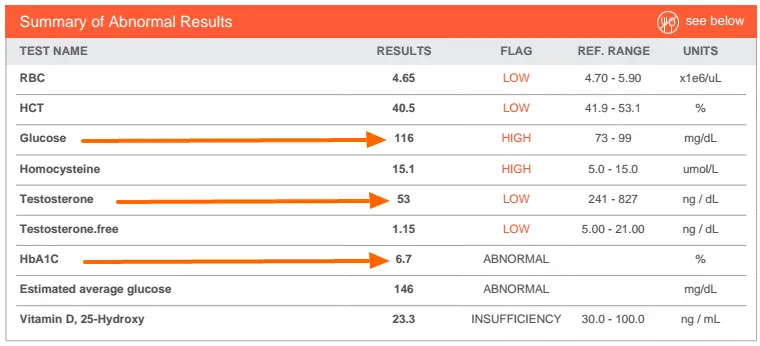
Immediately I found that she suffered from Diabetes type II (insulin resistance) and because of this, I didn’t even have to look at her thyroid function tests to know they were off.
Why?
Because insulin resistance (along with leptin resistance) can lead to hypothyroidism [1].
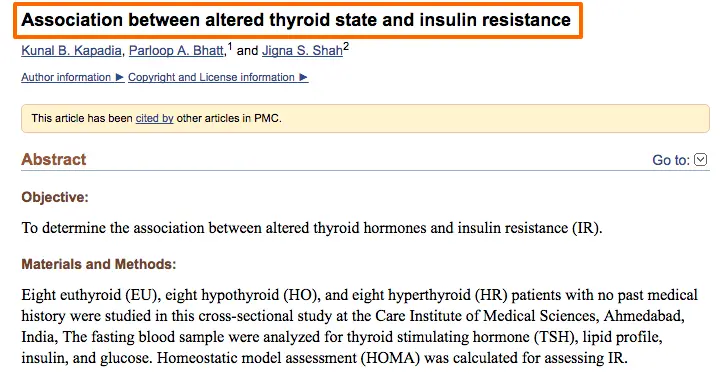
Not only that but treating hypothyroidism with T3 helps reverse insulin resistance [2]!
Both hormonal imbalances are connected!
And if she had seen an endocrinologist or GP that didn’t understand thyroid function, she would have most likely been labeled “normal”.
But that certainly isn’t the case as evidenced by her thyroid studies:
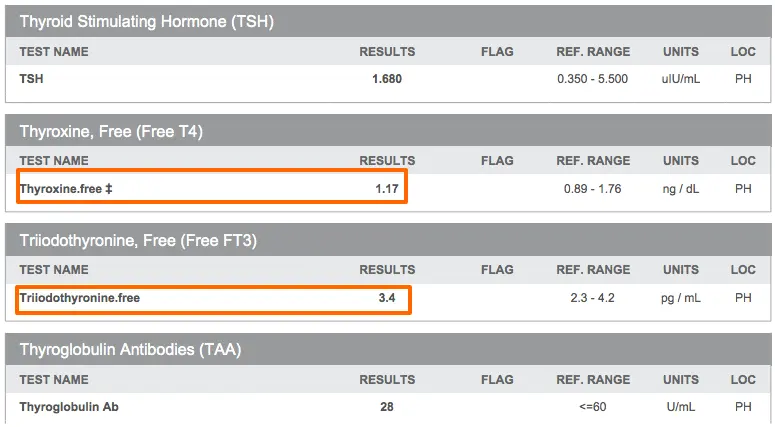

Low free T4, high reverse T3, and a falsely “normal” free T3.
And actually, this is one of those cases where her thyroid studies don’t really adequately reflect what is happening in her tissues.
Her body is screaming for thyroid hormone and yet her labs are really not that terrible.
Now let’s fast forward three months:
Her diabetes is completely reversed…
Starting Hgb A1c of 6.7 which falls into the type II Diabetes range [3].
(Labs on 1/28/2016)

(Second set of labs drawn on 4/1/2016)

In addition to reversing her diabetes, she lost 36 pounds and almost all of her symptoms have vanished.
But the primary question is:
How did she get there?
The Connection Between Weight Loss, Insulin Resistance, and Your Thyroid
What you have to understand is that high levels of insulin and type II diabetes will make it impossible to lose weight.
If you don’t address BOTH your thyroid AND your insulin levels you most likely will never feel better.
And this is a problem I see all too often in many patients.
They go to a “thyroid specialist” and get on T3 medications, but their weight doesn’t come off.
The problem is you really won’t ever feel better unless ALL of your problems are being addressed – not just one.
And because the thyroid plays a huge role in the function of other hormones, I’ve never seen a hypothyroid patient with only ONE hormone imbalance.
90% of the time it’s a combination of Thyroid + Insulin + Leptin issues.
And in order to treat it, you really need to use adequate amounts of T3 hormone and/or NDT.
But more important than that you will need to take a comprehensive approach which includes evaluating and treating all nutrient deficiencies, hormone imbalances, etc. like this one below…
Ruth’s Treatment Plan
In this case, the patient had multiple problems that we needed to address:
- Insulin Resistance
- Thyroid Resistance
- Low Testosterone
- Adrenal Fatigue/Low cortisol
- Inability to lose weight
- Stress Reduction Techniques
Adjusting T3 Medication in This Case
In this case, I started the patient on Natural Desiccated Thyroid using WP-Thyroid with a titration of 32.5mg every 10-14 days.
She noticed an almost immediate improvement in her symptoms on the medication and they continued to improve.
After setting them on 65mg I started to add liothyronine to her regimen to boost insulin sensitization and help increase her metabolism (it was damaged from years of yo-yo dieting).
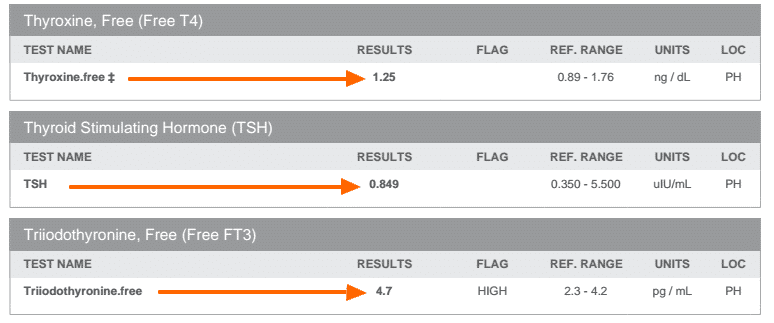
She is currently feeling great on a combination of 25mcg of Liothyronine and 65mg of WP thyroid.
Her resting pulse is in the 70-80 range and her body temperature has increased to > 98 degrees.
You can see what her thyroid lab results look like on this regimen:
Moral of the story:
Don’t try to get your labs into this “perfect range” that most people mention. Your thyroid doesn’t work that way – you need to find what works for YOUR body.
And I don’t recommend basing your dosing on your lab tests, I just wanted to give you an idea of what it looks like in her case.
Addressing Insulin Resistance and Weight
I put this patient on a fasting routine that was based on her fasting insulin level.
In her case, she needed a fasting routine of about 36 hours to lower her insulin enough to allow her body to burn fat as a fuel source.
Remember this image:
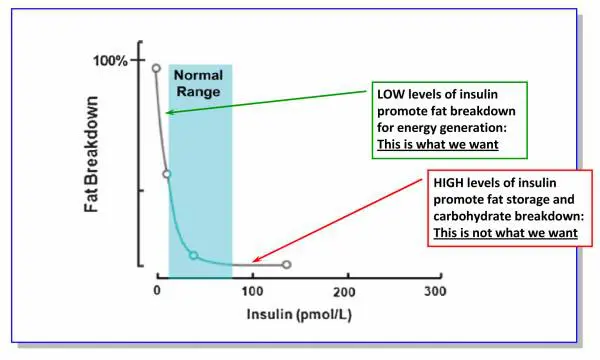
If insulin levels are high, it’s impossible for the body to burn fat.
As you can see from her fasting insulin level:

It was IMPOSSIBLE for her body to burn any fat.
The Role of Diet in Ruth’s Treatment
This is the part that so many patients get wrong.
They think that their diet is the KEY to weight loss.
And in about 50% of you, it may be true.
But in the other 50% – it doesn’t matter how little you eat or what kinds of food you eat, the weight won’t come off.
And that’s because weight gain is almost always a hormone problem.
It turns out that for most people diet isn’t effective enough by itself:
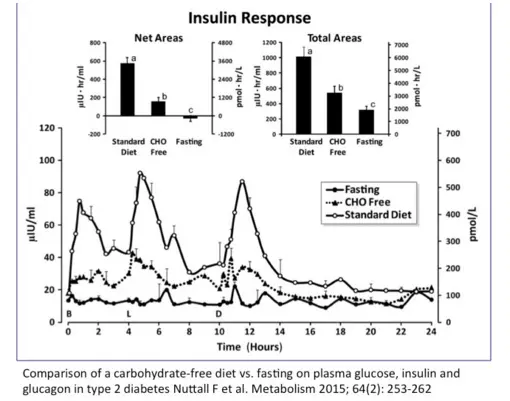
(Graph shows that a low-carb diet by itself doesn’t reduce insulin as much as fasting)
In this case, I simply put her on a whole foods-based diet which naturally favored high-fat foods but did NOT limit natural sources of carbs like moderate amounts of potatoes/fruits/white rice, etc.
While balancing other hormones was enough to allow her body to shed her excess weight.
Supplements and Other Factors Addressed in This Case
If you’ve read my other case studies you know how important these other areas are to obtaining optimal health.
I had this patient use the FAR IR sauna [4] frequently to help boost heat shock proteins, burn excess fat, and help detox endocrine-disrupting chemicals.
In addition, I also had her start slow weight training in combination with plyometric HIIT.
In addition to thyroid hormone, she was also placed on bio-identical testosterone.
Her supplements were directed at the deficiencies found in her blood work: liquid iron, vitamin B12, vitamin D, adrenal support, and zinc + selenium combo.
You should also take note that you don’t need hundreds of supplements to feel better either – you only need to take what you are deficient in.
For stress reduction, I had her practice mindfulness techniques along with SMT and meditation.
A good quick technique for reducing stress is listening to this audio right before sleep, which can help your brain increase delta wave [5] activity:
Recap of treatment over 3 months:
|
Medications |
Supplements |
Diet |
Detox |
|---|---|---|---|
|
WP-Thyroid (65 mg) |
Adrenal Support Vitamin B12 |
Whole food diet
|
Sauna |
|
Liothyronine (25mcg) |
Zinc Liquid Iron |
Fasting Routine |
HIIT |
|
Testosterone |
Recap of results:
> 40 pounds of weight loss at this point (steady 4-7 pounds of fat mass lost each week), no chronic pain, now sleeping through the night, diabetes is reversed, cholesterol levels improved, and energy now 9/10.
Of course, her treatment is not done, she still has another 40 pounds she would like to lose (definitely very possible).
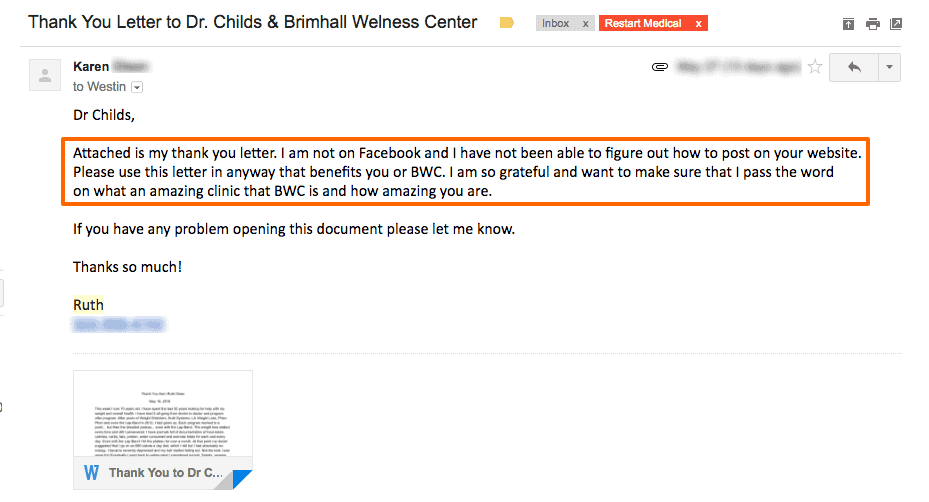
But she couldn’t be happier with her results so far! You can see her response below:

What Ruth’s Case Study Shows
Remember:
Dealing with hypothyroidism is so much more than just getting on the “right medication” and getting your free t3/free t4 levels in the “optimal range”.
If you want to actually feel your best and lose those extra pounds – you really need to take a comprehensive approach.
That means a complete hormonal analysis with a comprehensive functional blood panel – only then will you see what ELSE is going on.
When it comes to weight loss, I’ve only seen the thyroid being solely responsible for about 15-20 pounds of excess weight gain.
Anything more than that is usually some other hormone imbalance.
The problem is that it can be difficult enough to get a Doctor to treat even your thyroid correctly, let alone look at these other hormones.
But don’t give up! You can feel better.
If you’ve been struggling with hypothyroidism, weight loss, or insulin resistance and think you would benefit from my approach then you can learn more information about my weight loss program and therapies here.
Let me know if you have any specific questions about this case below and I will answer them.
Have you been able to deal with your insulin resistance? Do you have hypothyroidism and Diabetes? What have you done?
Scientific References
1. Kapadia KB, et al. (2012). Association between altered thyroid state and insulin resistance. Journal of pharmacology & pharmacotherapeutics. doi:10.4103/0976-500x.95517.
2. Lin Y, et al. (2011). Thyroid hormone potentiates insulin signaling and attenuates hyperglycemia and insulin resistance in a mouse model of type 2 diabetes. British journal of pharmacology. doi:10.1111/j.1476-5381.2010.01056.x.
3. Mayo Clinic. Prediabetes: Diagnosis and treatment.
4. Shui S, et al. (2015). Far-infrared therapy for cardiovascular, autoimmune, and other chronic health problems: A systematic review. Experimental biology and medicine (Maywood, N.J.). doi:10.1177/1535370215573391.
5. Nagendra RP, et al. (2012). Meditation and its regulatory role on sleep. Frontiers in neurology. doi:10.3389/fneur.2012.00054.