
- Aim for optimal ferritin levels of 30-40 ng/mL, not just the reference range minimum, as you can be symptomatic even with levels considered "normal" by standard lab values.
- Low ferritin directly impacts your thyroid function, energy, hair growth, and exercise capacity, so treating it supports multiple aspects of your health beyond just preventing anemia.
- Persistent low ferritin often signals underlying gastrointestinal problems like SIBO, dysbiosis, low stomach acid, or intestinal permeability that must be identified and treated, otherwise your iron will keep dropping.
- Track your symptoms (fatigue, shortness of breath, hair loss) as you treat low ferritin, because if they don't improve you likely have additional issues that need attention.
- You can have low ferritin with normal serum iron levels, and this functional deficiency still requires treatment because your cells need adequate iron storage to function optimally.
Ferritin is an indication of the amount of iron in storage in your body.
Low ferritin levels are often associated with symptoms such as fatigue, shortness of breath, inability to exercise, and even hair loss.
Diagnosing and treating low ferritin is important because it can actually reverse these symptoms and improve quality of life.
Having said that there are some tips you need to know before you start supplementing with iron…
How much is too much, should you use liquid over capsule form, how long should you take iron… etc.
All of these questions and more will be answered in this post:
Understanding the importance of Ferritin
Why is ferritin so important?
The reason is simple:
Ferritin is a marker of the iron stored in your body. And iron is responsible (and critical) to maintain energy levels, maintain thyroid function, promote proper hair growth and so much more.
That means managing your ferritin level becomes very important, especially if you have any of these symptoms (we will go over a full list of symptoms below).
Another important factor that shouldn’t be overlooked is that most providers tend to ignore ferritin levels unless you have anemia.
But this begs the question:
Can you have low ferritin levels and not be anemic?
And the answer to this question is a resounding YES.
Because of this, many patients with the symptoms of low iron tend to be ignored by physicians unless it is also accompanied by low hemoglobin (this is termed anemia, or iron deficiency anemia).
The problem with this treatment paradigm is that many patients who are obviously symptomatic tend to get ignored when all they need is some iron supplementation to increase their ferritin.
Signs & Symptoms
Because iron is involved in so many processes in the body, the symptoms of low ferritin tend to be all over the map.
By now maybe you already know if you have low ferritin (or maybe you are just suspicious that you do), in either event, you should be tracking your symptoms as you treat to ensure that you are on the right track.
Patients with low iron and low ferritin tend to present with 1 or more of the following symptoms:
- Extreme fatigue and/or decreased energy levels(the loss of energy from low ferritin is usually constant and worse with exercise)
- Inability to exercise or decreased exercise capacity
- Symptoms of hypothyroidism(low iron mimics the symptoms of hypothyroidism and can be misdiagnosed)
- Hair loss or inability to grow back new hair
- Shortness of breath
- Brittle or damaged nails
Using this list above and combined with classic lab studies can give you an idea of your iron status (both iron storage and readily available iron in the serum).
The good news is that these symptoms are reversed relatively quickly after supplementation with iron (which we will discuss below).
Having said that it’s important to consider this:
These symptoms of low iron/low ferritin are relatively broad – meaning more than one medical condition can share the same symptom.
This is both a good and a bad thing.
It’s good in the sense that if you replace your iron levels and you don’t have a complete resolution in your symptoms you know that you likely have some other problem.
And bad in the sense that figuring out the root cause may be more complex and may take some more time.
Understanding your Labs – the difference between low ferritin and suboptimal ferritin
There is a big difference between having low ferritin levels (obviously outside of the normal reference range) and having suboptimal ferritin levels (low on the reference range spectrum but still within “normal limits”).
If you’ve read about my blog you will notice a few trends:
1) There is a big difference between being optimal and being “normal”
2) Standard lab values aren’t 100% accurate in establishing a diagnosis of nutrient deficiencies
3) It’s important to use multiple factors when diagnosing nutrient deficiencies
With this in mind let’s apply these rules to low ferritin:
Optimal ferritin levels fall within the 30-40 ng/mL range.
That means it’s possible to still have ferritin levels in the low normal range and still be symptomatic.
Unfortunately the “reference range” includes all values between 10-154 ng/mL.
If you fall below 10 ng/mL then you are considered outside of the normal reference range and that is a “low ferritin” level.
But you can also be at the low end of the range and still be symptomatic.
For this reason, I generally set the recommended level between 30-40 ng/mL as mentioned above.
Let’s see an example of an obviously low ferritin level:

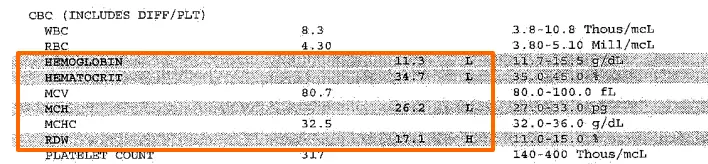
You can see from the example above that serum iron levels are low at 29, percent saturation levels are low at 7, and serum ferritin levels are low at 9 ng/mL.
This is a classic presentation for low iron and in this case, it is also accompanied by low hemoglobin, a low hematocrit, and a low MCV which is classic for iron deficiency anemia.
But recall from above that you can have low iron and low ferritin levels WITHOUT being anemic as well.
Bottom line: You want your ferritin levels between 30-40 ng/mL, anything less is considered “suboptimal” and may be associated with the symptoms listed above.
Can you have low ferritin with normal iron?
Yes, it is entirely possible to have low ferritin levels with normal serum iron studies.
This has to do with how iron is stored in the body.

Your body used ferritin as the marker for the amount of iron in “storage”. This should be compared to serum iron which is readily available for use.
Your ferritin measures this “store” of iron, so low levels of ferritin indicate that your storage is low.
So it’s possible to have low storage of iron, but adequate serum/blood levels of iron floating around.
But here’s the catch:
Adequate ferritin is still required for proper cellular function including proper thyroid function (1).
This means that low ferritin levels but normal iron levels should still be treated.
What about high ferritin but low iron?
This part can be somewhat confusing so let me explain:
Ferritin is a marker of iron stores in the body, so it would follow that high ferritin would mean you also have high iron in the body, right?
Well, that is one potential cause of high ferritin, but it’s not the whole story.
It turns out that ferritin is also an acute phase reactant.
That means ferritin may rise in the setting of inflammation (2).
So high ferritin doesn’t always mean high iron levels.
This is how some patients may have high ferritin (due to inflammation) but low serum iron levels (due to deficiency of some cause).
That’s why it’s always important to be evaluated with a fully comprehensive set of labs that includes all iron studies, ferritin levels, and inflammatory markers (including ESR & CRP).
What causes it?
Knowing you have low ferritin is just the beginning.
What is more important than knowing you have low ferritin is knowing WHY you have low ferritin, to begin with.
Low iron levels should not happen under normal physiologic conditions which means that something is in disarray if your levels are low.
The most common causes of low iron/ferritin include:
- Heavy bleeding(as is seen with a heavy menstrual flow or with heavy cycles)
- Gastrointestinal malabsorption(This is a big cause and one we will discuss at length below)
- Chronic internal bleeding(usually seen with gastrointestinal bleeding like gastric ulcers, polyps, etc.)
- Autoimmune conditions like Celiac disease (This disease usually causes intestinal damage which leads to malabsorption)
Some of these causes are easier to spot than others so we won’t focus on the easy ones.
For instance:
You know if your menstrual flow is heavy. You most likely also know if you have some internal bleeding (gastric ulcer is usually accompanied by intestinal pain, etc.).
Instead, I want to focus on the more sinister cause and least often diagnosed condition, that leads to iron deficiency and low ferritin levels: gastrointestinal malabsorption.
I will go over this in more detail below because there are many GI-related conditions that may contribute to malabsorption and it is critical to treatment because without reversing this condition your iron will repeatedly drop over time.
Now that you have a basic understanding of why ferritin is important, how to correctly identify and diagnose if you have low ferritin, and what causes it – let’s talk about the benefits of replacing ferritin levels…
#1. Low ferritin = Decreased thyroid function
One of the biggest reasons to replace your ferritin levels is because of its impact on thyroid function.
It has been shown in many studies that low levels of iron impair proper thyroid function (3).
And this makes sense, especially considering that many of the symptoms of low ferritin mimic the symptoms of hypothyroidism: decreased energy, hair loss, etc.
The good news is that replacing low iron levels should improve your thyroid function (assuming you had normal thyroid function, to begin with).
This information becomes very important if you have known hypothyroidism.
In this setting, it is extremely important for you to have “optimal” levels of ferritin in your body to ensure proper thyroid hormone metabolism, conversion, and production.
You can read more about the connection between iron deficiency and hypothyroidism here.
#2. Increases hair loss & Stop hair growth
What you may not realize is that iron plays a critical role in normal hair growth as well.
In addition, low iron (and thus low ferritin) is an important cause of hair loss in premenopausal women (4).
This is very important because many cases of hair loss are attributed to “genetics” and/or “thyroid” related problems when in reality they may be due to low iron levels.
Another study (of women of childbearing age without inflammation or other known conditions) showed that ferritin levels less than 30 ng/mL (5) are strongly associated with telogen hair loss.
This is another example showing the importance of “optimal” vs “standard” reference ranges.
If you have a ferritin level of less than 30 ng/mL and you are experiencing hair loss, then it would be worth considering iron supplementation (or at least discussing this option with your physician).
While iron is very important for proper hair growth, other nutrients (6) are also involved including zinc, selenium, and L-lysine.
If you are experiencing hair loss then proper evaluation of iron studies, thyroid studies, and other micronutrients is recommended.
#3. Decreases energy levels
One of the primary symptoms of iron deficiency is decreased energy levels or fatigue.
This is felt to be secondary to several factors:
Iron helps to carry oxygen (7) to peripheral tissues and oxygen is required for proper metabolic energy production in the mitochondria.
Low iron levels likely contribute to decreased energy production and efficiency in enzymatic processes.
The decreased efficiency may manifest as the subjective sensation of low energy.
In addition to this (and as already stated) ferritin is involved in thyroid metabolism.
Thyroid hormone is also involved in proper mitochondrial energy production (8) and one of the main symptoms of hypothyroidism is fatigue.
Nowadays chronic fatigue plagues many patients and the cause of this symptom is often missed.
If you have low energy levels (of unknown cause) this is yet another reason to have your iron and ferritin levels properly evaluated.
#4. Limits your ability to exercise and reduces your overall activity level
As mentioned low iron leads to the potential for low oxygen delivery to peripheral tissues.
This includes skeletal muscle in your body.
Decreased energy production in your skeletal muscle will result in diminished strength during exercise and a reduction in exercise capacity (9).
This usually manifests as shortness of breath during a workout (beyond what would be “normal” for your fitness level) in addition to rapid heart rate.
Both of these changes are felt to be compensatory to the decreased oxygen-carrying capacity of the body, but their effects are very important.
Diminished exercise capacity may lead to weight gain over time and disruption of other hormones involved in proper energy metabolism (leptin and insulin).
Your ability to exercise is yet another important factor to treat low ferritin if present.
If you are experiencing shortness of breath while exercising and you have many of the other symptoms listed above, then you should consider getting a complete set of iron studies.
#5. May impact your immune system
Another important (and often underappreciated) role of iron is in the immune system.
Dysregulation of serum iron levels may lead to changes in immune function and limit the cellular response to bacteria (10).
Iron is not the only nutrient involved in proper immune function, however.
If you feel your immune function is not functioning optimally then you can consider the evaluation of other micronutrients like Vitamin D and Zinc.
#6. Low ferritin may indicate hidden gastrointestinal problems that need to be treated
This may be the most important reason of all.
Low ferritin is caused by some imbalance in the body, which means that finding and reversing that imbalance is necessary to maintain normal iron and ferritin levels.
One of the more common causes of low ferritin is related to gastrointestinal issues and malabsorption of iron.
The following GI-related conditions have been associated with the malabsorption of micronutrients:
- Small intestinal bacterial overgrowth (11)
- Small intestinal fungal overgrowth
- Low stomach acid (12) (including patients taking acid-blocking medications)
- Intestinal dysbiosis (13)
- Increased intestinal permeability (14)
- Inflammatory bowel disease (15)
- Irritable bowel syndrome (16)
- Chronic constipation syndromes and/or chronic diarrhea syndromes
If you know that you already have one or more of the GI conditions listed then you have a smoking gun for the cause of your iron deficiency.
If you aren’t sure you have a GI-related issue then consider this:
You should not be experiencing gas, bloating, constipation, diarrhea, or acid reflux and the presence of these symptoms usually indicate some other GI problem.
The presence of any of these symptoms should make you consider further evaluation for the cause of these symptoms, especially in the presence of low ferritin.
Why?
Because if you don’t treat the underlying cause of your low iron levels then even if you replace those levels it will likely come back.
#7. Whatever caused your low iron levels may also be causing other nutrient deficiencies and contributing to your symptoms
The decline of one nutrient deficiency almost always leads to the decline of other micronutrients.
Why?
Because nutrients are absorbed in certain parts of the GI tract and absorption requires co-factors, stomach acid, and even other nutrients for complete absorption.
For instance: Iron requires vitamin C for absorption (17).
The combination of slightly abnormal levels of magnesium, B12, iron, zinc, etc. may negatively influence your symptoms and all contribute to the subjective symptoms you may be experiencing due to low ferritin.
This is important because replacing these other lost nutrients is critical for the complete reversal of your symptoms.
Let’s use this as an example:
Let’s assume your iron levels are < 10 (obviously low) so you decide to supplement with liquid iron or iron capsules.
Initially, you feel some improvement in your energy levels but not 100%.
What is accounting for the other 50%?
Some of this may be due to the combination of vitamin B12 deficiency that may be low as well and therefore energy levels will not improve until this deficiency is replaced.
Hopefully, this paints the picture of why replacing ALL lost nutrients is so important.
If you are deficient in 1 nutrient, there is a chance (by virtue of the same mechanism that caused the initial deficiency) you are also deficient in others.
- Bottom line: If you are deficient in 1 nutrient, there is a chance (by virtue of the same mechanism that caused the initial deficiency) you are also deficient in others.
How to increase Ferritin levels safely
If you’re planning on supplementing with iron to increase your ferritin levels there are a few things you should know:
1) Iron is very much a Goldilocks type of nutrient in your body – too little is a problem but too much also causes problems like iron overload.
This means you should only supplement with iron if you are basing your supplementation on your lab results.
I don’t recommend supplementing with iron if you don’t know your ferritin lab values and you don’t follow them.
2) Due to absorption issues (as mentioned above) most patients do better on liquid forms of iron.
Liquid iron is more readily absorbed and should NOT worsen constipation.
If you are unable to tolerate liquid iron (due to taste or some other problem) then switching to capsules is fine, but start out with liquid iron if possible.
3) Very low levels of ferritin may require IV iron infusions (depending on the cause).
This doesn’t apply to the majority of people out there, but if your ferritin levels are extremely low and you are unable to raise them then you should consult with your physician.
4) Patients taking Thyroid medication should not use iron within 2-4 hours of taking their thyroid medication.
Iron may decrease the absorption of thyroid hormone and these should be taken as far apart as possible.
In other words, hypothyroidism sets up a physiologic situation where iron deficiency is more common than in the general population.
To avoid absorption issues with thyroid hormone it’s best to take your iron supplement in the evening if you take your thyroid hormone in the morning.
5) Patients with Iron deficiency frequently also have Vitamin B12 deficiency.
For this reason, I frequently recommend checking both iron and B12 levels simultaneously (more information below).
B12 plays an important role in your energy levels (as does iron) and deficiencies of both may be contributing to your overall symptoms.
You can replete B12 levels with a high-quality over-the-counter B Complex.
Can low Ferritin lead to weight gain?
Another common symptom that many patients with low ferritin will experience is weight gain.
The connection between low ferritin and weight gain definitely exists, but exactly why it occurs is less understood.
Based on the interaction that ferritin has with thyroid function and thyroid conversion – this is most likely the reason that patients experience weight gain with low ferritin levels.
Low levels of ferritin reduce thyroid hormone production because an enzyme in the thyroid is required to create thyroid hormone.
This enzyme is known as heme-dependent thyroid peroxidase.
If thyroid hormone production falls then your metabolism will suffer, which means you will be burning fewer calories at baseline.
A reduction in thyroid hormone also promotes changes to other hormones resulting in resistance syndromes such as leptin resistance and insulin resistance.
Part of the problem with weight gain and low ferritin is that some patients are refractory to iron replacement therapy.
This may lead to a situation where replacing iron is required in order to lose weight, and you may ultimately need iron infusions to replete ferritin and iron stores in the body.
Recap & Final Thoughts
Iron is a critical nutrient involved in many biochemical pathways, the deficiency of which may lead to many negative symptoms.
Ferritin is used as a marker of iron stores in the body and low ferritin levels generally indicate low iron stores.
Low ferritin levels should be treated with liquid or iron capsules until ferritin levels rise into the 30-40 ng/mL range (this is considered the optimal range).
It is possible to have high ferritin levels but low iron stores due to how ferritin’s action as an acute phase reactant.
Remember that other nutrient deficiencies also tend to accompany iron deficiency and these must be treated as well.
Finding and treating the root cause of your iron deficiency is critical to long-term success as a lack of diagnosis of this problem may lead to persistent low iron levels over time.
Now it’s your turn:
Are your ferritin levels low?
Has supplementing with iron helped to improve your energy levels?
Why or why not?


Hello Doctor,
I just wanted to send you a very sincere thank you for this article. My husband in 2011 had gastric bypass surgery and has lost 230+lbs. September 2017 he had a massive abdominoplasty that resulted in several complications. (3 blood transfusions was one of the many things that took place). We recently discovered that his Ferritin was low (13) and continues to lower, while his iron and what not over all is fine. His extreme fatigue has been suspected as depression but his Psychiatrist didn’t think depression was the reason for fatigue.
He’s finally today going to start on liquid iron to hopefully help raise his Ferritin.
Your article is the only one that I’ve read (and I’ve read several), that made complete sense and is detailed in such a way that I don’t have any questions.
Again, thank you!!
I am so glad I found this article. I recently went to my naturopath to find out why I have been experiencing stomach cramps, pains and bloating. My test results showed a low TSH level, 0.250 uIU/ML and a very low ferritin, serum level; 6 ng/mL (Vitamin b12 was at 352 pg/mL). He explained a few things to me including that I should start taking a supplement but didn’t seem too concerned even though I had told him I have many of the symptoms mentioned in this article; bloating, hair loss, brittle nails, fatigue, digestive issues etc. After reading this I can see how it is all related and now realize this might be connected to the stomach pains I have experienced more frequently then ever these past couple of months. I have ordered the liquid iron as well as capsules. I am looking forward to trying them and hopefully feeling better. Again, I wanted to thank you so much for sharing this article and explaining things in detail since my doctor didn’t!!
Hi Silvia,
No problem and glad you found it helpful!
My ferritin level is so erratic and I cant keep it elevated. The max I have had is 32 back in Jan and just been retested at its 20! lowest was last year when it was 10 and I couldn’t function. Brain Fog, aches, pains, dizzy, falling over and SVT, and I cant go through again. I am worried it is dropping again even though I am taking 2 iron tablets everyday and its the 322mg ferrous fumarate. I really just need something to stop this happening. I get married in 7 weeks!
I have been taking integrative therapeutics iron complex w liquid liver in it. The iron level is 50mg/2 pills. My question is how much floradix would I need to equal what I’ve been taking? I ask because the product has a couple fillers I have Tested to be sensitive to. I have finally made headway w ferritin going from 10 to 20 after two years! I finally found a supplement that seems to work and now am told to find something purer. Thanks!
I just got a call from my doctor and my blood work showed that my ferritin levels are at a 1.7!! And my hematocrit is at an 8!! They have scheduled me to do 5 iron infusions over the next 5 weeks. What are the dangers of my levels being so low?
http://www.drlaurendeville.com/articles/ferritin-storage-iron-hair-loss/
https://www.hairsentinel.com/iron-and-hair-loss.html
“in our experience we believe that treatment for hair loss is enhanced when patients maintain a serum ferritin concentration greater than 70 ng/mL.”
I quit drinking Coke last fall and didn’t lose a pound. My primary care doctor did my blood work and my ferritin was 8. He looked back in my records and apparently it had been that low for years and my former primary care doctor had never explained that to me. I’ve been taking Vitron-C for 6 weeks and made it up to a ferritin level of 19. This tablet has vitamin C and I had read that elemental iron was best. Do you think the liquid iron you are suggesting might be better to try than the one I have been? My doctor didn’t suggest anything specific.
I have a ferritin level of 4.2 it fell from 6 after taking iron 150 mg for 3 weeks. I’m 59.
Hello Dr. Childs,
I am SO glad I discovered your website. I’ve found such great information that has been useful as I’ve been dealing with some health issues for the past few months.
In February, I was tested for iron and thyroid. My ferritin was super low (8) but I managed to get it up to 18 after 3 weeks of taking iron tablets. Since then (2 months ago), I’ve been supplementing with Mega Foods Blood Builder, and I just got lab results back. My ferritin is still at 18, but now my full iron panel shows I’m kind of on the higher end:
February, 2018: Ferritin = 8
March, 2018: Ferritin = 18
May, 2018:
Ferritin = 18
Saturation: 49
Total iron: 190
Iron binding capacity: 385
2 Months ago I also got thyroid tests back:
T3 reverse: 20.9
T3 free: 2.7
T4 free: 1.13
Negative for thyroid antibodies
Also, my TSH was 4.02 (Feb) 4.84 (March), and 3.6 (May)
I’m trying to figure out what’s going on – I’ve been combing your site for 2 months now! Anything stand out to you? Thank you so much for the great information!
Hi Dr. Childs,
My daughter is 19 years old, and she has very low ferritin.
Ferritin 5
Hemoglobin 12.2
TIBC 398
UIBC 344
Iron 54
Iron Saturation 14
all other lupus anticoagulant, anti SS-A/SS-B, antibodies all normal
She is loosing her hair tremendously, she has also very bad constipation problem from childhood. Do you think her hair loss is because of low ferritin? How to improve ferritin without constipation?
Thank you so much for your help…
Sonal
Hello Dr. Childs,
I’m glad I read your article. I have a chronic low hemoglobin since 2013. I was treated with blood transfusion due to hg 4 caused by my one-month menstruation treated with medication, a year after, I was diagnosed with endometrial polyps but undergone a minor operation. My menstrual cycle became normal/regular after that but still having low hemoglobin, not taking any oral iron supplements or milk rich in iron because I’m having an intolerance. I developed nausea and vomiting and worst diarrhea. I’m only taking Iron intravenously but I’m afraid of needles. I don’t like the thought of getting used to it for a lifetime. I recently checked my Ferritin and it’s 2.8, my hg is 8.3. I wanted to know what is the cause of my condition. I’m residing in the Philippines, I wanted to have a Gastrointestinal workout but I’m afraid those diagnostic exams aren’t available here. Can you please tell me what specific laboratory work out I need? And is it necessary to consult a Gastroenterologist or should I consult first a Hematologist? I hope you can help me.
Hi Dr. Childs,
Please help with my latest iron panel,
Ferritin, 52 ng/ml
TIBC, 242 ug/ml Low
UIBC, 104 ug/ml Low
Iron, 138 ug/dl
% Saturation, 57% High
Some are low some are high. Please let me know if you have seen this. Thanks.
Hi,
I’m 52 yr old female- started losing my hair last year, full blood work didn’t turn up anything- iron was 86 ug/dL and saturation was 27%. Finally saw a dermatologist- they suspected low ferritin. My level was in the low 30’s- started iron supplements- 3 months later my level was 70 and hair loss had stopped- continued supplements and tested again in 3 months- ferritin had dropped to mid 50’s tested again in 3 months- level had dropped to low 50’s and hair loss had started again- but the other levels, blood was at 215 and saturation was 69% So, they recommended I not take iron anymore and within two weeks, my hair is falling out A LOT! So, why would blood levels be elevated, but ferritin still drop? Would levels be high if it wasn’t being absorbed? Or is it being absorbed but not stored? At this point, what type of doctor would you recommend for dealing with this?
Hi Dr. Childs, I was wondering if you know why taking iron supplements raises your cholesterol levels? I was taking supplements and slowly building my ferritin up when a nurse informed me about it. Sure enough my cholesterol had gone from 163 to 248. I was having success with lots of issues, one was the regrowth of eyelashes and brows (I’ve had alopecia since childhood) while taking the iron, but the cholesterol rise scared me and I stopped taking them. Would liquid iron be a safer alternative?
Dr. Westin,
I am 47 year old female who has had 4 c-sections and suffered from low iron for quite awhile. I can’t tolerate iron pills, but my latest labs show my ferritin level is a 4, and my hemoglobin is 9.2, hematocrit is 31.8%. My doctor is sending me for a blood infusion. I definitely have fatigue, low desire to exercise, and have gained some weight. I also suffer from PTSD and anxiety (but that is slowly getting better.) Will the infusions help?
Hi Candi,
They should definitely help improve to improve your ferritin.
Good afternoon Dr Childs,
This is hands down the best explanation of iron and ferritin I’ve ever read, thank you for writing this. I’m becoming quite desperate and I would really appreciate any advice you could give me. I’m a 28yo woman and I’ve had low ferritin at least since my first iron study when I was 14. I have Ehlers Danlos syndrome with all the related joint problems, endometriosis, syncope and POTS, a mystery neurological condition, and IBS.I have seen a haemotologist and multiple gastros to try and find the cause of my low ferritin, including multiple scopes and a pill cam etc. with no cause found. I’ve been gluten and dairy free for over a year now as it helps my ibs symptoms. My endometriosis might be a contributing factor but my iron drops even without having my period.
My ferritin reaches as low as 7 (range 15-200) whilst taking liquid or tablet iron supplements, vit c taken at same time, and down to 2(same range) without oral supplements. My iron and transferrin have always remained perfectly within normal range. For a few years now I’ve been getting infusions every 3 to 6 months and I had been reaching 500 (range15-200) after every infusion. The most recent 2 infusions have been failures and my ferritin only reached 33(same range) 5 weeks after my infusion. I have so much scar tissue on my veins and my doctors have no idea what to do. I’m so desperate to just feel better as I have enough other health issues to deal with. I read some of your other amazing responses to posters and if you have any ideas on other avenues to investigate I would appreciate it more than you could imagine.
Thank you so much, Rae.
My ferritin is 7 and I’m also deficient in D and b12. I was just diaagnosed with hypothyroid and started on NDT. Feeling better but need to rectify these deficiencies. How do I test for SIBO? I have a feeling I may be Celiac. Also, what do you recommend for vitamin C? Thank you.
Hi E,
SIBO is different than Celiac disease but they may co-exist. Celiac is tested with basic blood tests while SIBO is usually diagnosed via breath testing.
Hi Westin,
I was diagnosed with mild periodic limb movement disorder back in 2012 & the specialist advised iron supplementation to increase ferritin levels, which started to improve things symptom-wise but then I got iron overload & was advised to stop supplementation (but my ferritin levels didn’t go up as much as the specialist wanted them to).
I believe things have worsened considerably over a recent couple of years (my sleep is incredibly fractured, with very little REM) & have been referred back to St Thomas’s for sleep studies. The reason for my message is to ask about my recent bloods – Serum ferritin: 40ug/L, however iron high at 28.0 umol/L – This happened last time too – I can’t seem to find any data on why ferritin levels would be considered low (for the purposes of normalising PLMD) whilst serum iron is high.
Any ideas would be gratefully received! Many thanks
My daughter was diagnosed with anemia in Feb of this year. She is getting set to head back to college and we just had her iron checked again. Her iron is back to 14 but her ferritin is still at 8. She was at a 5 back in Feb. What can this mean and do we just keep taking the iron pills even though her iron is now “normal”??
Hi Kristin,
Ferritin is a marker of iron “storage” in the body, so she can have normal serum levels while her storage remains low. What that means is once she stops taking iron she will probably become deficient rather quickly.
Hi Dr. Childs,
I have to start by saying that I am so happy to have found your website. I am 25 years old and was diagnosed with PCOS when I was 13. Fortunately, I did not experience any of the PCOS symptoms until my 20’s. Predominately, I suffer with acne on the chin, difficulty losing weight, and most of all, hair loss (FPHL). After reading the information that you provided, I strongly believe that I am exhibiting the effects of FPHL since my loss models the pictures of the “christmas tree” pattern. Last month, I visited a dermatologist to see what could be done for my hair loss, so the physician ordered blood work. My results are as follows:
iron= 98 ug/dL
ferritin= 11 ng/mL
Based on the values from my blood testing, I believe that I have “normal” iron levels, but low ferritin. Does this seem correct? If so, I would love to supplement with iron, but I am not sure what dose I should take.
Thank you,
Rebecca
Hi Rebecca,
Yes, it sounds like you are on the right track. I can’t give you medical advice but there is enough information in this post to help get you started!
I, too, have “normal” iron and Ferritin at 11. Are you starting meds or supplements? I am doing certain things first, like stopping drinking so much tea and water. I am also looking into zinc because my zinc was also low. I believe it’s all related. My b12 was high! And platelets low.
So I know that one thing can cause trouble. We can do it! I hope you post again and we can share success 🙂
Hello Dr.
I am just now reading this article so I hope it’s not too late to comment.
I just spent four days in the hospital for chest pain and general weakness. I was told that my ferritin level is 4 ng/ml (11 ng/ml-306 ng/ml.) My hemoglobin is 9.1. I was given 2 bags of iv iron. I have been home for 6 days and I feel worse than before. Does it take the iv iron a lot of time to help?
Thank you,
Cindy
Hi, I am 47 years old and I, too, have been struggling with low ferritin for years due to very heavy periods. I would love to know what is the root cause of my heavy periods is, I have been told it could be age, but I am not convinced. I have also read that it is a vicious cycle because low iron causes heavy periods and heavy periods in turn cause low iron. I would love to hear your thoughts on this theory.
I due best when I stick to regular iron supplementation, a clean diet, and 1/8th tsp ground dried ginger 3x per day, but I have yet to completely solve the problem and it is difficult to maintain. I sometimes fall off the wagon and things get worse quickly. I noticed that the liquid iron you recommend contains fennel extract which, while good for many things (!) has been shown to increase menstrual bleeding (turmeric has been shown to do this as well). For these reasons I thought you and your readers may find this video interesting.
https://nutritionfacts.org/video/fennel-seeds-for-menstrual-cramps-and-pms/ I’d love to know what you think, Dr. !
Thank you so much for posting this valuable information on a little talked about subject that I believe could be affecting so many women!
I like this Dr! I learned a lot from this article and his other ones. I can figure how to help myself if I know what is going on and how to work at trying to fix it. Thank you, Dr. Childs. New follower here.
Hi Oker,
No problem and glad it helped!
Hi Dr., Do you have any idea what would keep causing chronic iron deficiency….my Ferritin is between 3-21 depending on how it decides to respond every 3 months.
I am avid athlete/runner. My hemoglobin will be between 8-10. MHC low, MCHC low, but binding capacity high? M serum high at 264, Beta Globlin high, Hgb A a little high. I take iron supplements Vitron C 3 days a week, monthly female stuff is regular, been tested for Celiac and hand laparoscopy done. What the heck is wrong with me? Foot strike disease? I want to run decent and not feel like crap. I’m sick of trying to figure out this blood work. Is there a natural cure? Smoothie? Supplement? Blackstrap molasses? Please any help would be greatly appreciated!!! Thank you!!!!!
I was just diagnosed with low iron and while there are many “rules” about when to take iron supplements, I would like to know what other supplements are OK to take with the iron. I generally take my iron before bed, so it is hours after or before any meals or caffeine, but this is also when I like to take my probiotic. Can the two be taken together?
Hi Christy,
I usually find people do best if they take their iron alone or by itself and take all other supplements at different times throughout the day.
More pieces added to my own complicated puzzle which seems to be bringing the big picture into focus. I wish more specialists and primary care doctors would consider your educated wisdom more carefully.
For me the question here is (and for many I’m sure) which came first? What caused the thyroid dysfunction, or what induced the low ferritin levels which led to endocrine problems?
I can say there were symptoms of fatigue going as far back as middle school for me. My first day of 7th grade began with purchasing a bottle of caffeine tablets on the way to school. “Scrawny” is the medical term for me growing up and may have been another missed marker of something being amiss. As memory serves, it was in my twenties when I first tried supplementing – very cautiously – with iron due to relentless fatigue.
It was just circa July 2014 when my educated conclusion was confirmed with lab testing for hypothyroidism. Then about three years later at age 55, I was diagnosed with Monoclonal Gammopathy Of Unknown Significance (MGUS) after blood work showing low ferritin levels prompted further inquiries. The steady hair loss over many years had been chalked up to male pattern baldness, chronic traction of the roots; vision issues and finally a low functioning thyroid. Now it seems low ferritin may have been the common denominator for decades. The other possibility being an latent and undiagnosed MGUS condition extant from a relatively young age. ‘Chicken or the egg’ at this point.
I cannot thank you enough – again – for bringing insight to my and others’ struggle against our conditions as well as that with low information, stuck to their rigid protocols physicians.
You are truly ahead of your time Dr. Childs. The notion is even exemplified by this article’s update listed as 09092018 when today is the only the seventh.
All The Best,
JOEL WS
Hi. My husband has had low ferritin with intermittent low hemoglobin for years. Treated with 4 Feosol/carbonyl iron per day. Improves if he takes well. Has had colonoscopy and endoscopy. Nothing remarkable yet he does have hemorrhoids sometimes. What Tylenol specialist should he see? Always treated by a primary doc.
First I want to thank you for the very informative article on low ferritin!
I wanted to ask if your ferritin level or its symptoms can fluctuate. I have told my Dr for years at each physical that I have abnormal fatigue. My energy level definitely varies from one week to the next. I also have just recently recovered from SIBO and had my gall bladder out. I’ve had GURD for 28 years. I’m 47. I also see a involuntary movement specialist for Tardive dyskenesia and restless leg syndrome. This Dr.finally ran bloodwork to look for a cause for my neurological symptoms. My ferritin level was 25. Now I am supposed to follow up with my GP to find the cause. It seems I may have several causes you mentioned that won’t change. Does that mean iron supplements indefinitely? Why does this extreme fatigue come and go? Any help would be appreciated!
Here’s my list: NO thyroid (very small piece on left-hand side – removed 1982 due to Multi-Nodular Goiter – taking Levothyroxine 150 MCG), NO feminine parts (hysterectomy/Breast Cancer x2 – both sides), Ferritin levels at 15/low, B-12 deficiency, Weight Gain (No matter WHAT I EAT), Skin condition issues, Fatigue (no matter HOW much sleep I get), some hair loss – 6-10 strands in clumps all at ROOTS/various. Most websites talk about people WITH thyroids and how to supplement. I DON’T HAVE ONE. Low Ferritin is NOT from monthly period…I have none. Other than a THYROID STIMULATING HORMONE (TSH) test, what other blood tests could you recommend to hopefully shed light on my status that I could request Kaiser perform that they are not performing? My Primary Care doctor at Kaiser just says “change your diet, take iron supplements” and basically ignores me. There is more to this than she is taking interest in…and I am sick of it. Literally. Thanks in advance!
Hi Ang,
You can find a list of the complete thyroid lab panel on this page which also includes optimal ranges: https://www.restartmed.com/normal-thyroid-levels/
You can download a copy of these lab tests here as well: https://www.restartmed.com/start-here/
My ferritin was 4 the first time it was tested and my primary did not give me any info and was not very concerned. Just said ‘take iron supplements. After my gall bladder was removed and I was having other gastro issues. My GI doctor did blood work and it was still a 4. He referred me to hematologist bc he said I needed iron infusions since the meds he has me on can prevent me from absorbing iron. The hematologist would not give me iron infusion until I tried more supplements and her recommended levels. Now a year later I was tested again and ferritin was only a 7. Hemoglobin normal. I just had my first iron infusion, get another next week. Based on this very informative article and others I have found I was shocked at how unconcerned my doctors were about a 4 ferritin. I’ve had horrible fatigue and cardio symptoms. Felt like a zombie off and on for years. Thank you for providing this valuable detail.
Hi Laura,
You’re welcome and I’m glad you found it helpful! Thanks for sharing your story.
Hi. I have a low ferritin (5), low serum iron (20), low hemoglobin (10) and they have all been dropping. Intravenous iron treatment was the only one that worked.
Have been trying to find the reason why and every test has come out good: no bleedings, negative celiac, thyroid is ok, liver is ok, endoscopy is ok, no symptoms of bloating or diarrhea, etc.
Only symptoms are the ones related to anemia, I have them all.
What else could be causing a non absorption of iron?
Can you please address how iron supplements can raise your cholesterol? The ferrochel I was taking was helping to raise my ferritin levels and I was starting to see lots of hair regrowth (I have alopecia), but then my cholesterol shot way up, the nurse said it was from the iron. So how do you get your ferritin levels up without iron supplements?
Hi Suzanne,
Cholesterol levels return to whatever your normal is after you replete iron levels. It doesn’t cause high cholesterol, it just hides the fact that you had high cholesterol before you started supplementing: http://www.annclinlabsci.org/content/31/2/151.full
Thanks for the article. A little scary thinking my cholesterol is probably much higher than the 190 I thought it was. Going to start on liquid iron today and see if I have the same results as the tablets.
Hi Dr Childs,
Thank you for such an informative article, it’s very rare to find!
Do you have any advice for a decreasing ferretin (47ng/ml in Jan 19 dropped to 33ng/ml in April 19) but total iron is just above maximum range 147ug/dl.
I’d previously taken floradix up to Jan 19 on advice if dr for low ferritin levels being a vegetarian female.
Im still experiencing hair loss but Dr says to stay off supplements due to high total iron.
Is there a way to increase ferritin without increasing total iron?
Thanks so much for your help.
Thank you so much for all of the information! My adopted daughter has just turned 16. Her ferritin level is currently at 5 (normal range is shown as 15-77) and has been at 9 or below since first tested 2 years ago. Her biological mother has a history of low Ferritin as well that was only solved through IV infusion. My daughter’s thyroid has tested within normal ranges. There is a history of hypothyroidism in her biological family (mother and one brother).
She has not been able to tolerate iron capsules (doubles over in stomach pain 20 mins after taking, even with food). Her pediatrician then suggested infant iron drops which caused the same pain. She does have a history of constipation.
Recommendations for next steps? Is the Pediatrician still the right physician for her to be seeing?
Thank you.
Hi Susan,
You honestly might find better results seeing a hematologist over a pediatrician.
I just came across an article very similar to the one you have written here. I believe this site is stealing your content. Here is the url: http://healthyhormones.us/treatment-of-low-ferritin-levels/
Over the past year I have gone through some very traumatic experiences which have impacted me emotionally but also physically, which has actually caused me to pursue research around the idea of psychological stress and how the body responds because I believe the trauma caused my stores of B vitamins, Iron, Magnesium, and some other nutrients to be severely depleted. I won’t bore you with what had happened but it was sudden and highly painful. Prior to this event I was a bodybuilder and ate very healthy. I had just began graduate school and was beginning my journey into the field of Clinical Psychology. Fast forward three years, and although I am about to graduate, it did take me longer than expected because I have not physically felt normal for years I have always had IBS and knew about betain HCL and stomach acid issues, which I believe I have cleared up to the point where it does not cause me much discomfort anymore, but mid 2019 I began to be very tired, depressed, had no energy, anxiety right when I woke up, and almost a sense of panic, and I had stopped exercising etc. I was getting really bad and didn’t know what to do. Then I developed numbness in my leg and angular chelitis on the sides of my lips. At that point, I realized I was deficient in B vitamins and started to give myself injections, which started to make me feel better, and most of my symptoms went away. But recently, the angular chelitits came back, but I knew it could not be B vitamins because I had already been taking enough. I didn’t want to believe it because men are told we don’t need iron so months went by but eventually I have decided to take Blood Builder Iron tablets, and I am only three days in, and without applying anything to my lips they are healing and almost gone. I have done some research online through my schools database etc and have discovered that psychological stress can deplete humans and animals of their iron stores and from their bone marrow. This is something that fascinates me, and I believe this is one of those situations of which comes first the chicken or the egg.. Most of what I read and found was deficiencies were a side effect of anxiety, but very few articles studied if anxiety or depression was actually the culprit of the nutrient deficiency. I wanted to know what your thoughts are on this and why the medical world is not seeing these studies as revolutionary and significant because I had absolutely no issues with anxiety before the psychological trauma I had gone through, and I was in the best shape of my life, but then within a year or two, with constant and persistent stress, I became anemic. The first article I read from a peer reviewed journal was studying veterans with PTSD and they had found that practically all of them were deficient in B vitamins from the PTSD and night disturbances etc. As a future clinical psychologist, and someone who already works with children at an elementary school, I see some kids who have gone through some severe traumas like parental death, sexual and physical abuse, neglect, domestic violence, drug abuse, etc and I began to wonder if these kids are having problems concentrating because their bodies are not being given what they need, and instead of labeling them ADD, or dyslexic, which ironically I was all through elementary and high school, but found out during my start at community college that I had been wrongly diagnosed, so I see children going through similar struggles and wonder are they really ill and the nutrient deficiency is just the symptom of their add etc or is it the other way around which I am now believe the add etc is just a symptom of poor nutrition, and I wonder if these kids would be able to process these traumas far better if they were to address their nutrient deficiencies first? I’d also like to point out that suicide is the second leading cause of death for teenagers and young adults up to about 24 years old in America. They are more likely to die by their own hands than by someone else. I hypothesize that could it be that our youth are not only neglected by their parents who need to teach good eating habits and are eating horribly toxic food, but with the addition of social media and the psychological stress it causes, and the amount of social pressure these kids are under from their kids at a school because of all the media which is brainwashing our kids into becoming highly judgmental, insecure, narcissistic, and void of healthy levels of empathy, is causing our kids to become nutrient deficient because of the chronic stress, which then results in suicidal ideation? Because if I wasn’t raised how I was, and didn’t have a father who was a surgeon, I might have killed myself being so miserable and not knowing what could be wrong, but I have a profound belief that the human body is designed to heal and thrive, and it can always be fixed if we don’t give up. And because what I have learned on my own I am wondering how can I truly help these kids if they are suffering from these deficiencies which I have no control over? And I can’t tell you how many parents just don’t put in the effort. I have two students in 1st grade that both had their parents die and not one parent took them to a therapist and if it weren’t for their school providing a mental health counselor they would be on their own. Do you have any articles or sources you can provide that can help further solidify what I have discovered because it would be greatly appreciated? And do you have any suggestions on what else I can do, or should do, in terms of correcting any imbalances in my body that may pop up in your mind reading what I have written. I was a bit worried I had hypothyroid, but after reading your article, which helped a lot by the way, makes me think I should wait and see how the iron plays out.I am a 6’1 230lbs guy does that make a difference in my iron dosage? And do you think 13mg a day is enough of Blood Builder? And I read that Copper might also be a good addition? Because I know Iron can be toxic as well. I have plenty more I’d like to ask and discuss with you but this will suffice. I would certainly appreciate your input and thoughts on both topics. And if you do end up reading my post I would like to thank you for taking the time to do so as I know you are busy and I do not expect a response back but would be very happy to see one even if its short and concise.
Sincerely,
Brent
Brent, I had the exact same symptoms after a traumatic event. I suddenly developed symptoms like cognitive issues, muscle twitching, anxiety, insomnia, and much more. I struggled with this for several months until I discovered that I had serious deficiencies B1, B12, D, ferritin, with high homocysteine despite a well rounded diet and excellent physical condition prior to the event. It took me a year to recover and still not 100%. Neither my primary doctor nor neurologist were of much help. It’s simply astonishing that physicians are so ignorant of ways in which stress can manifest in our bodies.
Love this article and info. I’m struggling with low ferritin (5) right now, with normal hemoglobin (13) and normal b12. My thyroid levels were a little off but are normal now and I was tested for autoimmune antibodies for my thyroid that came back a little high, at (31). I also have gastro issues. I was tested for celiac which came back negative. I have a gluten intolerance that I just learned and IBS. I recently cut out gluten and dairy and am taking iron supplements in hopes of my ferritin going up. My question is, since my hemoglobin is normal is it dangerous to be taking iron supplements? I ask this because I started tasting metal and having symptoms of over iron while taking supplements. When I stopped the symptoms went away. Also, is it safe for me to try and raise my ferritin levels myself first because my doctor wants to do an infusion but since my hemoglobin is normal I wanted to try to raise it myself first. Also, looking at my results I noticed my total iron binding capacity is a little higher than normal range. Is this something to worry about? Thank you
Can’t absorb iron when take iron pills. Ferritin actually FELL when tested after 3 mos supplementing. Was 22, went down to 11. Yes I eat red meat and VitC foods.
When I take T3 for thyroid, my body just makes rT3 out of it.
My body hates me.
I did find taking lactoferrin with the iron gets me to absorb the iron (still not energetic but I’m crying tired anymore) but the T3 I’ve not figured out yet. SIGH
Hi Helene,
You might consider an iron infusion.
If people have a low ferritin but a ‘normal’ iron level, do you still think it is good to supplement? or should one only supplement if overall iron levels are poor?
Hi Tricia,
In most cases, yes. Especially in those with thyroid disease.
If ferritin is low, check histamine levels. If histamine is also low, supplement l-histidine.
Hi, thanks for the article. I had low ferritin and diagnosed as anemic, had all the gastro test done and found nothing. I addressed the low iron, and my ferritin level is now at 33, was 20.
Iron level is 79, what is the best range for Iron? And can NSAIDs cause low ferritin level, I have been going thru knee pain and recently had a knee replaced.
Thanks, Larry
Hello! My ferritin tested at only 1 and total iron at 5! My hemoglobin 6.8. The doctor suggested iron infusions. My counts seem insanely low, and yet I am able to run, bike, swim, or row on almost a daily basis. Could it be possible that exercise is a cause of my deficiency? How is it that I have the energy if my levels are so low?
I took a lot of zinc supplementation without testing due to covid prevention. It lowered my copper and iron. My ferritin was at 25 ug/ml. I have been really tired since I started going overboard with zinc (50plus mg a day plus mostly meat diet).
I am iron deficient. Dr I had missed it for 3 or 4 years. I finally diagnosed using your research. Thank you. My ferritin levels plummeted. Going back over my test results it seemed to have started when I cut back on T4 to try and get my reverse T3 level under control. RT3 was double what it should have been. RT3 started dropping then increased again so I reduced T4 again to 50mcg whilst also taking Liothyronine that I had quite recently been put on. Low iron symptoms worsened.
I found some research that says low T4 can affect ferritin levels? My T4 is low at the moment at 11.2 pmol/L and my RT3 has dropped to mid normal so I am going to slightly increase T4 and see what happens. Changed to a doctor that specialises in hormones and tests for other causes have been ruled out. I am very low in iodine too. Unfortunately because of demand appointments are only for 10 mins(!) so am having to once again figure things out for myself. I am so over a lifetime of not being able to get the help and advice needed! With the dietary changes I put in place my ferritin level increased but as I am still finding symptoms challenging I am going to try a supplement that uses Iron (II) glycinate (bisglycinate) combined with B vitamins, vitamin C and levomefolate glucosamine. Australian brand (as I am in Aus) Herbs of Gold Iron Max. https://herbsofgold.com.au/products/organic-iron-max-1?srsltid=AfmBOorrcplKxBW5ZnS1ZskltGLamQfvPOucJCJG5zzOPpYpxm7kU1av
Thank you so much for the life saving research and advice that you provide. Everything I have learned is through the information you provide.