
- Aim for optimal ferritin levels of 30-40 ng/mL, not just the reference range minimum, as you can be symptomatic even with levels considered "normal" by standard lab values.
- Low ferritin directly impacts your thyroid function, energy, hair growth, and exercise capacity, so treating it supports multiple aspects of your health beyond just preventing anemia.
- Persistent low ferritin often signals underlying gastrointestinal problems like SIBO, dysbiosis, low stomach acid, or intestinal permeability that must be identified and treated, otherwise your iron will keep dropping.
- Track your symptoms (fatigue, shortness of breath, hair loss) as you treat low ferritin, because if they don't improve you likely have additional issues that need attention.
- You can have low ferritin with normal serum iron levels, and this functional deficiency still requires treatment because your cells need adequate iron storage to function optimally.
Ferritin is an indication of the amount of iron in storage in your body.
Low ferritin levels are often associated with symptoms such as fatigue, shortness of breath, inability to exercise, and even hair loss.
Diagnosing and treating low ferritin is important because it can actually reverse these symptoms and improve quality of life.
Having said that there are some tips you need to know before you start supplementing with iron…
How much is too much, should you use liquid over capsule form, how long should you take iron… etc.
All of these questions and more will be answered in this post:
Understanding the importance of Ferritin
Why is ferritin so important?
The reason is simple:
Ferritin is a marker of the iron stored in your body. And iron is responsible (and critical) to maintain energy levels, maintain thyroid function, promote proper hair growth and so much more.
That means managing your ferritin level becomes very important, especially if you have any of these symptoms (we will go over a full list of symptoms below).
Another important factor that shouldn’t be overlooked is that most providers tend to ignore ferritin levels unless you have anemia.
But this begs the question:
Can you have low ferritin levels and not be anemic?
And the answer to this question is a resounding YES.
Because of this, many patients with the symptoms of low iron tend to be ignored by physicians unless it is also accompanied by low hemoglobin (this is termed anemia, or iron deficiency anemia).
The problem with this treatment paradigm is that many patients who are obviously symptomatic tend to get ignored when all they need is some iron supplementation to increase their ferritin.
Signs & Symptoms
Because iron is involved in so many processes in the body, the symptoms of low ferritin tend to be all over the map.
By now maybe you already know if you have low ferritin (or maybe you are just suspicious that you do), in either event, you should be tracking your symptoms as you treat to ensure that you are on the right track.
Patients with low iron and low ferritin tend to present with 1 or more of the following symptoms:
- Extreme fatigue and/or decreased energy levels(the loss of energy from low ferritin is usually constant and worse with exercise)
- Inability to exercise or decreased exercise capacity
- Symptoms of hypothyroidism(low iron mimics the symptoms of hypothyroidism and can be misdiagnosed)
- Hair loss or inability to grow back new hair
- Shortness of breath
- Brittle or damaged nails
Using this list above and combined with classic lab studies can give you an idea of your iron status (both iron storage and readily available iron in the serum).
The good news is that these symptoms are reversed relatively quickly after supplementation with iron (which we will discuss below).
Having said that it’s important to consider this:
These symptoms of low iron/low ferritin are relatively broad – meaning more than one medical condition can share the same symptom.
This is both a good and a bad thing.
It’s good in the sense that if you replace your iron levels and you don’t have a complete resolution in your symptoms you know that you likely have some other problem.
And bad in the sense that figuring out the root cause may be more complex and may take some more time.
Understanding your Labs – the difference between low ferritin and suboptimal ferritin
There is a big difference between having low ferritin levels (obviously outside of the normal reference range) and having suboptimal ferritin levels (low on the reference range spectrum but still within “normal limits”).
If you’ve read about my blog you will notice a few trends:
1) There is a big difference between being optimal and being “normal”
2) Standard lab values aren’t 100% accurate in establishing a diagnosis of nutrient deficiencies
3) It’s important to use multiple factors when diagnosing nutrient deficiencies
With this in mind let’s apply these rules to low ferritin:
Optimal ferritin levels fall within the 30-40 ng/mL range.
That means it’s possible to still have ferritin levels in the low normal range and still be symptomatic.
Unfortunately the “reference range” includes all values between 10-154 ng/mL.
If you fall below 10 ng/mL then you are considered outside of the normal reference range and that is a “low ferritin” level.
But you can also be at the low end of the range and still be symptomatic.
For this reason, I generally set the recommended level between 30-40 ng/mL as mentioned above.
Let’s see an example of an obviously low ferritin level:

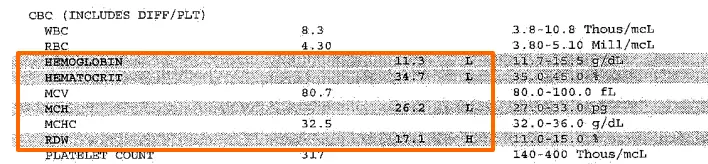
You can see from the example above that serum iron levels are low at 29, percent saturation levels are low at 7, and serum ferritin levels are low at 9 ng/mL.
This is a classic presentation for low iron and in this case, it is also accompanied by low hemoglobin, a low hematocrit, and a low MCV which is classic for iron deficiency anemia.
But recall from above that you can have low iron and low ferritin levels WITHOUT being anemic as well.
Bottom line: You want your ferritin levels between 30-40 ng/mL, anything less is considered “suboptimal” and may be associated with the symptoms listed above.
Can you have low ferritin with normal iron?
Yes, it is entirely possible to have low ferritin levels with normal serum iron studies.
This has to do with how iron is stored in the body.

Your body used ferritin as the marker for the amount of iron in “storage”. This should be compared to serum iron which is readily available for use.
Your ferritin measures this “store” of iron, so low levels of ferritin indicate that your storage is low.
So it’s possible to have low storage of iron, but adequate serum/blood levels of iron floating around.
But here’s the catch:
Adequate ferritin is still required for proper cellular function including proper thyroid function (1).
This means that low ferritin levels but normal iron levels should still be treated.
What about high ferritin but low iron?
This part can be somewhat confusing so let me explain:
Ferritin is a marker of iron stores in the body, so it would follow that high ferritin would mean you also have high iron in the body, right?
Well, that is one potential cause of high ferritin, but it’s not the whole story.
It turns out that ferritin is also an acute phase reactant.
That means ferritin may rise in the setting of inflammation (2).
So high ferritin doesn’t always mean high iron levels.
This is how some patients may have high ferritin (due to inflammation) but low serum iron levels (due to deficiency of some cause).
That’s why it’s always important to be evaluated with a fully comprehensive set of labs that includes all iron studies, ferritin levels, and inflammatory markers (including ESR & CRP).
What causes it?
Knowing you have low ferritin is just the beginning.
What is more important than knowing you have low ferritin is knowing WHY you have low ferritin, to begin with.
Low iron levels should not happen under normal physiologic conditions which means that something is in disarray if your levels are low.
The most common causes of low iron/ferritin include:
- Heavy bleeding(as is seen with a heavy menstrual flow or with heavy cycles)
- Gastrointestinal malabsorption(This is a big cause and one we will discuss at length below)
- Chronic internal bleeding(usually seen with gastrointestinal bleeding like gastric ulcers, polyps, etc.)
- Autoimmune conditions like Celiac disease (This disease usually causes intestinal damage which leads to malabsorption)
Some of these causes are easier to spot than others so we won’t focus on the easy ones.
For instance:
You know if your menstrual flow is heavy. You most likely also know if you have some internal bleeding (gastric ulcer is usually accompanied by intestinal pain, etc.).
Instead, I want to focus on the more sinister cause and least often diagnosed condition, that leads to iron deficiency and low ferritin levels: gastrointestinal malabsorption.
I will go over this in more detail below because there are many GI-related conditions that may contribute to malabsorption and it is critical to treatment because without reversing this condition your iron will repeatedly drop over time.
Now that you have a basic understanding of why ferritin is important, how to correctly identify and diagnose if you have low ferritin, and what causes it – let’s talk about the benefits of replacing ferritin levels…
#1. Low ferritin = Decreased thyroid function
One of the biggest reasons to replace your ferritin levels is because of its impact on thyroid function.
It has been shown in many studies that low levels of iron impair proper thyroid function (3).
And this makes sense, especially considering that many of the symptoms of low ferritin mimic the symptoms of hypothyroidism: decreased energy, hair loss, etc.
The good news is that replacing low iron levels should improve your thyroid function (assuming you had normal thyroid function, to begin with).
This information becomes very important if you have known hypothyroidism.
In this setting, it is extremely important for you to have “optimal” levels of ferritin in your body to ensure proper thyroid hormone metabolism, conversion, and production.
You can read more about the connection between iron deficiency and hypothyroidism here.
#2. Increases hair loss & Stop hair growth
What you may not realize is that iron plays a critical role in normal hair growth as well.
In addition, low iron (and thus low ferritin) is an important cause of hair loss in premenopausal women (4).
This is very important because many cases of hair loss are attributed to “genetics” and/or “thyroid” related problems when in reality they may be due to low iron levels.
Another study (of women of childbearing age without inflammation or other known conditions) showed that ferritin levels less than 30 ng/mL (5) are strongly associated with telogen hair loss.
This is another example showing the importance of “optimal” vs “standard” reference ranges.
If you have a ferritin level of less than 30 ng/mL and you are experiencing hair loss, then it would be worth considering iron supplementation (or at least discussing this option with your physician).
While iron is very important for proper hair growth, other nutrients (6) are also involved including zinc, selenium, and L-lysine.
If you are experiencing hair loss then proper evaluation of iron studies, thyroid studies, and other micronutrients is recommended.
#3. Decreases energy levels
One of the primary symptoms of iron deficiency is decreased energy levels or fatigue.
This is felt to be secondary to several factors:
Iron helps to carry oxygen (7) to peripheral tissues and oxygen is required for proper metabolic energy production in the mitochondria.
Low iron levels likely contribute to decreased energy production and efficiency in enzymatic processes.
The decreased efficiency may manifest as the subjective sensation of low energy.
In addition to this (and as already stated) ferritin is involved in thyroid metabolism.
Thyroid hormone is also involved in proper mitochondrial energy production (8) and one of the main symptoms of hypothyroidism is fatigue.
Nowadays chronic fatigue plagues many patients and the cause of this symptom is often missed.
If you have low energy levels (of unknown cause) this is yet another reason to have your iron and ferritin levels properly evaluated.
#4. Limits your ability to exercise and reduces your overall activity level
As mentioned low iron leads to the potential for low oxygen delivery to peripheral tissues.
This includes skeletal muscle in your body.
Decreased energy production in your skeletal muscle will result in diminished strength during exercise and a reduction in exercise capacity (9).
This usually manifests as shortness of breath during a workout (beyond what would be “normal” for your fitness level) in addition to rapid heart rate.
Both of these changes are felt to be compensatory to the decreased oxygen-carrying capacity of the body, but their effects are very important.
Diminished exercise capacity may lead to weight gain over time and disruption of other hormones involved in proper energy metabolism (leptin and insulin).
Your ability to exercise is yet another important factor to treat low ferritin if present.
If you are experiencing shortness of breath while exercising and you have many of the other symptoms listed above, then you should consider getting a complete set of iron studies.
#5. May impact your immune system
Another important (and often underappreciated) role of iron is in the immune system.
Dysregulation of serum iron levels may lead to changes in immune function and limit the cellular response to bacteria (10).
Iron is not the only nutrient involved in proper immune function, however.
If you feel your immune function is not functioning optimally then you can consider the evaluation of other micronutrients like Vitamin D and Zinc.
#6. Low ferritin may indicate hidden gastrointestinal problems that need to be treated
This may be the most important reason of all.
Low ferritin is caused by some imbalance in the body, which means that finding and reversing that imbalance is necessary to maintain normal iron and ferritin levels.
One of the more common causes of low ferritin is related to gastrointestinal issues and malabsorption of iron.
The following GI-related conditions have been associated with the malabsorption of micronutrients:
- Small intestinal bacterial overgrowth (11)
- Small intestinal fungal overgrowth
- Low stomach acid (12) (including patients taking acid-blocking medications)
- Intestinal dysbiosis (13)
- Increased intestinal permeability (14)
- Inflammatory bowel disease (15)
- Irritable bowel syndrome (16)
- Chronic constipation syndromes and/or chronic diarrhea syndromes
If you know that you already have one or more of the GI conditions listed then you have a smoking gun for the cause of your iron deficiency.
If you aren’t sure you have a GI-related issue then consider this:
You should not be experiencing gas, bloating, constipation, diarrhea, or acid reflux and the presence of these symptoms usually indicate some other GI problem.
The presence of any of these symptoms should make you consider further evaluation for the cause of these symptoms, especially in the presence of low ferritin.
Why?
Because if you don’t treat the underlying cause of your low iron levels then even if you replace those levels it will likely come back.
#7. Whatever caused your low iron levels may also be causing other nutrient deficiencies and contributing to your symptoms
The decline of one nutrient deficiency almost always leads to the decline of other micronutrients.
Why?
Because nutrients are absorbed in certain parts of the GI tract and absorption requires co-factors, stomach acid, and even other nutrients for complete absorption.
For instance: Iron requires vitamin C for absorption (17).
The combination of slightly abnormal levels of magnesium, B12, iron, zinc, etc. may negatively influence your symptoms and all contribute to the subjective symptoms you may be experiencing due to low ferritin.
This is important because replacing these other lost nutrients is critical for the complete reversal of your symptoms.
Let’s use this as an example:
Let’s assume your iron levels are < 10 (obviously low) so you decide to supplement with liquid iron or iron capsules.
Initially, you feel some improvement in your energy levels but not 100%.
What is accounting for the other 50%?
Some of this may be due to the combination of vitamin B12 deficiency that may be low as well and therefore energy levels will not improve until this deficiency is replaced.
Hopefully, this paints the picture of why replacing ALL lost nutrients is so important.
If you are deficient in 1 nutrient, there is a chance (by virtue of the same mechanism that caused the initial deficiency) you are also deficient in others.
- Bottom line: If you are deficient in 1 nutrient, there is a chance (by virtue of the same mechanism that caused the initial deficiency) you are also deficient in others.
How to increase Ferritin levels safely
If you’re planning on supplementing with iron to increase your ferritin levels there are a few things you should know:
1) Iron is very much a Goldilocks type of nutrient in your body – too little is a problem but too much also causes problems like iron overload.
This means you should only supplement with iron if you are basing your supplementation on your lab results.
I don’t recommend supplementing with iron if you don’t know your ferritin lab values and you don’t follow them.
2) Due to absorption issues (as mentioned above) most patients do better on liquid forms of iron.
Liquid iron is more readily absorbed and should NOT worsen constipation.
If you are unable to tolerate liquid iron (due to taste or some other problem) then switching to capsules is fine, but start out with liquid iron if possible.
3) Very low levels of ferritin may require IV iron infusions (depending on the cause).
This doesn’t apply to the majority of people out there, but if your ferritin levels are extremely low and you are unable to raise them then you should consult with your physician.
4) Patients taking Thyroid medication should not use iron within 2-4 hours of taking their thyroid medication.
Iron may decrease the absorption of thyroid hormone and these should be taken as far apart as possible.
In other words, hypothyroidism sets up a physiologic situation where iron deficiency is more common than in the general population.
To avoid absorption issues with thyroid hormone it’s best to take your iron supplement in the evening if you take your thyroid hormone in the morning.
5) Patients with Iron deficiency frequently also have Vitamin B12 deficiency.
For this reason, I frequently recommend checking both iron and B12 levels simultaneously (more information below).
B12 plays an important role in your energy levels (as does iron) and deficiencies of both may be contributing to your overall symptoms.
You can replete B12 levels with a high-quality over-the-counter B Complex.
Can low Ferritin lead to weight gain?
Another common symptom that many patients with low ferritin will experience is weight gain.
The connection between low ferritin and weight gain definitely exists, but exactly why it occurs is less understood.
Based on the interaction that ferritin has with thyroid function and thyroid conversion – this is most likely the reason that patients experience weight gain with low ferritin levels.
Low levels of ferritin reduce thyroid hormone production because an enzyme in the thyroid is required to create thyroid hormone.
This enzyme is known as heme-dependent thyroid peroxidase.
If thyroid hormone production falls then your metabolism will suffer, which means you will be burning fewer calories at baseline.
A reduction in thyroid hormone also promotes changes to other hormones resulting in resistance syndromes such as leptin resistance and insulin resistance.
Part of the problem with weight gain and low ferritin is that some patients are refractory to iron replacement therapy.
This may lead to a situation where replacing iron is required in order to lose weight, and you may ultimately need iron infusions to replete ferritin and iron stores in the body.
Recap & Final Thoughts
Iron is a critical nutrient involved in many biochemical pathways, the deficiency of which may lead to many negative symptoms.
Ferritin is used as a marker of iron stores in the body and low ferritin levels generally indicate low iron stores.
Low ferritin levels should be treated with liquid or iron capsules until ferritin levels rise into the 30-40 ng/mL range (this is considered the optimal range).
It is possible to have high ferritin levels but low iron stores due to how ferritin’s action as an acute phase reactant.
Remember that other nutrient deficiencies also tend to accompany iron deficiency and these must be treated as well.
Finding and treating the root cause of your iron deficiency is critical to long-term success as a lack of diagnosis of this problem may lead to persistent low iron levels over time.
Now it’s your turn:
Are your ferritin levels low?
Has supplementing with iron helped to improve your energy levels?
Why or why not?


I have low ferritin but normal serum iron. I have been using Floradix for 6 months now or so and haven’t seen a huge improvement. Have increased dosage to 10ml twice daily and am awaiting new tests.
Some literature says that low ferritin levels with normal serum iron levels suggest metal toxicity like copper and need to be detoxed.
What is your opinion on this?
Hey Amy,
The only literature I’ve seen shows the association between iron deficiency anemia and heavy metal toxicity, if you provide links to the studies you are referring to I will be happy to take a look.
Thank you so much for this helpful post! Just wanted to see if you had any updates about the association between metal toxicity and low ferritin with normal/mid range iron serum. I had overall low numbers but I’ve been supplementing with desiccated liver supplements, and though it’s risen a little bit, my ferritin is still only 13, and my total iron has risen from 101 to 135 (40-190 range). I too am concerned about heavy-metal toxicity after reading a post on stopthethyroidmadness. I haven’t been able to find much information otherwise though, and I am trying to consider my next steps for supplementation/detox testing… Any information you have to offer would be greatly appreciated!!
Hi Dr. Childs!
I really enjoyed reading all of the information you provided here. Just to put this out there, I have consulted with my bariatric doctor, but I was wondering what your thoughts were on the matter.
I had RNY Gastric Bypass in 2017. Recently, I have been fatigued and irritable. I followed up with my doctor for routine labs and these were the results:
Total Iron: 62
Iron Binding Capacity: 408
% Saturation: 15
Ferritin: 4
Hemoglobin: 11.7
Hematocrit: 37.2
MCV: 88.6
MCH: 27.9
MCHC: 31.5
I have been taking a multi-vitamin, iron, and b12 specific to gastric bypass patients.
Any thoughts on my levels and where to go from here? I have also recently started taking Vit. C to help with the absorption of iron, but I am SO tired!
I look forward to your thoughts.
Thanks,
Emily
I have Hashimoto’s, had total thyroidectomy in 2005 and RI due to thyroid cancer. Have had low iron since teen years (now 46) despite taking ion supplements for years! Have taken floradix and other preparations (some I can’t take as they affect thyroid Med absorption even if taken 12 hours apart). I have tried taking with vit c, apple cider vinegar and digestive enzymes. Cannot get ferritin levels above 12 (normal range 12-200). Doctors don’t see reason to get above 12. Any other suggestions?
Hey Shelley,
You should have your GI tract evaluated for problems such as SIBO/SIFO, IBS, etc.
Doctor..would an abdominal scan suffice?
My daughter has low ferritin (12), but high iron (25). She also has low folate… My doctor told me to give her iron supplements, but I’m not if I should since her iron is high… Thoughts?
Hey Amanda,
Lab results aren’t helpful unless given in units with accompanying reference ranges since each lab does it slightly different. I can’t speak to your daughters condition because I don’t know anything about her situation.
Ferritin 12 ug/L
Iron 25 umol/L
Tibc 64 umol/L
%sat 38%
Sorry… Forgot the reference ranges
Ferritin: 14-79 ug/L hers =12
Iron: 2.8-22.9 umol/L hers =25
Tibc: 43.4-76.5 umol/L hers =25
%Sat: 14-55% hers =38
Correction – her tibc is 64 as originally stated
Have her checked for Hemochromatosis.
Hi Dr. Childs,
I just want to first say Ive watched your youtube videos and came here to your website and thnk you so much for sharing your knowledge! About a year ago I started experiencing a ton of symptoms…dizzy spells, lightheadedness, fatigue, weight gain, my anxiety went through the roof, i was seeing spots in my vision. I saw eye doctors, my family doctor, a GI. Labs came back “normal” according to docs and all they found was i had a ferrtin level of 7, and low D, i was prescribed iron supplements and thats it! I cant get doctors to listen or take me seriously…I know my body and I feel strongly based on what ive seen in your videos and website that Im hypothyroid and extremely fristrated i cannot find a doctor who knows as much as you do. Many of the symptoms you talk about Ive dealt with. Im a busy 32 architect in New Mexico and too young to feel this way the rest of my life. Do you offer consultations/ correspondence for those of us who would like to discuss our situations further? I apologize if this got too long Im just so impressed with how much you know about this.
Hey Vanessa,
I am not accepting patients anymore but one of the best things you can do is find someone who understands what I’m discussing on my site who can help you further.
Hi Vanessa,
I read your post from about a year ago now and I live in New Mexico as well and suffer from the same symptoms. Was wondering how you are currently and if you found any relief/help?
Ferritin level 16.4. Didn’t increase after 6 months of 325mg of Ferrocite. I was sent to GI doctor. He ran a series of tests: colonoscopy, EDG, and I
Ultrasound. Nothing found gastro, but a there is a growth on my uterus. Have been referred to a gynecologist. What that cause low ferritin? I’m age 52, went through menopause a year ago….
Hey Sheika,
Make sure you get evaluated for gluten sensitivity/celiac’s.
It was negative for celiac…
Then you can check for non celiac gluten sensitivity as well.
I have Hashimoto’s and not tolerating any THRT. My recent labs are below. What are your thoughts? Thank you.
Iron Blood – 186 mcg/dL (59-158)
Ferritin – 31 ng/mL (30-400)
UIBC – 159 mcg/dL (112-346)
Total IBC – 345 mcg/dL (148-506)
Iron Saturation – 54%
Cortisol Blood (8 am) – 8.6 mcg/dL (6-18.4)
What are the implications with low ferritin, high blood iron, and potentially low AM blood cortisol? Thank you
Hi, I’ve been having so many crazy symptoms since April, was diagnosed with chronic gastritis back then. Thinking back I did have shortness of breath and one bout of dizziness when exercising back then. Skip forward to August, had dry sore throat for about a month, fatigue, ENT scoped my throat and said maybe silent reflux and that my salivary glands were dry. He recommended going on an alkaline diet. I changed my diet and cut out many things, lost 30 pounds, and started getting very ill. Nobody could find anything wrong except that my liver enzymes were very high (maybe due to prescribed Zantac, which I stopped taking?), US showed bad gallbladder, so had that out, and liver went back to normal. But very funky symptoms continued, shaking, intolerance to cold, high heart rate but low bp, pain in upper left back, trouble breathing, upper back pressure, feeling like I had the flu, eye flashes, and now shoulder pain (like rotator cuff pain). My naturopath did an iron panel and my ferritin showed an 8, iron binding 404, UIBC 339, transferring saturation 16, RBC 4.44, hemoglobin 13.4. In looking back at older bloodwork, in January I had a hemoglobin of 12.0 and RBC 4.05, and in December I had a low RBC right below lower normal. My GP never mentioned anything about low iron ever. I think it was dismissed because it wasn’t extremely low, or maybe because I had my gallbladder removed? When evaluating my diet I realized I wasn’t eating many things that were high in iron. I’m taking Ferrochel now for two weeks and the breathing is getting a little easier, still feel achy and not well. Adding in Floradix. My question to you, and I hope you please answer me because I’ve been suffering for so long, can low iron stores cause all these crazy symptoms? I’ve had every MRI and test done and nothing has been found. Will be seeing a gastro in a few weeks, I did have a colonoscopy five years ago that was completely normal. I’m 52 and not in menopause yet. Thank you!!
Hey Suzanne,
Low ferritin by itself would probably not account for all of the symptoms you’ve bene experiencing. It’s likely a combination of factors all contributing.
I was taking Ferrochel to boost my ferritin, and it was working, however it also caused my cholesterol to rise from 163 to 248! A nurse told me that taking iron supplements will do this, and they no longer advise taking it. So how can you boost your ferritin? Have you heard of iron supplements causing high cholesterol?
Suzanne, I say yes!
Sounds like most of my symptoms plus a few more! My ferritin was at 6… nothing else came up a red flag though.
I know this post was from a few years back, but I’m now 55 and experiencing pretty much exactly what you had gone through! Drs don’t tell you anything! They make you seem like it’s all in your head! Finally found out the my ferritin levels are low… caused by probably a few different things. But one big thing i had was terrible acid reflux, GI dr put me on a PPI.. I told him that I can’t take them.. he said it’s a very low dose try it. A week later my hands and legs were going numb and pain in all my joints. Story continues but I won’t elaborate.. just want to ask how you are feeling? I started iron supplements but low dose because I’m afraid of side effects.. no improvement yet but it’s only been
A week. I am too young to be feeling so awful!!
I know this is an old post but your symptoms sound similar to Lyme and/or Multiple Sclerosis. Hope you got the help you needed. If not I recommend the Igenex Immunoblot test for Lyme.
Daughter 19,diagnosed with Hashimotos at 15,not put on anything .Has menstrual cycle maybe 4x a year,very light. Has had insomnia over 5 years,always had belly, gained weight easily although eating good.went to college came home at break;gained 40 lbs,always sleeping,ferritin level 3,low ironoise and d,white blood cells low,thyroid antibodies very high, thyroid not functioning.she does have absorption issue. She is taking 975 Mcgraw iron a day and 50 synthroid, still feels horrible..her doctors don’t have a clue..what tests/actions do you suggest. I am worried about Iron amount. Thank you
Hello, my ferritin has been between 6-9 for the past 18 months, despite a year of taking 2-3 liquid iron supplements a day, with orange juice (Spatone). Coeliac blood test is negative, but no other investigative work has yet been done by my GP. I tried but couldn’t tolerate iron tablets. I’m not vegetarian and have lots of spinach, meat, and pulses in my diet. Any ideas?
Hey Rara,
Ensure that you have proper stomach acid production and proper thyroid function in your body.
spatone is not great for upping your ferritin. It only has 5mg of iron and you probably only get 2mg. if iron tablets dont suit you, then try a liquid preparation.
Afternoon Dr.Childs,
I have been going through this battle of iron malabsorption, extremely low ferritin levels for 3 years now. Have tested negative for colon cancer, multiple myeloma, leukemia, lymphoma, Celiac, Chrons, colon cancer, you name it. Have had my GI checked, upper/lower endoscopy, camera pill- nothing seen. Went from every 6months of IV Iron to every 3 months, to 2 months, and now today have been setup for every 6 weeks. I have been unable to function regularly in life due to the weakness, fatigue, joint pain, etc. Thyroid checked, etc. Even checked for rare congenital genetic mutations… Nothing… Im 29yo with 2 kids under 8yo and am really trying my best to not give up on it all, but I need some type of answers. What do you think I should do at this point or where to look?
Test for SIBO!
Hi Shannon,
You have to take iron on an empty stomach. You have to wait for 2 hrs before eating. Once you’ve eaten you must wait 4 hrs before you take your iron and once you take your iron you must wait for the 2 hrs before eating. Solgar has a gentle iron. Try 1 2 times daily. Check your numbers every 2 weeks to see if it’s rising. If not take 2 Tbs 2 times daily. Do not take calcium or drink dairy near your iron supplements and watch coffee near it. The other one that works great is Floradix liquid iron. 10ml 2 times daily. I hope this helps.
Hi doctor, please advise me , my iron supplement is 65mg equivalent to 325mg Ferrous Sulfate once daily is it enough ? my iron test. 65 ug/dL. Ref. 37-160 Transferrin saturation. 18%. 15-50. UIBC. 279 ug/dL. 135-392. TIBC. 362 ug/dL. 250-450. Ferritin 11 ng/mL. 15-200. Heamoglobin. 12.90 g/dL. 12.5-16.
My daughter has low ferritin attributed by a rheumatologist to her ehlers-danlos. The first measurement was 8. It returned to normal but recently went from 75 to 22 in about two months. She restarted the prescription ferritin but had extreme stomach pain. We are going to try liquid. Btw her rheumatologist wants it 80-100 based on her conditions although he understands this is higher than most recommend.
Hello Dr.Westin. Sir i am worry for the treatment of my sister she is 32 year old have 2 child from 6 month she is under treatment of iron and ferritin defficiency she have facing tiredness , weakness , headacehes pain ,lack of sleep lab test of ferritin showing 9 and iron is 24 please advise treatment.
The article states:
Low ferritin levels should be treated with liquid or iron capsules until ferritin levels rise into the 30-40 ng/mL range (this is considered the optimal range).
After I reach the optimal range, do you recommend stopping the liquid or iron capsules? Or perhaps cutting back?
I’ve taken the supplements before for 4-8 weeks and found that my levels dropped again about a month or so after I stopped.
Hi nicole,
Assuming you can fix whatever problem is causing you to be deficient then you don’t need further supplementation. If you can’t fix that problem, or don’t know what it is, then you will likely need indefinite supplementation.
Hello Dr. Westin,
Our daughter is a high school distance runner suffering with a ferritin of 13, she felt the affects this track season with much slower times and just very fatigued all around. Her pediatrician does not understand ferritin. She is taking 3 Proferrin a day, for a month now, we would like another blood test however we are not sure the Dr. will approve one. Online blood test companies do not allow for children to be tested, should we see a Hematologist and would we need a referral? hoping to get her levels up before cross country starts.
Thanks so much!
Hi Keli,
I think a referral to a hematologist is a reasonable next step. Most physicians will ignore a low ferritin in the setting of a normal Hgb, so that may be the issue you are facing.
Hi,
I’ve just been diagnosed with SIBO while also getting the results that my ferritin levels are on the low side (20). My naturopath put me on Vitanica Iron Extra Formula, which contains 25 mg iron. So my question is this: With the understanding from a few things I’ve just read, would it be worthwhile to be taking Iron supplements while on the SIBO diet, or will the iron aggravate the bacteria and therefor make everything worse? My hair is falling out like crazy, so I’m hoping there will be some good to the two treatments at once….what are your thoughts?
Thanks,
Anna
Thanks Dr Westin, for your post. It took a few doctor visits to figure out I was low ferritin and normal-low range for iron. I had a blood panel right away, which showed I was not anemic. But I did not get an iron panel until later. Just wanted to let you know your post was exactly what I needed.
Sincerely,
David in Colorado
Hi David,
I’m glad you found it helpful. Hopefully you get your ferritin figured out and feeling back to normal soon.
Thanks Dr Westin, my doctor recommended an iron supplement to take with Vitamin C. I did have some questions I was hoping you could answer:
What is a rough timeframe to get ferritin retested? It was 15 when I started iron supplementation, and I’d like to stop supplementation in the 30-40 range. I’m taking 29mg/day of Iron Glycinate.
Do you know how long it can take telogen hair loss to stop and reverse? Thanks.
Thanks Dr Westin,
Your article is spot on, thank you.
Modern medicine only seems capable of diagnosing with blood tests these days, ignoring symptoms. I’ve been repeatedly tested for Thyroid (basic panel) for 10 years and always been in the normal range so told nothing was wrong with me. Finally, my OBGYN decided to run an iron panel and of course very low Ferritin was the diagnosis. I’d been complaining of among other things, hair loss, inability to exercise and unexplained fatigue, despite being fit and active all my life. Anyway, the treatment: iron supplements and further testing in 3 months. Ferritin levels remained the same on that blood test but of course saturation tripled. My Dr said to stop taking supplements after I complained of the stomach ache and he’d test again in another 3 months. Any ideas why he’d suggest this? And yes, that’s going to be 9 months total since the diagnosis of low ferritin but no investigation of why, all he’s tested for is stomach cancer and a blood test for celiac.
Meanwhile, I hated the return of the symptoms so went back on the supplements but this time taking them in the evenings with 500mg of Vit C to stop stomach ache (helped a lot).
Now I seem to have heart pain and am awaiting his response to this.
Thanks for empowering us patients to be our own Drs.
Hello
My Neurologist did a ferritine and it was 17 he said normal was between 35 350 for my age 47 I have chronic unbearable leg pain and RLS tingling legs shortness of breath ect.Im very comfortable w my Dr he has me taking B12 Iron Vit C but my leg pain is so severe could you explain why the leg pain is so BADDD example of how i explain the pain
You go to the gym do the workout of your life and you cant walk the next day feeling like you have ripped every muscle tissue from dead lifts. Or ran a marathon I just really CANT WALK the pain is so BAD ive always been in the gym active was a gymnasts up until college Im confused as to why the PAIN i understand the low level and am on my way to hopefully reversing this. Please EXPLAIN this leg pain
My time w my Dr in my appts are 30 min and I never get to his answers as to my pain
Thank you for thr explanation if you have one please help im a mom of 4 active kids and im using a CANE
I’ve been doing accupuncture and it’s given me some relief!
I was diagnosed with periodic limb movement disorder, not unlike restless leg although it is different….. and found out that low ferritin can be a cause. My level was 18, I’m on iron supplements. It is helping. Try it.
Thank you, Dr. Westin, for your informative website.
I was diagnosed with Hashimoto’s 15 years ago and was put on thyroid meds. After nine years of taking Synthroid and Cytomel with occasional success, I decided to go off the meds and attempt to control my symptoms naturally. After many different diets, including a strict vegetarian diet, I started following a gluten-free plan two years ago. Since then, my TPO antibodies have dropped from 400 to 80! A huge success in my opinion. I am now on a dairy-free diet to try to get my numbers to drop to 30.
I had been successful in controlling most of my symptoms until three years ago when I developed a tremor and my hair started shedding excessively, about 400-500 hairs per day. These symptoms began after I trained for and ran two half-marathons and experienced a major life crisis, all within a few months’ time. Since then, my hair has fallen out regularly with two to three month breaks from the shedding in between major hair loss “events”. I have had very little new growth. No matter what I do, I can’t seem to stop it. I walk three to four miles daily, eat a clean, organic diet, and use safe household and body products.
Three months ago I started taking Pure Encapsulations iron with Vitamin C and within a month my hair loss slowed. Then my naturopath told me to stop the iron because I would cause more harm than good (something about causing anemia of chronic disease, due to autoimmunity, if I take an iron supplement). I listened to him and stopped the supplementation. Now, I am losing so much hair (worse than I have ever experienced). I actually have bald spots all along my hairline, my temples are receding, and the hair on the back of my head is incredibly thin. I call it cotton candy hair. I am also sad all the time and have zero energy (I am normally a happy-go-lucky person with endless energy).
My family doctor is treating me with progesterone/estriol cream to try to shrink fibroids, recently diagnosed. I’ve been on the hormone cream for three months. My testosterone is also low but she says this won’t cause hair loss. I feel like I cannot receive consistent answers from my doctors. I would appreciate your input if you have time, especially where iron supplementation is concerned.
Here are my iron-related lab values:
TIBC – 376
UIBC – 321
Iron, Serum – 55
Iron Saturation – 15
Ferritin, Serum – 7 (yikes)
Hemoglobin – 13.8
RDW – 13.6
RBC – 4.31
WBC – 4.6
MCV – 95
MCH -32
MCHC – 33.7
Platelets – 269
Thank you!
Looks to me like you are low in b12. Your MCV is 95 anything above 90 typically points to b12 deficiency and or folate. I would get mma test best way to tell deficiency.
B12 can cause nervous system and brain issues. When my b12 goes below 550 I can’t walk straight I get dizzy and short of breath. I have double mthfr genetic mutation so I need way more b12 then most.
Your MCH looks a little on lower side and MCHC but not horrible. Your platelet count is down typically for me when I’m low in iron my platelet count goes higher and neutrophils go higher and my egfr function goes lower. My hemoglobin and hematocrit drop but hemoglobin never goes lower than 10 even if my ferritin is 6.
Do you know if there is a connection between low ferritin levels and the MTHFR mutations?
Thank you.
Thank you so very much. What a complete read this was for me. I had low Hemaglobin and RBC counts and went for iron infusion. I did not completely understand why the Hemotologist was far more interested in the Feritin report. He explained it but this was much more of an education. Thanks again.
My ferritin is at 11 right now. I have battled with this for the last 5 years since my last son was born. I have tried every type of iron supplement and I had 6 iron infusions 2 years ago. My b12 is on the low end too. The Dr thought that it may be due to my period so I got an iud but it didn’t work. I tested negative for celiacs. I am getting so frustrated with having no answers and being so tired.
Dear Dr. Childs,
I am hoping you might be able to help – my 1.5 year old’s ferritin is continually low. 7 in March of this year (reference range 10-75), then down to 5 at the most recent test, even after we had upped his red meat intake and given a vitamin and mineral with added iron. His Hgb has always been fine (I cannot recall the values exactly; they were lower end of normal but still normal). His doctor has since given him a higher dose liquid iron supplement (Galfar, which contains ferrous fumarate) and we were told give him 5mls a day. We are not due back for another test for another few months but in the meantime I am quite concerned about him. He is really irritable, extremely hyper and suffers alot of bloating also (Coeliac screen came back negative). Is there anything else you would suggest please?
I have Hereditary Hemochromatosis, yet haven’t needed a blood draw in over a year. I’ve been diagnosed with chronic prostatitis, diverticulosis, and acid reflux. My iron level keeps dropping (still barely above minimum), and today my ferritin was 42 (from 58 3 months ago). Up to around a year ago, my labs were like clockwork, needed a phlebotomy about every 5-6 months if I was careful with diet. Now, I eat whatever I want, to include stuff like liver, and take Vitamin C supps. That’s probably the only reason my iron levels are above minimum.
I’ve had massive gut problems of all sorts, that got far worse around the same time I quit needing phlebotomies. I’ve suspected internal bleeding. I’ve got tingling/numbness in my extremities, and tired all the time. Keep asking them where the iron is going, doctors shrug. Hematologist could care less, “I only manage your hemochromatosis”.
What should I be saying or doing, to get this looked at? Or should I just chill out?
Hi Jon,
You certainly could have some sort of intestinal absorption issue related to some malabsorption syndrome such as Celiac disease (to name one condition that might cause something like this). You could try something simple like B12/B6 supplements to see if it improves your numbness/tingling and ask for serum b vitamin blood tests.
Doc; large laundry list of testing for Celiac et al. all normal, colonoscopy normal, CT with contrast normal. Or at least normal for someone who had untreated Hemochromatosis for 50 years and other minor stuff. Iron/ferritin still slowly dropping, but not at dangerous levels. GI doc sez he’s seen/heard of patients with Hemochromatosis iron/ferritin levels flattening out after long term treatment. Whether that’s temporary or not, didn’t know.
Also, I’ve found that fasting for 1-2 days when the abdominal symptoms get bad seem to clear them up for a couple weeks, then slowly start coming back. Rinse and repeat as needed. Right now, at the “low grade nausea and minor gnawing pain” stage. Still got the tingling/numbness in extremities, and Vitamin sups didn’t seem to make much difference. May have made slight difference, but not enough to tell whether it was imagination or not.
I guess just chill out, and watch levels.
I appreciate both your response and advice!
My daughter has low feritin 25 level but normal iron 13.9 and B12 *874. She is losing her hair, is breathless and has has increased palpitations and chest pains. She has low risk Brugada syndrome. She has been advised to increase her fertin levels.
You recommend Optiferin-C but looking at the ingredients I don’t see feritin listed
Hi Karen,
Ferritin is a serum marker for iron, so if you have low ferritin you want to take iron to increase ferritin levels.
My Son age is 8 Month. His Hemoglobin found by lab 8.2 gm/dl, Serum Ferritin is 3.60 ng/mL. Please advise his treatment and care procedures. He has been taken mother breast milk only upto 6 month age and now also with some extra food after 6 month of his age.
Today I got test results showing I have a ferritin level of 2 and after reading the symptoms I am actually relieved to finally see that everything I have been experiencing seems to correspond with this. It’s at least some explanation for the fatigue, heart-racing, hair loss, tremors, nightly leg cramps, depression and weight gain. My hemoglobin level has tested at 8 for several months now when I finally got it tested and I have been on 325 mgs of ferrous sulfate for a couple of months. When I called my doctor about the low ferritin level I was really hoping he would give me iron infusions or even a blood transfusion to help me feel better. I’ve read others posts about how much better they made them feel and want the same. The only thing my doctor did, however, was suggest I perhaps increase to two 325 mg supplements a day. He is totally attributing my anemia to heavy menstrual cycles. Should I consult another doctor? I am so so tired of feeling so terrible and just am not seeing any improvements from supplements. There has to be something more proactive to treat this. Can you help me?
Hello,
I have had low serum ferritin for several years. It is currently lower than it has ever been at a 2.4. Lab says the normal range is 15-150. My Hemoglobin and Iron Serum are normal. TIBC is high at 475 (250-450), UIBC is high at 435 (131- 425) adn iron saturation is low at 6 (15-55%). My tranferrin saturation is also low. My blood tests have been consistently low/high like this since 2013. My doctor said these results are all normal and are not causing my symptoms. My symptoms she can’t explain. I have restless leg syndrome, my hair is falling out, I am dizzy, have numbness and tingling in my arms, I am so tired I struggle to get out of bed and my brain is foggy. I can’t concentrate. While on my period symptoms get worse and I often pass out upon standing. Prior to 2013 I was a marathon runner. Symptoms became so severe I stopped running. Since then I have gained 60 pounds. I feel awful and I am miserable. I take iron supplements twice a day on my own despite my doctor saying I don’t need them. My ferritin levels continue to decrease. I am not sure what else to do. Is there a doctor other than a primary care I can see to be treated? I have seen 3 different primary care doctors since 2013 and was told by all that the abnormal levels are nothing to be concerned with. I am certain the cause is heavy periods, however everything my OB has done to lesson my periods has been ineffective. My OB suggested a hysterectomy, however my insurance denied it because I am 40 without life threatening issues. So I need to find a way to treat the blood loss until I hit menopause and the iron capsules are not cutting it.
Kristi, read this book on Iodine deficiency by Dr. Brownstein. I started taking Iodine a couple weeks ago, and about 2 days in, my bleeding finally stopped, my energy soared, and my brain fog ended. Iodine can eliminate or reduce the size of fibroids, and ovarian cysts, and if so, you could get your periods under control, and the loss of blood. I started with the iodine, and now intend to continue the progress with iron supplements (my ferritin has been as low as 5).
https://www.amazon.com/Iodine-Need-Cant-Live-Without/dp/0966088239/ref=la_B001JS8VBW_1_2?s=books&ie=UTF8&qid=1510342610&sr=1-2
Unfortunately, we’re mostly on our own with this. Even some of the best intentioned Dr.s can’t connect the dots for us.
Best Wishes!
Kristi, get a referral for a reproductive endocrinologist. I’m having all the things Dr. Was talking about and I went to my PCP and said ” look I love ya, but I’m not me and we need to figure this out!” If I need to I will find another doctor and I walked out of the office that day with 3 referrals and 2 scripts for aqua therapy and acupuncture!! (Fibromyalgia) but seriously do what I am telling you!!!
I had red hemoglobin of 6 and ferritin level of 22 and my Dr sent me to the ER where they gave me blood transfusions, 2 units plus a unit of iron. Within 2 weeks my levels gradually went up to hemoglobin 13.5 and ferritin 90. That lasted 18 months. 4 months ago it returned but my hemoglobin is 10.5 but my ferritin bounces up & down from 36 to 26 to 22 & today is is 27. I’ve been getting iron infusions weekly since November and levels don’t go up past 36.
I would suggest you go to the ER
I’m really confused on the ranges posted saying iron is normal at 15 Etc. Also range of 30-40 optimal every hematologist I go to think ferritin at 50 or under is bad. They want it into 111 range. I look at lab ranges and they don’t match any of what this. Dr is saying? So confused
SUZANNE!
I cannot believe that I have found someone else with identical symptoms..
The chronic gastritis, gall bladder removal,low ferritin, back and shoulder problems, anxiety,etc etc.
I too am sick and tired of feeling this,way. I have exceptionally heavy periods and have been taking ferrous fumarate since Aug 2015, only managing to get my levels up to mid 20’s.
Have you had success with any treatments or found a sympathetic doctor yet???
It really is debilitating and frustrating.
Hi Emma, I now know that I have reactivated EBV which was probably brought on by low immune system due to perimenopause or low ferritin or both. I was taking iron supplements and slowly working my ferritin level upwards, but a nurse informed me that iron supplements can increase cholesterol levels. So I had mine checked and found that my cholesterol went from 163 to 248! I stopped the iron. However, just recently I had my ferritin checked and I was back down to an 8. I’m going to try the liquid iron that the doctor recommends on here and see if that helps, and keep an eye on my cholesterol to see what happens. I have alopecia, have had it since childhood, and while I was on the iron my eyelashes and eyebrows grew back! I think I’ve probably had low ferritin all of my life.
How are you feeling?
This post has been incredibly helpful! I’ve been seeing naturopathic, and longevity Dr.s for some time. Although they haven’t been able to completely connect the dots with my health issues, I have at least compiled a solid history of blood work, which is something my PC physician would never have done. I’m so thankful for the internet, which allows us all to take control of our health! My blood work, and internet searches led me to this site, and Dr. David Brownstein’s work. Supplementing with Iodoral iodine has changed my life, and now I’ve got another missing link with iron supplementation.
Over the past 6 years or so, my primary symptoms were/are:
Ridiculously heavy periods–I switched to a new Gyn when he told me, “they’re probably not as heavy as you think they are”… no blood work, no recommendations. New Gyn recommended surgery to remove fibroids, and ovarian cysts last year. It didn’t work. Periods are still just as heavy. This Dr. also didn’t recommend irons supplements.
Fatigue– Formerly athletic. Now when I muster the energy to exercise I spend 2 days recovering. Going to bed around 8, only to wake up feeling like I partied all night.
Brain Fog–Forgetful. Extended mental focus drains my physical energy. I’ve lost my mental sharpness.
Weight Gain–I figured it was due only to inactivity, but hormones are definitely a factor as well.
High Cholesterol, and Blood Glucose–NP warns me about pre-diabetes, but only the strictest of diets keeps it under control.
My thyroid hormones are out of range, but not alarming, so NP prescribed Armor Thyroid. I couldn’t tell a bit of difference, even after a month.
My CBC has consistently shown values on the low end of normal, except for ferritin, which has bounced between 5 and 12 for about 5 years. I take iron for this, but only noticed a slight improvement for a couple weeks, then it leveled out.
I began supplementing with iodine 2 weeks ago, and within 2 days my energy came flooding back! Blood glucose is much lower, so I’m also expecting a lower A1C on my next check up. Also, my never-ending period stopped, within 2 days! I’m finding now that my symptoms are all connected to my thyroid, which wasn’t working properly due to a lack of iodine (very common apparently). Fibroids, fatigue, ovarian cysts, hair loss, cholesterol, blood glucose, can all be corrected with appropriate doses of iodine. However, I read supplementing with iodine can increase the body’s need for iron, which lead me here. I’m feeling amazing, and don’t want to crash due to an iron deficiency. I can see from this article that there is a great deal of overlap in symptoms, but also that the thyroid and iron levels are interdependent.
How much iron can I safely take, and expect my body to assimilate? I will be purchasing Floradix, which I understand is a lower dose than most, but more absorbable.
Thank you Dr. Childs! This information has been life changing.
Dr Westin, thank you for your informative article here. It helps to know that we are not alone in our quest to find answers, and I love that you focus on causes as well as solutions, which is something most GPs will not do, unless you fit into an easy-to-diagnose box. I understand that you have little time to reply to comments here, but I hope that my post will at least reassure others that they are not alone – and maybe even help in my own quest for renewed health and energy.
I have had low ferritin (anything from 4 to 15) for as long as I can remember. I’m vegetarian, with a healthy diet, and have normal haemoglobin and vitamin B stores. I’ve had all checks, from vitamins to thyroid levels, and all are fine. It’s just the ferritin that I cannot seem to up without iron supplementation.
The low ferritin alone doesn’t worry me so much as the decades-long chronic fatigue which I have always put down to a problem with sleep cycles/quality. The fatigue is particularly bad on first waking, when I believe iron stores should be at their highest, and it continues regardless of how high my ferritin levels are. Alongside this, I have battled with undiagnosed chronic bloating. Over the last year, I have developed brittle nails with hangnails on almost all fingers, constant diarrhoeoa over the past 6 months or more, and hair loss. From this article, it seems that most if not all of these things are due to low ferritin, though this doesn’t account for the morning fatigue when iron stores are supposed to be higher than throughout the day. Memory is also very, very poor and has been so since my 20s.
I have taken iron supplements in the past and having read this, I may try again to get the ferritin stores up. However, I am reluctant due to articles – particularly by Ray Peat – which suggest that iron supplementation can be both aging and, in some cases, harmful.
I’m determined to find answers IF the tiredness doesn’t kill me first (!) and would love to hear from others who are experiencing the same symptoms.
Dr. Childs,I have searched everywhere for a doctor who can help me figure out why I have tremendpus hair loss from taking Synthroid. I did not have hair loss before atarting the meds. The hair loss is in direct correlation to the medication. When my thyroid is optimal and I amd taking the “correct dose” of Synthroid, my hair sheds terribly. I have lost almost half of my hair. Do you think I have nutrient deficiency that causes this effect? My ferritin is 33 (range 20-150). I am currently supplementimg iron as well as other minerals. Nothing seems to help unless I stop the meds all together. Then I feel tired and have body aches. I have seen 3 endocrinologists and several GPs. No one knows the cause or takes me seriously. It is so depressing to see my hair come out by just touching it. I am 42- too young to be bald 🙁
Hi. I have just finished having an acute asthma exacerbation of several months duration, which was causing by exposure to cat dander. My IgE is 2,092. I had weakness, too, and my D3 levels were insufficient at 26 and my ferritin was 37, hemoglobin 14. Because I also have restless leg syndrome, my doctor put me on 60 units of iron a day as ferrous fumerate. I have been supplementing for 3 months. My D3 levels are now 45, but my ferritin is down to 30, even taking iron every day. The doctor did not recheck my hemoglobin. Should I still take iron supplements? Could my severe asthma inflammation have caused my low ferritin levels — chronic inflammation anemia? My asthma is now mostly under control and away from the cat dander. As inflammation decreases, will ferritin increase? Thanks! Veronica
I have a Ferritin Level of 22.1 ng/ml-Reference range 11.1 – 264.0 ng/mL. They haven’t tested for iron, however, I did have a B12 level of 361 and been getting B12 shots for about 3 months. Also in November my MCV went from 98 to 103. I was diagnosed with CLL (Chronic Lymphocytic Leukemia) in 2005 and actually doing pretty good with it. But in the past 6 months I’ve been extremely fatigued and losing lots of hair the past 2/3 months. Do you think I need to take extra iron?
My 16yo daughter donated blood for the first time recently. She received a letter from the donation agency deferring her from donating for 12 months due to low iron. The letter also states blood tests show ferritin is such a low value: <8mcg/liter, as iron stores are absent. Now that we were notified I realized, my son received a similar letter for 6 months deferral, and I have not been able to pass the simple finger print iron test in months. Now remembering my mother had to some health issues years ago (has since passed).
DR. called her at work to tell her that her labs were back and her hemoglobin level was 4 and she didn’t understand how she was even able to stand let alone work and to report to the nearest ER to have a blood transfusion and emergency hysterectomy. I was not told any other details. I also remember her saying she loved liver and onions so much when pregnant with my older brother. My son has always had weird eating issues as he would lick dirt and eat flowers as a toddler but iron finger pricks always testing good/high iron. Still today at 18yo he eating paper napkins and straw rappers.
Is there any hereditary conditions that I should have myself and my children tested for specifically?
Hi Robin,
The condition you are referring to is known as Pica (the eating of substances with no nutritional value) you can read more about that here: https://en.wikipedia.org/wiki/Pica_(disorder)
And yes, it would be a good idea to get tested for both hereditary issues as well as absorption issues such as Celiac disease. Your family practice Doctor should be able to help with all of these as they are fairly easy to test for with a complete blood count and a few other tests.
Diagnosed Hashi’s for 7 years now and on meds. Regular iron and B12 levels, but always low on ferritin (8)and Vit D. Highest I can get ferritin is 14 with Floravital, pills, and eating meat and spinach. Seeing gastro for GERD and since I suspect low stomach acid, but he won’t test for low stomach acid… will only do endoscopy and colonoscopy for my GERD. How do you test for low acid and how can I get him to do it?
Hi Mary,
Good question! Unfortunately there is no way to force your physician to test for anything but you can make a recommendation to try the Heidelberg stomach acid test. You might also consider testing for issues such as Celiac disease.
Over the past 3 months (post gastro bleed) I have experienced weight gain, bloating, reflux and other gastro symptoms. A recent blood test has confirmed low ferritin but normal (suboptimal) hemoglobin. I have been taking iron tablets daily so there is obviously an absorption issue going on. My specialist has booked me in for an iron transfusion in January and an appointment with him in February to get to the root of the cause.
I found this article very helpful and it explained pretty much all of my symptoms! Hoping that after the infusion my weight will return to normal.
Hi Jazmin,
Glad you found it helpful and glad you are figuring out what is going on in your body. Keep us updated on your progress!
Hi,
My son has been suffering from stomach aches for about a year and more recently painful urination. His test stats are below can you advise?
ferritn 17ng/ml 22-365 ng/ml standard range
hcb 12.9 g/dl 13.0 -17.0 g/dl
mcv 82fl 80-100 f
iron 105 ug/dl 50-212 ug/dl
transferrin sauration
27% 14-57%
tibc 387 ug/dl 228-428 ug/dl
Can you advise what I can do to minimize his pain.
Thank You
Hi Cynthia,
It might be a good idea to look into conditions such as Celiac disease, SIBO, IBS or IBD as all of these conditions may contribute to iron deficiency in the body and may explain some of his pain.
Hi,
I needed to include that my son is 12 years old. He has been seen in Gastroenterology department, to no avail. please advise
Hi My ferritin level is 0. I was finding it almost impossible to do a physical standards test I have to do for life-guarding so went and got a blood test. I am worried about this how long does it take to get to normal levels? This happened to me a few years ago as well, and the doctors didn’t really seem to care (said it was normal with menstruating women). I don’t want to feel this exhausted anymore. What should I say to the dr?
Hi Dr. Childs,
I am looking for some advice on what type of iron supplement to take. I am 37 years old, have seven children, and have heavy periods due to von Willebrand’s disease. I have had thinning hair for the past few years. My hematologist checked my ferritin levels and said I am severely iron deficient with a level of 8. He recommended taking Slow Fe. I have been taking it for two months, and not seen much improvement in my hair, fatigue, etc. I have many symptoms of hypothyroidism. My labs were normal, but I had an elevated ANA. I feel pretty good, other than the hair issue and some fatigue. I also have IBS, so I’m wondering if Slow Fe is the best supplement for me, or if something else would be more effective. Any advice would be appreciated.
Dr. Childs,
Amazing article! It could have been written about me. I’ve had Hastimoto’s for more than 5 years (well managed by my endocrinologist) and in April my thyroid levels took a dive. Then, the weight gain (20 pounds). I didn’t understand the anemia link until I read your article. My Iron Serum is 18 and Ferritin Serum is 7. I’m 52 and in decent shape with a 26 BMI. I exercise and lift weights, but have noticed my endurance slipping which was likely caused by the anemia. I’m supplementing with iron/OJ hoping everything will balance out. My endocrinologist wants a GI work-up. I definitely have IBS with constipation. What supplements do you recommend? I take a probiotic, but I’m very interested in your supplements. There’s got to be something better. I don’t eat red meat or pork, but I drink spinach/kale smoothies daily…the anemia is puzzling because my diet is decent with a high organic presence and no gluten. My hair is good (I take Biotin), but my nails need help. I can tell by your article that you get it. I need your advice on what to do next. Most doctors in my small town won’t be able to help me. They don’t understand the complexity of the problem like you do. Where do you practice? I need a doctor like you. Thank you for your help!
Genia Moody
Small Town USA (Warner Robins, Georgia…Jake Fromm is from here…the amazing quarterback from UGA)
Hey
So a bit about myself… I am 28, mother of a two year old and a one year old. I have always had low iron but before children never took anything for it. While pregnant I needed to have iron infusions weekly & still had extremely low iron upon giving birth.
Now a year post partum I am losing hair, tired, etc. So I’ve gone to the dr and she called today saying all of my blood work and everything came back okay however my ferrin is low, hemoglobin is perfect. My ferrin is 7 when it should be 20-400 she says and has suggested I take iron supplements. Is this just a matter of low iron or I could there be more going on? I have no idea about any of these things. My entire life my bathroom habits have been once a week & I have dealt with bloating often but never thought it to be abnormal. Reading some GI related things makes me wonder but I have no idea.
Hypothyroidism runs in my family also but she has said those levels are fine.
Any input?
This is a great article but in my example taking liquid iron would be worse.
I have low ferritin but normal iron so when I take iron the iron rises too high and the ferritin stores remain low. I have a treated thyroid condition and known malabsorption.
I am working on gut health and wondering what other suggestions.
This is great and much needed information. I am hypothyroid and at my recent endo appt. I told my doctor I thought my medicine might need to be increased because I was so tired and nails are a mess which is strong indicator for me along with poor concentration. I showed him my nails which are a mess but they have also been very pale in color for a couple of months. He thought iron tests were in order. My ferritin is 26; so just below your optimal range. Endo put me on Vitron-C; 3 days a week.
After reading this post, I know I am in the low stomach acid category. I have severe acid reflux despite dietary changes. I am taking 20 mg of a aciphex daily in the am and 150 Zantac at night. The Zantac was added within the last year due to nighttime acid reflux which would nearly strangle me and caused me to cough so hard I would lose my voice. Obviously, these meds are reducing my stomach acid drastically. B and D levels are optimal but I am probably deficient in other areas as you said in this post.
The question is – how do you handle severe acid reflux and still have enough stomach acid to absorb nutrients?
My ferritin levels, last tested, were 6 ng/mL. Weird, right? My doctor doesn’t seem to think it’s a big deal though.
If malabsorption is related to low ferritin, what is the best supplement to take to help with that. i’ve heard that l-glutamine helps heal the lining of the GI system/improved nutrient absorption but I had adverse reaction with it. what do you suggest for improved absorption?
Thank you so much for this. After donating my kidney to my father 3 years ago I have lots of health issues which the transplant center continues to deny and minimize. I started to see a holistic person which helped deal with the immediate symptoms such as fatigueness, constant morning sickness and loss of color in my face (pale looking). Over the past year I’ve been losing my hair with no answers from drs. I went to all my drs and got everything tested and nothing. I recently challenged my drs “everything looks good” response to my lab work and did my own research. I was right, she then tells me take in more iron and that my ferritin levels are below the recommended amount that can attribute to hair loss. I’m definitely dropping her as a dr, as I felt she should’ve called me and did some work specifically because we did those test to check my iron levels and find answers to my hair loss. I shouldn’t be doing the work for her. I started on a liquid iron, as I have to be careful with taking too many pill form supplements due to overworking the 1 kidney that I have. I made an appointment to see a nephrologist I’m hoping we can get my levels back up, I can start growing my hair back (I have bald spots now), and getting my energy levels at least to a functional point. This article was extremely helpful. It’s sad that I couldn’t find anything on impacts to kidney donors. As I was a really healthy person, and since donating my health issues just keep compounding.
I have had low ferritin levels for years… had tried many forms of supplements.. with no improvement. Finally Dr allowed infusions. After two infusions my ferritin went from 8 to 31. Would it be bennificial to o have more infusions? She says optimal levels are between 50 and 75. I have heard as high as 90. I feel so much better at 31. And want to get levels as good as possible.