
- High DHEA-S causes fatigue, weight gain, hair loss, and facial hair. Finding the underlying cause, whether it's PCOS, an adrenal tumor, or medication side effects, is essential for effective treatment.
- PCOS is the most common cause of high DHEA in women. If you have elevated DHEA plus irregular periods and weight gain, ask your doctor to screen for PCOS and consider inositol supplementation.
- Some medications that treat adrenal insufficiency can raise your DHEA levels too high. If you're on steroid replacement therapy and developing virilization symptoms, your dosage may need adjustment.
- Adrenal tumors producing excess DHEA are rare but serious. If your DHEA is markedly elevated and your symptoms don't improve with standard PCOS treatment, imaging of your adrenal glands may be necessary.
- Lowering high DHEA-S often requires treating the underlying condition rather than directly blocking DHEA. Work with your doctor to identify and address the root cause for lasting improvement.
Are you suffering from high DHEA-s?
If so maybe you are experiencing symptoms such as fatigue, weight gain, or signs of hirsutism.
All of these symptoms and more may be caused by high levels of DHEA, but the question is what causes high DHEA to begin with?
Once you understand WHY your DHEA levels are high then you can begin to talk about how to lower them and treat the problem.
This guide will walk you through the primary causes of high DHEA levels and, more importantly, what to do about it:
What is DHEA?
DHEA stands for dehydroepiandrosterone which is a fancy name given to the most abundant circulating steroid hormone in the human body.
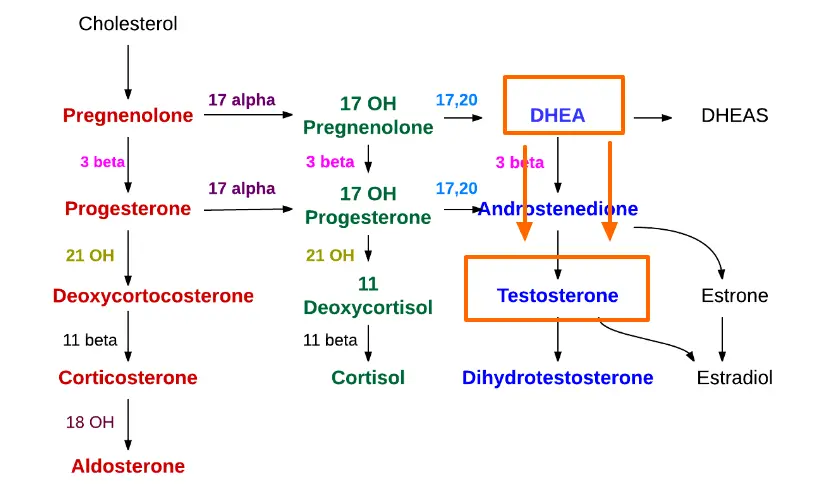
DHEA, and its sulfated form DHEA-S, is responsible for several different actions inside the cell and its unique ability to act as a hormone precursor for both estrogen and testosterone.
DHEA is very well known for its ability to convert into estrogen or testosterone (depending on the circumstances), but it also has direct cellular action by itself.
DHEA helps regulate immune function and acts on cells through an androgen receptor (1) (which is why low levels may lead to reduced libido and why high levels may cause symptoms of excess androgens).
Understanding how DHEA works helps us understand why it’s important to have enough of it in the body (not too much or too little).
DHEA is very much a Goldilocks type of steroid and androgen in the body.
What do I mean?
Studies have indicated that there is an increase in mortality (2) (increase in death) in patients who have too little or too much DHEA.

We can, therefore, interpret this to mean we want just the right amount of DHEA for optimal cellular function.
How do you know if you have high DHEA?
Most patients with high DHEA present with several key symptoms that trigger further testing which results in their Doctor finding high DHEA in their blood.
What kind of symptoms can you expect if you have high DHEA?
Symptoms of excessive serum DHEA-s and DHEA:
- Generalized fatigue or low-energy
- Weight gain
- Male patterned baldness or hair loss (in women and in men)
- Hirsutism
- Acne or oily skin
- Irritability, anger, or depression (and other changes in mood)
- Infertility
- Changes to your voice (a deeper voice in women)
- Changes to muscle structure (increase in muscle mass)
- Reduction in breast size
- Known history of PCOS
- Recent history of stress
The symptoms listed above are NOT normal and the presence of any of them should trigger further testing for adrenal hormones, cortisol, and DHEA levels.
Now that we have some basic information on DHEA let’s talk about what causes high DHEA.
6 Causes of High DHEA in Women
Before we jump into the causes let’s establish what a high level of DHEA is.
You can see an example below:

This patient has high DHEA-S with a value of 363.5 ug/dL with a reference range of 41.2 – 243.7.
This example is easy to diagnose because this patient falls outside of the given reference range.
But it is possible to have high-normal DHEA that causes symptoms in your body.
Part of this has to do with how your cells tolerate DHEA (hypersensitivity syndrome is discussed below).
The point is you need to be looking for an “optimal range” and in this case, it’s usually best for DHEA to be above 100 ug/dL but lower than 200 ug/dL.
In my clinical experience, it seems that women with DHEA-S levels over 200 ug/dL tend to experience the symptoms of androgen excess even though they are technically “normal”.
#1. Chronic Daily Stress
One of the most common causes of high DHEA is constant and persistent daily stress.
This is both a good and a bad thing…
It’s good in the sense that diagnosing the cause is relatively easy, and it’s hard in the sense that removing stress is something that most of us are not very good at.
How does stress lead to high DHEA?
In order to understand this relationship, we need to understand what stress does to the body.
Stress (really any cause of stress) stimulates a reaction in your body that activates a cascade of events in your HPA (hypothalamic-pituitary axis).
The activation of this axis results in hormone precursors that signal to your adrenal glands to produce hormones to combat the stress you are under.
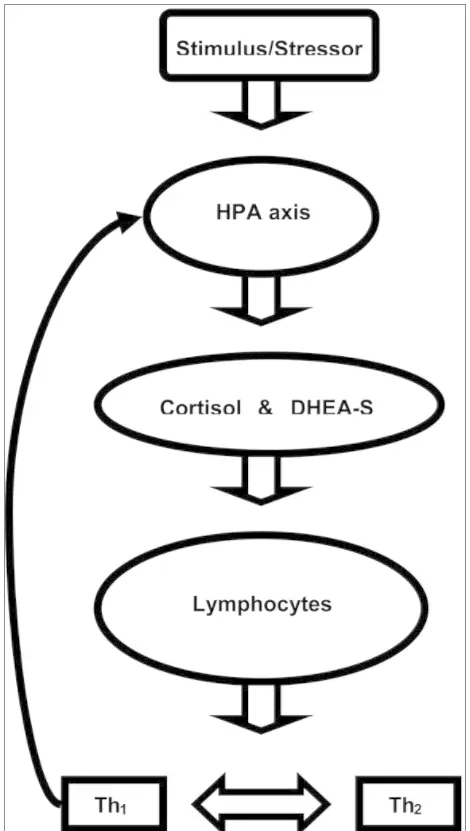
Usually, we associate this cascade with the release of cortisol (which is our “stress” hormone) and little attention is given to DHEA.
The truth is that stress causes the release of BOTH DHEA and cortisol from your adrenal glands.
The adrenal glands are non-discriminatory in the sense that their activation will lead to a release of more than just one hormone.
The release of cortisol and DHEA then acts on your cells and immune system to allow for adaptation to “tolerate” the stress you are under.
This cascade of hormones and changes usually isn’t a problem until the cascade is triggered too often.
Constant daily stress may lead to high circulating levels of DHEA and/or cortisol which then cause disruption to your immune system and other hormone systems.
For instance:
Stress has been shown to result in the rapid development of insulin resistance (3) (which may worsen weight gain) while chronic stress has been shown to suppress both cellular and humoral immunity (4).
The bottom line?
If your DHEA levels have been shown to be elevated AND you believe that stress may be playing a role you will want to take several steps:
- If possible find and eliminate the source of stress -> in some cases this won’t be possible so you may need to take further action to improve your “tolerance” of the stressful stimuli.
- Consider supplementing with the adrenal adaptogen Ashwagandha -> Ashwagandha has been shown in studies to reduce enzyme production in patients with adrenal hyperplasia (5) which may result in a direct reduction in androgen production in some individuals. Ashwagandha has also been shown to help balance cortisol levels which is also helpful if stress is worsening your DHEA. You can read my complete guide to using Ashwagandha here. Use a high-quality supplement with at least 500mg per day but note that some people may need up to 2,000mg per day.
- Consider further supplementation to improve adrenal function and treat chronic fatigue, you can find a complete guide and list here.
- Take steps to reduce the impact stress has on your life by adopting certain behavioral changes: get 8 hours of sleep at night, reduce your intake of refined carbohydrates and sugars, and exercise regularly (but not too much).
These steps will help you get started in the right direction but may not be sufficient for every person.
#2. PTSD
Another very common cause of high DHEA is PTSD (6).
Post-traumatic stress disorder is a disorder that results in multiple changes to hormone systems, the HPA axis, and immune function over time.
What’s more interesting is that the incidence of PTSD is at least 1% which estimates putting it as high as 15% of the general population of the US (7).
This is particularly important as it relates to DHEA.
Why?
Because studies have shown that PTSD results in documented high DHEA (8):

Unlike chronic stress (which we discussed above) PTSD generally results in high DHEA and low cortisol.
The hormonal systems seen in PTSD suggest that this condition exerts power and negative stimulus on the HPA system.
This condition is important to mention for several reasons…
First:
The diagnosis of PTSD may be missed as many patients may present with very generalized and non-specific symptoms.
This means that getting an accurate diagnosis becomes very important.
Second:
Treatment relies heavily upon the correct diagnosis and making targeted changes to reduce the impact of PTSD on your life.
Treatment may be complex and depends on the severity and cause of PTSD in each individual.
In addition to therapies such as counseling, patients may consider advanced techniques such as EMDR (9).
#3. PCOS
Next on the list is PCOS.
PCOS is actually one of the more common causes of elevated DHEA among women (along with stress and PTSD).
In fact, high androgens should prompt further work up into estrogen/progesterone levels to evaluate for PCOS.
It’s important to realize that PCOS is really just a combination of hormone imbalances that include the following:
- Elevated estrogen
- Low progesterone
- High insulin
- High Testosterone/DHEA
Studies have shown that PCOS likely has some hereditary component (10).
The brothers of women who have PCOS seem to show elevated DHEA levels (along with those women).
The difference is that males tend to tolerate higher levels of DHEA because men have higher levels of androgens at baseline.
The good news is that elevated DHEA secondary to PCOS can be treated by targeting the hormone imbalances associated with this condition.
I’ve put together a natural treatment guide for PCOS that you can see here.
I will leave the basic 7-step process below as well:
- Optimize your diet
- Exercise regularly
- Use the right supplements
- Reduce and manage your stress
- Address other hormone imbalances
- Avoid certain medications that may mask PCOS symptoms (birth control medications)
- Consider the use of certain prescription medications (if necessary)
You can also find more information about how to supplement for PCOS in this post.
#4. Elevated Prolactin
#4 isn’t as common as the other 3 but it’s worth mentioning here.
Prolactin is the hormone that normally promotes milk production in humans (and other mammals).
Normally prolactin should really only be produced in high quantities after pregnancy to promote milk production for children.
Some conditions (like microadenomas) may result in excessive production of prolactin during periods that are not considered “normal”.
High prolactin levels tend to suppress the menstrual cycle (which is why some women do experience a birth control-like effect when breastfeeding) by making changes to hormone levels in the body.
Prolactin has also been shown to directly increase DHEA levels and the presence of DHEA levels (11) (with a negative workup) should prompt evaluation into serum prolactin levels.
The good news is that assessing for high prolactin is quite easy and can be accomplished with basic serum testing.
If your prolactin level is elevated studies have shown that taking certain medications may help lower prolactin and therefore lower DHEA levels.
#5. Hypersensitivity to DHEA & Androgens at the Cellular Level
I’ve included this topic on the list because it’s very important but not necessarily a cause of high DHEA.
Instead, this condition may lead to high normal levels of DHEA and DHEA-s accompanied by symptoms associated with high DHEA (all of those we discussed above).
This can make diagnosis difficult for patients who fit into this spectrum which is why we are discussing it here.
Basically what is happening in this condition is that your cells become hypersensitive to even normal levels of androgens and DHEA.
Under normal conditions, DHEA interacts with androgen receptors on certain cells (think hair follicles and immune cells) to promote normal cell function.
In hypersensitivity syndromes, the exact same amount of androgen causes an exaggerated response which triggers cell stimulation and the symptoms of excess DHEA/androgens.
In hair follicles, this might mean increased hair growth or male-patterned baldness.
While this process is not well understood it’s what is felt to occur secondary to immune activation and it is seen in conditions such as benign prostatic hyperplasia (12) and androgenetic alopecia (hair loss) (13).
Remember that patients with this condition may present with completely normal labs but all of the symptoms are associated with high DHEA and high androgens.
Treatment for this condition should be targeted at the immune issues (if present) and any underlying hormone imbalances.
#6. Nonclassic Adrenal Hyperplasia (Late-onset adrenal hyperplasia)
Another uncommon cause of high DHEA is nonclassic adrenal hyperplasia (14) (otherwise known as adult-onset congenital hyperplasia).
This condition is an autosomal recessive genetic disease that tends to present later in life.
Women with this condition tend to have normal menses and pubertal growth patterns but symptoms of androgen excess tend to present later in life.
In addition, serum DHEA levels may be elevated when checked.
The condition stems from the overproduction/efficiency of certain adrenal enzymes which cause the production of excessive amounts of androgens.
Patients with this condition present with high DHEA levels along with symptoms such as acne, hirsutism, alopecia, and issues with fertility/menstruation.
Again, this isn’t a common diagnosis but it should be considered (15) if the cause of your elevated DHEA is unknown.
*Remember that ashwagandha has been shown to be effective in reducing DHEA in this condition (discussed above).
DHEA and Weight Gain
Many women who have high DHEA also tend to have weight gain.
This begs the question:
Does high DHEA cause weight gain?
The answer turns out to be slightly more complex than that.
Remember that the 3 most common causes of high DHEA include the following conditions: Stress, PTSD, and PCOS.
All of these conditions are associated with other hormonal abnormalities which are likely contributing to the weight gain seen in these patients.
Stress by itself has been shown to cause high cortisol, a reduction in sleep, and insulin resistance in addition to high DHEA levels.
PCOS includes high estrogen and leptin resistance which directly causes weight gain.
PTSD is often associated with mood changes/neurotransmitter changes which may alter diet and appetite.
Taken at face value it seems that the DHEA is probably NOT responsible for weight gain directly, but instead weight gain is the result of other hormone imbalances that tend to accompany high DHEA.
What does this mean for you?
If you have high DHEA and you are experiencing weight gain then your goal should be to find and treat the underlying cause of your high DHEA.
This will be the most effective way to lose weight.
Back to you
DHEA is an important hormone that needs to be in just the “right” range.
Everyday conditions such as stress may negatively impact DHEA and cause the symptoms of androgen excess.
If you are experiencing high DHEA the most important thing you can do is find the CAUSE and then target your treatment at that.
I’ve included the 6 most common causes of high DHEA in this article with the 3 most common being PCOS, stress, and PTSD.
Now I want to hear from you:
Do you have high DHEA? Are you experiencing the symptoms of androgen excess?
If so, has treating your high DHEA helped reduce these symptoms?
Leave your comments below!
Scientific References
#1. https://www.ncbi.nlm.nih.gov/pubmed/25022952
#2. https://www.ncbi.nlm.nih.gov/pubmed/20739385
#3. https://www.ncbi.nlm.nih.gov/pubmed/23444388
#4. https://www.ncbi.nlm.nih.gov/pmc/articles/PMC1361287/
#5. https://www.ncbi.nlm.nih.gov/pmc/articles/PMC4543599/
#6. https://www.nimh.nih.gov/health/topics/post-traumatic-stress-disorder-ptsd/index.shtml
#7. http://www.healthcommunities.com/posttraumatic-stress-disorder-ptsd/incidence-prevalence-ptsd.shtml
#8. https://www.ncbi.nlm.nih.gov/pmc/articles/PMC2829297/
#9. https://www.ncbi.nlm.nih.gov/pmc/articles/PMC3951033/
#10. https://www.ncbi.nlm.nih.gov/pmc/articles/PMC4428582/
#11. https://www.ncbi.nlm.nih.gov/pubmed/6090494
#12. https://www.ncbi.nlm.nih.gov/pmc/articles/PMC4652646/
#13. https://www.ncbi.nlm.nih.gov/pubmed/22134564
#14. https://www.ncbi.nlm.nih.gov/pmc/articles/PMC2910408/
#15. http://emedicine.medscape.com/article/273153-workup#c6


Hi,
My DHEA-S has always been high (in the 500s-600s). I have been told I may not have PCOS due to lack of cysts on my ovaries during a transvaginal scan in 2015.I experience the following:
Excessive weight gain (gained 55 lbs in less than 6 months back in 2008 and have mostly kept it on since then)
Irregular periods… I basically do not get them at all. Can’t remember when the last time I actually had one. Weird enough, I spot regularly every single day. Sometimes the bleeding is slightly heavier than most days. Sometimes the liner is completely blood-less until I wipe and I can see fresh blood. Sometimes the blood is old too. Very confusing.
I have hirsutism, affecting my face and body. I have acne issues all over my face and chest. I have experienced breast size reduction. I am very stressed out most of the time and my skin is very oily. I bloat easily. I am borderline diabetic. I do not eat healthy but I cannot help my sugary cravings at times.
I also have high testosterone levels. My cholesterol values seem to be in range most of the time.
My endocrinologist is retired now and I am in the middle of finding a new one. He told me once I have hypo-adrenolism and told me to take Prednisone daily. I was compliant until didn’t notice much difference and stopped. I am confused!
Hello Dr. Childs,
My 21-year-old daughter was recently tested for levels of DHEA-S04. Her level came back extremely elevated at 636 mcg/ul. She’s been overweight since age 17 despite regular gym exercise and her period is irregular. I’ve also noticed a significant hair loss and hirsutism. She is currently in nursing school and will be done by next year. I know she is under a lot of stress with balancing school and work which I believed was the reason for her weight gain. I also suspected hypothyroidism, but her THS, t3, t4 were all normal. After I came across your website, I am coming to this conclusion that she has PCOS, but could also be adrenal hyperplasia. Should my daughter be seen by an endocrinologist or OB-Gyn? Should I recommend she take your ashwagandha supplements? Your input is greatly appreciated. Thank you so much!
Pauline
Hi Pauline,
Ashwagandha may help alleviate some of the stress and may help with the DHEA but probably won’t lead to a significant amount of weight loss. It would be a reasonable thing to try, though!
Hi Doc,
My DHEA-sulfate is relatively high. Its 380 with a reference range of 45-270. Prolactin 36.32 with a reference of 5-35mg/ml. I have facial hair, the period is regular(28 days cycle) and I am not struggling with weight loss.
My concern is actually the facial hair, my Gynecologist feels I am not poly-cystic and he is a bit confused. Wha/t could be the problem pls
Kindly respond to me, please.
Thanks!
Hi, Dr. Childs
I’m writing to you because I have a concern. I’m 42 years old, a little over 4 years ago I have a plant based diet. All my life I have had acne but now it has become a problem I took the hormone test and went out with DHEA in 389. Which supplement is the most recommended for me.
I would appreciate your prompt response.
Thanks!
Jessika
jessikaf28@gmail.com
Hi Jessika,
You’ll also want to look into free and total testosterone, but it sounds like you may benefit from something like ashwagandha.
Dr. Childs,
I looked up “urine smells like smoky sausage” and the search came up with high DHEA. Then, I came upon your site. My endocrinologist/tests are indicating hypoparathyroidism. I have struggled with a 20 in. weight gain that no dieting seems to resolve. Just wondering if I should ask my doctor about this and what possible tests. I have Fibromyalgia, but levels of fatigue have really escalated. I’m 69. Also, itching all over that is in the extreme. Any insight is appreciated.
Hi there–I’m not sure if you’re still answering questions here, but I am a 25-year-old female with incredibly regular periods and no acne, but recently started experiencing incredibly abrupt and rapid hair loss. My hair growth and volume had been completely normal and thick my whole life and then one week it started falling out in much larger strands than usual, and has continued to every day since. My periods remain normal but I’ve been experiencing high anxiety and fatigue that I haven’t had to deal with in the past. I had a metabolic blood panel done two weeks ago and just got the results back–everything is normal except for a wildly high DHEA-S level of 801.1. My glucose is 71 and my thyroid is completely normal. The doctor told me that I need to rule out PCOS and then get checked for a secreting neoplasm, which made me incredibly panicked. Is a DHEA-S level of 801.1 typical in PCOS patients? Do these symptoms typically present with tumors, or is it possible they could mean something else? Not looking for diagnosis, just any sort of direction since the doctor cannot see me for some time. Thank you for your help here!
Hi, For the last year I have been treated for low cortizol (Flatlined) plus was also given DHEA 25mg per day A few months ago I had a crash, and have been trying to get back to where I was before the crash. Just had a saliva test which also measures DHEA. My cortisol levels have improved, but the late evening is now too high. My DHEA was >1000pg/ml (range 106-300) So have stopped taking the DHEA. What should I do?
I am 44 years old and have been experiencing weight gain and black patchy facial hair on my chin and lip area. My doctor ordered some lab tests that came back high. My testosterone was 106 and my DHEA-S was 650. She ordered a CT scan for next week. I am so nervous but hoping it’s not something very serious.
Hi – I have a current DHEA level of 802 (35yo female), high testosterone, PCOS since late teens, and currently trying to get pregnant. My DHEA levels have been high for years (some doctors like this, others are concerned and don’t believe me that I’ve never supplemented). I have multiple ongoing medical conditions that could lead to chronic stress that I don’t recognize because it has been this way for years. Naturopathic focuses on adrenal fatigue being the issue, other physicians are not concerned with my adrenals as my cortisol levels are consistently normal. I have never struggled with weight until gaining 30lbs this year with no known cause (thyroid is normal, other hormones are same as they have been, I eat very healthy – no refined sugar, careful sources of meat and vegetables, paleo-Mediterranean no dairy no gluten; exercise more than in the past so weight gain is completely befuddling – fat mass gain). Have had hirsutism for years that is currently worse than other periods but not worse than it’s ever been. I’m really not sure how to decrease this after reading your article as I can’t pinpoint the cause. Endocrinologist recently started me on metformin and inositol for PCOS/help with conception as prothrombin factor II keeps me away from birth control or supplemental progesterone. Any thoughts? Thank you!
Hi Dr.Childs
Four years ago I experienced at age 52 palpitations anxiety panic attacks. After many heart test that were negative My doctor diagnose perimenopause I was prescribed progesterone and after some time I felt normal again. Now 4 years later, the same thing except worst, my anxiety is horrible panic attacks when left alone, uncontrollable crying spells palpitations which at times elevated Blood test again were normal, hormone level normal but DHEA was 289.5. I was taken bio-hormones but no changes so currently not taken them I have stress but nothing unusual. This is going on 3 weeks and no relief. I’m a very independent woman so this is not like me to feel I need a “babysitter” and have so much anxiety. Any comments would be greatly appreciated. Thank you
Dr. Childs,
Could you explain the MOA of how you could have high SBGH but also have high levels of androgen metabolites and DHEA in urine testing? My understanding was that with high SBGH- testosterone and estrogen are bound so there is less “free” testosterone available. If this is the case- then how can there also be high levels of DHEA-S and androgen metabolites in urine? (DX of ovarian failure – on bio-identical HRT)
Hi Lee,
It’s certainly possible that you are providing your body with more androgens than SHBG can “bind” up. The fact that your androgens are high AND your SHBG is high, indicates that you have an issue with multiple hormones.
Hi. I just turned 40 and came out with high DHEA Sulfate of 344. I have searched in Google and I’m scared of adrenal tumors or cancer. I have normal testosterone and no symptoms of high DHEA. Thanks
Dr,
Cushing’s syndrome really needs to be added to this list. My first sign was high DHEA. I know Drs think it’s rare enough to leave out at times, but the fact is it’s only rarely tested for properly and often overlooked. I think in the next 20years there will be an increase in diagnosed cases. It just isn’t as rare as AACE claim it is ave their protocols for testing are poor. Please add it to your list so people coming here looking for why they might have high DHEA have all the reasons, not just a partial list.
Lauren
Hi Lauren,
You are right that it can potentially cause a high DHEA but it is rarely missed by doctors. The list here only includes those things which are frequently missed by doctors and which are most common.
Hello Dr. Childs,
Which supplements can I take to lower my DHEA levels?
Kind regards, Justine.
Hi, thank you for the info! This explains a lot. I am 59, menopausal, and overweight despite a very clean, organic, plant-based diet. (I’ve tried low-carb, keto, etc. – nothing worked.) I had severe insomnia for 20 years, which caused weight gain. I finally resolved the insomnia, but then had a highly traumatic experience and now have some anxiety and insomnia a few nights out of the week. Definitely PTSD. My blood test shows DHEA is high – 224.9. Cortisol is 10.7, free testosterone 5.6. Estrogen is fine, but progesterone is on the low end of normal – .1 The only other symptom I have is vaginal dryness. I don’t want to take estrogen, but am considering a progesterone vaginal cream, to avoid buildup of progesterone in fatty tissues (which is controversial). The problem is that the cream also contains DHEA, which, they say, convert to estriol without the dangerous side effects that estrogen creams have. So here is my question: Since my DHEA is already high, would the vaginal cream exacerbate it? OR, would the good benefits of better sleep from the progesterone and, as a result, stress reduction, outweigh any potential negative effects? I really don’t want to take transdermal progesterone cream and I haven’t found a vaginal cream with bio-identical progesterone only. Thanks!
I am 51 and recently had my thyroid and dhea checked. Thyroid levels all in normal range but DHEA is 441. When I had it checked six months ago it was 91.
I am under a lot of stress, gaining weight, and peri-menopausal. Menstrual cycle just started being irregular. I have been taking an adrenal suppliment for fatigue but it is mostly made up of B vitamins. No oily skin, acne, or excessive hair growth. Have been suffering with mood swings and anxiety.
I suffer from high DHEA levels 650, I tested 4 years ago at 383, my cortisol is never increased. I have been commonly thought to have hypothyroidism, but blood work comes back normal, which then turns into a depression prescription – which then spirals out of control – I don’t handle anti-depressants well. I show no signs of increased testosterone, and was told that my progesterone was duking it out with my estrogen, just to have an endocrinologist tell me it was normal. When my periods went to irregular 2 years ago, I mentioned it to an OB/GYN to have them ignore it. Last year, I had a male doctor order a DHEA test, only to get a cortisol response then tell me that I didn’t understand the test results, that an 8.9 result was DHEA. I was then urged to really advocate for my health care, so I pushed even more, to get a result of 650 today…the original doc that brought the high levels to my attention, ruled tumors out, but said that a 500-600 meant a tumor for sure. Freaking out, but still thinking something is missing…
Hi Westin. I went to endocrinologist with a suspicion of hirsutism. This has always been a problem since puberty but never checked until now when i noticed that black hair started to grow on my chin and the fact i cannot lose weight which is accumulating around my belly mostly. I got DHEA levels of 470 when the limit is around 320 per our scale, normal testosterone, an incipient resistance to insulin and i still have to get cortisol results.Several years ago i was indicated that i am suffering from generalized anxiety. Might be stress & anxiety the actual reason for my current results? Thank you.
Do you have an article concerning LOW DHEA? I know DHEA typically declines with age, however, I am seeking information on DHEA when it is significantly below the reference range.
Hi Brenda,
I do not have an article on low DHEA but I will add it to the list of future articles!
Hi dr child’s,
So I had previously had a dhea level of 440, and then it had dropped down to 400 and then after really pushing and pushing for several months w diet, excercze and heavy supplementation with omega, symplex f, spearmint, asheaghanda, Berberine, milk thistle it only dropped to 397. My symptoms are weight loss resistance with most of my weight being in my stomach, hair loss, facial hair and oily hair. What would you recommend I do now to lower it? And once I get my dhea in an optimal range would my symptoms go away?
I can’t really pin point what it is that is causing the increase, I have cut out toxic products, changed my diet, tried to supplement for stress, lead an active and healthy lifestyle, so I’m not sure what could be causing my high dhea.
Thank you!
Westin, I doubt you’ll have time to answer this but, in case you do :
Have you seen nonclassic CAH impact mental health ? Meaning, anxiety based issues, like GAD or OCD’ish tendencies ?
Do you know that elevated (meaning high normal and/or off-the-chart high) DHT can cause significant anxiety ? On one hand, I seem to recall DHT to increase GABA-A receptor expression, so because of this it should be a very calming signal. However, It can also facilitate adrenaline release. As you know, DHT affects myriad neuroendocrine signals.
At the end of the day, I’m trying to find out whether elevated DHT can be a cause of anxiety ? Tough question.
Thank you for this article!
Dear Dr.Childs,
do you have an experience with Maca ?
It seems to be a quite good adaptogen to regulate ones hormonal balance. However I coulnd’t find any studies about the relationship between Maca and DHEAS.
Thank you for your article
Hi Blackbramble,
Yes, I love maca and use it personally as well as therapeutically for others.
Hello,
I have excess DHEA and got tested all types of NCCAH but I have non of it. Im so desperate since i got depressions due to the symptoms like hair loss, acne and excess body hair. I even think of suicide. I am a 23 year old girl who just wants to be normal. Ive been taking large amounts of ashwagandha for about 8 months and theres only a slight improvement but negliable. I dont know that to do
I have had high testosterone and high dhea-s levels for many years. I have seen several doctors regarding this issue, and they either don’t know the cause, or not sure what to do about it, or don’t think it’s something that necessarily needs to be corrected.
Either way, I have found some success in reducing these levels by taking both myo-inositol (2000 mg/day), and d-chiro inositol (600 mg). After about a month, I had a 30% reduction in dhea-s levels, and my testosterone reduced to just about the upper limit (down about 30% as well). Just in case this might help anyone else.
Hello Dr. Childs. I am 26 yes and diagnosed with high DHES-S (in the ranges of 600) my prolactin level is also high. I also have recently developed symptoms like fatigue and hirsutism. Can it be bought back to normal with medications for normalising prolactin levels??
Hello Dr.Childs,
I’m 18, and a female. Since last November i have been experiencing body/facial hair growth ,weight loss, hair loss/thinning,stomach problems(constipation/diarrhea/bloating,sensitivity to different food etc), fatigue (sometimes extreme),mood swings(especially irritability/anger) and other symptoms. I went to the endocrinologist a couple months ago,and since I’m south asian and my body hair growth is not that severe they said it’s “normal”, but obviously i knew these things weren’t normal cuz i never experienced it before and i knew something wasn’t right. They tested my thyroid levels and it was normal and they basically tested me for everything and everything seemed normal. Then they tested my hormones and they found out that my dhea sulfate was 402 and the reference range was 37-307. My testosterone,free was 4.3 , and the reference range was .5-3.9. My endocrinologist said it’s nothing to worry about since it’s not above 10% above the range, they offered me a blood pressure medication where one of the side effects was the decrease in dhea s. But honestly they said it’s not major enough to take medications, so i didn’t take it. Also i forgot to mention, my mom experienced something similar to this when she was my age but hers was way worse and she was on pills, and her doctor said that she may or not be able to conceive a child. And surprisingly she has ovarian cysts now. But I still don’t know what caused all of this to happen all at once 5 months ago, I’ve been searching for answers but i couldn’t find one. I want to find a solution to fix this issue, and i don’t want to just take medication without knowing what’s the root cause, and none of the doctors that i went to tried to dig into this either. I’m stuck on what to do. I want to find the root cause of this so i can act accordingly and fix this Situation. I’ve been eating healthy and exercising too, but i Don’t know if it’s helping because i noticed that the hair thinning, oily face, acne and most of these symptoms get worse like every few weeks, it’s like a cycle. My hair looks healthy and really full for like a couple of weeks but then maybe before i get my period or after it my skin just goes haywire, i start shedding so much hair,the bloating comes back, the tiredness comes back. The only symptom that’s consistent is the body hair growth. Eventhough it’s not as severe there’s always new hair growing in place that i never had hair before overnight. Please help me. Thank you
Hi Dr. Childs,
I am 35 years old and I am going to be 36 in August. 7 years a ago I noticed that my hair was falling out from the scalp (root). I when to the doctor and was told that I have PCOS. I was given Metformin, however, I could not tolerate it. It made me gain weight instead of lose, my sugar would drop too far and I would get very nauseous. Bare in mind my blood sugar was good. Over the years the symptoms got worse, weight gain especially around the waist, hair loss, oily skin, sweat, sometimes bruised skin. I did several hormonal tests and they came back normal expect my DHEA level is high and I lack vitamin D. My DHEA level the last time I check was over
Dr. Childs, I am just going to pick up where I left off.
My DHEA levels is over 600. My doctor realized that I was misdiagnose with Pcos and recommended me to an Endocrinologist who send me to check my Adrenalin glands for tumor. that test came back that there was no tumor. Now I don’t know what more to do because each time I do a test the DHEA levels go up. I have to be wearing wigs for years now and I keep gaining weight. I am now pre diabetic and I don’t know how to help myself.
Please help me. Thank you
Just got my blood work back and my DHEA is over 700! I’m a 54 year old female with complex PTSD and metabolic syndrome and IBS-D. A little freaked out about the numbers, take many supplements but have not tried Ashwaganda though I’m familiar with it. Cholesterol is high as are triglycerides and I have hypothyroid disorder. Weigh has increased about 13 pounds to 172. Any ideas for how to proceed would be great. Thanks, deven
I am a 48 year old female who was on Sertraline for years until I discovered that it was the reason I was having heart issues so severe that I have 3 ablation procedures and many cardioversions. Upon discovering the problem with the medication, I stopped taking it this past February 2020. After a two-week honeymoon period, I began to suffer from manic depression and anxiety. After a few months of considering taking other potentially harmful medications to help with the D/A, I decided to see an NMD. The NMD advised a supplement course was meant to help “restart” my gut – gut shutdown, due to years of harmful medication was the determined culprit. So, I took the supplements and after two weeks things appeared to be slowly improving. Then, two weeks into my treatment I received my medical marijuana card to acquire potentially helpful versions of the plant, in this case it was a gel that I could ingest. I was advised to take this gel and immediately my D/A returned with much more… strength. After a week I had to stop taking the medical marijuana as I associated it with the D/A. I was then advised to take a pill called Stress B&C with adrenal. I took that and around the same time my anxiety became so intense that all I could do is sit in tears all day long. I have since stopped the Stress B&C and my anxiety is higher than ever. My most recent blood work is as follows: DHEA SULFATE – July 2020 – 361, August 2020 – 363; PREGNENOLONE – July 2020 – 33, August 2020 – 14; CORTISOL AM July 2020 – 14.4; TSH HS – July 2020 – 4.19; T4 Free – July 2020 – .9; PROGESTERONE – July 2020 – 6.6; ESTRADIOL FREE – July 2020 3.26. Can you give me a ballpark idea what is happening to me? My doctor cannot determine if it is adrenal cancer, Cushing’s Disease or PCOS. I am in Hell!
I’ve been having a ton of symptoms for 4 years right after 3 traumatic events happened with 2 weeks. Found out last week my DHEA is 550. Iron and ferritin is very low. Cholestrol (HDL) is 32. And i have adrenal fatigue. I was diagnosed in 2014 with PCOS and Endometriosis. Doctors diagnosed me eith POTS assumimg thats where my symtpoms are coming from. But now after more testing it is most certainly a Hormone Imbalance related to PTSD and high stress. Im a nurse and have not been able to work for 3 months because of my symptoms. I am plant based, I do yoga, meditate,and also take several vitamins , and ashwaganda. Any advice would be great. Thank-you so much.
I’m so happy to have found you on the web dr. Child’s. Your articles are extremely helpful. I was hoping you could help diagnose what type of DHEA issue I’m suffering with.
I recently tested triple the amount of testosterone I should have sitting at 1123.1 pg/ml and high dhea-s sitting at 6.9ng/ml
My cortisol was 3.7 during the morning hours and my progesterone was 286.4, E2 ratio 44.1 and my estradiol 6.5
I have no idea what any of this means and my doctor has just prescribed seed cycling, 2x spearmint tea daily and a 20mg dose of bio identical progesterone cream.
My current symptoms include:
Weight gain/ water retention
Circular face and puffy eyes during second phase of period
Hair loss and zero sex drive
Hair growth out of my neck, breasts and belly button area.
Mood swings (angry, anxious or sad)
I workout 3-5 days / week focusing on weightlifting and incline walking or HITT training. I am a whole food plant based vegan.
I’m desperate for any assistance at all… I haven’t started the cream because I’m terrified I’ll gain 5-15 lbs in less than 2 weeks as that’s what many woman seem to experience… along with weepyness depression etc.
Thank you for your time
Hi! I was just reading your information on DHEA. You have quit replying to anyone. Is there a way to contact you to ask questions on high DHEA? Has this discussion been closed?
I would like to know from others what has worked in lowering your DHEA. I can tell you mine has lowered but still close to 300 and I detoxed and made lifestyle changes and mine is very close to normal now so I know it lowers and detoxing helps.
Hy, very interesting and informativ article. I ‘m 35 years old, f, and yes .. my DHEA levels are not normal. DHEA-S is 349 ug/dl, DHEA is 88825 nmol/l ( 4507-33977), after dexamethazone text the hormons get back in normal range, the rest of hormons are greate: testosterone, prolactin, cortizol , 17-alpha hydroxyprogesterone, etc . Just Aldosteron i little hight (36000ng/dL) I also did a magnetic rezonance investigation to my andrenal gland , and loocks normal! Why is so big difference from DHEA to DHEA-S ? is that bad?
Hi Dr Westin,
I’m a 40 year old woman who is trying to conceive. I recently received the news that my AMH level is low at 0.5 and decided to do a DHEAS blood test privately. This has come back with very elevates results at 13.1. I’ve been told to contact my GP which I’ve done. I’m just about to embark on a journey to find the cause or my elevated levels of DHEAS. I have no symptoms of excess hair and have regular periods. However, a few years ago I experienced a 12 month episode of constant lumps growing in my armpit, after many episodes of this I was told it is was Hidradenitis suppurativa (HS). I only had the issue for 1 year and its not returned. I would like to get to the bottom of why my DHEAS levels are so high. I did twats to look for ll PCOS last year that came back normal. I would like to speed up the investigation by asking the GP for the right tests. Any information, advise or suggestions would be highly appreciated.
Kind regards
Alma
I’m 35 yo woman with 4 boys. Recently experiencing weight gain, hair loss, increased fatigue, off and on insomnia. My labs show my dhea-s is 727 (normal 50-270), my ths is low and my thyroid antibodies high, and everything else relatively normal (including cortisol). What can I do to lower my dhea-s? Thank you.
Hey dr child’s, what about males and DHEA? I have hypothyroidism and I always seem to be struggling with consistency even on optimal meds/labs.
My level of DHEA is 354, and it is effecting my kidneys. My creatinine is increasing and my glomerular filtration is reducing.
My doctor seems to want the level to be 400.
I know there are advantages to a good level of DHEA. I am aware that I can lower levels by discontinuing ingesting it, but how can I retain
the benefits it gave me? Is there another supplement I can take with the same benefits of DHEA, without the side effects?
Last question, will it in fact be reduced by eliminating the substance, or can you lower the levels by reducing the milligrams? If you reduced levels will the kidney function improve or did it leave lasting damage?
Please advise.
Thank you.
Hi Cheryl,
I’m not aware of a connection between oral DHEA and kidney damage. If it was the case that your creatinine was actually increasing due to DHEA then you would want to stop it ASAP as damaging your kidneys is far more dangerous than what little benefits DHEA would provide to your body. I doubt this is the case, though, so looking at more common problems of kidney damage would be a good idea!
DHEA is a precursor hormone so there are no replacements for it, it declines as humans age.
Hey doctor, my dhea-s level is 576 and I have hairloss and too oily hair. My periods are normal and doctors say I don’t have pcos. My cortisol levels were 86 so i guess its normal. My testosterone was 46 so i think it’s normal too. Do you know how can I lowery dhea-s? Im afraid to take supplements for the rest of my life cause I don’t know how the body will react in time.
Thank you for your time!
Can high levels of estrogen in HRT cause hyperthyroidism?
Hi Anna,
It’s usually the opposite.
Hello,
I have elevated dhea-s 708, high testosterone.
Diagnosed with hyperandrogen syndrome.
Developed a large, 4″ bald spot.
Have some facial hair too.
Endocrinologist wants to put me on dexamethasone 0.25mg at bed.
I also have low iodine and b12.
I do not want to take drug.
Supplementing with iodine and b12.
What else should I do?
Please contact me
Jjwalsh76@yahoo.com
Good afternoon Dr.Childs,
Thank you so much for this article! I found it very informative and helpful. I just started attending grad school at the beginning of this year and have also had symptoms of not being able to get the very back of my head/hair clean, every since 2022 started. I went to the doctor and discovered I have acid reflux and also discovered that I have high levels of DHEA. I was sent to a hormone specialist and she checked my DHEA levels again and serval other things including my thyroid and everything came back normal except for my DHEA levels. However, after getting my results back I have been unable to discuss them with the doctor because she just had a baby.
So THANK YOU again haha. I have started sleeping 8 hours every night because I was probably averaging about 4/5 hours every night. However, my hair is still greasy on the very back of my head immediately after showering & washing my hair. I have always had dry skin and a dry scalp so it being greasy is very abnormal for me. My scalp is still dry but the one spot of the back of my head is just greasy hair. My hair has always been naturally curly but has changed texture and is not as curly. How can I fix this problem and is it related to my high DHEA levels? Dry shampoo is the only thing working for me now.
Thanks for your time. 🙂
Well I have a curve ball for you all. I’m a 49 year old man with high levels of dheas 393, high prolactin (15.6) high androstenedione, low testosterone (245 total), and low cortisol (3.2). Almost every article I read deals with females dealing in these levels. This is so far stumping my PCP and endocrinologist. My last MRI of the pituitary hints at hypophysitis, however still no real answers. BTW love your information Dr. Child’s, read almost everything you write regarding this all.
Any insights welcome. God knows I’m getting little gain with all the tests being ran.
Thanks all,
Rob
Hi Dr. Childs,
I am treating my PCOS with spironolactone (for high dhea) and Syeda (high testosterone). Both meds are working to bring them into the normal range. My two biggest side effects are :
1) having to urinate frequently (I miss sooo much being able to sleep without middle of the night trips to the bathroom!)
2) a difficult time getting full after I eat. Hungry a lot!
I’m about to see a new gynecologist in January and I’d love alternatives to staying on those meds. (Maybe there are other meds without the side effects I mentioned?).
Side note: before I was diagnosed with pcos in 2019 I had a bipolar diagnosis in 2018. I didn’t at that point think to get my hormones checked. I’m convinced the high androgen levels are what gave me hypomanic symptoms. Sooooo all that to say, I don’t want my dhea and testosterone levels to return to high levels by going off meds. (And thereby giving bipolar symptoms again eek)!
Any suggestions (other meds or natural things)that I can bring to/mention to my gynecologist would be most appreciated! Thank you!
I’ve had high DHEA in the red zone on my blood test for years. And whenever I mention it I’m told it’s normal for menopausal woman to have high DHEA. Menopause has been one of the most stressful events in my life. My most extreme symptoms were zero sleep and having to eat every one to two hours day and night. Severe hypoglycemia. I would dose off and wake up an hour later with extreme hunger pangs. This would go on all day and all night. When this first happened I had no idea what was going on. And doctors had no idea it was menopause related. They would prescribe things like berberine or chromium for my blood sugar which made the hypoglycemia even worse!
Eventually a blood test showed an extreme drop in estradiol from about 200 to 20 in a very short time. No wonder my body freaked out. But it’s insane that even endos and gyns know so little about menopause. I mean this happened when I was in my early 50s, someone might have mentioned it.
Anyway I had started reading about hormones years before that when after a surgery I just felt worse and worse. So I picked up Dr. John Lees writings again on progesterone. This time I bought high dose progesterone cream online and started taking more and more every day. It helped the hypoglycemia, the sleep, my mood etc. Not perfect but I could function again. Through all these I had high DHEA.
Now in post meno I had to try estradiol with the progesterone. And now I’m gaining weight. Im feeling ok mentally and the body pains are gone but now it’s the weight gain that’s prevalent. And yes I still have high DHEA. I try to take higher doses of Ashwaganda and fish oil like you recommended. Maybe that will help. My TSH is around 1.5 and my T3 around 3. Something. So not bad. It has been a crazy journey.
I read the only mammals that go through menopause are humans and a few whales!! Why?!! What a night mare for many of us.
Also no one thinks it’s weird that I drink adrenal cocktail every day (salt water with potassium and c) and that my aldosterone is at 5. Why do we test if the red zone on the test doesn’t mean anyhting!
Hi there, 48 yo female, for 3 years straight (since I started getting blood work to investigate) I have had high DHEA, Low cortisol, High Progesterone, Estrogen highish to normal (Estrogen has always been high). I was in a long traumatic situation from 2021 to the end of 2022, plus the pandemic stress, and long term stress from a toxic workplace, combined with high exercise and low recovery (which was the outlet to try to deal with my mental health). My fasting blood sugars and insulin appear to be very good.
Right now my hormones are about the same, though my DHEA has slowly dropped in tiny amounts since 2023. I have high/low iron and transferrin numbers, indicating slow transport of ferritin. I also have high Bilirubin continuously Since late 2022 I’ve been unable to lose weight, had some hair loss, and what seems to be chronic fatigue with poor sleep (I wake up exhausted, but don’t notice waking through the night, and fall asleep easily).
Any suggestions?