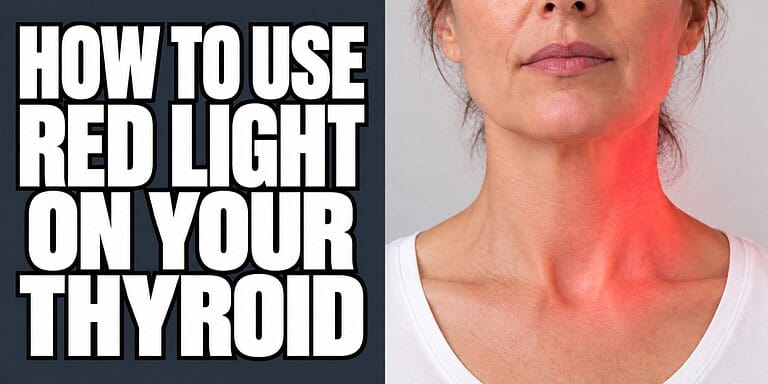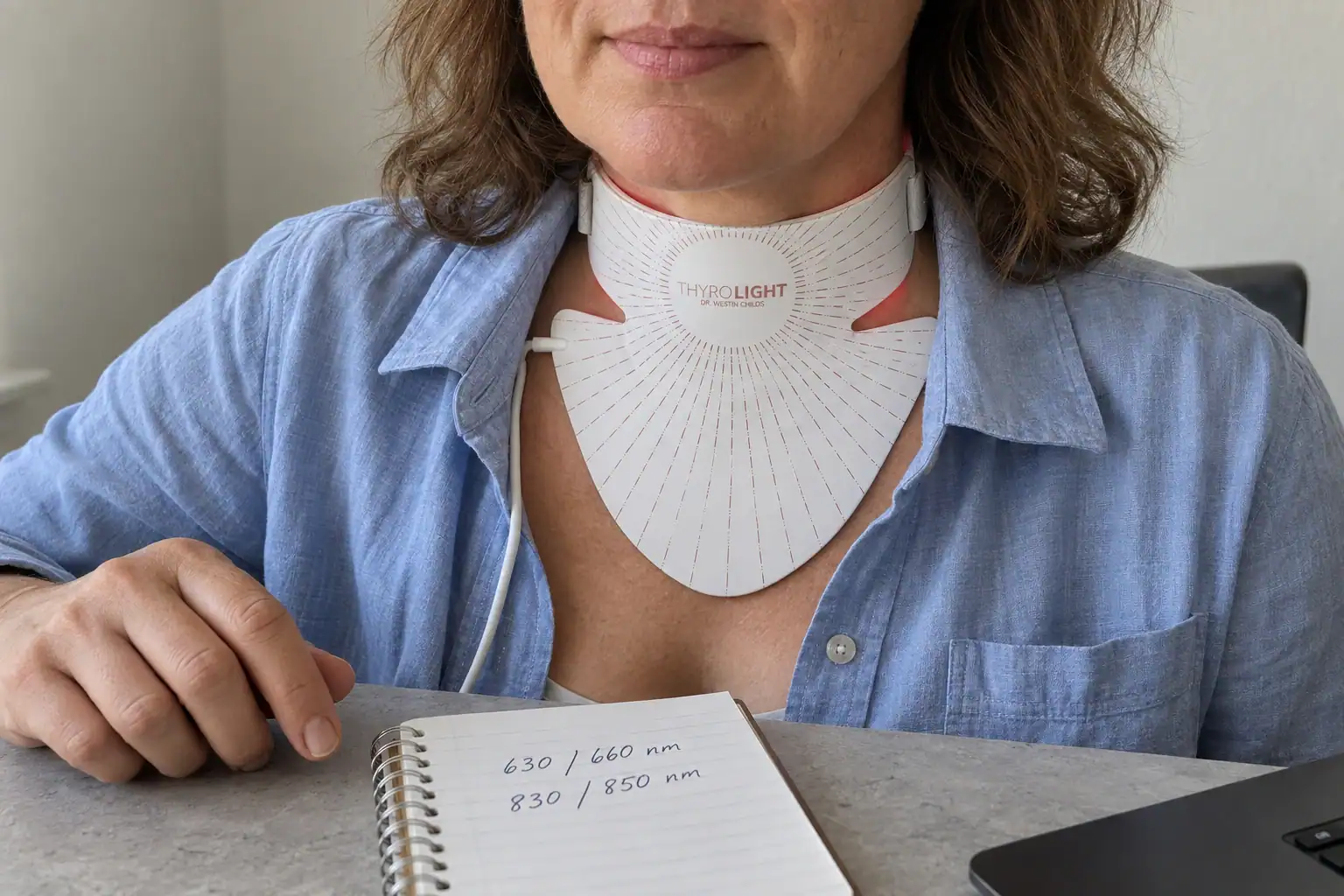

- Use red light wavelengths of 630, 660, 830, and 850 nm together to target different aspects of thyroid healing, from boosting circulation to repairing tissue damage.
- A 47% medication reduction occurred in a clinical study where patients used red light therapy twice weekly for just 5 weeks, with results sustained at 6-year follow-up.
- Your red light device must contact your skin directly and provide 50 milliwatts per centimeter squared of power to be effective for thyroid gland penetration.
- Follow a protocol of 5 sessions per week for 20 minutes during an 8-week therapy phase, then transition to maintenance with 1-2 sessions weekly.
Red doesn’t just boost your thyroid; it rejuvenates it.
Because of where the thyroid sits on your body, you can easily bathe it in red light [1], which penetrates deep into thyroid gland tissues, providing a restorative effect.
The result? You can improve thyroid function in an all-natural way that is unlike any other therapy available.
Here’s how it works:
From Light to Thyroid Gland Support
1. 630 nm Red Light and Circulation
It may not seem like much, but this matters a lot.
Blood flow to the thyroid gland is absolutely critical for 100% function.
Blood brings the nutrients that your thyroid gland needs to create thyroid hormone [2], and blood flow out of the gland takes thyroid hormone that has just been created to the tissues that need it.
This wavelength enhances all other treatments you’re currently using for your thyroid.
2. 660 nm Red Light and Mitochondrial Function
At this wavelength, light activates your mitochondria, which function as the battery for your thyroid gland.
Your thyroid has a huge demand for energy because it’s creating one of the most important hormones in your body.
Light in the 660 nm range acts as a natural stimulant to your mitochondria [3], which means your thyroid has energy to:
- Create more thyroid hormone
- Protect itself by creating glutathione
- And repair damaged thyroid tissue
Both 630 and 660 are great, but the real magic happens with these next two wavelengths…
3. 830 nm Near-Infrared Light and Thyroid Tissue
This wavelength starts to penetrate into the thyroid gland itself, where it stimulates the tissue itself [4].
The net effect is a reduction in inflammation and a restoration of tissues that have been damaged.
This effect is huge for thyroid patients because the majority of thyroid disease is caused by direct damage to the thyroid gland itself.
When you start to repair or fix that damage, you get true root cause healing and a reduced need for thyroid medication.
The final wavelength is 850nm.
4. 850 nm Near-Infrared Light and Tissue Repair
This wavelength is considered near-infrared, and it maximizes tissue repair and thyroid hormone production.
The result? Your thyroid becomes more efficient at producing T4 and T3 thyroid hormones directly from your gland.
In addition, it’s at this wavelength that you start to see changes to your immune system, which helps to lower thyroid antibodies.
Each of these wavelengths is important on its own, but when used together, they start to provide true thyroid gland healing and rejuvenation.
Red Light Benefits on The Thyroid Gland
And this isn’t some theoretical concept, either.
These are research-backed benefits.
One randomized, placebo-controlled study enrolled 43 patients with hypothyroidism caused by autoimmune thyroiditis [5]. Researchers assigned 23 patients to an 830 nm laser treatment and 20 to placebo. Here’s what they found at nine months:
Lower Medication Needs at 9 Months
Höfling et al., 2013 · Follow-up paper
At the six-year follow-up, the laser-treated group still needed less medication than the placebo group, but its average dose had risen from the nine-month level. The early results were not fully maintained.
What’s interesting is that in this study, these patients received one wavelength twice per week for 5 weeks.
This is significantly less than what I recommend to thyroid patients, which suggests to me they probably could have had much better results if they used multiple wavelengths with more sessions per week and for a longer period of time.
The bottom line is that red light has been proven to:
- Lower thyroid antibodies
- Increase T4 and T3 levels naturally
- Reduce the need for thyroid medication
- Reduce inflammation in the thyroid gland
- Repair damaged thyroid gland tissue
Getting these results is not as hard as you think, but it does require using the right type of device:
The Best Red Light Device for Thyroid Patients
The first thing you need to know is that for your thyroid, you want a red light device to come into direct contact with your skin.
This concentrates the power of the red light straight into your thyroid gland and prevents the diffusion of light that occurs when it’s farther away.
So don’t bother using high-powered red light stands or devices that aren’t in contact with your skin.
The next step is to use the right wavelengths.
We already discussed what those are, but I’ll remind you here as well. They are 630, 660, 830, and 850.
Preferably, you will use all of them together as they each do something different for your thyroid.
Next up? The power output of the device is also referred to as irradiance.
For your thyroid, you want an irradiance of 50 milliwatts per square centimeter. If a device doesn’t mention its power output, you can safely assume it’s of low quality.
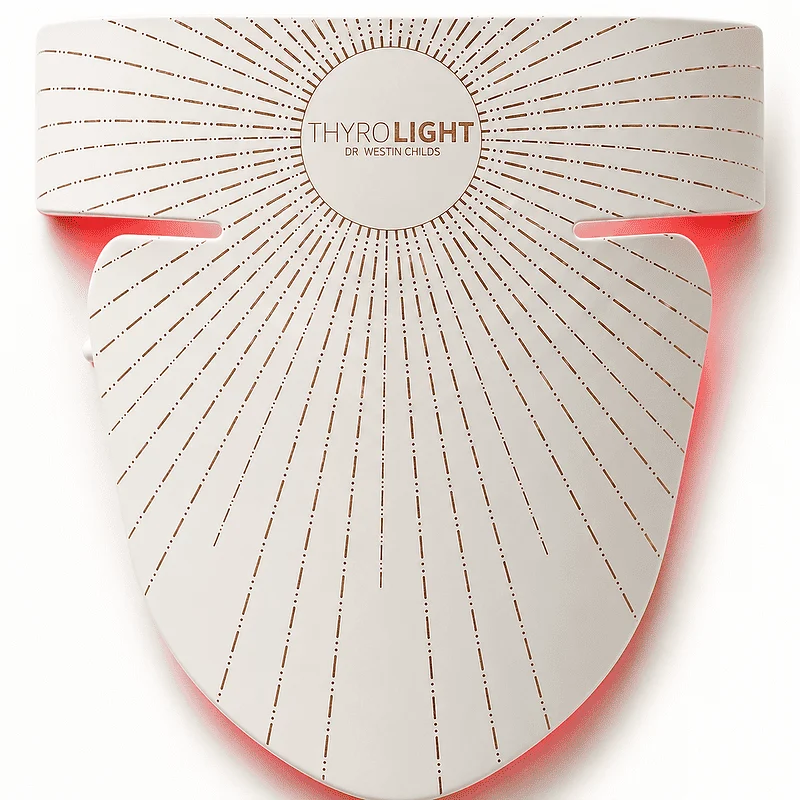
And finally, you want something that will cover your entire thyroid gland, something that wraps around the base of your neck, the sides, and goes all the way up to your chin.
If a device doesn’t meet all of these specs, you aren’t going to get the results you are looking for.
This is exactly why I created the Thyro Light.
I wanted to get results for my thyroid patients, but none of the devices out there met the specifications.
So I did the research and created one specifically designed for thyroid patients.
The Thyro Light is a targeted, wearable device that is engineered to meet every single specification required for thyroid gland healing and rejuvenation.
It sits directly on the skin where it sends red light deep into your thyroid gland tissue, at just the right wavelengths, and at just the right power, to give your thyroid exactly what it needs for repair.
The only thing left is the protocol:
The Thyroid Red Light Therapy Protocol
This part couldn’t be simpler. Over a thousand thyroid patients are using my Thyro Light daily with this exact protocol:
- 1 session a day (5 days a week) for 20 minutes.
- 5 sessions a week for 8 weeks (therapy phase).
- This is followed by a maintenance phase of 1-2 sessions per week to maintain your results and continue them.
- As needed, you can go back to the therapy phase to manage flare-ups or symptoms that get out of control.
That’s it. Follow these instructions, and you’ll be well on your way to healing your thyroid gland.
If you’re tired of generic red lights that aren’t designed for your thyroid, then my Thyro Light is perfect for you.
And if you don’t want to use my device, that’s fine too. Just make sure you find something that is as close to the specs that I mentioned above.
But let me tell you something from experience:
Don’t expect to get the same results. Red light panels and wands may provide some benefit, but they will never give you the full set of results that you will get from a specifically designed thyroid red light.
What Thyro Light customers are saying
“Since starting Thyrolight, my sleep has improved, my chronic fatigue and brain fog are gone, and I have more energy throughout the day.”
“I used to feel tired from the time I woke up to the time I went to bed. Plus I would take naps throughout the day. I am on week 7, I use it 5 times a week for 20 minutes, and I’m not tired during the day anymore. I am also sleeping better at night. This is definitely worth the money.”
“I love the ease of use of this light. It has produced a noticeable reduction in the size of my thyroid unlike anything I have ingested.”
120-day money-back guarantee.
If Thyro Light isn’t right for you, you can return it for a full refund. Start your return online in just a few clicks.
Scientific References
1. Lanzafame R (2020). Light Dosing and Tissue Penetration: It Is Complicated. Photobiomodulation, photomedicine, and laser surgery. doi:10.1089/photob.2020.4843.
2. Lee YI, et al. (2021). The Use of a Light-Emitting Diode Device for Neck Rejuvenation and Its Safety on Thyroid Glands. Journal of clinical medicine. doi:10.3390/jcm10081774.
3. Hossein-Khannazer N, et al. (2022). Low-Level Laser Therapy in the Treatment of Autoimmune Thyroiditis. Journal of lasers in medical sciences. doi:10.34172/jlms.2022.34.
4. Calderhead RG, et al. (2015). Adjunctive 830 nm light-emitting diode therapy can improve the results following aesthetic procedures. Laser therapy. doi:10.5978/islsm.15-or-17.
5. Höfling DB, et al. (2013). Low-level laser in the treatment of patients with hypothyroidism induced by chronic autoimmune thyroiditis: a randomized, placebo-controlled clinical trial. Lasers in Medical Science. doi:10.1007/s10103-012-1129-9.
6. Fuchs C, et al. (2021). Photobiomodulation Response From 660 nm is Different and More Durable Than That From 980 nm. Lasers in Surgery and Medicine. doi:10.1002/lsm.23419.
7. Höfling DB, et al. (2018). Safety and Efficacy of Low-Level Laser Therapy in Autoimmune Thyroiditis: Long-Term Follow-Up Study. International Journal of Endocrinology. doi:10.1155/2018/8387530.