
- Suppressed TSH from medication differs from endogenous hyperthyroidism because patients with medication-induced low TSH often experience hypothyroid symptoms rather than the classic hyperthyroid signs seen in Graves' disease.
- Post-menopausal women on suppressed TSH may lose up to 1% bone density per year, but this risk can be mitigated through bio-identical estrogen and progesterone replacement or calcium supplementation.
- Temporary TSH suppression of 3-9 months carries minimal cardiac risk, and beta-blockers can completely prevent heart complications if long-term suppression becomes necessary.
- Only suppress your TSH intentionally if you're experiencing significant hypothyroid symptoms and the quality-of-life benefits outweigh potential risks, always monitoring bone density and cardiac function.
Is having a suppressed TSH dangerous to your body?
Will it cause bone loss or damage to your heart?
Can the negative side effects be mitigated or avoided with other interventions?
In this post, we will discuss the pros and cons of having a suppressed TSH including what potential negative side effects it can cause, how to avoid them, and how you should dose your thyroid hormone.
Let’s jump in:
What Does it Mean to Have a Suppressed TSH and is it Dangerous?
A suppressed TSH is a way to refer to a condition in the body in which the TSH is lower than it should be under “normal” conditions.
TSH suppression occurs as a result of taking too much thyroid medication but is also secondary to certain medical conditions which cause hyperthyroidism (such as Graves’ disease).
In this article, I am going to be referring to TSH suppression secondary to the use of thyroid medication (meaning endogenous TSH suppression) because of its impact on patients who take thyroid medication.
It is estimated that anywhere from 25 to 40% of patients taking thyroid hormone may have a suppressed or “below normal” TSH.
The state of having a low TSH is considered to be a big problem and one that often results in Doctors altering (reducing) the dose of thyroid hormone a patient is taking.
This is often VERY confusing to patients, especially because usually when their TSH is low they often begin to feel better from a symptomatic standpoint.
So, from the patient perspective, why would a Doctor alter the dose of thyroid hormone if they are finally feeling better?
The answer has to do with the fact that TSH suppression is felt to lead to two potential negative side effects.
That of bone loss and heart problems (1).
But is this really a concern?
The answer may not be as clear-cut as you’d think.
In order to have a logical and coherent and honest discussion about TSH and its impact on your health we need to answer some basic questions:
Is causing TSH suppression with the use of medications the same thing as when it occurs from Graves’ disease?
In other words:
Is TSH suppression from exogenous hormone equivalent to TSH suppression from endogenous hormone?
How does the degree of TSH suppression impact the negative consequences?
In other words:
Is TSH suppression with T4 medication equivalent to TSH suppression from T3-only medications?
Is one worse than the other, are they the same?
There is evidence to believe that endogenous causes of hyperthyroidism may result in cellular hypersensitivity (2) (especially to tissues that are sensitive to catecholamines) which may not be seen in hyperthyroidism caused by excessive dosing.
What this means is that taking too much thyroid hormone by mouth may result in a suppressed TSH and high free T3, but this state may NOT be equivalent to the suppressed TSH and high free T3 seen in endogenous causes of hyperthyroidism such as Graves’ disease.
This phenomenon may explain why patients with endogenous causes of hyperthyroidism exhibit obvious signs of hyperthyroidism (such as weight loss, tremors, heart palpitations, and so on) while patients with a suppressed TSH secondary to medication use can, and often do, experience symptoms of hypothyroidism (weight gain, fatigue, cold intolerance, constipation and so on).
If these two conditions are the same then someone must explain how they can result in polar opposite symptoms in patients.
Does the benefit of TSH suppression outweigh the potential negative consequences of experiencing hypothyroid symptoms for an indefinite amount of time?
In other words:
Is it better for your health long term for you to be 40 pounds overweight or would you rather lose your weight and experience a risk of 1% bone loss per year due to a low TSH?
There isn’t a clear answer and the answer likely depends on the patient.
This should be a conversation that each person has with their Doctor to determine if the risk is potentially worth taking in their individual case.
Lastly, is there any risk of temporary TSH suppression for 3-9 months?
In other words:
Is there any harm that will occur if you temporarily suppress the TSH in an attempt to fix or reduce symptoms or help with weight loss?
If there is no short-term risk (and I would argue that most of the risk from using T3 isn’t realized until TSH suppression has been present for years) then what’s the harm in a trial of altering thyroid medication?
Suppressed TSH and Bone Loss (Osteoporosis)
One of the most cited concerns for TSH suppression is the potential loss of bone or the cause of osteoporosis.
The logic goes that suppressing your TSH will lead to an inevitable decline in bone health and an increased risk of fracture.
Bone cells have thyroid hormone receptors and therefore they react to changes in thyroid hormone (3).
In cases of endogenous hyperthyroidism (meaning your body produces too much thyroid hormone), patients do experience an increase in osteoporosis and fracture risk.
This logic has led physicians and patients to be scared of increasing thyroid dosing in fear that it may cause the same effects.
Doctors are worried that taking too much thyroid hormone (T4) will result in the same risk that hyperthyroid patients experience.
But is this actually observed in studies?
Sort of.
Some studies do show that TSH suppression does cause an increased risk of osteoporosis but with 2 very important points.
The absolute risk of osteoporosis and bone loss depends on the DEGREE of TSH suppression (4).
For instance:
If your TSH is less than 0.1 then you will experience more bone loss than someone with a TSH in the 0.2 to 0.5 range.
Second, this increase in risk is really only statistically relevant in women who are post-menopausal.
Pre-menopausal women do not see a statistically significant increase in bone loss presumably due to the beneficial effects of estrogen on bone maintenance.
But this begs a very important question:
Can the risk of bone loss be mitigated (reduced) in post-menopausal women with the use of bio-identical estrogen replacement therapy?
We don’t have an answer to this because the use of hormones isn’t widespread, but it may be worth considering on a case-by-case basis.
Is there a risk of bone loss in post-menopausal women who use thyroxine but have a normal TSH?
The answer is no.
The question is whether or not this TSH suppression is worth it (based on your case) and whether or not you can mitigate your risk based on other therapies.
In general:

If you are a menopausal woman (meaning you are menstruating regularly) then TSH suppression is likely not going to cause any significant risk to your bone health even if used long-term.
In the most severe cases, menopausal women with TSH suppression may realize a bone loss rate of 0.3% per year.
But what if you are a post-menopausal woman (meaning you no longer have menstrual cycles)?
It seems if you fall into this category then you will realize an increased risk of bone loss and osteoporosis based on how long your TSH is suppressed and how suppressed your TSH is.
Women who fall into this category may experience up to 1% bone loss per year, which after 10 years may increase their risk of fracture significantly.
What isn’t clear, however, is if this risk can be completely reduced with the use of bio-identical estradiol and progesterone with the idea to bring these hormones back to youthful levels.
This study highlights the importance of hormone control BEYOND thyroid hormone in all patients, and it highlights that physicians shouldn’t necessarily be scared of a slightly suppressed TSH in all patients.
What about the use of Calcium instead of estrogen?
Some studies do show that supplementation with calcium, even if your TSH is suppressed, may help prevent bone loss issues.
Does this mean that you should suppress your TSH?
Not necessarily, but it does mean that you should have a meaningful conversation about the risks vs the benefits with your current physician.
While bone health is important, there are other factors that should be considered with TSH suppression as well, and that includes heart health.
Suppressed TSH and Heart Problems (Atrial Fibrillation & Cardiac Enlargement)
There’s no question that thyroid hormone has an impact on cardiac function and cardiac size.
Studies have shown that thyroid hormone helps regulate the heart rate, and the size of the heart and has an impact on the pressure in various chambers in the heart (including the pulmonary arteries).
So why are Doctors and patients concerned about the heart when it comes to their thyroid?
It is then assumed that these complications would be seen in patients who take excessive doses of thyroid hormone by mouth for conditions such as hypothyroidism.
The problem with this thinking is that both conditions, hyperthyroidism caused by disease states and exogenous hyperthyroidism (caused by taking too much thyroid hormone), are considered to be equivalent and the same.
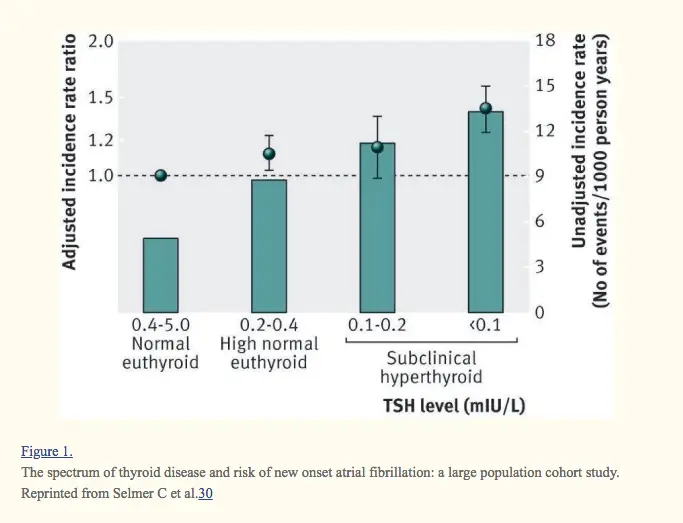
More studies are necessary to prove that this statement is in fact true.
In the meantime, it’s important to understand how thyroid hormone actually impacts the heart, especially if you are taking suppressive doses of thyroid hormone.
What’s interesting about the heart is that it only responds to T3 but it lacks the ability to alter T4 into T3 in its own tissues (9).
This means that your heart is particularly sensitive to T3-containing medications such as Cytomel/liothyronine and Natural Desiccated Thyroid hormone.
The heart is sensitive to T4 medications but only in patients who readily convert T4 into T3 (and we know that up to 15% of people may have an issue with this conversion).
What does this mean for you?
It means that you are more likely to experience cardiac effects when taking thyroid medications that contain T3.
It also means that we shouldn’t necessarily make general assumptions about the impact of thyroid hormone on the heart without differentiating between thyroid medications.
So, can we look at TSH suppression and the heart the same way that we view TSH suppression and your bones?
Not exactly, but there may be some similarities.
The impact of thyroid hormone on heart tissue depends on two important factors:
The first is the degree of TSH suppression.
The second is the length of time in which your TSH is suppressed.
Many of the complications of hyperthyroidism, aside from heart palpitations, may take years or decades to cause an issue.
It takes quite a bit of time for cardiac remodeling (hypertrophy) to cause gross or overt cardiac dysfunction.
Another very important point is that several studies have shown that reducing thyroid hormone (fixing the problem) causes a complete reversal in cardiac complications (heart problems).
What does this mean for you?
Several things:
It means that using TEMPORARY suppressive doses of thyroid hormone is not likely to cause any long-term cardiac complications.
It also means that, if you are taking suppressive doses of TSH, the use of a beta-blocker may be enough to completely PREVENT cardiac complications.
There may be situations in which suppressive doses of thyroid hormone may be beneficial, but you should always consult with your physician and determine if the benefits outweigh the risks.
It’s plausible that temporary TSH suppression, with the goal of weight loss in mind, may reduce your risk of cardiac issues long-term in exchange for a temporary (and reversible) risk of cardiac issues such as heart palpitations.
Should You Suppress Your TSH?
Dosing based on the TSH is an interesting concept and not one that is used for other hormones in the body.
Take for instance the case of birth control pills.
Prescribed birth control pills, when taken by mouth, act to completely shut down FSH and LH from the pituitary.
Remember that TSH is a pituitary hormone, much like FSH and LH, but Doctors never bother to check FSH and LH when using birth control because they know that they will be suppressed.
Birth control pills come in a standardized dose and hardly any thought is given to the degree of FSH/LH suppression when they are being used.
Why then is the TSH given so much more weight when compared to FSH and LH? Even though BOTH hormones are secreted by the pituitary gland?
The answer isn’t clear, but this is something that should be evaluated in future studies.
We do know, as you might suspect, that there are instances when the TSH is not necessarily the best measurement of thyroid function in the body.
Even though this is the case, it doesn’t mean that the TSH should be ignored when dosing thyroid hormone.
But it does mean that other factors such as Free T3, Free T4, Reverse T3 and other thyroid tests should be evaluated in conjunction with the TSH.
Suppressive doses of thyroid hormone may be beneficial in some patients, but you should never adjust your thyroid dosing while dismissing the TSH entirely.
The bottom line?
Following your TSH is an important part of thyroid hormone management, but it shouldn’t be the only test you order.
There may be some risks associated with TSH suppression (from endogenous thyroid hormone) but some of these potentially negative side effects may be avoided.
If you are taking suppressive doses of thyroid hormone ensure that you are monitoring bone density and cardiac function.
You can evaluate bone density with a DEXA scan and you can evaluate cardiac function with an echocardiogram.
In some cases, bone loss may be prevented or avoided with the use of bio-identical hormones such as estrogen or with calcium supplementation.
In some cases, cardiac complications may be prevented or avoided with the use of beta-blockers (12).
Your goal should NEVER be to suppress the TSH, but it may not be a serious problem if it is done correctly and only for a short period of time.
Now I want to hear from you:
Are you currently taking suppressive doses of thyroid hormone?
Are you experiencing negative side effects associated with your TSH being low?
Do you have a low TSH but still experience the symptoms of hypothyroidism?
Leave your comments below!
Scientific References
#1. https://www.ncbi.nlm.nih.gov/pubmed/20363722
#2. https://www.ncbi.nlm.nih.gov/pubmed/25438971/
#3. https://www.ncbi.nlm.nih.gov/pmc/articles/PMC4314789/
#4. https://www.ncbi.nlm.nih.gov/pubmed/8252740
#5. https://www.ncbi.nlm.nih.gov/pmc/articles/PMC4746080/
#6. https://www.ncbi.nlm.nih.gov/pubmed/7848399/
#7. https://www.ncbi.nlm.nih.gov/pubmed/8772604/
#8. https://www.ncbi.nlm.nih.gov/pubmed/8345037
#9. https://www.ncbi.nlm.nih.gov/pubmed/25438971/
#10. https://www.ncbi.nlm.nih.gov/pmc/articles/PMC3693616/
#11. https://www.ncbi.nlm.nih.gov/pmc/articles/PMC1431605/
#12. https://www.ncbi.nlm.nih.gov/pmc/articles/PMC3832836/



Hello Dr.,
I am a 56 year old male and not on any prescription medications, but after reading many of your articles I truly think I may have hypothyroidism with suppressed TSH. (Low energy, brain fog, long injury recovery, cold intolerance, weight gain) My recent blood work came back with good numbers for most all checks except for suppressed TSH ( <0.005). Testosterone was about 700 which I believe is good for my age. Is this a Pituitary problem? I haven't yet checked FT4 & FT3 and will be soon. What else should I be asking my doctor about this. Wondering if this could be a Pituitary tumor. Do you have any thoughts or suggestions?
Hi James,
It’s hard to say without more information. The first thing you’d want to rule out, though, is hyperthyroidism or subclinical hyperthyroidism. You can do that by checking for thyroid-stimulating antibodies as well as other thyroid antibodies.
I have been hypo for 27 years following pregnancy. I have been on Armour for several years, previously on Synthroid too, but not now. The last few years I have experienced increased heart issues, but stress echo was normal. NONE of my doctors EVER linked my heart symptoms to my thyroid. Now I am realizing that the T3 may be causing them. My TSH has been suppressed for several years, although both my FT3 and FT4 are low. I just saw a new naturopath due to having just moved, so I will discuss this – I am so frustrated and scared that now I have heart damage. Should I go back to just T4 meds? I previously had trouble converting to T3 which is why I had added Armour in the first place.
Hi Dr. Childs,
I have been dealing with secondary or tertiary hypothyroidism for 5 decades over about 40 years. I am 54 and healthy. I have been fully dependent on Armour the majority of the time and still am today. I am being challenged by my current doctor and would like to find a new Doctor that is wise and knowledgeable in this area. Do you know of any you can recommend in the Bellevue, Seattle area? Are you ever available to have a conversation?
This has been my cross to bear in life starting at age 16. I would like to see if my TSH would kick in, but am terrified and can only do this under the supervision of a REALLY GOOD DOCTOR.
Thank you, Lori
Hi Lori,
I don’t know anyone in that area but you can use this resource to help you find someone local: https://www.restartmed.com/how-to-find-a-doctor-to-treat-your-thyroid/
Hi, I have recently been diagnosed with Graves Disease. My thyroid levels were found to be abnormal during a routine blood test. I have no symptoms so have declined to take any medication. My TSH level was below 0.008 my T4 16.8 and my T3 was 6.3.
A 24 hour heart monitor should nothing significant and my bones showed that I was slightly osteopoenic. I am a 65 year old post-menopausal woman. I have asked to be monitored annually for the time being and am taking calcium supplements. I would value your thoughts on my case.
Hi Dr. Childs
I am 35 years old, I have hashimoto’s, I have fixed some gut problems, like killing Blasto, my TSH is 2.5, I exercise every day on an empty stomach, I take probiotics, I have improved a lot the reduction of hair loss, I follow an anti-inflammatory diet but for the first time I am having a hard time losing a lot of weight. Should I consider starting thyroid medication?
Thank you very much.
Hi Cecilia,
It may be necessary but you’d want to get a complete set of thyroid labs first before determining if you need it. You can learn more here: https://www.restartmed.com/normal-thyroid-levels/
I was just diagnosed with Osteoporosis at 57. I have had Hashimotos for a very long time and have had a suppressed TSH for many years. I use over the counter thyroid supplements from New Zealand grass fed cows (Nutri-Meds) and they have done a wonderful job managing my symptoms. But now that I have Osteoporosis I am very concerned. I also have low vitamin D. My Dr. recently told me to get on D3 and Calcium supplements. I have started taking D3/K2 (5,000 IUs per day) along with Magnesium, but I have not added any calcium supplements yet because I have seen conflicting information about calcium supplements and thyroid meds/bone loss/heart issues, etc. I would really like your opinion on what supplements I should be taking and how much. Can you recommend a good combination of D3/K2/A/Magnesium and Calcium (if needed) and how/when they should be taken? Thank you! You are the only thyroid Dr. I trust to be honest.
I am 57 years old and I’ve had Hashimoto’s since I was diagnosed at 20 years old. I take brand only Synthroid 112 MCG every morning I was recently told my TSH is suppressed. Here are my most recent lab results. I am totally confused as to how I should be treated. Do you think I need a T3? Am I having trouble converting?
Free T3 = 3.10 range (2.40-4.80)
Free T4 = 1.49 range (0.60-1.60)
TSH = 0.247 range (0.450-5.330)
I have an appointment with my endocrinologist next week. And unfortunately, I have zero faith in her. Why is it so hard to find a good doctor to help us in the day and age you have to be your own advocate and it shouldn’t be.
Hi Shannon,
It has to do with entrenched dogma and the sole reliance upon TSH and levothyroxine monotherapy. It will likely change in the future, but it will probably take 10 years or longer.
You can learn more about how to find competent thyroid doctors here: https://www.restartmed.com/how-to-find-a-doctor-to-treat-your-thyroid/
And why I generally do not recommend seeing endocrinologists here: https://www.restartmed.com/endocrinologist-for-thyroid/
Dr. Childs,
Do you have an article about suppressed TSH and hypothyroidism after TT in 2010? My TSH has been suppressed since my surgery.
Hi Rhonda,
I don’t believe I have one specifically addressing post thyroidectomy, but the information only really changes if you’ve had your thyroid removed for cancer. And even then, it’s not by much.
Dr. Childs,
I’m so glad I found your website and all the information you have regarding thyroid stuff. My thyroid was completely removed 15 years ago due to cancer. My TSH has been suppressed since. I had a bone scan done 9/2021 and there was no sign of osteoporosis. I have started my menopause journey in the last 6 months. I was taking 180mg of Armour Thyroid and I felt great. My endocrinologist was concerned and basically threatened to not be my doctor if I didn’t get my TSH up and lower my dosage. My TSH has been <0.01. My T4 Free has been 1.1ng/dl – 1.3ng/dl consistently, My T3 has been 93ng/dl to 123ng/dl consistently, Thyroglobulin AB <0.4u/ml, Thyroglobulin <.10ng/ml. My Dr. has had me decrease my dose down to 150mg for 6 weeks, take labs, TSH still suppressed and then had me decrease down to 120mg and I am due to take labs next week. I would love to know your thoughts on the TSH being suppressed. Unfortunately my Dr. only looks at the TSH and is concerned about heart attack, although I have no history or family history of that, and bone loss. I had no heart palpitations either on that dosage.
Since the decrease of medication I am now experiencing symptoms of hypothyroid such as significant decrease in bowel movements, cold all the time, tired, weight gain, dry skin, more emotional. I was not experiencing any of those symptoms when I was on the higher dosage. And I was not experiencing hyperthyroid symptoms either. Please help.
Hi Dr. Childs. Thank you for the article! What if your TSH is suppressed at .09, but you still have room for improvement with a Free T3 at 3.4 and a Free T4 at 1.2 (using Quest Labs)?
I have felt worsening fatigue as my doc lowered my thyroid meds to get me at this level. Previously, I was over-medicated on T3. However, she is now concerned about a .09 TSH and wants to drop my T4 further. (Note: My RT3 is 17 and dealing with Lyme disease but that’s not a quick fix.)
I’ve read that there is a negative feedback loop that happens when you start taking thyroid medication. Especially T3. This loop suppresses your TSH, so it is common to have suppressed TSH on thyroid medication. Is this true? I didn’t read anything about this in your article. The only way I can get my Free T3 in optimal range to feel good, is to super suppress my TSH.
Hi Jayne,
It is true that there is a feedback loop, it is not true that this must suppress your TSH. It is true that most people are taking too much T3 and this causes suppression, but this is not ideal.
Hello Dr. Childs,
I had a total thyroidectomy due to papillary cancer in 2010, and ever since that time, my TSH has been suppressed. The recent TSH test in November 2025 was 0.015; the year before it was 0.025, and the year before that, the test result was 0.019.
I was told in the beginning that my thyroid would be suppressed, so the cancer wouldn’t come back. I NEVER feel well. I take Armour 90 mg each morning. I am also getting old, soon to be 77. How long can the TSH be suppressed?
I haven’t taken anything to suppress my TSH and it’s been low on just about every test I’ve taken for the past 15 years, post menopause. Before that, I don’t know because I wasn’t getting regular lab work. It’s gone as low as .2 and has been below .4 most of the time. My Free T3 and Free T4 are in range, but my rT3 was 19.9 when tested last year.
My symptoms swing back-and-forth between what feels like hypo (gaining weight) and what feels like hyperthyroid (losing weight). I also have nodules, that I’m aware of for over 10 years, as discovered by a Functional MD when he palpated my thyroid. I just had a thyroid ultrasound done and I’m still awaiting results. I’m also awaiting a referral to get a DEXA scan. My last one which I believe was about 8 years ago showed osteopenia. I just had a full thyroid panel done to see if I have antibodies.
I had terrible cystic acne in my early 20s, but nobody mentioned thyroid could be a factor. I was put on several rounds of antibiotics and then Accutane. Horrible for the liver & gut microbiome. I feel betrayed by the system.
Hi Myriam,
Are you taking thyroid medication? If so, that would likely account for the swings in TSH that you are seeing. It’s also worth noting that you can suppress the TSH with any thyroid medication, but that doesn’t mean your symptoms will automatically be controlled. If your symptoms are swinging then there’s an issue that isn’t being addressed properly. You’d need further lab tests to figure out what that is.