

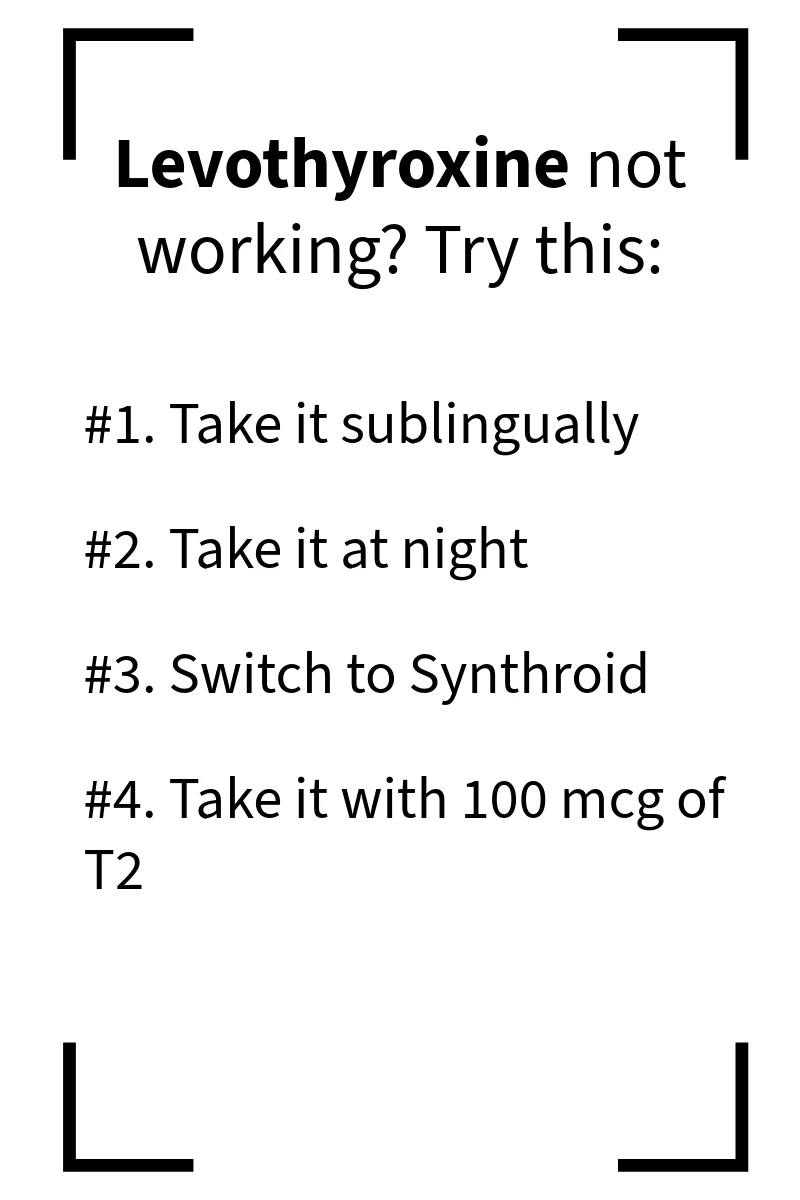
- How you take your medication matters as much as the dose. Crushing your levothyroxine and placing it under your tongue for 5 minutes improves absorption by bypassing your intestinal tract, or switch to a liquid form like Tirosint-Sol for better symptom control.
- Taking your thyroid medication at bedtime (at least 2 hours after dinner) can be equally or more effective than morning doses because an empty stomach at night eliminates absorption barriers. There's no requirement to take it in the morning.
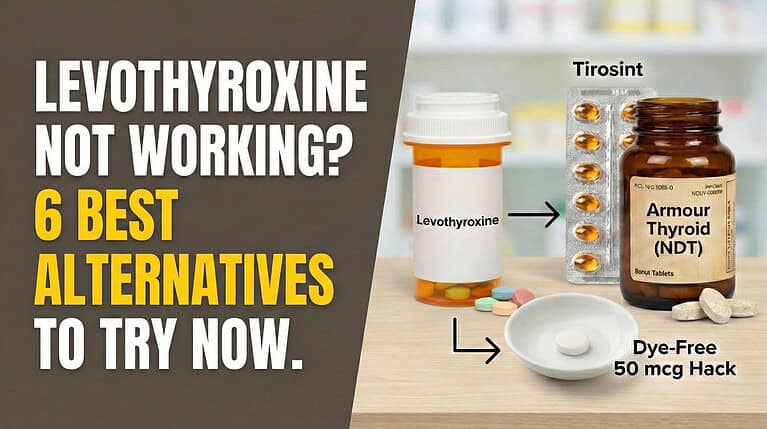
- If you've been on the same levothyroxine brand without improvement, try switching to Synthroid, another levothyroxine brand, or Tirosint. Research shows individual patients respond better to different formulations of the same medication, so don't assume one brand failure means levothyroxine doesn't work for you.
- Add T2 thyroid hormone (the only active thyroid hormone available over the counter) to amplify your current medication's effectiveness. T2 stabilizes T4 and T3 levels and can be taken at the same time as your other thyroid medication without additional cost or complexity.
- Before considering medication changes, optimize how your body uses the dose you're already taking. These four simple tweaks often produce dramatic improvements in symptom control and energy levels.
Most people on levothyroxine do the same thing every morning:
Wake up, swallow the pill, and wait to feel better.
For some people, that works fine.
But for most thyroid patients… it doesn’t.
If you aren’t feeling better on levothyroxine, know that you aren’t alone.
And that making a few simple tweaks can dramatically improve how well your med is working:

Free quiz
Can you stop taking levothyroxine? Take the quiz
Ten questions tell you whether you are a candidate and what would have to be true first. Results are emailed to you at the end.
Take the quiz#1. Change HOW you take your levothyroxine
If you’re like most thyroid patients, then you’re probably just swallowing your medication with a glass of water.
But did you know that you can take your meds sublingually?
If you crush up your medication, turn it into a powder, and then place it under your tongue for about 5 minutes, you can help your body bypass your intestinal tract.
This means better absorption and better symptom control[1].
Does it taste great? Not really, but it will help you feel better.
And, FYI, if you don’t want to crush up your meds, you can opt to get a liquid or gel cap like Tirosint or Tirosint-sol.
These are very similar to levothyroxine in that they contain the same type of hormone, but they come in a different form.
#2. Change WHEN you take your levothyroxine
Contrary to popular belief, there’s no official law that states you must take your thyroid medication first thing in the morning.
In fact, research suggests that taking your meds right before you go to bed is just as effective, if not more effective[2].
Here’s why:
It turns out that when you take your meds at night, there’s nothing in your stomach to prevent their absorption.
But the same is rarely true in the morning.
What’s the first thing that thyroid patients do when they wake up?
They take their medication, and then they usually go straight to breakfast with a cup of coffee.
But both of these things are terrible for levothyroxine absorption.
Most people aren’t in the habit of eating right before they go to bed (or drinking coffee at that time), which makes it an ideal time to take your medication.
As far as the timing of dinner goes, just make sure you take your levothyroxine at least 2 hours after dinner.
But bump that time up to 4 hours if you are taking a gut-slowing GLP-1 medication for weight loss like Ozempic or Wegovy.
My recommendation is to put your levothyroxine bottle on your nightstand with a cup of water.
Right before you lie your head down for bed, take it with a small sip of water. It’s that easy.
If you need help transitioning from morning to evening dosing, check out this article, which walks you through it.
#3. Change what TYPE of levothyroxine you are taking
Levothyroxine is levothyroxine, right?
Not exactly.
Generic levothyroxine and brand-name Synthroid are technically the same drug, but they are not made the same way.
And this holds true for all of the various “levothyroxine” formulations, which are branded under different names.
Some other names used interchangeably with levothyroxine include:
- Levothyroxine (you know this one)
- Synthroid
- Levoxyl
- Tirosint
- Tirosint-sol
- Levothyroxine injections
- Unithroid
- Euthyrox
- Levothroid
You don’t need to memorize these names, but you do need to understand this:
Some people do better on one over the other, even though they contain the exact same active ingredient.
If you’ve been on one form for years and still feel off, ask your doctor about switching to another version.
Practically, that means if you’re taking levothyroxine, switch to Synthroid.
If you’re taking Synthroid, switch to Tirosint.
And so on.
Even if you can’t get your doctor to prescribe one of the fancier and stronger thyroid medications like liothyronine or Armour thyroid, you shouldn’t have an issue getting them to prescribe one within the same class.
Even though it doesn’t seem like a big change, it can have a huge impact[3].
And research supports this idea.
#4. Add T3 to your levothyroxine
If you have your free T4 and free T3 results, use my T4 to T3 conversion calculator to explore the relationship between them.
Levothyroxine is a T4-only medication.
Your body is supposed to take that T4 and convert it into T3, which then does the job you want it to.
But not everyone does this effectively or efficiently.
Stress, inflammation, nutrient deficiencies, and certain genetic variants can all slow down this process.
If this is happening in your body, you can take all of the levothyroxine you want, but still feel terrible.
The reality is, some people need more T3 than what they can get from levothyroxine.
There are two main ways to get more:
The first is natural desiccated thyroid (NDT), like Armour Thyroid or NP Thyroid.
NDT is made from porcine thyroid gland and contains both T4 and T3 in a fixed ratio. The catch is that the T4:T3 ratio is static, so it doesn’t work for everyone.
The second option is adding liothyronine (Cytomel) directly to your levothyroxine.
This is sometimes called combination therapy, and research supports it for patients who don’t feel well on T4 alone[4].
Your two main dosing strategies here are:
- Levothyroxine + liothyronine (or Cytomel)
- Levothyroxine + NDT (or just NDT alone)
There is no best combination here because it all depends on your body.
But if you’ve been on levothyroxine for years and never felt right, adding T3 in some form is very likely to help.
#5. Add T2 to your levothyroxine
You can’t control how much thyroid hormone your doctor is giving you, but you can do things to make that dose more effective.
And one of those things is taking T2 thyroid hormone.
T2 is a real active thyroid hormone, the only one available over the counter, and it can help stabilize T4 and T3 levels[5].
You can purchase this as a supplement and take it at the same time as your levothyroxine or other thyroid medication.
It won’t replace your other thyroid meds, but it can help support their function.
On top of that, it does things levothyroxine can’t, like directly support the breakdown of fat cells, rev up mitochondrial energy production, and interact with your muscles.
You can get T2 as capsules or as a cream.
Start With One Change to Your Levothyroxine Routine
If this is all new to you, it may feel overwhelming.
But let me put your mind at ease:
You don’t need to try all five of these at once.
Pick the one that makes the most sense for where you are right now.
If you’ve never thought about absorption, start with sublingual dosing or switching to Tirosint.
If your conversion looks bad on labs, talk to your doctor about adding T3.
If you want something you can do today without a prescription, look into T2.
Try one or more of these simple changes and let me know how you feel. I think you’ll be pleasantly surprised by what they will do for you.
Scientific References
1. Peirce C, et al. (2018). Treatment of refractory and severe hypothyroidism with sublingual levothyroxine in liquid formulation. Endocrine. doi:10.1007/s12020-017-1367-5.
2. Rajput R, et al. (2011). Can Levothyroxine Be Taken as Evening Dose? Comparative Evaluation of Morning versus Evening Dose of Levothyroxine in Treatment of Hypothyroidism. Journal of thyroid research. doi:10.4061/2011/505239.
3. Wang L, et al. (2022). Comparative Effectiveness of Persistent Use of a Name-Brand Levothyroxine (Synthroid®) vs. Persistent Use of Generic Levothyroxine on TSH Goal Achievement: A Retrospective Study Among Patients with Hypothyroidism in a Managed Care Setting. Advances in therapy. doi:10.1007/s12325-021-01969-3.
4. Kaminski J, et al. (2016). Treatment of hypothyroidism with levothyroxine plus liothyronine: a randomized, double-blind, crossover study. Archives of endocrinology and metabolism. doi:10.1590/2359-3997000000192.
5. Mendoza A, et al. (2013). 3,5-T2 is an alternative ligand for the thyroid hormone receptor β1. Endocrinology. doi:10.1210/en.2013-1030.




I took Synthroid for at least 10 years. Medical insurance was great. Then I changed insurance and they suggested only using generics, for everything. I switched to Levothyroxin and found out it’s much less expensive.
However, Synthroid is the name brand, Levothyroxin is the generic and supposedly equal to Synthroid.
I tried Armour for awhile but that was the most expensive and I didn’t really notice any difference.
You mentioned taking all three at the same time. Doesn’t that mean you are taking the same dose three times instead of once?
Hi Cecyle,
No, what I’m referring to is something like this:
Tirosint (or Synthroid/levothyroxine) 100 mcg
Liothyronine (or Cytomel/SR T3) 10 mcg
T2 (as essential T2 or T2 Cream) 100 mcg
The first two require a prescription, T2 does not.
This allows you to titrate the dose of T4, T3, and T2 individually which you can’t do when using Armour.
I am on a low does 25 mg thyroid test has been normal for about 2 years fo I still need to take it. I take a blood thinner for irregular heart rate they said thyroid was the cause. I’m thinking I don’t need the thyroid pill.
I get terrible migraines when adding t3. But without it, I feel terrible on synthroid alone. Even SR t3 does not get me past evening without migraine starting. It’s debilitating and has gone on for a decade. I take 1 1/2 25 mcg (37.5mcg) synthroid with 5 mg SR t3 a day. I’m still miserable and get terrible migraines. Please advise. Thx. J