- Leptin resistance develops when high leptin levels desensitize your brain, slowing metabolism and increasing appetite. Check your fasting serum leptin (should be under 10-12) and uric acid levels to diagnose it properly.
- Leptin and thyroid resistance often occur together, with high leptin driving your body to convert thyroid hormone into inactive reverse T3. Adding T3 thyroid medication can bypass this conversion problem and restore your metabolism.
- Healing leptin resistance requires multiple simultaneous treatments (thyroid optimization, high-intensity interval exercise, anti-inflammatory diet, sleep improvement, and insulin management) because single interventions alone rarely produce results.
- Stop calorie-restricted dieting immediately, as it worsens leptin resistance by creating metabolic damage that persists for years. Instead, focus on healing your metabolism by slowly increasing food intake while treating underlying hormone imbalances.
- GLP-1 medications like Ozempic can directly lower leptin levels and prevent the leptin rise that typically causes weight regain after weight loss, but should be combined with the other interventions for lasting success.
Are you having trouble losing weight?
Or, better yet… do any of these sound familiar?
- You can’t lose weight no matter how much you exercise
- You are constantly gaining weight even though you haven’t changed your exercise or diet routine
- You feel like your metabolism is unusually slow or damaged
- You’ve tried 4+ different calorie-restricted diets in your life (weight watchers, HCG diet, etc.)
- You used to be able to lose weight by dieting but you can’t anymore
- You think you have thyroid problems but the Doctor keeps telling you everything is “normal”
โIf you fall into any of these categories you may be suffering from something known as Leptin resistance and/or Thyroid resistance.
โChances are this may be your first time hearing about Leptin resistance or Thyroid Resistance…
But don’t worry:
I’m going to explain everything – including how to diagnose, treat and manage both conditions.
Stay tuned…โ
The Powerful Connection between Weight gain and Leptin Levels
So what is Leptin (1) anyway?
Leptin is a hormone that is pumped out by your fat cells (Yes, they do more than just give you cellulite).
Leptin has a specific action in the brain (it works on your hypothalamus) to control your metabolism and your appetite (2).
You see:
We evolved with leptin as a way for our fat cells to communicate with our brains. And we want this to happen (when it works correctly).
When we have a lot of food to eat (and fat stores are high), our body is supposed to tell our brain to increase the metabolism of our body to start burning up that extra fuel.
So by now, you may be asking yourself…
If thatโs the case, why does it feel like my metabolism is so low despite having a lot of excess fat in my body?
Shouldn’t my metabolism be high so that I can burn up this extra fat?
The truth is that you SHOULD be doing that and if you aren’t, then you may have the condition known as Leptin Resistance.
So let’s find out how that happens…โ
How do we get Leptin Resistance?
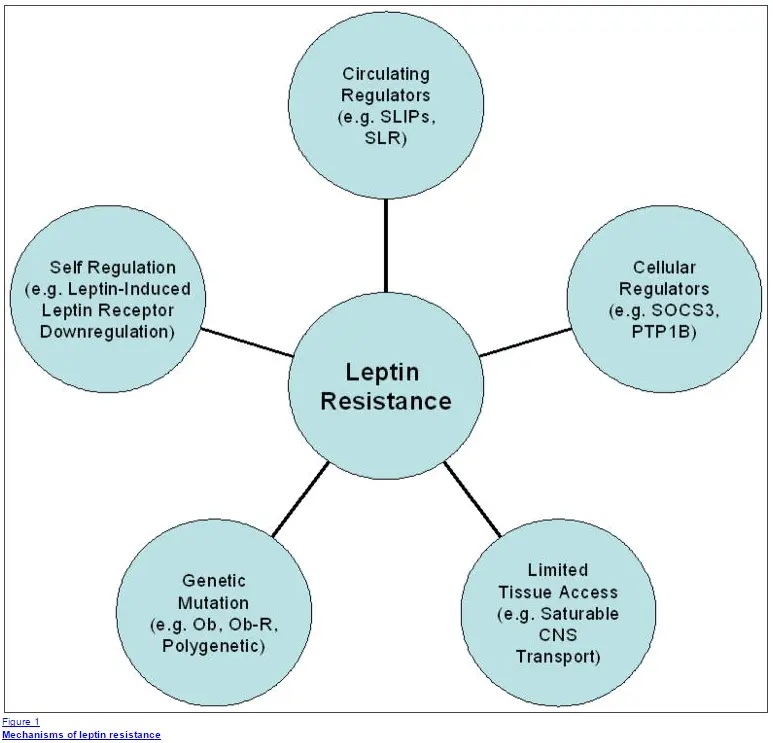
Leptin resistance is what happens when the entire system goes haywire, and it leads to some pretty unfavorable changes in the body.
As you gain more and more fat cells, your leptin levels continue to increase in the blood.
This is your body attempting to tell your brain to increase metabolism and slow down your appetite to help burn that extra fat. โ
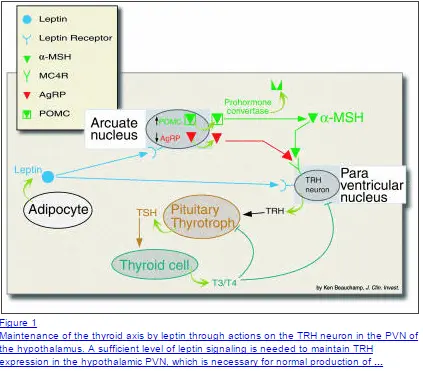
Eventually, your brain becomes โnumbโ to the signal and starts to tune out the leptin that it sees. Over time your brain completely blocks out any leptin in the system.
This process is similar to what occurs in the condition known as insulin resistance and type II diabetes. โ
And thatโs when the symptoms kick inโฆ
Once your brain tunes out the leptin it starts to think your body is in a state of starvation. So your brain slows down the metabolism of your entire body and increases your appetite to try and compensate.
So instead of burning the extra calories you just ate, your body stores it all as fat and INCREASES your appetite in the process (3).
This ultimately leads to more weight gain and higher leptin levels making the cycle even worse. โ
Signs and Symptoms of Leptin Resistance
Most people who suffer from Leptin Resistance know that something is wrong with their bodies.
They watch other people eating food, not exercising, or living an unhealthy life without gaining weight or changing their body type.
Meanwhile, patients with leptin resistance will gain weight if they don’t follow a STRICT diet.
Many patients with leptin resistance eat a calorie-restricted diet simply to maintain their weight (this has to do with the metabolic damage that accompanies leptin resistance which we will discuss later). โ
Even eating something like potatoes or white rice can cause weight gain in these individuals. โ
Now we know what it is, we need to talk about how to diagnose it.
Patients with leptin resistance tend to experience at least 2 of the following symptoms:
- Inability to lose weight despite eating a calorie-restricted diet and exercising regularly
- Constant weight gain is usually accompanied by a ravenous appetite
- Constant food cravings, even after eating a large meal
- Constant fatigue, low energy, or feeling “sluggish”
- Cold body temperature(defined as less than 98.0 degrees F)
- Low resting heart rate(defined as 50-60 first thing in the morning assuming that you are both overweight and not aerobically conditioned)
- Worsening symptoms of hypothyroidism (Hypothyroidism frequently accompanies leptin resistance)
โThese are what I call the “warning” signs of Leptin resistance.
They don’t necessarily mean you have it, but if you are suffering from more than 2 of the symptoms above then there is a high chance you might be.
The presence of these symptoms should trigger the next step, which is serum blood testing.
How to Diagnose Leptin Resistanceโ
If you want a definitive answer, then youโre going to have to get some lab tests (and you will have to ask your Doctor to order these or order them yourself online).
The absolute best way to diagnose Leptin Resistance is by checking a fasting serum Leptin Level.
Your Serum Leptin level should be less than 10-12.
If your fasting serum leptin level is greater than 10-12 and you are at least 20 pounds overweight this is an indication that you have leptin resistance.
Why?
Because the fact that leptin levels remain elevated in the face of obesity is a clear signal that the normal feedback loop is dysregulated.
You can see an example of a patient with leptin resistance and her labs below:
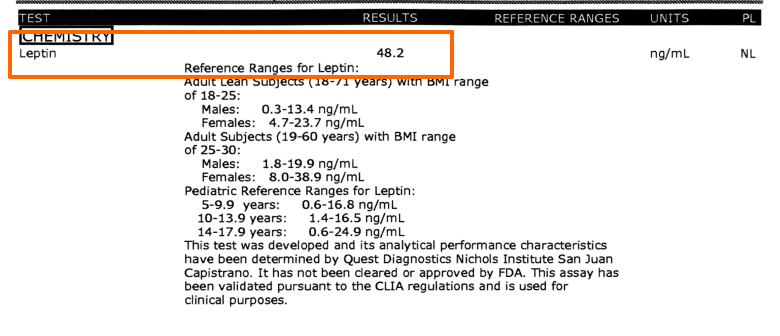
In this result, her fasting leptin level is 48.2 (note that there is no reference range for leptin levels).
โIt’s important to realize that most physicians don’t understand the significance or importance of leptin levels as they related to weight gain and weight loss.
As a result, you may need to be asking for these tests and read posts like this to evaluate your lab result.
Please also note that the lab will try to give you an approximate range for leptin levels based on your BMI.
This may erroneously lead you to believe that your leptin level is somehow “normal” because it falls within the specified range.
Believe me, this is not the case.
The lab makes observations about lab tests and notes that, for instance, patients with a BMI over 40 tend to have a leptin level > 30.
But this does NOT mean that it is normal, it just means that there are many others out there with leptin resistance. โ
Other lab tests to evaluate leptin and metabolismโ
In addition to checking serum leptin levels, I also recommend checking serum uric acid levels (4).
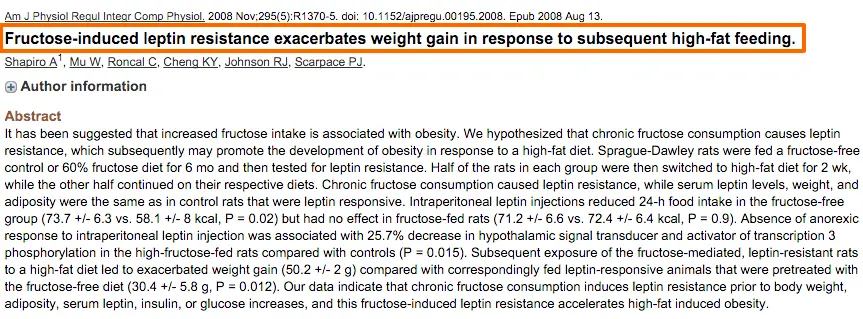
Uric acid levels act as a proxy for determining how well your body is metabolizing fructose. And fructose combined with a high-fat diet (5) can make leptin resistance worse.
So it’s worth looking at your liver to see how well you are metabolizing fructose.
If Uric acid levels are > 5 then you know you are consuming too much fructose for your body or your liver is having difficulty metabolizing the fructose. (This is also my secret weapon for determining if my patients are telling me the truth about their diet).
โI like to see uric acid levels < 5 and Leptin levels < 12.
The last test I like to order is Reverse T3.
As leptin increases and your metabolism slows, your Reverse T3 level will increase.
This is a compensatory reaction.
Thyroid hormone is responsible for a large portion of your metabolism at baseline.
So as leptin levels rise and you develop leptin resistance, your hypothalamus lowers your basal metabolic rate.
Reverse T3 acts as a brake for your metabolism, so as leptin levels rise your reverse T3 will also rise – thus damaging and further slowing your metabolism. โ
This connection is explained further in this study (6).
I use 15 as a cut-off for Reverse T3. Anything higher than that indicates to me that there is a problem with thyroid conversion and likely metabolism.
It’s not uncommon for me to see patients with Reverse T3 levels in the mid-20s, especially if they have a history of yo-yo dieting or calorie-restricted dieting (like the HCG diet).
If your levels are out of range then you are suffering from Leptin resistance and most likely Thyroid resistance (which we will talk about below). โ
- Bottom line: To evaluate your body for leptin resistance make sure to check these lab tests: Fasting serum leptin level, serum uric acid and reverse T3. You will have to ask your doctor for these tests.
Leptin Resistance causes Thyroid Resistance
Aside from the fact that Leptin Resistance makes it almost impossible to lose weight, it also causes further issues with your thyroid gland.
As Leptin levels increase and your brain slows down your metabolism, your body will start to convert Free T4 into Reverse T3 (7).
Reverse T3 actually competes with your cells for binding with the free and active T3 hormone.
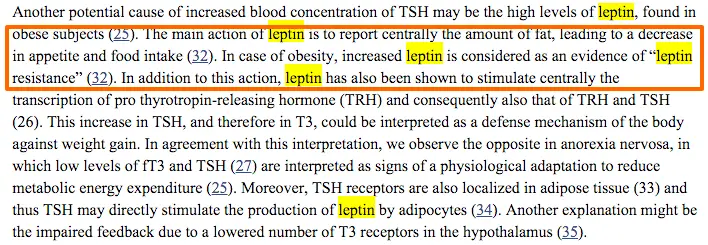
The higher your reverse T3 levels, the lower your metabolism and the more likely you are to suffer from hypothyroidism (8).
This increase in Reverse T3 is known as “Reverse T3 pooling”.
It’s also clinically seen as euthyroid sick syndrome or Low T3 syndrome. โ(I’ve outlined the connection between these conditions in the other blog posts)
Treating these high levels of reverse T3 can be a tricky process and requires a physician who is knowledgeable in both leptin resistance and reverse T3.
Often times the best treatment for patients with this condition is T3-only medication.
In addition, you may require a total reduction in your T4 thyroid medication to reduce the conversion of T4 to reverse T3.
This connection between leptin, obesity and thyroid hormone is very powerful.
In many cases, it’s hard to determine which condition came first considering that they all can worsen each other.
Because of this, it’s best to start with a comprehensive lab panel that includes testing beyond the leptin levels mentioned above. โ
If you think you might be suffering from Hypothyroidism get your levels checked.
I recommend testing for the following thyroid tests (at baseline):
- TSH: This test is highly inaccurate the higher your leptin levels get. But in general healthy levels (assuming you aren’t already on medication) is less than 1.0.
- Free T3: Should be in the upper 1/2 of the reference range (assuming you aren’t taking thyroid medication)
- Free T4: Less important than T3, but gives you an idea about T4 to T3 conversion.
- Reverse T3: Should be less than 15.
- Total T3: Should be in the upper 1/2 of the reference range.
- Antithyroid antibodies: As low as possible.
- Sex hormone binding globulin: 20-30 in men and 60-70 in women (assuming you aren’t on birth control or other oral estrogens). This gives you an estimation of tissue levels of thyroid hormone in the liver.
(Make sure that you evaluate your levels with the โoptimal rangeโ and not just the โnormal rangeโ in mind – please see the link above for further details.)
One of the most frustrating parts of diagnosing and managing Thyroid resistance with Leptin resistance is that your thyroid lab tests may always show up as “normal”.
In fact, your Doctor isn’t likely to even order the tests that you need to diagnose the condition unless you ask for them.
But there’s more:
โWhen reverse T3 levels increase in the blood, your body will naturally have higher levels of Free T3 as well.
This can fool you into thinking that your thyroid function is “normal” or that your body is converting Free T4 into Free T3 – but that is NOT the case.
The pattern I typically see in leptin resistance and thyroid resistance looks like this:
- Low levels of Free T4
- Mid-high levels of Free T3
- High levels of Reverse T3
- Low-normal levels of TSH
Even Doctors who order the right tests can be fooled by those numbers, but the reality is that patients with this lab pattern need more thyroid hormone (preferably T3) not LESS.
Don’t assume that just by ordering these tests that you will get proper treatment either, your physician must understand the importance of these hormones and lab tests in order for you to get the right treatment (elaboration below). โ
How to treat and Reverse both Leptin Resistance and Thyroid Resistance
So now comes the most important part:
If you have Leptin Resistance what are you supposed to do about it?
Treating and reversing leptin resistance can be tricky, but it’s not impossible.
In my experience, most patients will need to do a combination of therapies to get the best results possible.
Doing just one thing at a time isn’t likely to produce results.
โThis philosophy runs counter to the current treatment paradigm that most patients and physicians like to follow – treat one variable at a time and evaluate.
It took various insults to get you to where you are now (diet, stress, lifestyle, hormone imbalances, etc.) and it will require multiple therapies to reverse the process. โ
Note: these tips are not necessarily in order of importance or efficacy.โ
#1. Get on the right type and dose of thyroid hormone
โThis step is very important for treating and reversing leptin resistance.
Many patients stand to benefit from the addition of โT3 thyroid hormone in the form of Cytomel, liothyronine, or sustained release T3.
The reason T3 is so effective is that part of the problem with leptin resistance is that it causes T4 to reverse T3 conversion.
It’s important to under this point:
T4 is required for conversion to reverse T3.
If you remove T4 from the body then you won’t have the substrate to produce reverse T3 from.
Make sense?
And this is exactly what taking T3 does.
You can bypass this conversion step so you “force” your T3 levels higher while simultaneously reducing your reverse T3 levels.
โIf you are already taking T4 medication this might mean a reduction in your T4 dose.
This can sometimes, paradoxically, โimprove your thyroid function by reducing the T4 substrate.
This is also true of patients taking Natural Desiccated Thyroid hormone.
Even though NDT does contain some T3, it’s still mostly T4 thyroid hormone.
So reducing your dose of NDT may be necessary to reduce reverse T3 levels and help reduce leptin levels.
- Bottom line: Adding T3 thyroid hormone in the form of Liothyronine or Cytomel can help reduce your reverse T3 levels, increase your metabolism and improve energy levels. This is a critical component of reversing leptin resistance.
#2. Optimize your exercise routine and do the right kind of exercises
When it comes to exercising, not all exercises are created equal.
In addition, many patients are actually overtraining and may be making it more difficult to lose weight.
Over-training leads to higher than normal cortisol levels which may alter insulin levels and ultimately make weight loss more difficult.
If you have known leptin resistance then you will find the most benefit in doing high-intensity interval training.
HIIT has been shown to help reduce leptin levels (9) long-term (note this effect may take months).
But there’s a catch:โ
You need to make sure that you are doing enough to help lower the leptin levels, but not enough to cause issues with cortisol.
โIt may also be difficult to add in exercise due to the fatigue that often accompanies leptin resistance from reduced mitochondrial energy production.
With these variables in mind, it’s best to start off slow with 1 session of 10-30 minutes per week and increase your exercise frequency and intensity as tolerated.
- Bottom line: Adding high-intensity exercise can help reduce insulin and leptin levels and help with weight loss. Just make sure you aren’t over-exercising which can make weight loss more difficult.
#3. Optimize your diet
โChanging your diet is critical for lowering leptin levels.
There are multiple considerations (we will go over the others below) but for this section, we want to focus on reducing inflammation with your diet.
We know that the standard American diet (10) is full of industrial seed oils and inflammatory omega-6 fatty acids (the hallmark of processed food).
The addition of these foods can promote inflammation which further increases leptin levels (11) and adds fuel to the fire.
โWith this in mind is very important to remove all sources of processed foods, all sources containing industrial seed oils, and to eat a whole food diet.
True – this change in your diet by itself will be necessary for reducing your leptin level, but it will not be enough by itself to reverse the condition. โ
If you have no idea where to start remember that changing your diet is easy as adding in real sources of whole food.
I call this the one-ingredient diet.
Meaning you only eat foods with one ingredient (apples, bananas, almonds, etc.).
This is a very simple and clear way to dramatically improve your health.
You can also find more resources here:
- Whole 30 diet
- Anti-inflammatory diet
- My dietary recommendations and weight loss program
- Bottom line: Changing your diet will be necessary to reduce leptin levels but often will not be enough by itself for significant weight loss. Focus on natural whole food, and anti-inflammatory diets.
#4. Optimize your sleep (very important)
โSleep is one of the most overlooked factors when it comes to weight loss.
Lack of sleep is associated with an increase in insulin/blood sugar levels, and inflammation (12), and may increase leptin levels and leptin resistance (13).
While improving your sleep may not help you lose weight by itself, what it does is still very powerful.
Getting at least 8 hours of sleep will help increase the velocity of your weight loss over time.
Lack of sleep can also reduce how much weight you lose.
For instance:
Let’s say you would have lost 10 pounds in a month following my weight loss recommendations, however, if you don’t manage your sleep well you may only lose 5 pounds.
This is generally how sleep interacts with weight loss.
Fortunately, improving your sleep isn’t very difficult and you can start with some basic recommendations and ramp up the intensity as necessary. โ
Start with these supplements: โ
- 5 HTP: 5-HTP is a serotonin precursor and can naturally help calm you down before bedtime. This is especially helpful if you are also suffering from depression or other mood disorders. Use 50-100mg per night (1 hour prior to bedtime).
- Melatonin: Melatonin can help promote a regular circadian rhythm. Start with dosing between 1-3mg and take it approximately 30-60 minutes prior to bedtime.
- GABA + Serotonin potentiators: These supplements help promote natural neurotransmitters in the brain (GABA + serotonin) which help calm down the brain and induce regular sleep patterns. Take 1 capsule each night 30-60 minutes prior to bedtime.
- Bottom line: Improving your sleep will be necessary to lower your leptin levels if you are sleeping less than 8 hours per night. The addition of supplements can help to improve both the depth and quality of your sleep.
#5. Reduce your protein consumption
โIf you have leptin resistance you will also need to make some dietary changes beyond what we’ve already discussed.
It turns out that protein stimulates the release of leptin.
In the case of protein, this occurs primarily through signaling pathways with mTOR.
This is very important because the “standard” and “conventional” weight loss advice often includes copious amounts of lean protein.
Eating lean protein with every meal (or adding protein powder) can influence your leptin levels through this interaction with mTOR (14).
mTOR is involved in cellular signaling and sends the signal of growth.
That means growth for your fat tissues, obviously something you don’t want if you have leptin resistance.
For more detail on how to incorporate this style of eating into your diet, you can check out this article about the leptin diet.
- Bottom line: Reducing both fructose and your overall protein intake can help reduce leptin levels and should be incorporated into your dietary strategy.
#6. Stop limiting your calories and/or stop calorie-restricted dieting
This is both a very important step and also a tough step for many patients.
Naturally many patients with leptin resistance find that by reducing their calorie count they are able to maintain their current weight.
Unfortunately, this cycle of calorie restriction leads to a metabolic adaptation that results in a lower metabolism, high reverse T3 levels, and even higher leptin levels.
Put another way you are making the problem even worse.
This can be difficult for many patients because they know that increasing their food consumption will result in some weight gain, but it WILL be necessary to heal your metabolism long term.
It has been clearly shown (15) that calorie restriction plus constant exercise results in a severely damaged metabolism long-term.
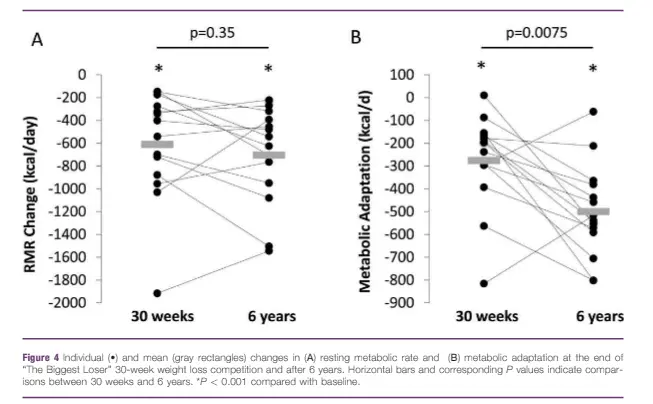
The image above shows the metabolism of the biggest loser contestants both during the program and 6 years after.
You can see that during the program their metabolism is damaged to the point that they are burning on average less than 600 calories than normal EACH day.
And, what’s even worse, is that this metabolic damage persists for 6+ years.
You can also see that 6 years later on average their metabolism is still damaged and they are burning on average โ700 calories less than what is “normal”.
Imagine you would burn 2,000 calories normally but because of your dieting, you now burn 1,300 calories per day on average due to your damaged metabolism.
Naturally, you would eat 1,300 calories per match your energy expenditure just to AVOID weight gain.
These changes are real and clearly outlined, but unfortunately, many physicians and Doctors either don’t know about them or don’t appreciate them.
As a result, when you go to the doctor and tell them you’re eating 1,300 calories each day and you’re still overweight – they don’t believe you. โ
In order to break this cycle, you must slowly increase your food intake to heal your metabolism (but note this may take a very long time).
- Bottom line: Calorie restriction (defined as anything less than 1,500 calories per day) or any diet that is considered a “low calorie” diet will ultimately make your leptin resistance worse over time. In order to fix this problem, you must slowly fix your metabolism and increase your calorie consumption to match your energy output.
#7. Optimize T4 to T3 conversion
As you might recall it is very important to improve your T3 levels when treating leptin resistance.
One of the ways that you can do this naturally is by increasing your T4 to T3 conversion (which will necessarily reduce your T4 to reverse T3 conversion).
You can do this in many ways, but one of the best ways is by introducing certain supplements that have been shown to increase this conversion.
You can see all of the steps involved (and nutrients required) for proper thyroid hormone production, signaling, and conversion in this post here. โ
Here we will go over only those supplements that help โconversion (which many people also happen to be deficient in):
- Zinc: Zinc helps to reduce inflammation, acts as a powerful anti-inflammatory agent, and can increase T4 to T3 conversion. Many people are deficient in zinc which makes supplementing a great option.
- Selenium: Selenium helps balance the immune system, reduces inflammation, and boosts T4 to T3 conversion naturally. Doses range from 75mcg to 150mcg per day.
- Bottom line: Using supplements to boost your thyroid conversion can help improve energy production, reduce leptin and increase thyroid function in the body.
#8. Reduce and treat high insulin levels if present
As you may already be aware your weight is a direct result of the hormone balance in your body.
This should be differentiated from the generic calorie in/calorie out model of weight loss.
Calories are important, but only in how they impact your hormones – not their caloric value necessarily.
For instance:
A diet high in refined carbs, sugars, bread, pasta, etc. will necessarily result in weight gain due to insulin resistance that develops as a result of this type of diet.
What you may not realize is that patients with leptin resistance generally have multiple hormone imbalances by the time they develop leptin resistance.
What this means for you is that you probably have leptin resistance in addition to other hormone imbalances in your body that need to be treated as well.
Leptin resistance and insulin resistance frequently come together as a package pair.
So if you have leptin resistance you should evaluate and treat insulin resistance if it is also present.
If you follow all of the steps outlined above (and below in the medication section) you will most likely be improving insulin resistance as well.
Having said that there are other things you can add to boost your weight loss results and lower both insulin and leptin levels.
You have insulin and blood sugar-related issues if your fasting insulin is greater than 5 (12 hours) and/or if your fasting blood sugar is greater than 90 (12 hours).
Both conditions represent abnormal glucose homeostasis.
And with a prevalence of about 50% of the US population, there is a good chance you are dealing with insulin resistance.
Consider these supplements to help lower your insulin and blood sugar levels:โ
- Sustained release alpha lipoic acid: ALA is a powerful antioxidant and helps reverse insulin resistance at the cellular level. For weight loss and a reduction in insulin levels, you will need doses as high as 1,800-2,400mg per day.
- Berberine: Berberine is another very powerful medication that can help reverse insulin resistance, help build muscle mass and improve energy production. Berberine has been shown to be as powerful as metformin in terms of reducing blood sugar and insulin levels but doses as high as 2,000mg per day may be necessary for this benefit.
- Sustained release curcumin: SR Curcumin has been shown to delay the onset of pre-diabetes to diabetes for at least 9 months. This powerful supplement helps reverse cellular inflammation and improves insulin sensitivity. Doses as high as 1,000mg per day may be necessary for this benefit.
- Bottom line: Insulin resistance contributes to obesity and often accompanies leptin resistance. Treating insulin and leptin often go hand in hand and must be treated concurrently.
#9. Consider the use of medications to manage insulin + leptin levels
This is where things get really interesting.
Leptin resistance is largely unknown to the medical community (even endocrinologists and many bariatric physicians), but this doesn’t mean that its incidence is growing.
Unfortunately, this means that getting help for your condition from your doctor may be difficult.
Having said that, there are a few medications that have been shown to dramatically reduce leptin levels and lead to significant weight loss on their own.
The best part about these medications is that they can be used to augment your results and don’t necessarily need to be maintained long-term.
โThey should, however, not be used alone.
Do not make this mistake.
The combination of medications + hormones + supplements + all of the other steps above will lead to the BEST results. โ
The medication referenced above includes the class known as GLP-1 agonists.
GLP-1 agonists have been shown to do several things ALL of which are beneficial to the patient with insulin and leptin resistance.
First:
They directly reduce leptin levels (16).
Second:
These medications help with weight loss if used by themselves in patients without diabetes or pre-diabetes (17).
These medications are approved for the treatment of type II diabetes, but they have special effects on patients without this condition.
Studies have shown that non-diabetic patients can benefit from the weight loss effects of these medications.
Third:
GLP-1 agonists REDUCE the rise in leptin levels (18) that often accompany rapid weight loss preventing weight gain long term.
One of the main reasons that patients gain weight after losing weight is due to the rise in leptin that occurs as a result of unhealthy weight loss.
The GLP-1 agonist medications can help reduce that rise in leptin and have been shown to help patients keep off their lost weight.
Fourth:
This group of medications also reduces insulin resistance and blood sugar (19).
As I mentioned previously, many of these therapies target both insulin and leptin resistance.
These medications do the same thing. โ
The fact that they target both leptin and insulin makes them very powerful when used in conjunction with the other recommendations listed above. โ
The trick in using GLP-1 agonists has to do with dosing. The standard recommended dosing doesn’t work very well and the medication must be adjusted for each individual in order to achieve optimal results.
- Bottom line: Some targeted medications can dramatically reduce leptin levels and help with weight loss. Many patients with leptin resistance will benefit from the addition of these medications.
Take home message
Leptin Resistance and Thyroid resistance are both serious conditions that can make losing weight almost impossible.
Itโs a vicious cycle that results in a hormonal imbalance where your body thinks itโs starving leading to constant weight gain and a voracious appetite.
Unfortunately, it can be hard to diagnose and is missed by most Doctors.
Because of this, you will need to be your own advocate, check your symptoms, and start taking action with the steps provided at home.
Remember balancing Leptin, the โmaster hormoneโ of your body fat, is required if you want to ever have long-lasting weight loss.
If you have any of the symptoms listed above make sure to get your leptin levels (and other hormones) evaluated and use these tips to help with weight loss. โ
Now itโs your turn:
Have you been diagnosed with Leptin resistance or Thyroid resistance?
What has actually helped you to lose weight?
โHave you tried T3-only medications for these conditions?
Leave a comment below!
Scientific References
#1. http://www.ncbi.nlm.nih.gov/pubmed/12403078
#2. http://www.ncbi.nlm.nih.gov/pubmed/17212793
#3. https://www.ncbi.nlm.nih.gov/pubmed/12403078
#4. https://www.ncbi.nlm.nih.gov/pmc/articles/PMC5409734/
#5. http://www.ncbi.nlm.nih.gov/pubmed/18703413
#6. https://www.ncbi.nlm.nih.gov/pmc/articles/PMC377492/
#7. http://www.ncbi.nlm.nih.gov/pmc/articles/PMC3608008/
#8. http://www.ncbi.nlm.nih.gov/pubmed/11086640
#9. http://ajcn.nutrition.org/content/73/2/240.full
#10. https://www.ncbi.nlm.nih.gov/pmc/articles/PMC4074336/
#11. https://www.ncbi.nlm.nih.gov/pmc/articles/PMC4556270/
#12. https://www.ncbi.nlm.nih.gov/pmc/articles/PMC3548567/
#13. https://www.ncbi.nlm.nih.gov/pubmed/15531540
#14. https://www.ncbi.nlm.nih.gov/pubmed/18583936
#15. http://onlinelibrary.wiley.com/doi/10.1002/oby.21538/epdf
#16. https://www.ncbi.nlm.nih.gov/pubmed/25287751
#17. https://www.ncbi.nlm.nih.gov/pubmed/24249759
#18. https://www.ncbi.nlm.nih.gov/pubmed/17130484
#19. https://www.ncbi.nlm.nih.gov/pmc/articles/PMC4792029/


I have recently been prescribed t3 20mcg added to my t4 reduced to 100 mcg
I have suddenly started dreadful cravings for chocolate and sweet foods
I have also gained weight
Prior to this I had been losing weight steadily for a few months then stopped and started oscillating slowly at first then 5lb on 5 lbs off on a weekly basis.
I have been swimming at least 5 x per week for 90 minutes a time in chlorinated water and I realized it was having an adverse effect on my thyroid but with HOCOM swimming is one of the few exercises I am allowed to do.
Are the effects I am experiencing likely to continue.
I fought very hard to have the t3 prescribed and any comments against it will give the doctor a reason to discontinue what is a very expensive medication
I would really are hate your input on this
Regards
Dorothy
Hi Dr Childs,
I have just done a blood test and discovered I am leptin resistant (although I have not done any of the other tests you have recommended). My naturopath suggested I test for it after having my second child and holding lots of fat around my mid section even though I exercise 1.5 hours a day and eat quite well. I had gestational diabetes and wonder if there is a correlation?
My first question is – do you recommend any of these medications while breastfeeding?
Secondly, I have been spending some time researching leptin resistance and most other articles recommend a diet of around 30% protein and to ensure high protein at breakfast. Your approach differs from this and now I wonder if I am having too much protein?
Thirdly, do you think trying to treat leptin resistance alone without doing all the other tests is a waste of time?
Thanks in advance, Nikki
Hi Dr Childs,
Thank you for your articles on Reverse T3. I came across your site while searching high reverse T3. I feel really confused at the moment because I’ve been reading about reverse T3 for many years and it actually took years to find a doctor who would test for it and when I finally got tested 2 years ago it was high at 35. By that time I had been on several different doses of synthroid, tried natural dessicated thyroid – didn’t feel well on any of them – with a lower dose I always had hypothyroid symptoms and when my dose was increased I would get palpitations and inner shaking. I had elevated antibodies at one point although practitioners never told me it was hashimoto’s – I had to ask and they confirmed it was. My antibodies were down on my last few tests. So my confusion now is about the high reverse T3 – when it was tested two years ago I went off T4 meds and went on cytomel only – could only tolerate low doses, anything over 10 mcg gave me palpitations. After switching to cytomel my reverse T3 dropped from 35 to 29 to 22 over about six months. For the past year I’ve been on only 5 mcg of cytomel, my reverse T3 wasn’t tested because I’m seeing a different practitioner. She finally agreed to test it last month and it was high again at 27 on T3 only meds. So now I’m really confused because most of what I’m reading says it has to do with T4 not converting to T3 but I’m on T3 only. Maybe there’s more to the high Reverse T3 issue. I did read on another website that too much T3 without enough T4 could also convert to reverse T3. I really wish there wasn’t so much conflicting information. It really is difficult when someone’s trying to figure things out on their own because many of the practitioners are not up on the latest in thyroid health and are still just checking TSH and prescribing synthroid meanwhile we have to resort to doing our own research on the internet. I’m grateful for your articles. Thank you.
Hi Joanne,
No problem and I’m glad you found them helpful! Keep us updated on your progress.
Dr. Westin,
I’m requesting a leptin test from my doctor tomorrow, but do you have a recommended time of day for the draw?
Also, I have a sluggish thyroid (T3 is not optimal and TSH is near 6). However, I’ve tried Naturethroid, Synthroid generic, and Tirosint, and all caused painful heart palpitations. Do you have any recommendations or does that mean I’m not ready for treatment?
Thanks!
Hello,
I’m 58 years of age and have been struggling with chronic constipation, some depression for no reason, being cold all of the time, thinning hair, weight gain, and terrible brain fog just to name a few for the last 8 years but, no doctor will treat me for Hypothyroidism because all of my blood tests always come back normal. I took my temp under my arm first thing every morning for 5 days and my temp ranged from 96.4 to 97.2. I believe with all of my being that I suffer from Hypothyroidism. How do I get someone to listen to me. What do you suggest?
Dr Childs,
Another great blog, I would like to know what is fasting + exercise (time of exercise particularly) for someone who is thyroid as well as leptin resistant but not at all insulin resistant or does NOT have any glucose issues?
I have read from some neurologists blog that they say fasting and exercise on empty stomach in above case specifically, is not good for leptin resistant?
Thanks in anticipation,
I was diagnosed last year with hypothyroidism…. Tried synthroid, but my body doesn’t convert it to t3… My endocrinologist switched me to cytomel (50mcg 3 times a day) I seem to feel the effects for about 1-2 weeks, but then all the fatigue and weight gain seem to start again. My free t3 was 5.5 a month ago which puts my into the hyper category. I workout and eat healthy… It’s my life…I teach special Ed pe and Pilates. I can’t lose a pound to save my life and now have increased cellulite on my legs/glutes and fat on my stomach that I’ve NEVER had before ๐ I’m at such a loss….
Where have you been all my life? Pretty sure you hit the nail on the head, question is how to find a Endo to comprehend the above. Do you have any referrals in Austin, TX? I was recently taking Topamax which immediately eliminated my desire to eat (leptin) but Iโm pretty sure itโs giving me brain damage and will make me go blind if I continue on it. The sad thing is I know what it feels like to be normal – at least in relation to food while taking it. You described me to a T above, very hopeful to find a Dr that can actually help me to resolve this life long battle once and for all. Thanks in advance! Clarisse
Hi, thanks for all these informative articles. I was thinking leptin resistance might be my problem, but you mention typically you see mid to high free T3 levels, whereas mine is below range. Can you point me in the direction of one of your articles that might best help me? Thank you.
THYROID STIMULATING HORMONE 1.62 mIU/L. 0.27 -4.20
FREE THYROXINE 14.9 pmol/L. 12.00 -22.00
TOTAL THYROXINE(T4) 66.1 nmol/L. 59.00 -154.00
FREE T3 *2.77 pmol/L. 3.10 -6.80
REVERSE T3 16 ng/dL. 10.00 -24.00
REVERSE T3 RATIO *11.27. 15.01 -75.00
No antibodies to speak of.
Searching for a doctor that is willing to listen and understand the struggle has been difficult. Do you have a suggestion on how to proceed with finding one that will test for and research the information? (FYI: Live in DFW area in Texas)
Good evening Dr. Childs,
I’ve written before but I’m a 28 year old male, 11 year history of bulimia, mostly in remission now as I’m completely and utterly terrified that I will continue to gain weight. I’m taking 50 mcg cytomel daily but have yet to get to the root of my hypothyroidism, though it seems my whole hormonal milieu is effed up pretty badly. My leptin is “<1" and my ADH is undetectable, which explains why I'm up roughly 6-10 times per night to urinate. As I've mentioned, I'm currently in school to be an APRN and plan to study/practice functional medicine which is my passion. I started working with a naturopath and had her run these tests in addition to many others. My serum B12 and B6 are three times the top of the reference range (no supplements for a few days prior) and my WBC's continue to be low (roughly 3 years). I honestly don't know where to start with the leptin and ADH. I know you can't offer medical advice, but have you found anything particularly helpful with this breed of dysfunction? It seems I've really destroyed my hypothalamus/pituitary (low testosterone last time I checked as well).
Thanks in advance for anything you can offer!
Josh
Hello Dr. Childs,
I have been diagnosed with both insulin and leptin resistance.
Currently on Naturathyroid and 16 other supplements. Problem is, no one can seem to help me get the insulin and leptin under control. My weight just keeps going up and up and it seems like everything I eat gets stored as fat. Where are you located or can you recommend a DR in or near Tampa, Fl?
Thank you for your help.
I was on levothyroxine 25 mcg before these labs and my functional med doc increased it to 50mcg after them. She added a saliva cortisol and fasting leptin after them too.
She wants some me to try low dose naltrexone but I am very nervous to do that. Have you prescribed that?
Iโve gained 50lbs despite working out and being on a plant-based diet…I have very low energy and achy joints
Iโm so sick of these side effects. Is there anything other labs I should ask my functional medicine doc for other than leptin and cortisol?
TSH 4.06 (ref 0.45-5.33)
Free t4 0.8 (ref 0.61-1.44)
Free t3 3.1 (ref 2.5-3.9)
Reverse t3 16 (ref 9-27)
Thyroglobulin Ab, quantitative 26 (ref <4)
Thyroid peroxidase Ab 490 (ref <9)
Insulin 9 (ref 20)
I am a bit confused. Everything else I have read says to eat more protein. I have also been reading Jack Krause and all of his stuff. Can you help me understand why there would be a difference between the interpretation of the data?
Hi Kimberly,
You’ll find that there are a number of ways to interpret the same data. You’ll also find a big difference between scientific data and the real world. I provide information based on my personal experience and success with various patients.
I have been on Victoza for 3 months and my levels have increased. I feel discouraged. I have not gained weight but I have not lost any either. I’m taking Armour thyroid and I’m talking to my doctor about trying just T3. My leptin was 22 and it increased to 44. My reverse T3 is 29.5 it increased as well. Still waiting on my insulin results but I’m guessing it is high too. Thoughts????
Thank you for your time…
Hi Dr.
Thank you so much for all the great info on Thyroid and leptin resistance. My daughter is 17 yrs old and has several thyroid symptoms-cold clammy hand and feet, fatigue, anxiety, weight gain no matter what she does, very difficult to lose weight even with exercise and diet. Muscle aches in legs frequently.
The family dr diagnosed her with Hashimoto’s so she has been on mostly paleo diet for several months but no weight loss and still has symptoms hypothyroid symptoms. We improved B12 from 450 to 757 and Vit D from 30 to 50 with supplementation. Here are labs: TSH 0.853, T4 7.8, DHEA 138.4, Reverse T3 33.7 (high), T3 free 2.8, Thyroglobulin antibody 4.9, Thyroid Peroxidase 15. I started her on Selenium and zinc last week and will be doing an iodine loading test to see if she is iodine deficient. She also had blood drawn for leptin serum last week-have not gotten results yet. I’m trying to learn more about leptin resistance. Do you have anymore suggestions for me? I feel like I’m leading the Dr. instead of the Dr. leading me… would you suggest any natural thyroid hormone?
Hi Elisha,
The single best thing you can do is find a knowledgeable doctor to help put it all together for you! I’m coming out with a program designed to help patients work with their doctor but it won’t be finished for a few weeks at least. In the meantime, this resource may be helpful: https://www.restartmed.com/thyroid-doctor/
Thank you so much for all of this. I’ve been overweight all my life despite being an avid swimmer and healthy eater. A progressive doctor put me on levothyroxine at a young age because he suspected that though my hormone levels were within the “normal” range, they may need a boost. In my adulthood, less progressive doctors have refused to re-up my prescriptions when they view my lab results within the “normal” range. I always thought, “the doctor knows more than me,” and followed their advice. My last lab results are from 2 years ago and follow the trend you outlined. It makes sense for me. Normal isn’t optimal given the interconnected relation hormones have with one another. I am going to go back to the doctor, recheck the levels mentioned in this article, and demand that, no matter what they say, I get on a T3 synthetic. A doctor may know medicine better than me, but I know myself better than them. If it’s not going to kill me, I want to try it. It could solve a 15 year mystery I’ve been trying in vain to unravel. Again, thank you for your insight. I hope to be able to get in touch with you if I have questions or concerns.
Hi Jessica,
You will probably want to evaluate your leptin and other thyroid lab tests before you determine if you need treatment. You can learn more about the optimal ranges and the complete thyroid lab panel here: https://www.restartmed.com/normal-thyroid-levels/
I hope this helps!
Can you recommend a Dr in the Phoenix ,AZ area. I believe I need to see someone with your knowledge as all of your info hits home.
Hi Jenn,
Unfortunately, I don’t have anyone to recommend or I would be happy to do so. I am planning to open a small clinic this year to train new physicians to accept patients and I will notify my email list when that becomes available.
HI.
I was diagnosed with Hashimoto’s in 2013. I have been to hormone doctors, endocrinologists, functional medicine doctors… all trying to get back to normal. For a while, I felt much better and with the help of HCG injections, I was able to lose some of the weight.
However, now I am going through menopause and all hell has broken loose again. I can’t lose weight. I feel like you described: eating a strict diet only to stay the same. I am currently using the anti-inflammatory diet that the functional medicine dr had me use 5 years ago. Not losing anything. I also showed your article about LDN to my doctor, so he prescribed me some. I am just now up to 2.0, so I have a few more weeks before I hit 4.5.
I have asked so many times for ALL of these lab tests you list. I don’t ever get them, though… they aren’t ordered. I am at a loss right now. I have no idea how to get my body back to where it will work again. I”m worried I have screwed up my metabolism to the point that it’s dead. I have one of those scales that tells your resting metabolism, body fat, etc. And my metabolism is 1285 calories a day. It’s impossible. I am so frustrated. My regular doctor prescribed me Victoza, but insurance wouldn’t cover it and it was expensive, so I didn’t get it.
I do want to get these supplements you mention, but I’m wondering if without exact testing, how do I know which ones to take?
It seems like in a year I have put on about 12 pounds. Pretty quickly and they have stayed put for the past year. Even doing HCG this summer, I only lost about 8 pounds in 3 weeks. Another reason I think I have damaged my metabolism even more.
I pray there is hope for me. My clothes are tight and I am constantly thinking about when I can get home and just go to bed. Or I’m wishing I could eat comfort foods every now and then without the scale going up 5 pounds the next day.
For my friend’s birthday, I ate 2 chicken street tacos, rice, a few beans, very few chips, guac, 2 margaritas and a slice of cake. It’s less than most of the other guests. However, I gained 5 pounds from it which took me a week to get rid of. I am so frustrated.
My Dr gave me a prescription for T3 when I was first diagnosed and it made me extremely nauseous, I finally convinced him to do my reverse t3 lab test. If it comes out high, do you know of a medication that is less likely to cause nausea. He prescribed the generic liothyronine. Thank you.
Dr Westin
I am a provider that is trying to now treat Leptin Resistance. I have been following your guide. I have a patient to which we have treated low ratio of RT3 for a long time and finally tested Leptin with initial level of 38. Tested food allergies IgE, IgG4, IgG and CD3 and removed all inflammatory foods. Is a avid weight lifter and use to do competitions until weight gain became crazy. We put her on a cytomel, thyroid support with selenium, zinc, iodine and then added Trulicity for 3 months. Pt had an immediate weight loss of 10 lbs within 2 weeks then it stopped. Retested Leptin at 3 months and now it is at 39.1 – Treating adrenals, and sex hormones too through nutrients and bioidentical hormones. Sleep is good. No caffeine – diet is pretty clean is also doing intermittent daily fasting.
Being trying to find more indepth protocols but nothing is much different. Taking Magnesium vitamin C, Cortisol support/ashwaganda and vitamin D3 in optimal range. She does have MTHFR and is on a methl-folate.
Any thoughts? Frustrated in Boise Idaho.
Hi Tamara,
I’m glad you are using the treatments in your practice! That’s awesome. In regards to GLP-1 agonists, it’s important to realize that each person will do better on one over another. It may take some time to play around with the various medications to figure out which one is ideal. Simply switching up which GLP-1 agonist she is on may be enough. Although there are also numerous other factors to consider as well but I would start there.
Hi, I just got my leptin tested and it came back at 11 ng/ml. is this high? and if so what should it be? Thank you for any help. Sammie.
Hi Sammie,
I would take a look at this article to help you interpret your lab results: https://www.restartmed.com/how-to-diagnose-leptin-resistance/
Hi Doc! My mom and I have both been fighting with hypothyroidism for years. Currently my mom is experiencing hair loss and has been for five years. We have traveled to doctors in Ohio, Arkansas, Chicago, etc. We have been to endocrinologist, natural path doctors, functional medicine doctors etc. You get the idea. No one is knowledgeable enough in hypothyroidism. We have spent thousands of dollars . We are currently consulting with a life coach/author of a thyroid/Paleo book. She has been a great help and has been very positive. However, she is not a doctor and can only help us so much. With every increase in Cytomel, my mother experiences more hair loss, depression, weight gain, etc. Along with the Cytomel increase, her Armour Thyroid has been decreased to practically nothing. I will do anything to help my mother. I truly believe we have tried everything and I donโt know where to go from here. I fear for my motherโs health. Iโm sure she has an address adrenal issues along with hypothyroidism. We have cases of supplements that have been handed out to us over the years which did nothing. Iโm at a loss. Can you give any guidance?
Dr. W Childs – I just found out my fasting leptin is 92. I’m dealing with significant health issues – cfs best describes it. I asked my Dr to test Leptin as I was curious – have gained significant weight and currently trialing t3 for a high-ish RT3 (other thyroid labs are normal). I’m in another country and there are not too many Drs treating this stuff – my Dr would be open to trialing the medication you mention – but the side effects worry me greatly. For example – delayed gastric emptying? This is a big cause of SIBO, which in turn increases inflammation – so it feels counterproductive to use it for leptin resistance?
Wow. A lot of questions now for my Endocrinologist. I have Congenital Adrenal Hyperplasia, PCOS (whole reproductive system removed at age 30), high levels of testosterone, and very low Vit. D (from time to time my Calcium levels run too high…they check the parathyroid after and it seems okay. I have many other things, but these are the things she treats)…oh and my body temp runs about 96.4 (most all the women in my family run low). I take metformin, hydrocortisone (I took dexamethasone for years until it stopped working), Vit. D 50,000 iu twice a week, and spirnolactone. I have been working on taking things out of my diet that cause inflammation. Since my husband died I rarely eat (except when a “binge” of cravings hit – usually lasts about 3 days…this only happens maybe once every 3 months… and I usually crave sweets…I normally am a savory person, not sweets). I found that on certain days my whole body will bloat and I can gain 10 pounds by the end of the day. One of the worst things is white flour. Living in the southern states in the US, carbs are big on the menu: biscuits and grave, floured and fried veggies, chicken and dumplings…you get the idea). Without a family to cook for, I eat a lot of veggies (broccoli, cauliflower, asparagus, brussel sprouts are my favorites), do not eat very much protein…maybe a couple of times a week and then not a lot. I have found that cycling for 20-30 minutes 3-4 day’s a week will cause me to lose body fat (but of course with the excess testosterone I gain muscle very easily)….but I plateau way too soon and stop after about 30 pounds…I am 5’3″ and weigh right now 215 pounds…I can get to about 185 and then poof, no more inches gone where it needs to be gone. Then after a few months…I can lose 30# in about 4 months doing the cycling…losing stops…and then, I get “beaten” up by myself, wonder why I bother, and give up.
Is there anything else you can suggest, besides the tests you mention (going to have them run at my next appt. next month), the suppliments, and fasting (I do that unintentionally already…I think it would work better if I did it in a structured manner)? I know that most of my endocrinology problems stemmed from the CAH. My endo told me that the endo system is like domino’s…one down, the rest begin to go down.
Thanks for your help. Great article.
Carmen Y.
I have researched the heck out of this! Your information was exactly what i have been looking for the past 3 months. I have Hashimotos, my weight was only about a 5 lb increase. My levels keep switching from hypo to hyper, have to keep changing my dose of levothyroxine. Iโve gained 60 pounds in 6 years and Iโve just been beside myself! I have to get bloodwork done she ordered ach, cortisol, E2, Fsh, and Lh. Hope that covers what i need, at first i thought i had cushings but i didnโt have all the symptoms. Thank you for helping patients like me!
Hi Nicole,
No problem! You should also check leptin and insulin.
Morning, Dr. Childโs. My Endo sent me a msg saying she doesnโt test leptin OT Reverse T3 she said thatโs more for an inpatient setting? She said itโs a holistic approach. Thoughts? Totally confused. Thanks again, Nicole
Dr. Childs – I too have researched the heck out of this subject. I have been with Functional Medicine at Cleveland clinic for over 2 years. thousand of dollars later I find out I’m gluten and dairy intolerant, have hypothyroidism and hashimoto’s, high levels of several heavy metals, and epstein-barr. I’m so frustrated – I’m still 35 pounds over weight, fatigued and I can’t get my dr. to even consider looking at leptin levels- she said there is no way of treating them anyways so why run them. I convinced her to switch me from synthroid to Amour, but she lately thinks all my thyroid numbers look ok. I’ve followed all nutritional advice to the T. Even before I wen to CC I followed nutritional menus very carefully, never cheating- because I was only cheating myself. Nothing works (Keto, interm. fasting, even fasted for 72 hours to push my body to a new set point). I even tried to get on your coaching program but it’s sold out. there are so many of us out there that are at our wits end. I think I’m giving in- liposuction and body sculpting is the only option. I’m tired of looking at this body . I’ve been fighting for 7 years now, I’m 56 yrs old and it’s finally getting to me. Impossible to find a doctor that will consider going off-script like you. I just want to thank you for all your info – at least I know it’s not in my head.
Hi L.D.,
Unfortunately, even “progressive” functional medicine doctors are behind the times when it comes to leptin resistance and leptin management! I think Cleveland Clinic also suffers from the problem that they are still more mainstream than they are functional or integrative. Remember, the doctors there fought tooth and nail to prevent the functional medicine clinic from opening there.
My total T3 levels were only 4.59 – 6% on the reference range with a T4 level of 1.77. The highest my total T3 has ever been was 16% in range with a T4 of 1.94. TSH ranged from 1.3-1.88. I’d have to say that’s probably poor conversion and I’ve lived that way for ten years on Levo-since I was 30! No wonder my hoarse voice and hypoglycemia never went away. I don’t think there’s anything ‘normal’ about those results. Can you believe, with my Total T3 levels at 4.59% my GP wanted to further reduce my Levo? I had a partial T and the rest of my thyroid is obviously non functional. It’s hard to understand where he thought I was going to get hormone from? He was probably thinking if he lowered my Levo it would stimulate more conversion….yeah not how it works for people with no thyroid. On 2 grains I was able to get my TT3 up to 39%. Still a bit low so I think I’ll have to reduce Levo or NDT quite a bit and add T3.
I had my thyroid removed 2 years ago and hormone replacement with Levothyroxone. Any changes to your regimen because of this?
Thank you-Mike
Hi Michael,
Are you asking if any changes are necessary to your thyroid medication if you also have leptin resistance? If so, the answer is most likely yes.
Thank you so much for this invaluable information.
Hi Lisa,
My pleasure!
Does anyone know how to increase leptin levels?
I have a history of extreme binge eating, fasting and yo-yo dieting along with hormones being out of sync thanks to PCOS. At the moment Iโm the biggest Iโve ever been and cannot lose any weight with a BMI of 36. Iโve just found out I have a low leptin levels of 7.4 (should apparently be from 25 for my BMI range). What is the impact of low leptin levels on fertility and my ability to lose weight, and is there any treatment or medication that anyone would recommend to increase my leptin levels? Thank you.
Thank you for mentioning that free T3 levels can be normal and even high with high rT3…the few doctors Iยดve seen who even knew rT3 exists seemed to think that FT3 needs to be LOW if you have high rT3 or you wouldnยดt be hypothyroid. This idea is often mentioned on the websites of functional doctors and in patient forums as well. I was on NDT with low FT4 and FT3 75% through range and told to go off NDT and take levo only…which only made matters worse. I was overweight to begin with and ended up obese. My fasting insulin levels went from 18 to 45 in a matter of months. Doctors just shook their heads and said that was impossible because my free T4 and TSH looked fine. I finally managed to find a truly knowledgeable doctor who put me on a low dose of NDT along with synthetic T3, prescribed Ozempic for leptin and insulin resistance and also recommended adrenal support and several supplements such as zinc, selenium, chromium, and Berberine. I am finally feeling better and able to lose weight, slowly but surely. I wasted several years and a lot of money on doctors and treatments that were doomed to failed. Many doctors have no idea how metabolism works, and most seem to think that weight is all about calories and exercise. When I have mentioned hormone imbalances as the reason I gained weight and was unable to lose it, I was told I was just looking for excuses. I am so happy I found your website which enabled me to take matters into my own hands and finally get the help I needed!
Hi Anna,
That honestly sounds like a treatment plan that I would have personally used so it sounds like you are on the right track.
Hi Dr C,
Iโm so grateful to find your articles and comprehensive information on leptin resistance and low t3.
Iโd really like to find an endocrinologist that will treat my low t3 but donโt know where to start.
My t3 has been 73 for a few months so Iโm worried they wonโt treat it since itโs not technically abnormal but I have all the symptoms of hypothyroidism.
I compete in bodybuilding and having my thyroid levels in an optimal range is crucial.
Hi Natalie,
I would recommend checking out this resource for more help finding a thyroid-literate doctor: https://www.restartmed.com/how-to-find-a-doctor-to-treat-your-thyroid/
Iโm inflamed from living in high levels of mold, (water damage) not Stachy but aspergillus. I have 15lbs to lose, reverse T3 is 13, leptin is 14 and hgA1c is 5.7 w fasting glucose of 92. Uric acid 3.4, fT3 2.7 so a bit sluggish. My integrative MD just prescribed LDN which Iโm hoping will help calm the inflammation and make it easier to lose weight. Iโm eating 1500-1650 cals a day but I was under eating for a long while. I added berberine and ALA. What else would you add in or do? I just ordered your leptin supplement.
Hi Elise,
I would recommend checking out these case studies which will give you a much better idea of what is necessary to lose weight:
https://www.restartmed.com/weight-loss-naturethroid/
https://www.restartmed.com/weight-loss-hypothyroidism-success/
https://www.restartmed.com/diabetes-reversed/
https://www.restartmed.com/thyroid-weight-loss/
https://www.restartmed.com/victoza-weight-loss/
https://www.restartmed.com/adding-t3-ndt/
You’ll get a lot out of these case studies if you read through them all.
What does a typical dosage look like for the clients you work with?
Hi Lisa,
For what medication/supplement?
GLP-1 agonists. And what criteria do you base non typical dosages on?
Hi Lisa,
Oh, that’s all over the place and it depends on the person. I have a slow titration schedule that preserves the effects of the GLP-1 agonist to ensure that it works long-term. If you raise your dose too quickly then you potentially lose out on the ability to titrate up during plateaus. I don’t think I have that information published anywhere but you can check out this article for more information: https://www.restartmed.com/victoza/
Can you please give me more information about the dosing? I have read all of your articles and comments and I canโt really find any more detail than this. My doctor prescribed Ozempic but Iโm hesitant to try it and I want to get the dosing right.
I gained a lot of weight in a short period of time and though not overweight, I was well into the healthy BMI rangeโฆI wonder if this massive weight gain and large calorie intake in itself screwed up my leptin and other hormones? I went on a diet shortly after to lose it and restricted a lot, didnโt exercise really due to depression, but I canโt say I was really hungry, I just felt like I was in starvation mode because I wasnโt eating enough and didnโt end up losing any weight. Now I have a huge weight problem at BMI 27 but my fasted leptin was 9.5 and fasted insulin 13.6โฆmy naturopath told me that doesnโt indicate resistance. What gives? It shows I have estrogen dominance no doubt because of all the fat Iโve gained and fat creates estrogen but how do I get out of this accidental โstarvation modeโ where 50 calories extra means an extra pound on my body? That must be resistance to something surely? go to bed slightly full but I donโt see how I can lose all this weight.
Hello,
I just had a cortisol test done by Dutch which is a urine test. It showed that i have low cortisol, but my total production is normal,but my body is metabolizing or clearing it quickly. I believe this is what caused my sublingual hypothyroid. I have tried all the meds and when I increase my T3 it causes hair loss, so I can’t get my T3 above 2.5. I feel that the more meds I give the worse my symptoms are. Im on 75 t4, 10 mg of SR lio T3. Adding the T3 did not increase my T3 labs at all. Is this normal? is this low cortisol or am I T3 resistant?
In the meantime, I have gained a lot of weight and was given Wegovy and I am at the second dose increase of .5. I have had a total of 10 pds lost in 5 weeks. I had my leptin checked a year BEFORE getting on Wegory and it was 34. I checked my labs two weeks After and it’s 60. From your information, i am leptin resistant, so I assume the GP1 is not working since my leptin increased. Should I stop this and try a different med, or is my low cortisol interfering and/or is my thyroid resistance? So many different items to consider? Should I try adding the T2 med? I’m considering a NeuroEndocrinologist for guidance… I would love your thoughts?
Would t you want to INCREASE leptin not decrease it? If it help you not be hungry. Ghrelin increases hunger leptin lowers it correct? Why decrease leptin thru HIIT?
Hi Valerie,
You want to decrease leptin if you are leptin resistant. If you are leptin sensitive, then increasing leptin is preferred. The problem is that most people are resistant because they are unable to lose weight. If you are losing weight with ease then you are already leptin sensitive and this information isn’t really relevant to you.
Hello, I’m 47 year old women and had my thyroid removed when I was 25, shortly after that my doctors tested me positive for thyroid resistance My level of THS got worse about 2 year ago and I’m gaining a lot of weight since. My endocrinologist is increasing dose of levtothyroxine by .25 every 2 months but by TSH levels only went down from 34 to 22 within 8 months. Are the same rules your introduced in this podcast or different rule since I don’t have thyroid? What kind of additional test I can do, or which supplements can I take to improve my condition. Thank you every much
Hi Magda,
The same rules would apply to your situation. Just so you are aware, you should aim to get your TSH back to a normal level within weeks (not months). It shouldn’t take 8 months to bring down your TSH just 8 points, it should occur much faster.
You can learn more about supplements used to support thyroid function here: https://www.restartmed.com/thyroid-supplements/
In the UK, Nice stopped prescribing T3.
As i remember it was due to concerns about heart damage.
Hi Thea,
As far as I’m aware, T3 is still available in the UK through private doctors. There are many people who frequent this blog who are in the UK and who are taking it.
Hello, this article is a goldmine – I’m 90% convinced I have this issue.
Unfortunately though, I’m in the UK and my doctor won’t/can’t prescribe me Armour, liothyronine, or semaglutide (GLP-1). Believe me, I’ve asked.
I could potentially go private for these, but I can’t afford all of them. If I did go private, which would you recommend?
My doctor has said the only thing they can do for me is metformin. But I’m reluctant to take it because of the side effects.
I’m already on levothyroxine. I have started taking a lot of the supplements you recommend for PCOS and hypothyroidism, including NAC, Omega 3, and Berberine. Should I just continue taking Berberine / increase my dose to the max?
Thanks so much for your incredible blog and advice.
Good info on reverse T-3 that was 24.8 in Feb 2025 but my Endo said nothing. I totally disagree with ever taking Levothyroxine again after doing extensive research on it because it is a synthetic T-4 only drug and causes Bone Loss and heart damage i older people like me at 85 yrs of age. Holistic Dr’s never recommend this drug and state high doses can be fatal kill you that even the manufacture advises against. I am talking every supplement for Thyroid health and still have symptoms. I was takin Raw thyroid with Adrenal-Thymus-Pituitary and Spleen for 6-8 months and my TSH was 1.7 then my Endo told me to stop taking it and my TSH in 3 months went up to 4.8. All other Thyroid lab work looks pretty good. I have tow Nodules 9mm and 14MM that are both solid and my Endo wants to do another Ultrasound in May and if there is no change she wants to do a biopsy and if there is cancer do a Thyroidectomy, no way! I asked her about RFA and she said it does not work on Cancerous nodules. I said Dr. I had a 4cm Renal Cell Carcinoma 8 yrs ago that was successfully Ablated by freezing the tumor and she said Kidney tissue is different than thyroid tissue. I have lost about 22 lbs in 10 months without trying and my diet has not changes so I fear the worst and hope for the best. My PTh was 7 which is extremely low so she has ordered another lab for that in May as well as other Thyroid lab work and all other standard lab work I do not eat processed foods and probably do not get as much exercise as I should but that does notn explain my extreme weight loss and my PCP completely ignores this sand my Endo does not discuss it either but has ordered a hole bunch of extra lab work although I do have fears because she is a typical Big Pharma trained Dr. so in addition I am starting to see a Holistic/Integrative Dr. who just ordered lab work that covers over 30 markers, so hopefully he can up with some answers. Sorry for the long soap box dissertation but I had a lot to say and I thank You.
Bill
Hi Bill,
There’s nothing inherently dangerous about a thyroid medication being synthetic, but it is true that taking too much of it may cause problems. But that also applies to all thyroid medications. The dose makes the poison for all thyroid hormones, regardless of their source.
There’s also limited data to support reverse T3 as a true indicator of thyroid function, which is why most endo’s won’t order it. But from the perspective of thyroid physiology and patient experience, it makes sense that it may be valuable in certain situations. I just wouldn’t put too much stock in it as an isolated test.