- Your body maintains a hormonal weight set point like a thermostat, not a calorie-counting scale. Focus on treating insulin resistance and lowering blood sugar to reset that point downward.
- Insulin is a powerful fat-storage hormone triggered by refined carbs and sugars. Reducing your insulin levels directly combats belly fat accumulation and leptin resistance, the feeling of constant hunger.
- Thyroid dysfunction combined with insulin resistance creates a double barrier to weight loss. Treating insulin resistance improves thyroid hormone conversion and reduces inflammation that worsens autoimmune conditions like Hashimoto's.
- Chronic stress elevates cortisol, which directly drives belly fat storage. Normal life stressors like worry, busy schedules, and poor sleep are enough to chronically elevate cortisol and sabotage your weight loss efforts.
- Thyroid patients cannot overcome insulin resistance through diet or exercise alone. Your body will return to its set point weight unless you address the underlying hormonal chaos that drives fat storage.
When treating any medical condition, it is absolutely essential to understand the basic physiology or reasons why it occurs. That means you have to be asking the right questions in order to get the right answers.
When it comes to obesity, conventional medicine hasn’t been asking any questions in over 40 years. If you are overweight and go to your doctor, you will get the same advice: eat less and exercise more, the so-called ‘calories in, calories out model. The problem is this: patients have been following their advice, and as a result, they are sicker than they have ever been:
- Excess weight now accounts for one in three deaths among middle-aged people in the US every year
- A billion people around the world suffer from diabetes and obesity
- 50 million people in the US (1 in 6 Americans) suffer from autoimmune diseases like Hashimoto’s thyroiditis, multiple sclerosis, Crohn’s disease, and rheumatoid arthritis
If you have a thyroid condition like hypothyroidism or Hashimoto’s, this problem is even worse for you. Your thyroid is already impacting your metabolism, and when you throw insulin resistance on top of that? It’s a recipe for weight gain that no amount of calorie counting will fix.
If we are all getting sicker and fatter despite following the advice of our doctors, is it crazy to ask, do we really understand why people gain weight and become obese?
Obviously, we don’t have a solid understanding of the issue, and in truth, it is very complex, but it can be made easy to understand when we start asking the right questions.
What else can be causing us to become obese sicker and fatter? BESIDES eating too much and exercising too little?
How Hormones Affect Thyroid-Related Weight Gain
We really don’t have to look far. If our fat cells are getting bigger and bigger why don’t we look at what causes them to grow or regulate them? Science and doctors already know the answer to this, if you look at any medical textbook, you will find the major regulator of fat cells.
Insulin.
Insulin is a type of growth hormone and it makes your fat cells grow! If you ask any doctor what happens when they start someone on Insulin for diabetes (maybe you know from personal experience), they will all tell you that their patients immediately gain 10-20 pounds.
Insulin actually has many jobs as a hormone, but the primary job as it relates to fat cells is to make them grow. And it is a super fat-storage hormone. Insulin causes all of the calories you eat to be laid down as fat in your body, specifically belly fat [1].
The idea that hormones and insulin cause you to gain weight has been well-established in the medical literature but for some reason, it seems to stop there. Very few doctors have been applying the principle of reducing insulin to treat obesity or any of the other chronic conditions associated with insulin resistance.
It’s hard to move away from the old dogma, but let me help you understand with an analogy.
Our current understanding of weight gain looks something like this…
…where your weight fluctuates based on the difference between what you consume in calories and what you spend in energy. In this model, it doesn’t matter what the amount of calories you consume is, as long as you are burning more than that.
Instead of thinking of your body as a scale, it’s more accurate to think of it as a thermostat. As a thermostat, your weight is ‘set’ at a certain weight by your hormones (predominantly insulin, cortisol, and some sex hormones).
In the thermostat analogy, it’s really difficult to budge the temperature (your weight) unless you treat the underlying cause of the problem – insulin resistance. This is why it’s so difficult to lose weight by dieting or exercising. Unless you alter your insulin resistance, your body will naturally take you back to its preferred ‘set point’ and weight.
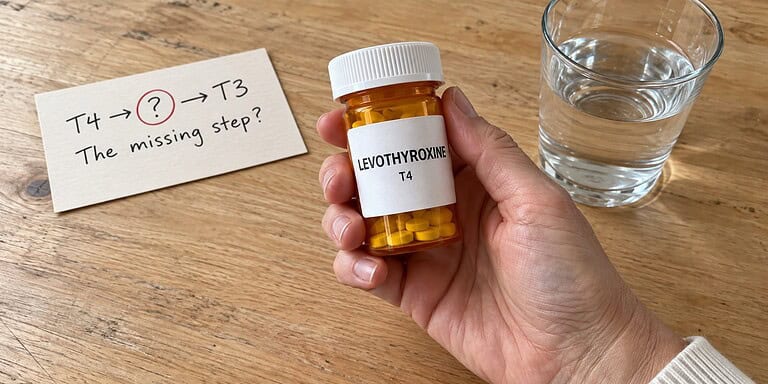
If you are a thyroid patient, this is especially important for you to understand. Your thyroid hormone is one of the hormones that helps set this thermostat. When your thyroid is sluggish AND you have insulin resistance on top of it? You are fighting two battles at the same time and both of them are working to keep your weight elevated.
To really help this concept sink in let’s use an example…
Imagine a scenario where you are eating two different meals that are equal in calories but differ in how they will affect your hormones.
Let’s use an example of Krispy Kreme donuts. Each one has 190 calories. Therefore if you eat 8 Krispy Kreme donuts you will have eaten 1520 calories.
If you are a woman it is recommended you consume between 2000-2400 calories per day to maintain a healthy weight [2]. The CDC states that if you burn in excess of 3500 calories you will drop a pound of weight [3]. Using the calorie in-calorie out model, and assuming you are a woman if you consume 8 Krispy Kreme donuts per day you will only be eating 1520 calories of your ~2000 calorie daily limit. In this scenario, you should lose 1 pound per week.
Do you really think that this diet over the course of the week will result in you losing 1 pound?
Let me explain what will really happen…
The donuts you eat will cause an immediate spike in your blood sugar because the sugar in the donuts is so rapidly absorbed in your gut. This will cause an increase in your insulin levels from your pancreas to bring down the glucose (high levels of sugar or glucose in your blood are harmful, and your body knows this).
The spike in insulin level then starts a cascade of hormonal responses that turns on bad biochemistry in your body.
Insulin causes you to store those calories as belly fat, it increases overall inflammation [4] in your body, raises your triglycerides, lowers your good cholesterol (HDL), and increases your blood pressure.
It doesn’t end there…
In men, elevated levels of insulin lower testosterone [5]. In women, it causes excess estrogen. It may make sense now why so many men suffer from ‘Low T’ and why so many women suffer from ‘Estrogen dominance’ conditions such as PCOS, breast cancer, and decreased libido!
This increase in insulin also causes changes to your brain chemistry as well.
It increases your appetite and blocks leptin, which is your appetite control hormone. If you have sustained levels of insulin you will become leptin resistant. When this occurs you have now lost your ‘I’m full’ response. Your brain is now incapable of telling your body when you’re full. This may help you understand why people who are overweight constantly feel hungry!
In your liver, this spike in insulin causes fat to deposit there (the so-called fatty liver) which results in even more inflammation. Chronic inflammation then results in more weight gain, leptin and insulin resistance, increased appetite, and ultimately diabetes and obesity.
The real model of obesity is best described in the figure below:
It’s time for some change. The long-recommended diet that is high in wheat and grain products inevitably leads to elevated blood sugar and poor sensitivity to insulin [6][7][8]. As a consequence, this change in insulin sensitivity has been shown to be a major cause of abdominal fat accumulation [9][10]. The most alarming part? this is a vicious self-perpetuating cycle, the more abdominal fat you gain the worse your insulin sensitivity becomes – leading to more belly fat, more hormonal chaos, and increased risk of heart disease and diabetes [11][12].
When we start asking the right questions about how we get fat, while pushing aside the calorie in-calorie out model, we really can appreciate new insights for the treatment of obesity.
It’s important to point out here that while insulin plays a major role in weight gain in most people, it’s not the only hormone that can cause problems.
The second major cause of excess belly fat is due to constant, low-grade chronic stress on your body. A small level of stress can be good for your body, but in large and constant amounts it can wreak havoc.
When you are stressed for ANY reason (emotionally, physically, spiritually, etc.) your body secretes a stress-coping hormone called cortisol. Unfortunately, increased cortisol levels are also directly linked to belly fat [13]. It doesn’t take a lot of stress to chronically increase your cortisol levels either, this study showed that ‘normal’ stressors of life, such as subconscious worry/anxiety, busy schedules, and lack of sleep are enough to cause increased cortisol [14] and thus increased belly fat.
In addition to cortisol, the sex hormones (estrogen, testosterone), as well as thyroid hormones, seem to be particularly sensitive to the chaos that insulin resistance causes. These hormones are often in flux in chronic inflammatory states and they should be evaluated as well if you are obese.
If you are a thyroid patient, pay close attention here. Insulin resistance doesn’t just cause weight gain on its own. It can also make your thyroid function worse. The chronic inflammation that comes from insulin resistance can suppress thyroid hormone conversion and may even worsen autoimmune conditions like Hashimoto’s. So treating insulin resistance isn’t just about losing weight. It’s about getting your thyroid to function better, too.
Most of the time though, as you treat insulin and chronic inflammation your other hormones tend to come into balance without further medication.
Next Steps for Thyroid Weight Loss
Let’s do a quick recap of what we learned before we move on:
- The calorie in calorie out model is outdated and doesn’t stand up to current medical literature or science.
- Obesity and belly fat is caused by too much insulin in the body which is caused by eating sugars and refined carbohydrates (bread, pasta, bagels, cereals, etc.).
- Insulin resistance leads to other hormonal imbalances such as low testosterone in men and excess estrogen in women leading to ‘estrogen dominance’ and conditions such as PCOS, breast cancer, and decreased libido.
- Increased insulin levels set the stage for chronic diseases such as diabetes, heart disease (heart attacks, heart failure, etc.), and rapid aging via chronic inflammation.
- Increased insulin levels and the biochemical changes that occur cause you to become overweight and sedentary. You are not ‘fat and lazy’ first.
- Most doctors, personal trainers, major news outlets, and hospital centers do not treat obesity correctly or understand how increased insulin levels or insulin resistance fit into why people become obese.
- Other hormones are involved in weight gain and overall health including thyroid hormone, growth hormone, cortisol (the stress hormone), and sex hormones such as testosterone and estrogen in addition to insulin.
- You are about to learn how to REVERSE all of these changes through simple lifestyle changes…
If you are a thyroid patient who has been struggling to lose weight, everything in this article applies directly to you. And here’s the best part: treating your insulin resistance may be the missing piece that your thyroid medication alone hasn’t been able to fix.
The next posts will help you understand how to lose weight by lowering your insulin levels.
Scientific References
1. Usui C, et al. (2010). Visceral fat is a strong predictor of insulin resistance regardless of cardiorespiratory fitness in non-diabetic people. Journal of nutritional science and vitaminology. doi:10.3177/jnsv.56.109.
2. Coleman E (2018). Daily Recommended Caloric Intake for Women.
3. Centers for Disease Control and Prevention. About Healthy Weight and Growth.
4. Shoelson SE, et al. (2006). Inflammation and insulin resistance. The Journal of clinical investigation. doi:10.1172/JCI29069.
5. Pitteloud N, et al. (2005). Relationship between testosterone levels, insulin sensitivity, and mitochondrial function in men. Diabetes care. doi:10.2337/diacare.28.7.1636.
6. Merat S, et al. (1999). Western-type diets induce insulin resistance and hyperinsulinemia in LDL receptor-deficient mice but do not increase aortic atherosclerosis compared with normoinsulinemic mice in which similar plasma cholesterol levels are achieved by a fructose-rich diet. Arteriosclerosis, thrombosis, and vascular biology. doi:10.1161/01.atv.19.5.1223.
7. Garg A, et al. (1992). Comparison of effects of high and low carbohydrate diets on plasma lipoproteins and insulin sensitivity in patients with mild NIDDM. Diabetes.
8. Borkman M, et al. (1991). Comparison of the effects on insulin sensitivity of high carbohydrate and high fat diets in normal subjects. The Journal of clinical endocrinology and metabolism. doi:10.1210/jcem-72-2-432.
9. Carey DG, et al. (1996). Abdominal fat and insulin resistance in normal and overweight women: Direct measurements reveal a strong relationship in subjects at both low and high risk of NIDDM. Diabetes. doi:10.2337/diab.45.5.633.
10. Després JP (1993). Abdominal obesity as important component of insulin-resistance syndrome. Nutrition (Burbank, Los Angeles County, Calif.).
11. Volek JS, et al. (2002). Body composition and hormonal responses to a carbohydrate-restricted diet. Metabolism: clinical and experimental. doi:10.1053/meta.2002.32037.
12. McAuley KA, et al. (2005). Comparison of high-fat and high-protein diets with a high-carbohydrate diet in insulin-resistant obese women. Diabetologia. doi:10.1007/s00125-004-1603-4.
13. Mårin P, et al. (1992). Cortisol secretion in relation to body fat distribution in obese premenopausal women. Metabolism: clinical and experimental. doi:10.1016/0026-0495(92)90171-6.
14. Epel ES, et al. (2000). Stress and body shape: stress-induced cortisol secretion is consistently greater among women with central fat. Psychosomatic medicine. doi:10.1097/00006842-200009000-00005.