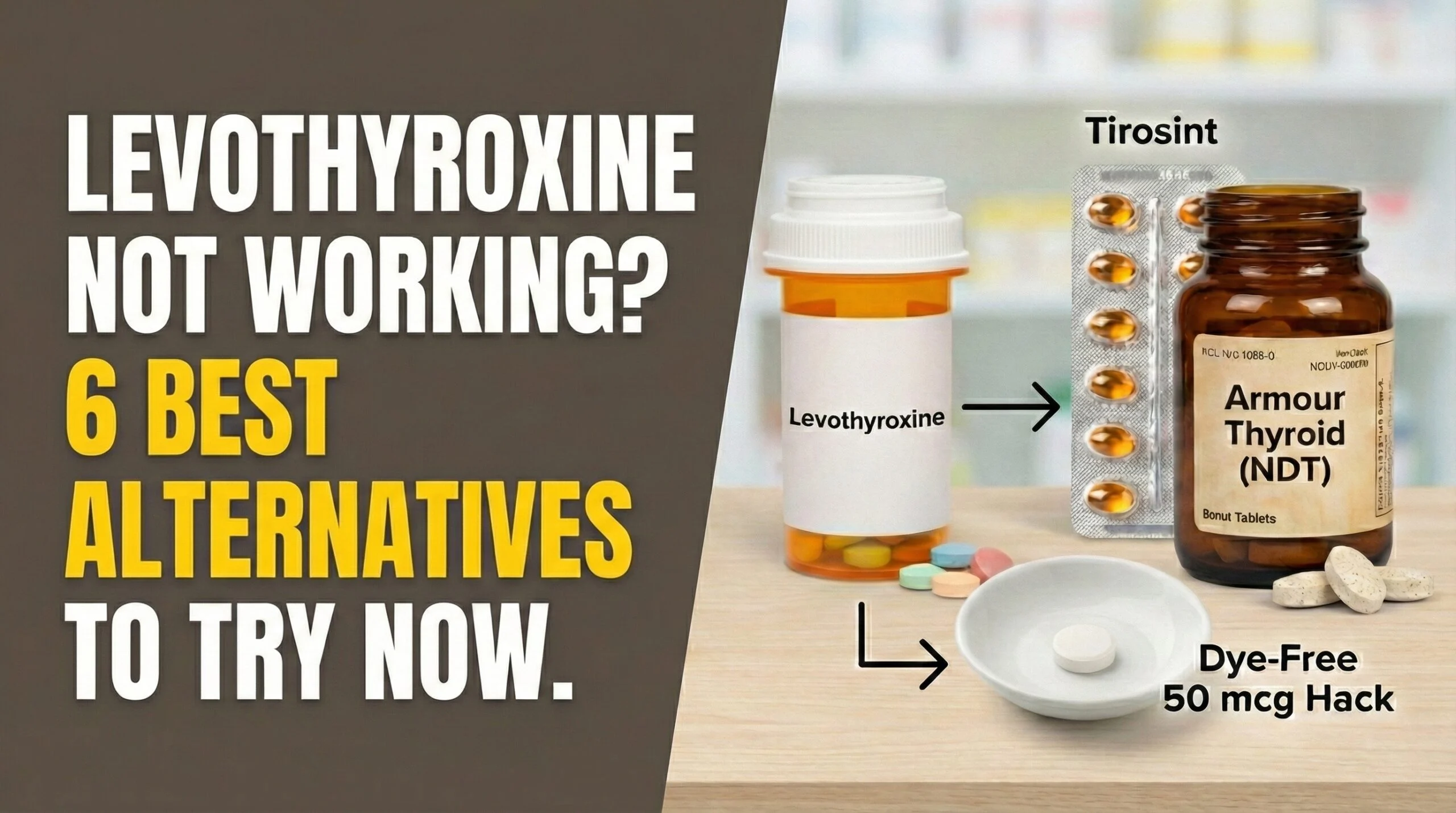

About 50% of thyroid patients still have thyroid symptoms when taking levothyroxine.
If this is you, know that you aren’t alone.
The fact that so many people do poorly on levothyroxine isn’t surprising.
What is surprising is that most of these patients have no idea that alternatives exist.
And that these alternatives are much better than levothyroxine.
If you’re sick of levothyroxine not working, try these:
Alternative #1. Tirosint
Some people think the problem with levothyroxine is the fact that it only contains T4 thyroid hormone.
And while that is a huge part of it, there’s another that most people miss:
The inactive binders and fillers found inside the medication.
These inactive ingredients are there to stabilize the medication and make manufacturing easier.
But they also happen to impact its absorption and utilization in the body (1).
This is where Tirosint steps in.
It contains the same T4 hormone as levothyroxine, but without the added fillers or dyes.
Fewer fillers and no dyes mean better absorption for you as the thyroid patient.
And better absorption = better symptom control. It’s that simple.
Want to give it a try? Here’s how to use it:
Swap your dose of levothyroxine out for Tirosint with a 1:1 ratio. If you are taking 100 mcg of levothyroxine, you’d take 100 mcg of Tirosint instead.
Because it’s a T4-only medication, most doctors have no issues prescribing it.
And because it’s much cleaner, most thyroid patients notice an improvement in their symptoms a few weeks after making the switch.
The biggest downside to Tirosint is the cost, but there are generics available, so try those if your insurance doesn’t want to cover it.
Alternative #2. Tirosint-sol
If you really want to take absorption to the next level, try Tirosint-sol.
It’s made by the same people who made Tirosint, but instead of being a gel cap, this one is a liquid.
In fact, it’s the only liquid thyroid medication on the market.
And, just like Tirosint, this one is incredibly clean with only 3 total ingredients:
- T4 thyroid hormone
- Glycerol
- And water
The biggest downside is the fact that it’s so expensive.
For this reason, it’s not usually ideal to jump from levothyroxine straight to Tirosint-sol unless you have undergone abdominal surgeries or have allergies to fillers and dyes.
If that isn’t you, then start with generic Tirosint first and move to Tirosint-sol if that doesn’t work.
Alternative #3. Synthroid
Most doctors and thyroid patients believe that levothyroxine and Synthroid are identical. They’re not.
Yes, Synthroid is the name brand, and yes, levothyroxine is the generic, which is why they are often used interchangeably.
But they differ in their inactive ingredients, and that can make all of the difference.
This is why research has shown that some thyroid patients who take levothyroxine and switch to Synthroid see an increase in their free thyroid hormone levels (2), even without changing their dose.
The only explanation for this is the inactive fillers.
It seems to be the case that some thyroid patients are so sensitive to these fillers that they can impact their thyroid lab tests.
The biggest downside to Synthroid is that it contains lactose, so it’s not a great option if you are someone who is lactose intolerant.
Unfortunately, that’s about 70% of thyroid patients (3).
But if you aren’t lactose intolerant and levothyroxine isn’t working, it’s a great option.
Your doctor typically won’t give you pushback for wanting to make the switch, but your insurance might.
Synthroid is more expensive than levothyroxine, so your pharmacy may give you levothyroxine instead of Synthroid, even if your prescription says that’s what you need.
If you are on Synthroid or making the switch, make sure you ask your pharmacist if you’re getting the right thing.
Alternative #4. Armour Thyroid (NDT)
Many thyroid patients consider Armour Thyroid and other formulations of NDT the “gold standard” of thyroid treatment.
I don’t necessarily agree with that, but I won’t deny that it’s often a much better alternative to levothyroxine.
Unlike levothyroxine, Armour Thyroid contains a full spectrum of thyroid hormones, including:
- T4
- T3
- T2
- T1
- Calcitonin and other trace minerals
This matters because your thyroid produces more than just T4.
When you take Armour Thyroid, you are getting more of what your body is used to, which is probably why most thyroid patients who take it prefer it over levothyroxine (4).
But it’s not without downsides.
Among those is that it’s hard to get. Most doctors don’t want to prescribe it because of their clear preference for synthetics.
On top of that, even if you do get it prescribed, most doctors underdose it because they don’t understand how to convert from levothyroxine to NDT.
In addition, at least right now, the makers of Armour Thyroid are under pressure by the FDA.
So there is a non-zero chance that Armour Thyroid may not be around forever.
But if you are able to get your hands on it, and are dosed correctly, you will probably love it.
Alternative #5. Liothyronine
If you’re looking for the strongest levothyroxine alternative, this is it.
Liothyronine contains pure T3 in an immediate-release form.
Because of its power, it’s best used in addition to your levothyroxine, not 100% in place of.
Though there are some people who do find benefit by taking T3 thyroid medication by itself, without any other thyroid hormones.
This is not something that I personally recommend long-term, but it has its place in certain situations.
Dose for dose, liothyronine is 4 times more powerful in its impact on the TSH.
Meaning, a 5 mcg dose of T3 is “worth” 20 mcg of levothyroxine.
For this reason, most dosing is in the range of 5-25 mcg per day, added on top of your existing dose of levothyroxine (which usually needs to be reduced).
Research shows that simply swapping out T3 for T4, in equivalent doses, leads to weight loss, more energy, and a better quality of life for thyroid patients (5).
The biggest downside?
It’s hard to get; most doctors don’t give you enough when they do prescribe it, and it’s more likely to cause side effects.
None of this means you shouldn’t use it; it just means you need to be careful when you do. It’s one of my favorite thyroid medications available.
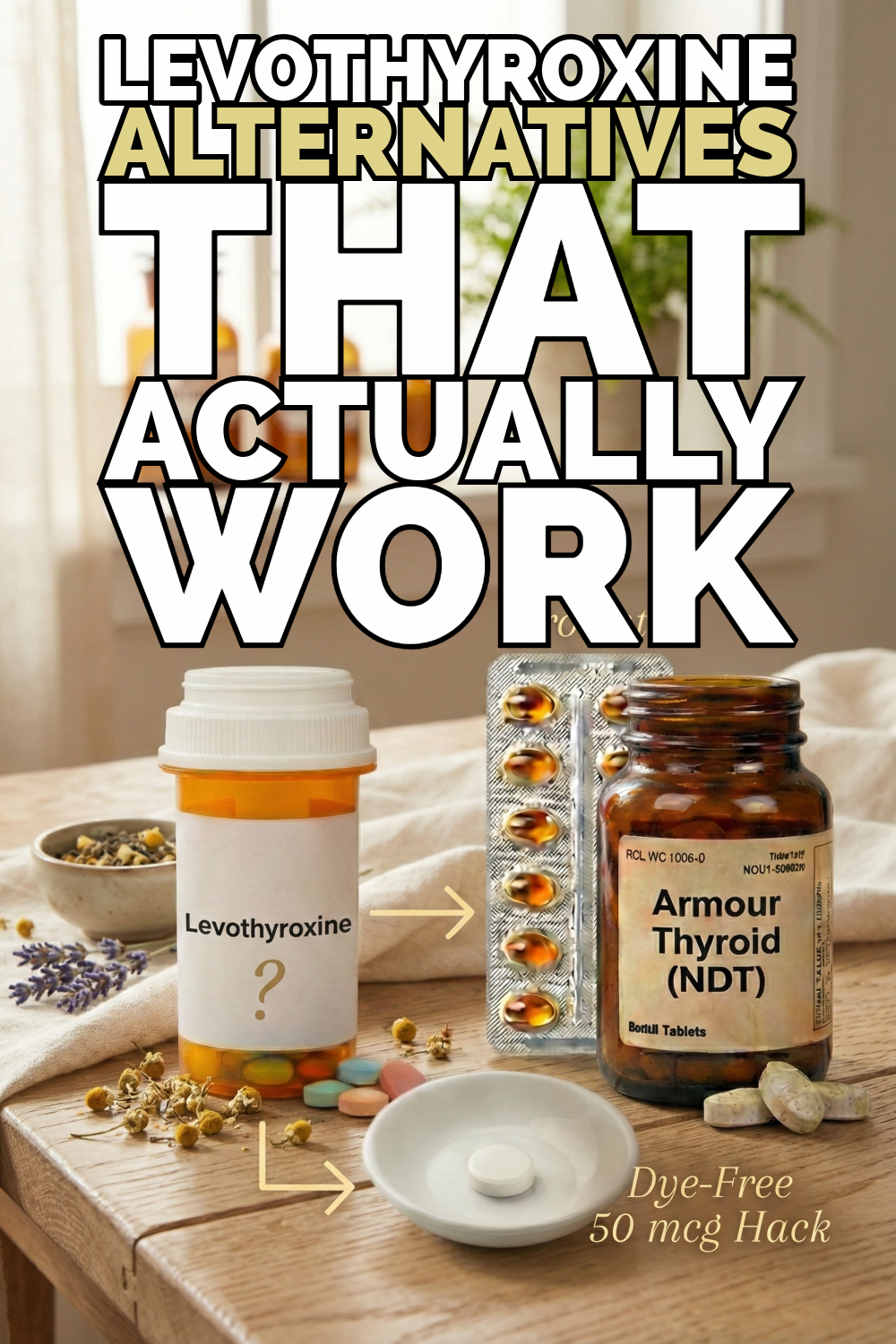
Alternative #6. Levothyroxine 50 mcg tablet
If you can’t get your doctor to prescribe anything other than levothyroxine, this is your answer:
I call it the 50 mcg levothyroxine hack.
Here’s how it works:
If you look at the various doses of levothyroxine, such as the 25 mcg, 75 mcg, or 100 mcg dose, you will see that they are all different colors.
What you may not realize is that these colors are not natural; they are intentionally altered with synthetic chemical dyes.
This may be good for pharmacists, but it’s not good for you, because each of the artificial dyes used is a potential compound that you can react to (6).
And thyroid patients definitely react to them.
There’s one caveat here, though:
The 50 mcg tablet of levothyroxine is the only dose that contains NO color additives.
In other words, it’s the cleanest dose of levothyroxine.
This means that you can dose whatever you are taking in 50 mcg increments.
For instance, if you are taking 100 mcg of levothyroxine per day, you would use 2 tablets of the 50 mcg dose instead of 1 tablet of the 100 mcg dose.
This effectively cuts down on unnecessary dyes that your body has to process and eliminate.
And, believe it or not, this small change can have a profound impact on how you feel.
Never Settle For Symptoms On Levothyroxine
The moral of the story is you should never settle for symptoms on levothyroxine.
Your doctor may tell you to tough it out, but you don’t have to.
There is always another alternative, another thyroid medication, or another combination that will work for you.
Yes, it may take some trial and error to get there. But there are literally hundreds of combinations you can try, and there is one out there that is perfect for you.
If your levothyroxine isn’t working for you, give one of these alternatives and let me know how it goes.
And if you want to optimize your thyroid medication dose even more perfectly, check out this article next.