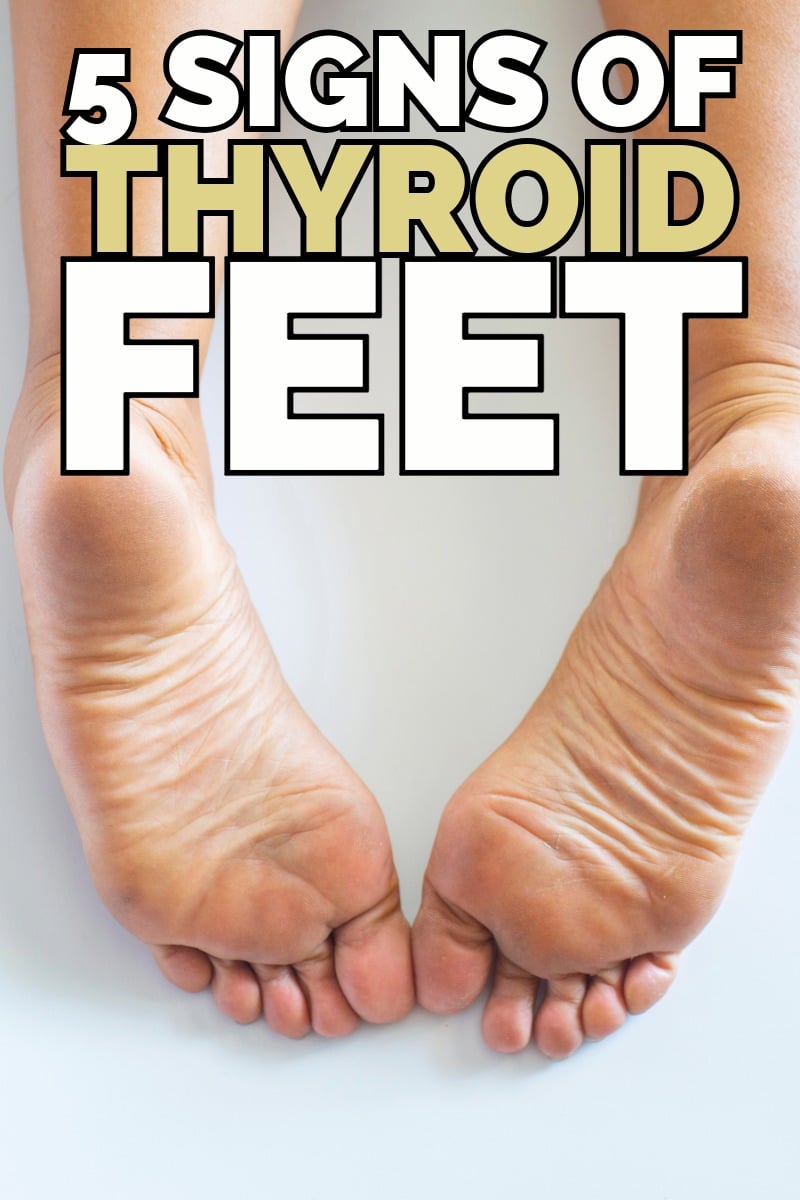

Does having a thyroid problem impact your feet? Absolutely.
And when it does, you end up with what I call “thyroid feet”.
The bad news? It will make your feet unsightly, cold, and painful.
The good news? It’s 100% reversible (more on this later).
For now, let’s jump into the 6 changes that happen to your feet when your thyroid is off:
#1. Yellowing of The Soles
One of the first things that thyroid patients notice is a change in the color of their feet.
It’s really never normal if your feet are changing color, especially if they are turning yellow (1).
But this happens frequently to thyroid patients.
Why?
Because low thyroid states slow the conversion of beta carotene into vitamin A in the liver (2), leading to a buildup in the blood and skin.
Beta carotene is the compound that gives carrots their orange color, and it can do the same to you if it’s not properly dealt with.
When it accumulates in your body, it tends to concentrate in thicker areas of skin, like your soles. This changes their tint to a yellowish-orange color.
On its own, this change is relatively harmless, even though it may not seem like it.
But it does serve as a powerful warning sign that both your thyroid and liver are not working properly.
#2. Cracked & Damaged Heels
You probably don’t realize this, but your thyroid controls the moisture and oil production in your skin (3).
When thyroid function drops, your skin will get rough, scaly, and dry… everywhere.
Including your feet.
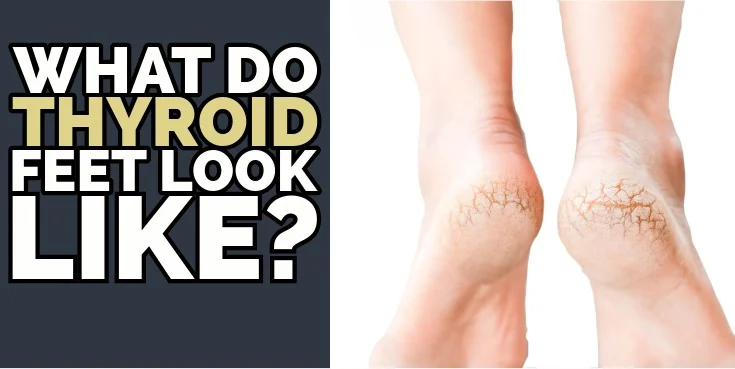
This is why thyroid feet almost always have cracks in the heels.
These cracks can run deep, become extremely painful, and increase your risk of skin infections.
Many thyroid patients find that their heels never fully heal, no matter how much lotion they use on them.
Moisturizers like Aquaphor and heel scrubs can help manage the discomfort, but they rarely solve the problem because the root cause is your thyroid (not your skin).
#3. Swollen Feet & Ankles
This is very common among thyroid patients, and it’s something my wife still deals with to this day.
The hypothyroid state results in edema due to a buildup of water-loving compounds called glycosaminoglycans (4).
These compounds diffuse into tissues where they attract nearly 100x their weight in water.
Wherever they go, water follows, and this can happen anywhere and everywhere on your body.
But for thyroid patients, this will be most obvious in the ankles and legs, especially towards the end of the day.
Swelling from your thyroid isn’t automatically a big deal, but it is a sign that your thyroid isn’t completely optimized.
And just so you are aware, this is one symptom that may persist, even after you improve your thyroid with the things we are going to be talking about soon.
#4. Brittle Toenails
Your toenails can tell you a lot about your thyroid.
Why?
Because they require a steady flow of nutrients and blood if you want them to stay healthy and strong.
But thyroid problems disrupt this process, leading to changes in toenail texture, color, and strength.
Most thyroid patients will experience this as brittle nails that crack and break.

While others may experience ridges, slow growth, discoloration, and even nail separation (5).
What type of toenail problem you get depends on your genetics.
But one thing is for certain:
These problems aren’t just cosmetic. They open the door to other complications like fungal infections and a change in your quality of life.
If you have a thyroid problem, pay attention to the cosmetic appearance of your toenails!
Not because you want them to look pretty, but because of what that means for your thyroid health.
#5. Cold Feet
This one frustrates thyroid patients (and their spouses) the most!
When I refer to cold feet, I’m not just talking about them being cold to the touch, though that is common.
What I’m talking about is an unreasonable level of irritability that occurs when they get cold.
This irritability actually has a medical name. It’s called cold intolerance, and it’s a classic sign of hypothyroidism.
Cold intolerance can happen all over your body, but when it comes to your feet, I call this the positive “sock sign”.
When a thyroid patient has a positive sock sign, it means that they must wear socks all day and especially to bed, to prevent this irritability.
If you can relate to what I’m saying here, there’s a good chance your thyroid is slowing down your body’s ability to generate heat to keep you warm.
#6. Leathery Skin
Chronic and long-standing hypothyroidism can actually change the structure of your skin (6).
This effect is from slower cell turnover, which eventually leads your skin cells to build up on top of each other.
The more they build up, the thicker your skin appears to be.
Some thyroid patients notice this as a change in the texture of the feet to something that feels puffy or doughy.
This symptom takes a while to develop, so if you were just recently diagnosed with your thyroid problem, you probably won’t experience it for a few more years.
It’s also the symptom that takes the longest to reverse.
Fix Your Thyroid Feet:
Have thyroid feet? Here are your next steps if you want to get rid of them:
Step 1. Get the right tests.
You’re going to need more than just the TSH.
TSH is a decent marker for telling you if there’s enough thyroid hormone floating around in your bloodstream, but it’s a terrible marker for assessing thyroid function in your cells.
And if you have thyroid feet, that’s what matters.
Your first step is to get a full thyroid lab panel, including TSH, free T3, free T4, and reverse T3.
Focus specifically on free T3 and free T4. Both of these need to be in the high-normal range (not the low or low-normal range).
If they aren’t, and there’s a good chance this is the case because of your symptoms, move on to the next step…
Step 2. Optimize thyroid hormones.
After getting your labs drawn, you will probably realize you need more T4 and T3.
If that’s the case, it’s time to move your thyroid medication routine into the year 2025.
Instead of just taking levothyroxine, you’re going to need a combination of T4, T3, and T2.
T3 will require a prescription, but you can get T2 over the counter.
It’s not until you take all of these that your thyroid will truly be optimized.
Step 3. Take thyroid & skin supplements.
For faster results, combine your new thyroid routine with a few supplements. For thyroid feet, here’s what I recommend:
- Thyroid glandulars. These provide the full spectrum of thyroid hormones, cofactors, and enzymes found in the thyroid gland and perfectly complement all thyroid medications.
- T2 thyroid hormone. This helps T3 work more effectively on your cells and is a great way to naturally boost thyroid function.
- Silicon as MMST. This is great for hair, skin, and nails, and something that many thyroid patients don’t get enough of.
- Collagen as VERISOL. This peptide helps rebuild damaged skin and connective tissue.
Do these things, and you can say goodbye to thyroid feet for good.
By the way, we really just touched the surface on how to optimize your thyroid function.
If you need more help with that, make sure to check out this article next.
Scientific References
#1. https://www.ncbi.nlm.nih.gov/books/NBK534878/
#2. https://pmc.ncbi.nlm.nih.gov/articles/PMC9592814/
#3. https://pmc.ncbi.nlm.nih.gov/articles/PMC10214500/
#4. https://pmc.ncbi.nlm.nih.gov/articles/PMC3219173/
#5. https://pmc.ncbi.nlm.nih.gov/articles/PMC6522173/
#6. https://pmc.ncbi.nlm.nih.gov/articles/PMC3726898/