
50% of thyroid patients will have problems with hair loss.
And to make matters worse, not all of this hair loss is the same.
But the pattern of hair loss that you are experiencing will tell you everything you need to know about what is wrong and how to fix it.
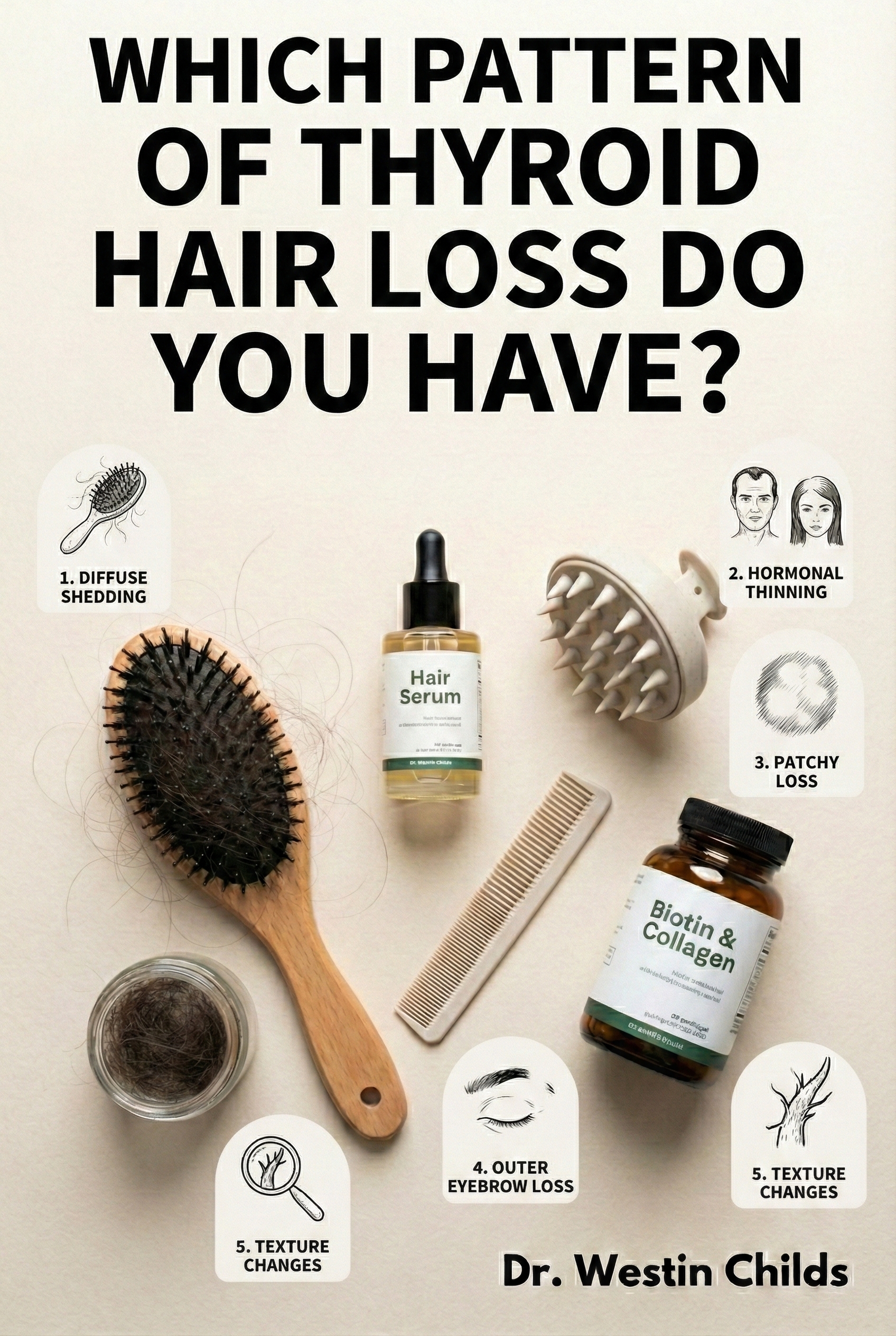
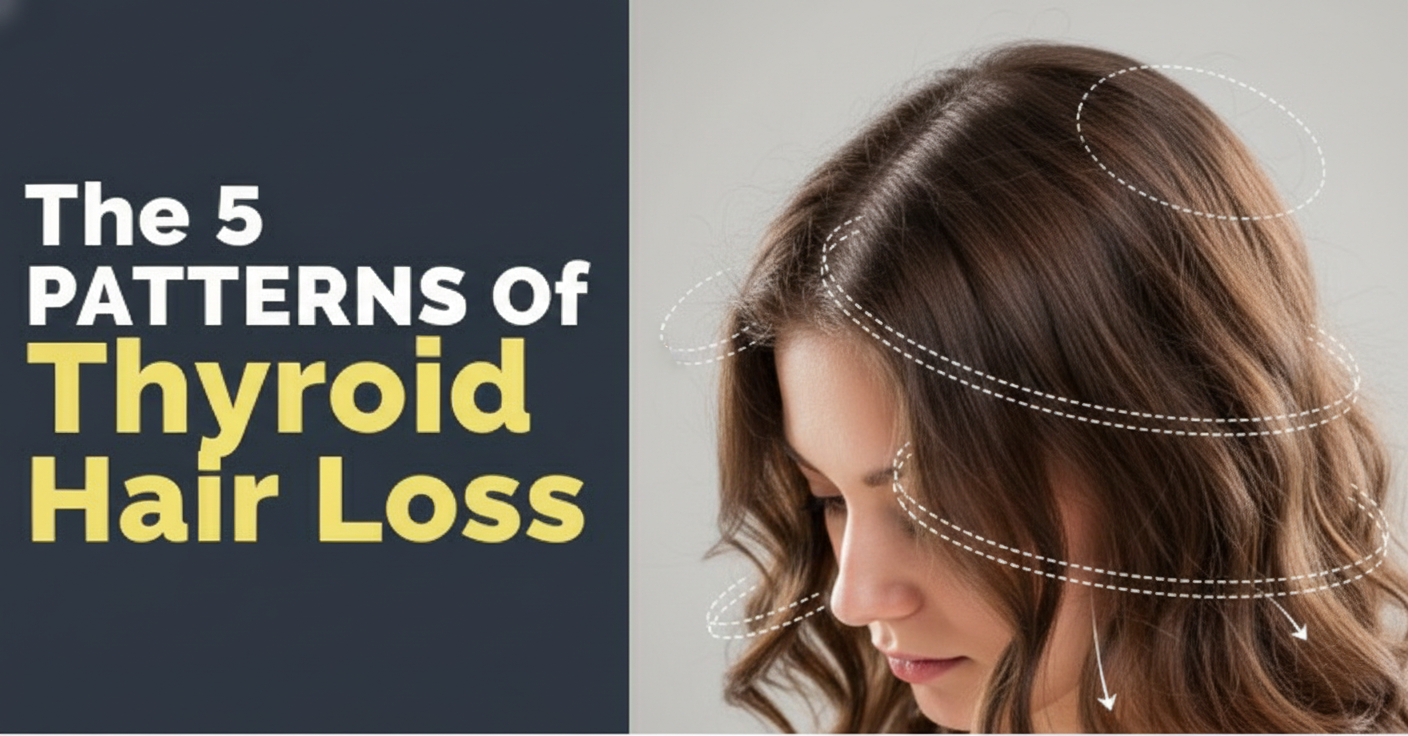
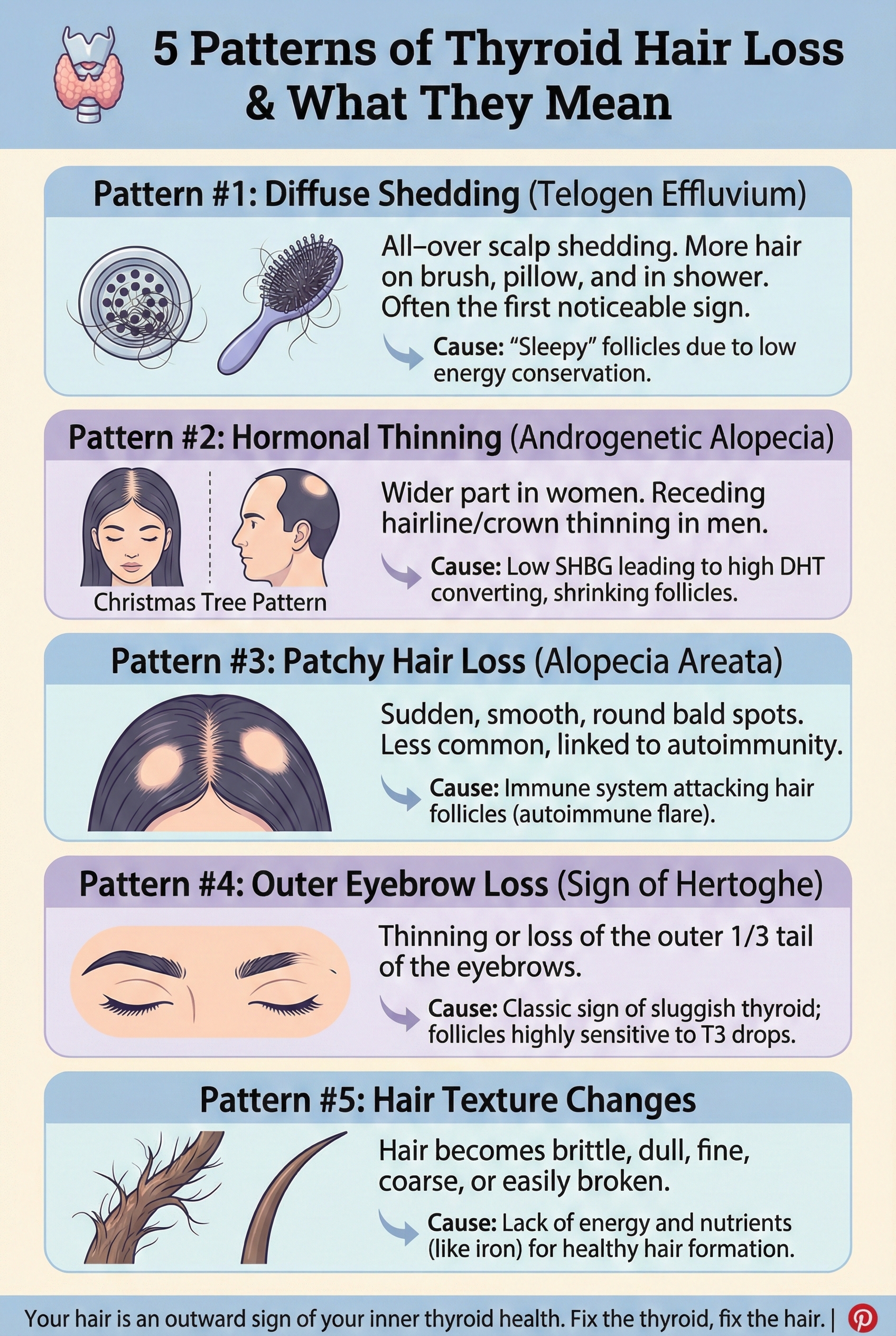
If you have thyroid-related thinning or shedding, look for these five patterns:
Pattern #1. Diffuse Hair Shedding
This is the #1 cause of hair loss in thyroid patients, and it’s called telogen effluvium.
Normally, your hair stays in the growth phase for years and transitions to the dormant phase for a few months at a time.
But when your thyroid is low, your body attempts to conserve energy by pushing your follicles into the resting phase early (1).
On top of this, thyroid dysfunction slows down hair growth all over the body.
When you combine sleepy hair follicles with slowed growth, you end up with mass hair shedding.
This is, by far, the most important cosmetic sign you should be on the lookout for if you have a thyroid problem.
Why?
Because by the time you notice visible thinning, you’ve already lost 50% of your hair.
As a thyroid patient, you should always keep an eye on your hair texture, quality, and density.
If you even suspect that there’s a problem, assume there is and treat it.
You’ll know you have this type of thyroid hair loss if your scalp is becoming more visible or if you see or feel your hair getting thinner.
You will probably also notice more hair in the shower drain, extra hair on your pillow, and lots of hair on your brush.
Pattern #2. Hormonal Thinning
Thyroid problems cause a chain reaction in your sex hormones:
They lower SHBG (2) and raise testosterone and DHT.
This combination shrinks your hair follicles, causing a condition known as androgenetic alopecia.
And this form of thyroid hair loss looks different if you are a man or a woman.
If you’re a woman:
You will notice your center part getting wider and wider, and your scalp becoming more visible on the crown of your head.
This is called the “Christmas Tree” pattern.
If you’re a man:
You will see a deep recession at your temples and a thinning of hair on the crown of your head.
If you have this pattern, you will need to do more than just fix your thyroid; you will also need to address your sex hormones.
But more on that in a minute.
Pattern #3. Patchy Hair Loss
This is the most difficult to treat form of hair loss that thyroid patients get, and it’s called alopecia areata (3).
It’s not caused by hormones; it’s caused by an autoimmune disease.
It happens when your immune system gets confused and starts attacking your own hair follicles.
Compared to the other forms we’ve discussed, this is less common, but it still occurs with a higher frequency in thyroid patients for this reason:
If you have one autoimmune disease, you are much more likely to get another.

And since 90% of thyroid disease is caused by Hashimoto’s, thyroid patients are “primed” for this issue.
Fortunately, anywhere from 10-20% of thyroid patients will experience this form of hair loss.
You’ll know if you have it because you will experience smooth, coin-sized bald patches on your scalp that will appear out of nowhere.
Treatment for this form focuses more on your immune system than your thyroid.
Pattern #4. Outer Eyebrow Hair Loss
You can get hair loss from more than just your thyroid, but losing the outer ⅓ of your eyebrows is classic for one specific condition (4):
And that’s a sluggish thyroid.
This pattern is called the “sign of Hertoghe”, and it happens because the follicles on the ends of your eyebrows are highly sensitive to even small drops in T3 thyroid hormone.
If the tails of your eyebrows are thin or non-existent, your body is screaming you need more T3.
Pattern #5. Hair Texture Changes
Even if you aren’t losing hair, your thyroid can still change the quality and texture of your hair.
When your hair follicles don’t get the energy that they need, you may experience hair that is:
- Brittle
- Dull
- Fine
- Easily broken
- Or coarse
Most thyroid patients with hair problems experience a combination of hair quality changes plus hair thinning, not just one or the other.
Fixing Your Thyroid Hair Loss
If you are someone reading this and you have noticed changes to your hair, it’s time to do something about it.
The sooner you can address the root cause, the more hair you can save.
But remember: each pattern of thyroid hair loss must be treated in a different way.
Here’s a quick guide to help you determine how to address your type of hair loss:
If you have diffuse hair loss all over your scalp, here’s what you need to do:
- Optimize your thyroid medication: the reason you’re losing hair is that your other cells are stealing all of your thyroid hormone. But if you take more, you can ensure that your follicles get what they need. The best way to do that is with more types of thyroid hormone. This means using a combination of T4, T3, and T2 altogether.
If you fix your thyroid medication dose, you will see improvement in your hair within about 8 weeks.
If you have specific areas of hair thinning from your hormones, here’s what you need to do:
- Step #1 here is also to optimize your thyroid medication. If you do this, you will raise your SHBG, which will naturally lower your free testosterone.
- Supplements: On top of that, you can use natural DHT blockers (5) like zinc, saw palmetto, pumpkin seed oil, and reishi (rayshee) mushroom.
- Topicals: To immediately rescue your hair follicles from androgen damage, you may also want to add topical treatments like minoxidil or rosemary oil (6).
If you have patchy hair loss from autoimmune disease, here’s what you need to do:
- Immune Support: First, calm down your immune system. The best way to do that is by removing inflammatory triggers from your diet, specifically gluten, dairy, and soy. These are the worst offenders for thyroid patients.
- Vitamin D: Next, optimize your vitamin D status. Vitamin D is needed for a healthy immune response, and low levels will make your hair loss worse (7). If you find that it’s low, replace it with 2,000 to 5,000 IU of D3 each day.
- Medications: Finally, look into medications like low-dose naltrexone. This is especially helpful if you also have Hashimoto’s (which is likely if you have autoimmune hair loss).
If you have outer eyebrow hair loss, here’s what you need to do:
- Free T3: Focus specifically on your free T3 levels. Remember: eyebrow hair follicles are very sensitive to small drops in thyroid hormone, and they won’t grow back until every other cell in your body has enough. Most thyroid patients have plenty of T4 because they are taking levothyroxine. But few have enough T3, because they don’t convert that levothyroxine into the active form. You can boost your T3 by taking T3 medications or using natural thyroid conversion boosters like guggul extract and ashwagandha.
- Goal: Your free T3 should be in the top ⅓ end of the provided reference range.
If the quality or texture of your hair is getting worse, here’s what you need to do:
- Iron: Check your ferritin levels. Ferritin is a marker of iron storage. If your ferritin is low, it means your body doesn’t have the iron that it needs. And your thyroid needs that iron to create thyroid hormones.
- Goal: If needed, supplement with extra iron until your ferritin reaches a level of 50-60 ng/mL (8).
The bottom line?
Your hair is an outward sign of your inner thyroid health.
If it doesn’t look healthy, it’s because your thyroid isn’t healthy.
The good news: fixing your thyroid problem usually fixes your hair.
By the way, no matter what pattern of hair loss you have, you can still benefit from supplements like collagen and silicon.
Check out this article next to see how I recommend using them.
Scientific References
#1. https://pmc.ncbi.nlm.nih.gov/articles/PMC10766245/
#2. https://pubmed.ncbi.nlm.nih.gov/8536064/
#3. https://pmc.ncbi.nlm.nih.gov/articles/PMC10769472/
#4. https://pmc.ncbi.nlm.nih.gov/articles/PMC10492440/
#5. https://pubmed.ncbi.nlm.nih.gov/30980598/
#6. https://pmc.ncbi.nlm.nih.gov/articles/PMC11549889/
#7. https://pubmed.ncbi.nlm.nih.gov/34553483/
#8. https://pubmed.ncbi.nlm.nih.gov/37820340/